Osiris: The Murdered King Who Rules the Dead
Seth shut his brother in a chest, Isis searched for him across the world, and Osiris became the king and judge of the dead. Yet no Egyptian text tells the whole story. The fullest telling we have is Greek.
- Type: myth, a murdered god who becomes lord of the dead
- Culture: ancient Egypt; later worshipped across the Roman world
- Earliest texts: the Pyramid Texts (from the pyramid of Unas, 24th century BCE) allude to it; the fullest telling is Plutarch’s On Isis and Osiris, written in Greek some 2,500 years later
- Key figures: Osiris, Isis, Seth, Nephthys, Horus, Anubis
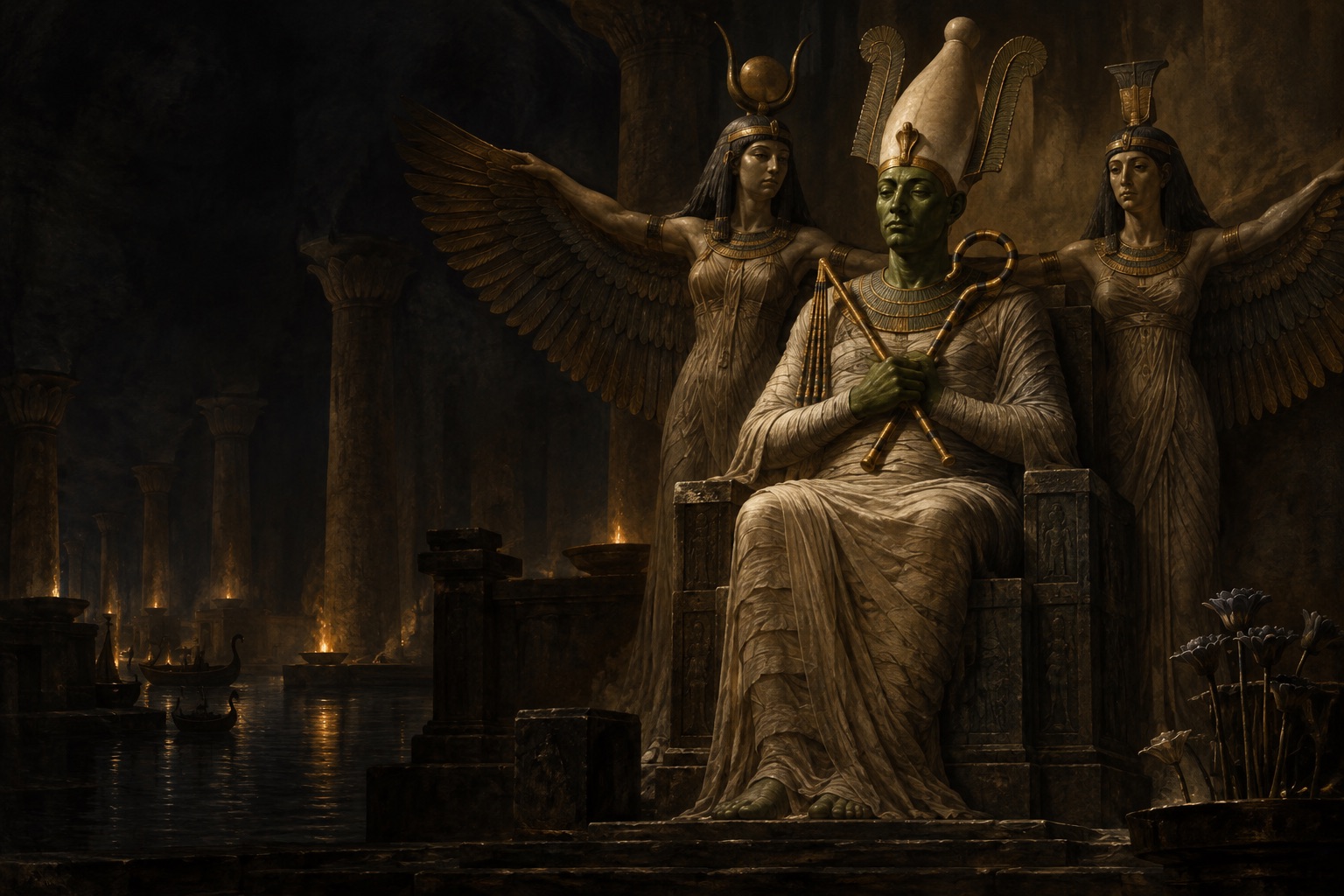
For nearly three thousand years Egyptians hoped to become Osiris when they died. His story explained why that was possible: a king was murdered, his wife would not let him go, and he came back, not to this world but to rule the next.
Did the Egyptians tell this story? In pieces. They wrote about the murder, the mourning sisters and the son born after his father’s death, but no Egyptian text tells it from start to finish. As the Louvre puts it, few pharaonic sources recounted his whole legend “until Greek authors came along with their compilations”.
1 The Telling
This is the version of Plutarch, a Greek writer and priest at Delphi in the late 1st and early 2nd century CE, in his treatise On Isis and Osiris.
1-1 The Good King
Osiris was born on the first of the five extra days at the end of the Egyptian year. His brother Seth, whom Plutarch calls Typhon, was born on the third, bursting out through his mother’s side. Isis was born on the fourth, and Nephthys, who became Seth’s wife, on the fifth.
As king, Osiris freed the Egyptians from a “destitute and brutish manner of living”. He showed them how to farm, gave them laws and taught them to honour the gods. Then he travelled the world and civilized it “without the slightest need of arms”. That, says Plutarch, is why the Greeks identified him with their god Dionysus.
1-2 The Chest
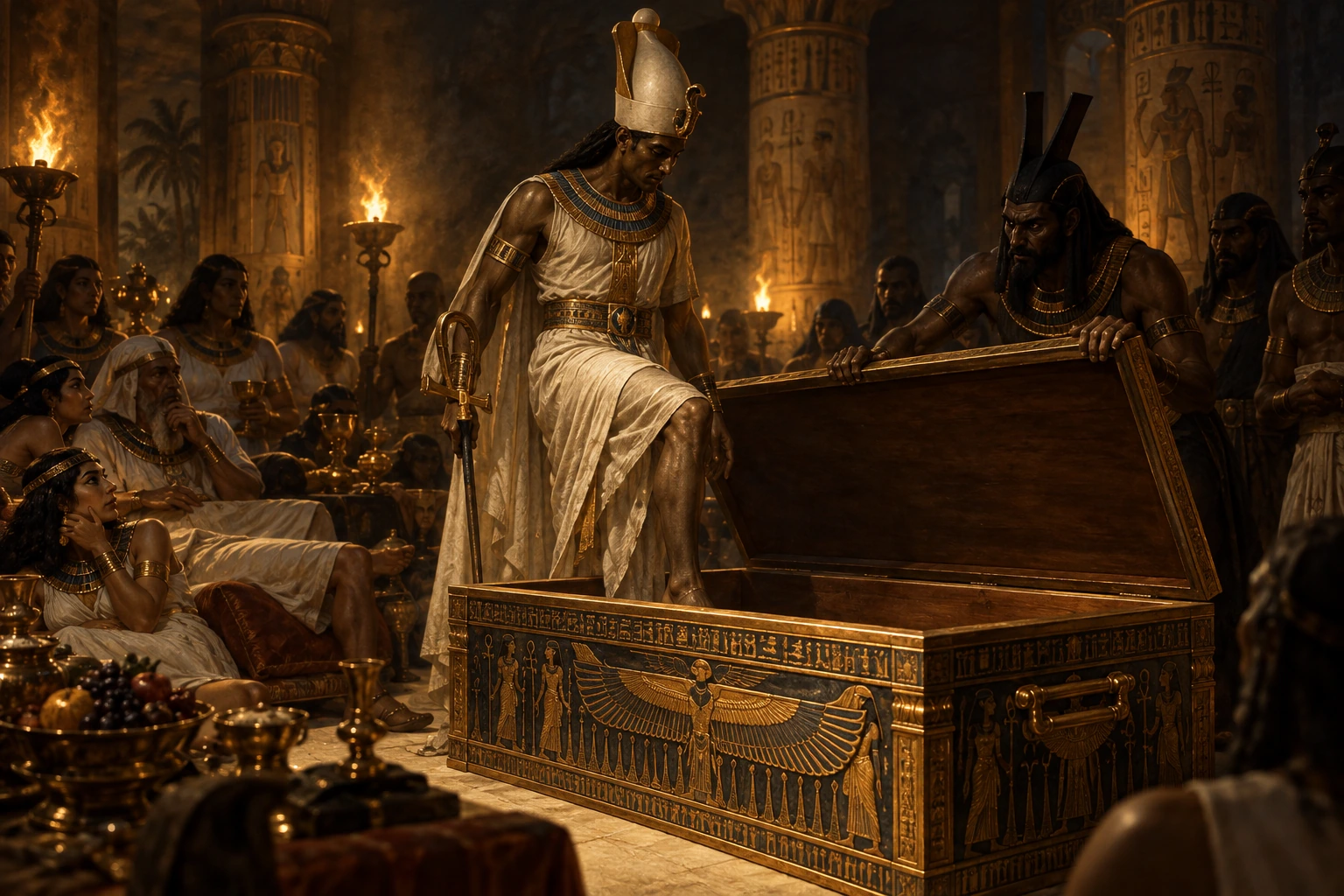
When Osiris came home, Seth set a trap. With seventy-two conspirators and a queen from Ethiopia named Aso, he secretly took Osiris’s measurements and had a beautiful chest made to fit him. At a banquet he promised, as if in jest, to give the chest to whoever fitted it exactly.
The guests tried it one by one, and none of them fitted. Then Osiris lay down in it. The conspirators slammed down the lid, nailed it shut, sealed it with molten lead, and sent it down the river to the sea through the Tanitic mouth of the Nile.
1-3 Isis at Byblos
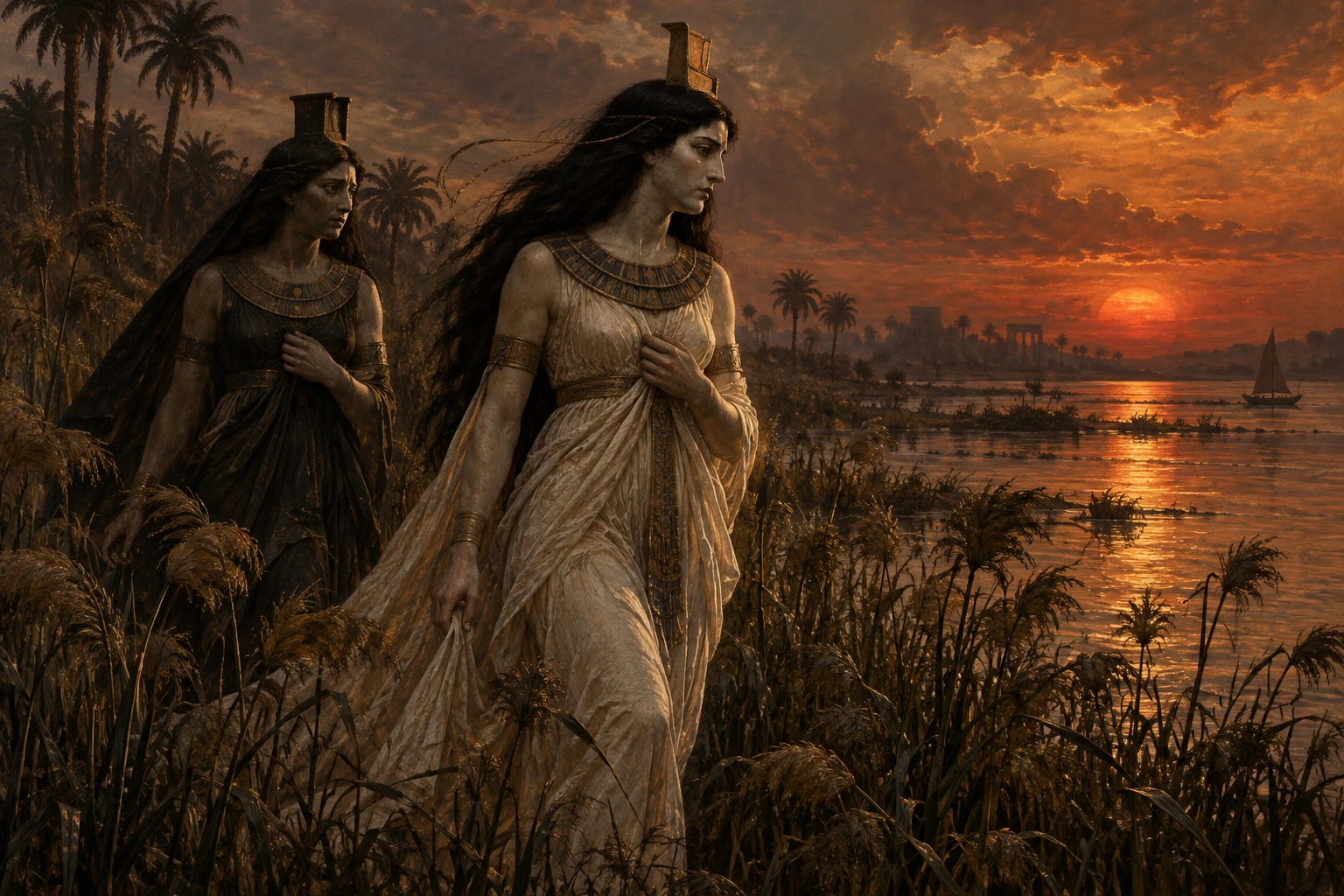
Isis cut off a lock of her hair, put on mourning and wandered in search of him. Some children told her which mouth of the Nile the chest had gone out by.
The waves had carried it to Byblos, on the coast of what is now Lebanon, and set it down in a clump of heather. The heather grew into a great trunk that closed around the chest. The king of Byblos admired the tree, cut it down and used it as a pillar to hold up the roof of his house.
Isis came to Byblos and sat by a spring, speaking to no one but the queen’s maids, whose hair she dressed. The queen made her nurse to her baby son. At night Isis began to burn away the child’s mortal parts, and she turned into a swallow and flew around the pillar, lamenting. The queen saw her son in the flames and screamed, and so robbed him of immortality. Isis showed herself as a goddess, cut the chest out of the pillar and took it home.
1-4 Fourteen Pieces
Isis hid the chest. But Seth, hunting by moonlight, found it, recognized the body and cut it into fourteen parts, which he scattered. Isis searched for them through the marshes in a boat made of papyrus. That, Plutarch says, is why crocodiles leave papyrus boats alone.
Wherever she found a part, she held a funeral. So Egypt has many “tombs of Osiris”. One part she never found, his male member, which had been thrown into the river and eaten by three kinds of fish. She made a likeness of it instead and consecrated it.
1-5 Horus
Osiris came back from the other world to train his son Horus for war. Horus fought Seth for many days and won. But Isis set the captured Seth free, and Horus, in his fury, tore the crown from her head. Seth then accused Horus of being illegitimate. With the god Thoth (Plutarch’s Hermes) to speak for him, the gods ruled that Horus was the true heir.
And Plutarch adds that Osiris lay with Isis even after his death, and she bore another son, Harpocrates, “untimely born and weak in his lower limbs”.
2 What the Egyptians Wrote
- The Pyramid Texts, carved inside royal pyramids from Unas, the last king of the 5th Dynasty, onward. They allude to the story many times without ever telling it:
- Isis and Nephthys come as birds, one of them a kite, and “found Osiris, after his brother Set had felled him to the earth in Nedit”;
- they come “in search of their brother Osiris”;
- another spell speaks of Isis conceiving Horus from the dead Osiris.
- The Great Hymn to Osiris, on a limestone stela of the 18th Dynasty (Louvre, C 286). The Louvre calls it “rare testimony of Osiris’s earthly kingship prior to his murder”. Isis searches for him without tiring, fans air into him with her wings, raises his lifeless limbs, conceives an heir and raises the child alone.
- The Shabaka Stone, copied about 710 BCE (British Museum, EA 498). Here Osiris “had drowned in his water”, and Isis and Nephthys found him.
- The Contendings of Horus and Seth (Papyrus Chester Beatty I, from the reign of Ramesses V, 12th century BCE). It is a comic court drama: the gods argue for years over who should inherit the throne of Osiris.
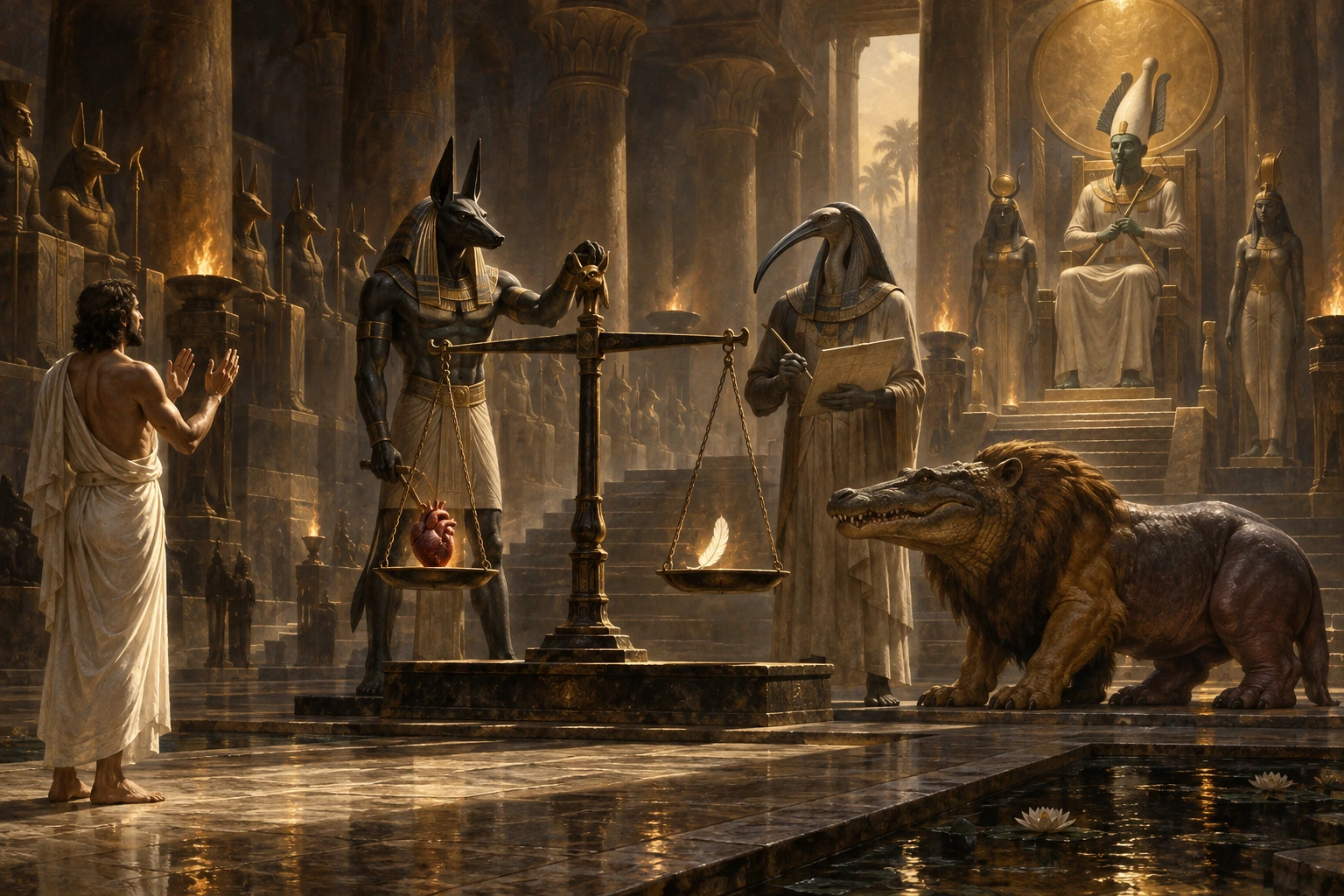
- The Book of the Dead, spell 125. The dead person is brought before Osiris in the Hall of the Two Truths. Their heart is weighed against the feather of Maat, the goddess of truth and order, and a heart that fails is eaten by the monster Ammit.
- The stela of Ikhernofret (Berlin 1204, 12th Dynasty). An official describes staging the god’s festival at Abydos: “I overthrew all his enemies on the sandbanks of Nedit.”
3 Competing Versions
- How did Osiris die? The Pyramid Texts: Seth felled him at Nedit. The Shabaka Stone: he drowned. Plutarch: he was shut alive in a chest.
- How many pieces? Plutarch says fourteen. The Greek historian Diodorus, writing about 150 years earlier, gives twenty-six in the printed text; some manuscripts read sixteen. Temple texts at Dendera, from the 1st century BCE, speak of the nomes of “the sixteen divine relics”, and elsewhere of “fourteen objects which are divine relics”.
- What happened to Seth? In Plutarch, Isis lets him go. In Diodorus, Isis and Horus avenge Osiris “after slaying Typhon and his accomplices”.
- Isis the bird: a kite in the Pyramid Texts, wings in the Great Hymn, a swallow in Plutarch.
- Byblos appears in no Egyptian source. Plutarch’s translator Frank Babbitt compared Isis by the spring, nursing a prince in the fire, with the Homeric Hymn to Demeter. In the Hymn, Demeter, grieving for her daughter, sits by a well and puts the baby prince Demophon in the fire until his mother cries out.
4 History and Tradition
- Abydos. The god’s festival was held at Abydos. Plutarch says wealthy Egyptians wanted to be buried there, “in the same ground with the body of Osiris”.
- Corn mummies. Every year, Egyptians shaped little figures of Osiris from grain and earth, so that the god would sprout again like the crops. The Metropolitan Museum of Art holds one in its coffin, with a wax mask of Osiris (58.98a–d, about 380–200 BCE).
- Philae. The temple of Isis on the island of Philae kept the old gods longer than any other. The Byzantine historian Procopius records that the emperor Justinian had it shut down in the 6th century CE and its statues sent to Constantinople.
- Greek and Roman Egypt. Herodotus already wrote that Osiris “is, in the Greek language, Dionysus” and Isis is Demeter. Under the Romans, the mysteries of Isis and Osiris spread across the empire. In Apuleius’s novel The Golden Ass, the hero is initiated into them.
“Horus was born of a virgin on 25 December” is a popular claim online. No source supports it. In the Pyramid Texts, in the Great Hymn and in Plutarch, Horus is conceived from Osiris.
5 Related Stories
- Kuniumi: Izanagi and Izanami Give Birth to Japan: in Japan, too, a death comes early in the story of the world. Izanami dies giving birth to fire, and Izanagi follows her to the land of the dead. We have not found a scholar who compares the two myths; we link them for the theme.
- The Churning of the Ocean: Gods, Demons and the Nectar of Immortality: two answers to death. Indian gods churn the sea for a drink that keeps them from dying, while Osiris dies and becomes the king of the dead.
- Ra and Apophis: The Serpent the Sun Must Defeat Every Night: the Seth who murders his brother here is, in the Book of the Dead, the god who spears the serpent Apophis from the sun’s boat. And every night the sun’s journey passes through the realm Osiris rules.
- Baldr: The Death of the Shining God: in 1920 Gustav Neckel called Baldr “an Osiris-like god”. Both are killed by a trick and mourned by the women closest to them, and neither returns to the living: Osiris rules the dead, and Baldr stays with Hel.
- Inanna’s Descent to the Underworld: Seven Gates and a Substitute: James George Frazer put Osiris and Tammuz, the Mesopotamian Dumuzi, in one class of gods who stood for “the yearly decay and revival of life”. In the Sumerian poem, though, it is the goddess Inanna who goes down to the dead and comes back, and she hands Dumuzi over to the demons herself.
6 Sources
- Plutarch, On Isis and Osiris, trans. Frank Cole Babbitt (Loeb, 1936), chapters 12–20: LacusCurtius
- Diodorus Siculus, Library of History 1.21–22, trans. C. H. Oldfather (Loeb, 1933): LacusCurtius
- Pyramid Texts, utterances 366, 532 and 535, trans. Samuel A. B. Mercer
- Louvre, “Hymn of Imenmes, chief of Amun’s flocks” (C 286): Louvre
- The Shabaka Stone, trans. Miriam Lichtheim, and the Dendera texts on the Khoiak mysteries, trans. Sylvie Cauville: attalus.org, attalus.org
- The stela of Ikhernofret, trans. Mark-Jan Nederhof: University of St Andrews
- The Metropolitan Museum of Art, “Coffin and corn mummy with Osiris mask” (58.98a–d): metmuseum.org
- Herodotus, Histories 2.59 and 2.144, trans. A. D. Godley: Perseus
- Procopius, History of the Wars 1.19: LacusCurtius
- “オシリス”: Kotobank
Cover and illustrations: AI-generated images made for Arcana. They are interpretations, not historical artworks.