Isis: The Goddess of Magic Who Outwitted the Sun
Isis made a serpent from the old sun god's spittle and would heal him only for his secret name, and she drove the scorpions' poison out of a stranger's child and out of her own. The spells that tell these stories were recited over the sick, and her worship spread from the Nile to Rome.
- Type: myth, the goddess whose words heal and command the gods
- Culture: ancient Egypt; later worshipped across the Greek and Roman world
- Earliest texts: the Pyramid Texts (from about 2350 BCE) already show her mourning Osiris; her own stories survive in a Turin papyrus of the 20th Dynasty (12th–11th century BCE) and on the Metternich Stela (360–343 BCE)
- Key figures: Isis, Ra, Horus, Nephthys, Thoth, Seth, the seven scorpions
“In ancient Egyptian texts, no deity speaks more than Isis,” writes the Egyptologist Martin Bommas. She speaks in laments for her murdered husband, in spells for her son, and later in Greek hymns carved on stone across the Aegean. Her best stories were not written down to be read for pleasure. They were spells: a healer told how Isis had once cured a god, so that her words would work again on the patient in front of him.
Why is Isis the goddess of magic? Because in her stories her words work. Egyptian magic, heka, was a force at work in gods, people and things, not a forbidden art: “there can thus be no question of the legitimacy of magic in pharaonic Egypt”, writes Robert Ritner. On the Metternich Stela Isis calls herself “the maker of words of power” and says “I know how to utter words with magical effect” (Budge’s translation, 1912).
1 The Telling
No Egyptian text tells the life of Isis from beginning to end. Her search for the murdered Osiris, her mourning with her sister Nephthys and the conception of Horus belong to the story of Osiris, which has its own page. Here are the three stories that are hers, as a papyrus in Turin and a stela now in New York tell them, in E. A. Wallis Budge’s translations of 1912. Where a later translation reads them differently, we say so.
1-1 The Secret Name of Ra
Ra, the creator of heaven, earth, gods and people, had so many names that “the gods know them not”. Isis then lived in the form of a woman who had the knowledge of words of power. She had grown weary of men; she set her heart on the gods and the spirits, and wondered whether she might become as Ra was, in heaven and on earth, by knowing the name of the holy god.
Ra had grown old. As he went about, he dribbled at the mouth, and his spittle fell to the ground. Isis kneaded it in her hand with dust and shaped it into a sacred serpent in “the form of a dart”. She left it lying on the road by which the great god travelled every day through the two lands.
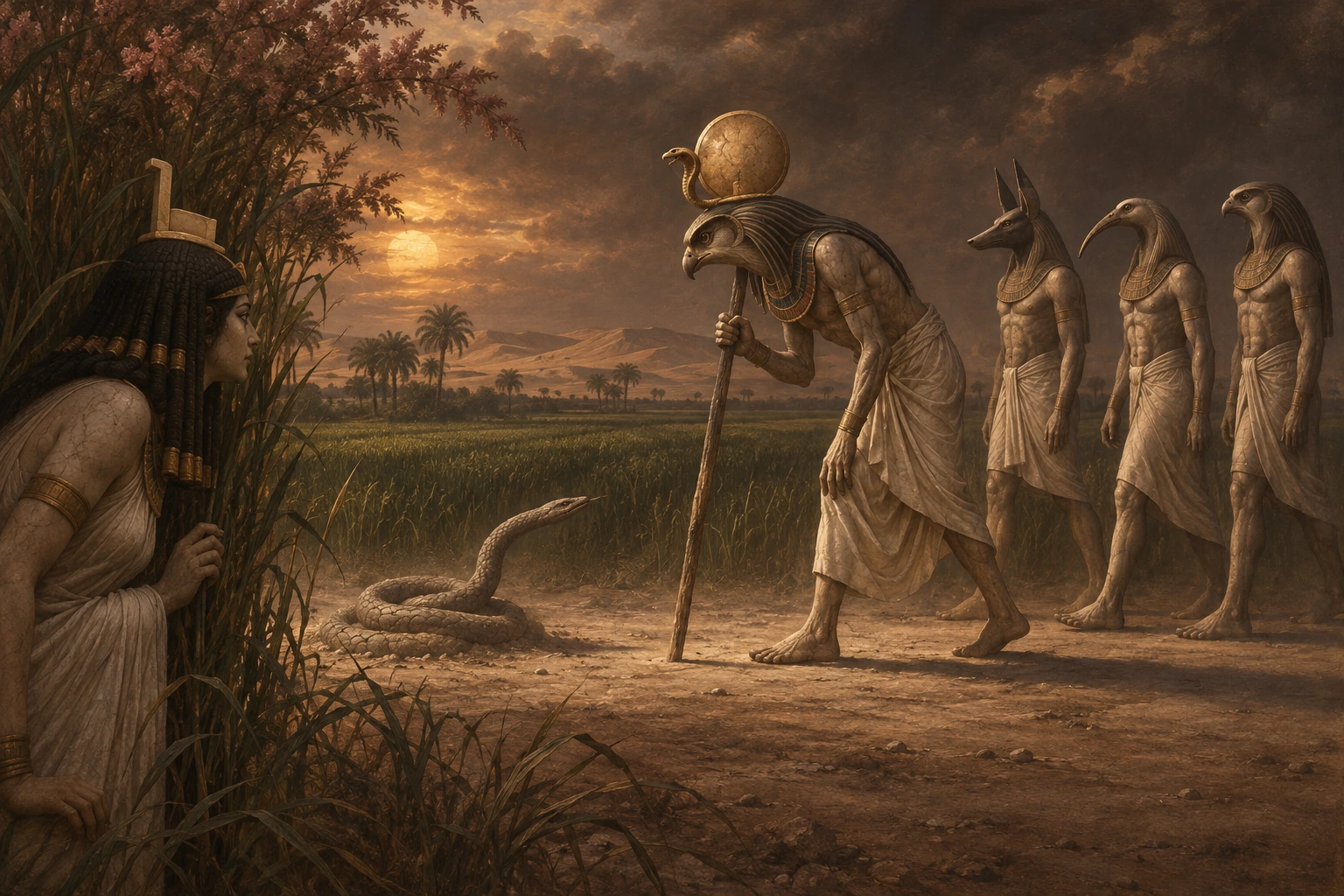
The serpent struck. Ra cried out until his cry reached the sky; his jaws shook, his lips trembled, and the poison took hold of his flesh as the Nile takes hold of the land. He called the gods together. His father and mother, he told them, had hidden his name in his body at his birth, so that no magician’s words could have power over him. Yet something he had neither seen nor made had struck him: “Behold, is it fire? Behold, is it water?”
Isis came with her words of magic. “Tell me thy name,” she said, “for he who is able to pronounce his name liveth.” Ra listed his works: he had made heaven and earth, the waters, the hours and the days; he was Khepri in the morning, Ra at noon and Atum in the evening (Budge writes Khepera and Temu). The poison did not move. Isis told him that his name was not among the things he had said. At last, burning, Ra gave way: “my name shall come forth from my body and go into hers.” He hid himself from the gods, and the throne in the Boat of Millions of Years stood empty.
Then Isis, “the great lady of enchantments”, spoke: “Flow on, poison, and come forth from Ra”, and “Let Ra live, and let the poison die.” The papyrus repeats the words for “a certain man, the son of a certain man”: here the healer put in the name of the patient. The text ends with the instruction to recite the words over images of Atum, of a god called Heru-Hekennu, of Isis and of Horus.
1-2 Isis and the Seven Scorpions
After Osiris was murdered, Seth shut Isis up in a house (a “weaving house”, in James P. Allen’s translation of 2005). Thoth came and told her to hide with her son until the boy was grown and could take his father’s throne. She went out at evening, and seven scorpions went with her: Tefen and Befen behind her, Mestet and Mestetef at her sides, and Petet, Thetet and Maatet in front, preparing the road. She ordered them to speak to no one and to keep their faces to the ground.
At the edge of the papyrus marshes they came to a town where married couples lived. A woman of rank, Usert in Budge’s reading, saw Isis on the road and shut her door on her, because she feared the scorpions. The seven took counsel and put all their poison together on the sting of Tefen, while a poor woman of the marshes opened her door and took Isis in. Tefen crept in under the rich woman’s door and stung her son. A fire broke out in her house with no water to put it out, and rain fell on it out of season.
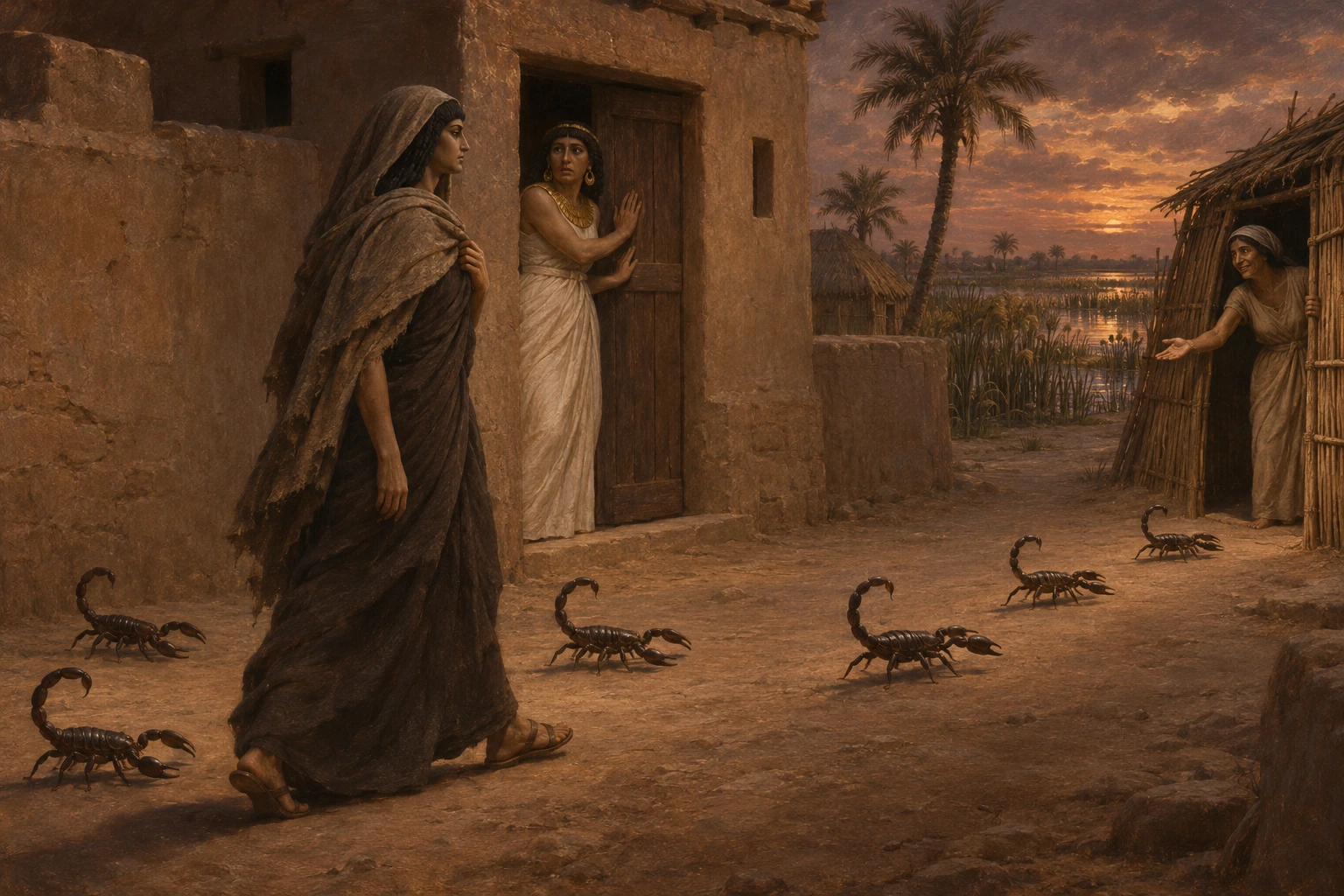
The mother went through the town crying for help, and nobody came. Isis grieved for the child, who had done no wrong. “Come to me,” she called. She laid her hands on the boy and named the poison of each scorpion in turn, ordering it out of his body and down to the ground: “I am Isis, the goddess,” she said, “and I know how to utter words with magical effect.” The fire went out, the sky grew calm and the child lived. The rich woman brought her goods to the poor woman’s house and filled it with them.
1-3 The Child in the Marshes
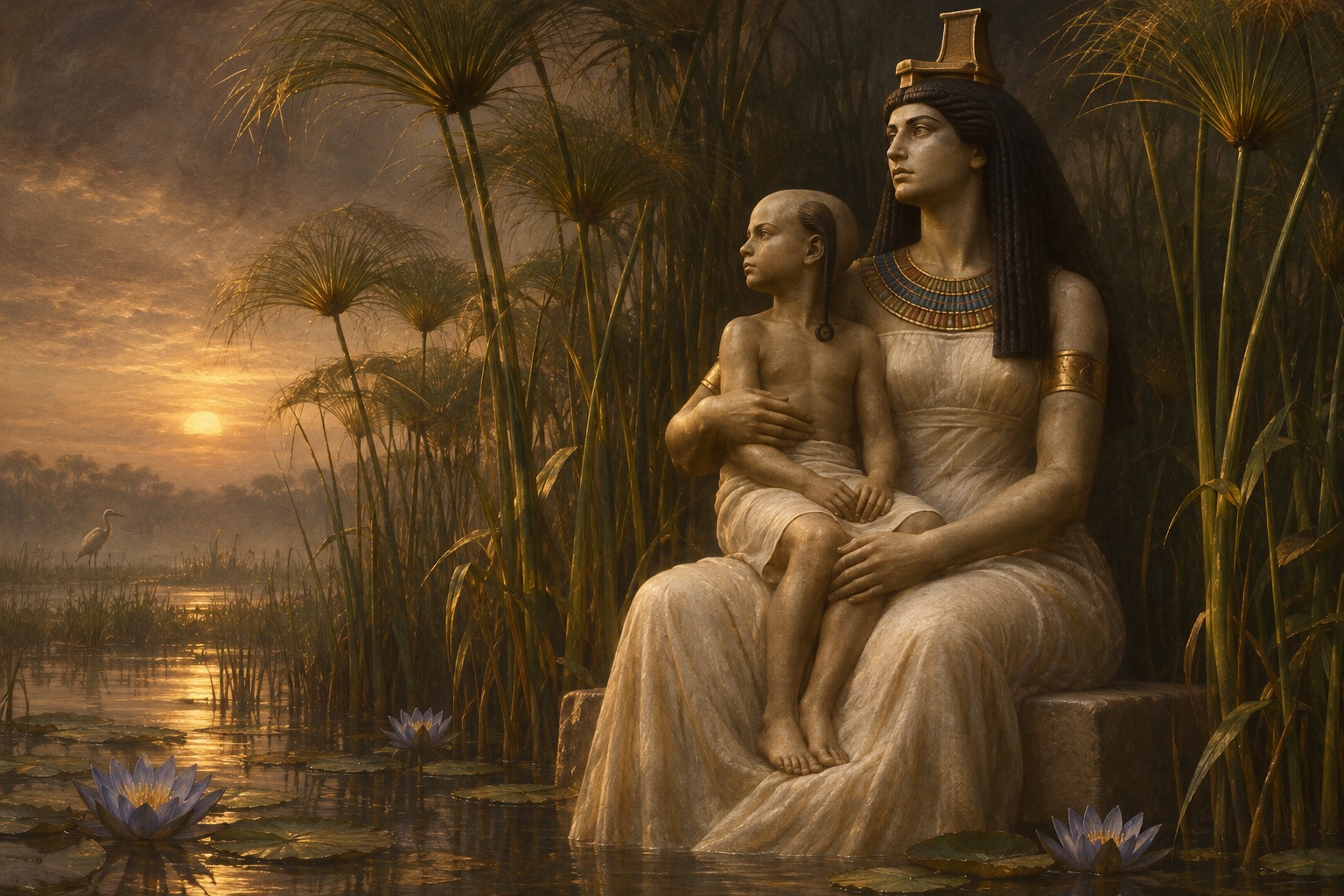
Isis bore Horus in Chemmis, among the papyrus thickets of the Delta, and hid him there. On the same stela she comes back one day and finds him limp, with no breath in him. The marsh people come running at her cries and weep with her, but none of them knows a spell. She puts her nose to his mouth, smells the poison and begins her lament, every line of which starts with the words “Horus is bitten”.
Nephthys comes weeping, and the scorpion goddess Serqet tells Isis to cry out to the sky. Her cry reaches the Boat of Millions of Years, and the sun stands still. Thoth comes down from the boat with his magic: darkness will cover the world, he says, until Horus is well again for his mother. He drives the poison out, and the child breathes. Then Thoth returns to the boat, the sun moves on, and the people of Chemmis are charged to guard the boy.
Herodotus heard the story in Egypt about 430 BCE and told it with Greek names (Histories 2.156). Near Buto, he writes, a lake held an island called Chemmis that the Egyptians said could float. There Leto, “taking charge of Apollo from Isis, hid him for safety”, when Typhon, the Greek name for Seth, “came hunting through the world, keen to find the son of Osiris”. Apollo, he explains, is Horus, and Isis is Demeter. The boy grew up to claim his father’s throne before the gods, in the trial told in Horus and Seth: The Eighty-Year Trial.
2 Where the Story Is Written Down
- The Pyramid Texts, carved inside royal pyramids from Unas, at the end of the 5th Dynasty (about 2350 BCE), onward. Isis already appears in them with Nephthys, weeping and lamenting for Osiris (Bommas).
- The Turin papyrus (Museo Egizio, Cat. 1993), a hieratic book of spells against snakes and scorpions from the 20th Dynasty (about 1190–1077 BCE), probably from Deir el-Medina, the village of the royal tomb builders. It came to Turin with the Drovetti collection in 1824. The tale of Isis and Ra fills columns 2 to 5 of its front, and a drawing among its columns shows Isis with a throne on her head. Pleyte and Rossi published it with the other Turin papyri; Budge translated it in 1912.
- The Metternich Stela (Metropolitan Museum of Art, 50.85), a magical stela of metagraywacke 83.5 cm high, from the reign of Nectanebo II (360–343 BCE). The Met gives it as probably from the temple of the Mnevis bulls at Heliopolis, and its text says that a priest, Nestem, copied it “after he had found it removed from the domain of Osiris Mnevis” (as Ritner quotes it). Dug up in Alexandria in 1828, it was given to Prince Metternich by Muhammad Ali (Budge). On its front, Horus the child stands on two crocodiles; nearly three hundred figures of gods surround him, and spells cover every free surface, among them the scorpions and the child in the marshes.
- The cippi of Horus, smaller stelae of the same kind showing “Horus on the crocodiles”, made from the 18th Dynasty to the Roman era (Ritner). Few people read their spells. Water was poured over the carving and drunk by the sufferer, and the larger ones had basins to catch it.
- The London Medical Papyrus, of the Ramesside period: Horus lies feverish in his nest while his mother is away, and Isis comes out of the workhouse with Nephthys to put out “the fire” with her milk (Bommas).
- The birth house at Philae, the room where the birth of Horus was celebrated. One of its scenes shows Isis nursing her son in the marshes (Egyptian Ministry of Tourism and Antiquities).
3 Competing Versions
- What did Ra give up? In Budge’s translation, as the name leaves Ra’s heart, Isis tells Horus that the great god “shall bind himself by an oath to give his two eyes”, which Budge took to be the sun and the moon. The Museo Egizio’s summary reads the passage differently: Ra reveals his name on condition that Isis tells it to no one but her son Horus.
- Dead or dying? Budge told the marsh story as a death and a return to life: Horus “was stung by a scorpion and died”, and Thoth’s spell revived him. In Allen’s translation Horus is poisoned and failing, and Isis fears he “will die completely” if no help comes.
- Which Nectanebo? The Met dates the stela to Nectanebo II (360–343 BCE). Budge, in 1912, named Nectanebo I; Bommas, in 2022, also names Nectanebo I, with the dates the Met gives for the second king.
- What does her name mean? Her Egyptian name, which Budge writes Ast, is spelled with the sign of a seat or throne. Budge (1904) could connect it with nothing she does and called every proposed meaning “mere guesses”. The Japanese Heibonsha encyclopedia sees her origin in the throne made divine. Plutarch, writing in Greek, thought “Isis is a Greek word” and read the name of her temple, Iseion, as a promise of knowledge (On Isis and Osiris 2).
- Who taught her magic? On the Metternich Stela she says her father taught her the spell, and the god Geb gives her “his own magical spells”. A note of Budge’s says she learned her words of power from Thoth. Ritner sees her power, heka, as derived from that of the older god Heka, “Magic” itself.
- Where was Chemmis? On the stela, a hiding place in the papyrus marshes of the Delta; in Herodotus, an island in a lake near Buto that the Egyptians said floated, though “I never saw it float”.
4 History and Tradition
- Heka. Magic was a god as well as a force. Heka is named from the Old Kingdom to the Roman period, and some doctors at the end of the 5th Dynasty were also “prophets of Heka” (Ritner). The Instruction for King Merikare says the creator made magic for people as weapons “to ward off the blow of events” (Ritner’s translation). Healers spoke Isis’s words as the model of that power.
- The last inscriptions at Philae. The great temple of Isis on the island of Philae, near Aswan, was begun by Ptolemy II (285–246 BCE). There a priest of Isis, Esmet-Akhom, carved the last known hieroglyphic inscription with a figure of the god Mandulis; a Demotic text beside it dates the work to 24 August 394 CE. The last Demotic one, left by Smet the Elder, first prophet of Isis, is dated 2 December 452 (Youri Volokhine, University of Geneva).
- The end of the temple. Procopius writes that Justinian had the sanctuaries pulled down and their statues sent to Constantinople. Volokhine dates that to 535–537 and finds the temple’s name as “the last bastion of paganism” an overstatement. The temple became a church, and crosses were cut where the face of Isis had been. Threatened by the Aswan High Dam, the monuments were taken apart under UNESCO and rebuilt on the island of Agilkia, about 500 metres away; the Heibonsha encyclopedia dates the move to 1980.
- Delos. Traders brought Isis and Sarapis to the Aegean island of Delos from the end of the 3rd century BCE, and from about 180 BCE their cult was official (French School at Athens). One of their sanctuaries, Sarapeion C, had an avenue of sphinxes in the Egyptian manner, yet the temple of Isis and her statue are “in impeccably Greek style”. The people of Athens gave the statue in 128/127 BCE (Bommas).
- Hymns in her own voice. Greek inscriptions found at Kyme, on Delos and elsewhere, called aretalogies, have Isis list her powers in the first person, beginning “I am Isis”. In one she says “I overcome Fate; Fate obeys me” (as Ritner quotes it). Bommas finds only twelve of the fifty powers in the Kyme text that match the Egyptian goddess: about three-quarters are Greek.
- Pompeii. The temple of Isis at Pompeii was found in 1764 with its decoration and furnishings almost intact. Water for its rites came from a basin said to hold water from the Nile (Archaeological Park of Pompeii). An inscription over its entrance records that Numerius Popidius Celsinus rebuilt “from the foundation” the temple of Isis “collapsed in an earthquake”, and that the town council admitted him though he was six years old (CIL X 846). The park adds that Mozart saw the temple in 1770 and that it inspired the first staging of The Magic Flute in 1791.
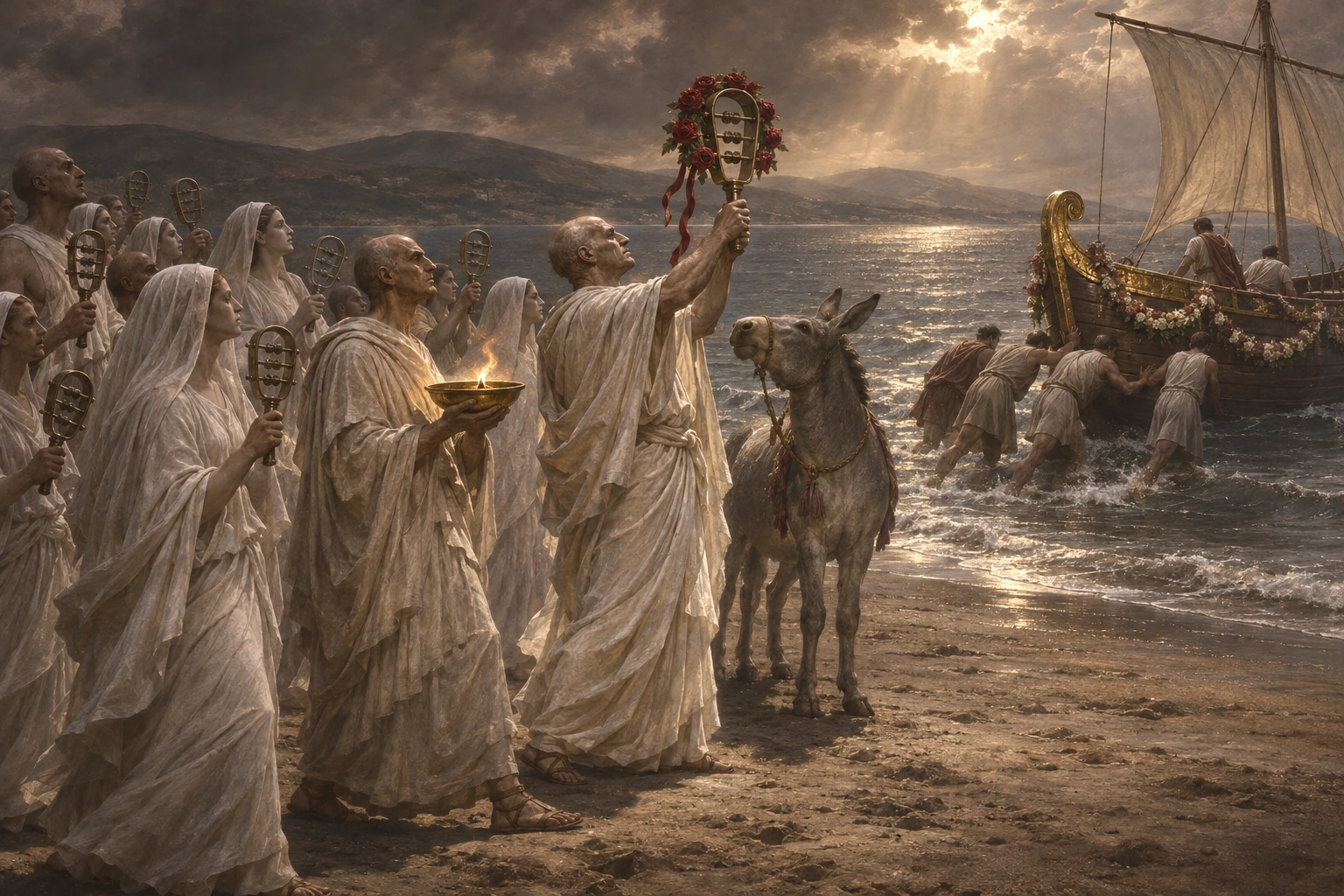
- The procession. In book 11 of Apuleius’s Metamorphoses, or The Golden Ass (2nd century CE), Lucius, turned into an ass, prays on the shore at Cenchreae, the port of Corinth. Isis rises from the sea: every nation worships her under another name, she says, but the Egyptians “call me by my true name, Isis the Queen”. The next day her procession goes down to the sea: initiates in white linen shaking rattles (sistra) of bronze, silver and gold, a lamp in a golden bowl, and a new ship, dedicated to her and launched to open the sailing season. A priest carries roses on his sistrum; Lucius eats them and becomes a man again.
- The initiation. After ten days without meat or wine, Lucius is led at evening into the heart of the temple. He may not tell what he saw, only this: “I drew nigh to the confines of death, I trod the threshold of Proserpine”, and “I saw the sun gleaming with bright splendour at dead of night” (H. E. Butler’s translation, 1910). In Rome he goes on to worship Isis as “Goddess of the Field of Mars”, named for her temple there.
Was the Christian Virgin and Child copied from Isis nursing Horus? The likeness is real: Isis seated, offering her breast to the child on her lap, was a familiar figure from about 700 BCE to the 4th century CE. Thomas Mathews and Norman Muller (2016) argue for continuity between pagan panel paintings and the first icons; we know the book only from a review, in which Harikleia Brecoulaki sums up its view: the scheme of Mary with her child “can hardly be separated” from Isis with Harpocrates. Sabrina Higgins (2012) accepts that the picture type was borrowed, but not the worship: the first certain images of Mary nursing in Egypt are 6th- or 7th-century paintings in monks’ cells at Saqqara, nearly two centuries after the last such Isis, and the two “need to be understood within their respective cultural contexts”.
5 Related Stories
- Osiris: The Murdered King Who Rules the Dead: the search for Osiris, Isis at Byblos, the fourteen pieces and the mourning with Nephthys, which this page leaves to that story.
- Horus and Seth: The Eighty-Year Trial: the child hidden at Chemmis grows up and claims his father’s throne, and Isis outwits Seth again, this time in court.
- Ra and Apophis: The Serpent the Sun Must Defeat Every Night: in the seventh hour of the night the sun’s boat moves by the words of power of Isis and an “Elder Magician”. In the Turin papyrus she turns the same power on Ra himself.
- Persephone: The Pomegranate and the Seasons: Herodotus wrote that Isis “is Demeter in the Greek language”, and Apuleius’s Isis says the people of Eleusis call her “the ancient goddess Ceres”. Both are mothers who search, and both had mysteries with initiation.
6 Sources
- The Turin papyrus and the Metternich Stela, trans. E. A. Wallis Budge, Legends of the Gods: The Egyptian Texts, Edited with Translations (1912), “The Legend of Ra and Isis” and “The Legend of the Death of Horus through the Sting of a Scorpion”: Project Gutenberg
- Museo Egizio, Turin, “Cat. 1993: The Tale of Isis and the Name of Re”: museoegizio.it
- The Metropolitan Museum of Art, “Magical Stela with Horus the Child” (50.85): metmuseum.org
- The Metternich Stela, the stories of Isis, trans. James P. Allen, The Art of Medicine in Ancient Egypt (2005), no. 52: attalus.org
- Herodotus, Histories 2.59 and 2.156, trans. A. D. Godley: Perseus
- Plutarch, On Isis and Osiris 2, trans. Frank Cole Babbitt (Loeb, 1936): LacusCurtius
- Apuleius, The Metamorphoses or Golden Ass, book 11, trans. H. E. Butler (Oxford, 1910), vol. 2: archive.org
- Procopius, History of the Wars 1.19, trans. H. B. Dewing (Loeb, 1914): LacusCurtius
- E. A. Wallis Budge, The Gods of the Egyptians (1904), vol. 2, pp. 202–203: archive.org
- Robert K. Ritner, The Mechanics of Ancient Egyptian Magical Practice (Oriental Institute, 1993), pp. 15, 19–20, 22, 106–107, 206–207: ISAC
- Martin Bommas, “‘I Am Isis’: The Role of Speech in the Cult of Isis”, in Jeffrey Spier and Sara E. Cole (eds), Egypt and the Classical World (J. Paul Getty Museum, 2022): getty.edu
- Youri Volokhine, “In the field: religious mutations at Philae” and “A church in the temple of Isis”, in Honouring the gods in the classical Mediterranean realm and on its fringes (Université du Maine, 2012): univ-lemans.fr, univ-lemans.fr
- Egyptian Ministry of Tourism and Antiquities, “Philae”: egymonuments.gov.eg
- French School at Athens, “Delos: sanctuaries and cults”: efa.gr
- Archaeological Park of Pompeii, “Temple of Isis”: pompeiisites.org; CIL X 846: Judaism and Rome
- Sabrina Higgins, “Divine Mothers: The Influence of Isis on the Virgin Mary in Egyptian Lactans-Iconography”, Journal of the Canadian Society for Coptic Studies 3 (2012), abstract: Lockwood; and Embodying the Virgin (PhD thesis, University of Ottawa, 2015), pp. 104–107: uOttawa
- Harikleia Brecoulaki, review of Thomas F. Mathews and Norman E. Muller, The Dawn of Christian Art in Panel Paintings and Icons (Getty, 2016), Bryn Mawr Classical Review 2018.06.03: bmcr.brynmawr.edu
- “イシス” (Heibonsha encyclopedia, by Yakata Teisuke): Kotobank; “フィラエ島” (Daijisen): Kotobank
Cover and illustrations: AI-generated images made for Arcana. They are interpretations, not historical artworks.