Persephone: The Pomegranate and the Seasons
Hades carried Demeter's daughter down to the dead, and her mother kept the seed in the ground until the gods gave her back. But Persephone had eaten a pomegranate seed below, so for part of every year she must return, and the oldest telling never says that part is winter.
- Type: myth, a daughter carried off to the land of the dead and a mother’s search; the founding story of the Eleusinian Mysteries
- Culture: ancient Greece, above all Eleusis in Attica; retold in Rome
- Earliest texts: Hesiod’s Theogony (8th–7th century BCE) mentions the abduction in three lines; the full telling is the Homeric Hymn to Demeter (7th–6th century BCE), which survives in a single manuscript, found in Moscow in 1777
- Key figures: Persephone (also called Kore, “the Maiden”), Demeter, Hades (Aidoneus), Zeus, Hecate, Helios, Hermes, Celeus and Metaneira of Eleusis, their son Demophon
“Every year the Athenians observe this festival for the Mother and the Maiden,” an Athenian explains in Herodotus, “and any Athenian or other Hellene who wishes is initiated.” The Mother was Demeter, goddess of the grain; the Maiden was her daughter Persephone, carried off by the king of the dead. Their story explains the rite at Eleusis. Whether it also explains the seasons is a question the oldest text leaves open.
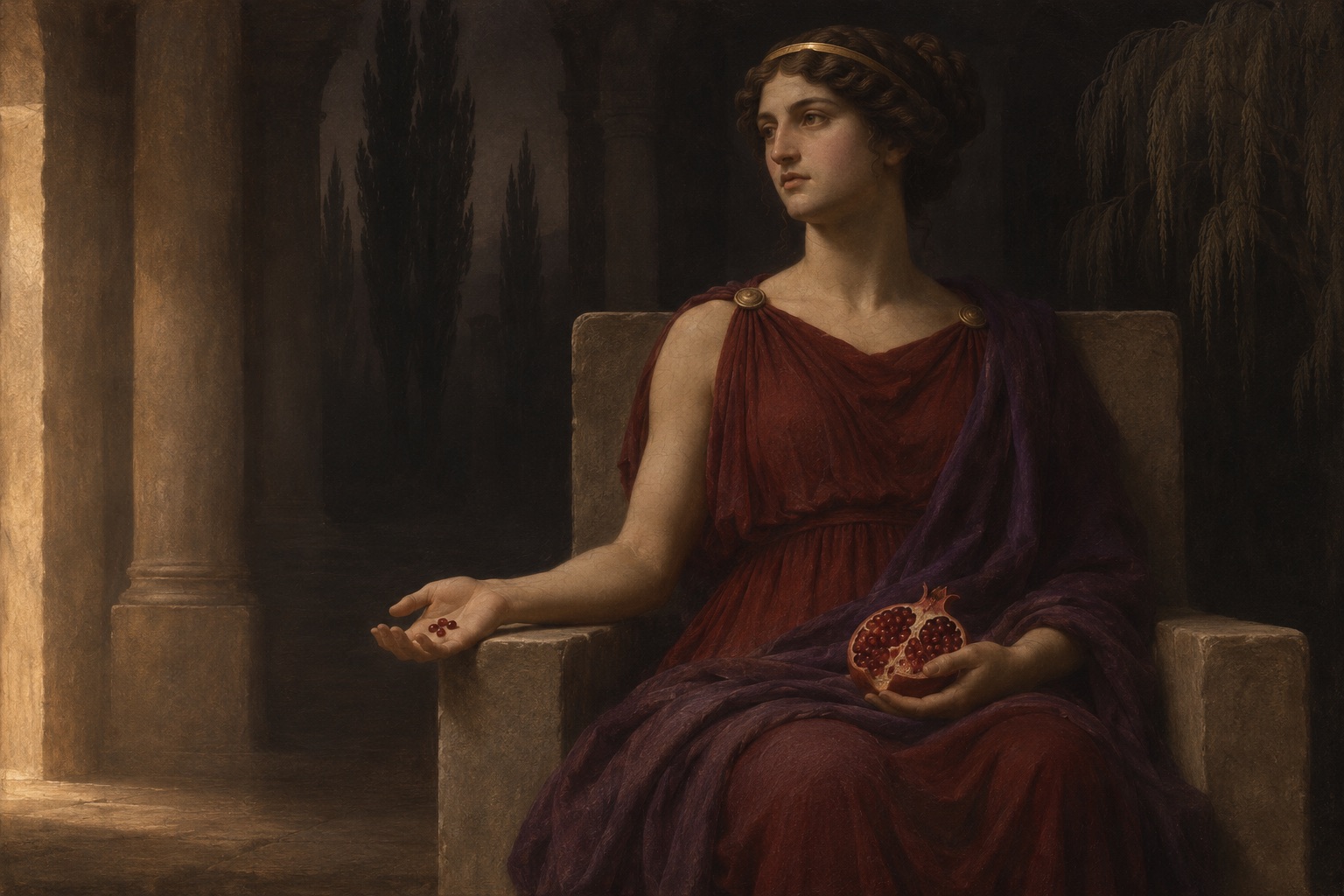
Why must Persephone go back every year? Because she ate in the land of the dead. In the Hymn to Demeter, Hades slips her a pomegranate seed as she leaves, and she tells her mother that he “forced me to taste against my will”. Whoever has tasted food below, Demeter tells her, must live there “a third part of the seasons every year”. In Ovid she picks the fruit herself and eats seven seeds, and her share below becomes half the year.
1 The Telling
This is the version of the Homeric Hymn to Demeter, an anonymous poem of nearly five hundred lines handed down among the hymns ascribed to Homer, in the translation of Hugh G. Evelyn-White (1914).
1-1 The Narcissus
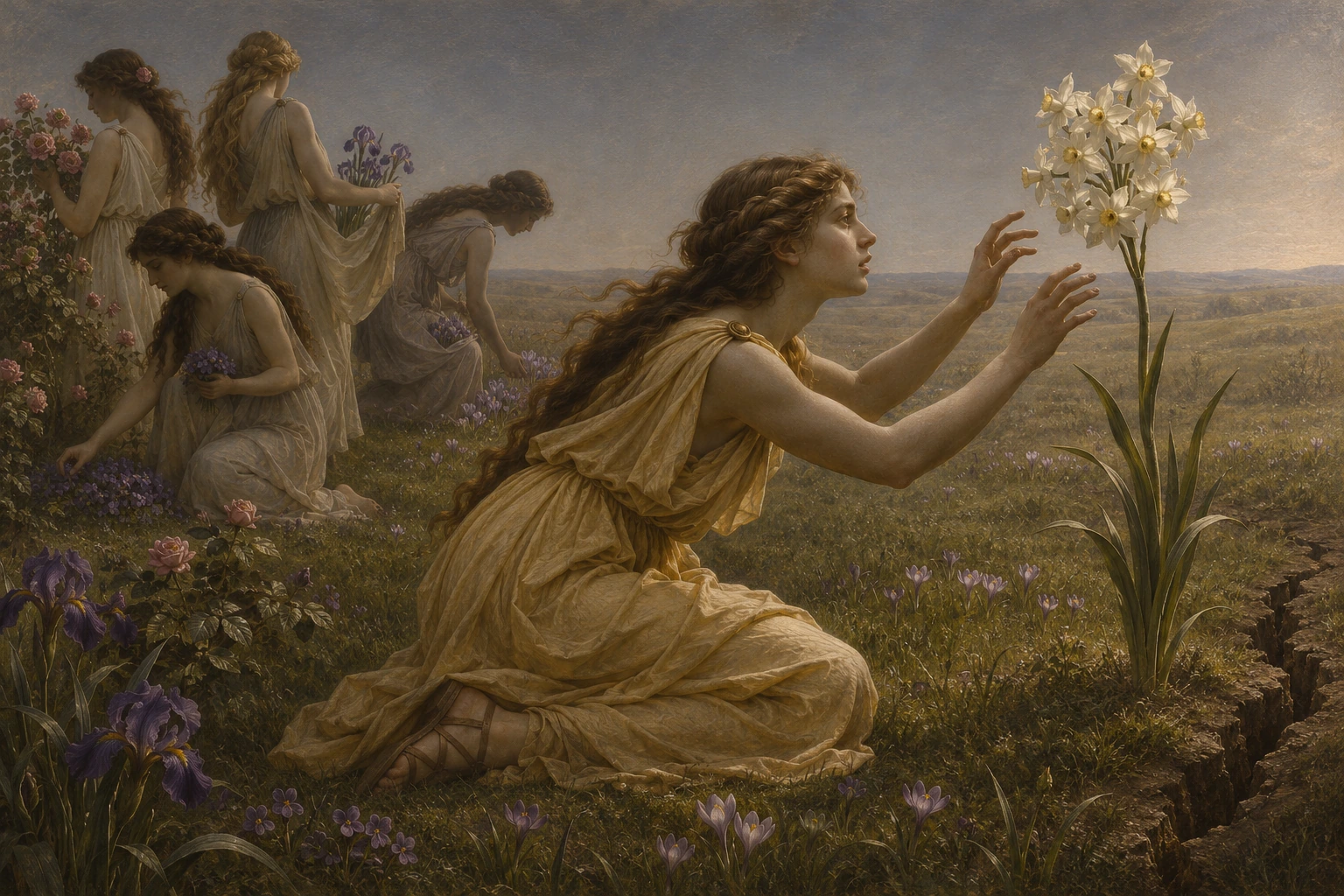
Persephone was playing far from her mother with the daughters of Ocean, gathering flowers in a soft meadow. Among them grew a narcissus that Earth had made to grow “at the will of Zeus”, “to be a snare for the bloom-like girl”: a hundred blooms on one root, with a scent that made the sky, the earth and the sea laugh. She reached out with both hands to take it. The earth opened in the plain of Nysa, and out sprang Hades with his immortal horses, the god the poem calls “Host of Many” (the Greeks avoided naming him, Evelyn-White notes). He caught her up “reluctant” in his golden chariot and carried her away as she cried to her father. Only Hecate, in her cave, and Helios, the Sun, heard her. Zeus sat apart in one of his temples: it was “by leave of Zeus” that his brother took her (1–32).
1-2 Nine Days with Torches
The mountains and the sea rang with her voice, and her mother heard. Demeter tore the covering from her hair, cast off her dark cloak and sped like a bird over land and sea. For nine days she wandered with flaming torches, tasting neither ambrosia nor nectar. On the tenth dawn Hecate met her: she had heard the girl’s cry but had not seen who took her. Together they went to Helios, “watchman of both gods and men”, and he told the truth. None of the gods was to blame “but only cloud-gathering Zeus who gave her to Hades, her father’s brother” (38–87).
1-3 The Old Woman at the Well
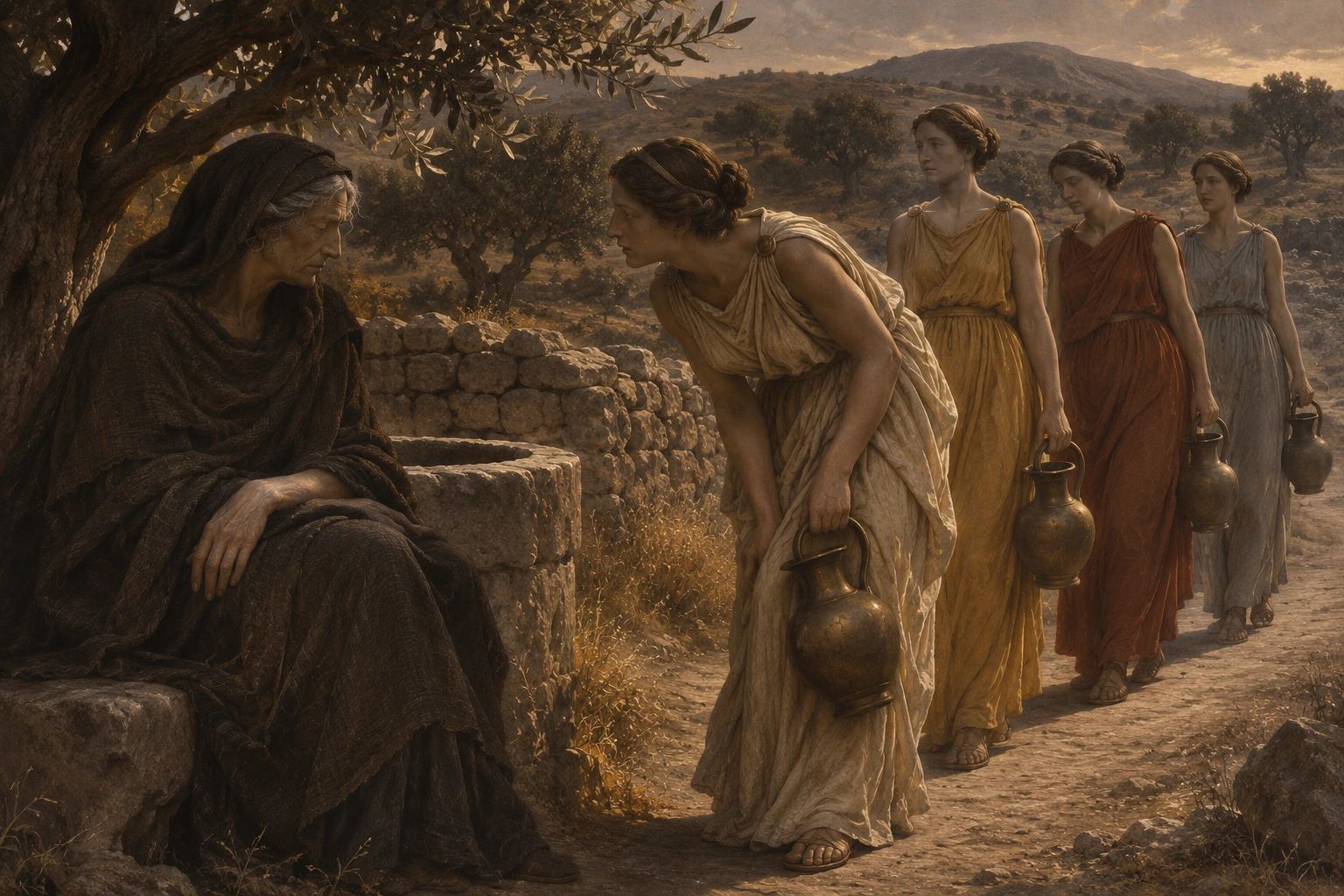
Angrier still, Demeter kept away from Olympus and went among the towns of men in disguise. At Eleusis she sat by the wayside at the Maiden Well, under an olive, looking like an old woman long past childbearing. The four daughters of Celeus, lord of Eleusis, came with bronze pitchers for water and spoke to her kindly. She told them her name was Doso, carried off from Crete by pirates, and said she could nurse a newborn child; their mother Metaneira had a late-born son. In the palace the goddess’s head touched the roof and the doorway filled with light, yet she sat on a low stool, veiled and silent, eating nothing, until the servant Iambe made her smile with jests. She refused red wine and asked for barley meal and water mixed with mint (90–211). Evelyn-White notes that drinking this potion, the kykeon, “was one of the most important pieces of ritual in the Eleusinian mysteries”.
1-4 The Child in the Fire
Demeter nursed the boy, Demophon, on no food at all: by day she anointed him with ambrosia, and at night she hid him “like a brand in the heart of the fire”, and he grew like a god. She would have made him deathless and ageless, but one night Metaneira saw her son in the flames and cried out. The goddess snatched him from the fire, put him down on the ground and told her what her fear had cost: now he could not escape death, though honour would always rest on him. Then she threw off her old age, golden hair falling over her shoulders, and the house filled with light as if with lightning. She ordered a temple and an altar on the hillock above the spring Callichorus, where she would teach her rites, and Celeus had the people build it (231–300).
1-5 The Year Without Grain
In her new temple Demeter sat apart from the gods, wasting with longing. Then she made “a most dreadful and cruel year” for mankind. The ground would not let the seed sprout; the oxen drew the ploughs in vain. The human race would have died of famine, and the gods would have lost their sacrifices. Zeus sent Iris, then all the gods one after another with gifts. Demeter vowed that she would never set foot on Olympus, nor let fruit spring from the ground, until she saw her daughter. So Zeus sent Hermes down to Erebus to bring Persephone back to the light (301–339).
1-6 The Pomegranate Seed
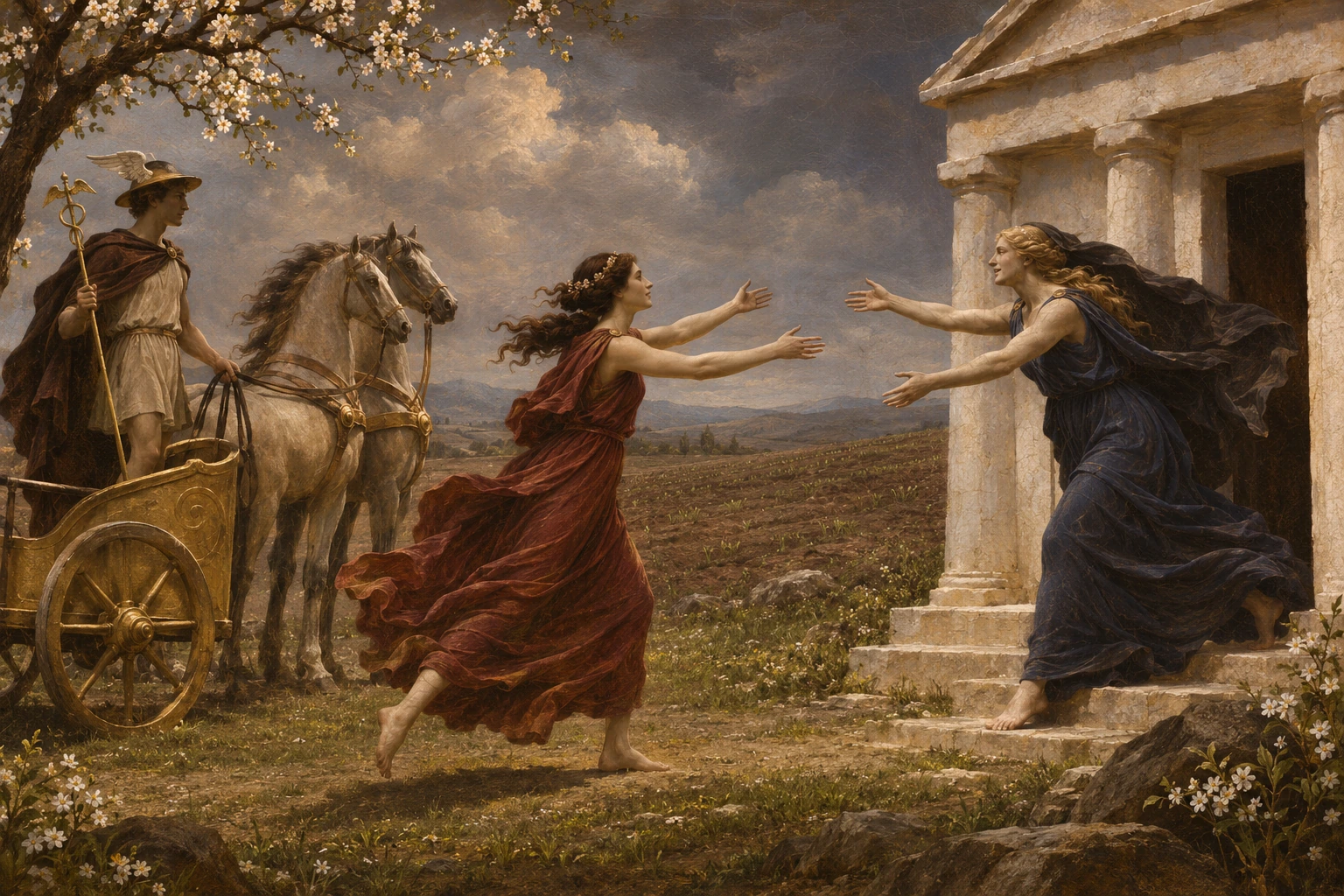
Hermes found Hades on a couch, his unwilling wife beside him. Hades smiled grimly and obeyed. “Go now, Persephone, to your dark-robed mother,” he said, promising that with him she would “rule all that lives and moves”. She sprang up for joy, and he “secretly gave her sweet pomegranate seed to eat”, so that she would not stay for ever with her mother. Hermes drove her to Eleusis in the golden chariot; Demeter rushed out “as does a Maenad down some thick-wooded mountain”, and Persephone leaped down to run to her (340–389).
Even as she held her daughter, Demeter feared a trick. Had she eaten anything below? If not, she could stay. If she had, she must go back “to dwell a third part of the seasons every year”, and spend the other two parts above. “But when the earth shall bloom with the fragrant flowers of spring in every kind, then from the realm of darkness and gloom thou shalt come up once more” (390–403). Persephone told her that Hades had “secretly put in my mouth sweet food, a pomegranate seed, and forced me to taste against my will” (411–413). Zeus sent Rhea, Demeter’s own mother, with his terms: a third of the year below, two thirds above (441–447). Demeter made the fields grow again, and before she returned to Olympus she taught the kings of Eleusis her rites, “awful mysteries which no one may in any way transgress or pry into or utter”. “Happy is he among men upon earth who has seen these mysteries” (470–482).
2 Where the Story Is Written Down
- Hesiod, Theogony 912–914 (8th–7th century BCE). Three lines in the list of Zeus’s wives: Demeter “bore white-armed Persephone whom Aidoneus carried off from her mother; but wise Zeus gave her to him”.
- Homer never tells the abduction, but his Persephone already rules below. In the Odyssey the dead live in “the house of Hades and dread Persephone”; she has left the seer Teiresias alone his reason (10.490–495), and she sends up the shades of famous women to Odysseus (11.225–227). In the Iliad, Althaea calls on “Hades and dread Persephone” to bring death on her son (9.569).
- The Homeric Hymn to Demeter. The Theoi Project dates the longer hymns to the 7th–6th century BCE; Evelyn-White put this one in the 7th, partly because it does not mention Iacchus, whose name the initiates cried in Herodotus’s day (8.65). It survives only in a manuscript of the first half of the 15th century, now Leiden University Library BPG 33 H, which, its catalogue notes, was “discovered in Moscow in 1777 by C.F. Matthaei”. Some lines are lost.
- Diodorus of Sicily, Library of History 5.2–5 (1st century BCE). The Sicilians held their island sacred to Demeter and Kore. The abduction took place in the meadows of Enna, where flowers bloom all year, through a cave with a chasm “which leads down into the earth”. Another tradition puts it near Syracuse, at the spring Cyane, where a festival was held every year.
- Ovid, Metamorphoses 5.341–571 (finished around 8 CE) and Fasti 4.417–620, and Apollodorus, Library 1.5.1–3 (1st or 2nd century CE). Apollodorus, notes his translator J. G. Frazer, “is based on the Homeric Hymn to Demeter”, yet differs in places (section 3).
3 Competing Versions
3-1 Ovid: Two Sicilian Versions
In the Metamorphoses the story is a song of the Muse Calliope. Venus, vexed that Pallas and Diana have refused love and that Ceres’s daughter means to do the same, has Cupid shoot Dis, the king of the dead. At the lake Pergus near Henna, where “spring eternal reigns” (perpetuum ver est), Proserpina was picking violets and lilies when she was “seen, beloved, and carried off”. The nymph Cyane rose from her pool to bar the way: Dis should have asked for the girl, not seized her. He struck the pool with his sceptre and drove down through it, and Cyane wept until she dissolved into her own waters. Ceres searched every land with pine torches lit at Etna and broke the ploughs of Sicily, until the spring Arethusa, which runs beneath the earth, told her she had seen Proserpina below, a queen “supremely great in that opacous world” (5.341–508). Jupiter allowed her return if she had eaten nothing. But in the gardens below she had picked a pomegranate and eaten seven seeds. Only Ascalaphus saw, and she turned the tell-tale into the screech owl, “sad omen to mankind”. Jupiter “divided the long year in equal parts”: six months with her mother, six with her husband (5.533–567).
The Fasti, Ovid’s poem on the Roman calendar, tells it again under 12 April, the Games of Ceres. Here Celeus is a poor old farmer; Ceres breaks her fast by tasting a poppy at nightfall, “which is why the initiates eat when the stars appear”; and the child she lays in the embers is Triptolemus. When his mother snatches him out, Ceres says: “he will be mortal, but he will be the first to plough and sow” (4.533–560, our translation). Persephone has eaten three seeds, and Jupiter agrees that she will spend “twice three months” in heaven (4.607–614).
3-2 Where the Versions Disagree
- Where? The Hymn names the plain of Nysa, “but whether this was a real or a mythical place is doubtful”, writes Frazer. Diodorus and Ovid put it in Sicily, perhaps, Frazer guesses, because of “the abundance of its corn”.
- How many seeds, and how long? Hymn and Apollodorus: one seed, a third of the year. Metamorphoses: seven seeds, half the year. Fasti: three seeds, six months above.
- Who fed her, and who told? In the Hymn, Hades gives her the seed in secret; in Apollodorus she swallows it “not foreseeing the consequence”; in Ovid she picks it herself. Apollodorus has Ascalaphus bear witness too, but there Demeter lays a heavy rock on him in Hades. Demeter learns the truth from Helios in the Hymn, from the people of Hermion in Apollodorus, from Arethusa in the Metamorphoses and from the Sun in the Fasti.
- The child in the fire. In the Hymn Demophon lives, but as a mortal. In Apollodorus a woman named Praxithea sees him in the fire and cries out, and “the babe was consumed by the fire”; Triptolemus receives a chariot of winged dragons and sows wheat over the earth. In the Fasti the child is Triptolemus.
3-3 Which Season?
The Hymn says when Persephone comes up, in spring, but not when she goes down, and it never ties her yearly absence to bare fields. Scholars have read her four months below in two ways.
- The sown seed. J. G. Frazer, in The Golden Bough, took Persephone for the seed corn “sown in autumn, to reappear in spring”: her descent “would thus be a mythical expression for the sowing of the seed”. The Japanese encyclopedia Nipponica gives the same reading: a myth of the grain spirit, sown and hidden in the earth, that sprouts again in spring.
- The stored seed. In 1913 F. M. Cornford proposed another descent, into the underground granaries where the first-fruits were kept between harvest and sowing: “No one ever sowed corn in a cave, but it is a very suitable place for storing it.” Martin Nilsson made the case outright: “After the harvest in June the corn was stored in subterranean silos. It was not brought up again till the seed-time approached in October,” and for those four months the fields are “barren and desolate, burnt by the scorching sun”. His view, he admitted, “has been contested”; he called it “irrefutable”.
- One word, three readings. Diodorus says the Sicilians held Kore’s festival when the grain ripened and Demeter’s when the sowing began. The name of Kore’s festival, katagogē, is “her return” in C. H. Oldfather’s translation, “the bringing home of the maiden” in Frazer’s (as Cornford quotes it), and for Nilsson “the bringing down of the [corn-]maiden”, into the storehouse.
4 History and Tradition
- The sanctuary. Demeter was worshipped at Eleusis from the Mycenaean age to the end of the 4th century CE, says the Greek Ministry of Culture. Her cult became Panhellenic in the mid-8th century BCE, and in Solon’s time, early in the 6th, Eleusis was joined to Athens and the Mysteries became an Athenian festival. The Persians destroyed the sanctuary in 480 BCE; it was rebuilt with a new great Telesterion, Demeter’s main temple. Pausanias saw the well Callichorum, “where first the women of the Eleusinians danced and sang in praise of the goddess” (1.38.6). The excavators found it outside the gate of the precinct, “carefully built of polygonal stones”, Frazer reports, and visitors still pass it beside the Great Propylaea.
- The secret. The Hymn forbids anyone to “utter” the rites, and the initiates kept the rule. “My dream forbade the description of the things within the wall of the sanctuary,” writes Pausanias (1.38.7), and Eunapius will not even name the hierophant, the priest who initiated him. Outsiders are hostile or vague. The Christian writer Clement of Alexandria quotes what he calls the initiates’ token: “I have fasted, I have drunk the cup; I have received from the box; having done, I put it into the basket, and out of the basket into the chest.” Cicero, an initiate, says only that from these “beginnings” (initia) we learned “a way to live with joy, and to die with a better hope” (Laws 2.36, our translation).
- The end. In 391 and 392 laws issued under Theodosius I forbade sacrifice and the visiting of temples (Theodosian Code 16.10.10 and 16.10.12). Eunapius records his hierophant’s prophecy that “the worship of the Goddesses would come to an end”, and dates the disasters to the time when Alaric’s Goths came through Thermopylae, in 395 according to his translator, Wilmer Cave Wright. With the Visigoths’ invasion, says the Ministry of Culture, the sanctuary became ruins and the cult was abandoned.
Persephone’s story is often called the Greek explanation of winter. The Hymn to Demeter never says so. It brings her back “when the earth shall bloom with the fragrant flowers of spring”, but the only barren time it describes is a single “dreadful and cruel year”, Demeter’s punishment, which ends when mother and daughter are reunited. In Attica the grain grows through the winter and the fields are bare in summer, which is why Nilsson took her months below to be the summer.
5 Related Stories
- Zeus: The Youngest Son Who Became King of the Gods: Demeter is one of the children Kronos swallowed, and in Hesiod’s list of Zeus’s wives she is the mother of Persephone, “whom Aidoneus carried off from her mother; but wise Zeus gave her to him” (Theogony 912–914).
- The Odyssey: Ten Years on the Way Home from Troy: in the land of the dead it is Persephone who sends the shades of famous women to Odysseus (11.225–227), and he leaves in fear that she will send up the Gorgon’s head (11.633–635).
- Orpheus and Eurydice: The Look Back: in Ovid, Orpheus sings his plea before Persephone and the lord of the shades, and reminds them that if the “old report” of how Pluto stole his wife “is not a fiction, Love united you the same as others” (Metamorphoses 10.15–29). In Virgil’s Georgics, it is Proserpina who sets the condition he breaks (4.487).
- Osiris: The Murdered King Who Rules the Dead: in Plutarch, the mourning Isis sits by a spring at Byblos, nurses the queen’s son in the fire and is stopped by the queen’s cry. Plutarch’s translator Frank Babbitt points to “the similar account of Demeter” in the Hymn.
- Izanagi in Yomi: The Land of the Dead and the First Quarrel: in Japan’s oldest book, Izanami cannot simply come back from the land of the dead because she has already eaten at its hearth. W. G. Aston set her meal beside Proserpina’s pomegranate in 1896, and Yoshida Atsuhiko called the two “just like” each other.
6 Sources
- Homeric Hymn to Demeter and Hesiod, Theogony 912–914, trans. Hugh G. Evelyn-White (Loeb, 1914), with his notes and introduction: Perseus, Theoi, Wikisource, Perseus; the manuscript, Leiden University Libraries BPG 33 H: Biblissima
- Homer, Odyssey 10.487–495 and 11.204–227, 630–635, trans. A. T. Murray (Loeb, 1919), and Iliad 9.565–572, trans. A. T. Murray (Loeb, 1924): Perseus, Perseus
- Ovid, Metamorphoses 5.332–571 and 10.1–29 (line numbers of Hugo Magnus’s Latin text, 1892), trans. Brookes More (1922): Perseus, Latin text; Fasti 4.393–620, Latin text: The Latin Library; Virgil, Georgics 4.485–491, Latin text: Perseus
- Apollodorus, Library 1.5.1–3, trans. Sir James George Frazer (Loeb, 1921), with Frazer’s notes: Perseus; Diodorus Siculus, Library of History 5.2–5, trans. C. H. Oldfather (Loeb, vol. III, 1939): LacusCurtius
- Herodotus, Histories 8.65, trans. A. D. Godley, and Pausanias, Description of Greece 1.38.6–7, trans. W. H. S. Jones (Loeb, 1918): Perseus, Perseus
- Cicero, On the Laws 2.35–36, Latin text: The Latin Library; Clement of Alexandria, Exhortation to the Heathen 2, trans. William Wilson (Ante-Nicene Fathers, vol. 2, 1885): New Advent
- Eunapius, Lives of the Philosophers and Sophists, “Maximus”, trans. Wilmer Cave Wright (Loeb, 1921): tertullian.org; Theodosian Code 16.10.10 and 16.10.12, Latin text: Université Grenoble Alpes
- Plutarch, On Isis and Osiris 15, trans. Frank Cole Babbitt (Loeb, 1936), note 82: LacusCurtius
- J. G. Frazer, The Golden Bough, abridged edition (1922), chapter 44, “Demeter and Persephone”: Project Gutenberg
- F. M. Cornford, “The ἀπαρχαί and the Eleusinian Mysteries”, in E. C. Quiggin (ed.), Essays and Studies Presented to William Ridgeway (Cambridge University Press, 1913), pp. 153 ff.: archive.org; Martin P. Nilsson, A History of Greek Religion, trans. F. J. Fielden, 2nd edition (Oxford: Clarendon Press, 1949), preface and pp. 122–123, 211–212: archive.org
- Hellenic Ministry of Culture, “Ελευσίνα”, by Kalliopi Papangeli and Kalliopi Florou: odysseus.culture.gr, odysseus.culture.gr
- Nakatsukasa Tetsuo, “ペルセフォネ”, Nipponica: Kotobank
Cover and illustrations: AI-generated images made for Arcana. They are interpretations, not historical artworks.