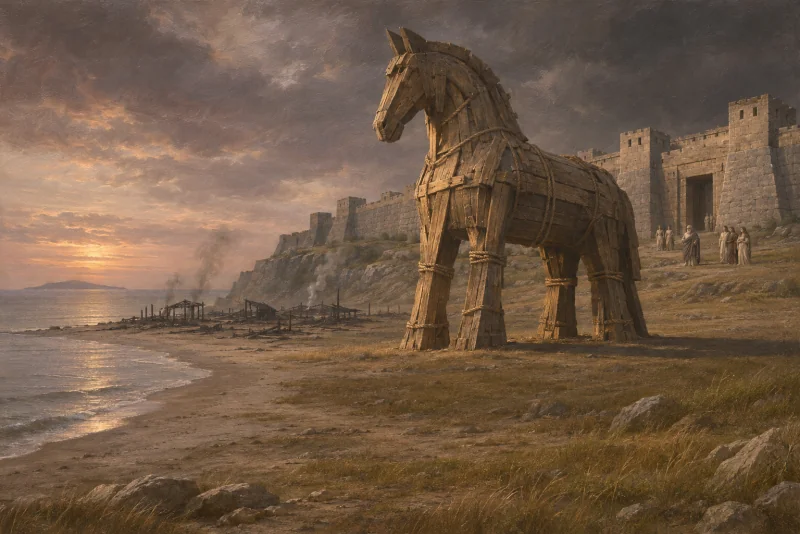
The Odyssey: Ten Years on the Way Home from Troy
Odysseus helped take Troy, then spent ten more years trying to get home. Homer is precise about why: he blinded the sea god's son, and his crew ate the cattle of the Sun.
- Type: epic poem, a hero’s long return home
- Culture: ancient Greece
- Earliest texts: Homer’s Odyssey, usually dated to the late 8th century BCE; later poems and handbooks give Odysseus other endings
- Key figures: Odysseus, Penelope, Telemachus, Athena, Poseidon, the Cyclops Polyphemus, Calypso, Circe
Every Greek king who lived through the Trojan War had to sail home, and Greek poets told how each of them fared. A poem called the Returns is known today only from a later summary and a few quotations. The Odyssey, the story of the king who took longest, survives whole.
Why did it take Odysseus ten years to get home? Homer gives specific reasons. A north wind first drove his ships off course at Cape Malea (Odyssey 9.79–81; the numbers are book and line). Then he blinded the Cyclops Polyphemus, and from that day, Zeus says, Poseidon “makes him a wanderer from his native land” (1.68–75). His crew were lost for eating the cattle of the Sun (1.6–9; book 12). And most of the years went by on land: a year with Circe (10.467–469) and seven with Calypso (7.259).
1 The Telling
This follows Homer’s Odyssey in the translation of A. T. Murray. The poem opens in the twentieth year after Odysseus left for Troy, and lets him tell the earlier years himself. Here the events are told in order.
1-1 Noman
After Troy, Odysseus raided the Cicones and lost men to them, and nearly lost more to the Lotus-eaters, whose fruit made men forget “their homeward way”. Then he came to the land of the Cyclopes, an “overweening and lawless folk” who have no assemblies and no laws.
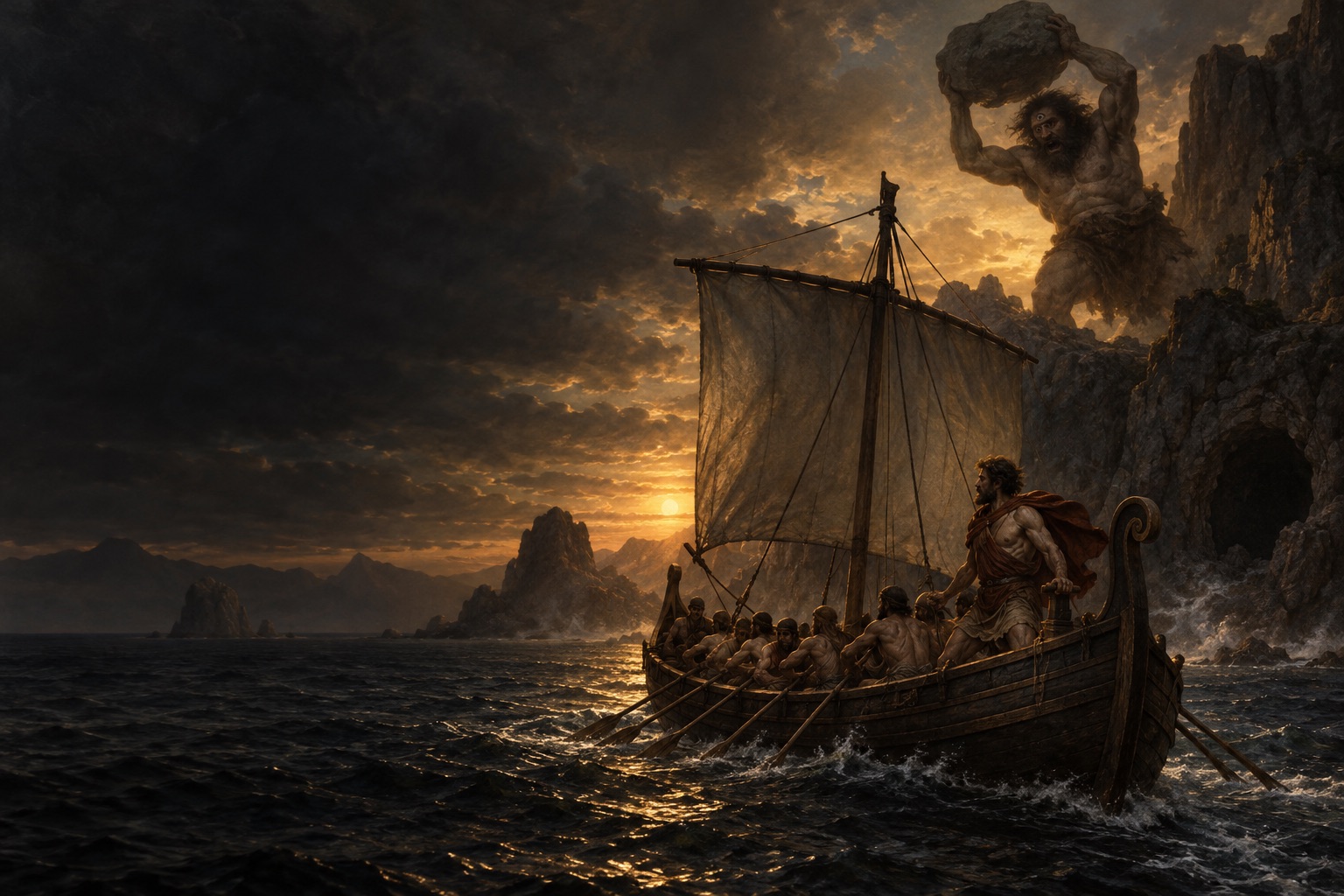
In a cave he met Polyphemus, a son of Poseidon, who shut the men in with a great stone and ate them two at a time. Odysseus made him drunk on strong wine and told him his name was “Noman” (in Greek, Outis). While the giant slept, the men drove a glowing stake of olive wood into his one eye. When the other Cyclopes came running at his cries, he shouted that “Noman” was killing him, and they went home.
In the morning the blind giant felt along the backs of his sheep as they went out to graze. The men hung beneath their bellies, and Odysseus clung under the largest ram.
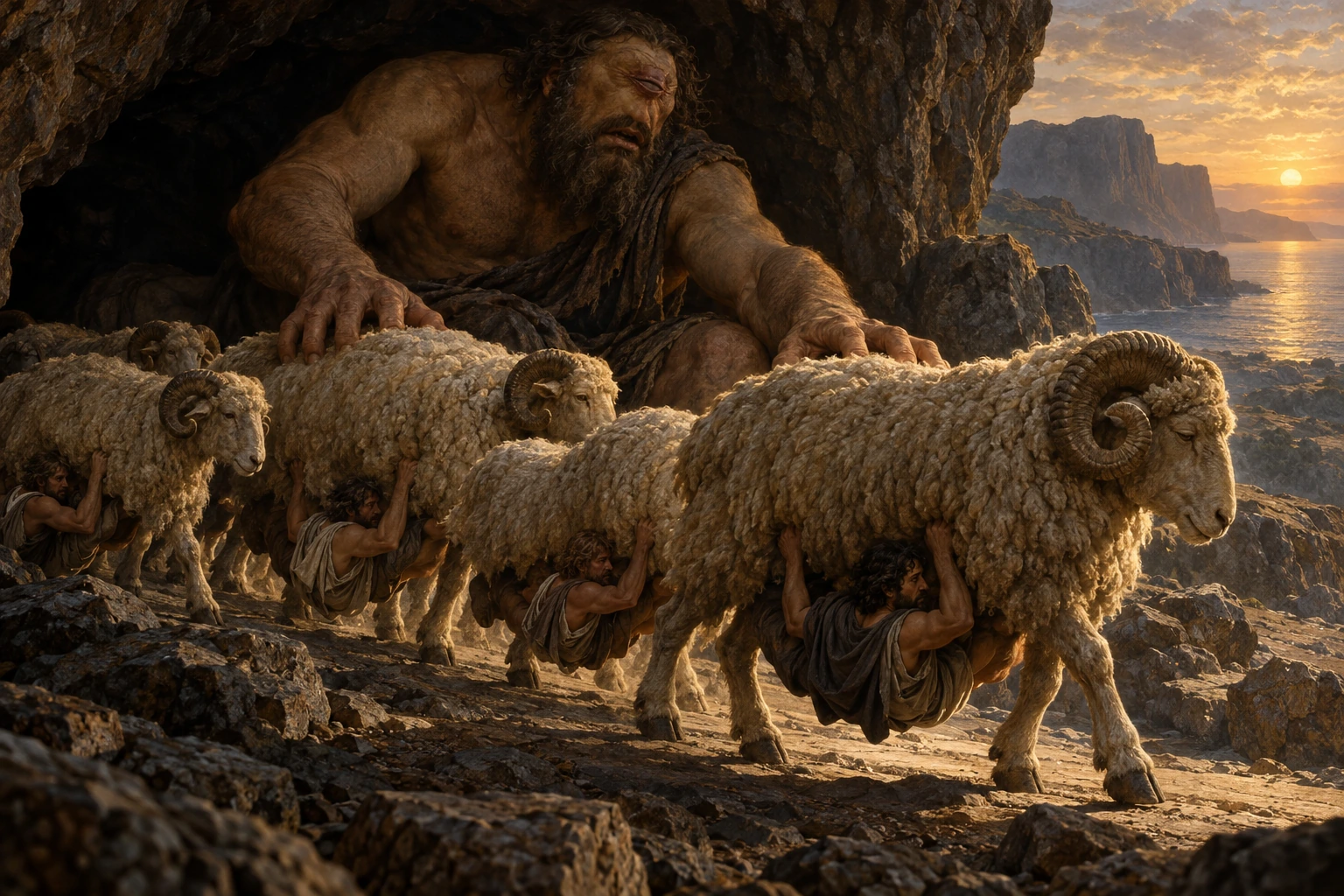
From his ship Odysseus could not resist shouting his real name. Polyphemus prayed to his father that Odysseus might never reach home, or reach it “late”, “after losing all his comrades, in a ship that is another’s” (9.526–536). Then he hurled a rock after the ship. “The dark-haired god heard him.”
1-2 Winds, a Witch and the Dead
Aeolus, keeper of the winds, gave Odysseus the stormy winds tied up in an oxhide bag. On the tenth day at sea the men could see the fires of Ithaca. Odysseus fell asleep, his crew opened the bag in search of gold, and the winds blew them all the way back to Aeolus’s island. Next the Laestrygonians, “not like men but like the Giants”, destroyed every ship but his.
On the island of Aeaea, the goddess Circe, sister of King Aeetes, turned the men he sent to her house into swine. The god Hermes gave Odysseus a herb the gods call moly, and with it he made her free them. They stayed with her a full year, until his own men reminded him of home.
Circe sent him to the house of Hades to consult the dead seer Teiresias. The seer said the Earth-shaker was “angered that thou didst blind his dear son”, and warned him to leave the cattle of Helios unharmed. After killing the suitors he must walk inland with an oar until someone took it for a winnowing fan. Death would come “far from the sea”, gently, in old age (11.100–137).
1-3 The Sirens and the Cattle of the Sun
Circe warned him of the Sirens, who sit in a meadow by a heap of bones and sing men to their deaths. Odysseus stopped his crew’s ears with wax and had himself bound to the mast. The Sirens promised him knowledge of everything at Troy and “all things that come to pass upon the fruitful earth”. He begged to be freed, and his men only tied him tighter.
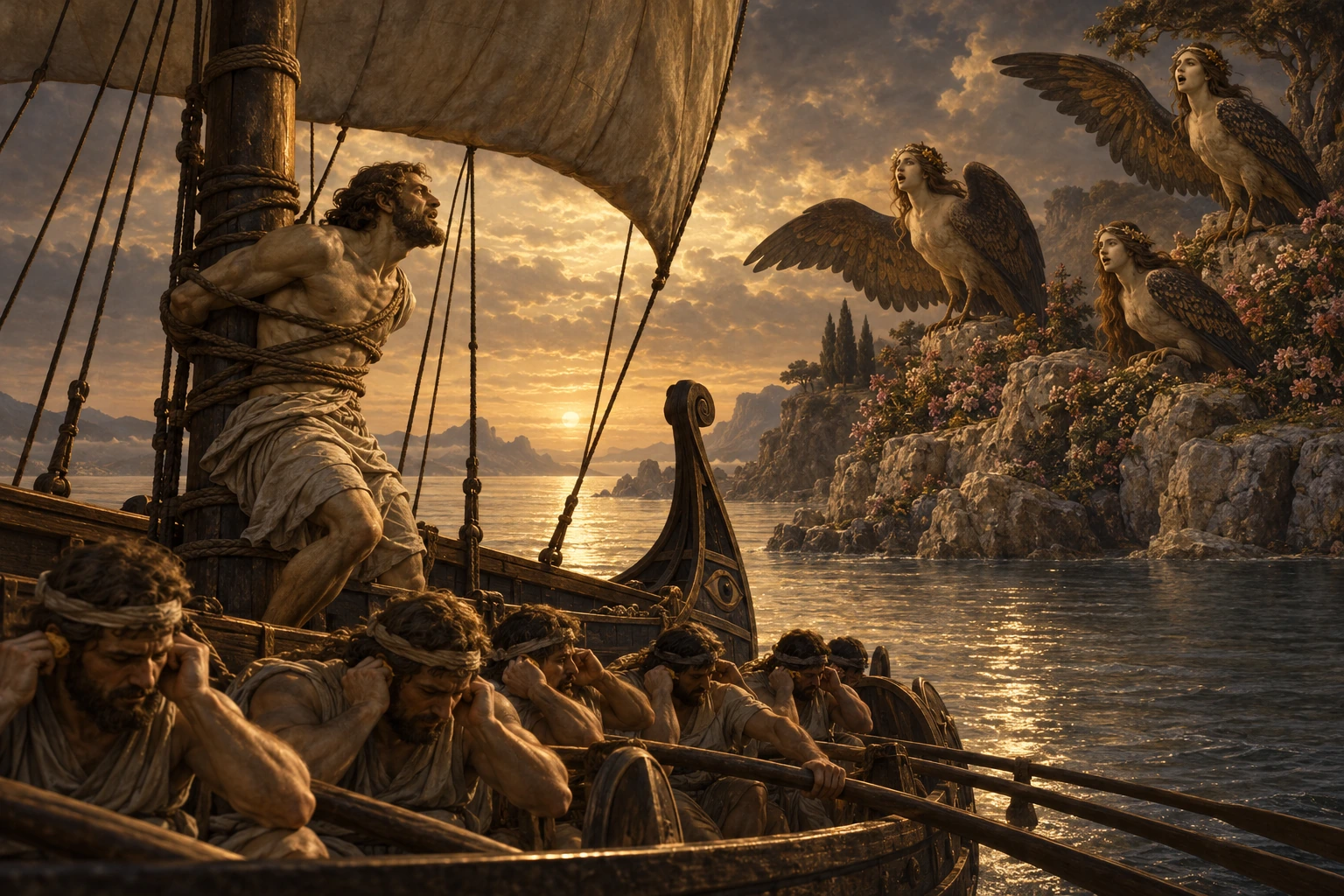
As they passed between the whirlpool Charybdis and the monster Scylla, Scylla snatched six of his best men from the deck. Then they reached Thrinacia, the island of the Sun. Contrary winds kept them there a month, and when the food ran out, Eurylochus persuaded the crew to kill the best of the cattle while Odysseus slept. Helios threatened Zeus that he would go down and “shine among the dead”. When they sailed, Zeus struck the ship with a thunderbolt. Every man drowned but Odysseus, who drifted for nine days to Ogygia, the island of the nymph Calypso.
1-4 Calypso and the Phaeacians
Calypso kept him seven years and offered to make him immortal, but he refused. While Poseidon was away feasting with the Ethiopians, Athena pleaded with Zeus, and Zeus sent Hermes to order his release. Odysseus built a raft and sailed for seventeen days. On the eighteenth Poseidon saw him and wrecked the raft. The sea goddess Ino gave him her veil, and after two days and nights in the water he crawled ashore on Scheria, land of the Phaeacians.
The princess Nausicaa found him, and King Alcinous made him welcome. At the king’s table Odysseus told the whole story of his wanderings. The Phaeacians carried him home to Ithaca while he slept. Poseidon took his revenge on them: as their ship came back, he turned it to stone in sight of their city.
1-5 The Beggar in His Own House
Athena changed Odysseus into a ragged old beggar. In his house more than a hundred young nobles were wooing his wife Penelope and eating up his wealth. For three years she had held them off by weaving a shroud for Odysseus’s father by day and unpicking it by night, until a maid gave her away (2.93–110). Their son Telemachus had sailed to Pylos and Sparta for news of his father. He came home, and Odysseus revealed himself to him alone: “I am come in the twentieth year to my native land” (16.206).
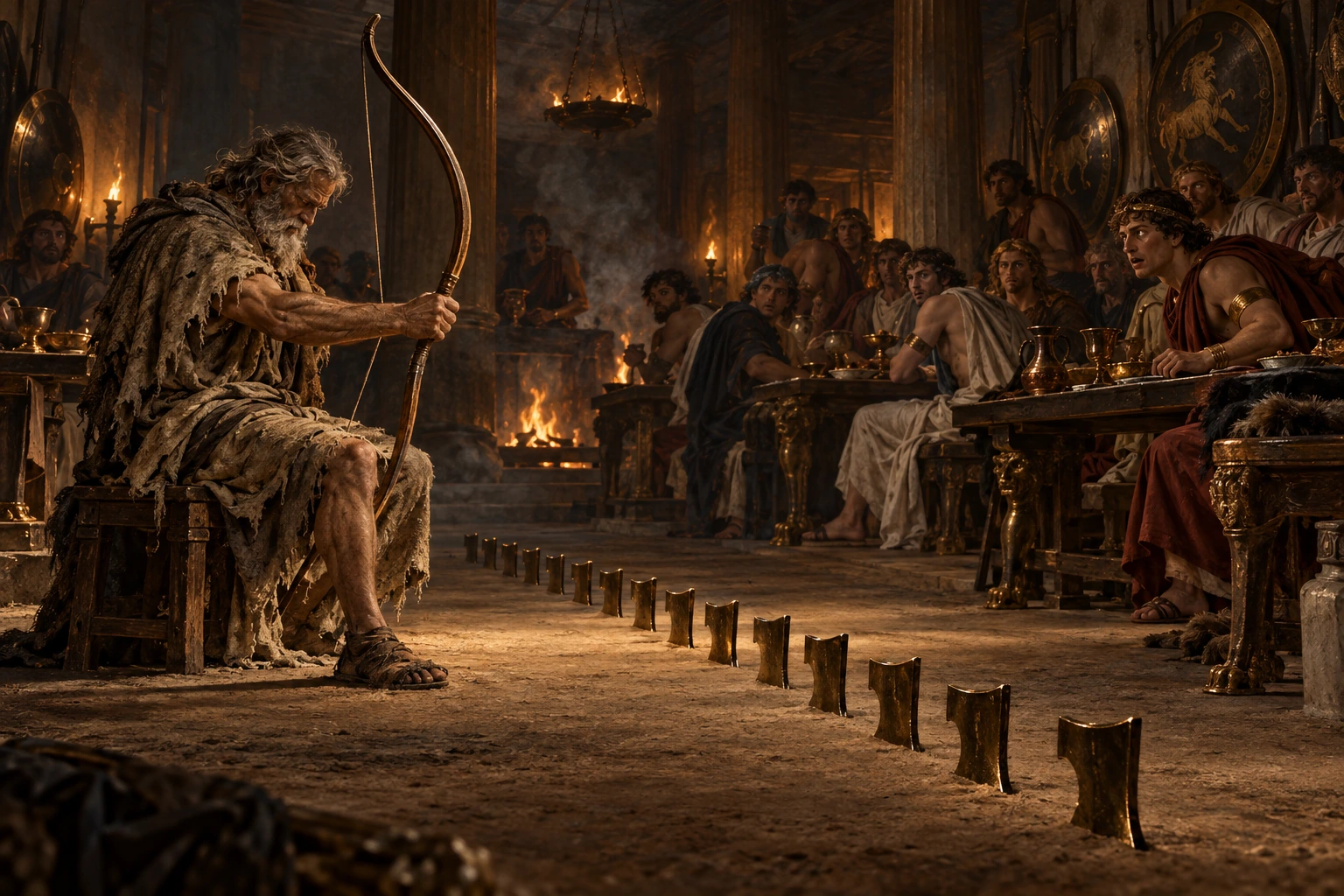
At the palace his old dog Argos knew him, wagged his tail and died. His nurse Eurycleia recognized a boar scar on his leg as she washed his feet. Then Penelope announced a contest. She would marry the man who could string Odysseus’s bow and shoot an arrow through twelve axes set up in a line (19.572–581).
None of the suitors could string the bow. The beggar strung it as easily as a singer strings a lyre, and the string sang “like to a swallow in tone”. He shot through all twelve axes, threw off his rags, and with Telemachus and two loyal herdsmen killed the suitors, beginning with Antinous.
1-6 The Bed
Penelope still tested him. She ordered the nurse to carry his bed outside the bedroom. Odysseus burst out that no one could move it: he had made it himself from the trunk of a living olive tree, and built the room around it. At this sign she knew him, and ran into his arms. The next day he found his old father Laertes. When the suitors’ families came to fight, Athena called out to stop the war, and Zeus hurled a thunderbolt to end it.
2 Where the Story Is Written Down
- Homer’s Odyssey. Twenty-four books, about 12,000 lines of hexameter verse. A Japanese reference, the Nipponica encyclopedia, gives the dating “close to the accepted view” today: the Iliad around 750 BCE, the Odyssey somewhat later, at the end of the 8th century. The poems lived orally first and were probably fixed in writing around the 6th century BCE. The division into twenty-four books, numbered by the letters of the Greek alphabet, has come down from the Alexandrian period.
- The shape of the poem. Books 1–4 follow Telemachus to Pylos and Sparta. Books 5–8 bring Odysseus from Calypso’s island to the Phaeacians. In books 9–12 Odysseus tells his own story at King Alcinous’s table: the Cyclops, Circe, the dead, the Sirens. Books 13–24 take place on Ithaca. Most of the famous adventures are reported by Odysseus himself.
- The Telegony. A poem in two books by Eugammon of Cyrene, who was active, according to Evelyn-White, around 568 BCE. It told what happened after the Odyssey, and survives only in a summary by Proclus (section 3).
- Later handbooks. The Library attributed to Apollodorus and the guidebook of Pausanias record other endings for Odysseus and Penelope.
- In Japanese and Vietnamese. Matsudaira Chiaki’s Japanese translation is in Iwanami Bunko (1994). In Vietnamese, Phan Thị Miến’s translation, Ôđyxê, was published by Văn học in Hanoi (2nd printing, 1983).
3 Competing Versions
- Whose anger? The poem knows a general anger too. The bard Phemius sings of “the woeful return from Troy which Pallas Athena laid upon” the Greeks (1.325–327), and Nestor says many died “through the fell wrath” of Athena (3.130–135). Hermes even folds Odysseus’s last shipwreck into that story: “they sinned against Athena, and she sent upon them an evil wind” (5.105–111). But Zeus (1.68–75) and Teiresias (11.100–103) name Poseidon’s grudge over Polyphemus, and in Odysseus’s own account Zeus sinks his last ship for Helios (12.374–419). For Odysseus himself, Athena is a helper throughout.
- How many Sirens, and what did they look like? Homer never describes their bodies, only their voices and their meadow. He speaks of them in the Greek dual form, meant for exactly two: “the two Sirens” (12.52, 12.167), “the voice of us two” (12.185). The handbook of Apollodorus names three, Pisinoe, Aglaope and Thelxiepia, and says “from the thighs they had the forms of birds” (Epitome 7.18–19). Greek vase painters showed them as birds with women’s heads or upper bodies.
- How did Odysseus die? Teiresias promises a gentle death in old age. The Greek words ex halos (11.134) can mean “away from the sea”, as Murray translates, or “from the sea”. In Proclus’s summary of the Telegony, Telegonus, Odysseus’s son by Circe, lands on Ithaca and kills his father unknowingly. Then Telegonus marries Penelope, and Telemachus marries Circe. Apollodorus adds that the spear was tipped with a stingray’s spine, and his translator J. G. Frazer reads the prophecy of a death “from the sea” as foreshadowing it. Apollodorus also reports another tradition, in which Odysseus was exiled and “died in old age” in Aetolia (Epitome 7.36–40).
- Was Penelope faithful? In Homer, yes. But Pausanias describes a mound near Mantineia in Arcadia said to be her grave. The local story was that Odysseus convicted her of “bringing paramours to his home” and drove her out (8.12.5–6). Apollodorus gives two more versions: Odysseus sent her back to her father over the suitor Antinous, and she bore the god Pan to Hermes; or he killed her over the suitor Amphinomus (Epitome 7.38–39).
- Did he stay home? In Homer, Teiresias has already told him he must set out again with an oar. In Dante’s Inferno (canto 26), Ulysses never goes home at all. Leaving Circe, he says, neither his son nor his old father nor Penelope could hold him back. He sailed west past the Pillars of Hercules, and his ship went down in sight of a mountain higher than any he had seen.
4 History and Tradition
- Who was Homer? No one knows. In 1795 the German scholar F. A. Wolf argued that poems this long could not have been composed without writing, and so were not the work of one man. Scholars then long argued over which parts were “genuine”. In the 1930s, Milman Parry showed that the poems are built from the formulas of oral poetry, and his successor Albert Lord showed by fieldwork in Yugoslavia that singers can compose long epics without writing. Whether the same poet made the Iliad and the Odyssey is still debated. Nipponica says the view that they did not now prevails, while Heibonsha’s World Encyclopedia says the case against one poet has never outweighed ancient tradition.
- Where was Ithaca? Odysseus describes his home as lying “furthest toward the gloom”, that is, the west, among the isles of Dulichium, Same and Zacynthus (9.21–26). Modern Ithaki is usually assumed. In Odysseus Unbound (Cambridge University Press, 2005), Robert Bittlestone, with the classicist James Diggle and the geologist John Underhill, proposed Paliki, the western peninsula of Kefalonia. A 2026 University of Aberdeen release reports that the geology shows Paliki was not an island in the Late Bronze Age. Diggle argues that Homer never calls Ithaca an island anyway, and both still hold that Paliki was Homer’s Ithaca. The release itself calls the question “one of the great unsolved mysteries of Homeric study”.
- The Cyclops is a folktale. The Aarne–Thompson catalogue of international folktales lists the story as type 1137, “The Ogre Blinded (Polyphemus)”. A Dutch lexicon of folktales finds it told orally from Iceland to the Caucasus, and a related tale in the third voyage of Sindbad. When a version has the “Noman” trick, it usually depends on Homer.
- Yuriwaka in Japan. In the Muromachi-period ballad drama Yuriwaka Daijin (幸若舞「百合若大臣」), a general returning from victory over the Mongols is abandoned on an island by his retainers. He comes home unrecognized, reveals himself by drawing a great iron bow, and takes revenge. In an essay dated January 1906, “The Origin of the Yuriwaka Legend”, Tsubouchi Shōyō argued that the story derives from Homer. He noticed how closely it resembled the Odyssey, and that Odysseus’s Latin name is Ulysses. Heibonsha’s encyclopedia notes that the theory has never been proven.
Sirens are often imagined as mermaids. Homer gives them no bodies at all, only their song and their meadow of bones. Greek vase painters gave them the bodies of birds.
5 Related Stories
- Medusa: The Gorgon Whose Story Kept Changing: Odysseus leaves the land of the dead in “pale fear”, afraid that Persephone will send up “the head of the Gorgon, that awful monster” (11.633–635).
- Jason and the Argonauts: The Voyage for the Golden Fleece: Circe tells Odysseus that only one ship has ever passed the Planctae, rocks that wreck every ship that comes near: “Argo famed of all, on her voyage from Aeetes”, which Hera saved for Jason’s sake (12.69–72). Circe herself is the sister of that same Aeetes (10.135–139).
- Zeus: The Youngest Son Who Became King of the Gods: the poem opens with Zeus complaining that mortals “blame the gods” for troubles they bring on themselves (1.32–34). It is also Zeus who sinks the last ship for Helios.
- Mount Olympus: The Real Mountain Where the Gods Lived: the Odyssey describes Olympus as a place no weather reaches. It is never shaken by winds, “nor ever wet with rain, nor does snow fall upon it” (6.41–46).
- Gilgamesh: The King Who Tried to Escape Death: Yajima Fumio writes that comparative literature has discussed the Mesopotamian epic’s relation to the Odyssey. Gilgamesh, too, crosses the sea to the edge of the world and comes home changed.
6 Sources
- Homer, Odyssey, trans. A. T. Murray (Loeb, 1919), with the Greek text: Perseus, Perseus (Greek)
- Proclus, Chrestomathia, summaries of the Returns and the Telegony, in Hesiod, the Homeric Hymns, and Homerica, trans. Hugh G. Evelyn-White (1914): Project Gutenberg
- Apollodorus, Library, Epitome 7.18–19 and 7.36–40, trans. J. G. Frazer (1921), with Frazer’s notes: Perseus
- Pausanias, Description of Greece 8.12.5–6, trans. W. H. S. Jones and H. A. Ormerod: Perseus
- Dante, Inferno, canto 26, trans. Henry Wadsworth Longfellow: Project Gutenberg
- Tsubouchi Shōyō, 「百合若伝説の本源」, in 『文芸瑣談』 (Shun’yōdō, 1907), pp. 232–240: National Diet Library
- “オデュッセイア”, “ホメロス” and “百合若大臣”, in Nipponica and Heibonsha’s World Encyclopedia: Kotobank, Kotobank, Kotobank
- A. J. Dekker, J. van der Kooi and Theo Meder, “Polyphemus, de eenogige reus”, in Van Aladdin tot Zwaan kleef aan (1997): DBNL
- University of Aberdeen, “Homer’s Ithaca - the homeland of Odysseus - was not an island” (1 July 2026): abdn.ac.uk
- “Seirenes”, on the Sirens in Greek literature and art: Theoi
- Matsudaira Chiaki’s translation (Iwanami Bunko, 1994): NDL Search; Phan Thị Miến’s translation (Văn học, 1983): Hanoi University of Culture library
Cover and illustrations: AI-generated images made for Arcana. They are interpretations, not historical artworks.