Jason and the Argonauts: The Voyage for the Golden Fleece
Jason sailed to the far end of the Black Sea for a fleece of gold, and Medea, the king's daughter, helped him take it. The Odyssey already calls his ship "famed of all", and later tellers kept changing it, down to who killed Medea's children.
- Type: heroic legend, a sea voyage and a quest
- Culture: ancient Greece; the story runs from Iolcus in Thessaly to Colchis, at the eastern end of the Black Sea
- Earliest texts: Homer’s Odyssey and Hesiod’s Theogony allude to it; the oldest full telling is Pindar’s Pythian 4 (462 BCE); the fullest is the Argonautica of Apollonius of Rhodes (3rd century BCE)
- Key figures: Jason, Medea, Pelias, Aeetes, Phrixus, Hera, Athena, and the ship Argo
When Circe warns Odysseus about the Wandering Rocks, she tells him that only one ship has ever come through them: “that Argo famed of all, on her voyage from Aeetes”. Homer did not need to say more. His listeners already knew who Jason was, what he had sailed to fetch, and whom he had brought back.
Did Medea really kill her children? In Euripides’ Medea, staged in Athens in 431 BCE, she does, and his version is the one that lasted. Older stories told it otherwise. Pausanias says the Corinthians stoned the two boys to death; in the Corinthian poet Eumelus, as Pausanias reports him, Medea hides each newborn in Hera’s sanctuary, hoping to make them immortal, and her hopes come to nothing. An ancient note on the play even repeats a story that Corinth paid Euripides five talents to put the blame on her.
1 The Telling
No ancient text tells the whole story by itself. This telling follows the mythographer Apollodorus, whose handbook, the Library, gives the most complete summary (1.9.1 and 1.9.16–28). Where the poets Pindar and Apollonius of Rhodes add a scene, the text says so.
1-1 The Ram with the Golden Fleece
Athamas, a king in Boeotia, had two children by Nephele, a son Phrixus and a daughter Helle. Their stepmother Ino had the seed wheat parched so that the crops failed, then persuaded the messengers sent to Delphi to report that the famine would end if Phrixus were sacrificed to Zeus. As the boy stood at the altar, Nephele snatched up both children and gave them a ram with a golden fleece, a gift from Hermes. It carried them through the sky, but over the strait between Europe and Asia Helle slipped off and drowned. The strait was called the Hellespont after her.
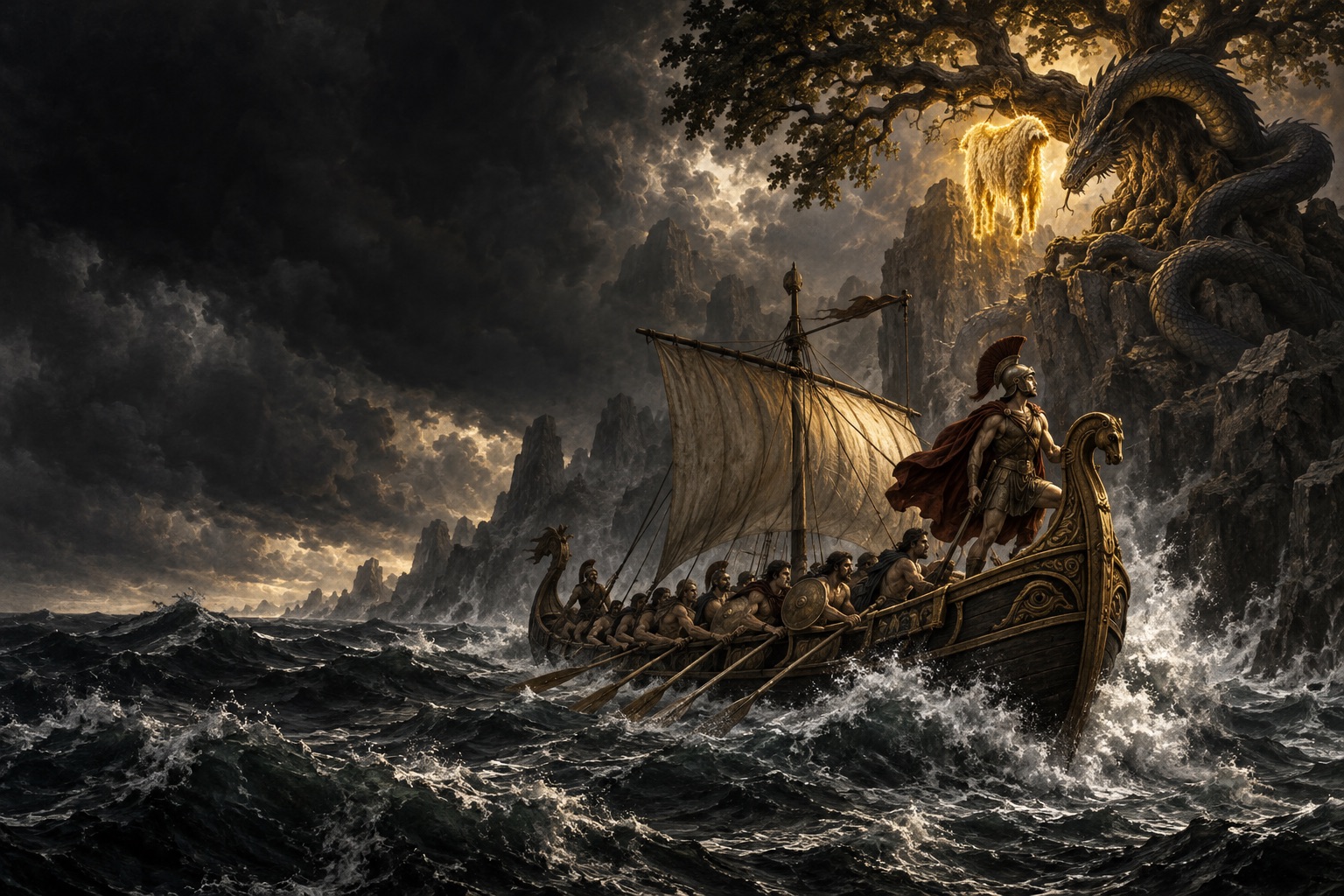
Phrixus reached Colchis, whose king Aeetes was a son of the Sun and a brother of Circe. There he sacrificed the ram to Zeus, the god of escape, and gave the fleece to Aeetes, who nailed it to an oak in a grove of Ares. A serpent that never slept kept watch over it.
1-2 The Man with One Sandal
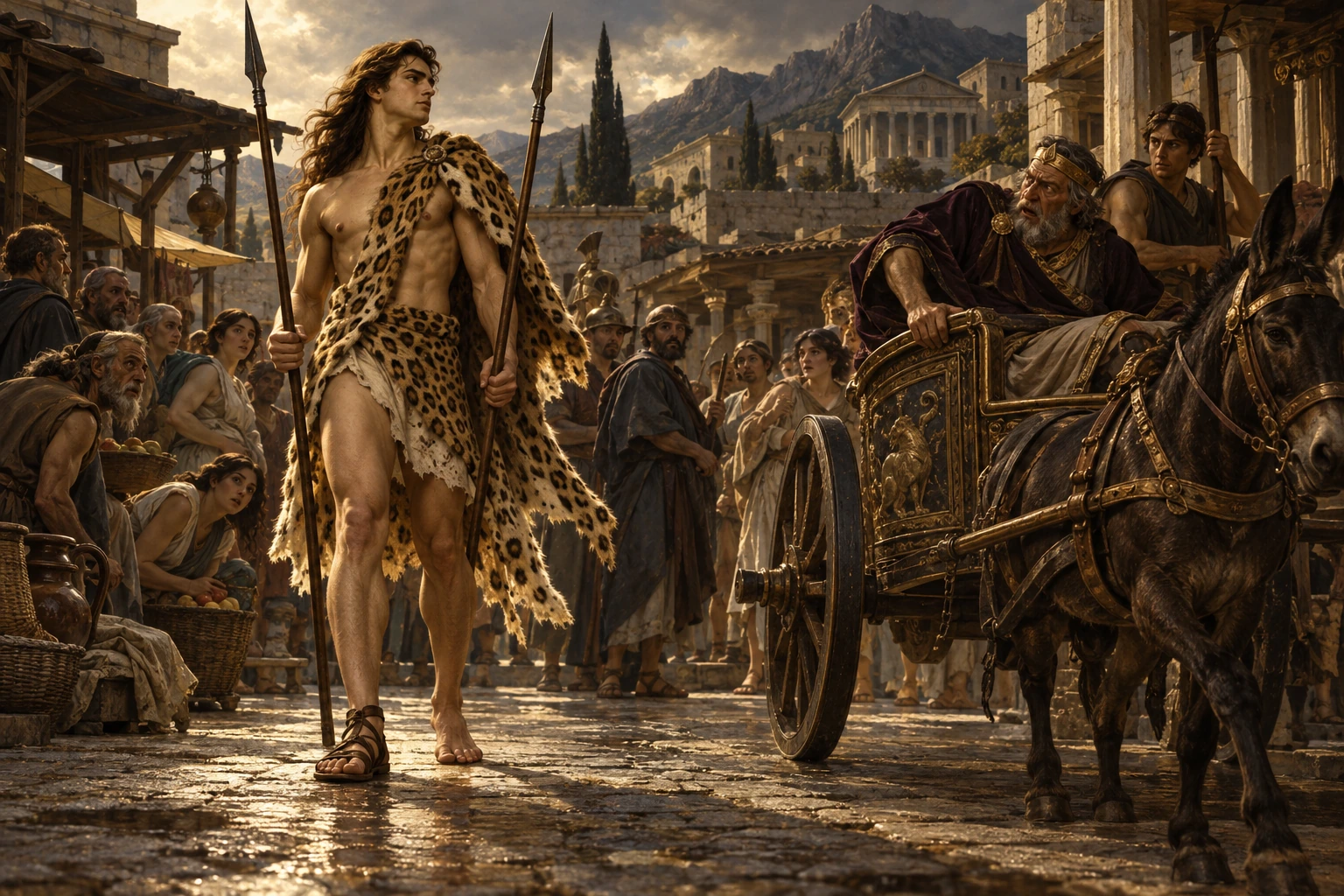
Pelias, king of Iolcus, had an oracle from Delphi: beware the man with one sandal. That man was Jason, son of Aeson, and Pindar tells how he arrived. He had been raised in the cave of the centaur Chiron, because his parents feared Pelias, who had taken Aeson’s throne. At twenty he came down from the mountains, “a hero terrible to look upon”, with two spears, the close-fitting dress of his country and a leopard skin against the rain, his long hair uncut. He went and stood in the crowded marketplace. Pelias came driving up in his mule chariot, saw the single sandal on the stranger’s right foot, and hid his fear.
Jason claimed his father’s throne. Pelias agreed to give it up, but first, he said, Jason, who was young, must go to the halls of Aeetes and bring home the spirit of Phrixus and the fleece of the ram; a dream had told him so, and Delphi had confirmed it (Pythian 4.71–167).
1-3 The Argo and the Clashing Rocks
Argus, guided by Athena, built a ship of fifty oars and named it Argo after himself; in its prow Athena set a speaking timber from the sacred oak of Dodona. Heroes came from all over Greece. Pindar says Hera kindled in them such a longing for the ship “that none should be left behind”. Apollodorus lists forty-four, including Heracles, Orpheus, Castor and Pollux, and one woman, the huntress Atalanta.
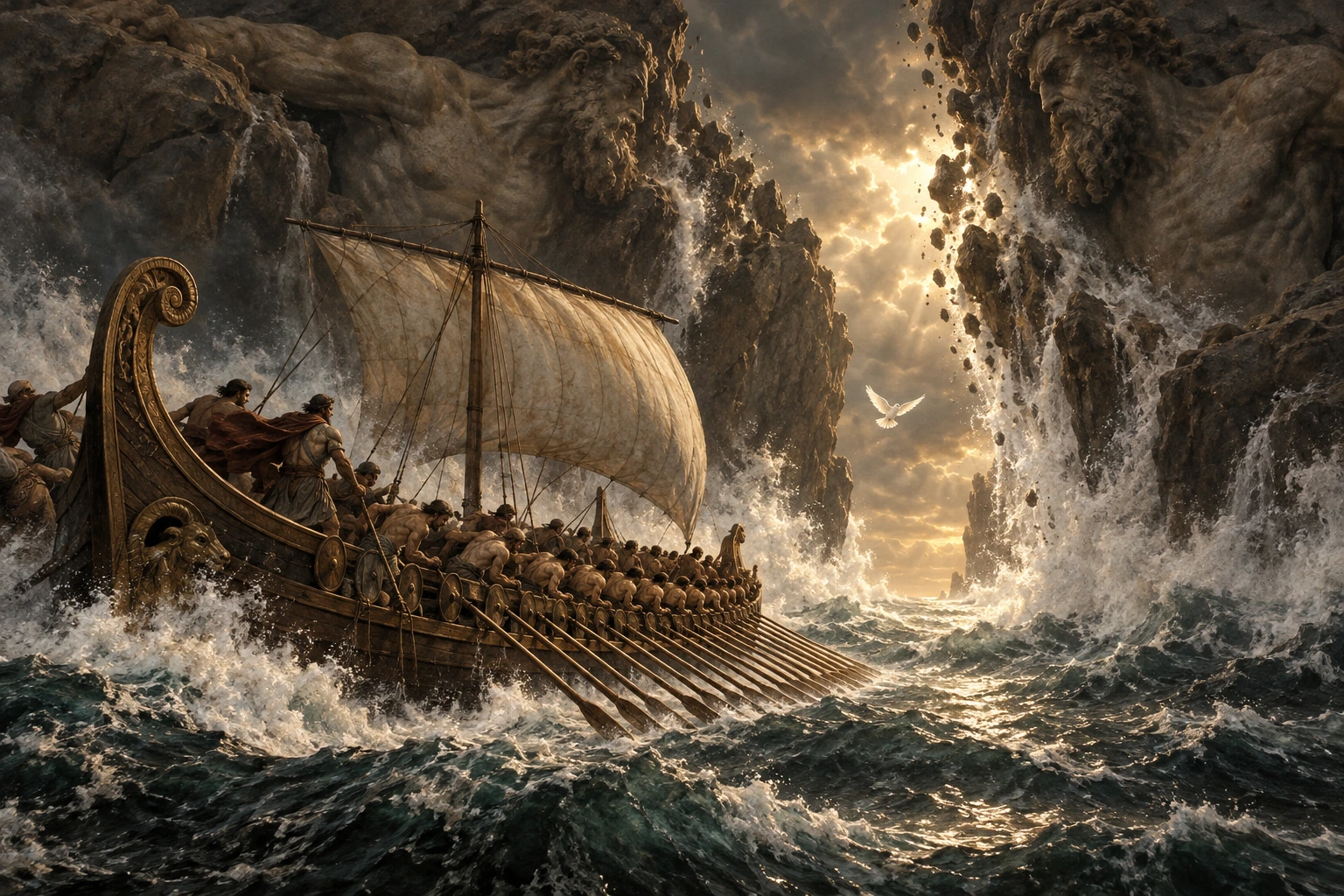
They put in at Lemnos, an island whose women had murdered their men, and Jason fathered sons there with Queen Hypsipyle. In Mysia they lost Heracles (see the note at the end of section 4). In Thrace the blind seer Phineus, freed from the Harpies by the winged sons of the North Wind, told them how to pass the Clashing Rocks, two cliffs that slammed together and closed the way into the Black Sea: send a dove through first. The dove got through with the tip of its tail nipped off. The Argo followed and lost the end of its stern ornament. From then on the rocks stood still, for it was fated that once a ship had passed between them they would come to rest. In Apollonius, Athena herself holds back one rock with her left hand and pushes the ship through with her right (Argonautica 2.549–618).
1-4 The Bulls and the Serpent
At the river Phasis, Jason asked Aeetes for the fleece. The king promised it if Jason would yoke, single-handed, two bulls with bronze feet that breathed fire, and sow dragon’s teeth. Medea, the king’s daughter, fell in love with Jason; in Pindar, Aphrodite gave him a love charm to win her. She made him swear to marry her and take her to Greece, and gave him a drug that kept fire and iron from harming him for one day. He yoked the bulls, and when armed men sprang from the sown teeth, he threw stones among them so that they fought each other, then killed them.
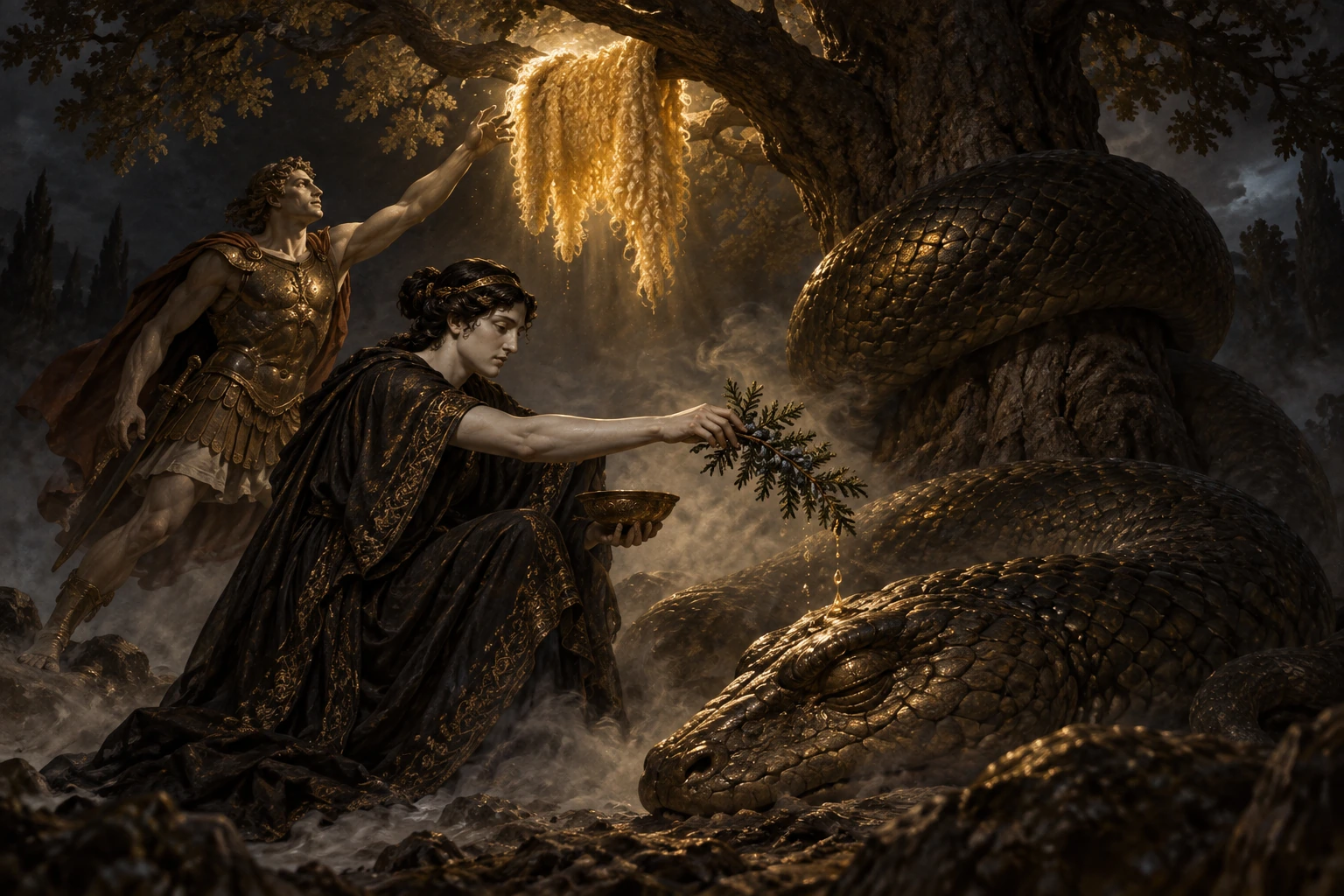
Aeetes still refused, and planned to burn the Argo. That night Medea led Jason to the fleece. Apollonius tells it at length: the serpent’s hiss echoed down the river, and mothers woke and clutched their babies. Medea sang to Sleep and called on the queen of the underworld; then, with a freshly cut sprig of juniper dipped in her brew, she sprinkled the serpent’s eyes until its jaw sank to the ground. “Hereupon Jason snatched the golden fleece from the oak” (4.123–166).
1-5 The Way Home, and Corinth
Medea had brought her young brother Apsyrtus. When Aeetes caught up with them, she killed the boy, cut him limb from limb and threw the pieces into the sea, and her father fell behind to gather them. Zeus, angered by the murder, sent a storm, and the ship itself spoke: they must go to Circe to be purified. Orpheus drowned out the Sirens with his own song; Thetis and the sea nymphs steered them past Scylla, Charybdis and the Wandering Rocks; in Corcyra, Queen Arete married Medea to Jason so that the pursuing Colchians could not take her back. Off Crete, Medea’s arts destroyed Talos, the giant of bronze. The whole voyage took four months.
In Iolcus, Pelias had driven Aeson to his death, and Jason’s mother had hanged herself. Medea took revenge for Jason. She cut up a ram, boiled it, and brought out a lamb; Pelias’s daughters believed her, and boiled their father. His son Acastus drove Jason and Medea out. They lived in Corinth for ten years, until Jason married Glauce, the daughter of King Creon. Medea sent the bride a poisoned robe that burned her and her father, killed her own sons Mermerus and Pheres, and fled to Athens in a chariot of winged dragons, a gift of the Sun. Euripides gives Jason his end: Medea foretells that he will die struck on the head by a piece of the Argo (Medea 1386–1388).
2 Where the Story Is Written Down
- Homer, Odyssey 12.59–72. The Planctae, the “Wandering” rocks, catch even the doves that carry ambrosia to Zeus. Only the Argo passed them, and only because Hera sent it through, “for that Jason was dear to her”. Circe herself is “own sister to Aeetes” (10.135–139).
- Hesiod, Theogony 992–1002. Jason “led away from Aeetes the daughter of Aeetes” after finishing the labours set him by “overbearing Pelias”, brought her to Iolcus and married her. Their son Medeus was raised by Chiron. There is no fleece in these lines and no tragedy.
- Mimnermus, an elegiac poet of the late 7th or early 6th century BCE, in lines quoted by Strabo (Geography 1.2.40): Jason brought “the great fleece from Aea”, the city of Aeetes, “where the rays of the swift Sun lie in a chamber of gold beside the lips of Oceanus”. For Mimnermus, Strabo explains, Aeetes lived in the far east, outside the inhabited world.
- Pindar, Pythian 4 (462 BCE), the oldest full narrative. It celebrates the chariot victory of Arcesilas IV, king of Cyrene, whose line went back to one of the crew, Euphemus. Pindar moves fast: of the serpent he says only that Jason killed it “by his cunning”, because he knows “a short path” (lines 247–249).
- Euripides, Medea. An ancient summary of the play dates it to the archonship of Pythodorus, 431 BCE, and records that Euripides came third that year, after Euphorion and Sophocles.
- Apollonius of Rhodes, Argonautica, an epic in four books by a scholar of 3rd-century BCE Alexandria, and the fullest telling that survives. His translator R. C. Seaton notes that Apollonius took many details from Pindar.
- Apollodorus, Library 1.9.16–28, tells the whole story in brief, often noting who told it differently; in Latin, Ovid’s Metamorphoses 7 has Medea make Aeson young again and trick the daughters of Pelias.
- The Douris cup. An Athenian red-figure cup attributed to the painter Douris and dated 500–450 BCE (Vatican, Museo Gregoriano Etrusco 16545). Inside it, a huge serpent disgorges Jason, named by an inscription, before the tree with the fleece, while Athena watches with an owl in her hand. The Theoi Project says this version comes from a lost work. No surviving text tells it.
3 Competing Versions
- Who chose the quest? In Pindar, Pelias sets it. In Apollodorus, Pelias asks Jason what he would do with a man fated to kill him, and Jason, perhaps prompted by Hera, who wanted Medea to be the ruin of Pelias, answers that he would send him for the Golden Fleece (1.9.16).
- Why one sandal? Pindar gives no reason. In Apollonius and Apollodorus, Jason lost it crossing the river Anauros (Argonautica 1.5–17; Library 1.9.16). Apollonius adds that Hera, disguised as an old woman, had been waiting at the flooded river, and Jason carried her across on his shoulders. That is why she loved him (3.55–75).
- Which rocks? Homer’s Argo passes the Planctae “on her voyage from Aeetes”, on the way home. Pindar’s clashing rocks are on the way out, and the Argo’s passage stops them for good (207–211). Apollonius and Apollodorus have both: the Clashing Rocks going out, the Wandering Rocks by Scylla and Charybdis coming back (Argonautica 4.922 ff.; Library 1.9.25).
- Killed or lulled? In Pindar, Jason kills the serpent. In Apollonius and Apollodorus, Medea puts it to sleep. The Douris cup shows a third story.
- Apsyrtus. In Apollodorus he is a child, cut up on board. In Apollonius he is a grown man leading the pursuit. Medea lures him to a temple of Artemis, veils her eyes, and Jason cuts him down “as a butcher strikes down a mighty strong-horned bull” (4.452–481).
- The way home. Pindar: into Ocean, then the Red Sea, the ship carried for twelve days across the Libyan desert, and Lemnos on the way back (25–27, 251–252); Apollonius and Apollodorus put Lemnos on the way out. Apollonius: up the Ister (the Danube) and through the rivers Eridanus and Rhodanus to Circe in the west, and later the same twelve days across Libya (4.1380–1392).
- Aeson. Apollodorus: Pelias drove him to drink bull’s blood and die (1.9.27). Ovid: Medea drained his old blood and filled his veins with her brew, and he was again as he had been “years four times ten before” (7.159–293). The lost epic Nostoi, quoted in the ancient summary of Euripides’ Medea, already told of the rejuvenation.
- Medea’s children. Pausanias: the Corinthians stoned them for bringing the poisoned gifts (2.3.6). Eumelus, as Pausanias reports him: Medea hid each newborn in Hera’s sanctuary to make them immortal, in vain (2.3.11). Ancient notes on Euripides cite Creophylus, for whom Creon’s relatives killed them and spread the story that Medea had, and Parmeniscus, for whom the Corinthians killed fourteen of her children at the altar of Hera Akraia. The note on line 9 reports the five-talent bribe as a story current among scholars, which Parmeniscus also told. The ancient summary of the play adds that Dicaearchus and Aristotle said Euripides took his play from one by Neophron, a tragedian of uncertain date.
- Jason’s death. Euripides: a piece of the Argo. Staphylus, in the same ancient summary: Medea urged him to sleep beneath the old ship’s stern, and it fell on him.
4 History and Tradition
- Iolcus. Near Dimini, five kilometres from Volos, a Bronze Age township with a palace has been “tentatively identified with Mycenaean Iolkos, where the legendary Argonauts started off”, in the words of the Greek Ministry of Culture. It was founded in the mid-15th century BCE; its palace, built in the early 13th, burned at the end of the 13th or the start of the 12th. A Mycenaean settlement nearby, at Pefkakia, may have been its port.
- The gold of Colchis. Strabo says that in his day the city of Aea was still shown on the Phasis, and that the region’s mines of gold, silver, iron and copper suggest “a reasonable motive for the expedition” (1.2.39). Since the 1930s, archaeologists at Vani, inland in today’s Georgia, have uncovered 28 burials of about 450–250 BCE, the elite dead adorned with gold jewellery, much of it made locally. And of the Soanes of the Caucasus, Strabo writes that “it is said” gold comes down their mountain torrents and is caught with perforated troughs and fleecy skins, “and that this is the origin of the myth of the golden fleece” (11.2.19).
- Medea in history. Herodotus opens his Histories with a Persian account of the quarrel between Asia and Greece: women carried off in turn, Io, Europa, then Medea, taken by Greeks who sailed “in a long ship to Aea”. When Paris took Helen, the Trojans pointed to Medea (1.2–3). His translator A. D. Godley notes: “This is the legendary cruise of the Argonauts.”
- Mourning in Corinth. Euripides’ Medea buries her sons in the sanctuary of Hera Akraia and orders a festival for all time (1378–1383). Pausanias says Corinthian children cut their hair and wore black for Medea’s sons, until Corinth was destroyed by the Romans and the new settlers dropped the custom (2.3.7).
- The Argo sails again. In May 1984 the explorer Tim Severin set out from Volos with a crew of rowers in a 54-foot replica of the Argo, built on Spetses, on a route worked out from Apollonius. The newspaper Georgia Today recalls that the boat reached the Georgian coast, and that the crew went up to Svaneti to see the old way of catching gold with a sheep’s hide.
Heracles is often counted among the heroes who won the fleece. In Apollonius he never reaches Colchis: the Argo sails on while he searches for the boy Hylas in Mysia, and a sea god says it is against the will of Zeus to bring him to Aeetes (1.1273–1325). Apollodorus records that Demaratus did have him sail to Colchis, and that Herodorus said he never sailed at all (1.9.19).
5 Related Stories
- The Odyssey: Ten Years on the Way Home from Troy: the Argo had already passed the rocks that Odysseus is warned about, and Circe is Aeetes’ sister: Strabo thought Homer made her so “with Medea in mind”, and named her island Aeaea after Aeetes’ city, Aea.
- Zeus: The Youngest Son Who Became King of the Gods: the fleece came from a ram sacrificed to Zeus the god of escape, and in Pindar it is Zeus whose thunder answers Jason’s prayer as the Argo sets out.
- Medusa: The Gorgon Whose Story Kept Changing: in Apollodorus, Perseus, too, names his own impossible errand in front of a king who wants him out of the way, and Athena guides him. We link the two for this shared pattern.
- La Llorona: The Woman Who Weeps for Her Children: in Mexico, a mother who drowns her children when their father leaves her. The folklorist Bacil Kirtley, as Winick reports, pointed out the resemblance to the myth of Medea.
- Heracles: The Twelve Labours and the Pyre on Mount Oeta: the hero the Argo left behind in Mysia, as the note above tells. His labours, his death on Mount Oeta and his place among the gods are told there.
6 Sources
- Homer, Odyssey 10.135–139 and 12.59–72, trans. A. T. Murray (Loeb, 1919): Perseus
- Hesiod, Theogony 992–1002, trans. Hugh G. Evelyn-White (Loeb, 1914): Perseus
- Pindar, Pythian 4, trans. Sir John Sandys (Loeb, 1915): archive.org; Greek text with line numbers: Perseus
- Euripides, Medea, trans. David Kovacs: Perseus; the ancient summaries and scholia (ed. E. Schwartz), trans. Celia Luschnig: Diotíma
- Apollonius of Rhodes, Argonautica, trans. R. C. Seaton (1912): Theoi, Project Gutenberg
- Apollodorus, Library 1.9.1, 1.9.16–28 and 2.4.2, trans. Sir James George Frazer (Loeb, 1921): Perseus, Theoi
- Ovid, Metamorphoses 7.159–397, trans. Brookes More (1922): Perseus
- Pausanias, Description of Greece 2.3.6–11, trans. W. H. S. Jones and H. A. Ormerod (Loeb, 1918): Perseus
- Strabo, Geography 1.2.39–40 and 11.2.19, trans. Horace Leonard Jones (Loeb, 1917 and 1928): LacusCurtius, LacusCurtius
- Herodotus, Histories 1.2–3, trans. A. D. Godley (Loeb, 1920): Perseus
- Beazley Archive, vase 205162 (Vatican 16545): University of Oxford; Theoi Project, “Jason and the Dragon”: Theoi
- Hellenic Ministry of Culture and Sports, “Dimini” and “Demetrias”: odysseus.culture.gr, odysseus.culture.gr
- The Golden Graves of Ancient Vani: Getty Villa, 2009, ISAW, New York University, 2008
- The Christian Science Monitor, 18 May 1984: csmonitor.com; Georgia Today, 15 January 2021: georgiatoday.ge
- Nakatsukasa Tetsuo, “イアソン”, Nipponica: Kotobank
Cover and illustrations: AI-generated images made for Arcana. They are interpretations, not historical artworks.