Zeus: The Youngest Son Who Became King of the Gods
Kronos swallowed his children as they were born, until he was handed a stone in place of the youngest. That child, Zeus, grew up hidden on Crete and became the third king of heaven, though the Greeks never agreed on where he was hidden, or even on whether he was the youngest.
- Type: myth, the succession of the kings of heaven
- Culture: ancient Greece; Zeus was worshipped across the Greek world, from Crete to Dodona and Olympia
- Earliest texts: his name is already on Bronze Age clay tablets in the Linear B script; the oldest tellings of his rise are Hesiod’s Theogony and Homer’s Iliad, usually placed in the 8th or 7th century BCE
- Key figures: Zeus, Kronos, Rhea, Gaia (Earth), Ouranos (Heaven), the Cyclopes, the Hundred-Handers, the Titans, Typhoeus, Metis
Zeus was not the first king of the gods. In Hesiod’s account of how the world began he is the third, and he comes to power the way his father did, by overthrowing his own father. What sets him apart is that the pattern ends with him.
Was Zeus always the king of the gods? No. In Hesiod’s Theogony he is the third, after his grandfather Ouranos and his father Kronos, and he wins the throne in a war that lasts ten years. Even then he does not simply take it. Once the Titans are beaten, Hesiod says, the gods “pressed far-seeing Olympian Zeus to reign and to rule over them”, on the advice of Earth.
1 The Telling
This is the version of Hesiod, a poet of Boeotia, in his Theogony (“Birth of the Gods”). Hesiod passes over the child’s infancy in a few lines, so for the cave on Crete the details come from two later writers: the poet Callimachus (3rd century BCE) and the Library, a handbook of myths that goes under the name of Apollodorus and is usually dated to the 2nd century CE.
1-1 The Father Who Swallowed His Children
Kronos had come to power by attacking his own father. Ouranos, the Heaven, kept his children hidden away inside Earth, and Earth gave the youngest of them, Kronos, a great jagged sickle. When Ouranos came at nightfall to lie with Earth, Kronos cut off his father’s genitals and flung them away.
Kronos then married his sister Rhea, and she bore him Hestia, Demeter, Hera, Hades and Poseidon. He swallowed each one “as each came forth from the womb to his mother’s knees”, because Earth and Heaven had told him that he was destined to be overcome by his own son.
1-2 The Stone
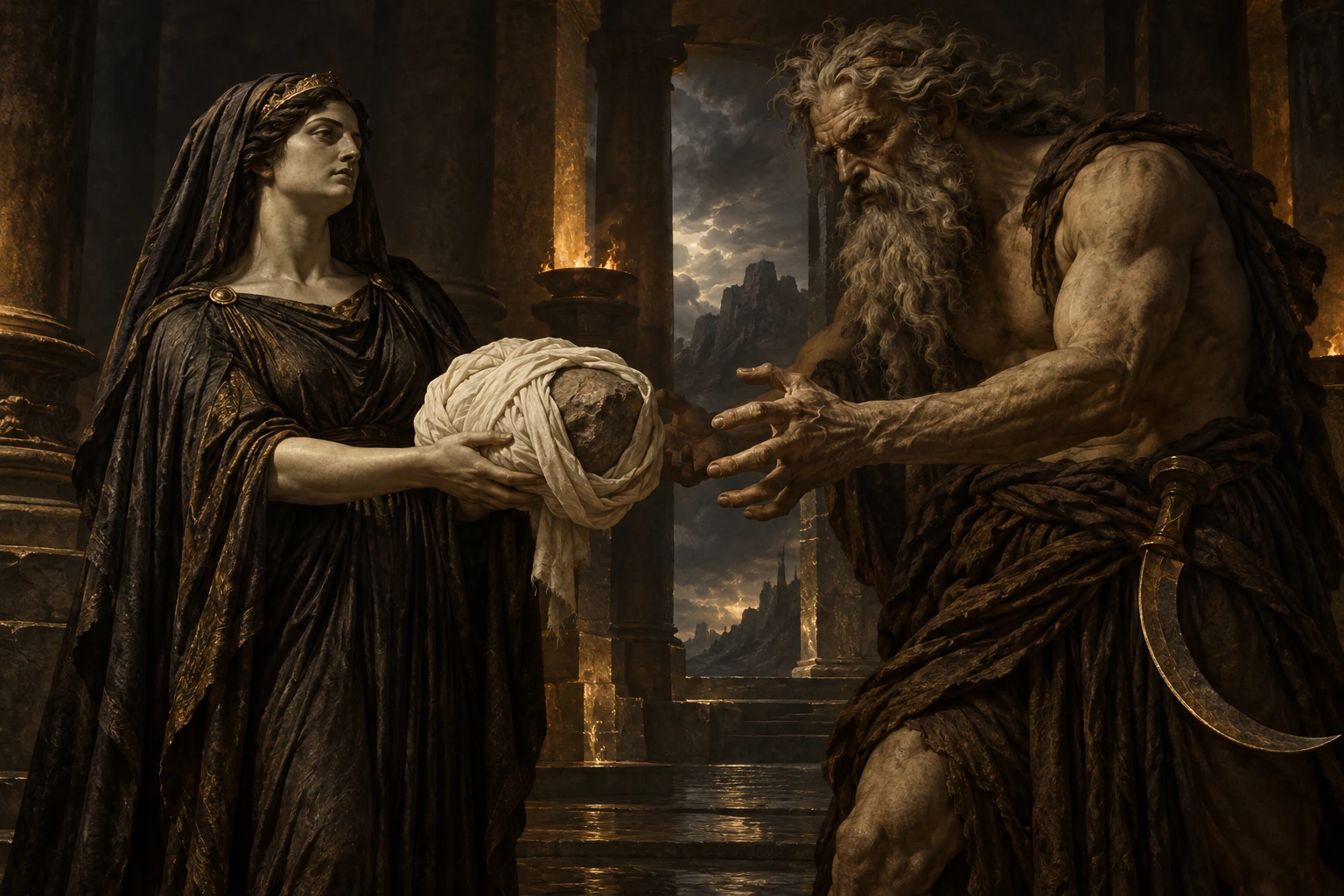
When Rhea was about to give birth to Zeus, “the youngest of her children”, she begged her parents for a plan. They sent her to Lyktos, in Crete. There Earth took the newborn and hid him “in a remote cave beneath the secret places of the holy earth on thick-wooded Mount Aegeum”.
To Kronos, “the earlier king of the gods”, a great stone wrapped in swaddling clothes was handed instead. He took it and thrust it down into his belly. He did not know that his son was left behind in its place, “unconquered and untroubled”.
1-3 The Cave
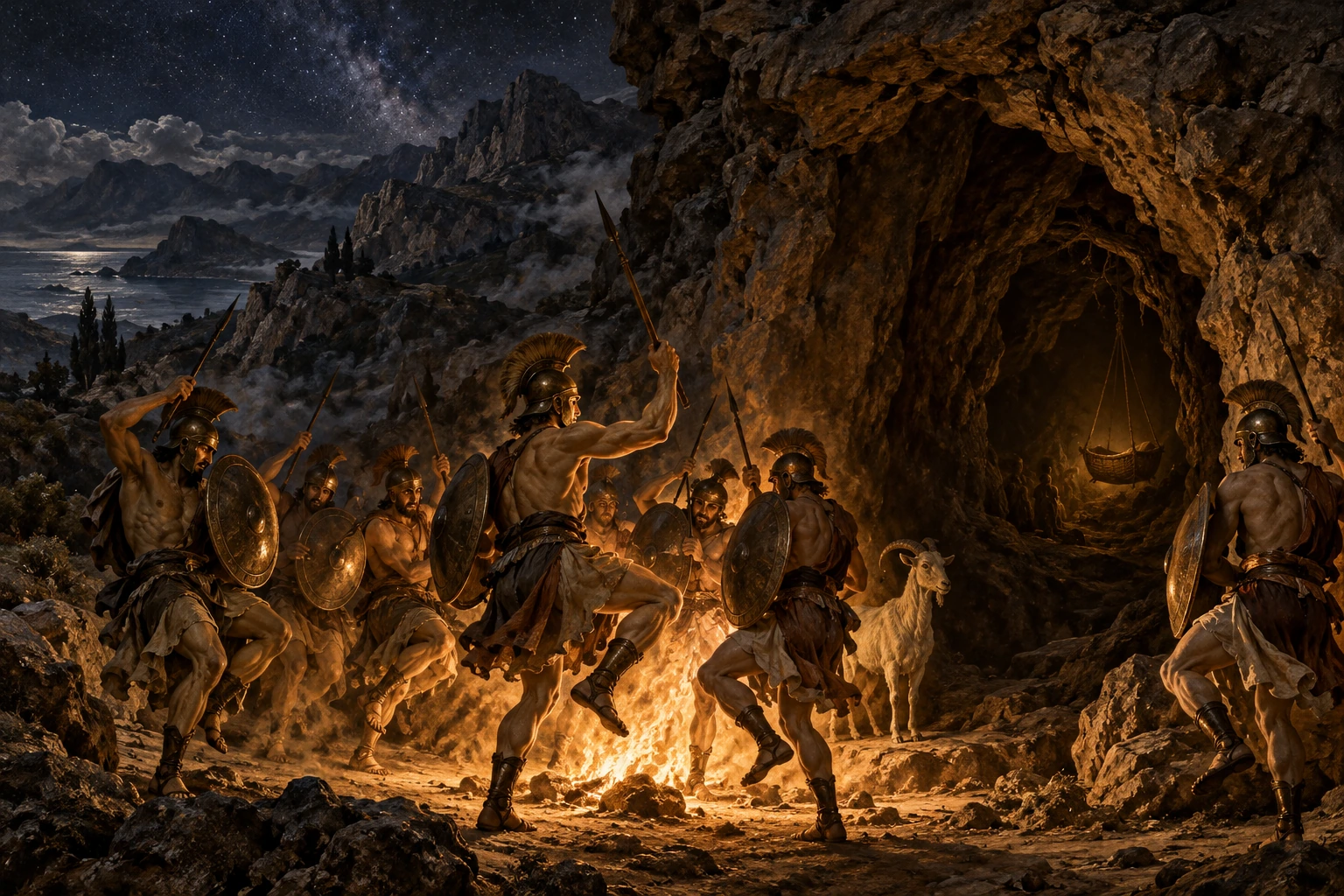
Apollodorus fills in what Hesiod leaves out. Rhea gave birth in a cave on Mount Dikte and handed the baby to the Kouretes and to two nymphs, Adrasteia and Ida, who fed him on the milk of Amaltheia. The Kouretes kept guard in arms, clashing their spears on their shields “in order that Cronus might not hear the child’s voice”.
Callimachus makes Amaltheia a she-goat and adds honey: the child also ate sweet honeycomb, for the works of the bee suddenly appeared on the hills of Ida. Adrasteia laid him in a cradle of gold, and the Kouretes danced a war-dance around him, beating their armour, so that Kronos would hear “the din of the shield, but not thine infant noise”.
1-4 The War with the Titans
Zeus grew quickly. Kronos, “beguiled by the deep suggestions of Earth”, brought his children up again, and the stone came up first. Zeus set the stone in the ground at Pytho, the old name of Delphi, below Mount Parnassus, “to be a sign thenceforth and a marvel to mortal men”.
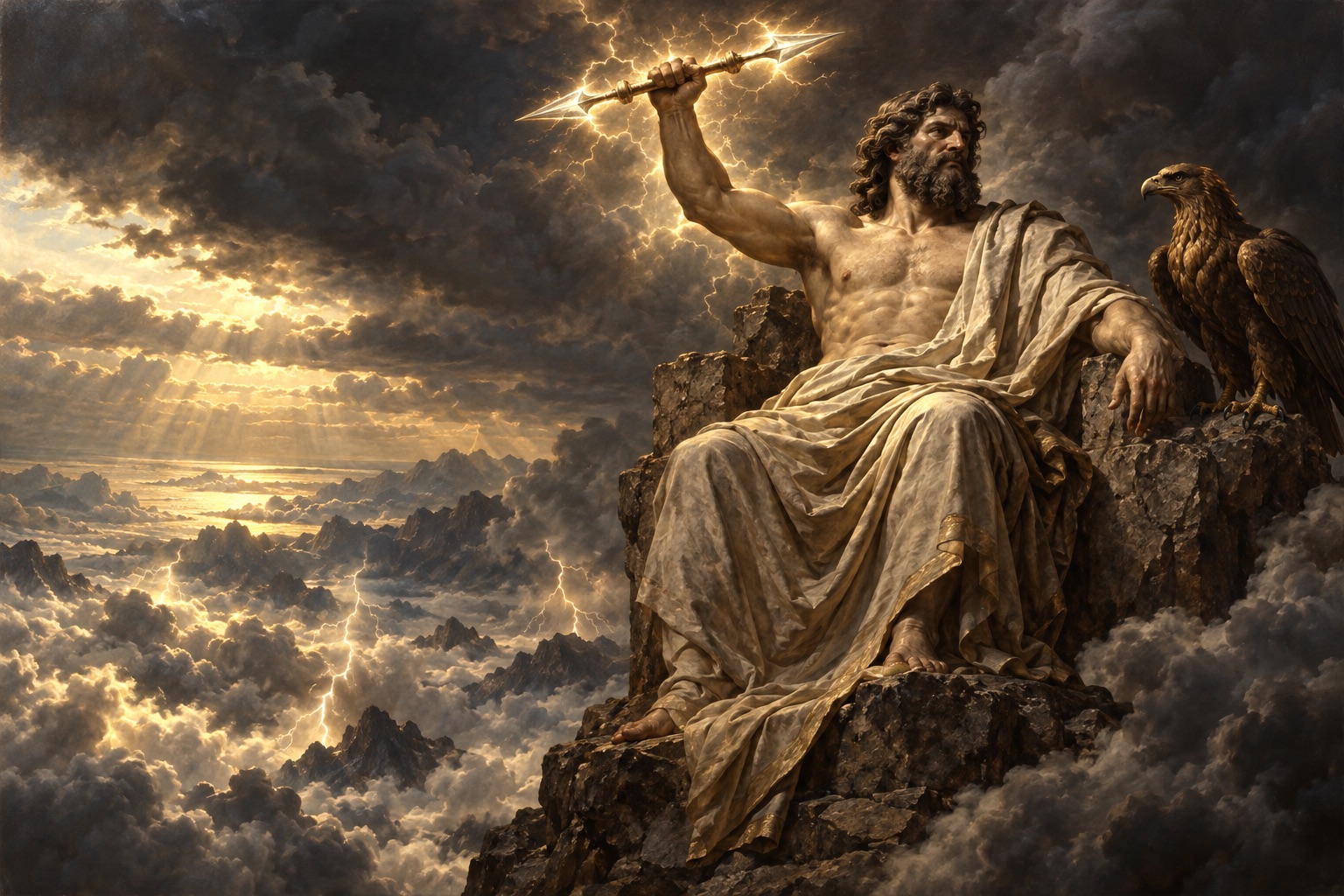
He also freed his father’s brothers, the one-eyed Cyclopes, from the bonds they had been kept in. In gratitude they gave him thunder, lightning and the thunderbolt, which Earth had kept hidden until then. From that day these were his weapons.
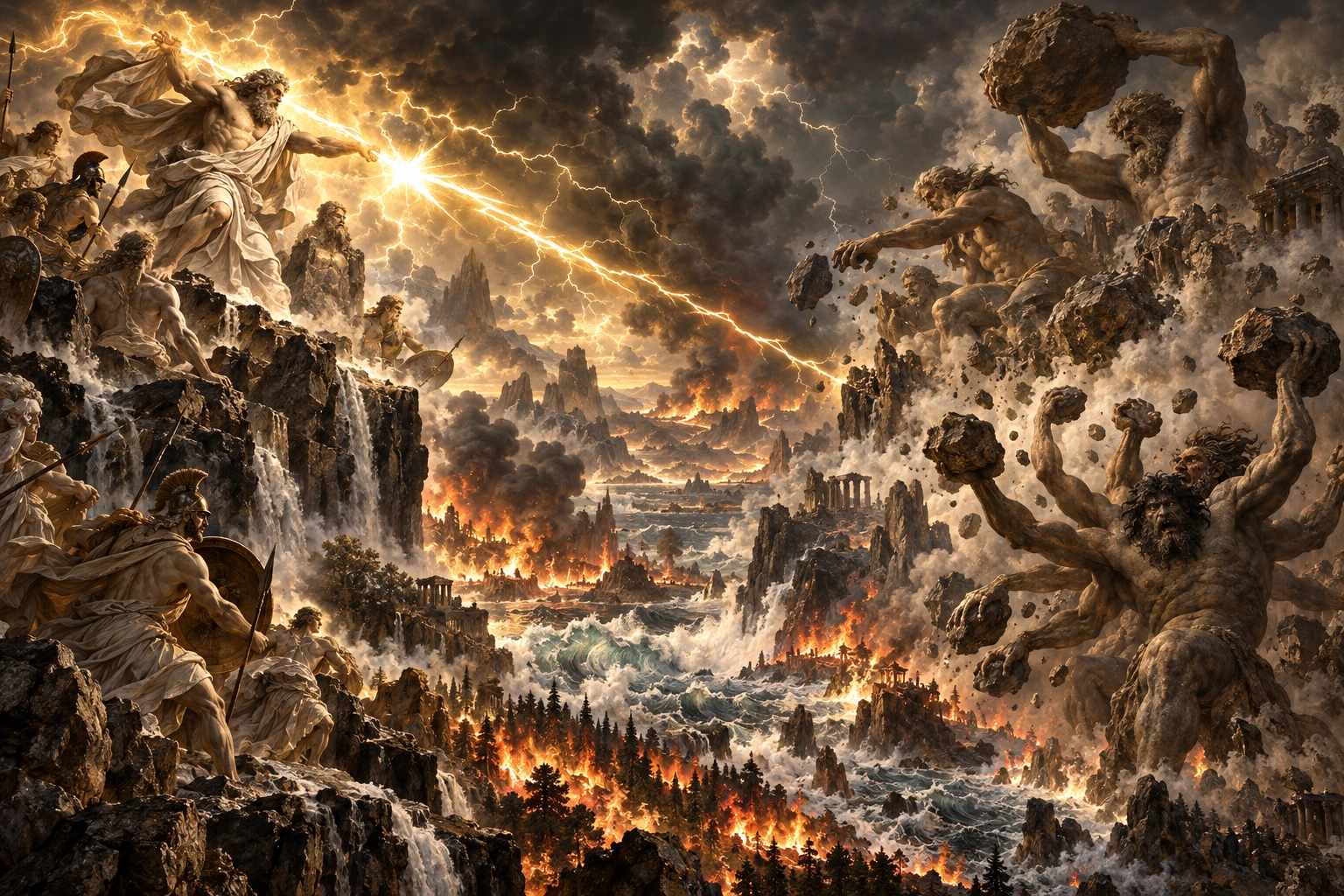
Then came the war. The Titans fought from Mount Othrys, and Zeus and his brothers and sisters from Mount Olympus. For ten full years neither side could win. On Earth’s advice Zeus brought three more sons of Heaven up from under the earth, Kottos, Briareos and Gyes, each with a hundred arms and fifty heads, and revived them with nectar and ambrosia.
Now Zeus “no longer held back his might”. He came down from Olympus hurling lightning until the land seethed and the forests crackled with fire. The Hundred-Handers launched three hundred rocks, one after another, buried the Titans under them and chained them in Tartarus. Tartarus lies as far below the earth as the sky is above it: a bronze anvil, says Hesiod, would fall for nine days and nights and reach it on the tenth.
1-5 The Last Challengers
Earth bore one more child, the monster Typhoeus, with a hundred snake heads and voices that bellowed like bulls and roared like lions. He would have come to reign over gods and men, Hesiod says, “had not the father of men and gods been quick to perceive it”. Zeus struck him, burned all his heads with the thunderbolt, and threw him into Tartarus.
Only then, at Earth’s prompting, did the gods ask Zeus to be their king, and he shared out their honours among them.
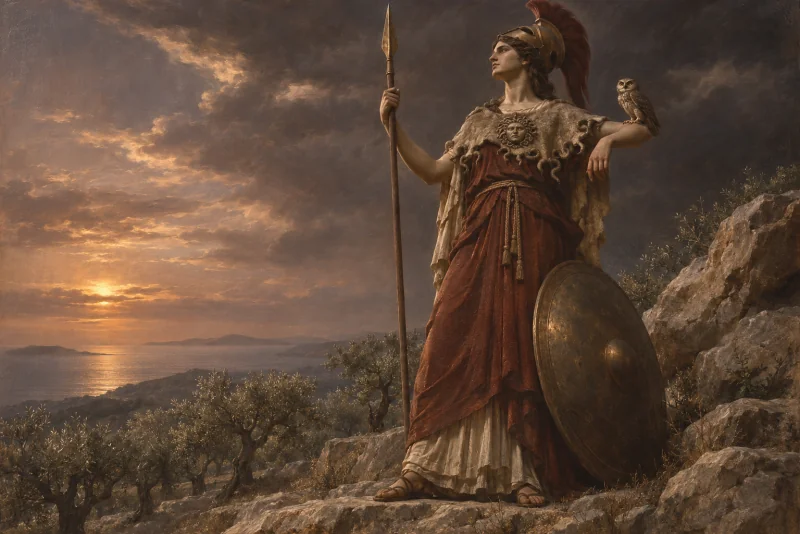
His first wife was Metis, the wisest of gods and mortals. Earth and Heaven warned him that she would bear a daughter, Athena, and after her a son who would be “king of gods and men”. So when she was about to give birth, Zeus tricked her with cunning words and swallowed her. Athena was later born from his own head. Kronos had swallowed his children once they were born. Zeus swallowed the mother before the son could be born, and in Hesiod no one ever takes the throne from him. After Metis he married Themis, then took Eurynome, Demeter, Mnemosyne and Leto, and “lastly” Hera.
2 Where the Story Is Written Down
- Linear B tablets. The name is older than Greek literature. A clay tablet from the Mycenaean palace at Pylos (Tn 316) lists gold bowls offered “to Zeus” (di-we), “to Hera” (e-ra) and to Drimios, “the son of Zeus” (di-wo i-je-we), in the reading published by Roger Woodard. Linear B was used between the 16th and 12th centuries BCE, and the Pylos tablets survived because the fire that destroyed the palace baked them hard. The tablets record offerings; they tell no stories.
- Homer’s Iliad never tells Zeus’s rise, but it knows the story. Hera recalls that Ocean and Tethys took her from Rhea and raised her “what time Zeus … thrust Cronos down to dwell beneath earth and the unresting sea” (14.201–204), with no word of her being swallowed. Poseidon recalls how the brothers divided the world (section 3).
- Hesiod’s Theogony is the oldest telling from start to finish. The classicist Erik van Dongen dates its composition to about 750–650 BCE and argues that its version of the story was shaped “to illustrate the superiority of Zeus over his predecessors”.
- Callimachus, Hymn to Zeus (3rd century BCE), opens by asking where the god was born, and goes on to argue with the old stories (section 3).
- Apollodorus, Library (1.1.5–1.2.1), gives the fullest prose account. Its translator, Sir James Frazer, gathered the other ancient versions in his notes of 1921.
3 Competing Versions
- Youngest or eldest? In Hesiod Zeus is Rhea’s youngest. In Homer he is the eldest. In the Iliad Zeus warns Poseidon that he is “better far than he in might, and the elder born” (15.165–166), the poet says the same (13.355), and when Poseidon protests, Iris reminds him that the Furies “ever follow to aid the elder-born” (15.204). The Japanese encyclopedia Nipponica puts it in a parenthesis: the youngest child, “in Homer the eldest”.
- Chosen or drawn by lot? In the Iliad (15.187–193), Poseidon says that the three sons of Kronos shook lots: he won the sea, Hades “the murky darkness”, and Zeus “the broad heaven”, while the earth and Olympus stayed common to all. Apollodorus also has the lots. In Hesiod there are no lots; the gods ask Zeus to rule. Callimachus scoffs at the lots: “who would draw lots for Olympos and for Hades – save a very fool?” Zeus was made king, he says, by “the deeds of thy hands”.
- Where was he hidden? Hesiod names Lyktos and a cave on Mount Aigaion. Apollodorus names Dikte. Callimachus has Zeus born in Arcadia, at Parrhasia, and carried by the nymph Neda to Crete, near Knossos; the bees come from the hills of Ida. Frazer sums it up: “The ancients were not agreed as to whether the infant god had been reared on Mount Ida or Mount Dicte.” And in Arcadia, the people of Methydrion told the traveller Pausanias that Kronos was handed the stone on their own Mount Thaumasius.
- Who handed over the stone? In Hesiod the sentence comes straight after Earth hides the child and names no new giver. Apollodorus says plainly that Rhea wrapped the stone and gave it to Kronos.
- How were the children brought up? Hesiod says Kronos was tricked by Earth. Apollodorus says Metis gave him a drug that made him vomit. Frazer notes that Hesiod “says nothing about the agency of Metis”.
- Whose weapons? In Hesiod the Cyclopes give Zeus his thunder and lightning. In Apollodorus they also give Hades a helmet and Poseidon a trident.
- Did Zeus die? The Cretans showed visitors a tomb of Zeus. Callimachus answers: “‘Cretans are ever liars.’ Yea, a tomb, O Lord, for thee the Cretans builded; but thou didst not die, for thou art for ever.” His translator notes that the saying was attributed to Epimenides and is quoted in the New Testament, in the Letter to Titus (1:12).
4 History and Tradition
- The name. “Zeus” comes from an old Indo-European word for the sky, dyeus. The Roman Jupiter was the same god in origin: his name means “father Dyeus”. In 1911 the scholar L. R. Farnell set it beside the Sanskrit Dyâus, “sky”, and the Latin Diespiter. But he warned that the conclusion often drawn from this, that all the Indo-European peoples once worshipped a single Sky-Father, “has been now seen to be hazardous”.
- A Hittite forerunner. The closest parallel to Hesiod’s story is the Hurro-Hittite Song of Going Forth, often called the Song of Kumarbi. It too has a line of kings of heaven: Alalu, Anu and Kumarbi. Van Dongen lists the matches: “Both Anu and Ouranos are castrated by their successors, Kumarbi and Kronos”; Kumarbi, like Kronos, means to eat the child who will succeed him, the storm-god, and is fed a rock instead; and “this rock subsequently becomes an object of worship”. The part where the storm-god takes the throne is lost.
- The stone at Delphi. Pausanias saw at Delphi a stone “of no large size”. Every day olive oil was poured over it, and at each festival unworked wool was laid on it. Some said it was the stone “given to Cronus instead of his child”, which he later vomited up.
- Olympia. The great statue in the temple of Zeus at Olympia was signed under its feet: “Pheidias, son of Charmides, an Athenian, made me.” It was of gold and ivory, a seated Zeus with a Victory in his right hand and a sceptre topped by an eagle in his left. The geographer Strabo thought it too big for its temple: “if Zeus arose and stood erect he would unroof the temple”. It does not survive.
- Dodona. In north-western Greece, Zeus spoke through an oak. Odysseus, says the Odyssey, “had gone to Dodona, to hear the will of Zeus from the high-crested oak of the god” (14.327–328). In the Iliad Achilles prays to Zeus “ruling over wintry Dodona”, where his interpreters, the Selloi, sleep on the ground with unwashed feet (16.233–235). Herodotus calls Dodona the oracle “held to be the most ancient in Hellas”, and its priestesses told him that it began when a black dove settled on an oak and spoke with a human voice.
Zeus’s “Master Bolt” is not an ancient name. It comes from Rick Riordan’s novel The Lightning Thief (2005), the first Percy Jackson book, whose hero hunts for “Zeus’ master bolt”. In Hesiod the Cyclopes give Zeus thunder, lightning and the thunderbolt.
5 Related Stories
- Mount Olympus: The Real Mountain Where the Gods Lived: in Hesiod’s war, Olympus is the stronghold of Zeus and his brothers and sisters, and the Titans fight from Mount Othrys.
- Medusa: The Gorgon Whose Story Kept Changing: Perseus, who beheads her, is a son of Zeus. Apollodorus reports that Zeus came to the imprisoned Danae “in the shape of a stream of gold”.
- The Odyssey: Ten Years on the Way Home from Troy: at the gods’ council in Book 1 Zeus is the first to speak, complaining that mortals blame the gods for their own folly (1.32–34), and later he wrecks Odysseus’s ship with a thunderbolt after the crew eat the cattle of the Sun (12.415–417).
- The Churning of the Ocean: Gods, Demons and the Nectar of Immortality: there it is Indra who puts out the fire on the mountain with rain. Zeus’s name does have an Indian relative, but it is Dyâus, the sky, not Indra (section 4). We have not found a scholar who compares the two stories; we link them for the theme of gods who command the weather.
- Thor: The Thunder God Who Lost His Hammer: the Norse thunder god. Around 1075 Adam of Bremen wrote that the Thor of Uppsala “seems to resemble Jupiter”, Zeus’s Roman counterpart, and scholars, Dumézil among them, have compared Thor with Zeus. Zeus had his thunderbolt from the Cyclopes, Thor his hammer from the dwarves.
6 Sources
- Hesiod, Theogony, trans. Hugh G. Evelyn-White (Loeb, 1914), lines 134–182, 453–506, 617–735 and 820–929: Theoi
- Homer, Iliad 13.354–355, 14.200–204, 15.158–217 and 16.233–235, trans. A. T. Murray (Loeb, 1924): Perseus
- Homer, Odyssey 1.26–34, 12.403–419 and 14.327–328, trans. A. T. Murray (Loeb, 1919): Perseus
- Apollodorus, Library 1.1.5–1.2.1 and 2.4.1, trans. Sir James George Frazer (Loeb, 1921), with Frazer’s notes: Perseus
- Callimachus, Hymn 1: To Zeus, trans. A. W. and G. R. Mair (Loeb, 1921): Theoi
- Pausanias, Description of Greece 5.10.2, 5.11.1, 8.36.2–3 and 10.24.6, trans. W. H. S. Jones (Loeb, 1918): Perseus
- Strabo, Geography 8.3.30, trans. H. L. Jones (Loeb, 1924): Perseus
- Herodotus, Histories 2.52 and 2.55, trans. A. D. Godley: Perseus
- Roger D. Woodard, “Linear B po-re-na, po-re-si, and po-re-no-”, Classical Inquiries (Center for Hellenic Studies, 2018), with the text of Pylos tablet Tn 316: CHS
- Erik van Dongen, “The ‘Kingship in Heaven’-Theme of the Hesiodic Theogony: Origin, Function, Composition”, Greek, Roman, and Byzantine Studies 51 (2011) 180–201: GRBS
- L. R. Farnell, “Zeus”, Encyclopædia Britannica, 11th edition (1911): Wikisource
- Rick Riordan, The Lightning Thief: rickriordan.com
- “ゼウス”, “線文字B”: Kotobank, Kotobank
Cover and illustrations: AI-generated images made for Arcana. They are interpretations, not historical artworks.