Prometheus: The Theft of Fire
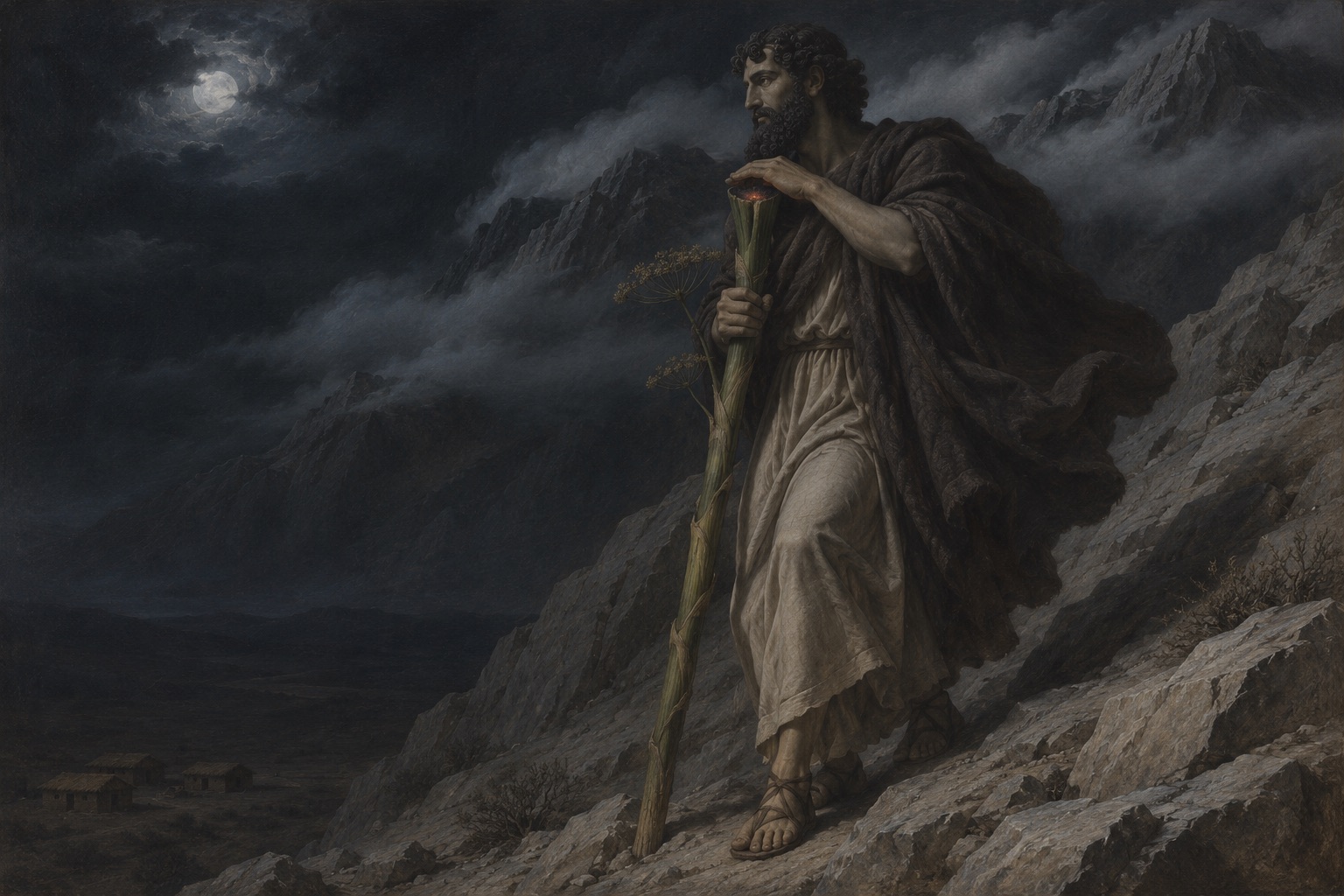
Prometheus tricked Zeus over the shares of a sacrifice, stole back the fire Zeus withheld in a fennel stalk, and was chained where an eagle came every day for his liver. In the oldest poems he is the champion of humankind, not its maker: the clay came later.
- Type: myth, the god who stole fire for mortals and was punished by Zeus
- Culture: ancient Greece; at Athens a torch race was run from his altar
- Earliest texts: Hesiod’s Theogony and Works and Days (around 700 BCE); the tragedy Prometheus Bound, handed down under the name of Aeschylus (5th century BCE)
- Key figures: Prometheus, Zeus, Epimetheus, Hephaestus, Kratos and Bia (Power and Force), Heracles, Deucalion, Pyrrha
When the Greeks sacrificed an ox, the gods’ share went up in smoke as bones wrapped in fat, and the people ate the meat. Hesiod explains why. A son of the Titan Iapetus once divided an ox to fool Zeus, and when Zeus kept fire from mortals in anger, he stole it back. His name was Prometheus, and he paid for both.
Why was Prometheus punished? In Hesiod, for two things, one after the other. First he tricked Zeus over the shares of a sacrifice; then, when Zeus kept fire from mortals because of the trick, he stole it. Zeus was angry, Hesiod says, “because Prometheus matched himself in wit with the almighty son of Cronos”. In the tragedy Prometheus Bound it is the fire, given to mortals: he must learn “to bear with the sovereignty of Zeus and cease his man-loving ways”.
1 The Telling
This is the version of Hesiod, a poet of Boeotia, in the Theogony (lines 507–616) and Works and Days (42–58). The Theogony tells the punishment first and its causes afterwards; here the events are told in order. Iapetus and Clymene, a daughter of Ocean, had four sons: Atlas, who holds up the sky at the edge of the earth; Menoetius, whom Zeus struck down to Erebus with a thunderbolt; Prometheus, “full of various wiles”; and Epimetheus, “scatter-brained”, who was “a mischief to men who eat bread” from the start, for he was the first to accept the woman Zeus had made.
1-1 The Ox at Mecone
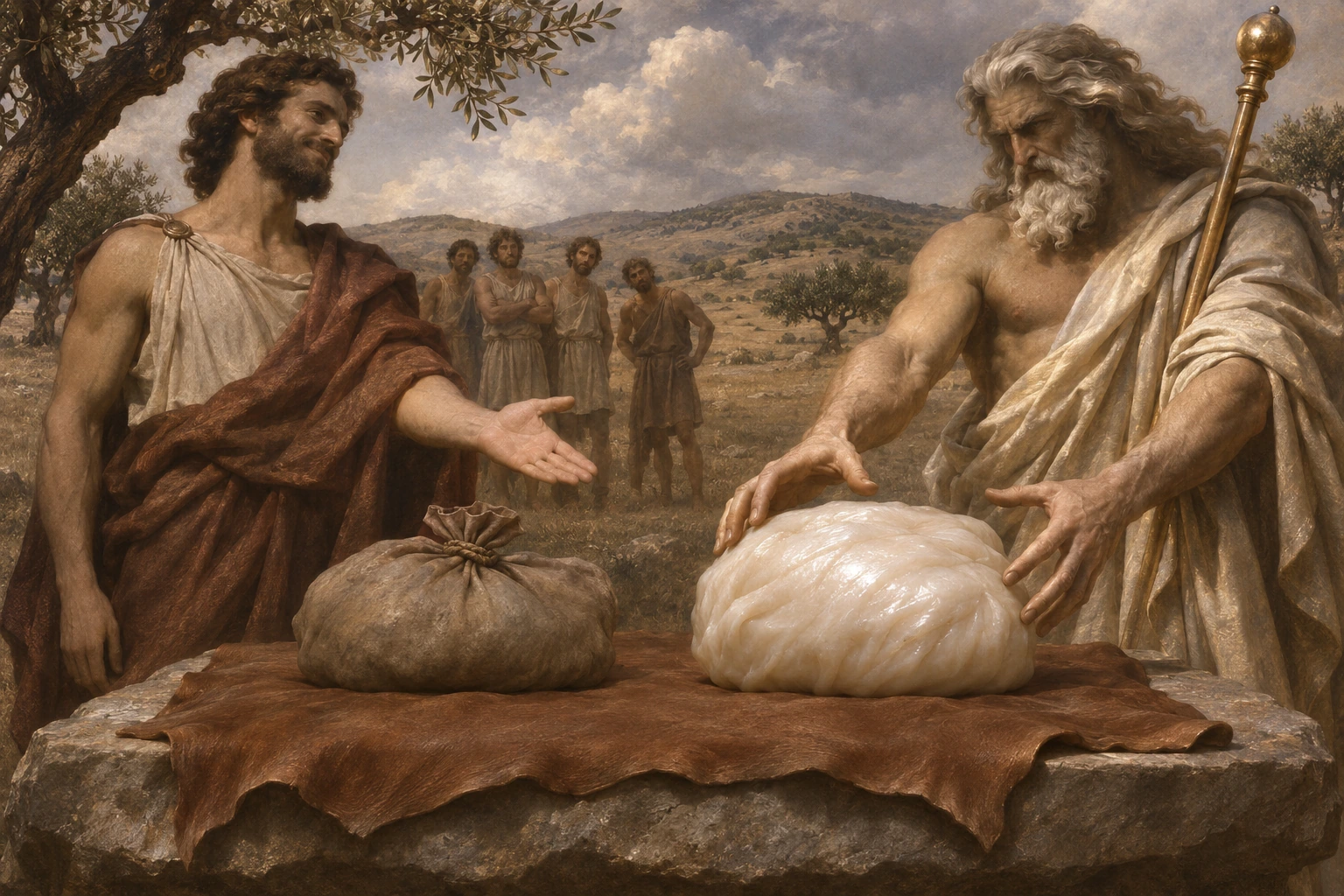
Gods and mortal men once met at Mecone to settle a dispute. Prometheus came forward, cut up a great ox and set out two portions, “trying to deceive the mind of Zeus”. One held the flesh and the rich innards, laid on the hide and hidden inside the ox’s stomach. The other, set out for Zeus, held the white bones, “dressed up with cunning art and covered with shining fat”.
“How unfairly you have divided the portions!” said Zeus. Prometheus smiled softly and told him to take whichever his heart bade. Hesiod insists that Zeus “saw and failed not to perceive the trick”, and was already planning harm for mortals. He lifted the white fat with both hands, and anger came over him when he saw the bones beneath. “Because of this,” Hesiod concludes, “the tribes of men upon earth burn white bones to the deathless gods upon fragrant altars.”
1-2 Fire in a Fennel Stalk
Zeus did not forget. From then on he “would not give the power of unwearying fire” to mortals. But the son of Iapetus outwitted him again and stole “the far-seen gleam of unwearying fire in a hollow fennel stalk”, “so that Zeus who delights in thunder did not see it”, as Works and Days puts it. When Zeus saw “the far-seen ray of fire” among men, he answered with a gift: “I will give men as the price for fire an evil thing.” That evil thing was the first woman, shaped by Hephaestus out of earth and dressed by Athena; her story, and her jar, are told in Pandora.
1-3 The Eagle and the Archer
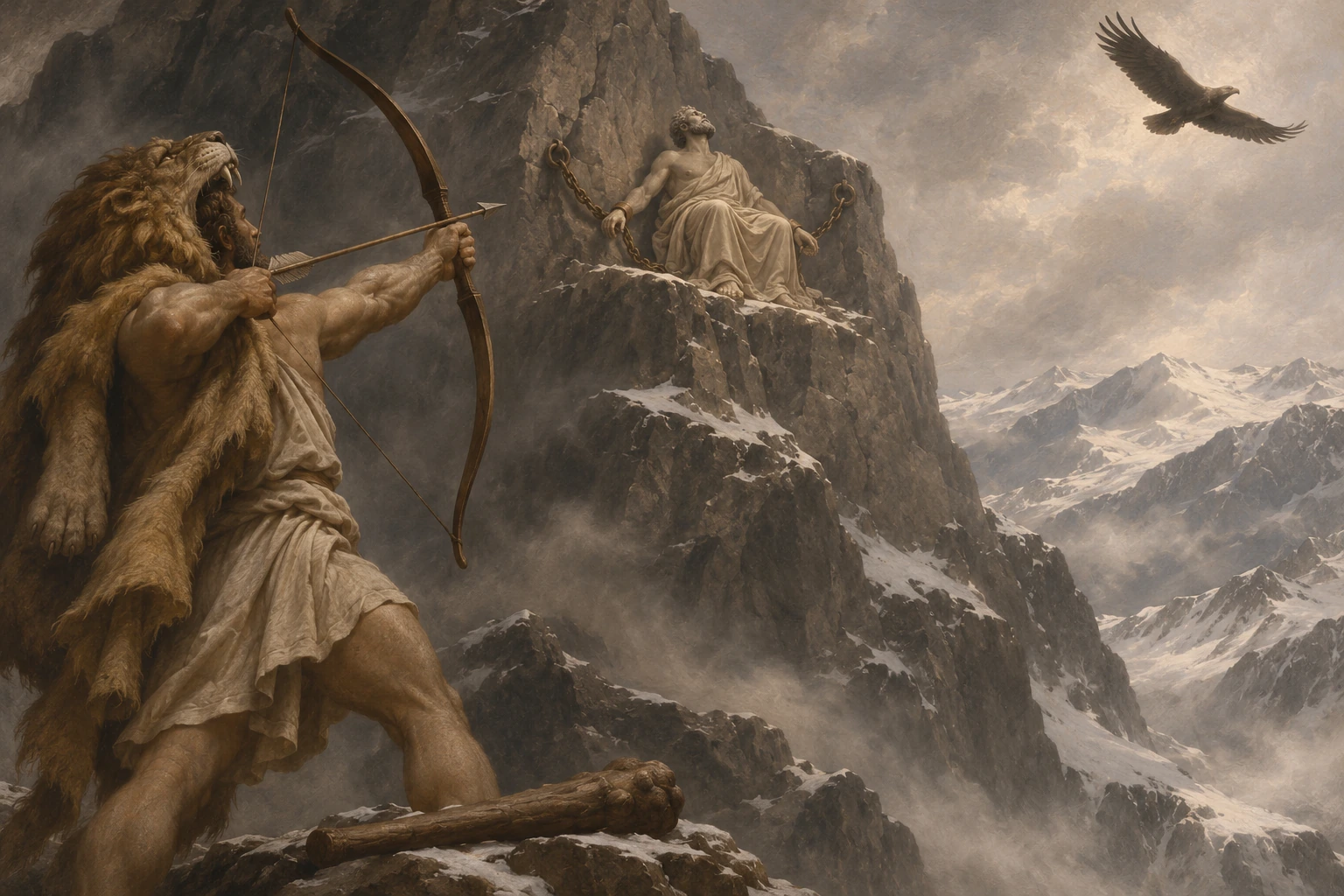
For Prometheus himself Zeus had chains. He bound him “with inextricable bonds, cruel chains”, drove a shaft through his middle, and set on him a long-winged eagle. Every day the eagle ate his immortal liver, and every night the liver grew back as much as the bird had eaten. Hesiod does not say where. The eagle was killed by Heracles, son of Alcmene, who freed the son of Iapetus from his torment, and Hesiod is careful to add that this was “not without the will of Olympian Zeus”: Zeus allowed it for the glory of his son, “the Theban-born”, and let go of his old anger.
The Library, a handbook of myths that goes under the name of Apollodorus (1st or 2nd century CE), gives the release a place and a price. Heracles shot the eagle on the Caucasus and freed Prometheus, “after choosing for himself the bond of olive”, and gave Zeus a substitute: the centaur Chiron, “who, though immortal, consented to die in his stead”. In return, Prometheus told Heracles not to fetch the golden apples of the Hesperides himself, but to send Atlas.
2 Where the Story Is Written Down
- Hesiod, Theogony 507–616 (around 700 BCE), the oldest telling. It gives the binding and the release first (521–534), then the reasons: the ox at Mecone (535–560), the fire (561–569) and the woman made as its price (570–612). It ends with a moral: “it is not possible to deceive or go beyond the will of Zeus” (613).
- Hesiod, Works and Days 42–105. The fire hidden by Zeus and stolen back (42–58), and the woman, named Pandora here though not in the Theogony (59–105).
- Prometheus Bound, the tragedy handed down under the name of Aeschylus (5th century BCE); a sequel, Prometheus Unbound, survives only in fragments. Who wrote the play is “still the subject of considerable debate”, Ian Storey wrote in 2013, reviewing Ian Ruffell’s companion to it: some place it in Aeschylus’s last years, others in a later production, perhaps in the 430s BCE, of Aeschylean material. In 1970 C. J. Herington had argued, as his publisher sums up the book, that it can only be by Aeschylus, written after the Oresteia in the last two years of his life.
- Later writers add the clay and the flood (section 3): Plato’s Protagoras (4th century BCE), book 1 of Ovid’s Metamorphoses (finished around 8 CE), Apollodorus’s Library (1.7.1–2) and Pausanias’s Description of Greece (10.4.4, 2nd century CE).
3 Competing Versions
3-1 Aeschylus: Chained in Scythia
The play opens at “earth’s remotest limit”, “the Scythian land, an untrodden solitude” (1–2). Kratos and Bia, Power and Force, bring Prometheus there, and Hephaestus, who has no heart “to bind with force a kindred god”, rivets him to the crag at Zeus’s command (12–20). His crime, says Power, is that he stole Hephaestus’s own “flower, flashing fire, source of all arts”, and gave it to mortals (7–8).
Left alone, Prometheus gives his side. He had fought for Zeus against the Titans, because his mother, “Themis, or Earth (though one form, she had many names)”, had told him that guile, not force, would win (209–221; the war is told in Zeus). When Zeus planned to wipe out mortals and make a new race, he alone stood against it (231–236). He gave them “blind hopes” and fire (250–254). Men had lived “like swarming ants, in sunless caves”, until he taught them the risings of the stars, “numbers, too, chiefest of sciences”, and “the combining of letters”, “with which to hold all things in memory” (452–461). He yoked animals, invented ships, mixed remedies, read dreams and found the metals; he even taught them to burn “the thigh-bones, wrapped in fat”, for the gods (496–497). “Every art possessed by man,” he sums up, “comes from Prometheus” (505–506).
He also holds a secret. Zeus will make a marriage, and his wife will bear “a son mightier than his father” (764–768); only Prometheus could save him, and he will not name her. Nor does the play. Its translator, H. W. Smyth, notes that the poet follows the story of Thetis, whose son, Themis had foretold, would be mightier than his father; Apollodorus adds that “some say” it was Prometheus who warned Zeus (3.13.5). At the end Zeus’s thunder strikes the rock and Prometheus vanishes from sight (1080–1093). Hermes has told him what comes next: a long time inside the rock, then the eagle, all day long (1016–1025).
3-2 The Potter
- Hesiod’s mortals are already there to share the ox. In Plato’s Protagoras the gods mould mortal creatures “within the earth, of a mixture made of earth and fire”, and give Prometheus and Epimetheus the task of equipping each kind. Epimetheus spends every gift on the animals, so that man is left “naked, unshod, unbedded, unarmed”, and Prometheus steals from Hephaestus and Athena “wisdom in the arts together with fire” (320d–321d).
- Ovid hesitates. Man was made, he says, either by the maker of the world from divine seed, or from new earth that “the son of Iapetus” mixed with rain water and shaped in the likeness of the gods (1.78–83). Brookes More’s translation writes “Prometheus”; Ovid’s Latin has only satus Iapeto, “born of Iapetus”.
- Apollodorus has no doubts: “Prometheus moulded men out of water and earth” (1.7.1).
- At Panopeus in Phocis, Pausanias was shown two stones by a ravine, each big enough to fill a cart. They had the colour of clay and smelled “very like the skin of a man”, and people said they were “remains of the clay out of which the whole race of mankind was fashioned by Prometheus” (10.4.4).
3-3 The Flood
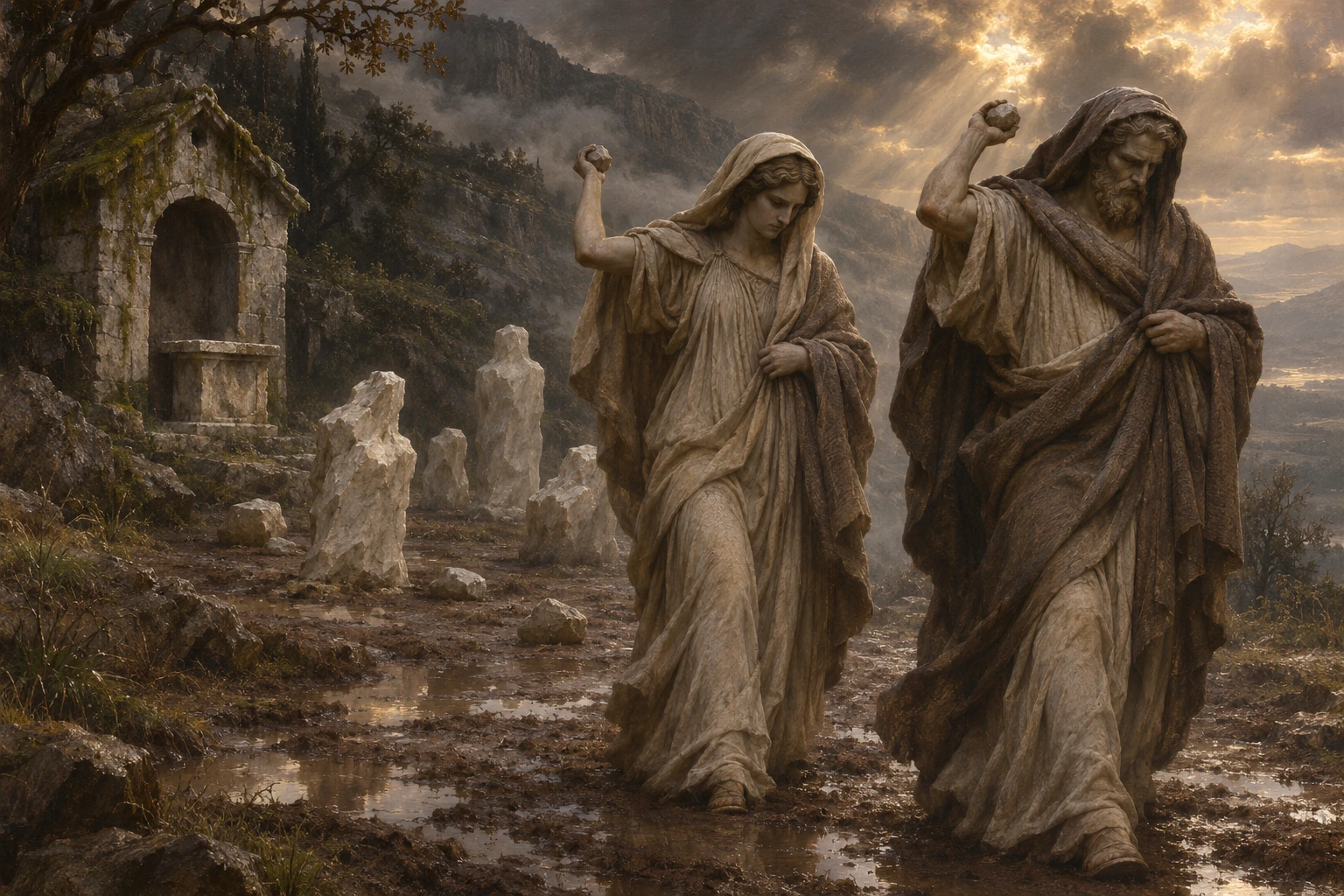
In Apollodorus, Prometheus’s son Deucalion, king of the land around Phthia, married Pyrrha, the daughter of Epimetheus and Pandora. When Zeus resolved to destroy the men of the Bronze Age, Deucalion, on his father’s advice, built a chest, stocked it and went aboard with Pyrrha. Zeus poured down rain until most of Greece was under water. The chest floated for nine days and nights and came to rest on Parnassus, where Deucalion sacrificed to “Zeus, the god of Escape”. Zeus sent Hermes to let him choose a gift, and he chose people. At Zeus’s bidding he threw stones over his head: his became men, and Pyrrha’s women. That is why, says Apollodorus, a people is called laos, from laas, “a stone” (1.7.2).
Ovid tells it at length (1.253–415). His couple, the son of Prometheus and the daughter of Epimetheus, as he calls them (1.390), reach Parnassus in “a small and fragile boat”. Looking at the empty world, Deucalion wishes that “by my father’s art” he could “inspire this clay to take the form of man” (1.363–364). At the shrine of Themis, its altars cold and its gables green with moss, the goddess tells them to throw behind them “the bones of your great mother”. Pyrrha refuses, appalled, until Deucalion reads the riddle: “Our mother is the Earth”, and her bones are stones. The stones soften and grow, at first like a statue just begun in marble, then into men and women. “So are we hardy,” Ovid concludes.
3-4 Where the Versions Disagree
- His mother. Hesiod: Clymene, daughter of Ocean (507–508). Apollodorus: Asia (1.2.3). Aeschylus: Themis, who is also Earth (18, 209–210).
- Where was he bound? Hesiod names no place. Aeschylus: “the Scythian land” (2). Apollodorus: “Mount Caucasus, which is a Scythian mountain” (1.7.1).
- The eagle. In Hesiod it comes every day. In Aeschylus it has not come yet: Hermes threatens him with it (1021–1025). Apollodorus makes it the offspring of Echidna and Typhon (2.5.11), following, Frazer thought, the older mythographer Pherecydes.
- Freed, or still bound? Hesiod says both. Heracles frees him (526–528), yet the passage ends with “strong bands” holding him (615–616), and the Greek verb, erukei, is in the present tense: the bond holds him still. In Aeschylus his “deliverer is not yet born” (27). It will be a descendant of Io, “the third in descent after ten generations” (774), “renowned with the bow” (871–873), and a god must go down to the dead in his place (1026–1029); Smyth names them Heracles and Chiron.
- Did Zeus see? In the Theogony Zeus sees through the trick with the bones and takes them anyway (550–557). The fire, in Works and Days, is stolen “so that Zeus… did not see it” (50–52).
4 History and Tradition
- Forethought. In Prometheus Bound, Power taunts the prisoner: “Falsely the gods call you Prometheus, for you yourself need forethought” (85–86). Smyth notes the play on the name, Pro-metheus, “Fore-thought”, which the Greeks took seriously. In Plato’s Protagoras Socrates says he likes the Prometheus of the fable better than the Epimetheus, and takes “Promethean thought continually for my own life” (361d).
- A torch race. “In the Academy is an altar to Prometheus,” writes Pausanias, “and from it they run to the city carrying burning torches.” A runner whose torch went out lost; if every torch went out, no one won (1.30.2). Frazer found it remarkable that the benefactor of mankind “appears not to have been worshipped by the Greeks”, citing Lucian, who saw no temples of Prometheus anywhere. What Pausanias describes is an altar, not a temple.
- The fennel. The narthex in which the fire was hidden is commonly identified with the giant fennel, Ferula communis. Frazer quotes Tournefort’s Voyage du Levant (1718): its dry white pith “catches fire just like a wick”, and “hence people use this plant to carry fire from one place to another; our sailors laid in a supply of it”.
- Goethe. His poem “Prometheus”, written in 1772–1774, was first printed in 1785 by F. H. Jacobi, without Goethe’s consent or name. Prometheus speaks to Zeus, and ends: “Here I sit, forming people in my own image, a race to be like me, to suffer, to weep, to enjoy and be glad, and to pay no heed to you, as I do!” (our translation).
- The Shelleys. In 1818 Mary Shelley’s Frankenstein; or, The Modern Prometheus came out in three volumes without her name, with lines from Milton’s Paradise Lost on the title page: “Did I request thee, Maker, from my clay / To mould me man?” In 1820 Percy Bysshe Shelley published Prometheus Unbound. Aeschylus’s lost play, he wrote in the preface, reconciled Jupiter (Zeus) with his victim in exchange for the secret about Thetis, and he was “averse from a catastrophe so feeble as that of reconciling the Champion with the Oppressor of mankind”.
“Prometheus made the first humans out of clay” is how the story is often told. The oldest texts do not say so. In Hesiod mortals are already there when he divides the ox at Mecone, and in Works and Days the races of men are made by “the deathless gods who dwell on Olympus” and by Zeus (109–110, 143–145). As Frazer put it, in the earliest versions “Prometheus appears only as the benefactor, not the creator, of mankind”. Even in Plato the gods do the moulding. Prometheus the potter appears in Ovid, who offers him as one possibility of two, and then in Apollodorus and Pausanias.
5 Related Stories
- Pandora: The Jar, Not the Box: the “price for fire”. Prometheus had warned his brother never to take a gift from Zeus, and Epimetheus took her (Works and Days 85–89). In Apollodorus her daughter Pyrrha is the woman who survives the flood with Prometheus’s son.
- Heracles: The Twelve Labours and the Pyre on Mount Oeta: the archer who kills the eagle. In Apollodorus he does it on his way to the golden apples, and Aeschylus’s Prometheus foresees him as a descendant of Io, “renowned with the bow”.
- Utnapishtim: The Flood Survivor, and the Older Atrahasis: in 1918 James George Frazer set Deucalion’s flood among the flood stories of the world. In the version Lucian tells in his account of the temple at Hierapolis on the Euphrates, Deucalion takes the animals into his ark in pairs, and Plutarch has him let loose a dove. Frazer found the resemblances to the Babylonian story “sufficiently close”, and the Greek legend in that form “coloured, if not moulded, by Semitic influence”. Utnapishtim, too, sets free a dove.
- Loki: The Shape-Shifter Between Gods and Giants: another god put in chains for his misdeeds. Jacob Grimm wrote that Loki “is put in chains, like Prometheus who brought fire to men; but he is to be released again at the end of the world”.
6 Sources
- Hesiod, Theogony 507–616 and Works and Days 42–155, trans. Hugh G. Evelyn-White (Loeb, 1914): Perseus, Perseus; Greek text of Theogony 613–616: Perseus
- Aeschylus, Prometheus Bound, trans. Herbert Weir Smyth (Loeb, 1926), with his notes: Perseus
- Plato, Protagoras 320c–322a and 361d, trans. W. R. M. Lamb (Loeb): Perseus
- Ovid, Metamorphoses 1.76–88 and 1.253–415 (line numbers of Hugo Magnus’s Latin text, 1892), trans. Brookes More (1922): Perseus, Latin text
- Apollodorus, Library 1.2.3, 1.7.1–2, 2.5.11 and 3.13.5, trans. Sir James George Frazer (Loeb, 1921), with Frazer’s notes: Perseus, Perseus
- Pausanias, Description of Greece 1.30.2 and 10.4.4, trans. W. H. S. Jones and H. A. Ormerod (Loeb, 1918): Perseus
- James George Frazer, Folk-Lore in the Old Testament, vol. 1 (1918), pp. 146–155: Internet Archive; Jacob Grimm, Teutonic Mythology, vol. 1, trans. James Steven Stallybrass (1882), p. 244: Internet Archive
- Ian C. Storey, review of Ian Ruffell, Aeschylus: Prometheus Bound (2011), Bryn Mawr Classical Review 2013.04.06: BMCR; C. J. Herington, The Author of the Prometheus Bound (University of Texas Press, 1970), publisher’s description: UT Press
- J. W. von Goethe, “Prometheus”, Goethes Schriften, vol. 8 (Göschen, 1789), pp. 207–209: Wikisource
- [Mary Shelley], Frankenstein; or, The Modern Prometheus, vol. 1 (London: Lackington, Hughes, Harding, Mavor and Jones, 1818): Internet Archive; Percy Bysshe Shelley, Prometheus Unbound (1820), preface, in The Complete Poetical Works, ed. Thomas Hutchinson: Project Gutenberg
- Japanese translations: Hirokawa Yōichi (trans.), Hesiod, Shintōki (Iwanami Bunko, 1984); Kure Shigeichi (trans.), Aeschylus, Shibarareta Promētheus (Iwanami Bunko, 1974); Kōzu Harushige (trans.), Apollodorus, Girishia shinwa (Iwanami Bunko, 1953; revised edition 1978): CiNii, CiNii, CiNii
Cover and illustrations: AI-generated images made for Arcana. They are interpretations, not historical artworks.