Heracles: The Twelve Labours and the Pyre on Mount Oeta
Hera's trick at his birth put Heracles in the service of a lesser cousin, and the labours he did for him ended with his rise to the gods. Yet the oldest poems never count the labours, and in the fullest Greek account the oracle orders ten.
- Type: heroic legend, a hero’s labours, his death and his rise to the gods
- Culture: ancient Greece; honoured all over the Greek world as both hero and god, and in Rome as Hercules
- Earliest texts: Homer’s Iliad and Odyssey and Hesiod’s Theogony (8th–7th century BCE) know the labours but give no number; the twelve are carved together on the temple of Zeus at Olympia, finished around 456 BCE; the fullest telling is the Library of Apollodorus (1st or 2nd century CE)
- Key figures: Heracles, Zeus, Hera, Alcmene, Amphitryon, Eurystheus, Iolaus, Megara, Deianira, the centaur Nessus, Hebe
In the Iliad, Achilles makes his peace with dying by remembering that “not even the mighty Heracles escaped death”. In the Odyssey, Odysseus meets Heracles among the dead, and the poet stops to explain that this is only “his phantom”: Heracles himself feasts among the immortal gods, married to Hebe. The greatest of the Greek heroes, whom the Romans called Hercules, was both a dead man and a god, and the Greeks sacrificed to him as both.
Why did Heracles have to serve Eurystheus? The sources give two reasons. In the Iliad, it is Hera’s trick at his birth: Zeus swore that a man of his blood born that day would rule his neighbours, and Hera made his cousin Eurystheus be born first. Ever after, Zeus would groan to see “his dear son in unseemly travail beneath Eurystheus’ tasks”. In the Library of Apollodorus, the service is a penance: after Heracles has killed his children in a fit of madness sent by Hera, the oracle at Delphi sends him to Eurystheus, and promises that when the labours are done he will be immortal.
1 The Telling
This follows the Library (2.4.8–2.7.7), a handbook of myths that goes under the name of Apollodorus, in Sir James Frazer’s translation of 1921. Where Homer or Pindar tells a scene first, the text says so.
1-1 Born One Day Too Late
On the day Alcmene was to give birth to Heracles in Thebes, says the Iliad, Zeus boasted to the gods that a man of his blood born that day would be lord of all who lived around him. Hera made him swear to it. Then she went down to Argos, brought the wife of Sthenelus, a son of Perseus, to birth in her seventh month, and held back Alcmene’s labour. The child born that day was Eurystheus (19.95–133).
Apollodorus tells how the child was conceived. While Amphitryon was away at war, Zeus came to his wife Alcmene in his likeness and made one night last three. She bore twins: Heracles, the son of Zeus, older by one night, and Iphicles, the son of Amphitryon. When Heracles was eight months old, Hera sent two huge serpents to the bed, and the baby rose and strangled them with his hands. Pindar tells it as his first fight: Alcmene leaps from her bed, Amphitryon runs in with his sword drawn, and the seer Teiresias foretells the monsters the boy will kill on land and sea, and his marriage to Hebe at the end (Nemean 1).
1-2 The Madness
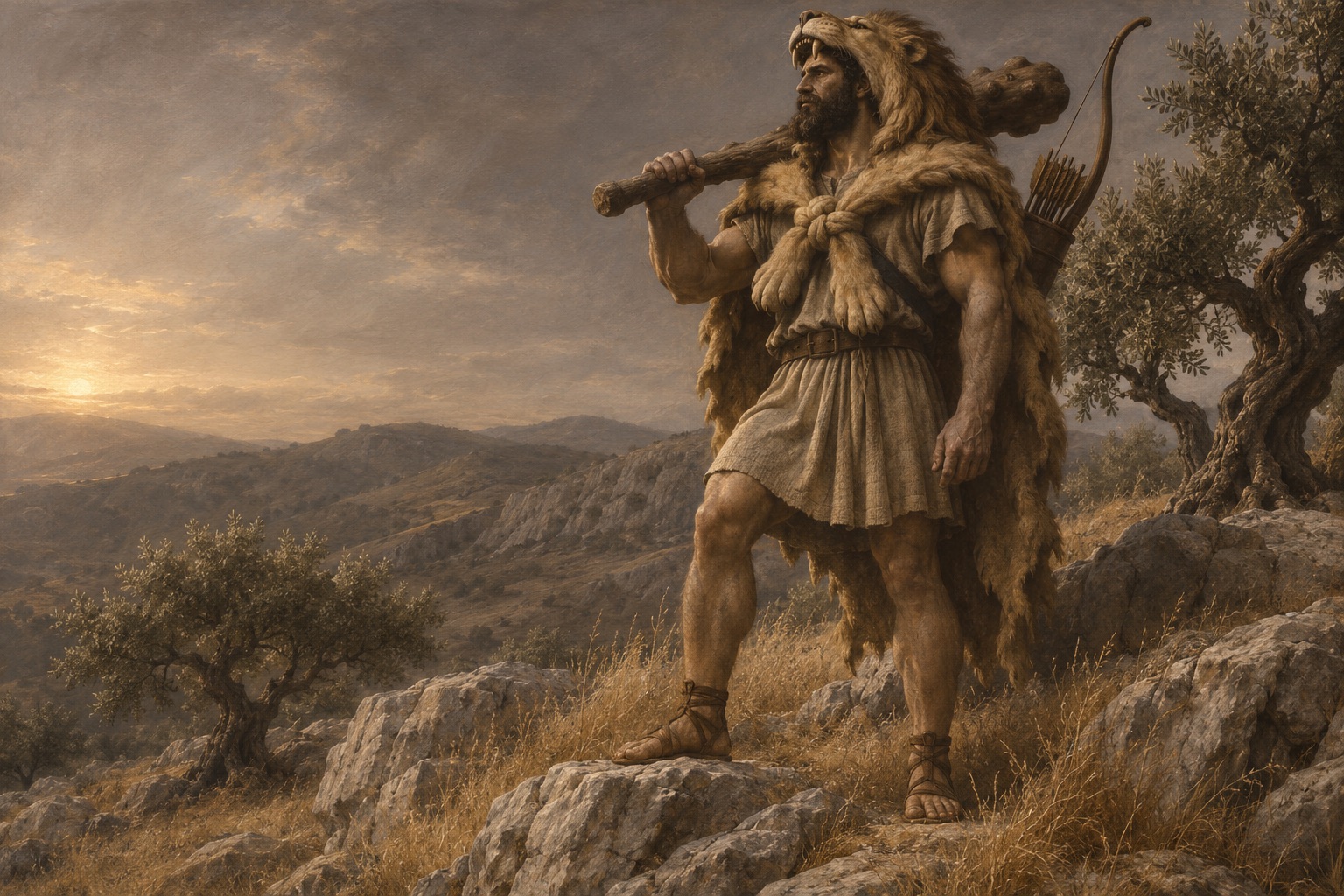
Heracles grew to four cubits, flashing fire from his eyes. At eighteen he killed the lion of Mount Cithaeron and wore its skin, with the scalp for a helmet. He freed Thebes from the tribute it paid to the Minyans of Orchomenus, and King Creon gave him his eldest daughter, Megara. They had three sons. Then, through Hera’s jealousy, Heracles was driven mad, and he threw his children by Megara, and two children of his brother Iphicles, into the fire. He sentenced himself to exile, was purified of the killing, and went to Delphi to ask where he should live. There, says Apollodorus, the Pythia first called him Heracles; until then he had been called Alcides, after his grandfather Alcaeus. She told him to live at Tiryns and serve Eurystheus for twelve years, performing “the ten labours imposed on him”. When they were done, he would be immortal (2.4.9–12).
1-3 Ten Labours, and Two More
- The Nemean lion, a child of Typhon that no weapon could wound. Heracles blocked one mouth of its cave, went in by the other and choked it with his arm. Eurystheus, terrified, forbade him to enter the city again; it was said he had a bronze jar sunk in the earth to hide in.
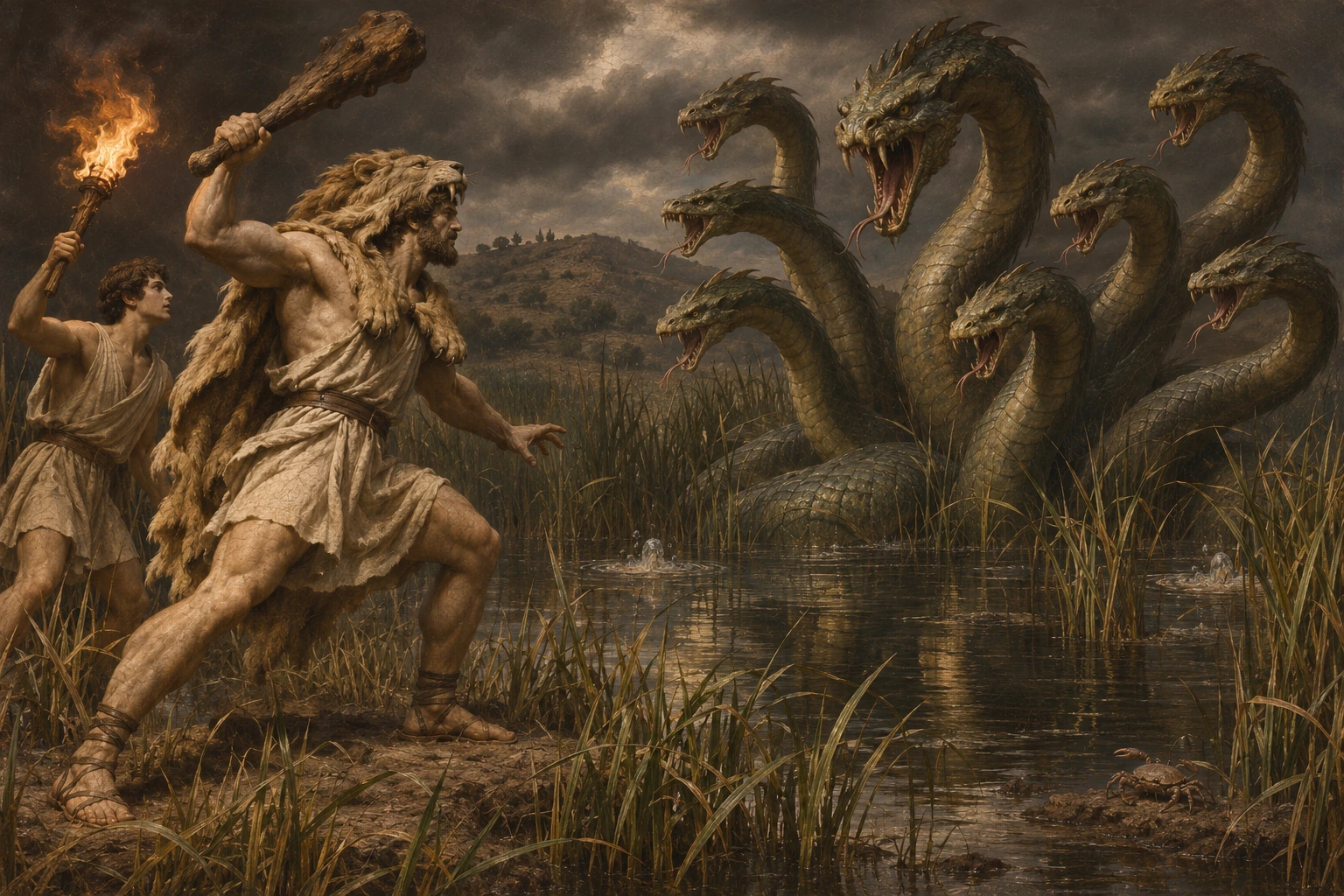
- The Hydra of Lerna, with nine heads, the middle one immortal. For every head he smashed, two grew back, until his nephew Iolaus burned the stumps with brands. Heracles buried the immortal head under a rock and dipped his arrows in the creature’s gall. Eurystheus refused to count this labour, because Heracles had not won alone.
- The Ceryneian hind, with golden horns, sacred to Artemis, hunted for a whole year and carried alive to Mycenae; and the Erymanthian boar, driven into deep snow and taken alive.
- The stables of Augeas, king of Elis, cleared in one day by turning the rivers Alpheus and Peneus through the yard. Heracles had asked Augeas for a tenth of his cattle, so Eurystheus refused to count this labour too: it had been done for pay.
- The Stymphalian birds, frightened out of their wood with bronze castanets from Athena and shot; the Cretan bull, caught and brought to Eurystheus, who let it go; and the man-eating mares of Diomedes, king of the Bistones in Thrace.
- The belt of Hippolyte, queen of the Amazons. She promised to give it, but Hera, disguised as an Amazon, spread the word that the strangers were carrying off their queen. When the Amazons charged, Heracles killed Hippolyte and took the belt.
- The cattle of Geryon, a man with three bodies, on the island of Erythia in the far west. On the way Heracles set up two pillars, facing each other at the bounds of Europe and Libya.
The ten had taken “eight years and a month”. Because two had not been counted, Eurystheus set two more (2.5.11–12).
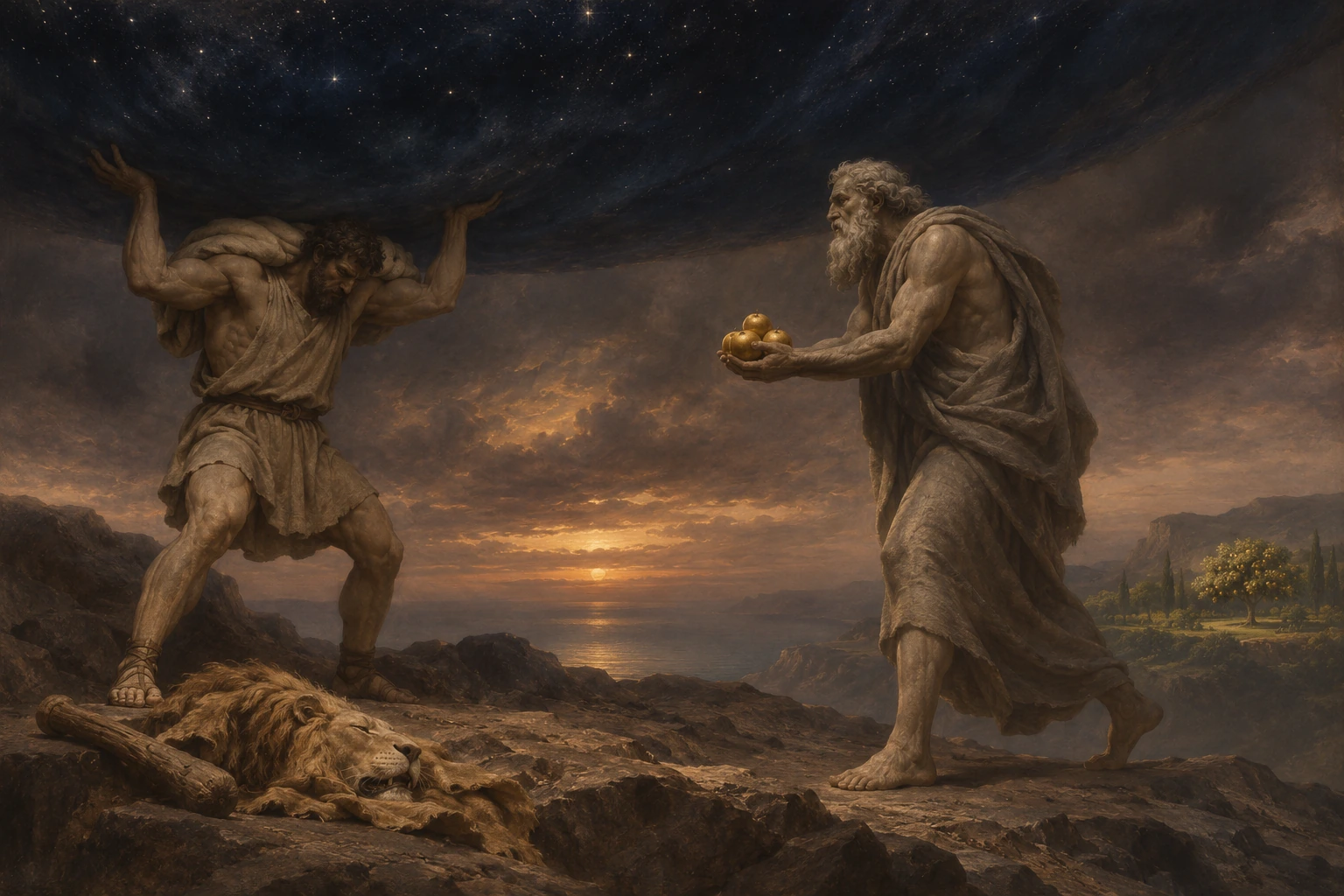
- The golden apples of the Hesperides, guarded by a dragon with a hundred heads. On his way Heracles shot the eagle that was eating the liver of Prometheus and set him free. Prometheus advised him to send Atlas for the apples and hold up the sky in his place. Atlas came back with three apples and offered to take them to Eurystheus himself, but Heracles asked him to take the sky back for a moment while he put a pad on his head, and left with the apples.
- Cerberus, the three-headed hound of Hades. Heracles went down at Taenarum, raised Theseus from the place where he was held fast, and was allowed by Pluto to take the dog if he used no weapons. He choked it until it yielded, carried it up, showed it to Eurystheus and took it back.
1-4 The Robe and the Pyre
After the labours Heracles won Deianira, daughter of Oeneus of Calydon, by wrestling the river god Achelous. Taking her with him to Trachis, he came to the river Evenus, where the centaur Nessus carried travellers across for a fare. In midstream Nessus tried to violate her, and Heracles shot him to the heart. Dying, Nessus told Deianira that his blood would be a love charm, and she kept it. Years later Heracles sacked Oechalia and took its princess, Iole, captive. He sent his herald Lichas home to Trachis for fine clothes to wear at a sacrifice. Deianira learned about Iole, feared he would love the girl more than her, and smeared a tunic with the blood. As soon as it grew warm on his body, the Hydra’s poison from the old arrow began to eat into his skin. He hurled Lichas into the sea and tore the tunic off, and his flesh came away with it. When Deianira heard what had happened, she hanged herself.
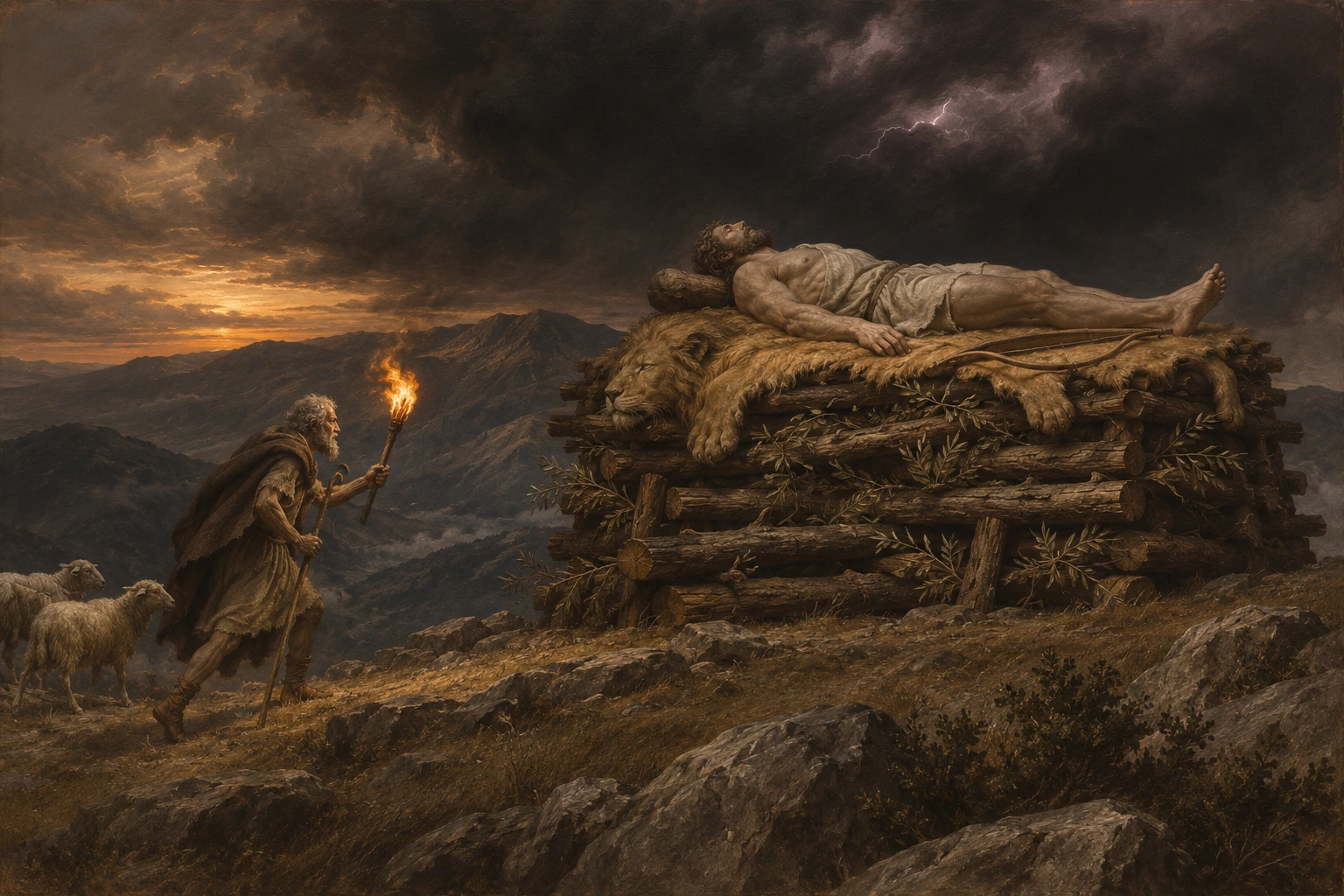
Heracles told his son Hyllus to marry Iole when he came of age, went up Mount Oeta, built a pyre and climbed onto it. No one would light it, until Poeas, passing by in search of his flocks, set fire to it, and Heracles gave him his bow. As the pyre burned, “it is said”, a cloud passed under him and carried him up to heaven with a peal of thunder. There he became immortal, made his peace with Hera, and married her daughter Hebe (2.7.5–7).
2 Where the Story Is Written Down
- Homer, Iliad and Odyssey (8th–7th century BCE), knows the labours but never counts them. Athena recalls how often she rescued Heracles when he was “fordone by reason of Eurystheus’ tasks”, and names one: the hound of Hades (Iliad 8.362–369). In the Odyssey his phantom tells Odysseus that a far worse man “laid on me hard labours”, and that the hound was the hardest (11.617–626).
- Hesiod, Theogony (8th–7th century BCE), names the deeds one by one as it lists the monsters he killed: Geryon (287–294), the Hydra, with Iolaus (313–318), the Nemean lion (327–332), the eagle of Prometheus (526–534). It ends with his marriage to Hebe on Olympus, “when he had finished his grievous toils” (950–955).
- Pindar, Nemean 1, probably of 476 BCE as its translator Sir John Sandys dates it: the snakes and the prophecy of Teiresias. Isthmian 4 recalls the Theban rites for the sons of Megara (section 3).
- The temple of Zeus at Olympia, finished around 456 BCE. Its twelve metopes, the carved panels over the two porches, six at each end, show the same twelve labours as Apollodorus. Pausanias, who saw them in the 2nd century CE, names eleven (5.10.9); the Perseus Digital Library’s catalogue notes that Cerberus “was inadvertently omitted”.
- Sophocles, Women of Trachis, and Euripides, Heracles, two Athenian tragedies of the 5th century BCE: his death, and his madness.
- Theocritus, Idyll 24, “The Little Heracles” (3rd century BCE): the snakes again, and a prophecy that now counts “labours twelve” (81–82) and foresees the “pyre of Trachis”.
- Diodorus of Sicily, Library of History 4.8–39 (1st century BCE). Its account of Heracles, notes the translator C. H. Oldfather, “is generally considered to have been drawn from” a Praise of Heracles by Matris of Thebes, “who is otherwise unknown”.
- Apollodorus, Library 2.4.5–2.7.8: the fullest account, retold in section 1. Ovid’s Metamorphoses 9 (finished around 8 CE) tells the end in Latin, where the hero is Hercules.
3 Competing Versions
- Was the madness before the labours or after? Before, in Apollodorus. Before, too, in Diodorus, but there it follows Delphi’s order: unwilling to serve a lesser man, Heracles falls into despair, Hera sends the madness, and he shoots his children, taking them for enemies (4.10.6–4.11.2). In Euripides it comes after the last labour: “now that he has accomplished the labors of Eurystheus”, Iris says, Hera wants him to shed kindred blood (827–832). He kills Megara and their three sons, Athena stops him with a stone before he can kill Amphitryon, and Theseus takes him to Athens, Heracles following “as a little boat in the wake of Theseus” (1424). Pindar’s Thebans honoured not three sons of Megara but eight, “mail-clad men, now dead”, with sacrifices and fires that blazed all night (Isthmian 4).
- Ten, twelve or thousands? Apollodorus: ten, then two more. Diodorus: twelve from before his birth, agreed between the outwitted Zeus and Hera (4.9.4–5), and in another order, with Cerberus eleventh and the apples last. Sophocles’s dying Heracles names six, the lion, the Hydra, the centaurs, the boar, the hound of Hades and the dragon of the apples: “These toils and thousands more” (1089–1102); his chorus counts years instead, “the twelfth year” (824–826). The chorus of Euripides sings twelve deeds, as Jebb counts them, but not Apollodorus’s twelve: the centaurs, Cycnus, clearing the seas and holding up the sky are in it, and the boar, the stables, the birds and the Cretan bull are not (359–429).
- The snakes and the name. Hera sends the snakes in Pindar, Theocritus and Apollodorus. But Apollodorus adds that the early writer Pherecydes made it Amphitryon, who put them in the bed to learn which twin was his: Iphicles fled, Heracles stood his ground. The baby is newborn in Pindar, eight months old in Apollodorus, ten in Theocritus. In Diodorus it is after the snakes that the people of Argos name him Heracles, because he gained glory, kleos, through Hera; before that he was Alcaeus (4.10.1).
- The end. Sophocles’s Deianira drives a sword into her side (930–931); Apollodorus’s hangs herself. Apollodorus has Poeas light the pyre. Ovid has Philoctetes light it, while Heracles lies on the Nemean lion’s skin, “club for pillow”, as calm as a guest at a banquet.
- Dead or a god? Achilles says that “fate overcame him, and the dread wrath of Hera” (Iliad 18.117–119). The Odyssey has it both ways (11.601–604), and Hesiod makes him “untroubled and unaging all his days”.
4 History and Tradition
- Hero and god. Herodotus sailed to Tyre and Thasos to see temples of Heracles older than the Greek hero, and concluded that the Greeks who did best kept two cults, “sacrificing to one Heracles as to an immortal, and calling him the Olympian, but to the other bringing offerings as to a dead hero” (2.44). In Apollodorus, his host before the lion hunt is to sacrifice to Zeus the Saviour if Heracles comes back, and to Heracles “as to a hero” if he is dead; Greek, Frazer notes, had a different verb for each.
- The lion skin and the club. Strabo calls the outfit “a fabrication of the authors of the Heracleia, whether the author was Peisander or someone else”, much later than the stories of Troy: “The ancient statues of Heracles are not thus accoutred” (15.1.9). Even the lion differs: Cithaeron’s in Apollodorus, Nemea’s in Diodorus and Ovid.
- Olympia and the edge of the world. Diodorus says Heracles founded the Olympic Games (4.14.1). Most of the metopes are at Olympia, where the series has been restored; some fragments are in the Louvre. The two pillars at the bounds of Europe and Libya are placed at today’s Strait of Gibraltar by Mizutani Tomohiro in the Japanese Heibonsha World Encyclopedia, which gives the meaning of the name Heracles as “glory of the goddess Hera”.
- The choice. In Xenophon’s Memorabilia (2.1.21–34), Socrates retells an essay by the sophist Prodicus: the young Heracles sits alone, “pondering which road to take”, and two women come to him, Virtue and Vice, each offering him a life.
- Hercules in Rome. In Livy, Hercules drives Geryon’s cattle to the Tiber, and the shepherd Cacus drags the best of them backwards by their tails into his cave. Hercules kills him with his club, and King Evander greets him with a prophecy of the Ara Maxima, the Greatest Altar. It was the only foreign rite Romulus adopted, as though he felt that “an immortality won through courage” would one day be his own reward (1.7.3–15).
“The twelve labours of Heracles” sounds as old as the hero. Homer never counts them: he speaks of “Eurystheus’ tasks” and names only one. Hesiod names deeds one by one, without a number. In Apollodorus the oracle orders ten, and there are twelve only because Eurystheus refused to count two. “We do not know exactly when the ‘twelve labours’ of Heracles became a definite legend,” wrote Sir Richard Jebb in his edition of Sophocles’s Women of Trachis. The earliest evidence he knew was the twelve metopes at Olympia, and the first text he knew to name the number was Theocritus’s, in the 3rd century BCE; the abstract of a 1976 thesis by Susan Gibbons sets a fragment of Pindar, of the 5th century, beside the metopes. Jebb himself thought the cycle older than the temple. And Euripides’s chorus, decades after the temple, sang a different twelve.
5 Related Stories
- Prometheus: The Theft of Fire: Heracles shoots the eagle and sets Prometheus free. Hesiod says Zeus allowed it, so “that the glory of Heracles the Theban-born might be yet greater than it was before” (Theogony 526–534).
- Jason and the Argonauts: The Voyage for the Golden Fleece: Apollodorus lists Heracles among the heroes of the Argo, and has him left behind in Mysia while he searches for the boy Hylas (1.9.16–19).
- Theseus and the Minotaur: The Labyrinth: in Apollodorus, Heracles raises Theseus from the underworld; in Euripides, Theseus repays him by taking him to Athens.
- The Seven Labours of Rostam: The Short Road to the White Div: another hero who rides alone from one monster to the next, to free a captive king, in the Persian Shahnameh. We have not found a scholar who compares the two series of labours; we link them for the theme.
- Krishna: The Cowherd God: Megasthenes called Krishna “Herakles”, and Macdonell agreed that Krishna was meant. Both are babies who kill monsters sent against them, Heracles the serpents of Hera, Krishna the killers of Kamsa; that likeness we link as a shared theme.
6 Sources
- Apollodorus, Library 1.9.16–19 and 2.4.5–2.7.8, trans. Sir James George Frazer (Loeb, 1921), with Frazer’s notes: Perseus, Theoi
- Homer, Iliad 8.360–369, 18.115–121 and 19.95–133, trans. A. T. Murray (Loeb, 1924), and Odyssey 11.601–626, trans. A. T. Murray (Loeb, 1919): Perseus, Perseus
- Hesiod, Theogony 287–332, 526–534 and 943–955, trans. Hugh G. Evelyn-White (Loeb, 1914): Perseus
- Pindar, Nemean 1 and Isthmian 4, trans. Sir John Sandys (Loeb, 1915): archive.org
- Sophocles, Women of Trachis (Trachiniae), trans. Sir Richard Jebb (1892): Perseus
- Euripides, Heracles, trans. E. P. Coleridge, in The Complete Greek Drama, ed. Whitney J. Oates and Eugene O’Neill Jr. (1938): Perseus
- Theocritus, Idyll 24, trans. J. M. Edmonds (Loeb, 1912): Theoi
- Diodorus Siculus, Library of History 4.8–39, trans. C. H. Oldfather (Loeb, 1935): LacusCurtius
- Ovid, Metamorphoses 9, trans. Brookes More (1922): Perseus
- Pausanias, Description of Greece 5.10.9, trans. W. H. S. Jones and H. A. Ormerod (Loeb, 1918); Perseus Digital Library, “Olympia Metopes” and “Olympia, Temple of Zeus”: Perseus, Perseus, Perseus
- Herodotus, Histories 2.44, trans. A. D. Godley (Loeb, 1920): Perseus
- Strabo, Geography 15.1.8–9, trans. Horace Leonard Jones (Loeb, 1932): LacusCurtius
- Xenophon, Memorabilia 2.1.21–34, trans. E. C. Marchant (Loeb, 1923): Perseus
- Livy, History of Rome 1.7, trans. Canon Roberts (1912): Perseus
- Sir Richard C. Jebb, Sophocles: The Plays and Fragments, Part V: The Trachiniae (Cambridge, 1902), Introduction, section 2, with its notes: Perseus
- Susan Estella Gibbons, The Labours of Heracles, a Literary and Artistic Examination, doctoral thesis, Bedford College, University of London (1976), abstract only: Royal Holloway Research Online
- Nakatsukasa Tetsuo, “ヘラクレス”, Nipponica, and Mizutani Tomohiro, “ヘラクレス”, Heibonsha World Encyclopedia: Kotobank
Cover and illustrations: AI-generated images made for Arcana. They are interpretations, not historical artworks.