The Seven Labours of Rostam: The Short Road to the White Div
To free a blinded king from the demons of Mazandaran, Rostam rode the short road alone and met a lion, a desert, a dragon, a witch and the White Div on the way. He is the greatest hero of the Persian epic, yet the Avesta never names him.
- Type: epic, a hero’s ride in seven stages to free a captive king
- Culture: Iran; the heroes of Sistan, told in New Persian
- Earliest text: Ferdowsi’s Shahnameh, finished in 1010 CE. The Arabic chronicles tell the seven stages of another hero, Esfandiyar, but not Rostam’s
- Key figures: Rostam, his horse Rakhsh, Zal, Kay Kavus, Olad, the div Arzhang, the White Div
A king who would not take advice marched into the land of the demons and lost his sight. To win it back, his champion rode out alone by the shortest and worst road, and met an adventure at each of its seven stages. Persians call the journey the haft khan, and painters and storytellers have come back to it ever since Ferdowsi put it into verse a thousand years ago.
What are the seven labours? Seven stages of one journey, from Sistan to the cave of the White Div. Rakhsh kills a lion while Rostam sleeps. A ram leads him to water in the desert. Rakhsh wakes him three times before he sees the dragon and kills it. A witch at a feast shows her true face when he speaks God’s name. He takes the marchlord Olad prisoner and makes him his guide. He kills the div Arzhang. And in a cave he kills the White Div, whose blood cures the blinded king. Rostam has no army: only his horse and, from the fifth stage, a prisoner to show him the way.
1 The Telling
This follows Ferdowsi’s Shahnameh, in the reign of Kay Kavus, as Arthur and Edmond Warner translated it into English verse (volume 2, 1906) from the Persian edition of J. A. Vullers. Short quotations are theirs. Ferdowsi wrote in the Islamic period, around 1000 CE: his poem is literature drawn from old Iranian tradition, not Zoroastrian scripture.
1-1 Rostam and Rakhsh
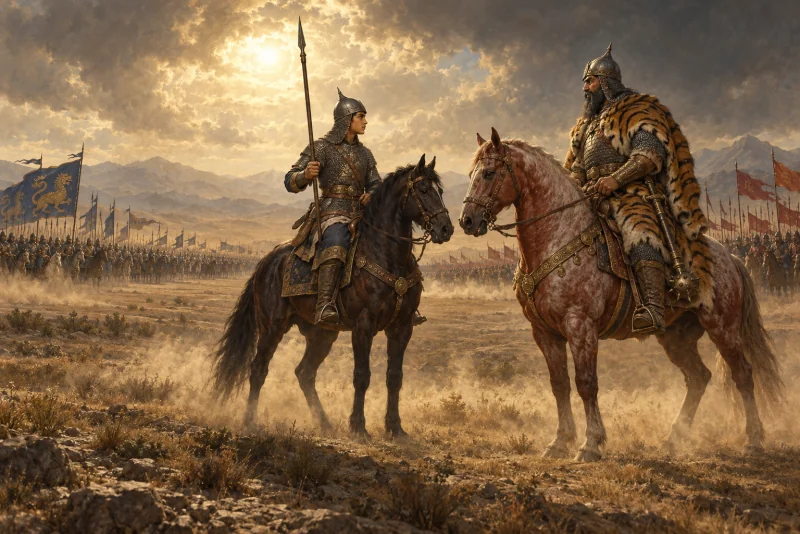
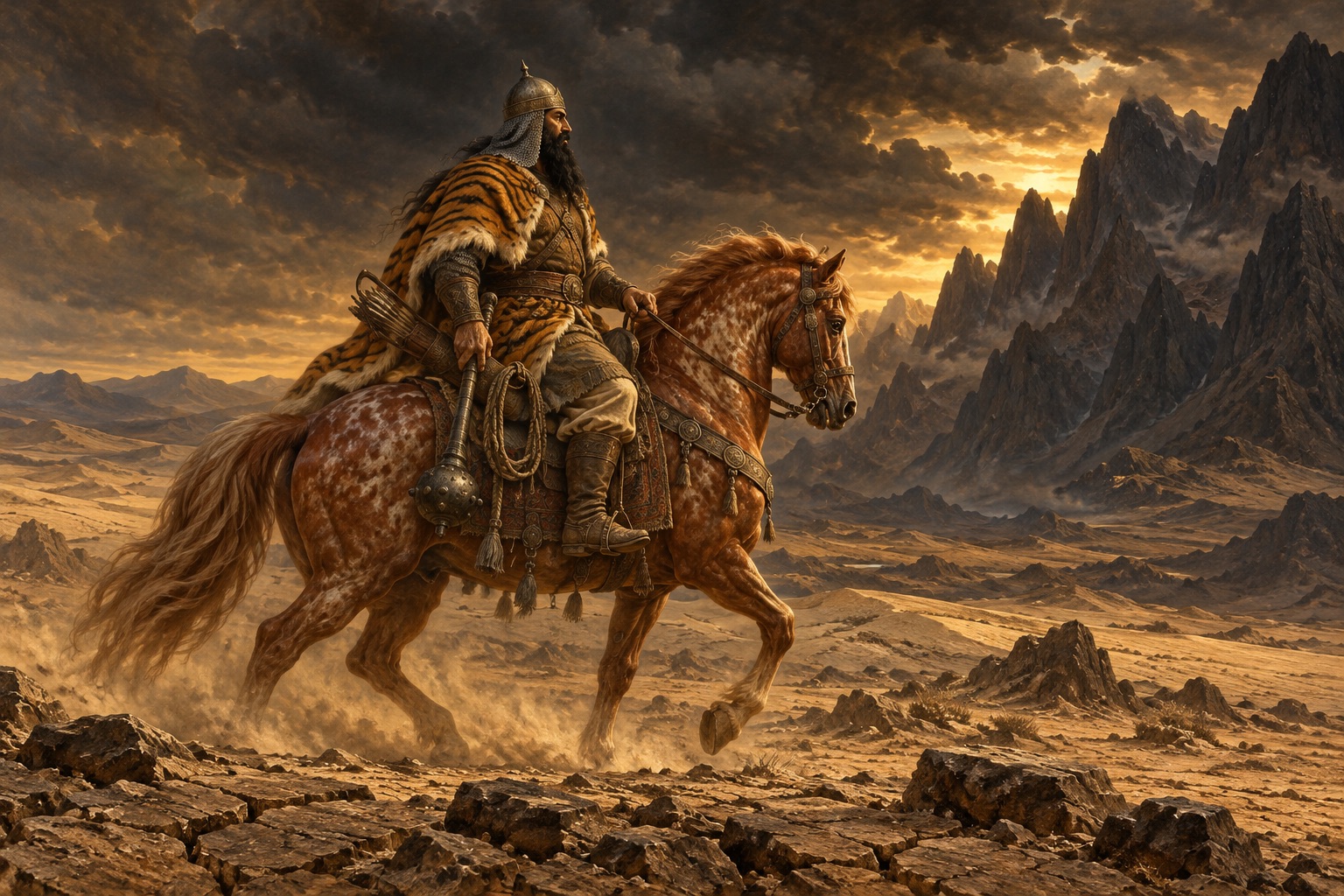
Rostam is the son of Zal, the white-haired prince of Sistan in the east of Iran, and the champion of its kings. He chose his horse himself. When Zal had his herds driven past, Rostam pressed each horse’s back with his hand, and each sank until its belly touched the ground. Then came a colt no one had been able to saddle, a piebald bay “like roses spread upon a ground of saffron”. Rostam caught him with his lasso, and the colt did not give under his hand. Asked the price, the old herdsman answered that if this was Rostam, the price was Iran: ride him and set the land to rights. The colt was Rakhsh (Warner, vol. 1, pp. 378–380).
In battle Rostam wears a coat over his armour that the poem calls the babr-e bayan. The Warners translate it “tiger-skin”; section 3 shows why the animal is not certain.
1-2 The Singer from Mazandaran
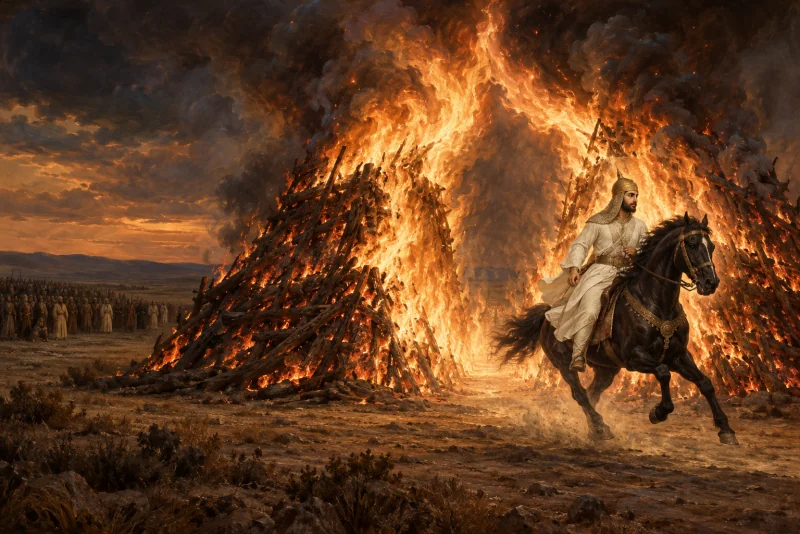
Kay Kavus sat drinking on his golden throne and asked who was king but he. A div came to the gate dressed as a minstrel from Mazandaran and sang of his homeland: tulips and roses on every height, rivers that seemed to run with rose-water, neither heat nor cold but spring all year. The king resolved to conquer it. He surpassed Jamshid, Zahhak and Kay Kobad in fortune and Grace, he told his warriors, and meant to surpass them in deeds.
The nobles turned pale and sent for Zal. Zal warned the king that no shah before him had attempted Mazandaran, “the home of warlock-divs and under spells / Which none hath power to loose”. Kavus answered that he was greater than his forefathers, left Zal and Rostam to rule Iran in his absence, and marched.
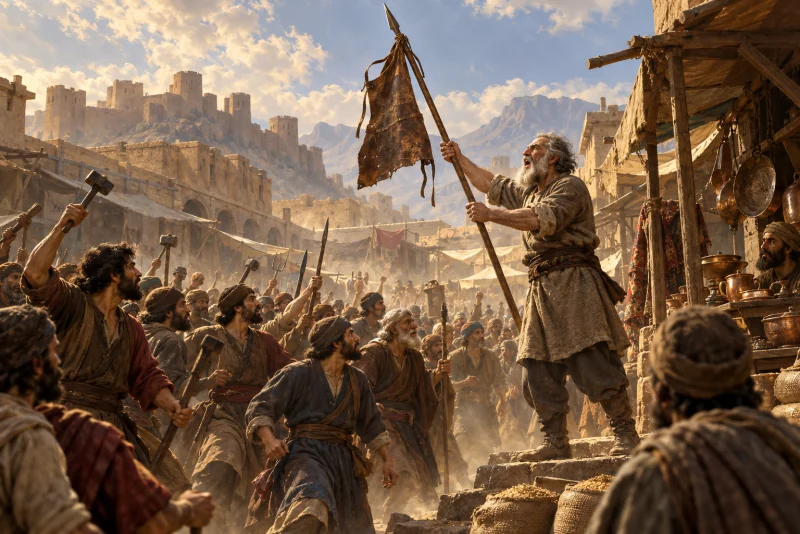
His vanguard under Giv burned the towns of Mazandaran and spared no one, and for a week the army plundered. Then the king of Mazandaran called on the White Div. At night a cloud covered the Iranian camp, a “tent of pitchy smoke”; stones and darts rained from the sky, and in the morning the king and most of his men were blind. The White Div set twelve thousand divs to guard them and sent their treasure to the king of Mazandaran with his general, the div Arzhang. He had not threatened Kavus with death, he said, only taught him “the ups and downs of fortune”.
Kavus sent a rider to Zal: “I often sigh to think on thine advice.” Zal told Rostam to saddle Rakhsh. There were two roads, he said: the long one Kavus had taken, and a short one, “a journey of two weeks”, through the haunts of divs and lions and darkness. “Choose thou the short, / And see its wonders; God will be thine aid.” Rostam put on the tiger-skin and rode out, while his mother Rudabeh wept (Warner, vol. 2, pp. 30–44).
1-3 Lion, Desert, Dragon
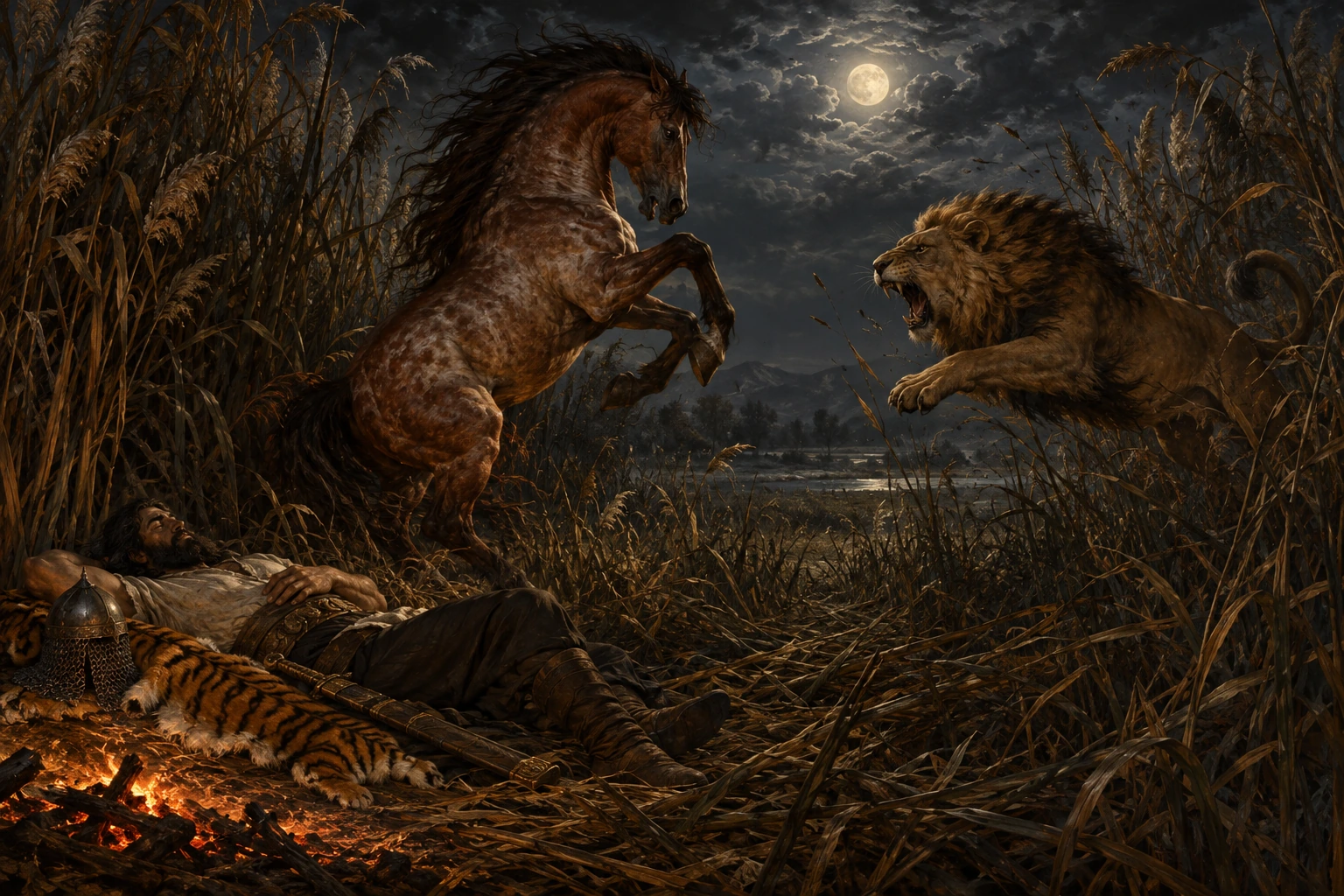
Rostam rode night and day, two days’ journey in one. On the first evening he roasted an onager over a fire struck from an arrowhead, turned Rakhsh loose and lay down to sleep in a reed-bed. It was a lion’s lair. The lion came out, decided to deal with the horse first, and sprang at Rakhsh. Rakhsh struck at its head and bit into its back until it was dead. Rostam woke and scolded him: had Rakhsh been killed, how would he have carried his helmet, bow, sword and mace to Mazandaran?
The second stage was a waterless desert, its heat so fierce that it “dried the birds to powder”. Rakhsh was spent, and Rostam fell with his tongue cracked from thirst and prayed. A well-fed ram passed by. Rostam followed it to a spring, then saw that it had left no tracks at the water: “It is no desert-sheep of flesh and blood!” He blessed it, washed Rakhsh, ate, and told the horse to fight no one: if a foe came, he was to run and wake his master.
That night a dragon came out of the waste. Rakhsh ran to wake Rostam, who saw only darkness and was angry. It happened again, and Rostam swore to cut off the horse’s head if he was woken once more. The third time Rakhsh hesitated, then, out of love for his master, woke him anyway, and now God let the dragon be seen. Before the fight they told each other their names, as warriors do. Rakhsh bit into the dragon’s shoulders, and Rostam cut off its head.
1-4 The Witch and the Marchlord
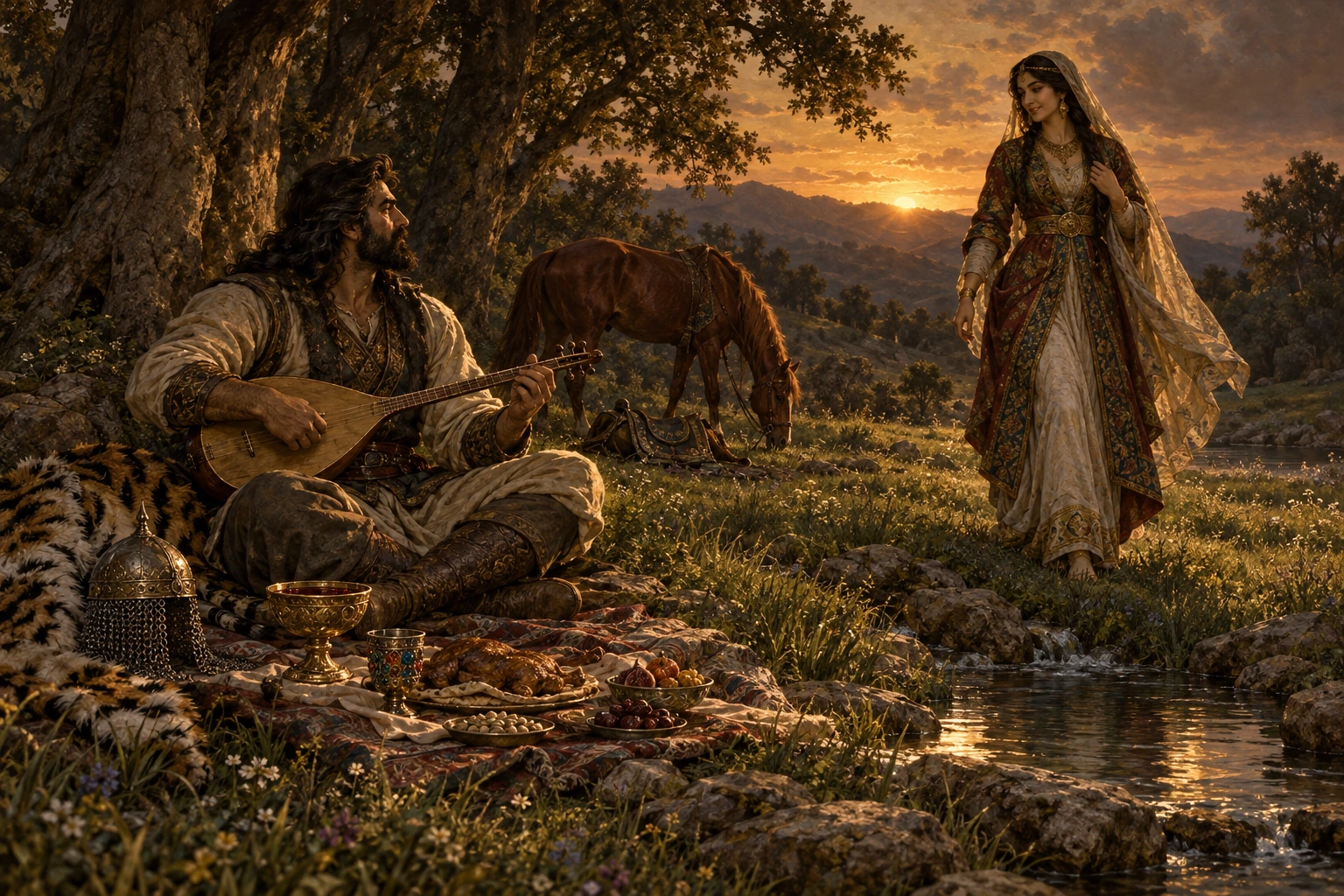
Next he came at sunset to a spring where a meal lay ready: a golden bowl of wine, a roasted sheep, bread, sweetmeats and a lute. It was a sorcerers’ feast. Rostam took up the lute and sang about himself: Rostam is an outcast with no days of pleasure, and “wilderness and mountain-height / Must serve him for a garden”. A witch heard, made herself beautiful and sat down beside him. He handed her a cup and named God as he did, and at the name her face turned black. He caught her in his lasso, saw a wrinkled hag, and killed her with his sword.
The fifth stage began in a darkness without moon or stars. Rostam came out into green fields, spread his soaked tiger-skin and helmet to dry, let Rakhsh loose in the crops and slept. A field-watchman struck him awake with a stick, and Rostam, without a word, wrung off his ears. The marchlord of the land, the young Olad (the Warners’ Ulad), rode up with his men. Rostam scattered them, caught Olad with his lasso and made him an offer: show me where the White Div lives and where Kavus is held, and I will make you king of Mazandaran.
1-5 Arzhang and the White Div
Olad led him to the mountain where the Iranians had been defeated. Rostam tied him to a tree, rode into the camp of the div Arzhang, seized him by the head and tore it off, and the divs fled. Then Olad took him to the city where Kavus was held. Rakhsh neighed, and the blind king knew the sound; his men thought he was talking in his sleep.
Kavus told Rostam the rest of the road: seven mountains full of divs, and then a cave, the White Div’s home. He passed on what his physicians said: three drops of the White Div’s blood in the eyes would cure the blindness.
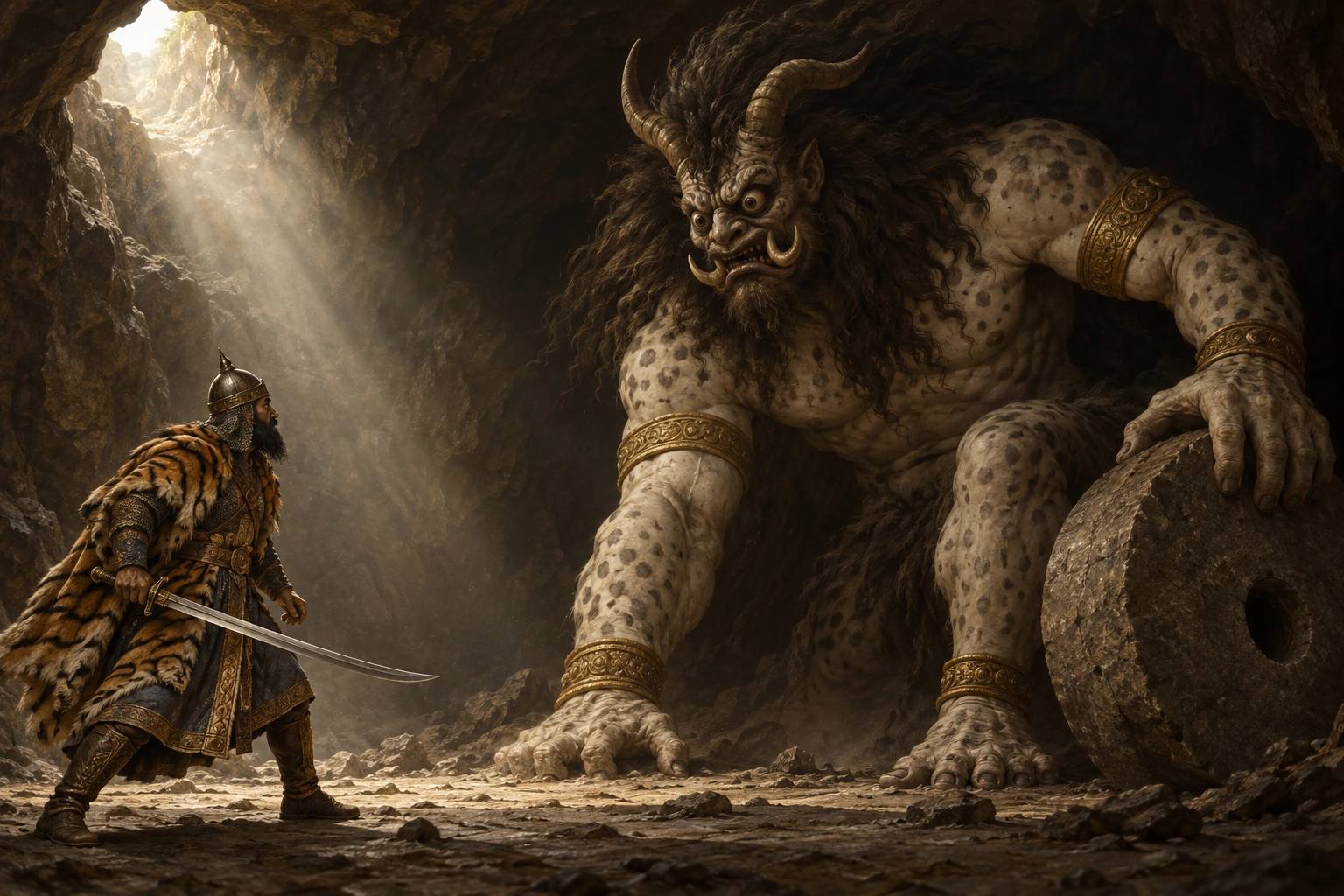
Olad advised waiting for the heat of noon, when the divs sleep. Then Rostam cut his way through the guards and went down into the cave. In the dark he made out a shape like a mountain, in the Warners’ words “with sable face / And hair like lion’s mane”. Rostam would not kill him asleep and woke him with a roar. The div came at him with a millstone. Rostam cut off a hand and a foot, and still the div fought on, until Rostam lifted him neck-high, threw him down, stabbed him and took out his liver.
The blood went on the king’s eyes and then on everyone’s, and they could see. After a further war, in which the king of Mazandaran turns himself into a rock and Rostam carries the rock to the camp, Kavus kept Rostam’s promise and crowned Olad king of Mazandaran (Warner, vol. 2, pp. 44–76).
2 Where the Story Is Written Down
- The Shahnameh. Ferdowsi finished it in 1010 and dedicated it to Mahmud of Ghazna; François de Blois counts “some 50,000 verses” (Encyclopaedia Iranica, “EPICS”). He worked from written sources, an “old book” in New Persian prose. Kuroyanagi Tsuneo names the chief of them as the prose Book of Kings completed in 957 for Abu Mansur (Nipponica).
- Editions. In the two standard critical editions the episode fills vol. 2, pp. 91–110 of the Moscow edition and vol. 2, pp. 21–44 of Djalal Khaleghi-Motlagh’s (Olga M. Davidson, Iranica, “HAFT ḴᵛĀN”). The Warners translated the older edition of Vullers and give its page numbers in their margins: the seven courses run from page 335 to 356.
- The Arabic histories. Esfandiyar’s seven stages appear in Arabic chronicles such as Tabari’s. Rostam’s do not: Theodor Nöldeke pointed out that no Arab historian reports them, not even Tha’alebi (Ehsan Yarshater, Iranica, “ESFANDĪĀR”). Tha’alebi tells Esfandiyar’s stages and, as he begins, takes a swipe at the tales of Sistan as far-fetched marvels (Davidson).
- After Ferdowsi. The Nozhat-nama-ye Ala’i, written in 1119–1120, dismisses much of Rostam’s story as “mere” fable, yet admits its charm and offers a sensible explanation for the king’s blindness (Davidson).
- Rostam outside the epic. A Middle Persian text, Draxt i asurig (“The Assyrian Tree”), already names him as Rodstahm (Yarshater). The Bundahishn, a Middle Persian compilation of the 9th century, has Rostam free Kay Us, its form of Kavus, and the captive Iranians (P. O. Skjærvø, Iranica, “KAYĀNIĀN v”). A fragmentary Sogdian text tells of his adventures and describes his coat (de Blois; Khaleghi-Motlagh, “BABR-E BAYĀN”).
3 Competing Versions
- Stages or courses? The Moscow edition spells the word khvan, “a laden tray, a feast”; Khaleghi-Motlagh’s spells khan, “a stage, a halt”. Most early manuscripts favour khvan. Davidson reads the double meaning as deliberate: the hero fights at each stage and eats a solitary meal after it. The Warners chose “The Seven Courses”, “a meal with seven courses”, and kept “The Seven Stages” for Esfandiyar’s.
- Two weeks or seven days? In the Warners, Zal calls the short road “a journey of two weeks”. Davidson, translating Khaleghi-Motlagh’s text, has “mountains and uplands for seven days and nights”.
- Blood, heart or liver? The Warners’ physician prescribes three drops of blood, and Rostam brings back the liver. Marianna Shreve Simpson notes that a single verse has Rostam stab the div, cut out his heart and tear out his liver. Painters of the 14th century chose different moments: two Injuid manuscripts of 1330 and 1333 show the stabbing, two smaller paintings the liver (Iranica, “ŠĀH-NĀMA iv. Illustrations”).
- Tiger, leopard or dragon? Babr means tiger, but the Shahnameh also calls the coat palangina, from palang, leopard, and so does the Sogdian text. Even here Zal tells Rostam to “don the tiger-skin”, while the watchman reports a man “with leopard-skin cuirass”. A story copied into one manuscript of the Shahnameh has the fourteen-year-old Rostam kill a dragon called Babr-e Bayan in India and make the coat from its hide; another says the coat came from heaven. Khaleghi-Motlagh reads bayan as a place-name and recalls that Heracles, too, wore the skin of an invulnerable beast, the lion named after Nemea, the place it had plagued (“BABR-E BAYĀN”; “AŽDAHĀ ii”). The twelve labours of Heracles and the seven of Rostam are a shared theme; we have not found a scholar who compares the two series.
- Where is Mazandaran? The Warners place it on the Caspian, the ancient Hyrcania, and call Olad’s account of its size “enormously exaggerated”. Mahmoud Omidsalar warns that the land of the divs is “not to be confused with” the modern province (Iranica, “DĪV”), and Khaleghi-Motlagh glosses the Mazandaran of the dragon’s stage as India (Iranica, “AŽDAHĀ ii”).
- Which rescue? In Tabari, Kavus is captured by the king of Yemen and freed by Rostam coming from Sistan; in the Bundahishn, Rostam frees him from the land of Shambaran (Skjærvø).
- Esfandiyar’s seven stages. Late in the poem the prince Esfandiyar rides to the Brazen Hold to free his sisters from King Arjasp, and passes seven stages of his own: two wolves, two lions, a dragon he fights from a spiked chariot, a witch undone by a talisman from Zarathustra, the Simurgh, a three-day snowstorm and a river crossing (Warner, vol. 5, pp. 116–153; Davidson). Unlike Rostam he goes with an army, a brother and a captured guide. Which series copies the other? Friedrich Spiegel thought Zoroastrian priests modelled Esfandiyar’s on Rostam’s to glorify their champion; Nöldeke thought the reverse; Kurt Heinrich Hansen answered Nöldeke. Yarshater concludes that minstrels and storytellers attached the same popular motifs to both heroes.
4 History and Tradition
- The hero of Sistan. Sistan takes its name from the Sakas, Iranian nomads who reached it around 120–80 BCE: Sakastan, “the land of the Sakas” (Pierfrancesco Callieri, Iranica, “SAKAS: IN AFGHANISTAN”). For Yarshater, the absence of Rostam and Zal from the Avesta is one sign that the stories of their house are Saka. They were joined to the Kayanian legends of the Avesta gradually, most probably between Alexander and the Sasanians, as Zoroastrianism spread among the Sakas (“ESFANDĪĀR”). A. Shapur Shahbazi argued that the full stories of the house of Rostam reflect a Parthian family that ruled the old Sistan until Ardashir I destroyed it (Iranica, “ZĀL”).
- Painted before Ferdowsi. In Panjikent (Panjikant), a Sogdian city in today’s Tajikistan, the halls of houses were often painted with “the exploits of Rostam” (Boris I. Marshak, Iranica, “PANJIKANT”). Markus Mode dates the house paintings of the Rustam cycle to about 650–722 (“SOGDIANA iv”). Sugimura Tō calls them the oldest pictures of the stories later gathered into the Shahnameh (Heibonsha World Encyclopedia).
- In the manuscripts. The seventh course, Rostam and the White Div, was frequently painted in the illustrated Shahnamehs of the 14th century, though no painter was obliged to include it (Simpson).
- Told aloud. The Shahnameh itself calls Rostam divband, “binder of demons” (Omidsalar). The tales lived on in speech: the folklorist Abu’l-Qasem Enjavi Shirazi collected them from townspeople and villagers all over Iran (Davidson), and in these oral versions the White Div is still prominent (Omidsalar).
Rostam is often presented as a hero of the Avesta, as old as the hymns of Zarathustra. He is not in it. Its hymns name Jamshid (Yima), Zahhak, Fereydun, the dragon-slayer Garshasp, Kay Kavus (Kavi Usa) and Esfandiyar, and even “the Daevas of Mazana” (Yasht 5.22), but not Rostam, and not Zal (de Blois, “EPICS”; Yarshater, “ESFANDĪĀR”). He enters the record later, in Middle Persian and Sogdian texts and on Sogdian walls.
5 Related Stories
- Rostam and Sohrab: The Father Who Killed His Son: it opens like the first course. Rostam hunts, roasts an onager and sleeps while Rakhsh grazes, but this time Turkmen horsemen take Rakhsh, and the search leads him to Samangan (Warner, vol. 2, pp. 120–122).
- The Simurgh: The Great Bird of the Alborz: Esfandiyar kills a Simurgh in his fifth stage. When he later fights Rostam, a Simurgh heals Rostam and shows him how Esfandiyar can be killed; Yarshater calls it the mate of the bird Esfandiyar killed.
- Jamshid: The King of the Golden Age and His Cup: Kavus boasts that he surpasses Jamshid. His nobles say among themselves that Jamshid, with divs at his command, never once spoke of Mazandaran.
- Ahura Mazda and Angra Mainyu: The Two Spirits: the demons of Mazandaran are older than Rostam. In the Aban Yasht the hero Haoshyangha already asks to smite “two thirds of the Daevas of Mazana”, and that post tells who the daevas are.
- Heracles: The Twelve Labours and the Pyre on Mount Oeta: the Greek hero of a numbered series of labours, who wore the skin of the lion of Nemea that Khaleghi-Motlagh recalls. We have not found a scholar who compares the two series; we link them for the theme.
6 Sources
- Ferdowsi, The Shahnama of Firdausi, trans. Arthur George Warner and Edmond Warner, vol. 1 (1905), pp. 378–380; vol. 2 (1906), pp. 27–78 and 120–122; vol. 5 (1910), pp. 116–153, from the edition of J. A. Vullers: archive.org, archive.org, archive.org
- Avesta, Aban Yasht (Yasht 5) and Zamyad Yasht (Yasht 19), trans. James Darmesteter (Sacred Books of the East, American edition, 1898): avesta.org, avesta.org
- Encyclopaedia Iranica: Olga M. Davidson, “HAFT ḴᵛĀN” (2002); Ehsan Yarshater, “ESFANDĪĀR (1)” (1998); Dj. Khaleghi-Motlagh, “BABR-E BAYĀN” (1988) and “AŽDAHĀ ii. In Persian literature” (1987); François de Blois, “EPICS” (1998); P. O. Skjærvø, “KAYĀNIĀN v. Kauui Usan, Kay-Us, Kay Kāvus” (2000); Mahmoud Omidsalar, “DĪV” (1995); A. Shapur Shahbazi and Simone Cristoforetti, “ZĀL” (2009); Pierfrancesco Callieri, “SAKAS: IN AFGHANISTAN” (2016): Haft Khan, Esfandiyar, Babr-e Bayan, Azhdaha, Epics, Kay Kavus, Div, Zal, Sakas
- Encyclopaedia Iranica: Boris I. Marshak, “PANJIKANT” (2002); Markus Mode, “SOGDIANA iv. Sogdian art” (2009); Marianna Shreve Simpson, “ŠĀH-NĀMA iv. Illustrations” (2009): Panjikant, Sogdian art, Illustrations
- Kuroyanagi Tsuneo, “シャーナーメ”, Nipponica, and Kuroyanagi Tsuneo and Sugimura Tō, “シャーナーメ”, Heibonsha World Encyclopedia: Kotobank; Japanese translations: Kuroyanagi Tsuneo, Ōsho: Perushia eiyū jojishi (Heibonsha, Tōyō Bunko 150, 1969); Okada Emiko, Ōsho: Kodai Perusha no shinwa, densetsu (Iwanami Bunko, 1999): NDL, NDL
Cover and illustrations: AI-generated images made for Arcana. They are interpretations, not historical artworks.