Jamshid: The King of the Golden Age and His Cup
Under Yima, says the Avesta, no one grew old or died; the day Jamshid rose into the sky on his throne, says the Shahnameh, was the first New Year. Then he called himself the maker of the world and lost his glory, and in the epic the famous cup of Jamshid is not his at all.
- Type: myth and epic, the first king of a golden age and his fall
- Culture: ancient Iran; the Zoroastrian scripture and the Persian epic of the Islamic era
- Earliest texts: the Avesta, handed down by word of mouth and written down around the 6th century CE: one verse of the Gathas (Yasna 32.8), the hymns Yasna 9 and Yasht 19, and Vendidad 2; then Ferdowsi’s Shahnameh, finished in 1010 CE
- Key figures: Yima (Jamshid), Ahura Mazda, the royal glory (khvarenah, in Persian farr), the divs, Zahhak, Kay Khosrow
Every spring, at the equinox, families from Iran to Central Asia sit down to Nowruz, the “New Day”. Ferdowsi’s Shahnameh says the first one was the day a king had his throne lifted into the sky. That king was Jamshid. Long before Ferdowsi, the Zoroastrian scripture knew him as Yima, the shepherd-king under whom no one grew old or died, and who saved the best of every living kind from a killing winter.
Was Jamshid a real king? Not one that history knows. He is the Yima of the Avesta: his name joins Yima to xšaēta, “king”, a word Persians came to read as “shining”. Yima’s father Vivanghvant answers to Vivasvat in the Indian Vedas, whose son Yama became the king of the dead. And the great ruins that Iranians call Takht-e Jamshid, “Jamshid’s throne”, are Persepolis, a palace city that the Achaemenid king Darius I began in the late 6th century BCE.
1 The Telling
Jamshid’s story has two layers. The older is the Avesta, the scripture of Zoroastrianism, quoted here in James Darmesteter’s translation (Sacred Books of the East 4 and 23, 1880–1883). The younger is Ferdowsi’s Shahnameh, a Persian epic of the Islamic era: literature that draws on the old tradition, not scripture. It is quoted in the verse translation of Arthur and Edmond Warner (vol. 1, 1905) and checked against the Persian text.
1-1 The Shepherd Who Would Not Preach
In the second chapter of the Vendidad, Zarathustra (Zoroaster) asks Ahura Mazda who was the first mortal he spoke with before him. “The fair Yima, the good shepherd,” the god answers. He had asked Yima, son of Vivanghvant, to preach and carry his religion, and Yima refused: “I was not born, I was not taught to be the preacher and the bearer of thy Religion” (Vd 2.1–3).
Then rule my world instead, said Ahura Mazda: make it grow, nourish it and watch over it. Yima agreed, and promised that while he was king there would be “neither cold wind nor hot wind, neither disease nor death”. Ahura Mazda gave him two implements, which Darmesteter translates as “a golden seal and a poniard inlaid with gold” (2.4–6). What they really were is still argued over (section 3).
1-2 Three Times Larger
Three hundred winters passed, and the earth filled with flocks and herds, men, dogs, birds and “red blazing fires”, until there was no more room. Warned by Ahura Mazda, Yima stepped out southwards, in light, on the path of the sun. He pressed the earth with the golden seal, bored it with the poniard and called on Spenta Armaiti, the spirit of the earth: “kindly open asunder and stretch thyself afar.” The earth grew by a third (2.8–11). After six hundred winters it was full again and he did it a second time, and after nine hundred winters a third (2.12–19).
1-3 The Winter and the Var
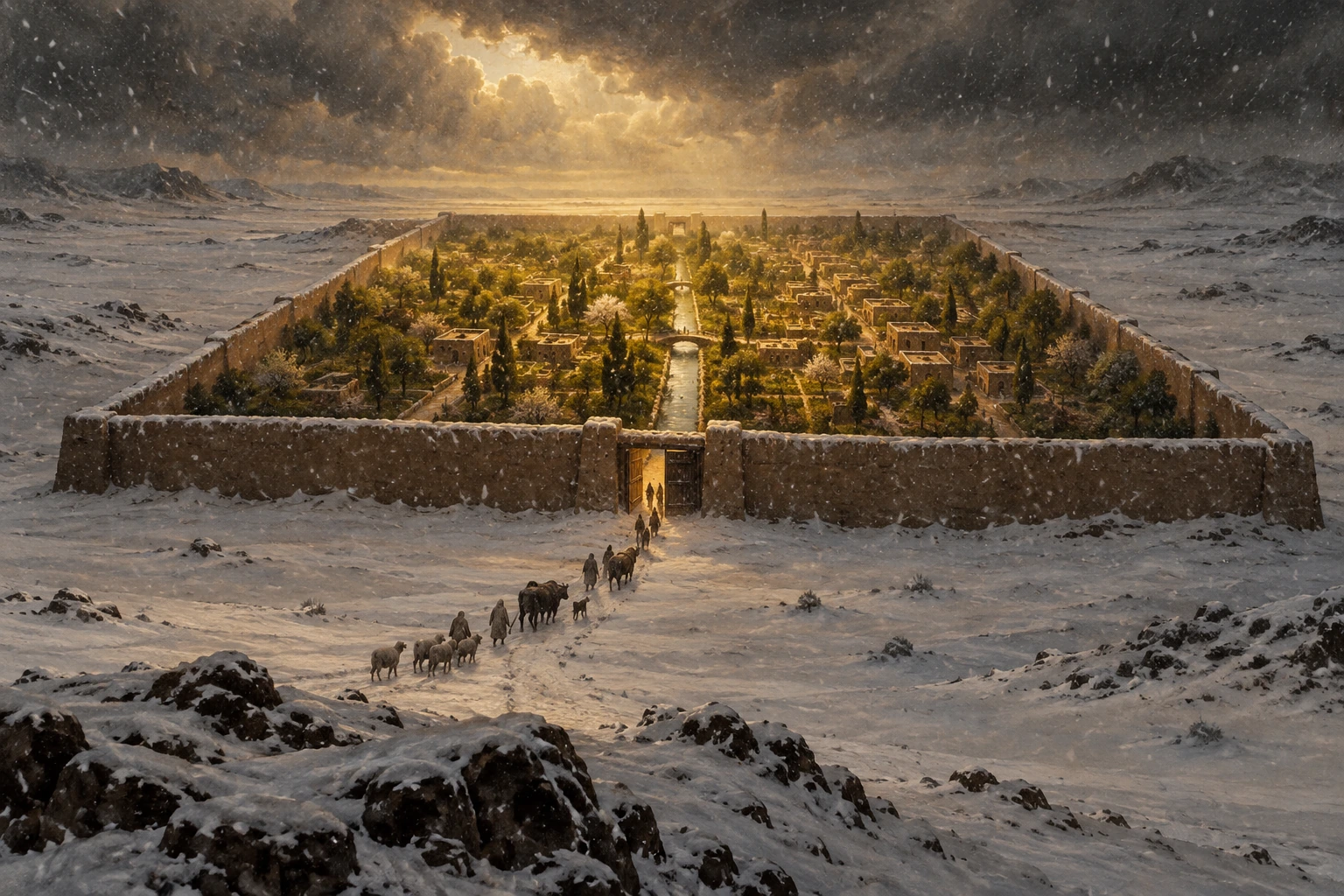
Then Ahura Mazda called the heavenly beings to a meeting in Airyana Vaejah, by the river Daitya, and Yima came with the best of mortals. Evil winters were about to fall on the world, the god said, with a fierce, deadly frost and snow lying deep even on the highest mountains. When it melted, the sight of a sheep’s footprint would be “a wonder in the world” (2.20–24).
So Yima was to build a var, an enclosure “long as a riding-ground on every side of the square”. Into it he was to bring the seed of the finest men and women, of every kind of cattle, of the tallest and most fragrant trees and the best fruits, “two of every kind”, with running water, birds and green that never fades. No one deformed was to enter, no liar, no jealous man, none who bore the marks that Angra Mainyu stamps on mortal bodies (2.25–30). When Yima wondered how to build it, Ahura Mazda told him to stamp the earth with his heel and knead it with his hands, “as the potter does” (2.31).
Yima did as he was told, and sealed the var with a door and a window that shone from within (2.32–38). Inside, no one sees the stars, the moon or the sun, and “a year seems only as a day”. Every fortieth year each couple has two children, a boy and a girl, and the people of the var “live the happiest life”. The bird Karshipta brought the religion to them (2.39–42).
1-4 The Glory Takes Wing
Yasht 19, the hymn to the royal glory, khvarenah, tells how Yima lost it. The glory clung to him for a long time, while he ruled the seven regions of the earth, demons and men alike. In his reign food never failed, men and flocks did not die, and there was “neither old age nor death”, “before he began to have delight in words of falsehood and untruth” (Yt 19.31–33).
Then “the Glory was seen to flee away from him in the shape of a bird”. Yima trembled before his enemies and lay down on the ground (19.34). Three times the glory left him as a vareghna bird. Mithra caught it the first time; Thraetaona, who overcame the three-headed dragon Azhi Dahaka, the second; and the hero Keresaspa the third (19.35–38). The hymn never says what the lie was.

1-5 Jamshid the Maker
In the Shahnameh, Jamshid succeeds his father Tahmuras. “His girdle was the Grace of king of kings”, the Warners translate (vol. 1, p. 131): the Grace is the farr, the royal glory. Divs, birds and peris obey him. “Mine is the Grace,” he says, “I am both king / And archimage.”
He spends his reign in spans of fifty years. In the first he forges helmets, mail and armour; in the second he makes linen, silk and wool into cloth and teaches people to spin, weave, wash and sew. In the third he divides people into four classes: priests, who worship on the mountains, warriors, free farmers and craftsmen. Then he has the divs mix earth with water, mould bricks and raise baths, high halls and sanctuaries. He draws rubies, silver and gold out of the rocks, brings in camphor, musk, aloe, ambergris and rose-water, opens the secrets of medicine and crosses the sea in ships (pp. 132–133).
1-6 The Throne in the Sky
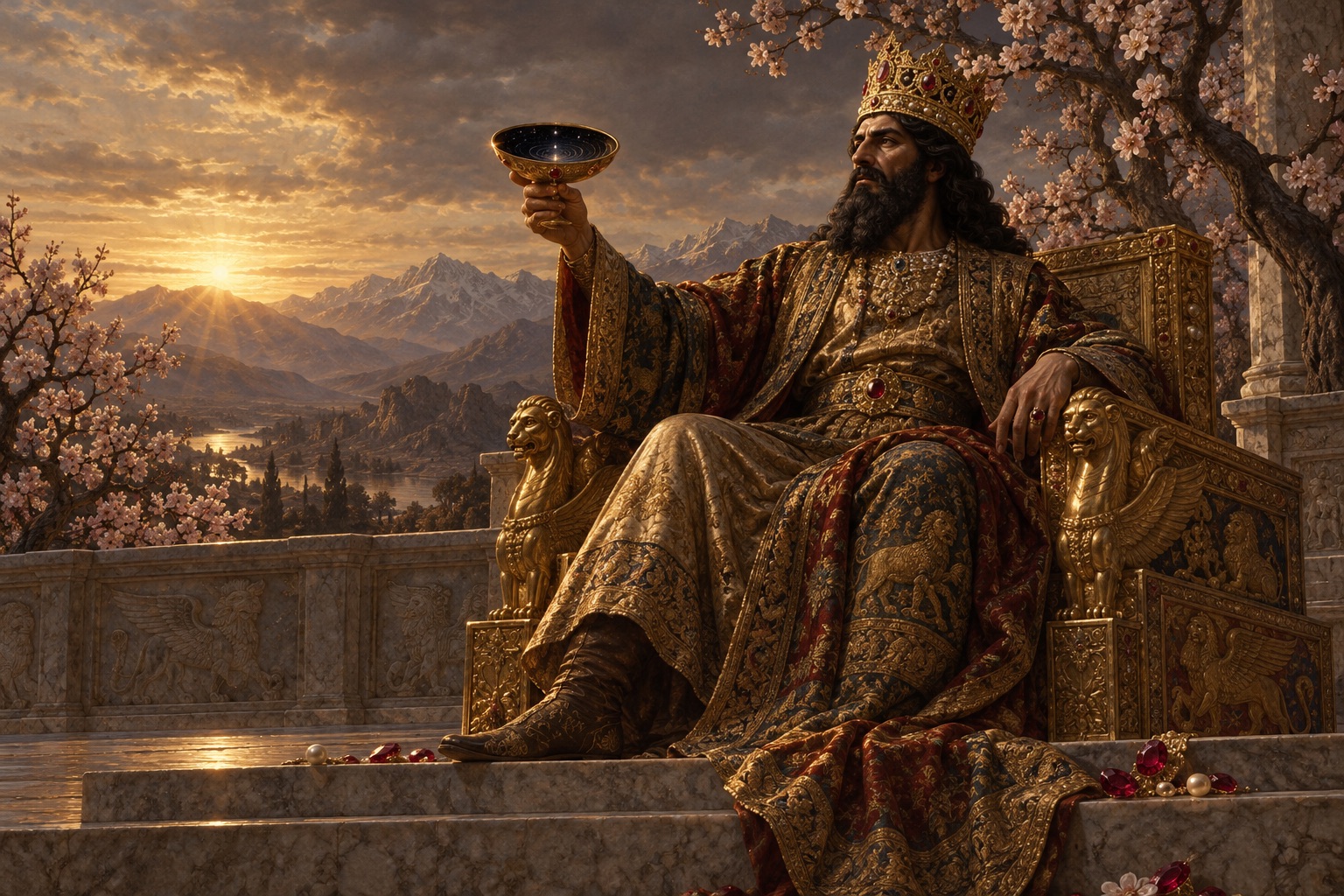
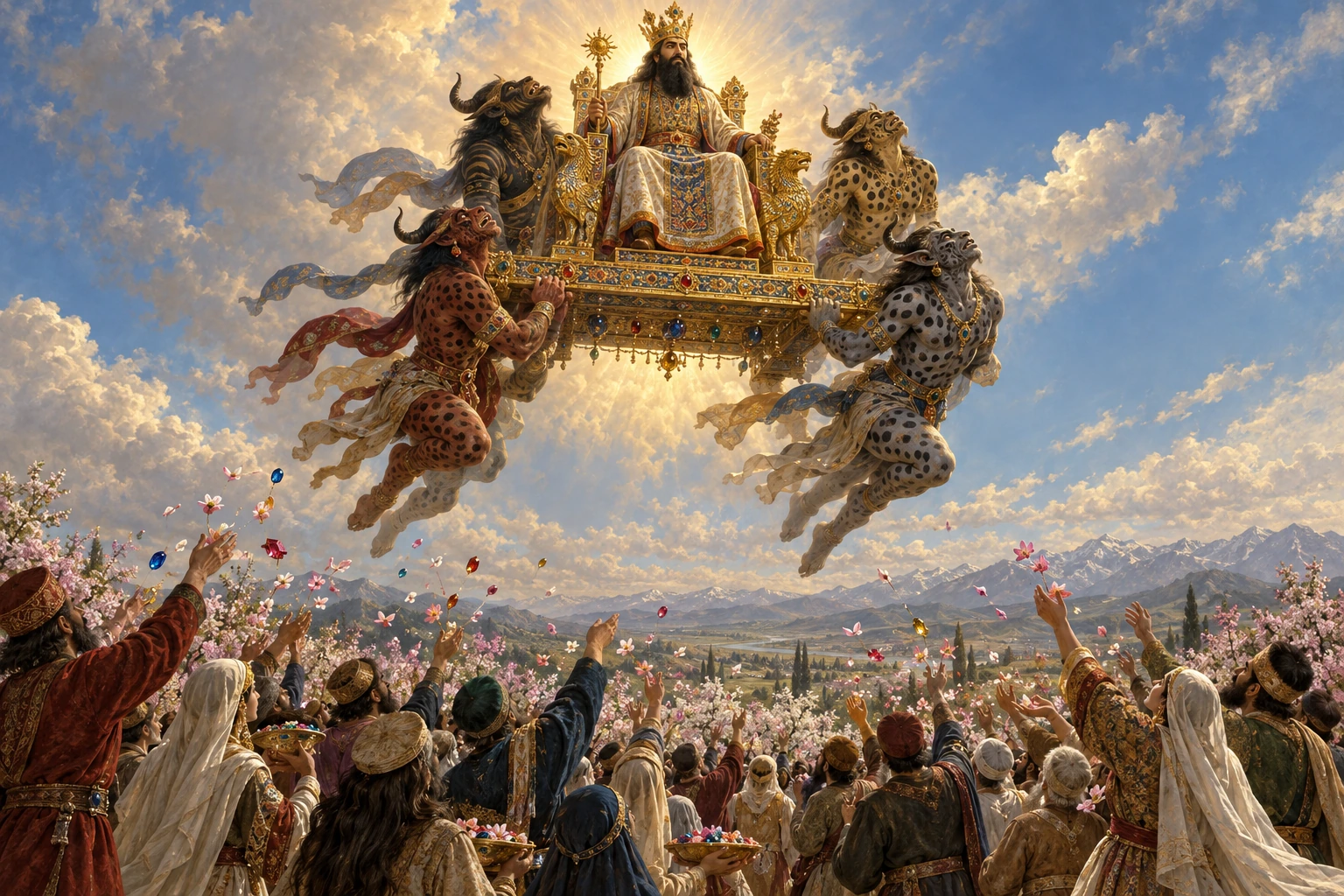
Then he made a throne set with gems, which the divs lifted from earth to heaven whenever he wished. There the Shah “sat sunlike in mid air”. The world gathered in wonder, scattered jewels over him and gave the day a name: in Ferdowsi’s Persian ruz-e now, “the new day”, the first of the month Farvardin and of the year. The nobles held a feast, and “ever since that time that glorious day / Remaineth the memorial of that Shah” (pp. 133–134). For three hundred years after that, no one saw death.
1-7 “The Maker of the World”
One day Jamshid looked at his throne and saw no one equal to himself. He summoned the chiefs and told them that every art had come from him and that he had stayed disease and death: “All hail me as the Maker of the world” (p. 134). The priests hung their heads, and God’s Grace left him. The court emptied. He wept “tears / Of blood” for pardon, but the Grace did not come back (p. 135).
Rebellion broke out, and the discontented nobles went over to Zahhak, “the king of dragon-visage”, who seized the throne. Jamshid fled and hid for a hundred years, until he appeared by the sea of Chin, as the poem calls China, and Zahhak had him sawn in two (pp. 139–140). He had reigned seven hundred years.
2 Where the Story Is Written Down
- The Gathas, the oldest part of the Avesta, name Yima once, among sinners. In Christian Bartholomae’s translation of Yasna 32.8, Yima, “desiring to satisfy men gave our people flesh of the ox to eat”.
- Yasna 9, the hymn to Haoma, the sacred drink. Vivanghvant was the first man to prepare it, and his reward was a son, Yima, “the sunlike-one of men”. In his reign there was “neither cold nor heat, there was neither age nor death”, and father and son looked as young as boys of fifteen (9.4–5, trans. L. H. Mills).
- Yasht 19, the hymn to the royal glory, verses 30–38 and 46.
- Vendidad 2. The Vendidad is a book of laws for driving away evil and impurity; its second chapter tells the whole story of Yima, the var included. The Avesta was handed down orally for a long time and written down around the 6th century CE, under the Sasanians, in a script made for it (Yamamoto Yumiko, Nipponica).
- The Bundahishn, a Middle Persian compendium of Zoroastrian lore whose last important redaction, Mary Boyce writes, belongs to about the end of the 9th century. It counts Yim’s reign “till his glory departed” as 616 years and six months, followed by a hundred years in hiding (34.4), and puts the var “in the middle of Pars”, below Mount Yimakan (29.14).
- Al-Biruni, The Chronology of Ancient Nations, written in Arabic around 1000 CE. His chapter on the Persian festivals collects the stories told to explain why Nowruz belongs to Jamshid (section 4).
- The Shahnameh, which Ferdowsi finished, by his own dating, in the year 400 of the Hijra, that is 1010 CE (Warner, vol. 1, p. 24). The Warners render farr as “Grace” or “Glory” and note that the Avesta treats it as something that “could be sought, seized, and carried off” (p. 82).
3 Competing Versions
- What did Ahura Mazda give Yima? Darmesteter’s “golden seal and poniard” is one reading among many. Mirosław Michalak lists what translators have made of the first Avestan word, suβrā-: a spear, a seal or signet ring, an arrow, a ploughshare, a pick, a horn. He argues that the two objects are a herdsman’s tools, a goad and a whip, which suits a king the text calls “the good shepherd”.
- Whose son was he? The Avesta makes him the son of Vivanghvant (Yasna 9, Vendidad 2), the Shahnameh the son of Tahmuras. In the Bundahishn, Yim, Tahmurasp, Spitur and Narsih are brothers, and Yim has a sister, Yimak (31.3–4).
- What was his sin? In the Gathas, giving people the flesh of the ox; in Yasht 19, an unnamed lie; in the Shahnameh, calling himself the maker of the world. Kuroyanagi Tsuneo’s article on Yima in Nipponica sets the scripture’s reason beside the epic’s.
- How long did he reign? In Vendidad 2, nine hundred winters pass before the third enlargement; in the Bundahishn, 616 years and six months, then a hundred years hidden; in the Shahnameh, seven hundred years.
- Who killed him? Yasht 19 names Spityura, “he who sawed Yima in twain” (19.46). In the Bundahishn, Spitur and Dahak (Zahhak) cut him up together (31.5). In the Shahnameh, Zahhak alone has him sawn apart. Al-Biruni calls the killer Bewarasp, “his sister’s son”; Biwarasp is one of Zahhak’s names in the Shahnameh.
- Yima and Yama. The Warners note that in the Vedas Yama is a son of Vivasvat, as Yima is the son of Vivanghvant. The Japanese Britannica International Encyclopedia pairs Yima and his twin sister with Yama and his sister Yami. But where Yima ruled a world without death, Yama became the ruler of the dead, and through Buddhism the Enma of Japan (Kuroyanagi, Nipponica).
4 History and Tradition
- Nowruz. Al-Biruni gives several reasons why Nowruz is Jamshid’s day. In one, his carriage, borne by jinn and divs, flew in a single day from Damavand to Babylon, and people swung on swings to imitate him. In another, Jam came back from the south and “rose on that day like the sun”, so that people saw two suns and said “roz-i-nau, i.e. a new day” (pp. 200–202). Nowruz falls every year on the spring equinox, usually 21 March. UNESCO first inscribed it on its Representative List of the Intangible Cultural Heritage of Humanity in 2009, and the shared listing has since grown to thirteen countries, from Türkiye and Iraq to India and Mongolia.
- Takht-e Jamshid. Persepolis was built by Darius I and Xerxes I, and burned in 330 BCE after Alexander’s army took it. Iranians call its ruins Takht-e Jamshid, “Jamshid’s throne” (Satō Susumu, Heibonsha World Encyclopedia). Edward FitzGerald’s Rubáiyát of Omar Khayyám (1859) carried the name into English verse: “They say the Lion and the Lizard keep / The Courts where Jamshyd gloried and drank deep”. His note calls Persepolis “Takht-i-Jam-shyd—THE THRONE OF JAMSHYD”.
- Jamshid and Solomon. A builder-king served by demons was easily taken for Solomon. Kuroyanagi quotes the historian al-Dinawari (d. 895), who reports Ibn al-Muqaffa’s complaint that ignorant Persians took King Jam for Solomon son of David, when three thousand years and more lay between them. Al-Biruni’s first story of Nowruz is told of Solomon.
- The cup of Jam. In Persian poetry the jam-e jam, the cup of Jam, shows the whole world. Kuroyanagi names Ferdowsi as the first poet of New Persian to use such a cup, finds none tied to Kay Khosrow, its owner in the epic, in the older Iranian texts, and cannot say whether Ferdowsi invented it. From the 12th century, Sufi poets read it as the heart: Sanai (d. 1141) tells his reader to know that the cup of Jam is his own heart. Hafez (d. 1389) opens a famous ghazal, in our translation: “For years my heart asked us for the cup of Jam, / and begged from strangers what it had itself.” In the end the Magian elder, wine-cup in hand, says the Wise One gave him this world-seeing cup “the day He made this azure dome”. FitzGerald’s “Jamshyd’s Sev’n-ring’d Cup”, his note says, “was typical of the 7 Heavens, 7 Planets, 7 Seas, &c., and was a Divining Cup”; Kuroyanagi traces the rings to a legend of seven lines engraved on the cup.
The cup of Jamshid is often told as part of Jamshid’s own story. In the Shahnameh it is not his. Ferdowsi gives the “world-showing cup”, jam-e giti-nama, to Kay Khosrow, who looks into it on Nowruz and sees the young hero Bizhan chained in a pit in Turan (Warner, vol. 3, pp. 317–319). Kuroyanagi Tsuneo, following Mohammad Moin, reports that it went on being called Kay Khosrow’s cup until about the 12th century; only then did poets make it the cup of Jam.
5 Related Stories
- Zahhak: The King with Serpents on His Shoulders: the king who takes Jamshid’s throne and has him sawn in two. In Yasht 19 the dragon Azhi Dahaka, the Avestan Zahhak, wrestles with the fire Atar for the glory Yima lost.
- Siyavash: The Trial by Fire: his son Kay Khosrow owns the world-showing cup in the Shahnameh. The Warners’ summary of his reign says he gave up the world fearing that, “like Jamshid”, he too might fall away “by reason of his great successes”.
- Mithra: The God of the Covenant: in Yasht 19, Mithra is the first to seize the glory when it flies from Yima.
- Utnapishtim: The Flood Survivor, and the Older Atrahasis: Darmesteter found it “difficult not to acknowledge” in Yima’s var an adaptation of the flood story, “whether it was borrowed from the Bible or from the Chaldaean mythology”. In both, a righteous man warned by his god builds a refuge for the seed of every living kind; in the Avesta the danger is a winter and the thaw after it.
6 Sources
- Vendidad 2 and Yasht 19, trans. James Darmesteter, The Zend-Avesta, parts I and II (Sacred Books of the East 4 and 23, 1880 and 1883; American edition, 1898), digital edition by Joseph H. Peterson: avesta.org, avesta.org
- Yasna 9, trans. L. H. Mills (Sacred Books of the East 31), revised by J. H. Peterson; Yasna 32, trans. Christian Bartholomae, from I. J. S. Taraporewala, The Divine Songs of Zarathushtra: avesta.org
- Bundahishn, chapters 29, 31 and 34, trans. E. W. West (Sacred Books of the East 5), with Mary Boyce’s note: avesta.org
- Ferdowsi, The Shahnama of Firdausi, trans. Arthur George Warner and Edmond Warner, vol. 1 (Kegan Paul, 1905), pp. 24, 82, 129–140, and vol. 3 (1908), pp. 285 and 317–319: archive.org, archive.org; Persian text of the Moscow edition: Ganjoor, Ganjoor
- Al-Biruni, The Chronology of Ancient Nations, trans. C. Edward Sachau (W. H. Allen, 1879), chapter IX, pp. 199–203: archive.org
- Hafez, ghazal 143, in the edition of Mohammad Qazvini and Qasem Ghani: Ganjoor
- Edward FitzGerald, Rubáiyát of Omar Khayyám, first and fifth editions, with his notes: Project Gutenberg
- Kuroyanagi Tsuneo, “ペルシア文学におけるジャムの酒杯” (Jam-e Jam in Persian Literature), Orient 17:2 (1974), pp. 87–100: J-STAGE
- Mirosław Michalak, “Reconsidering a Paragraph of the Pahlavi Vidēvdād and Its Translation”, Folia Orientalia — Bibliotheca 2 (2025), pp. 29–36: Polish Academy of Sciences
- “イマ” (Kuroyanagi Tsuneo, Nipponica; Britannica International Encyclopedia), “ペルセポリス” (Satō Susumu, Heibonsha World Encyclopedia; Britannica International Encyclopedia), “アベスタ” (Yamamoto Yumiko, Nipponica), “フィッツジェラルド” (Saotome Tadashi, Nipponica): Kotobank, Kotobank, Kotobank, Kotobank
- UNESCO, “Nawrouz, Novruz, Nowrouz, Nowrouz, Nawrouz, Nauryz, Nooruz, Nowruz, Navruz, Nevruz, Nowruz, Navruz”; United Nations, “International Nowruz Day”: UNESCO, un.org
- Japanese translations of the Shahnameh: Kuroyanagi Tsuneo, Ōsho (Heibonsha, Tōyō Bunko 150, 1969); Okada Emiko, Ōsho: Kodai Perusha no shinwa, densetsu (Iwanami Bunko, 1999): NDL, NDL
Cover and illustrations: AI-generated images made for Arcana. They are interpretations, not historical artworks.