Utnapishtim: The Flood Survivor, and the Older Atrahasis
A god spoke to a reed wall, a man built a boat, and after the flood the gods gathered like flies at his sacrifice. Gilgamesh hears it from Utnapishtim himself, but scribes were copying the story a thousand years before the epic's Nineveh tablets, with the hero called Atrahasis.
- Type: myth, the great flood and the one man the gods made immortal
- Culture: Mesopotamia, in what is now Iraq; Sumerian and Babylonian
- Earliest texts: Atrahasis, in copies made under Ammi-ṣaduqa of Babylon (17th century BCE), and a Sumerian flood story on an Old Babylonian tablet from Nippur; the best-known telling, Tablet XI of the Standard Babylonian Epic of Gilgamesh, survives in copies of the 7th century BCE from Nineveh
- Key figures: Utnapishtim (also called Atrahasis; in Sumerian, Ziusudra) and his wife, Ea / Enki, Enlil, Anu, Bēlet-ilī (Nintu, Mami), Adad, Shamash, Gilgamesh
Far away, at the mouth of the rivers, lives the one man the gods ever made immortal. When Gilgamesh reaches him and asks how he found life, Utnapishtim answers with a story: the flood. It was an old story even then. Under the name Atrahasis, the same man is the hero of a Babylonian poem copied a thousand years before the Nineveh tablets of the epic, and Sumerian scribes called him Ziusudra.
Why is Utnapishtim called Atrahasis in Tablet XI? Because the epic took its flood from an older poem, and twice the old name slips into his own account: the townspeople gather at Atrahasis’s gate (XI 49), and Ea tells the gods he only let Atrahasis see a dream (XI 197). Atrahasis, “exceedingly wise”, is the hero of Atrahasis, and it is, in John Day’s words, “generally accepted” that the Gilgamesh flood story is based on it.
1 The Telling
Utnapishtim tells it himself in Tablet XI of the Standard Babylonian epic. Line numbers follow Andrew George’s edition in the electronic Babylonian Library (eBL); quotations are from R. Campbell Thompson’s translation of 1928.
1-1 The Reed Wall
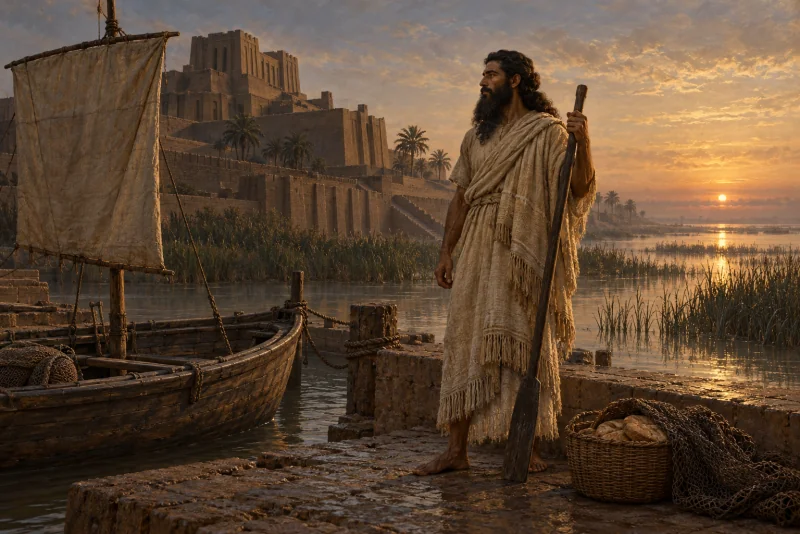
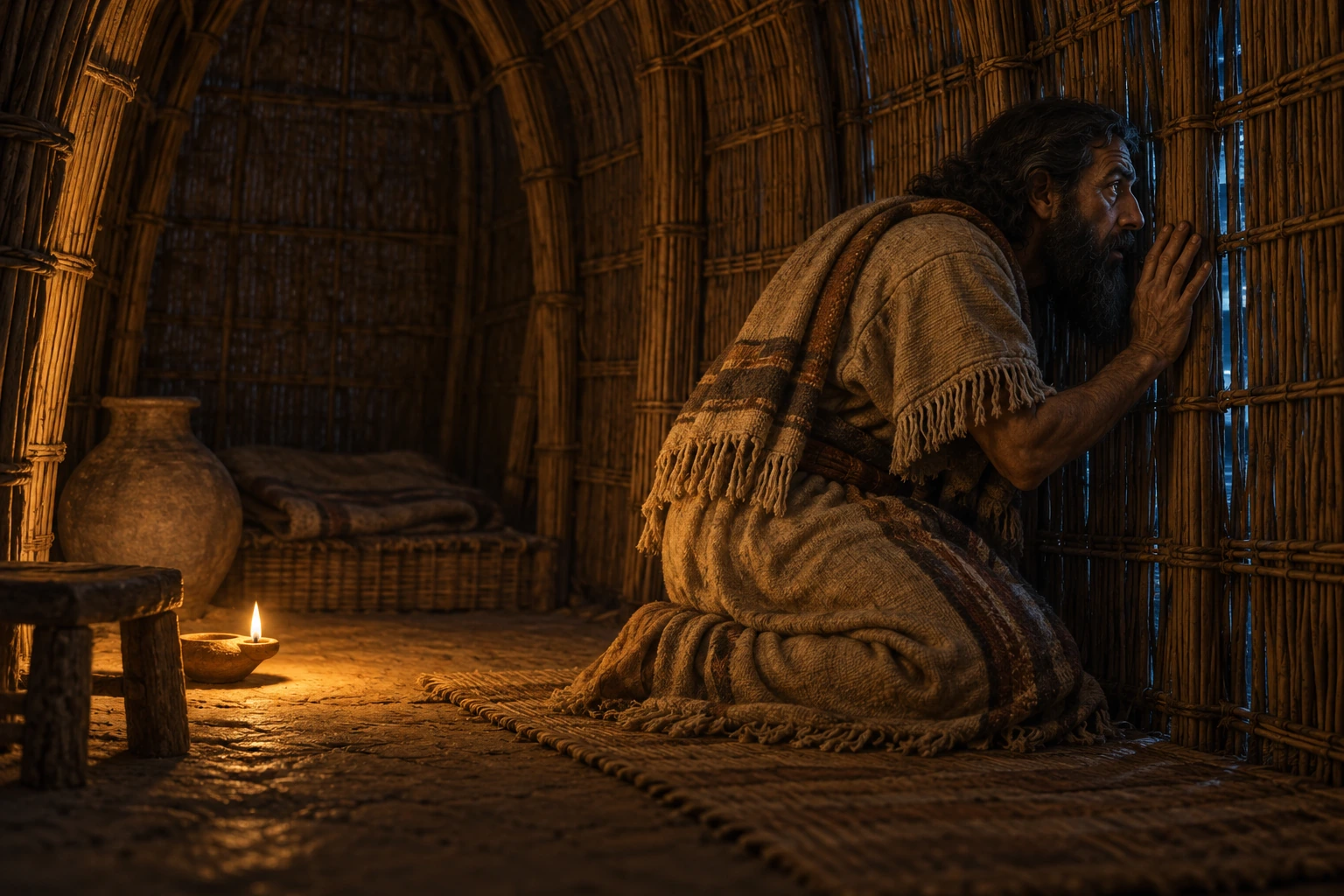
Gilgamesh looks at him and sees nothing strange: you are just like me, he says, so how did you stand in the assembly of the gods and find life? (XI 1–7). Utnapishtim offers to tell him “the rede of the Gods”. Shuruppak was an old city on the Euphrates, with gods dwelling in it, when the great gods decided to send the Deluge: Anu their father, Enlil their counsellor, Ninurta and Ennugi (XI 11–18). Ea had sworn the oath with them, so he told the secret not to a man but to a wall: “O Reed-hut, O Reed-hut! Wall, wall!” (XI 19–22). Through the wall he spoke to the man of Shuruppak, son of Ubar-Tutu: tear down your house and build a boat, abandon riches and save life, and put on board the seed of every living thing. The boat should be as wide as it is long, and roofed like the Apsu, the fresh waters under the earth (XI 23–31).
And what should he tell the city, its people and its elders? Ea gave him a cover story. Enlil hates me, he was to say, so I may no longer live in your city or set foot on Enlil’s land; I am going down to the Apsu to live with Ea, my lord, and on you he will rain down plenty: birds, fish, a rich harvest, bread-cakes in the morning and a torrent of wheat in the evening (XI 32–47).
1-2 The Boat and the Storm
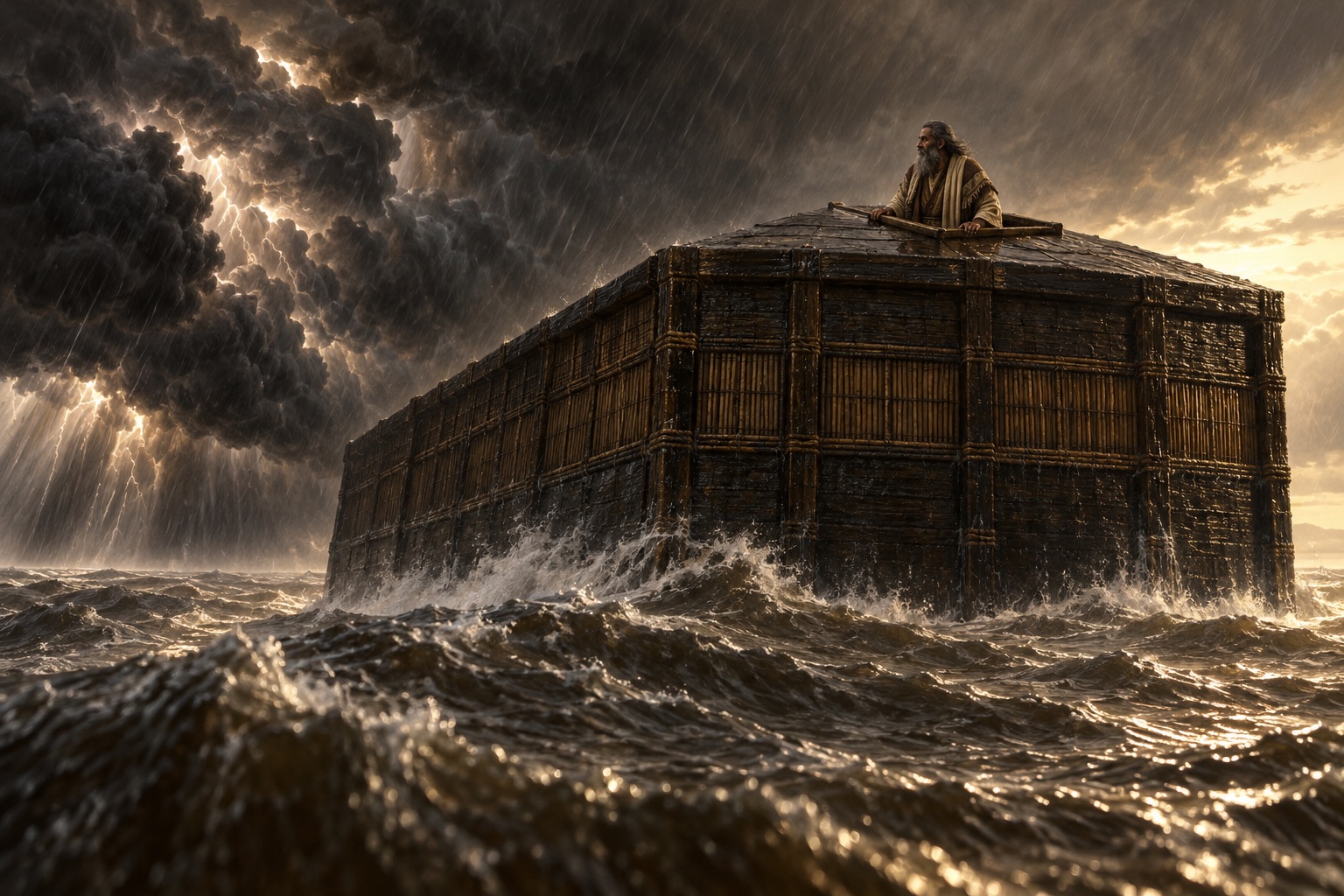
At first light the people gathered at the gate: the carpenter with his axe, the reed-worker with his stone, the old men with rope of palm fibre, the rich man with bitumen. On the fifth day the hull was laid out, a floor of one ikû (about an “acre”), walls ten rods high, the roof ten rods across. He gave her six decks, divided her into seven parts and nine compartments, and poured in myriads of measures of bitumen, tar and oil (XI 48–70). Every day he slaughtered oxen and sheep, and gave his workmen beer, ale, oil and wine like river water, so that they feasted as at the New Year. He loaded silver, gold and the seed of all living things, then his kin, the beasts of the field and craftsmen of every kind (XI 71–86).
Shamash, the sun god, set the hour: when bread-cakes rained in the morning and wheat in the evening, he was to go in and seal the hatch. He did, and gave his palace and all its goods to the shipwright who sealed the boat, Puzur-Enlil (Thompson read Puzur-Amurri) (XI 87–96). At dawn a black cloud rose with Adad, the storm god, bellowing inside it; Errakal ripped out the mooring posts, Ninurta made the weirs overflow, and the Anunnaki raised their torches. The gods themselves fled up to the heaven of Anu, “cow’ring like curs” (XI 97–116). Bēlet-ilī, the mother goddess, screamed like a woman in labour: she had spoken for this evil in the assembly, and now the people she had borne filled the sea like fish (XI 117–127). For six days and seven nights the wind and the flood flattened the land. On the seventh day the sea grew calm; all humankind had turned to clay, and the flood plain lay flat as a roof. He opened a vent, the sunlight fell on his face, and he knelt and wept (XI 128–139).
1-3 Dove, Swallow, Raven
Land rose in fourteen places (XI 141; Thompson and George Smith read “twelve”). The boat ran aground on Mount Nimush, which held it fast for six days; older translations read the name as Nisir (XI 142–146). On the seventh day he set free a dove, which found no perch and came back; then a swallow, which came back too; then a raven, which saw the waters going down, ate, scratched about and did not return (XI 147–156).
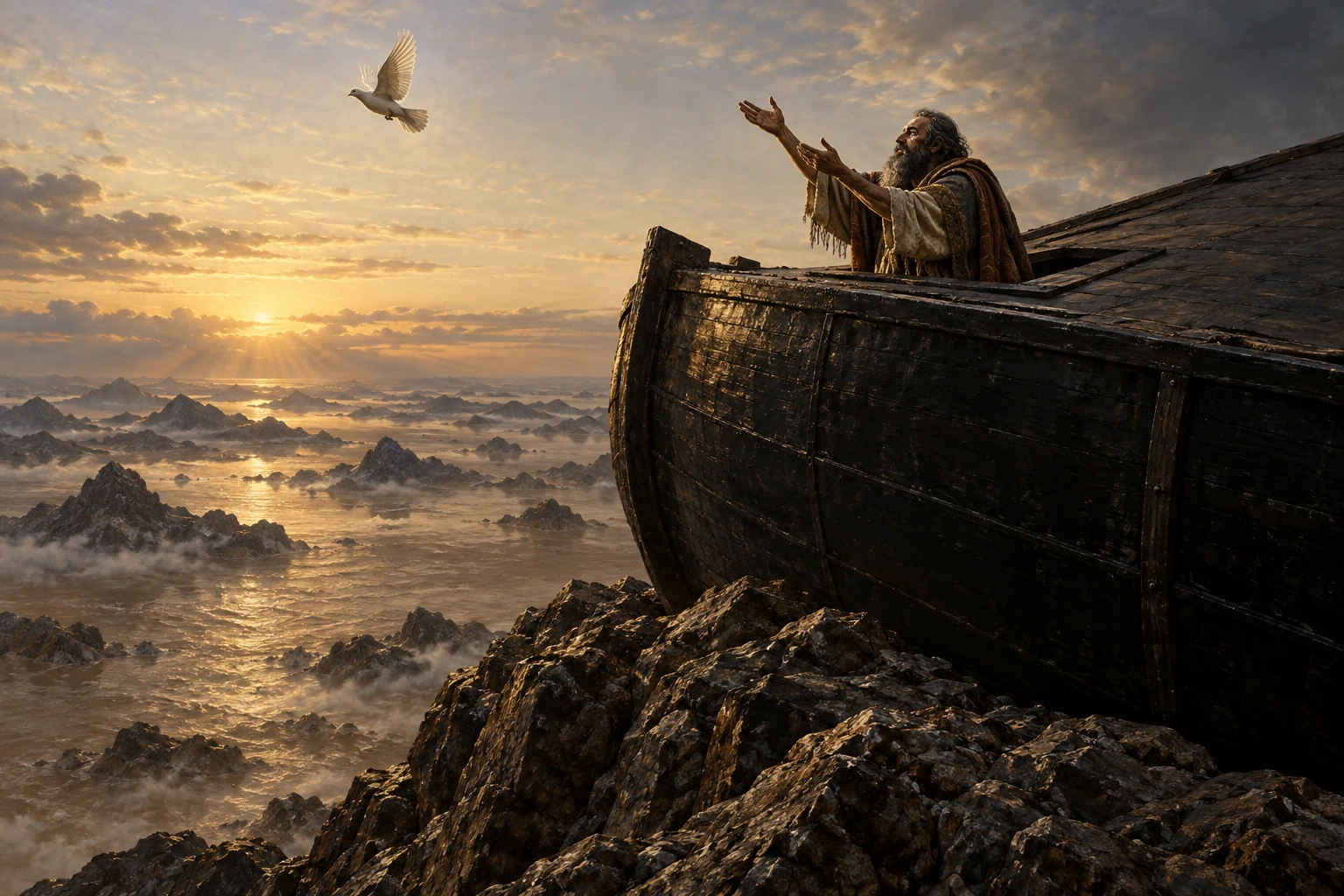
He sacrificed to the four winds and set out incense on the peak, seven vessels and seven more, with reed, cedar and myrtle heaped beneath them. The gods smelled the sweet savour, and “the gods did assemble like flies o’er him making the off’ring” (XI 157–163).
1-4 Like Us Gods
Bēlet-ilī lifted up the great “flies” of lapis lazuli that Anu had made for her: by these beads at her neck she would remember these days for ever. Let the gods come to the offering, she said, but not Enlil, who had brought the flood without taking counsel (XI 164–171). Enlil came, saw the boat and raged at the Igigi gods: no man was meant to survive. Who but Ea could have done this? asked Ninurta (XI 172–180). Ea answered Enlil: punish the sinner for his sin; instead of a flood, let a lion or a wolf thin out the people, or a famine, or the plague god Erra. He had not betrayed the gods’ secret, he said; he had only let Atrahasis see a dream (XI 181–198).
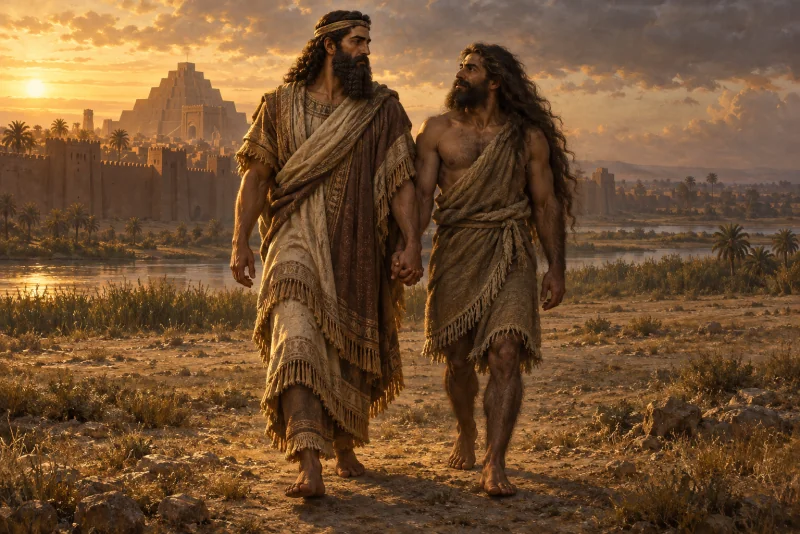
Then Enlil came aboard, took Utnapishtim and his wife by the hand, made them kneel and touched their foreheads. “Uta-Napishtim hath hitherto only been mortal”, he said, but now he and his wife would be “like to us gods” and live far away, at the mouth of the rivers (XI 199–206). There Gilgamesh finds him, and Utnapishtim asks him who will gather the gods for his sake (XI 207–208).
1-5 When the Gods Were Men
Atrahasis tells the flood as the end of a longer story. Its first line gives its ancient title, “When the gods were man” (inūma ilū awīlum). Tablet I is cited from the Old Babylonian copy edited in eBL; where that edition stops, and for tablets II and III, from the edition of Nathan Wasserman and Michael Streck in Sources of Early Akkadian Literature (SEAL). Once, the gods did the work. Anu took heaven, Enlil the earth and Enki the waters below, and the junior gods, the Igigi, dug the rivers. After forty years of it they set fire to their tools and in the middle of the night surrounded Enlil’s house (I 1–73). Enlil was terrified, but Ea asked the gods what they blamed the rebels for: their work was too heavy. Let the birth goddess create a human being to carry the yoke (I 84–186).
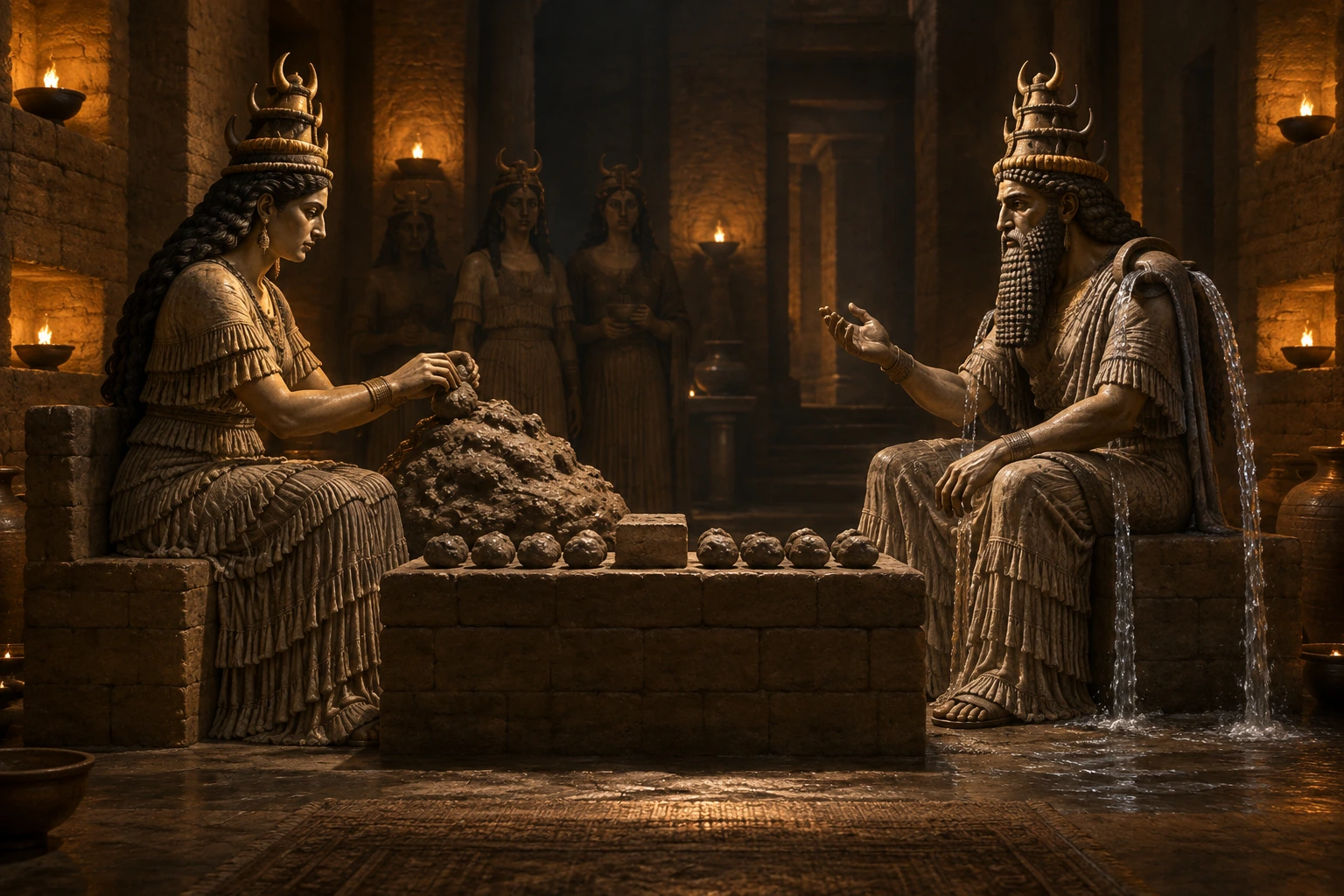
One god was slaughtered, Aw-ila. The goddess Nintu mixed clay with his flesh and blood, so that a spirit from the god’s flesh would remain in humankind, and the Igigi spat on the clay (I 204–230). She told the gods she had lifted their toil and laid it on man, and they gave her a new name, Mistress of All the Gods (I 231–243). In the house of destiny, while Enki trod the clay and she recited the incantation, she pinched off fourteen pieces, seven on the right and seven on the left, with a brick between them (I 245–255; broken on the Old Babylonian tablet and read from a later copy, SB III 13–23).
1-6 Noise, Plague, Drought, Flood
Before six hundred years had passed (the number is damaged), the land grew wide and the people many; the land bellowed like a bull, and Enlil could not sleep for their noise. He sent Namtar with a plague. Atrahasis, whose god was Enki, asked for help, and Enki told him to have heralds proclaim: do not revere your gods, but take baked bread to Namtar’s gate, and he will be ashamed. Namtar left the people, and their noise returned (I 352–414). Next Adad withheld the rain, the fields turned white and the plain produced salt; again the offerings shamed Adad. Then the gods stood guard over heaven, earth and the sea, and the famine went on until, in the sixth year, people served up their own children for food (II, SEAL segments A–E).
At last the gods decided in assembly on a flood (Larsa copy, iv 5’–6’). Atrahasis asked Enki to explain a dream, and Enki spoke to the wall: leave your house, build a boat, roof it over like the Apsu. He set a water-clock and told him of the flood to come, its seven nights (III i 11’–37’). Atrahasis loaded the boat and held a banquet, but he could neither sit nor crouch: his heart was broken and he was vomiting gall. Adad thundered, and he sealed the door with bitumen (ii 40’‘–55’‘). For seven days and seven nights the storm came, while the gods sat hungry and thirsty and Nintu wept for her people (iii–iv 25’). More than fifty lines are lost or too broken to translate. Then he sacrificed, and the gods gathered like flies over the offering (v 30’‘–35’').
Enki owned that he had done it in front of them, to protect life (vi 16–19). To keep humankind from growing too many again, the gods set a new order: women who bear and women who do not, the demon Pāšittu who snatches babies from their mothers’ laps, and priestesses who must not bear children (vii 1–9). The poet ends by saying he has sung of the flood for all people to hear (viii 18’–19’).
2 Where the Story Is Written Down
- Tablet XI of the Epic of Gilgamesh, the version attributed to Sîn-lēqi-unninni. The eBL edition of Tablet XI uses manuscripts from Nineveh, Assur, Kalhu (Nimrud) and Babylon. The best known, K 3375, probably comes from Ashurbanipal’s palace library at Nineveh (7th century BCE): it is the tablet George Smith read in 1872.
- Atrahasis. The best copy is three Old Babylonian tablets from Sippar, written by a junior scribe whose name is read Ipiq-Aya (the reading is discussed). Tablet I is dated to the 12th year of Ammi-ṣaduqa (eBL), tablet II to his 11th (Clay, 1922). The colophons count 416, 439 and 390 lines, 1,245 for the three tablets. Later copies come from Ugarit and Nippur, from Ashurbanipal’s palace at Nineveh, and from Babylon and Sippar.
- The Sumerian flood story (ETCSL 1.7.4) is known from one Old Babylonian tablet from Nippur, CBS 10673 in the Penn Museum. Arno Poebel found its pieces in 1912 and published it in 1914; he reckoned the whole tablet had about three times the inscribed surface that survives. He read the hero’s name Ziugiddu; today it is read Ziusudra.
- The “Ark Tablet”, in which Atrahasis is told to build a round boat. Douglas Simmonds brought it to the British Museum in 1985, and Irving Finkel published it in The Ark Before Noah (2014), when it went on display. Press reports called it 4,000 years old; Michael Streck dates it between the Old and Middle Babylonian periods (eBL).
- Berossus, a Babylonian priest who wrote in Greek about 280 BCE. His book is lost; his flood of Xisouthros survives in excerpts by Alexander Polyhistor, preserved by Syncellus and Eusebius, and in a quotation by Josephus.
3 Competing Versions
- Four names. Utnapishtim in the Standard Babylonian epic (Uta-na’ishtim on an Old Babylonian Gilgamesh tablet from Sippar); Atrahasis in Atrahasis, and twice in Tablet XI; Ziusudra in Sumerian; Xisouthros, which John Day calls a Greek form of Ziusudra, in Berossus.
- Whose son? Tablet XI: son of Ubar-Tutu (XI 23). The Instructions of Shuruppag: Ziusudra is the son of Shuruppag, son of Ubara-Tutu (ETCSL 5.6.1, 1–13). The Sumerian King List ends the kings before the flood with Ubara-Tutu of Shuruppag, and then the flood sweeps over (ETCSL 2.1.1, 1–39). Berossus: Xisouthros is the tenth king, son of Ardates.
- A wall or a dream? Tablet XI has Ea speak to the reed wall, then claim he sent a dream (XI 19–22, 197). In Atrahasis, Atrahasis asks Enki to explain a dream and is answered through the wall (III i 11’–21’). In the Sumerian story, Ziusudra has a vision that is not a dream, and hears a voice as he stands by a wall (C 1–27). In Berossus, Kronos appears to Xisouthros in a vision.
- How long? Six days and seven nights in Tablet XI (XI 128); seven days and seven nights in Atrahasis (III iv 24’–25’) and in the Sumerian story (D 1–11). Genesis: forty days and forty nights of rain, and the waters prevail 150 days (7:12, 7:24).
- What shape of boat? Tablet XI: as wide as long, with a floor of one ikû and walls ten rods high (XI 29–30, 57–59). The Ark Tablet: a circle with a floor of one ikû and walls one rod high, of plaited rope coated with bitumen (lines 1–22). Berossus: five stadia long and two wide. Genesis: 300 cubits by 50 by 30 (6:15).
- Which birds? Tablet XI: dove, swallow, raven. Berossus: unnamed birds sent three times; the second time they come back with mud on their feet. Genesis: a raven, then a dove three times, the second time with an olive leaf (8:6–12). Atrahasis is broken just where birds could have been.
- Where did it land, and what came after? Mount Nimush, and Utnapishtim and his wife become like gods at the mouth of the rivers (XI 142, 203–206). Ziusudra is granted life like a god and settled in Dilmun, where the sun rises (E 3–11). Xisouthros vanishes with his wife, daughter and pilot, in Armenia. Noah lands on “the mountains of Ararat” (8:4) and lives on; Smith noted in 1872 that in the Bible it is Enoch, not Noah, who is taken up in this way.
- Who made humans, and from whom? In the Old Babylonian copy, Ea proposes it and the slain god is Aw-ila (I 174, 219). In the later Babylonian copies it is Anu who proposes it and the god is Alla (SB II 61, 103).
4 History and Tradition
- “The first man to read that.” K 3375 was covered by a thick, limelike crust, and Smith had to wait weeks for the museum’s restorer, Robert Ready, to clean it. When he read the cleaned lines, as Wallis Budge told it in 1925, he said, “I am the first man to read that after more than two thousand years of oblivion”, rushed about the room and, to everyone’s astonishment, began to undress.
- 3 December 1872. Smith read “The Chaldean Account of the Deluge” to the Society of Biblical Archaeology, with Henry Rawlinson in the chair and William Gladstone, then prime minister, on the platform. Smith could not read the hero’s name and called him Izdubar; the flood hero he called Sisit. Yajima Fumio credits T. G. Pinches with reading the name as Gilgamesh, in 1890–91.
- The missing piece. The Daily Telegraph put up 1,000 guineas to send Smith to Nineveh, and in May 1873 he found a fragment of seventeen lines “fitting into the only place where there was a serious blank in the story”. A seventeen-line fragment from that dig, DT 42, is catalogued today as part of Atrahasis, not Gilgamesh; Albert Clay’s translation of it (1922) names the hero Atra-hasis. Smith died near Aleppo in 1876.
- Not part of the epic at first. In 1920 Budge already wrote that the flood “had not originally any connection with the Legend of Gilgamish”, and that an Old Babylonian flood tablet’s colophon showed it belonged to another series.
- Bitumen from the boat. Berossus said part of the vessel was still in the mountains of Armenia, and that people scraped off its bitumen to use as amulets; Josephus quotes him (Antiquities 1.3.6).
“The flood story first appears in Gilgamesh, and the Bible copied it.” Neither half holds. Atrahasis was being copied in the 17th century BCE and the Sumerian Ziusudra story is on an Old Babylonian tablet, while John Day holds that the flood “was not part of the original Old Babylonian Gilgamesh epic”. As for Genesis, Smith himself concluded in 1872 that the differences showed “a distinct and independent tradition”. Day argues that Genesis is closer to Atrahasis than to Tablet XI, and that the story reached Israel by tradition, the Priestly writer picking it up in the Babylonian exile.
5 Related Stories
- Gilgamesh: The King Who Tried to Escape Death: the quest that brings him to Utnapishtim, and what follows the flood story in Tablet XI: the week without sleep he cannot manage, and the plant the snake steals (XI 207–307).
- Enki: The Clever God of Fresh Water: the god who, bound by the gods’ oath, passes on their secret by talking to a wall. “'Tis Ea is privy to ev’ry design”, says Ninurta in Tablet XI (XI 179–180).
- Nüwa: The Serpent-Bodied Goddess Who Mended the Sky: a goddess who shapes people from yellow earth and finds the work too much. We have not found a scholar who compares her with the clay figures of Atrahasis; we link them for the theme.
- Ymir: The Frost Giant Whose Body Became the World: Snorri’s flood of giant’s blood, survived by Bergelmir on a lúðr. Anthony Faulkes thinks Snorri linked the word with örk, “coffin” or “ark”, so the link runs through Noah, not through Babylon.
- Jamshid: The King of the Golden Age and His Cup: in the Avesta, Yima builds an enclosure, the var, to keep the seed of every living thing through a great winter. Darmesteter found it “difficult not to acknowledge” an adaptation of the flood story in it.
6 Sources
- Epic of Gilgamesh, Standard Babylonian Tablet XI and the Old Babylonian Sippar tablet, ed. and trans. Andrew R. George, electronic Babylonian Library (2022): eBL, eBL; R. Campbell Thompson (trans.), The Epic of Gilgamish (Luzac, 1928), Tablet XI: archive.org
- Atrahasis, Old Babylonian tablet I, ed. Enrique Jiménez and Geraldina Rozzi, trans. Benjamin R. Foster; Standard Babylonian tablet III; the Ark Tablet (MOW 1); and the eBL Library records for K 3375, DT 42 and BM 78941: eBL, eBL, eBL, eBL, eBL, eBL
- Atraḫasīs, tablets I and II (all periods), Old Babylonian tablet III (Sippar) and the Larsa copy (MS 5108), ed. and trans. Nathan Wasserman, with Michael P. Streck for tablet I, Sources of Early Akkadian Literature: SEAL 1515, SEAL 39732, SEAL 1517, SEAL 1518
- ETCSL 1.7.4 “The Flood story” (with its bibliography), 2.1.1 “The Sumerian king list”, 5.6.1 “The instructions of Shuruppag”; CDLI P265876: ETCSL, ETCSL, ETCSL, ETCSL, CDLI
- Arno Poebel, Historical Texts (Philadelphia, 1914); Albert T. Clay, A Hebrew Deluge Story in Cuneiform (Yale, 1922): archive.org, archive.org
- Berossus, from Alexander Polyhistor and Abydenus, in Isaac Preston Cory, Ancient Fragments (1832), pp. 26–34; Josephus, Antiquities of the Jews 1.3.6, trans. William Whiston; Genesis 6–9, King James Version: archive.org, Project Gutenberg, Project Gutenberg
- George Smith, “The Chaldean Account of the Deluge”, Transactions of the Society of Biblical Archaeology 2 (1873), and Assyrian Discoveries (1875), p. 97: Wikisource, archive.org
- E. A. Wallis Budge, The Babylonian Story of the Deluge and the Epic of Gilgamish (British Museum, 1920) and The Rise and Progress of Assyriology (1925), pp. 113, 152–153: archive.org, archive.org
- John Day, “The Mesopotamian Origin of the Biblical Flood Story”, TheTorah.com (2020): TheTorah.com
- Jill Lawless (AP), “Noah’s Ark: Was it really round?”, January 2014; Sandy Rashty, “The tablet that altered the story of Noah’s ark”, 17 February 2014: CSMonitor, The JC
- Yajima Fumio, “ギルガメシュ叙事詩”, and Ōbayashi Taryō, “洪水神話”, Heibonsha World Encyclopedia; Japanese translations by Tsukimoto Akio (Iwanami Shoten, 1996) and Yajima Fumio (Chikuma Gakugei Bunko, 1998): Kotobank, Kotobank, CiNii, CiNii
Cover and illustrations: AI-generated images made for Arcana. They are interpretations, not historical artworks.