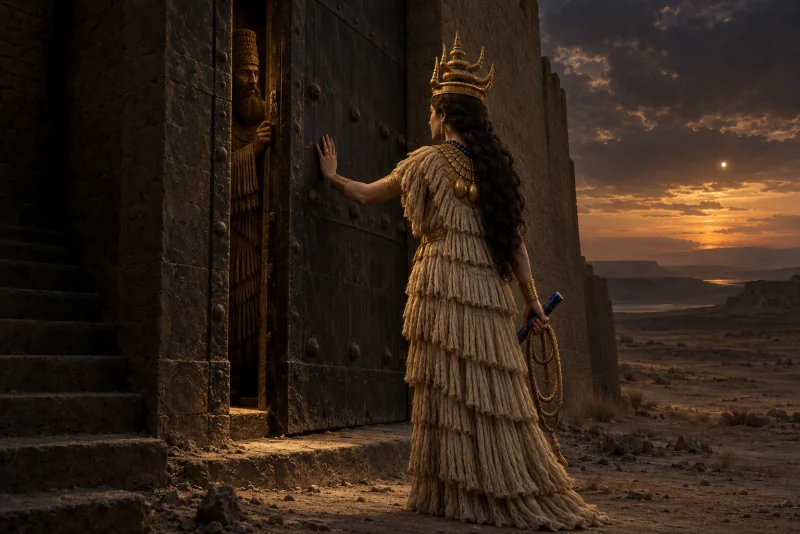
Enki: The Clever God of Fresh Water
He lived in the fresh water beneath the earth, gave every god a task, ate the eight plants of Dilmun and, after a drinking contest, handed his divine powers to Inanna. To the Babylonians he was Ea, the god who warned the flood hero.
- Type: myth, the Sumerian god of fresh water, wisdom and crafts, and the poems told about him
- Culture: Sumer and Babylonia, in southern Mesopotamia (today’s Iraq); as Ea, wherever Akkadian was written
- Earliest texts: his name in the texts from Fara (c. 2600–2500 BCE); the Sumerian poems about him on clay tablets of the Old Babylonian period (c. 1900–1600 BCE)
- Key figures: Enki (Ea), his minister Isimud, Ninhursag, Inanna, Ninmah, Namma, Uttu
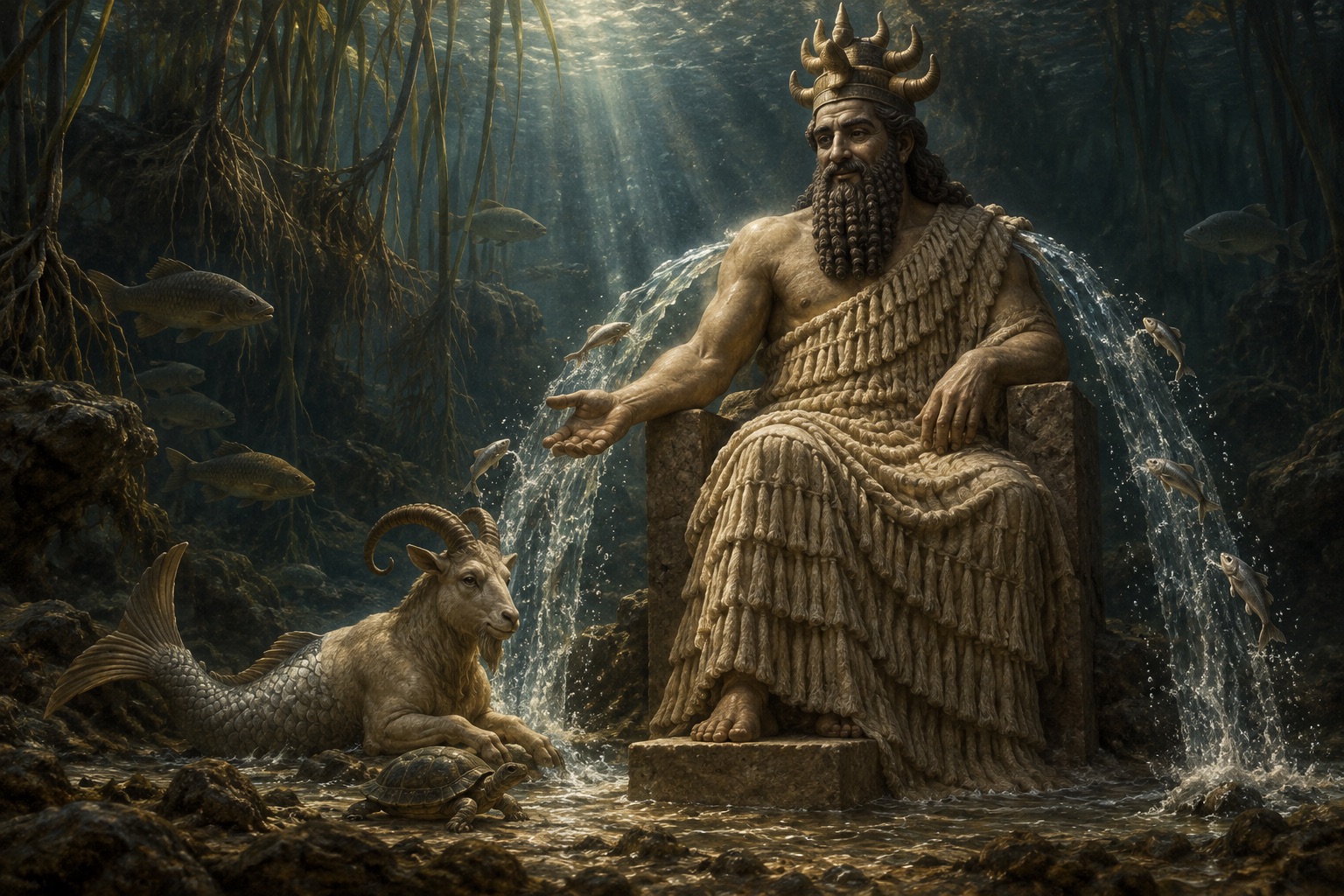
Beneath the land, the Mesopotamians believed, lay an ocean of fresh water, the Abzu, and Enki lived in it. The ORACC handbook of Mesopotamian gods calls him a “mischievous god of wisdom, magic and incantations who resides in the ocean under the earth”. In the Sumerian poems he fills the rivers, hands out the world, eats plants he has not yet named and, after a drinking contest, gives his powers away to a goddess, then tries to get them back.
Are Enki and Ea the same god? By the time of the Babylonian stories, yes: Enki is the Sumerian name and Ea the Akkadian one. How the two came together is not known. ORACC notes that Enki already appears in the texts from Fara, that the name Ea is first found in the 24th century BCE, and that “it is unclear to which language this name belonged originally”. This post tells the Sumerian poems, where he is Enki.
1 The Telling
No single text tells Enki’s life. He is the hero of a group of Sumerian poems, each about a different deed. Here are four, retold from the translations of the Electronic Text Corpus of Sumerian Literature (ETCSL), whose line numbers we follow. The tablets are broken in many places; where a gap leaves the story open, we say so.
1-1 The Lord of the Abzu
In Enki and the World Order (ETCSL 1.1.3), a poem of 472 lines, Enki praises himself, twice. He is An’s firstborn son, he says. His elder brother, “the king of all the lands”, a title the poem gives to Enlil, gathered all the divine powers and put them in his hand, and he carried the arts and crafts from Enlil’s temple, the E-kur, to his own Abzu at Eridu (lines 61–80). When he comes near the sky, a rain of plenty falls; when he comes near the earth, the water rises in a flood full of carp. By his house the carp dart through the reeds and small birds chirp in their nests (89–99).
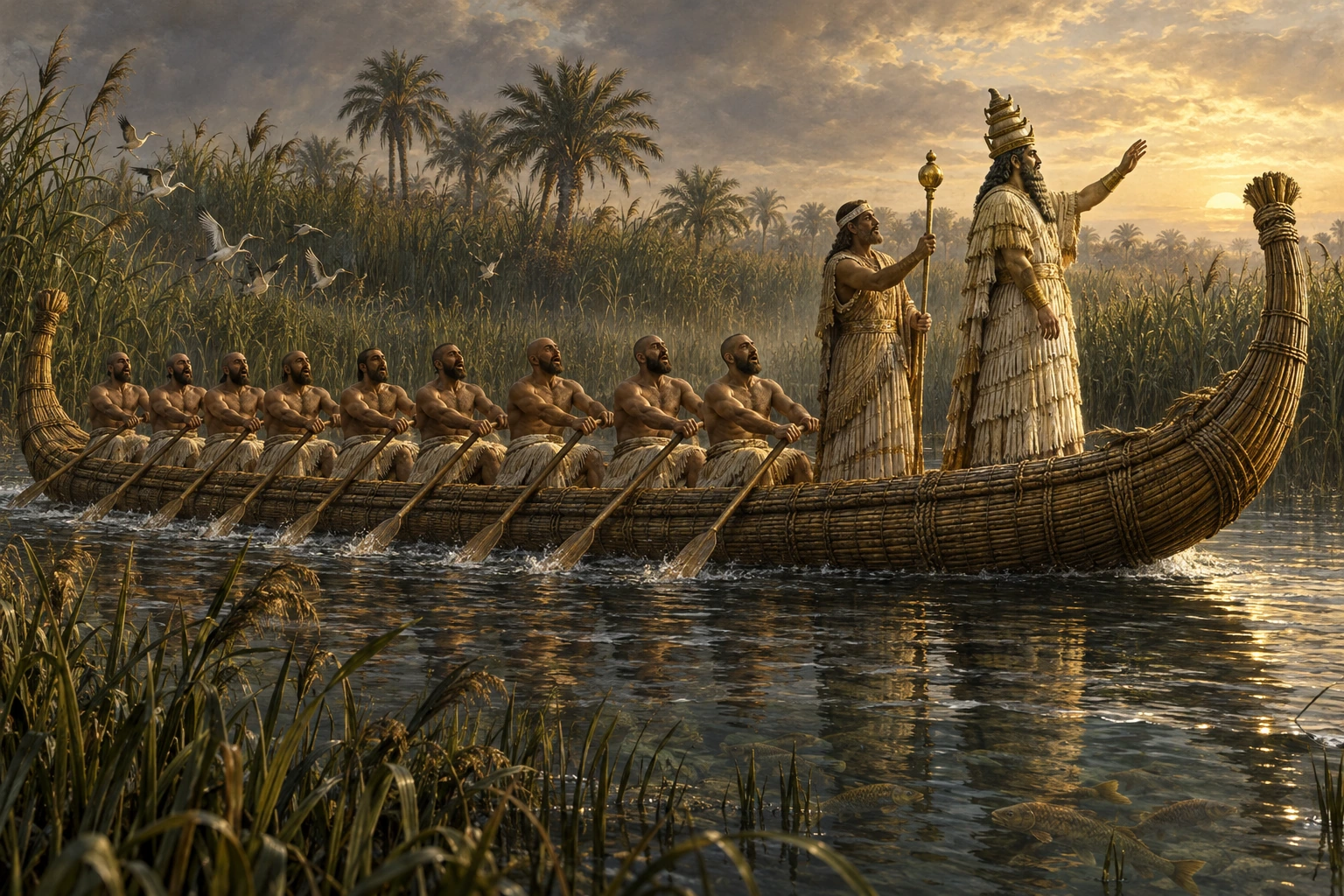
Then he sets out to see his land in his barge, the “Stag of the Abzu”. The oarsmen pull in time and sing as they row, and the captain holds a golden sceptre for him (100–122). He calls on the far lands of Dilmun, Magan and Meluhha to load their boats with timber, gold and silver for Enlil at Nippur (123–130).
1-2 A Task for Every God
He decrees the fates of Sumer, of the city of Ur and of the distant land of Meluhha, and cleanses Dilmun (192–247). Then, full of desire like a rutting bull, he fills the Tigris with flowing water; the poem says plainly that the water is his seed (250–266). ORACC notes this link between the god’s semen and the fresh water of the Abzu, and that modern translations long left such details out. Next he gives each part of the world a keeper. The waterways go to Enbilulu, the sea to the goddess Nanshe, the rain to the storm god Ishkur, ditches and dykes to the farmer Enkimdu, grain to Ashnan, the brick mould to Kulla, building to Mushdama, the high plain and its wild animals to Shakkan, the sheepfolds to Dumuzi, the whole of heaven and earth, once he has fixed its borders, to the sun god Utu, and weaving to Uttu (267–386).
Inanna comes last, in tears. Every other goddess has her office, she says: one is the midwife of the land, one its metalworker, one its scribe. Where are hers (387–423)? Enki answers that he has already given her much: the speech of women, the spindle, the shepherd’s staff and crook, words of good and evil omen in the din of battle. And he tells her what she does: she heaps up human heads like dust, destroys what should not be destroyed and creates what should not be created (424–450). The rest of his answer is too broken to read (451–471).
1-3 Dilmun
Enki and Ninhursag (ETCSL 1.1.1, which spells her name Ninhursanga) opens in Dilmun when the world was new. “In Dilmun the raven uttered no cries,” runs Samuel Noah Kramer’s translation of 1944, “the lion killed not, the wolf snatched not the lamb”, and no old woman said “I am an old woman” (lines 11–26). But the land had no fresh water. When its goddess Ninsikila complained, Enki promised that water would run out of the ground for her when the sun god rose. Her salt pools turned fresh, her fields gave grain, and Dilmun became a harbour for the land (29–62).
Then Enki lay in the marsh with Ninhursag, also called Nintud, “the mother of the land”. Her nine months lasted nine days, and she bore a daughter, Ninsar. When Ninsar went down to the riverbank, Enki saw her from the marsh and asked his minister Isimud whether so fine a girl should not be kissed; Isimud steered the boat across. Ninsar bore Ninkura in the same way, and Ninkura bore Uttu (63–126). Ninhursag warned Uttu about the god in the marsh, but most of her advice is lost (127–146). Uttu asked for cucumbers, apples and grapes. Enki came to her door as a gardener with all three, and she let him in (147–185). Ninhursag took Enki’s seed from Uttu’s body, and from it grew eight plants (186–197).
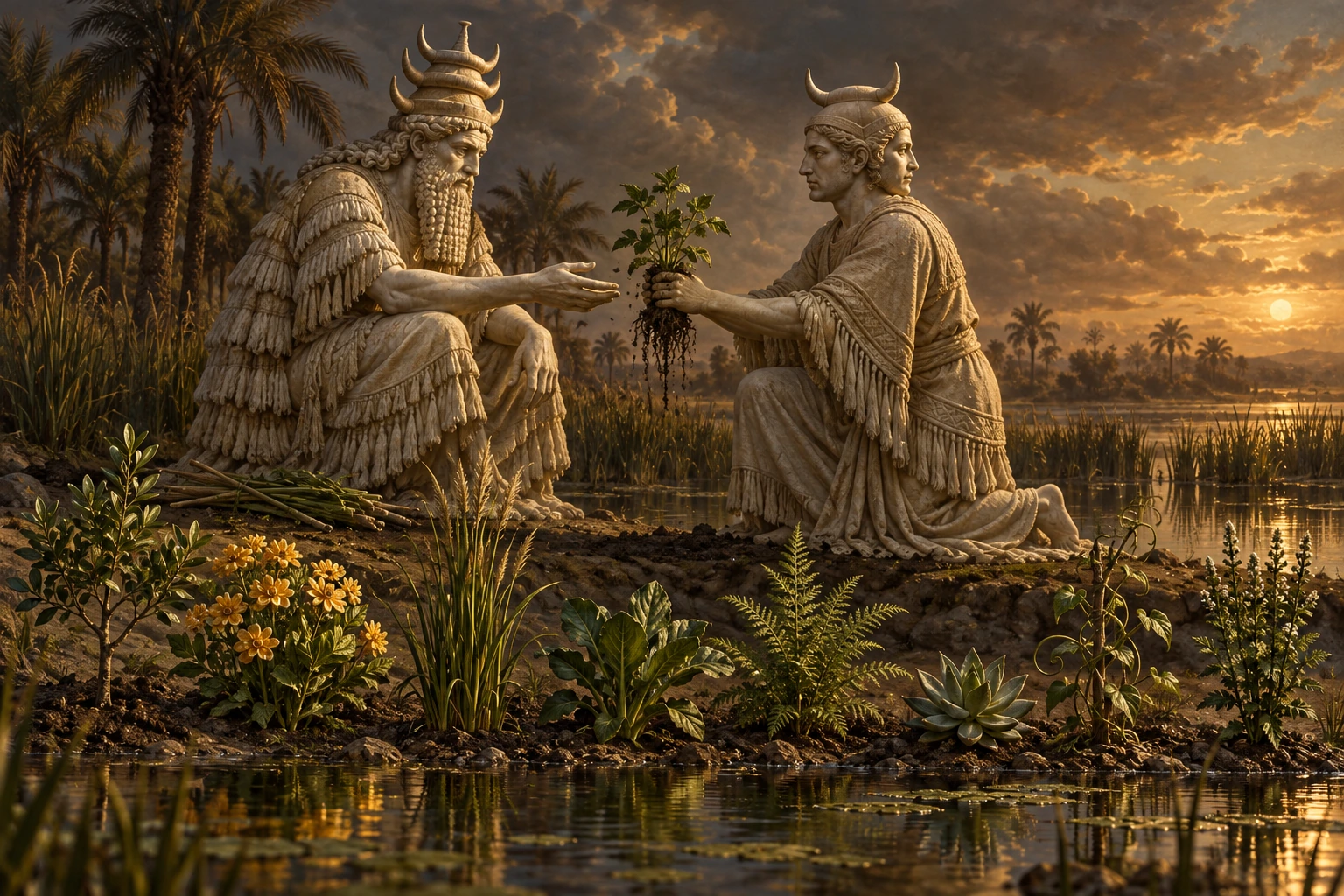
Enki saw them from the marsh. He had not yet decreed their destinies, he said: what was this one, and that one? Isimud named each one, the “tree” plant, the “honey” plant and six more, cut it or pulled it up, and Enki ate it. In this way, the poem says, Enki fixed the destiny of the plants (198–219).
Ninhursag cursed him: “Until thou art dead, I shall not look upon thee with the ‘eye of life’” (220–227, in Kramer’s words). The great gods sat down in the dust. A fox offered to bring her back if Enlil would reward him, and got himself ready, oiling his body, shaking out his fur, putting kohl on his eyes; what he said to her is mostly lost (221–246). Ninhursag returned and sat Enki beside her. “My brother, what hurts thee?” she asked, and for each of eight aching parts she bore a god: for his ribs, Ninti; for his mouth, Ninkasi. Then each was given a destiny: Ninti would be the lady of the month, and Ensag the lord of Dilmun (247–280).
1-4 Inanna and the Me
Inanna and Enki (ETCSL 1.3.1) survives in pieces with long gaps between them, and ETCSL numbers the lines of each segment, A to J, separately. Inanna sets out alone for the Abzu at Eridu. Enki knows her plan before she is within six miles, and tells Isimud to receive her as a guest, with butter cake, cool water and beer at the table of An (B 6–15, C 1–26). The two drink together and start a contest, drinking from bronze vessels (C 27–30). Then about 35 lines are lost.
When the text resumes, Enki is handing over the me, the divine powers, a few at a time, swearing each time by his power and by his Abzu that he gives them to Inanna, his daughter (D 1–27). In Kramer’s translation: “O name of my power, O name of my power, / To the pure Inanna, my daughter, I shall present…”. They include heroism and power, the plundering of cities and lamentation, the crafts of the carpenter, the smith and the scribe, wisdom, the kindling and putting out of fire, judging and decision-making. Kramer counted “over one hundred”.
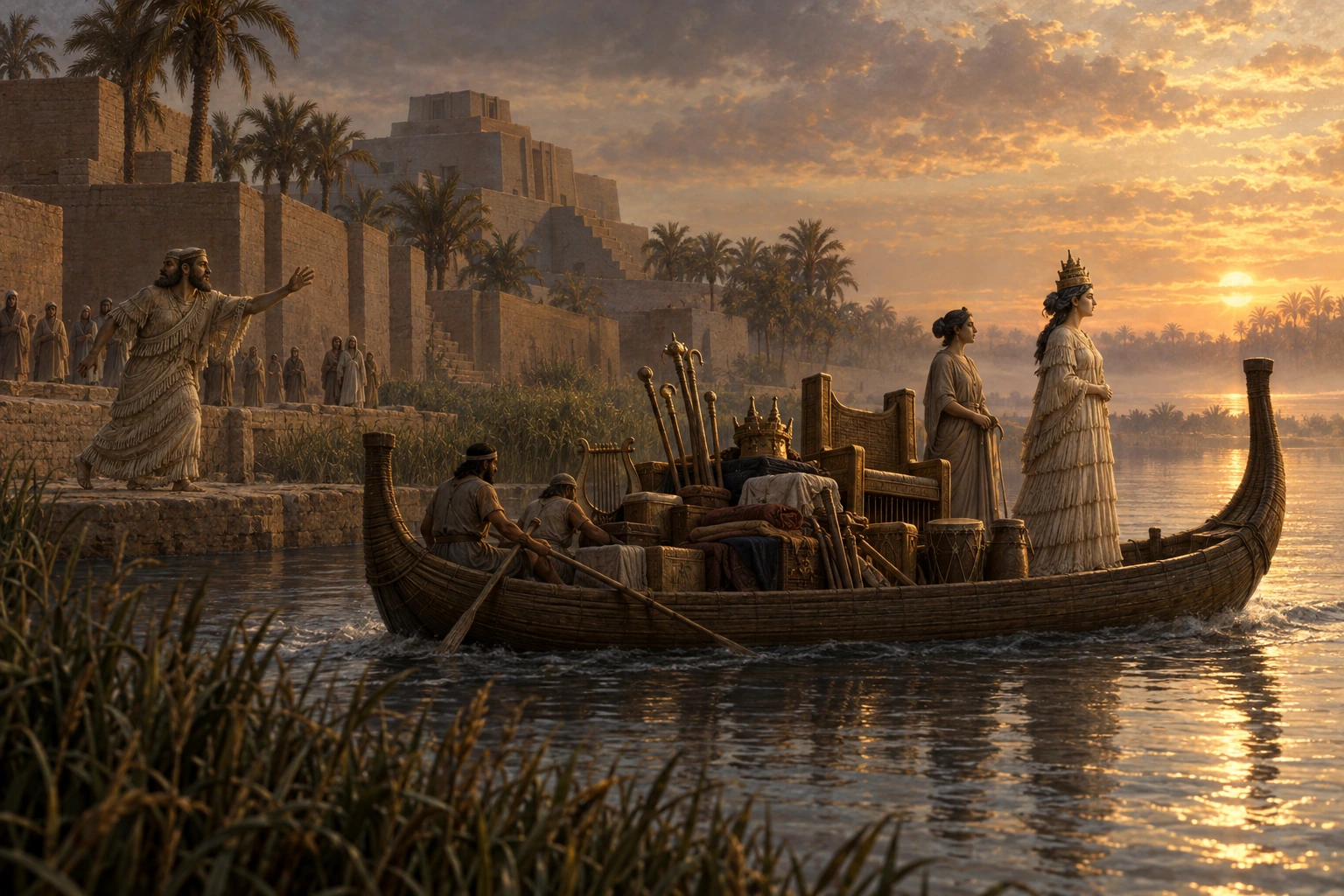
Inanna loaded them onto the Boat of Heaven and left. As the beer wore off, Enki asked Isimud where the throne, the crown and the priestly offices had gone, and each time the answer was the same: his master had given them to his daughter (F 1–34). Six times he sent Isimud after the boat with a new band: the enkum, the fifty giants of Eridu, the fifty lahama of the deep waters, the great fish, the guardians of Uruk, the creatures of the Id-surungal. Six times Inanna called on her minister Ninshubur and kept hold of the boat and the powers; the seventh attempt is broken (H 1–217). The Boat of Heaven came to Uruk through the Gate of Joy, and Inanna called for a festival (H 218–256). Near the end Enki speaks to Inanna once more, but the lines are too broken to show, in Kramer’s words, “whether it is reconciliatory or retaliatory” (J 126–142).
1-5 Clay from the Top of the Abzu
Enki and Ninmah (ETCSL 1.1.2) begins before there were people. The senior gods oversaw the work while the junior gods dug the canals and piled up the silt, and complained (lines 1–11). Enki lay asleep in the deep water, in a place whose inside no other god knows. His mother Namma brought him the gods’ tears and told him to wake and make a substitute, so that they could be freed from their toil. Enki told her to knead clay from the top of the Abzu; birth goddesses would nip it off, and Ninmah would help her (12–37).
At the feast that followed, Enki and Ninmah drank beer. Ninmah boasted that whether a human body turned out good or bad depended on her will; Enki answered that he would balance whatever fate she decided (52–61). She shaped six people, and he found a place for each. A man whose weak hands could not bend became a servant of the king. A man whose eyes stayed open (the reading is uncertain) was given music. One with crippled feet was set to work, the damaged line says, as a silversmith among other things. For one who could not hold back his urine, Enki bathed him in enchanted water and drove a demon out of his body. A woman who could not give birth was placed in the queen’s household, and one with neither male nor female organs was set to stand before the king (56–78).
Then Enki shaped a creature for Ninmah to place: Umul, afflicted in head, eyes, neck, lungs and heart, who could not sit down once he stood, could not lie down and could not put bread into his mouth. Ninmah spoke to him, and he could not answer; she offered him bread, and he could not reach for it. She could find him no place (79–101). Her reply to Enki is mostly broken; where it can be read, she says that her city is ruined and her house destroyed (122–128). The poem ends with its verdict: Ninmah could not rival the great lord Enki (140–141).
2 Where the Story Is Written Down
- The Sumerian poems are edited in the ETCSL from clay tablets, with a composite text and a bibliography for each. Enki and Ninhursag is known from tablets from Nippur and from Ur, whose differences the translation notes, and from a duplicate in the Louvre that Henri de Genouillac published in 1930. Enki and Ninmah was still being copied a thousand years later: among its witnesses the CDLI lists a Neo-Assyrian tablet from Nineveh, written in Sumerian and Akkadian (P357080).
- One tablet. CBS 4561 in the Penn Museum, a large six-column tablet of Enki and Ninhursag, was excavated at Nippur and is dated by the Cuneiform Digital Library Initiative to the Old Babylonian period, c. 1900–1600 BCE (CDLI P260875). It was first published in 1915 (section 4).
- His name is older than the poems. ORACC dates its first appearance to the Early Dynastic IIIa period, in the texts from Fara (c. 2600–2500 BCE). In the poems he is also called Nudimmud (Enki and the World Order, lines 1–16).
- Enki’s Journey to Nippur (ETCSL 1.1.4) tells how he built his temple at Eridu of silver and lapis lazuli, a house whose brickwork speaks and gives advice and whose eaves roar like a bull (lines 1–17). He then sailed to Nippur and gave a banquet, and Enlil praised him for making Eridu rise from the ground like a mountain (96–129).
- The Babylonian stories, written in Akkadian, call him Ea. In Atrahasis and Tablet XI of the Epic of Gilgamesh he is the god who warns the flood hero (Utnapishtim). In Enuma Elish he overthrows Apsu and is the father of Marduk (Enuma Elish). In the Adapa story his advice costs Adapa eternal life (Adapa).
3 Competing Versions
- Whose son? In Enki and the World Order he is An’s firstborn, and Enlil is his elder brother (lines 61–80). In Enki’s Journey to Nippur, Enlil calls him his son (117–129). In Enki and Ninmah his mother is Namma, the first mother, who bore the senior gods (12–23). ORACC gives him as the son of An or of Nammu.
- The daughters. ETCSL’s main text has three generations: Ninsar, Ninkura and Uttu. One manuscript of unknown origin adds a fourth, Ninimma, before Uttu (126A–126CC). ORACC’s summary, following Kramer and Maier, calls the first daughter Ninmu.
- Where did the plants come from? In ETCSL, Ninhursag takes Enki’s seed from Uttu and grows the eight plants (186–197). In Kramer’s 1944 summary, Uttu is impregnated “and eight different plants sprout forth”.
- Which aches? Kramer in 1944 read hip, tooth, mouth, side and rib among the eight; ETCSL reads the top of the head, the hair, the nose, the mouth, the throat, the arm, the ribs and the sides. ETCSL prints the Sumerian word beside each, and each sounds in the child’s name: ti, “ribs”, in Ninti; ka, “mouth”, in Ninkasi. And who gives the eight their destinies? ETCSL gives the last speech to Ninhursag (272–280); Kramer gave it to Enki.
- Given or stolen? ORACC writes that Inanna “gets Enki drunk in order to steal the powers”. In the lines that survive, it is Enki who orders the beer for her, and he hands over the powers in his own name. How the giving began is lost in the gap after the drinking contest.
- Six creatures. In 1944 Kramer could make out only the last two of Ninmah’s six people, the barren woman and the one without sex organs. ETCSL reads all six, with question marks. One manuscript makes the third a man born without understanding, who becomes a servant of the king, and the fifth woman a weaver (66–74).
4 History and Tradition
- Eridu. Enki’s city is the mound of Tell Abu Shahrain, some 20 km south-southwest of Ur. The Sumerian King List opens there: when kingship first came down from heaven, it was at Eridu (ETCSL 2.1.1, lines 1–3). His temple was the E-abzu, “house of the Abzu”, also called the E-engura. Iraq’s Department of Antiquities excavated the site in the late 1940s. A deep pit at the centre of the mound reached virgin soil and found temples built one on top of another, almost without a break, from near the lowest levels; after a gap of about a thousand years, a ziggurat was built on the spot under the Third Dynasty of Ur (c. 2112–2004 BCE). In 2016 Eridu was listed by UNESCO, together with Ur, Uruk and the marshes of southern Iraq, as a mixed World Heritage site.
- Dilmun was a real place. Sumerian and Akkadian inscriptions name it for some 1,800 years, from Ur-Nanshe of Lagash around 2520 BCE, for whom it supplied timber, to Sargon II of Assyria around 710 BCE. Historical Dilmun is now usually identified with the island of Bahrain.
- His picture. Cylinder seals show him as a bearded god in a horned headdress and long robes, surrounded by flowing water full of fish. On the greenstone seal of the scribe Adda, of the Akkadian period (c. 2300–2200 BCE, British Museum 89115), his two-faced minister Isimud stands beside him. His symbols are a goat-fish, a turtle and a curved sceptre with a ram’s head.
- The master of incantations. Ea was a favourite god of diviners and exorcist priests, the source of all the ritual knowledge they used against evil. From the later second millennium BCE, prayers and rituals invoked him with Shamash and Marduk: Ea supplied the spell, Marduk saw it carried out, and Shamash purified. Because of his water, he was also the patron of cleaners.
- The last echo. In a Greek text of the third century BCE attributed to the Babylonian priest Berossus, he appears as Kronos.
- The first reading. Stephen Langdon published CBS 4561 in 1915 as the Sumerian Epic of Paradise, the Flood and the Fall of Man. He read in it a flood that lasted nine months and a hero called Tagtug who lost his long life by eating a forbidden plant. In 1944 Kramer wrote that at the time “the contents of this difficult poem were largely misunderstood”.
“The Anunnaki were astronauts from the planet Nibiru” goes back to Zecharia Sitchin’s The 12th Planet (1976), not to the tablets. In the texts the Anunna, in Akkadian Anunnaki, are the great gods, and Enki is called their leader in Enki and the World Order (lines 61–80). The name probably means something like “those of princely seed”, and no picture of them as a group is known. Michael S. Heiser, a scholar of ancient Semitic languages, went through the uses of nibiru gathered in the Chicago Assyrian Dictionary: it is a word for a “crossing”, and in astronomical texts a star, nearly always Jupiter, the star of Marduk. It is “never mentioned in any respect with the Anunnaki”.
5 Related Stories
- Enuma Elish: Marduk Splits Tiamat to Make the World: Apsu, whom Ea overthrows, carries the Akkadian form of the name of Enki’s Abzu. L. W. King, who knew the passage only in fragments in 1902, already concluded that “Ea caused the overthrow of Apsû”.
- Utnapishtim: The Flood Survivor, and the Older Atrahasis: in Tablet XI, Ea sits in council with the gods who decide on the flood, then repeats their word to a reed hut: “O reed hut, reed hut, O, wall, wall”. In Atrahasis, too, humans are made of clay, which the mother goddess mixes with the blood of a slain god; ORACC’s entry on the mother goddess sets the two stories side by side.
- Adapa: The Man Who Refused the Bread of Life: “Food of death they will set before thee, Eat not,” Ea tells Adapa before he goes up to heaven. There Anu has the food of life brought to him.
- Inanna’s Descent to the Underworld: Seven Gates and a Substitute: when Inanna is held among the dead and Enlil and Nanna refuse to help, Enki makes two creatures from the dirt under his fingernails and sends them down with the plant and the water of life (ETCSL 1.4.1, lines 183–225).
6 Sources
- Enki and the World Order, Enki and Ninhursag, Enki and Ninmah, Inanna and Enki, Enki’s Journey to Nippur, Inanna’s Descent to the Netherworld and the Sumerian King List, translations and bibliographies: ETCSL 1.1.3, 1.1.1, 1.1.2, 1.3.1, 1.1.4, 1.4.1, 2.1.1, bibliography 1.1.1
- Samuel Noah Kramer, Sumerian Mythology (1944; revised edition 1961): archive.org
- Stephen Langdon, Sumerian Epic of Paradise, the Flood and the Fall of Man (University Museum, Philadelphia, 1915): archive.org
- CBS 4561, Enki and Ninhursaga, Penn Museum, and a Nineveh tablet of Enki and Ninmah, British Museum: CDLI P260875, CDLI P357080
- R. W. Rogers, Cuneiform Parallels to the Old Testament (1912), pp. 74–76 (Adapa) and 90–91 (Gilgamesh XI): archive.org
- L. W. King, The Seven Tablets of Creation, vol. 1 (1902), pp. xl–xli: archive.org
- Ancient Mesopotamian Gods and Goddesses (ORACC): Ruth Horry, “Enki/Ea”; Nicole Brisch, “Anunna” and “Mother Goddess”; “Mesopotamian history”: Enki, Anunna, Mother Goddess, history
- Michael S. Heiser, “The Myth of a Sumerian 12th Planet: ‘Nibiru’ According to the Cuneiform Sources”: sitchiniswrong.com; Zecharia Sitchin, The 12th Planet (Stein and Day, 1976): archive.org
- Nakata Ichirō, “エンキ”; Onoyama Setsu, Takahashi Masao and others, “エリドゥ”; Yajima Fumio, “ディルムン”: Kotobank, Kotobank, Kotobank
- A Japanese translation of Enki and Ninhursag: Sugi Isamu and Ozaki Tōru (trans.), Shumēru shinwa shūsei (Chikuma Gakugei Bunko, 2015): CiNii
Cover and illustrations: AI-generated images made for Arcana. They are interpretations, not historical artworks.