Etana: The King Who Flew on an Eagle
A childless king of Kish pulls an eagle out of a pit, and the eagle carries him up towards the heaven of Anu to find the plant of birth. The tablets break off before the end, and the ancient sources disagree on whether he ever had a son.
- Type: legend, a king’s flight to heaven, joined to a fable of an eagle and a serpent
- Culture: Mesopotamia; the story is told in Akkadian, in Babylonia and Assyria
- Earliest texts: Akkadian-period cylinder seals (about 2350–2150 BCE) show a man carried off by an eagle; the Sumerian King List, in Old Babylonian copies, calls Etana the man who went up to heaven; tablets of the Etana story survive from the first half of the 2nd millennium BCE down to the library of Ashurbanipal at Nineveh
- Key figures: Etana, king of Kish; the eagle; the serpent; Shamash (Utu), the sun god and judge; Ishtar; Anu; Etana’s wife; Balih, Etana’s son in the King List
The Sumerian King List gives most of the early kings of Kish a name, a reign and nothing more. Etana it describes: a shepherd who went up to heaven. The story behind those words was copied for more than a thousand years. It joins a fable about an eagle that broke its oath to the tale of a king who had no heir, and it breaks off in heaven, because no copy of its end survives.
Did Etana get his son? The tablets break off before we find out. The Sumerian King List says that after Etana, his son Balih was king. But an Old Babylonian dialogue between a father and his son, on a clay prism now at Yale, tells it the other way: Etana wandered the mountains looking for a child and went up to heaven, and the gods gave him the lot of mortals, and no child.
1 The Telling
This retelling follows the Standard Babylonian version in the electronic Babylonian Library (eBL), edited by Zsombor J. Földi with Benjamin R. Foster’s translation (2024). Tablet and line numbers are the eBL’s. Where a break of unknown length interrupts a tablet, the edition counts again from the break (a+1, b+1). Scenes lost from the Standard version are told from the older ones.
1-1 A City without a King
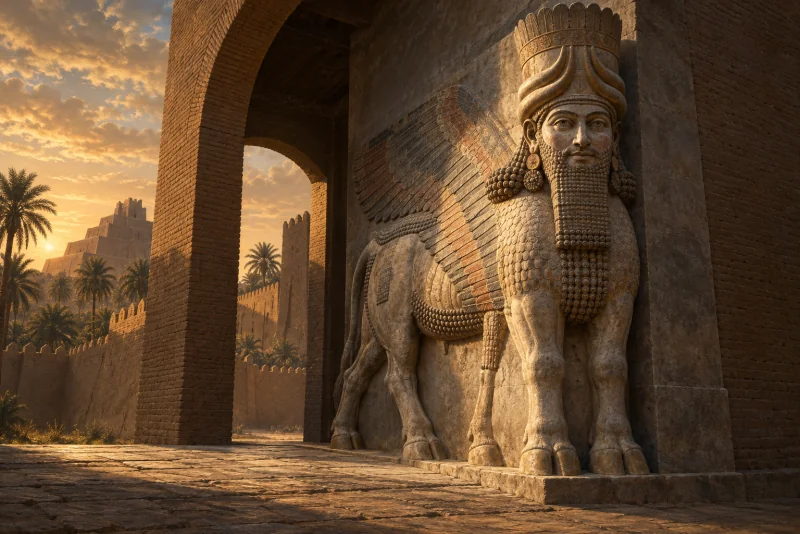
The gods planned the city of Kish. The Anunna-gods laid its foundations and the Igigi-gods its brickwork, and a broken line names Etana as the people’s master builder (Tablet I 1–7). But no king had yet been set over the teeming peoples. No headdress or crown had been made, no scepter set with lapis, no throne dais built, and the seven gods kept the gates barred against the crowd (I 12–17). The Old Babylonian version adds that scepter, crown, headdress and staff still lay before Anu in heaven, until kingship came down (Morgan tablet 11–14).
Ishtar looked everywhere for a shepherd and a king, and Enlil inspected the dais: let kingship be established in the land, and the heart of Kish be glad (I 19–25, partly restored). Then the tablet breaks. A fragment has Etana’s wife tell him of a dream. The few words left mention Etana the king, and a ghost (I a+2–a+7).
1-2 The Eagle and the Serpent
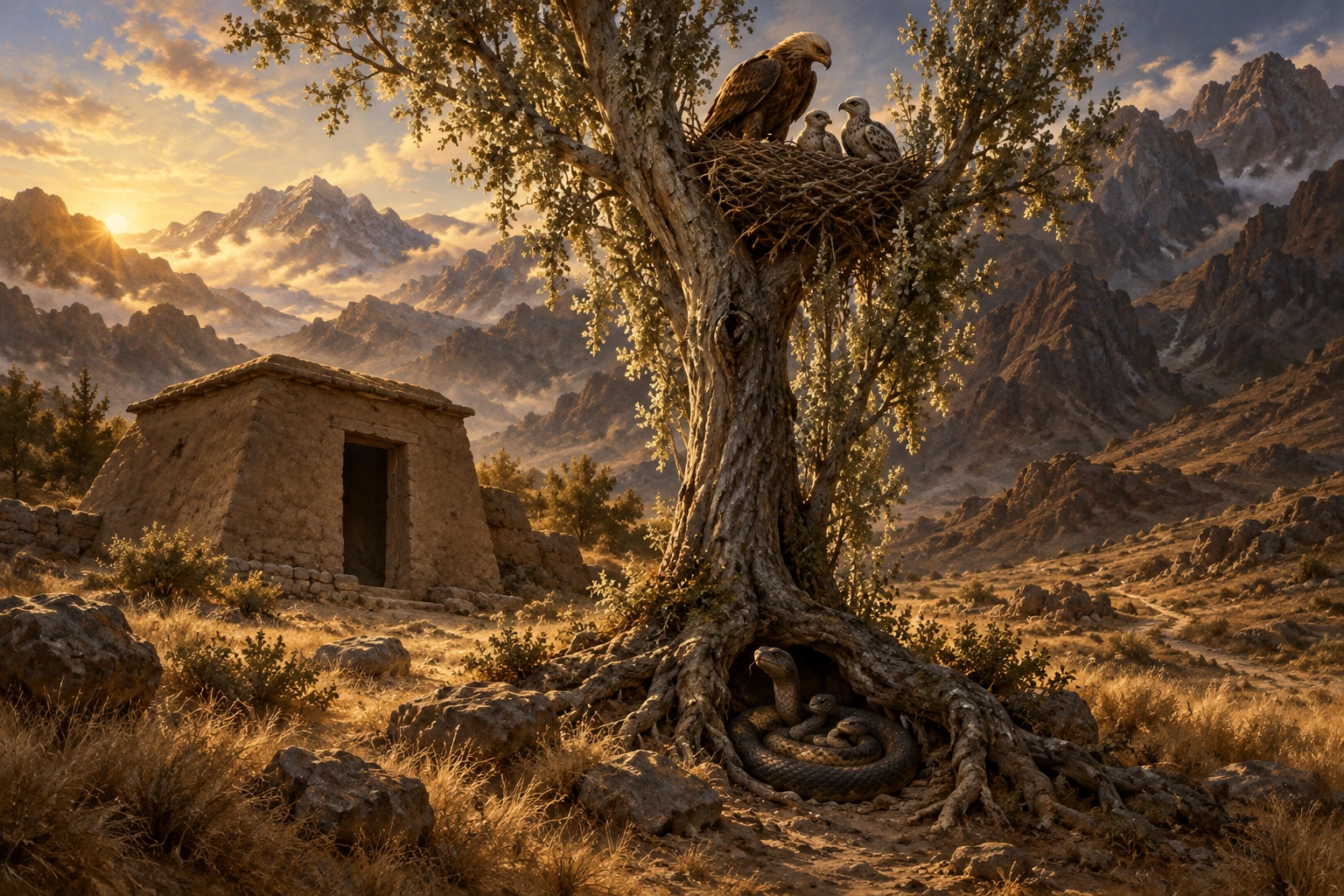
Beside a shrine of the storm god Adad grew a poplar. An eagle nested in its crown and a serpent at its root (II 3–5). The eagle proposed that they be friends. The serpent warned him that friendship stands under the eye of Shamash, and that breaking it would be an abomination to the gods (II 7–13). So before Shamash the warrior they swore an oath: whoever oversteps the limits of Shamash, may Shamash hand him to the slayer, may the mountains hide their passes from him, may the weapon fly straight at him (II 16–22).
Then they hunted by turns. The eagle brought down wild oxen and wild asses, and the serpent ate, turned away, and let its young eat. The serpent brought down buck and gazelle, and the eagle and his young ate (II 26–33).
1-3 The Broken Oath
When his young were grown, the eagle’s heart plotted evil. He would eat the serpent’s young, then fly up to heaven and come down only to the top of the tree, out of reach (II 36–44). The smallest fledgling, a very wise one, warned him. “Do not eat, O my father,” it begins in Morris Jastrow’s translation of 1898. The eagle would not listen. He went down and ate the serpent’s children (II 45–52).
That evening the serpent came home carrying meat and found its nest gone. The eagle had torn up the ground with his talons, and the dust rose to the sky. The serpent wept before Shamash: “thy net is the broad earth. Thy trap is the distant heavens” (Jastrow), let the eagle not escape it (II 53–72). Shamash told it what to do. Cross the mountain, where a wild ox lies dead. Open its belly and hide inside. When the eagle comes in to feed, seize him by the wing, cut off his wings, pinions and tail feathers, and throw him into a bottomless pit to die of hunger and thirst (II 75–87).
All the birds came down to the carcass. The eagle hung back, and the wise fledgling warned him again that the serpent was waiting inside. But the eagle went down, tore at the meat, searched in front of it and behind it, and worked his way into the belly. The serpent seized him. The eagle offered a ransom fit for a king. The serpent refused: if it let him go, the punishment would fall on itself, and how would it answer to Shamash? It cut off his wings and threw him into the pit (II 93–121).
1-4 The Pit and the Childless King
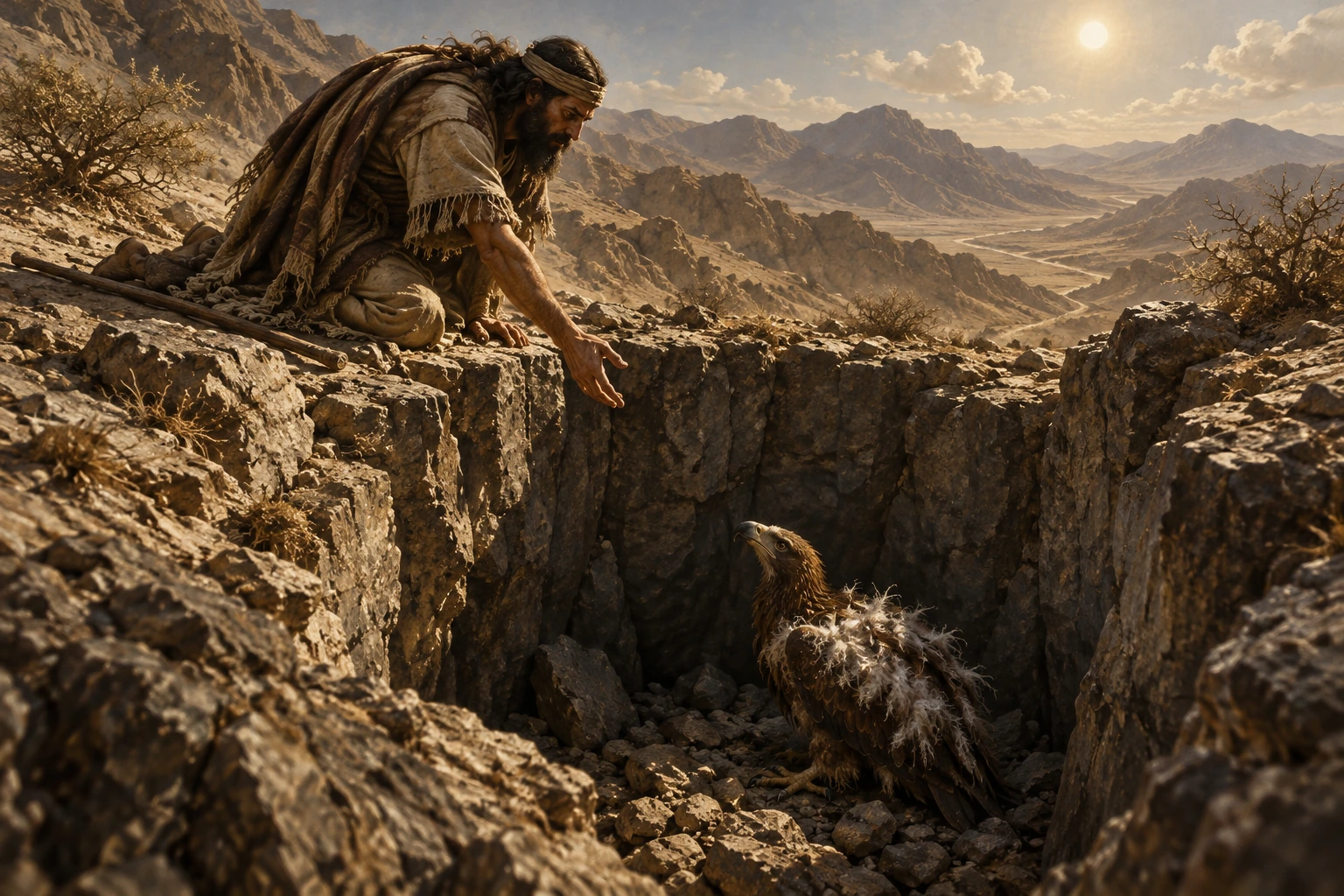
Day after day the eagle prayed to Shamash from the pit. Shamash would not come near an oath-breaker, but he promised to send a man to help him (II 123–132). Day after day Etana prayed too. He had fed Shamash his fattest sheep and the netherworld the blood of his lambs. Now he asked Shamash to show him the plant of birth, to take away his disgrace and give him an heir (II 133–142). Shamash sent him over the mountain to a pit with an eagle in it, who would show him the plant. Etana went, and found it (II 143–152).
In lines mostly lost, the eagle asked Shamash that the man and the bird might understand each other (III 1–8). The rescue is broken in the Standard version, but the Old Babylonian Morgan tablet tells it. Etana took the eagle by the hand in the seventh month and in the eighth brought him out over the edge of the pit. The eagle ate like a ravening lion and grew strong. Then he spoke: let us be friends, ask me whatever you wish (Morgan c+1–c+7).
1-5 The First Flight
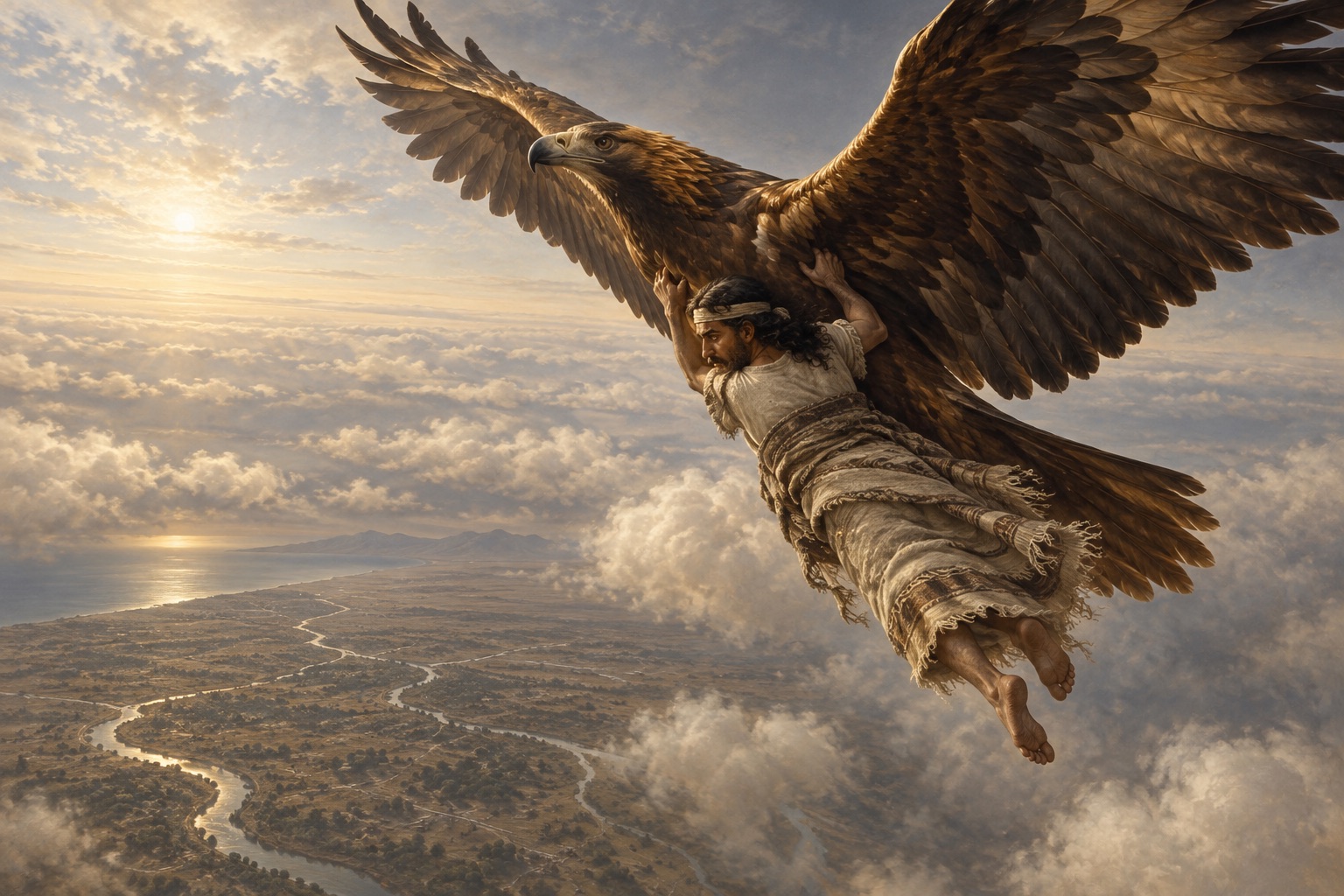
Etana asked his friend for the plant of birth (III 12–17). The eagle searched the mountains alone and found nothing. The plant, he said in a line partly restored, was with Ishtar, and they would have to go to her. He had Etana put his arms against his sides and his hands against his wing feathers, and lifted him (III 18–29).
After one league the eagle told him to look down: the vast sea had become like a paddock. After a second, the land was a garden plot and the sea no bigger than a trough. After a third, Etana could see neither land nor sea. He would not go up to heaven, he cried; let the eagle set him down and let him go back to his city (III 30–43). The eagle let him drop a league and dived to catch him, then a second, then a third, the last time within three cubits of the ground (III 44–51). After a break, someone reaches his city and his house, and someone, perhaps his wife (the words are restored), asks Etana about the plant of birth (III a+4–a+6).
1-6 The Dream and the Heaven of Anu
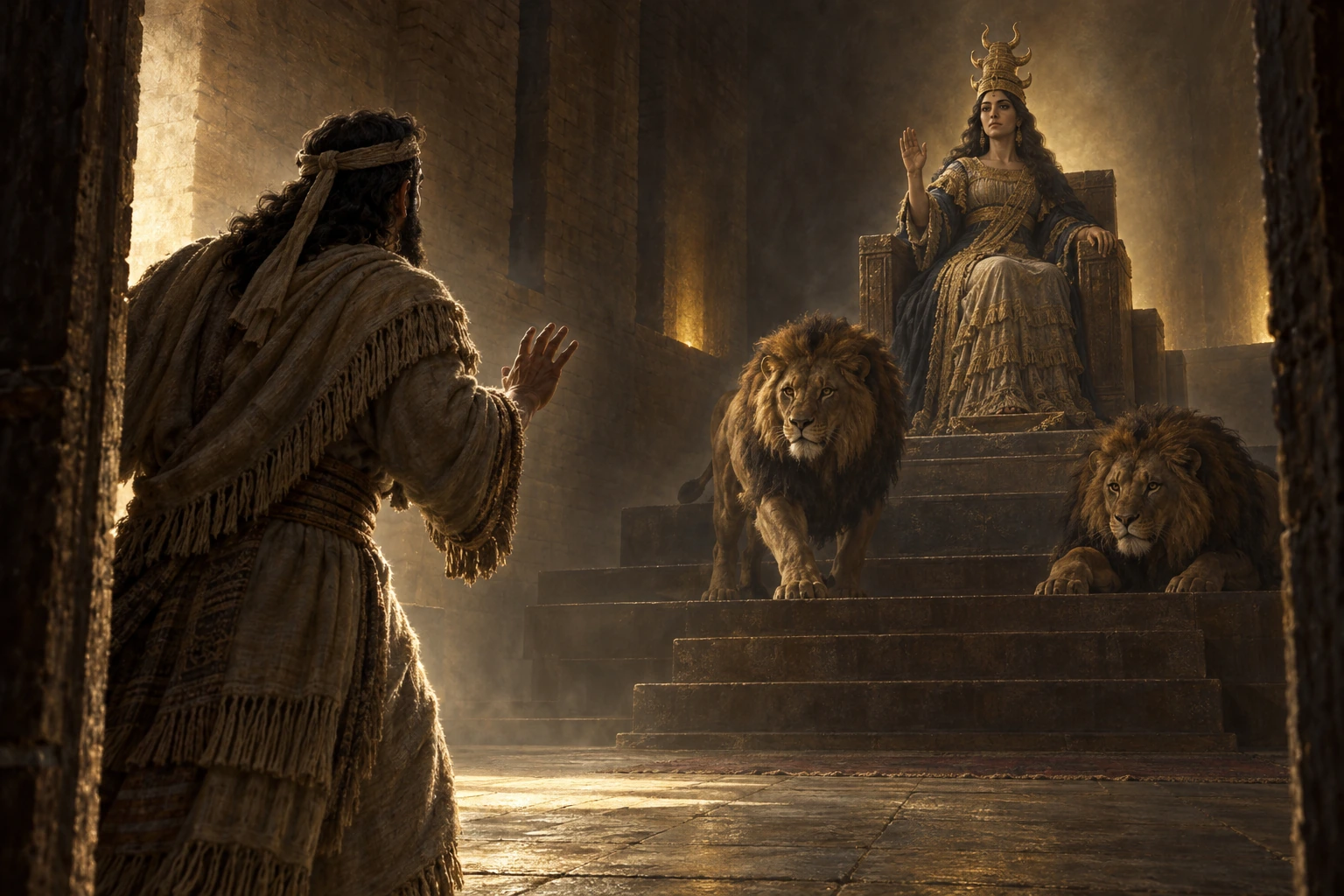
Etana told the eagle a dream. They had passed through the gates of Anu, Enlil and Ea, then of Sin, Shamash, Adad and Ishtar. He had opened the seal of a house and gone in. A beautiful woman in a tiara sat there; a throne was set out, and it was Ishtar, with lions crouching beneath it. As he came in, the lions moved against him (the verb is restored), and he woke with a shudder (III b+3–b+14).
The eagle said the dream was plain. In Jastrow’s translation: “Come and let me carry thee to the heaven [of Anu]. On my breast place thy breast, On my pinion place thy palms, On my side place thy side.” Great was the burden. After one league the sea had become a stream; after the second the land was watery; after the third the sea was a gardener’s ditch (III b+15–b+38). They reached the heaven of Anu, passed through the same gates and bowed down together. Etana saw a house and pushed open its door: these last lines are restored from the words of the dream (III b+39–b+45).
1-7 The Lost Ending
After that, only scraps survive, a word or two to a line: a friend, the gods, a rival (III c+1–c+7). No copy says what Etana found inside, whether he brought the plant home, or whether he came home at all.
2 Where the Story Is Written Down
- The Sumerian King List (ETCSL 2.1.1). After the flood, kingship came down from heaven to Kish (lines 39–42). Etana is the thirteenth king there in the ETCSL composite text: “the shepherd, the man who went up to heaven, who made firm all the lands” (lines 64–67, our translation of the Sumerian). He reigns 1,500 years, or 635 in one manuscript. “Balih, son of Etana” follows for 400 years, or 410 in two manuscripts (lines 68–70). ETCSL takes its numbers from the Weld-Blundell prism in the Ashmolean Museum, an Old Babylonian copy (CDLI: about 1900–1600 BCE).
- The Old Babylonian version. According to the eBL, the oldest manuscripts of the story come from Babylonia and Susa, from the first half of the 2nd millennium BCE. One is the Morgan tablet (MLC 1363), published by Albert T. Clay in 1922 among the epic fragments “in the Pierpont Morgan Library”; it keeps the opening, the eagle in the pit and the rescue. The other, from Susa (Sb 9469), keeps the end of the oath and the serpent’s lament.
- The Middle Assyrian version: four tablets from Ashur, from at least two manuscripts, of the second half of the 2nd millennium BCE.
- The Standard Babylonian version is known only from the libraries of Ashurbanipal at Nineveh, where at least three sets were kept. The eBL arranges it in three tablets. Wolfgang Röllig noted in 1992 that only three tablets can be made probable (the colophon of K 2606 calls it Tablet 2, and another must have followed), not the five that J. V. Kinnier Wilson assumed in his edition of 1985.
- An author. The Assyrian Catalogue of Texts and Authors lists the Series of Etana as the work of Lu-Nanna, the sage, remembered, the eBL adds, as a sage from Ur (line d+17).
- Discovery. George Smith published the first fragments in 1876, among “Babylonian fables”. “I am unable to ascertain the order of the fragments of these legends,” he wrote, “and must translate them as they come.” The eBL says the epic was first recognized in 1894.
- Etana elsewhere. In the Yale dialogue (YBC 2394, edited by Benjamin R. Foster and Andrew R. George in 2020), the father, facing death, asks whether he should go up into Anu’s heaven like Etana. In Enkidu’s dream of the netherworld in the Standard Babylonian Epic of Gilgamesh, Etana sits among the dead (VII 202). And an omen tablet on the entrails, from the Seleucid era, reads: “If the tirani is like an eagle; the omen of Etana, the king, who went up to heaven” (MLC 1874, line 33, trans. Clay, 1923).
3 Competing Versions
- Who did the hunting? In the Standard version the eagle and the serpent hunt by turns. On the Susa tablet and in the Middle Assyrian version only the serpent hunts, and the eagle and his young eat what it brings (Susa 8–11; Middle Assyrian b+14–b+20).
- Who sends Etana to the pit? In the Standard version, Shamash answers his prayer himself (II 143–147). In the Middle Assyrian version Etana lies down to see a dream, and the dream sends him to the pit (d+5–d+11).
- On its back, or at its breast? The seals show a man astride the eagle. The text has him press his chest to the eagle’s chest and hold on to its wing feathers. Etana, Röllig wrote, “by no means” sits on the eagle’s back, “as the seal images suggest”.
- A son not yet born? Jastrow (1898) and Ward (1910) understood that Etana’s wife had conceived but could not give birth. The eBL calls Etana simply childless, and his prayer asks for an heir.
- Which flight comes first, and did Etana fall? Jastrow (1910) and Clay (1922) put the flight to Anu’s heaven first and the fall last: the eagle sets out for Ishtar, his strength fails or the goddess intervenes, and they plunge to earth. “We are left to conjecture what happened to Etana and to his ancient ‘airship’,” Jastrow wrote, and Ward thought both “are perhaps dashed to pieces”. The Japanese encyclopedias on Kotobank still end the story with the fall. Röllig judged its outcome uncertain, and thought the passages at the gates of heaven suggest that Etana reached his goal, perhaps even before the fall. The eBL edition puts the failed flight first: the eagle catches him three cubits from the ground, he goes home, and the ascent to Anu’s heaven comes later on the same tablet.
- A son, or none? The King List names Balih. The Yale dialogue says the gods gave Etana the lot of mankind and no child (YBC 2394, obverse ii 42–51, in Foster and George’s reading).
- Old readings. Clay translated a line of the Morgan opening as the Igigi “determined upon enmity for the people”. The eBL reads the same line as the Igigi fixing a holy day for the people (Morgan 5). We follow the modern reading.
4 History and Tradition
- A king who went up. In the King List, the same Sumerian verb, ed₃, “to go up or down”, is used for the kingship that came down from heaven (line 41) and for Etana, who went up (line 65). In the epic, Röllig noted, the first man to hold the kingship that came down from heaven is one who later goes up, and the name Etana may have been heard, perhaps by folk etymology, as “he who goes up to heaven”.
- Kish lay in central Iraq, about 15 km east of Babylon. The archaeologist Onoyama Setsu notes that the King List makes it the first city to receive kingship after the flood.
- The seals. Akkadian-period cylinder seals show a man borne off by an eagle while dogs and shepherds look up. Ward knew five in 1910: “They are very few in number.” Two in the Vorderasiatisches Museum in Berlin are described on its museum-digital pages. On one (VA 03456, serpentine, 2350–2200 BCE), a crescent and a disc, perhaps the sun, appear by the rider’s head, two dogs gaze up, a man lifts his hand to his mouth, and a second scene shows a bearded shepherd driving three sheep. On the other (VA 08795, 2350–2150 BCE), two dogs sit under the eagle while a man with a jug and a shepherd with three sheep come up. The seals are older than any surviving tablet of the story, and the name Etana comes from the texts: Ward recognized him “so far as the available known texts go”, and read the shepherd scenes as his early life only “if we may venture”.
- Later echoes. Jastrow saw “the influence of the myth of Etana” in the Iranian legend of King Kay Kāvus, who tried to fly to heaven with the help of eagles and came to grief. The folklorist Ozawa Toshio notes that the fight of the serpent and the eagle has parallels in Finnish tales and resembles the Japanese folktale Kō no tamago (鴻の卵), a question, he writes, still waiting for comparative study.
5 Related Stories
- Adapa: The Man Who Refused the Bread of Life: the other man in these myths who reaches the gate of Anu, as Jastrow noted. He read both stories as teaching that a human cannot become immortal like the gods.
- Gilgamesh: The King Who Tried to Escape Death: Röllig compares the dreams before Etana’s flight with the three dreams before the fight with Huwawa, and the founding of Kish with the walls of Uruk. In Enkidu’s dream of the netherworld, Etana is among the dead.
- Utnapishtim: The Flood Survivor, and the Older Atrahasis: in the King List, Etana’s dynasty is the first to rule after the flood swept over the land.
- Yggdrasil: The World Tree That Suffers More Than Men Know: another tree with an eagle in its crown and a serpent at its roots. We have not found a scholar who compares the two; we link them for the theme.
- The Simurgh: The Great Bird of the Alborz: in Encyclopaedia Iranica, Schmidt sets the Persian Simurgh beside the eagle that carries Etana to heaven and, following J. Aro, sees in them a “common Near Eastern heritage”.
6 Sources
- Etana, electronic Babylonian Library, ed. Zsombor J. Földi, trans. Benjamin R. Foster (2024): Old Babylonian (Morgan, Susa), Middle Assyrian (Ashur) and Standard Babylonian (I–III) versions: eBL
- The Sumerian King List, ETCSL 2.1.1, lines 39–70, composite text and translation: ETCSL, ETCSL; the Weld-Blundell prism, Ashm 1923.444: CDLI
- Catalogue of Texts and Authors, Assyrian version, line d+17: eBL
- YBC 2394, ed. Benjamin R. Foster and Andrew R. George, “An Old Babylonian Dialogue between a Father and his Son”, Zeitschrift für Assyriologie 110 (2020): eBL, De Gruyter
- Epic of Gilgamesh, Standard Babylonian Tablet VII 202, ed. and trans. Andrew R. George: eBL
- George Smith, The Chaldean Account of Genesis (1876), 138–144: archive.org
- Morris Jastrow Jr., The Religion of Babylonia and Assyria (1898), chapter 24, “The Etana Legend”: Project Gutenberg; “Another Fragment of the Etana Myth”, Journal of the American Oriental Society 30 (1910), 101–131: archive.org
- William Hayes Ward, The Seal Cylinders of Western Asia (1910), chapter 22, 142–148: archive.org
- Albert T. Clay, A Hebrew Deluge Story in Cuneiform and Other Epic Fragments in the Pierpont Morgan Library (1922), 33–38; Babylonian Records in the Library of J. Pierpont Morgan IV (1923), nos. 2 and 13: archive.org, Yale Babylonian Collection
- Wolfgang Röllig, “Überlegungen zum Etana-Mythos”, in Gegengabe: Festschrift für Emma Brunner-Traut (1992), 283–288: Propylaeum-DOK, archive.org
- Vorderasiatisches Museum, Staatliche Museen zu Berlin, VA 03456 and VA 08795: museum-digital, museum-digital
- Ozawa Toshio, “エタナ”, and Onoyama Setsu, “キシュ”, Heibonsha World Encyclopedia: Kotobank, Kotobank
Cover and illustrations: AI-generated images made for Arcana. They are interpretations, not historical artworks.