Yggdrasil: The World Tree That Suffers More Than Men Know
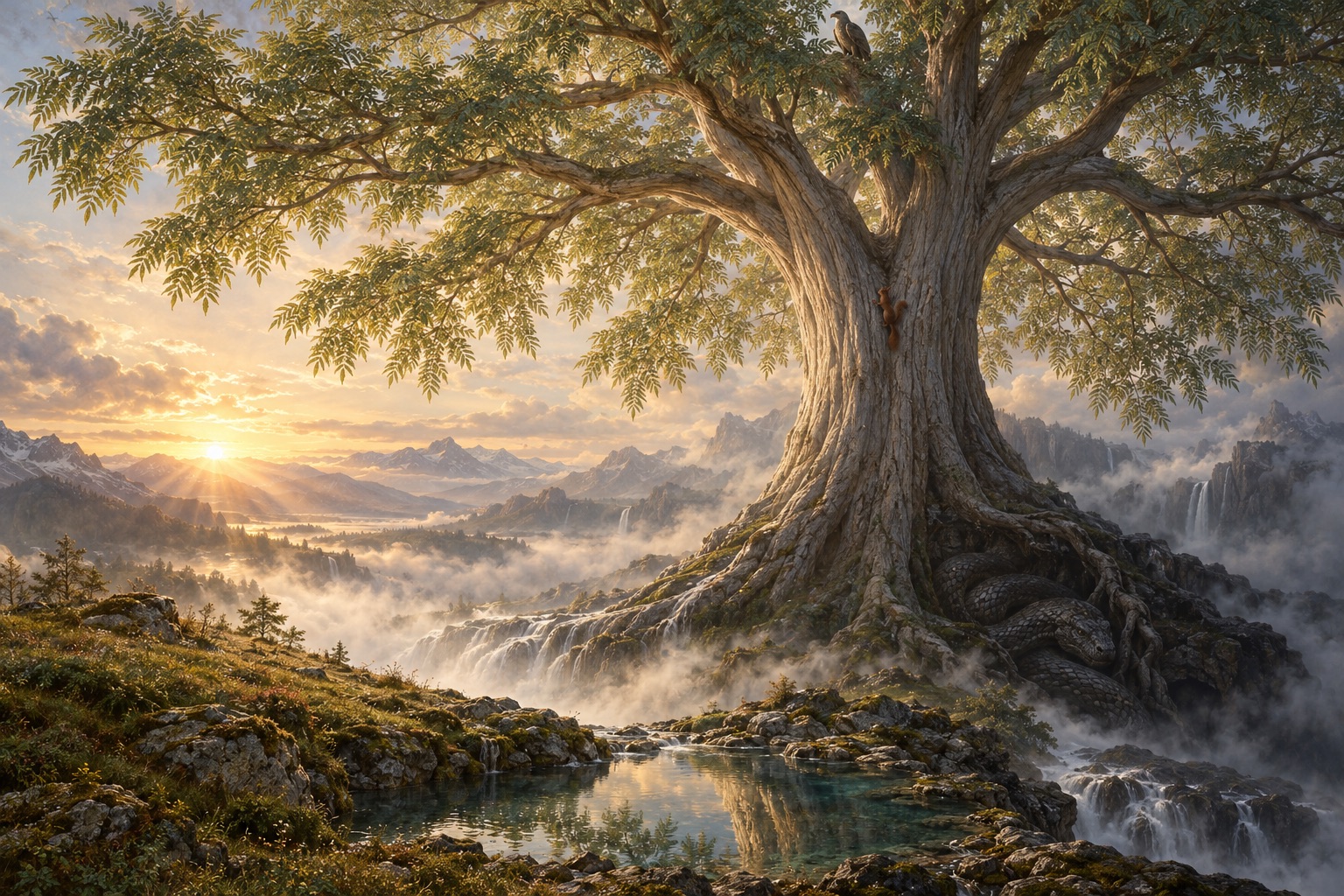
An eagle in the crown, a dragon at the roots and a squirrel running between them: the Eddic poems give the world ash three roots and endless wounds. They also speak of nine worlds, but no medieval text says which nine.
- Type: sacred place, the world tree of Norse myth
- Culture: Norse; Viking Age Scandinavia and medieval Iceland
- Earliest texts: the poems Völuspá, Grímnismál and Hávamál, written down in the Codex Regius (c. 1270) but older than it; Snorri Sturluson’s Edda (c. 1220–30) describes the tree at length
- Key figures: Odin, Mímir, the norns, the eagle and the hawk Veðrfölnir, the squirrel Ratatoskr, the dragon Níðhöggr, four harts
In the poem Grímnismál, Odin has sat for eight nights between two fires in a king’s hall, in disguise. Only the king’s ten-year-old son brings him a horn to drink, and then he begins to describe the world. Part of what he describes is a tree: an ash with three roots, a squirrel running up and down it, harts tearing at its shoots and a dragon gnawing it from beneath. “Yggdrasil’s ash great evil suffers,” he says, “far more than men do know.”
What does “Yggdrasil” mean? Probably “Yggr’s horse”. Yggr, “the Terrible One”, is a name of Odin, and drasill is a poets’ word for a horse. A gallows was called the horse that a hanged man rides, so the name is usually read as Odin’s gallows, after the poem in which he hangs on a “windy tree” for nine nights. But that poem never names its tree, and scholars have argued over the name since the nineteenth century (section 3).
1 The Telling
No single text tells the whole of it. What follows joins the Eddic poems, quoted in Henry Adams Bellows’s translation of 1923, to the prose of Snorri Sturluson’s Gylfaginning, written in Christian Iceland in the 1220s, quoted in Arthur Gilchrist Brodeur’s translation of 1916. Where a detail is only in Snorri, we say so.
1-1 An Ash Beneath the Ground
Völuspá, “the prophecy of the seeress”, opens with her oldest memories. She remembers the giants who raised her, “nine worlds” and nine íviðjur, a word no one is sure of, and a mjötviðr, a “measure-tree”, “beneath the earth” (stanza 2). In the next stanza she remembers the age of Ymir, when there was nothing yet but a yawning gap.
Later she names the tree (stanza 19): “An ash I know, Yggdrasil its name, / With water white is the great tree wet; / Thence come the dews that fall in the dales, / Green by Urth’s well does it ever grow.” Grímnismál calls it “the best of trees” (stanza 44). Snorri goes further: “The Ash is greatest of all trees and best: its limbs spread out over all the world and stand above heaven” (Gylfaginning 15).
1-2 Three Roots, Three Wells
Odin, in Grímnismál 31: “Three roots there are that three ways run / 'Neath the ash-tree Yggdrasil; / 'Neath the first lives Hel, 'neath the second the frost-giants, / 'Neath the last are the lands of men.”
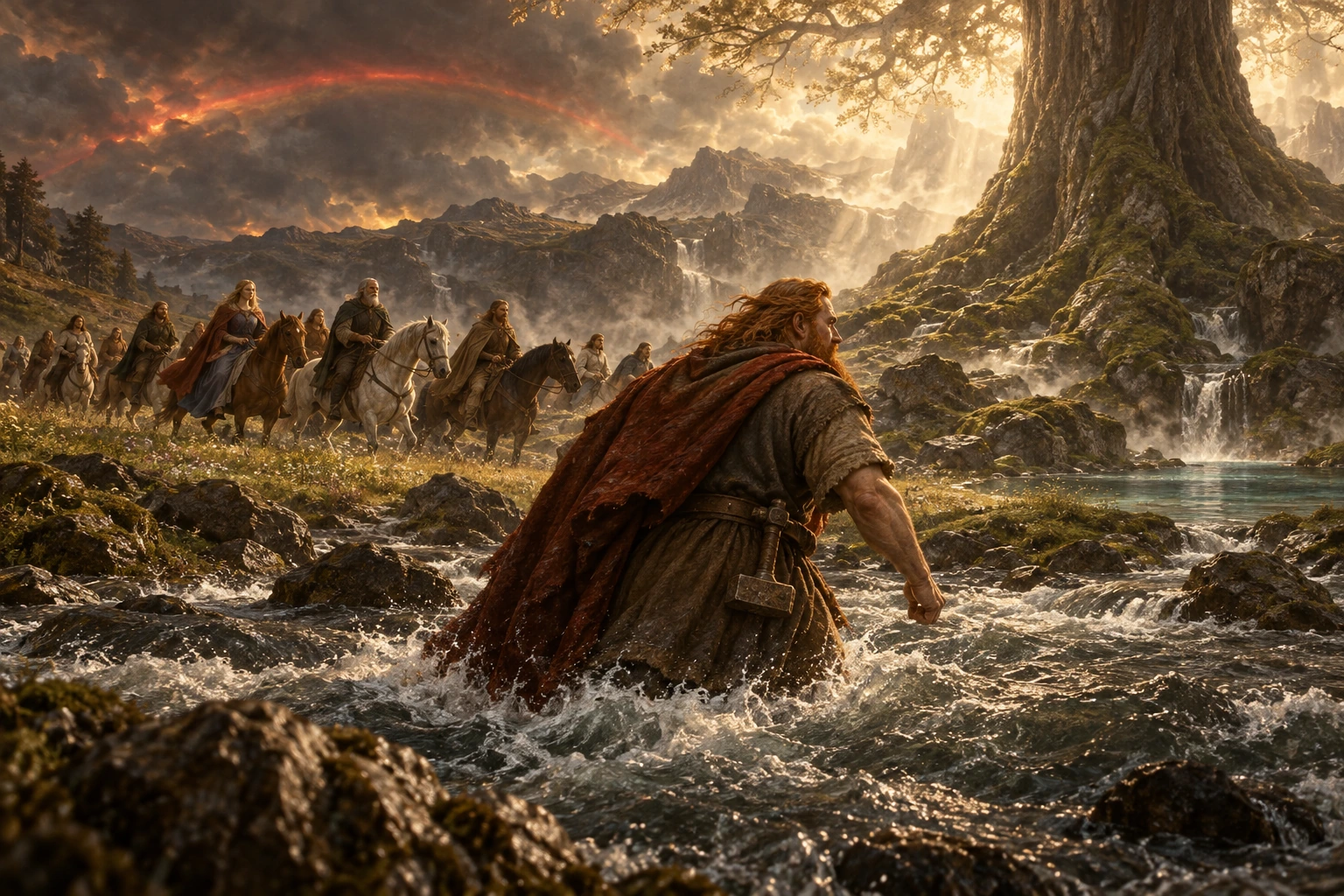
Snorri’s roots run elsewhere, and he sets wells beneath them (Gylfaginning 15). One root is “among the Æsir”, the gods. One is among the frost giants, where Ginnungagap, the yawning void, once was; under it lies Mímir’s well, in which “wisdom and understanding are stored”, and where Odin left an eye in pledge for a single drink. The third stands over Niflheim, above the spring Hvergelmir, where the dragon Níðhöggr “gnaws the root from below”. Then Snorri adds that “the third root of the Ash stands in heaven”, over Urðr’s well, “which is very holy”. There the gods hold their court every day. In Grímnismál 29–30 they ride to the ash on their horses “when dooms to give”. Only Thor goes on foot, wading the rivers “Kormt and Ormt and the Kerlaugs twain”, for “heaven’s bridge burns all in flame”.
1-3 The Eagle, the Squirrel and the Dragon
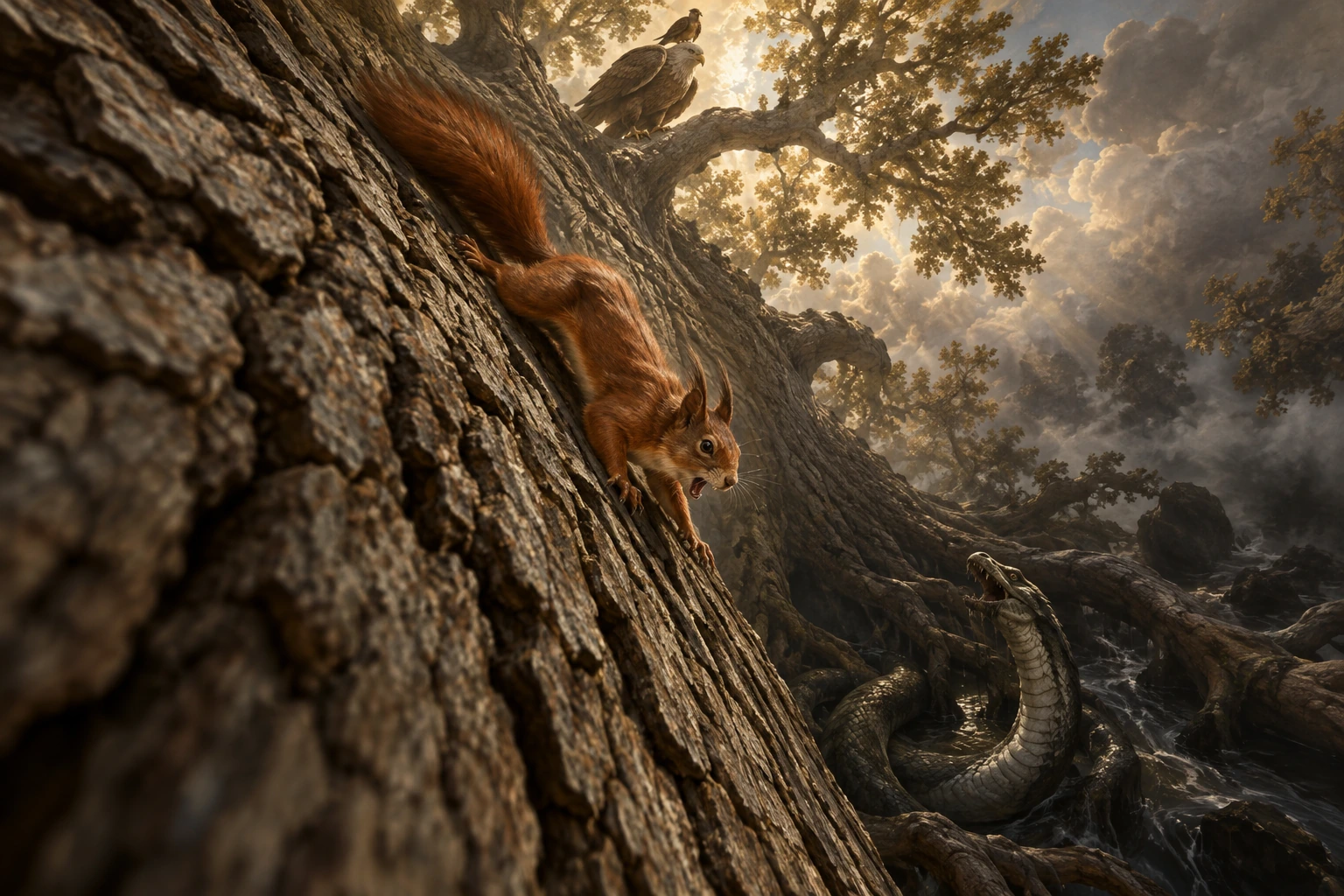
Grímnismál 32: “Ratatosk is the squirrel who there shall run / On the ash-tree Yggdrasil; / From above the words of the eagle he bears, / And tells them to Nithhogg beneath.”
The eagle has no name in any text. Snorri alone says more (Gylfaginning 16): the eagle “has understanding of many a thing”, a hawk called Veðrfölnir sits between its eyes, and the squirrel Ratatoskr runs up and down the trunk “bearing envious words between the eagle and Nidhoggr”. Bellows thought a stanza about the eagle might have dropped out of Grímnismál, and that Snorri had paraphrased it.
1-4 The Tree That Suffers
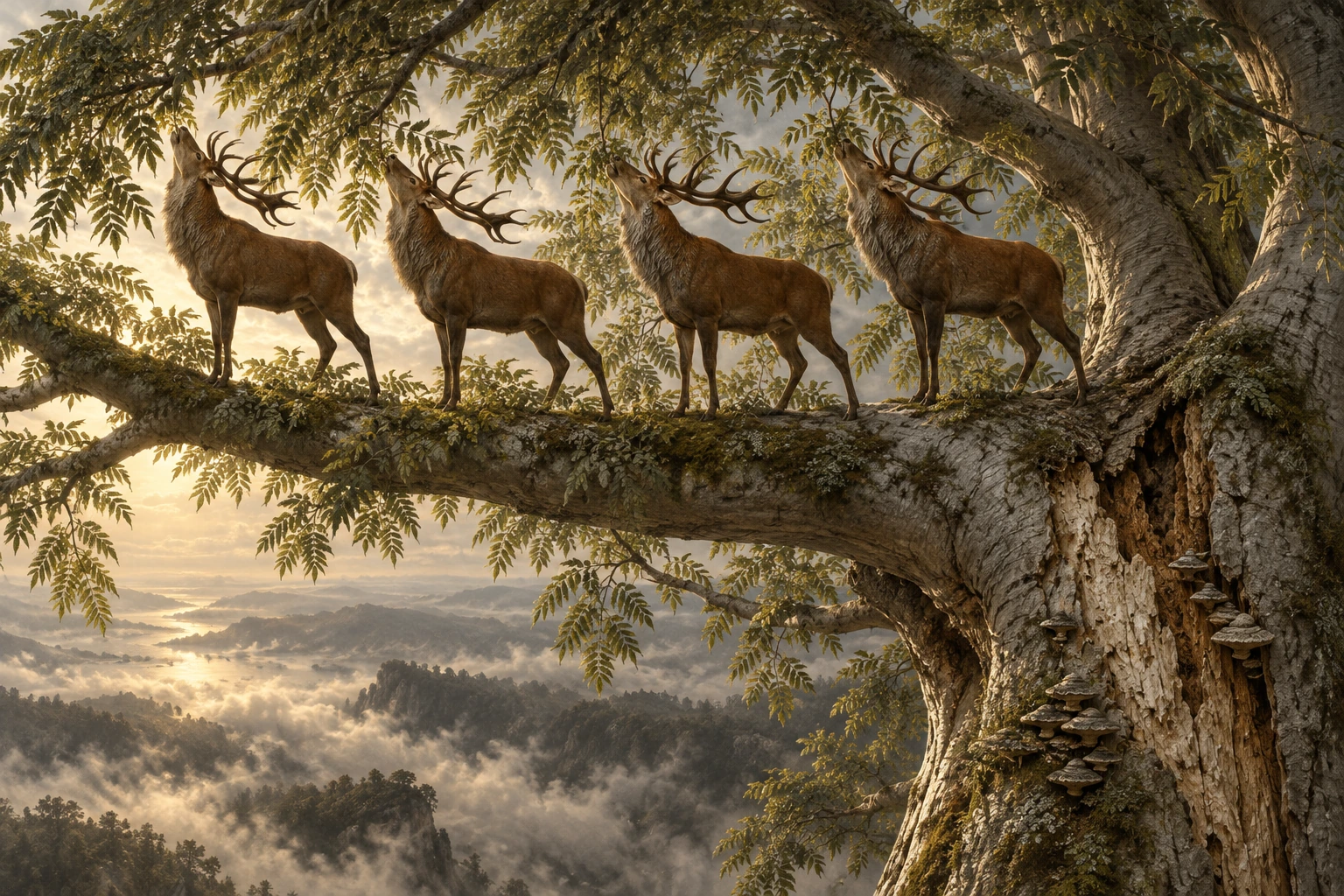
Four harts gnaw the tree’s shoots “with necks bent back”: Dáinn, Dvalinn, Duneyrr and Duraþrór (Grímnismál 33). “More serpents there are beneath the ash / Than an unwise ape would think” (34): Góinn and Móinn, the sons of Grafvitnir, Grábakr and Grafvölluðr, Ófnir and Sváfnir. Then the stanza that gives the tree its sorrow (35): “Yggdrasil’s ash great evil suffers, / Far more than men do know; / The hart bites its top, its trunk is rotting, / And Nithhogg gnaws beneath.”
Völuspá has the tree wet with white water; Snorri alone says who keeps it so. Every day the norns who dwell by Urðr’s well sprinkle it with the well’s water and clay, “to the end that its limbs shall not wither nor rot”. The water is so holy that whatever enters it turns as white “as the film which lies within the egg-shell”. The dew that falls from the tree is honeydew, and bees feed on it. Two birds feed in the well, the first swans, and all swans come from them.
1-5 The Windy Tree and the Shaking Ash
In Hávamál 138 (139 in Bellows), Odin speaks of a tree of his own: “I ween that I hung on the windy tree, / Hung there for nights full nine; / With the spear I was wounded, and offered I was / To Othin, myself to myself, / On the tree that none may ever know / What root beneath it runs.” The poem never names it. It is usually taken to be Yggdrasil because of the name. At the end of the world, the seeress sees the tree again (Völuspá 47): “Yggdrasil shakes, and shiver on high / The ancient limbs, and the giant is loose”. In Snorri, “the Ash of Yggdrasill shall tremble, and nothing then shall be without fear in heaven or in earth” (Gylfaginning 51).
2 Where the Story Is Written Down
Stanza numbers follow Guðni Jónsson’s edition of the Old Norse, as given on heimskringla.no, with Bellows’s number added where his differs.
- Völuspá survives in two different versions, in the Codex Regius (c. 1270) and in Hauksbók (14th century), and Snorri quotes stanzas from a third. Where and when it was composed is unknown; Edward Pettit, in his edition of 2023, notes that Iceland around its conversion to Christianity in 999/1000 “has often been favoured”. The tree is in stanzas 2, 19, 27, 28 (28–29 in Bellows) and 47, which Pettit, following the Codex Regius, prints as 46, with its lines in another order.
- Grímnismál is in the Codex Regius and in a second manuscript, AM 748 I a 4to. Odin, calling himself Grímnir, recites it between the fires. Stanzas 29–35 describe the tree and its animals. Bellows called stanzas 27–35 “confused”, possibly added later, and noted Sophus Bugge’s view that 33–34 are younger than the stanzas around them.
- Hávamál 138: the “windy tree”, never named.
- Vafþrúðnismál 43 and 45: a giant who has been to “nine worlds” beneath Niflhel, and the wood of Hoddmímir, where two humans will live through the end of the world.
- Fjölsvinnsmál 19–24 (Svipdagsmol 29–34 in Bellows) survives only in 17th-century manuscripts. Its tree, Mímameiðr, “Mímir’s tree”, spreads its limbs “o’er every land”, no one knows from what roots, and neither fire nor iron will fell it. A golden cock, Víðópnir, sits in it. Bellows and Pettit both take it to be the world tree.
- Gylfaginning, chapters 15–16, with 3, 34 and 51, is the only full description, and it quotes Völuspá and Grímnismál as its authorities. Anthony Faulkes, its editor, calls it “an attempt at a scholarly systematisation of traditional legends”, by a Christian author who “would probably not have felt inhibited from inventing new stories or drastically altering old ones”. Snorri’s quotations also differ from the manuscripts: his Völuspá 19 adds that the tree is “holy”.
3 Competing Versions
- Which three roots? Grímnismál: Hel, the frost giants, humans. Snorri: the Æsir, the frost giants, Niflheim, and then a third root “in heaven”. Only Snorri ties the wells to the roots. The poems set the tree over Urðr’s well (Völuspá 19) and Odin’s eye in Mímir’s well (28), without tying either to a root.
- One hart or four? Grímnismál 35 has “the hart” biting the top; 33 has four. Stanza 34 names six serpents; Snorri says no tongue can count them. Faulkes points out these conflicts, and Bellows guessed that the four harts were “a late multiplication” of a single hart, and the serpents an expansion of Níðhöggr.
- Nine what? Pettit takes the íviðjur of Völuspá 2 as probably giantesses or troll-women, perhaps ones who lived “in a wood”. They might also be withies, the tree’s roots, or the word might be related to Old English inwid, “evil”. Bellows translated “the nine in the tree”. As for the nine worlds, in Vafþrúðnismál 43 the nine worlds lie “beneath Niflhel”. Snorri says Niflhel is “down in the ninth world” (Gylfaginning 3), and that Hel was given “power over nine worlds” (34). No text names them, and none places them on the tree.
- What does the name mean?
- Uhland and Bugge read Yggr + drasill as “Yggr’s horse”, the gallows on which Odin hung. In 1903 Sivert Hagen called this reading “widely accepted by scholars”, and Bellows explained the name as “literally ‘the Horse of Othin,’ so called because of this story”. Cleasby and Vigfússon’s dictionary (1874) records that “the gallows is called the horse of Odin”, and that to give someone a horse meant to hang him.
- The grammar is awkward: “Yggr’s horse” should be Yggsdrasill. So Detter read it as “terrible horse”, and Heinzel argued that as a poetic name it could only mean “gallows”, not Odin’s gallows.
- Eiríkr Magnússon (1895) read askr Yggdrasils as “the ash of Odin’s horse”, Sleipnir. Yggdrasil, then, was never the tree’s own name.
- Pettit (2023) calls the original sense uncertain. It may have meant “Terrible Colossus”, later understood as “Yggr’s steed”, with the ash as the post where the steed was tied.
- Ash or yew? The poems say askr, ash, yet Völuspá 19 has it “ever” green, and ash trees lose their leaves. Snorri’s harts bite its barr, a word for the needles of conifers. Cleasby and Vigfússon thought he misused it (“Icel. has no trees”); Faulkes suggests alliteration, or an evergreen tree imagined “to partake of the nature of a conifer”. The yew comes in through Uppsala (section 4). J. E. Thaasen (1856) thought the evergreen tree there stood for Yggdrasil and was beyond doubt an ash. L. Fr. Läffler (1911) argued that it could only have been a yew, by then so rare in Sweden that people had forgotten its name. For that very reason, he rejected the idea that it was an earthly copy of the ash Yggdrasil.
- Does the tree fall? Völuspá and Snorri say only that it shakes. Surtr then burns “all the world”, and some reference works, such as Taniguchi Yukio’s entry in the Heibonsha World Encyclopedia, say the tree burns with it. The texts never say so plainly. In Völuspá 57, smoke rages against the aldrnari, the “life-nourisher”, a poets’ word for fire; Pettit suggests it might here be the world tree. Against that, Fjölsvinnsmál says fire will not fell Mímameiðr, and in Hoddmímir’s wood, “probably” the tree itself in Bellows’s view, two humans survive.
4 History and Tradition
- The tree at Uppsala. Adam of Bremen finished a first version of his history of the archbishops of Hamburg around 1076. He describes a temple at Uppsala, and a marginal note, scholion 138, adds (our translation of the Latin): “Near that temple is a very great tree, spreading its branches wide, always green in winter and summer; of what kind it is, no one knows. There is also a spring there, where the pagans are accustomed to make their sacrifices.” Scholars since R. Nyerup (1816) have compared it with Yggdrasil and Urðr’s well. Rudolf Simek points out that the scholia may have been added after Adam’s death, perhaps much later. He trusts Adam on a cult centre at Uppsala, but “not in any of the details concerning … the temple, or evergreen trees”.
- A birch under a church. At Frösö church in Jämtland, Sweden, an excavation in 1984 found beneath the chancel a birch stump surrounded by the bones of bear, pig, elk, sheep, cattle, red deer, squirrel and horse. Radiocarbon dating put the felling of the tree around 1060, give or take 75 years. The diocese suggests that the tree stood in a sacrificial grove, and that the bones fell from animals hung in it as offerings.
- A Christian tree? Sophus Bugge argued in the 1880s that the hanging of Odin and the ash Yggdrasil both came from medieval legends of the Cross. He pointed to a 13th-century Latin legend, retold by Hagen, who agreed with him: Seth looks into Paradise and sees a great tree over a spring from which all the waters of the earth flow, a serpent wound round it, its top in heaven and its root reaching down to hell. Taniguchi Yukio, who translated the Poetic Edda into Japanese, judged that Norse poets built Yggdrasil out of many images, and that such cosmic trees are found in the Orient and on the medieval European continent too.
- The nine worlds listed. The notes to Rasmus B. Anderson’s translation of Snorri (1901 printing) sort them into three groups of three: Muspelheim, Ljosalfaheim and Asaheim above the earth; Jotunheim, Midgard and Vanheim on it; Svartalfaheim, Niflheim and Niflhel below. Bellows (1923) gave Asgarth, Vanaheim, Alfheim, Mithgarth, Jotunheim, Muspellsheim, Svartalfaheim, Niflheim, and “presumably” a world of the dwarfs, “but the ninth world is uncertain”. Faulkes (2005): the number is traditional, “though they are nowhere listed and nowhere systematically described”.
Yggdrasil is often drawn holding nine named worlds, Asgard, Midgard, Jotunheim and the rest, some in its branches and some under its roots. No medieval text gives that list. Völuspá, Vafþrúðnismál and Snorri say there are nine worlds, but not which; the names in the popular list are gathered from different passages, and the people who gathered them did not agree on the ninth.
5 Related Stories
- Ymir: The Frost Giant Whose Body Became the World: in Völuspá the seeress remembers the tree “beneath the earth” in one stanza and the age of Ymir, when there was only a yawning gap, in the next. Snorri sets one of the roots where that gap once was.
- Odin: The God Who Gave an Eye for Wisdom: the eye left in Mímir’s well under one of the roots, and the nine nights on the windy tree that may have given Yggdrasil its name.
- Ragnarök: The End of the World, and What Comes After: the ash shakes as the giant breaks loose, and in Hoddmímir’s wood two humans wait out the end.
- Dangun: The Bear, the Tiger and the First Korean Kingdom: the god Hwanung comes down from heaven onto a mountain top, beneath the Sacred Altar Tree, and rules from there. We have not found a scholar who compares the two trees; we link them for the theme of a tree where heaven meets earth.
6 Sources
- Völuspá, Grímnismál, Hávamál, Vafþrúðnismál and Fjölsvinnsmál, Old Norse text ed. Guðni Jónsson: heimskringla.no, heimskringla.no, heimskringla.no, heimskringla.no, heimskringla.no
- Henry Adams Bellows (trans.), The Poetic Edda (American-Scandinavian Foundation, 1923), with his notes: Project Gutenberg
- Edward Pettit (ed. and trans.), The Poetic Edda (Open Book Publishers, 2023), Völuspá, Hávamál, Vafþrúðnismál, Grímnismál and Svipdagsmál, with notes: Open Book Publishers
- Snorri Sturluson, Gylfaginning, Old Norse text ed. Guðni Jónsson: heimskringla.no; trans. Arthur Gilchrist Brodeur, The Prose Edda (American-Scandinavian Foundation, 1916), chapters 3, 15–16, 34 and 51: Internet Archive
- Anthony Faulkes (ed.), Snorri Sturluson, Edda: Prologue and Gylfaginning, 2nd ed. (Viking Society for Northern Research, 2005), introduction, notes and glossary: Viking Society
- Rasmus B. Anderson (trans.), The Younger Edda (Scott, Foresman, 1901 printing): Project Gutenberg
- Sivert N. Hagen, “The Origin and Meaning of the Name Yggdrasill”, Modern Philology 1 (1903): 57–69: Internet Archive
- Richard Cleasby and Gudbrand Vigfússon, An Icelandic-English Dictionary (1874), “barr”, “drasill”, “hestr”: Internet Archive
- Rudolf Simek, “The Sanctuaries in Uppsala and Lejre and their Literary Antecedents”, Religionsvidenskabeligt Tidsskrift 74 (2022): 217–230, with the Latin text of Adam of Bremen’s scholion: tidsskrift.dk
- L. Fr. Läffler, “Det evigt grönskande trädet vid Uppsala hednatämpel”, Svenska landsmål och svenskt folkliv (1911): 617–696: Internet Archive
- Church of Sweden, Diocese of Härnösand, “Frösö medeltida kyrka”: svenskakyrkan.se
- Taniguchi Yukio, “イグドラシル”, Nipponica and Heibonsha World Encyclopedia: Kotobank
Cover and illustrations: AI-generated images made for Arcana. They are interpretations, not historical artworks.