Valkyries and Valhalla: The Choosers of the Slain and Odin's Hall
A hall roofed with shields, a boar eaten every day and whole again by evening, dead warriors who cut each other down for sport and then sit down to drink, and the women who choose who will die. Most of the picture comes from Snorri Sturluson, writing in Christian Iceland around 1220. The older poems do not always agree with him.
- Type: myth, the hall of the chosen dead and the women who choose them
- Culture: Norse; Norway, Iceland and the Viking world
- Earliest texts: two poems for dead kings of Norway, Eiríksmál (after 954) and Hákonarmál (after 961), preserved in 13th-century histories; the Eddic poems Grímnismál, Vafþrúðnismál and Völuspá, in a manuscript written in Iceland in the later 13th century; the fullest account is Snorri Sturluson’s Gylfaginning, about 1220
- Key figures: Odin, the valkyries (Hildr, Skögul, Göndul, Gunnr and others), the einherjar, Freyja, King Eiríkr Blood-axe, King Hákon the Good
Valhalla, in Old Norse Valhöll, “the hall of the slain”, is where Odin gathers warriors who have died in battle. It is so large that eight hundred of them march out of each of its doors at once. The women who decide who will fall are the valkyries, the “choosers of the slain”. What the Norse believed about either depends on which book you open: the fullest picture was written by a Christian Icelander about 1220, and the older poems he quotes do not always say what he says.
Did every warrior who fell in battle go to Valhalla? Not in the poems. In Grímnismál the goddess Freyja chooses half of the slain every day for her own hall, Fólkvangr, “and half is Odin’s”. Snorri quotes that stanza, yet later his questioner says that all the men who have fallen in battle since the beginning of the world have come to Odin, and the answer is “That which thou sayest is true”. Those who die of sickness or old age, Snorri says elsewhere, go to Hel.
1 The Telling
Snorri Sturluson’s Gylfaginning gives the fullest account of the hall, quoting the Eddic poem Grímnismál as it goes. Snorri is followed here for the hall itself; two older poems then show the valkyries at work. Chapters of Gylfaginning are numbered as in Arthur Brodeur’s translation of 1916, Eddic stanzas as in Guðni Jónsson’s Old Norse edition. Quotations from Snorri follow Brodeur’s translation; other quotations, unless a translator is named, are translated here from the Old Norse.
1-1 Odin’s Adopted Sons
Odin has many names. One of them, Snorri says, is Valföðr, “Father of the Slain”, “because all those that fall in battle are the sons of his adoption”. He gives them Valhöll and Vingólf, and they are then called the einherjar, “champions” in Brodeur’s version (chapter 20). In Grímnismál, Odin himself lists the homes of the gods. The fifth is Glaðsheimr, “where gold-bright Valhöll stands wide; and there Odin chooses every day the men who died by weapons” (stanza 8).
1-2 The Hall Roofed with Shields
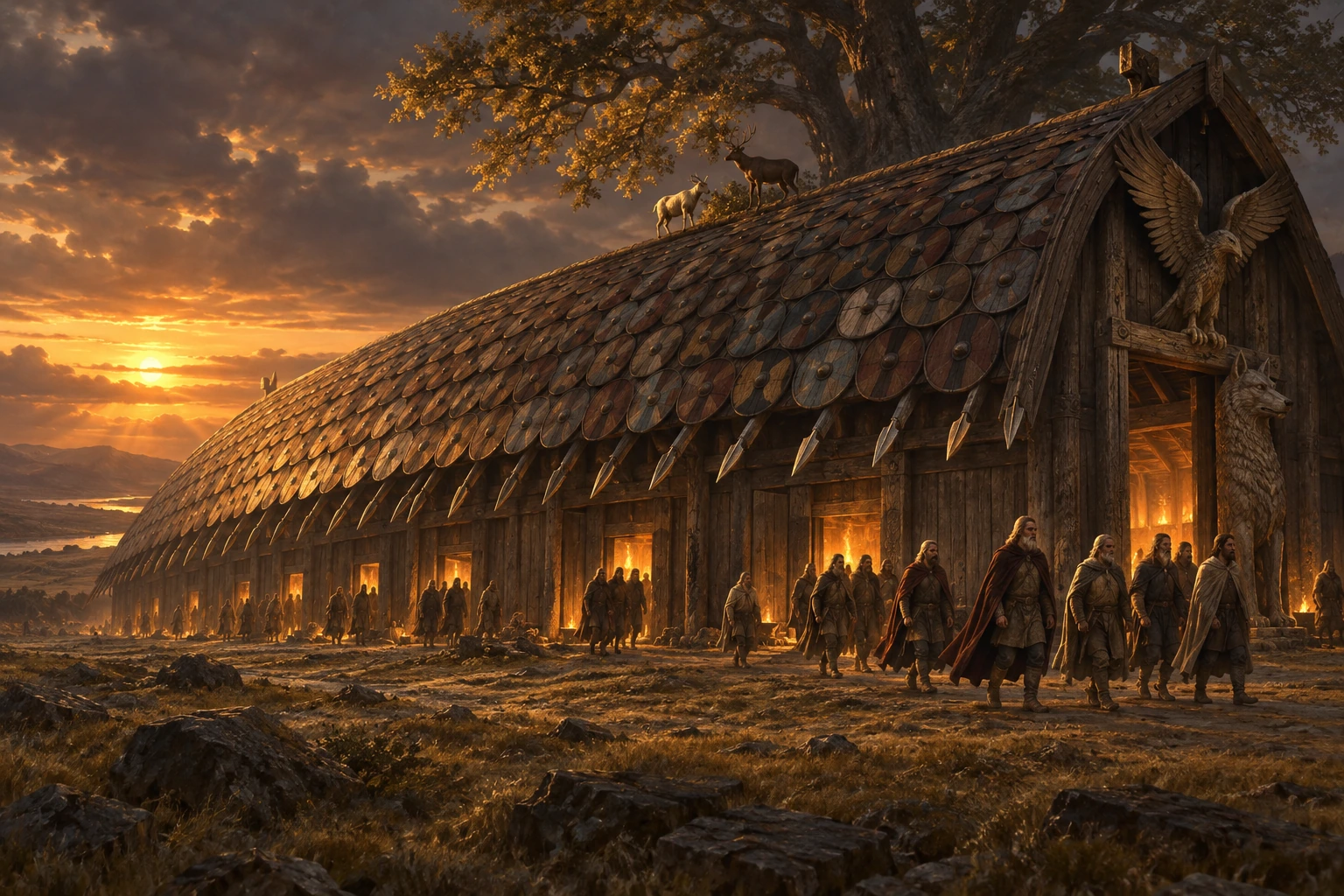
Anyone who comes to Odin, the poem goes on, will know the hall at a glance: its rafters are spear-shafts, it is roofed with shields, and mail-coats lie strewn on its benches. A wolf hangs by the western door, and an eagle hovers over it; Henry Adams Bellows, who translated the poems in 1923, thought these were probably carvings (stanzas 9–10). The hall has five hundred and forty doors, and through each one eight hundred einherjar go out together “when to war with the wolf they go” (stanza 23, in Bellows’s words): the wolf Fenrir, at the end of the world.
At the very start of Gylfaginning, the Swedish king Gylfi comes to Asgard disguised as an old man. He sees a hall so high he can hardly make out its top, its roof laid “with golden shields after the fashion of a shingled roof”, and Snorri adds a verse by the poet Þjóðólfr of Hvinir to show that Valhöll was thatched with shields. Inside are many people, “some with games, some drinking; and some had weapons and were fighting” (chapter 2).
1-3 Meat, Mead and Sport
How can one hall feed so many? Gylfi, who calls himself Gangleri, asks exactly that. The cook Andhrímnir, he is told, boils the boar Sæhrímnir in the kettle Eldhrímnir: “he is boiled every day and is whole at evening”, and there is always enough. Odin eats none of it. He gives his food to his two wolves, Geri and Freki, for wine is both food and drink to him (chapter 38).
Is it water they drink, then? “Now thou askest strangely”: as if Odin would invite kings and earls and give them water! On the roof of Valhöll stands the goat Heiðrún, nibbling the tree Læraðr, and mead runs from her udders to fill a vat every day, enough to make all the einherjar drunk. Beside her stands the stag Eikþyrnir, and so much drips from his antlers that it falls into the spring Hvergelmir, from which all the rivers flow (chapter 39; Grímnismál 18, 25–26).
And their pleasure? “Every day, as soon as they are clothed, they straightway put on their armor and go out into the court and fight, and fell each other. That is their sport.” When mealtime draws near, they ride home to Valhöll and sit down to drink (chapter 41). Snorri backs this with Vafþrúðnismál 41: all the einherjar hew at one another every day in Odin’s courts, “they choose the slain and ride from the fight”, and then sit together again, reconciled.
1-4 The Valkyries
There are others, Snorri says, whose work is to serve in Valhöll, “to bear drink and mind the table-service and ale-flagons”. He names them with Grímnismál 36, in which Odin wants Hrist and Mist to bring him the horn, and then Skeggjöld, Skögul, Hildr, Þrúðr, Hlökk, Herfjötur, Göll, Geirönul, Randgríðr, Ráðgríðr and Reginleif: “they bring the einherjar ale”. Bellows glosses some of the names, Hrist “Shaker”, Hildr “Warrior”, Herfjötur “Host-Fetter”, Randgríðr “Shield-Bearer”, but warns that their spellings, and so their meanings, vary.
“These are called Valkyrs,” Snorri goes on: “them Odin sends to every battle; they determine men’s feyness and award victory”. They decide, that is, who is doomed to die and who wins. Three of them, Gunnr, Róta and “the youngest Norn, she who is called Skuld, ride ever to take the slain and decide fights” (chapter 36).
1-5 A King Comes to Valhalla
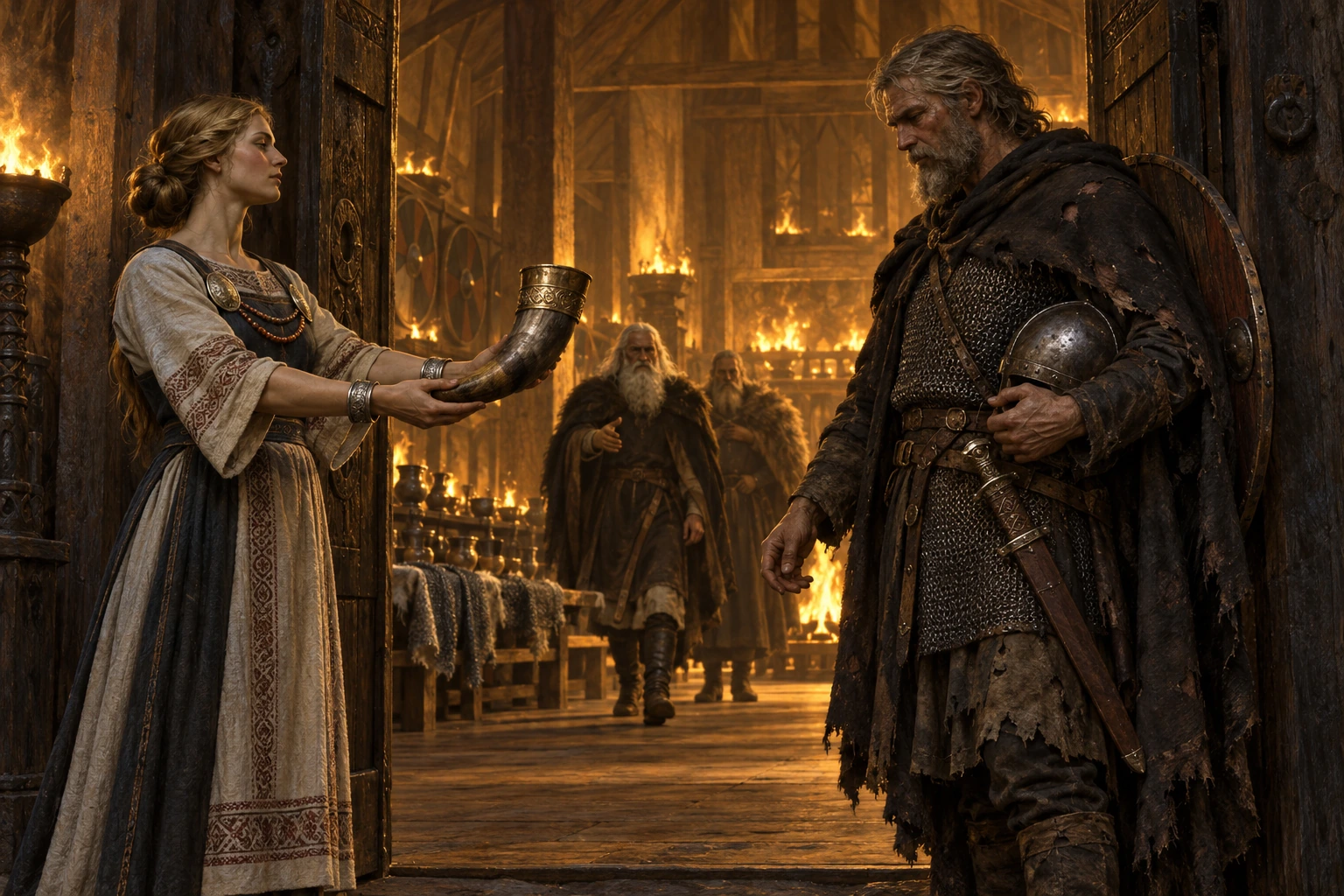
In Eiríksmál, made for King Eiríkr Blood-axe, Odin wakes from a dream. He had risen before daybreak to make Valhöll ready for slain men, woken the einherjar to strew the benches and rinse the beer-vessels, and told the valkyries to bring wine, “as if a prince were coming”. Then comes a din as if thousands were on the move, and the god Bragi says the benches creak “as if Baldr were coming back”. It is Eiríkr, says Odin, and he sends the heroes Sigmundr and Sinfjötli to meet him. Why, Sigmundr asks, did you take victory from so brave a king? Odin’s answer, in Nora Kershaw’s translation: “The grey wolf is gazing upon the abodes of the gods.” Eiríkr comes in with five kings: “I am the sixth myself.”
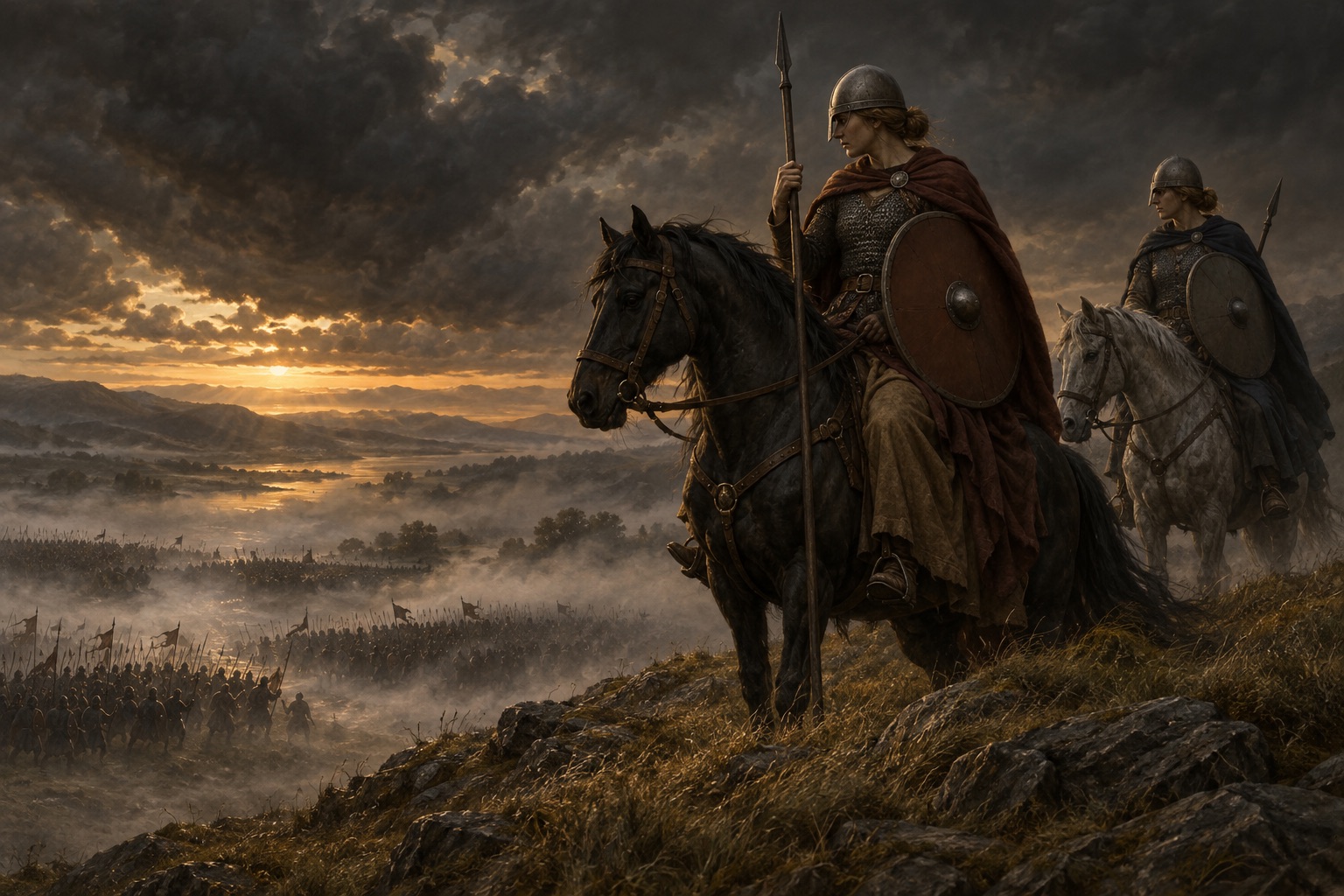
In Hákonarmál, by the poet Eyvindr skáldaspillir, Odin sends two valkyries, Göndul and Skögul, “to choose among kings” which of Yngvi’s line should go with Odin and be in Valhöll (stanza 1). They find King Hákon the Good at war on the island of Stord. Göndul speaks, leaning on her spear-shaft: the gods’ following is growing, now that they have invited Hákon home. The king hears the valkyries talking on horseback, helmeted, their shields before them (10–11).
“Why do you deal out the battle so, Geirskögul?” he asks. “We deserved victory from the gods.” “We brought it about that you held the field and your enemies fled,” Skögul answers, and the two ride off to the green worlds of the gods to tell Odin that a king is coming (12–13). Odin sends Hermóðr and Bragi to meet him. Hákon arrives still drenched in blood, and wary: Odin seems ill-disposed to him. Bragi promises him the peace of all the einherjar, ale among the gods and eight brothers waiting inside. The king will keep his war-gear all the same, his helmet and his mail-coat: “it is good to have weapons at hand” (14–17).
1-6 The Loom in Caithness
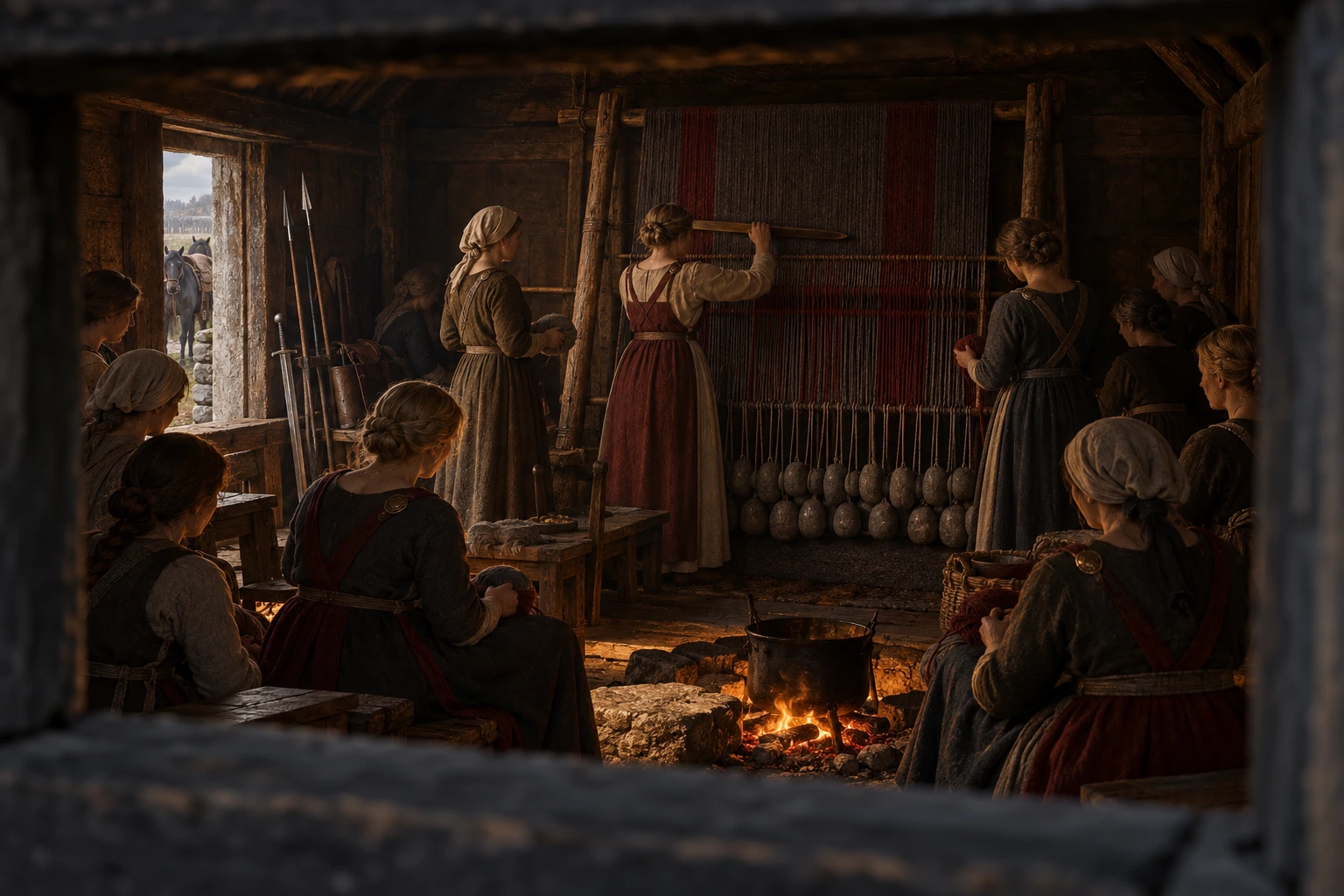
Njáls saga tells of a great battle in Ireland in which King Brian fell. On the morning of that Good Friday, in Caithness in the north of Scotland, a man called Dörruðr saw twelve riders go into a women’s house together and vanish. He looked in through a window. Women had set up a loom. Men’s heads were its weights and men’s entrails its warp and weft, and a sword and an arrow were its tools (chapter 157).
They sang as they wove. “Wide is the warp set up for the slaughter,” the song begins; “blood is raining”. Hildr goes to weave, with Hjörþrimul, Sanngríðr and Svipul, swords drawn. The refrain is “Let us wind, let us wind the web of the spear”, and one verse says outright that “the valkyries have the choice of the slain”. They sing of a young king they will follow into battle, an earl fallen before the spear-points, and a grief for the Irish that men will never forget. Then they tore the web apart, each keeping the piece she held, mounted their horses and rode away, six to the south and six to the north.
2 Where the Story Is Written Down
- The Eddic poems. Most survive in one manuscript, the Codex Regius (GKS 2365 4to), written in Iceland in the second half of the 13th century. Grímnismál is Odin’s monologue between two fires, with the hall (8–10, 18–26) and the valkyries’ names (36); Snorri quotes over twenty of its stanzas, and Bellows dated it “probably” to the first half of the 10th century. Vafþrúðnismál 41 has the daily fight. In Völuspá 30 (31 in Bellows) the seeress sees valkyries “come from far and wide, ready to ride”: Skuld, Skögul, Gunnr, Hildr, Göndul and Geirskögul. Bellows thought this list “may be an interpolation”.
- Snorri’s Edda, a handbook for poets written about 1220. Its first part, Gylfaginning, is a dialogue between Gylfi and three men on high seats, Hárr, Jafnhárr and Þriði; the Valhalla chapters are 2, 20, 24, 34, 36 and 38–41. Brodeur saw it as written “in the true antiquarian spirit”, for young poets of a Christian age who might not know the old stories.
- Eiríksmál, on the fall of Eiríkr Blood-axe in 954, said to have been made at the request of his widow, Queen Gunnhildr. The poet is unknown, and only the beginning survives, in Fagrskinna, a history of the kings of Norway written in the 1220s. Both medieval manuscripts of Fagrskinna burned in the Copenhagen fire of 1728; copies had been made.
- Hákonarmál, by Eyvindr skáldaspillir, on Hákon the Good, who died of a wound after the battle on Stord in 961. It is preserved whole in Snorri’s Heimskringla, at the end of the saga of Hákon the Good, and in part in Fagrskinna, which says that Eyvindr modelled it on Gunnhildr’s poem for Eiríkr.
- Njáls saga, written about 1280. Chapter 157 (156 in George Webbe Dasent’s translation of 1861) contains the weavers’ song now called Darraðarljóð; the manuscripts give it no title.
3 Competing Versions
- Who goes to Valhalla?
- Grímnismál 14: Freyja chooses half of the slain each day. Snorri repeats it in his chapter on Freyja (chapter 24). Bellows, following Mogk, took this Freyja to be confused with Odin’s wife Frigg, and added: “Snorri has this same confusion”. In chapter 38, though, all who have fallen in battle are with Odin, and those who die of sickness or old age go to Hel (chapter 34).
- Ynglinga saga, Snorri’s history of the earliest Swedish kings, makes Odin a man who ruled in Sweden. His law was that the dead be burned with their goods, and each would come to Valhöll with what was on his pyre (chapter 8). Dying of sickness, he had himself marked with a spear-point and claimed all men who die by weapons (chapter 10).
- Who chooses? In Grímnismál 8, Odin chooses. In Snorri, Odin sends the valkyries and they choose. In Hákonarmál they also decide the battle: “we brought it about that you held the field”. In Darraðarljóð they weave it themselves.
- How many, and what names? Völuspá names six, Grímnismál thirteen; Snorri adds Gunnr, Róta and Skuld; Darraðarljóð names Hildr, Hjörþrimul, Sanngríðr, Svipul, Gunnr and Göndul, and the saga counts twelve riders. Skuld is a valkyrie in Völuspá and “the youngest Norn” in Snorri.
- Are the dead healed every day? The texts do not quite say so. Vafþrúðnismál has the einherjar sit together “reconciled” (sáttir) after the fight, and Snorri simply has them ride home and drink; “All healed full soon to sit” is Bellows’s rendering. The boar that is “whole at evening” is Snorri’s alone: Grímnismál 18 only says that it is boiled. So are Heiðrún’s udders: in Grímnismál 25 she simply fills the vat with mead that never runs short.
- Valkyries of the hero poems. In the heroic poems of the same manuscript, Brynhildr, Sváva and Sigrún are, in Bellows’s words, “originally quite human women” given the qualities of valkyries. In the prose of Sigrdrífumál, Sigurðr finds a woman asleep in armour inside a tower of shields on a mountain. She is the valkyrie Sigrdrífa: she had killed a king to whom Odin had promised victory, and Odin pricked her with a sleep-thorn and said she would never win a battle again, but must marry. She vowed to marry only a man who knew no fear.
- Who was Dörruðr? According to Kershaw it was “generally agreed” that the man owes his existence to the poem’s refrain, vef darraðar. Finnur Jónsson read Darraðr as a name of Odin; others take the words to mean “web of the spear”. Bugge, Finnur Jónsson and Mogk thought the poem was made soon after the battle, Heusler later; Kershaw herself suspected it was made in Dublin for another battle.
4 History and Tradition
- The Hårby figurine. In 2012 a metal detectorist found a silver figure of a woman, 3.4 centimetres tall, near Hårby on the Danish island of Funen. She wears a long dress and holds a sword and a shield; the figure is partly gilded and dated to about 800. “There can hardly be any doubt,” said Mogens Bo Henriksen of the city museum in Odense, “that this depicts one of Odin’s valkyries.” Writing with Peter Vang Petersen of the National Museum of Denmark, where it is now shown, he suggested it may have topped a staff like those carried by seeresses in the sagas. It could also show a real woman: the sagas mention women taking up arms, as the archaeologist Leszek Gardeła has pointed out. At Ribe, moulds for another “so-called ‘valkyrie’” pendant, a woman with helmet, shield and sword, lead Sarah Croix of Aarhus University to ask whether it shows a mythological being or “an actual social role”.
- Women with drinking horns. A Viking Age silver pendant from Köping on Öland, in the Swedish History Museum, shows a woman striding forward and holding out a drinking horn. It has usually been read, says the museum’s label, as a valkyrie welcoming a fallen warrior to Valhalla, “but it could just as well be an aristocratic lady of the house at a drinking ceremony”. On the 8th-century picture stone from Tjängvide on Gotland, a woman offers a horn to a rider on an eight-legged horse, in front of what may be a hall; the rider may be Odin, or the hero Sigurðr.
- A Christian king in Valhalla. Hákon the Good had been brought up a Christian at the court of the English king Æthelstan. In Heimskringla the dying king says that if he lives he will go to a Christian land and atone, but if he dies “in heathendom” his men may bury him as they see fit. They laid him in a mound in full armour and spoke over the grave as heathens did, sending him to Valhalla (chapter 32). Hákonarmál says the gods welcomed him because he had spared their sanctuaries (stanza 18).
- The Fatal Sisters. The English poet Thomas Gray paraphrased the weavers’ song by May 1761, from a Latin translation, and published it in 1768 as “The Fatal Sisters”. A story in J. G. Lockhart’s life of Walter Scott, quoted by Kershaw, has old people on North Ronaldsay in Orkney hearing Gray’s poem and saying they knew it “in the original”: they called it “The Enchantresses”.
- Walhalla on the Danube. King Ludwig I of Bavaria built a hall of fame for great German men and women near Regensburg and named it Walhalla, after “the warrior’s paradise of Germanic mythology”. Its architect, Leo von Klenze, took the Parthenon in Athens as his model. It opened on 18 October 1842.
- Wagner’s Die Walküre. In this “first day” of Richard Wagner’s Der Ring des Nibelungen, Wotan punishes his daughter Brünnhilde for disobeying him. No more will he send her from Walhall “to seek upon fierce fields for the slain”, nor will she “pour the wine in my horn” (Margaret Armour’s translation, 1910): the two tasks Snorri gives the valkyries. He lays her asleep on a mountain ringed with fire, for whoever wakes her, a fate much like Sigrdrífa’s, and Bellows notes that Wagner built much of the third act of Siegfried from three stanzas of Sigrdrífumál. None of the names of her eight sisters, from Gerhilde to Rossweisse, is in the lists of Völuspá, Grímnismál, Snorri or Darraðarljóð. The whole Ring was first staged at the first Bayreuth Festival, which opened on 13 August 1876.
Valkyries and Viking warriors are often drawn in horned helmets. Archaeologists have not found a single Viking Age helmet with horns: the only well-preserved Viking Age helmet from Scandinavia, from Gjermundbu in Norway, has none. The horned Viking is usually traced to Carl Emil Doepler’s costumes for the first complete Ring at Bayreuth in 1876. Horned helmets did exist in the North, but in the Bronze Age, like the pair found at Veksø in Denmark.
5 Related Stories
- Odin: The God Who Gave an Eye for Wisdom: the lord of the hall. In Eiríksmál he even takes victory from a king he admires, because “the grey wolf is gazing upon the abodes of the gods”.
- Freyja: The Goddess Who Weeps Gold and Chooses Half the Slain: the goddess who, in Grímnismál, chooses half of the slain for her own hall, Fólkvangr.
- Ragnarök: The End of the World, and What Comes After: what the einherjar are gathered for. Eight hundred go out of every door of Valhöll “when to war with the wolf they go”.
- Mount Olympus: The Real Mountain Where the Gods Lived: in the Iliad the gods sit in council by Zeus while the goddess Hebe pours them nectar (4.1–3), as the valkyries bring ale to the einherjar. A divine hall where women serve the drink is a shared theme; we have not found a scholar who compares the two.
- The Morrígan: The Phantom Queen of Battle: the Irish war goddess who foretells who will fall. In 1870 C. Lottner wrote that “to the ancient Irish goddesses of war correspond the Norwegian (and, in general, Germanic) Valkyrias”, and Angelique Gulermovich Epstein (1998) found likenesses that “go beyond what one would expect from parallel typology”.
6 Sources
- Snorri Sturluson, The Prose Edda, trans. Arthur Gilchrist Brodeur (American-Scandinavian Foundation, 1916), Gylfaginning, chapters 2, 20, 24, 34, 36, 38–41: archive.org; Old Norse text of Gylfaginning, Ynglinga saga (chapters 8, 10) and Saga Hákonar góða (chapter 32): heimskringla.no, heimskringla.no, heimskringla.no
- The Poetic Edda, trans. Henry Adams Bellows (American-Scandinavian Foundation, 1923), with notes: Project Gutenberg; Old Norse text of Grímnismál, Vafþrúðnismál and Völuspá, ed. Guðni Jónsson: heimskringla.no, heimskringla.no, heimskringla.no
- Eiríksmál, Hákonarmál and Darraðarljóð, Old Norse text, ed. Finnur Jónsson, Carmina Scaldica (1929): heimskringla.no, heimskringla.no, heimskringla.no; N. Kershaw (ed. and trans.), Anglo-Saxon and Norse Poems (Cambridge, 1922): archive.org
- The Story of Burnt Njal, trans. George Webbe Dasent (1861), chapter 156: Project Gutenberg
- Store norske leksikon: Eiríksmál, Hákonarmál, Valhall, Den eldre Edda, Snorres Edda, Fagrskinna, Njåls saga
- Jarrett A. Lobell, “Visions of Valhalla”, Archaeology, May/June 2013: archaeology.org; Kristina Killgrove, “Hårby Valkyrie”, Live Science, 2025: livescience.com; Sarah Croix, “Aux armes!”, Aarhus University, 2020: projects.au.dk
- Swedish History Museum, “Valkyriahänge” (108864_HST): samlingar.shm.se; World-Tree Project, University College Cork, “Tjängvide (I) Picture Stone” and “The horned helmet”: worldtreeproject.org, worldtreeproject.org
- Thomas Gray Archive, “The Fatal Sisters”: thomasgray.org; Bavarian Palace Administration, “Walhalla”: schloesser.bayern.de
- Richard Wagner, The Rhinegold & The Valkyrie, trans. Margaret Armour (Heinemann, 1910): Project Gutenberg; Bayreuth Festival, “Festival History” and Ring programme: bayreuther-festspiele.de, bayreuther-festspiele.de
- Kasper H. Andersen, “MYTE: Havde vikingernes hjelme horn?”, Lex: lex.dk; Bård Amundsen, “No, the Vikings didn’t wear helmets with horns”, sciencenorway.no, 2022: sciencenorway.no; Homer, Iliad 4.1–3, trans. A. T. Murray: Perseus
Cover and illustrations: AI-generated images made for Arcana. They are interpretations, not historical artworks.