Odin: The God Who Gave an Eye for Wisdom
He left an eye in Mímir's well, hung nine nights on a windy tree to take up the runes, and sends two ravens out over the world every day. The poem that tells of the eye never says it bought wisdom. That explanation is Snorri's.
- Type: myth, the chief of the Æsir and his search for knowledge
- Culture: Norse, in Scandinavia and Iceland; as Wōden or Wodan, also among the English and the peoples of the Continent
- Earliest texts: his name on gold bracteates from Vindelev, Denmark, of the 400s CE; the poems Völuspá, Hávamál and Grímnismál in the Codex Regius, written about 1270; Snorri Sturluson’s Edda, 13th century
- Key figures: Odin, the seeress of the Völuspá, Mímir, Frigg, the ravens Huginn and Muninn, the wolves Geri and Freki, King Geirröðr and his son Agnarr
Odin is a god who never stops looking for knowledge. In the poems he leaves an eye in a well, hangs for nine nights on a tree, sends two ravens out over the world every morning and walks among men under false names. And in the Völuspá a seeress tells him how the gods, and he himself, will end.
Did Odin give his eye for wisdom? That is Snorri’s version. The poem that tells of the eye, the Völuspá, says only that it is hidden in Mímir’s well, and that Mímir drinks mead every morning “from Valfather’s pledge”. It never says why. It is Snorri, writing in Christian Iceland in the 13th century, who explains that the well held “wisdom and understanding”, and that Odin had to lay down his eye for a single drink.
1 The Telling
Odin’s story is not one tale but many, scattered through the poems of the Poetic Edda and retold in prose by Snorri Sturluson. Here are the episodes that made his image. Stanza numbers follow Guðni Jónsson’s edition of the Old Norse; where Henry Adams Bellows’s English translation of 1923 counts differently, both are given.
1-1 The Eye in Mímir’s Well
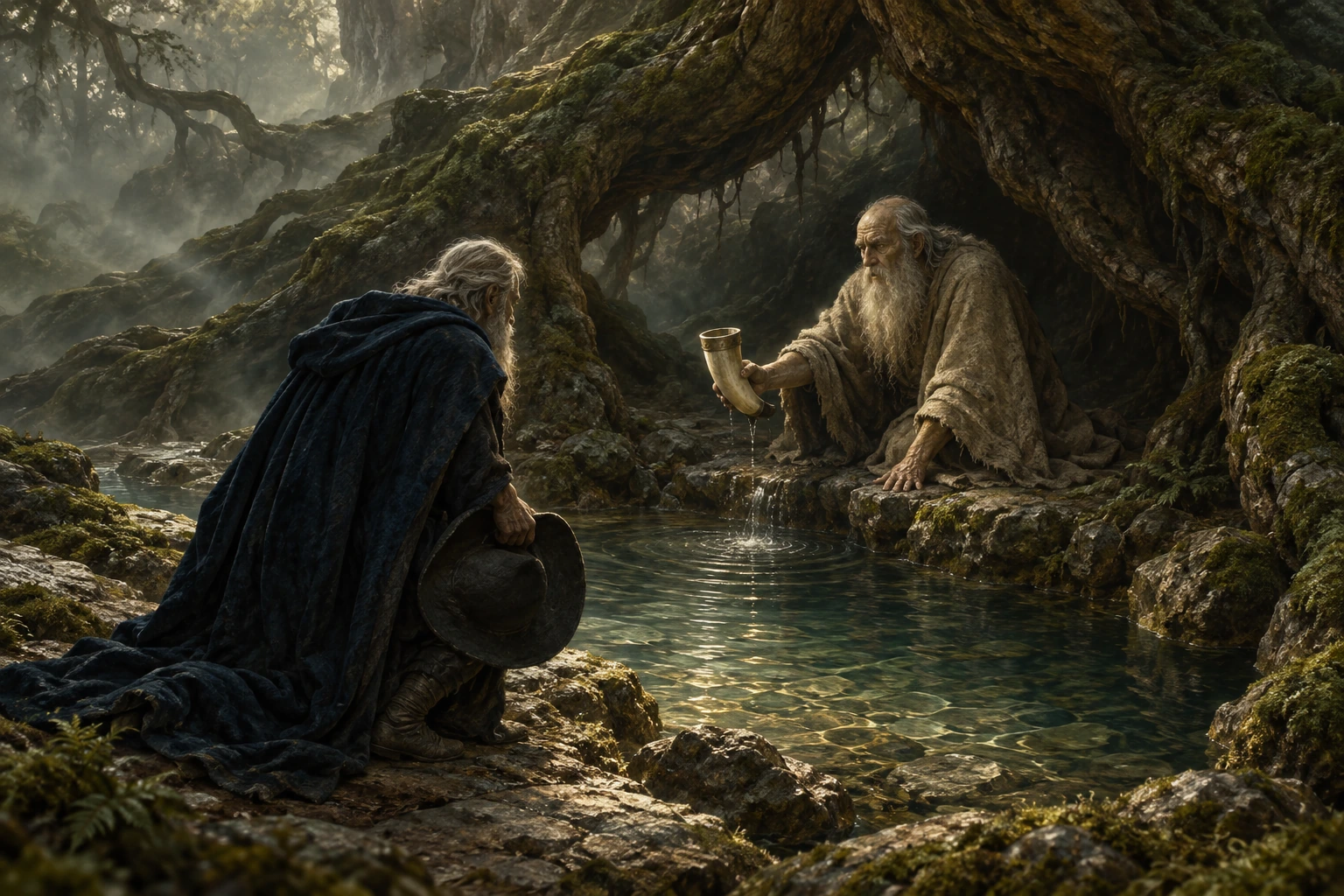
In the Völuspá, “the prophecy of the seeress”, Odin has called a wise woman to speak to him. She sat outside alone, the poem says, when the old one came, “the terror of gods” in Bellows’s rendering, and looked into her eyes. “What do you ask of me? Why do you test me? I know everything, Odin: where you hid your eye, in the famous well of Mímir.” Every morning, she adds, Mímir drinks mead from Valfather’s pledge (stanza 28; 28–29 in Bellows). Valfather, “father of the slain”, is one of Odin’s names. He pays her with rings and necklaces, and she goes on to tell him what is to come.
Snorri tells it more plainly in Gylfaginning, chapter 15. Under the root of the world ash Yggdrasil that turns toward the frost giants lies Mímir’s well, “wherein wisdom and understanding are stored”. Its keeper, Mímir, is full of ancient lore because he drinks from it with the Gjallarhorn. Allfather came and asked for one drink, “but he got it not until he had laid his eye in pledge”.
1-2 Nine Nights on the Windy Tree
In the Hávamál, “the words of the High One”, Odin speaks for himself (stanzas 138–145; 139–146 in Bellows). He knows, he says, that he hung on a windy tree for nine whole nights, wounded with a spear and given to Odin, “myself to myself”, on a tree of which no one knows from what roots it rises.
No one gave him bread, or a drink from a horn. He peered down, took up the runes, took them screaming, and fell back from there. He learned nine mighty songs from a son of Bölþorn, the father of his mother Bestla: an uncle the poem does not name. He got a drink of the precious mead, poured from Óðrerir; that mead belongs to another tale, how Odin won the mead of poetry from the giants, which the Hávamál tells earlier on. And he began to grow and to be wise: “word from word sought word for me, deed from deed sought deed”.
The poem goes on about the runes and who carved them for each race: Odin for the Æsir, Dáinn for the elves, Dvalinn for the dwarfs, Ásviðr for the giants. Then it questions the listener. Do you know how to carve, how to read, how to colour, how to test, how to ask, how to sacrifice, how to send, how to offer? Better not to pray at all, it answers, than to sacrifice too much: “a gift always looks for a return”. Snorri, who retells so much about Odin, does not tell this story. In Gylfaginning it survives only as one of his names: “God of the Hanged” (chapter 20).
1-3 Huginn and Muninn
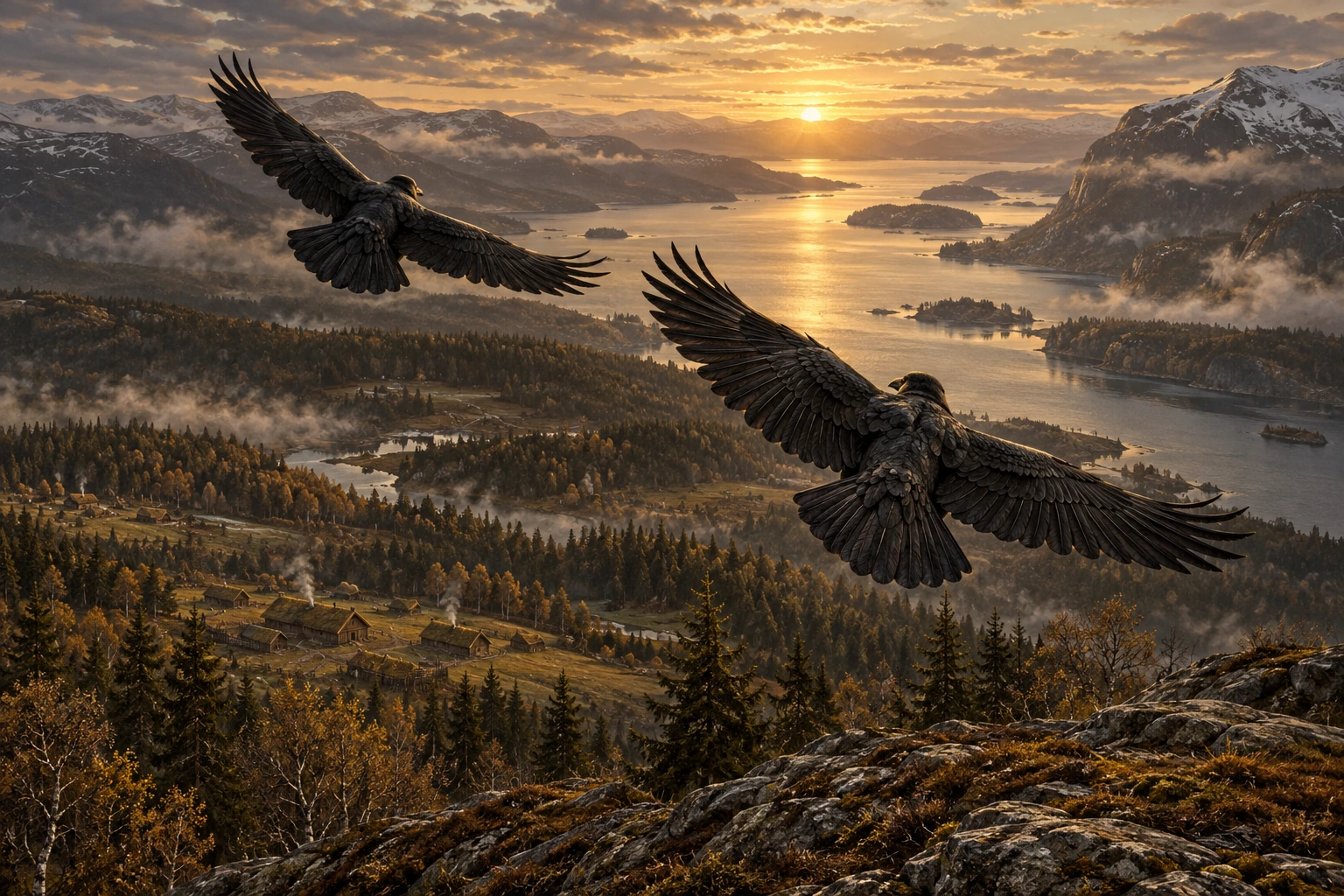
From Hliðskjálf, where his high seat stands, Odin looks out over all the worlds (Grímnismál, prose introduction; Gylfaginning 9). He also has messengers. “Huginn and Muninn fly every day over the wide earth,” he says in the Grímnismál; “I fear for Huginn, that he may not come back, but I fear more for Muninn” (stanza 20). The names mean roughly “thought” and “memory”. The stanza before tells of his two wolves, Geri and Freki: Odin feeds them, for he himself lives on wine alone (stanza 19).
Snorri sets the ravens on Odin’s shoulders (Gylfaginning 38). They speak into his ears all the news they see or hear. He sends them out at daybreak to fly over the whole world, and they are back by the morning meal. So he learns of many things, and that, says Snorri, is why men call him the Raven-God. In Ynglinga saga (chapter 7) he had taught them to speak the language of men.
1-4 Grímnir Between the Fires
The Grímnismál, “the lay of Grímnir”, opens with a prose story. Two young princes, Agnarr and Geirröðr, were shipwrecked and spent a winter with a poor old couple. The old woman fostered Agnarr; the old man fostered Geirröðr and taught him cunning. When the boys sailed home, Geirröðr leapt ashore and pushed the boat, with his brother in it, back out to sea. He became king.
Odin and Frigg sat in Hliðskjálf, looking over all the worlds. Odin pointed out that his foster-son was a king, while Frigg’s was raising children with a giantess in a cave. Frigg answered that Geirröðr was so stingy with food that he tortured his guests if too many came. They made a wager, and Frigg sent her maid Fulla to warn the king: a sorcerer had come to his land, and he could be known because no dog would attack him.
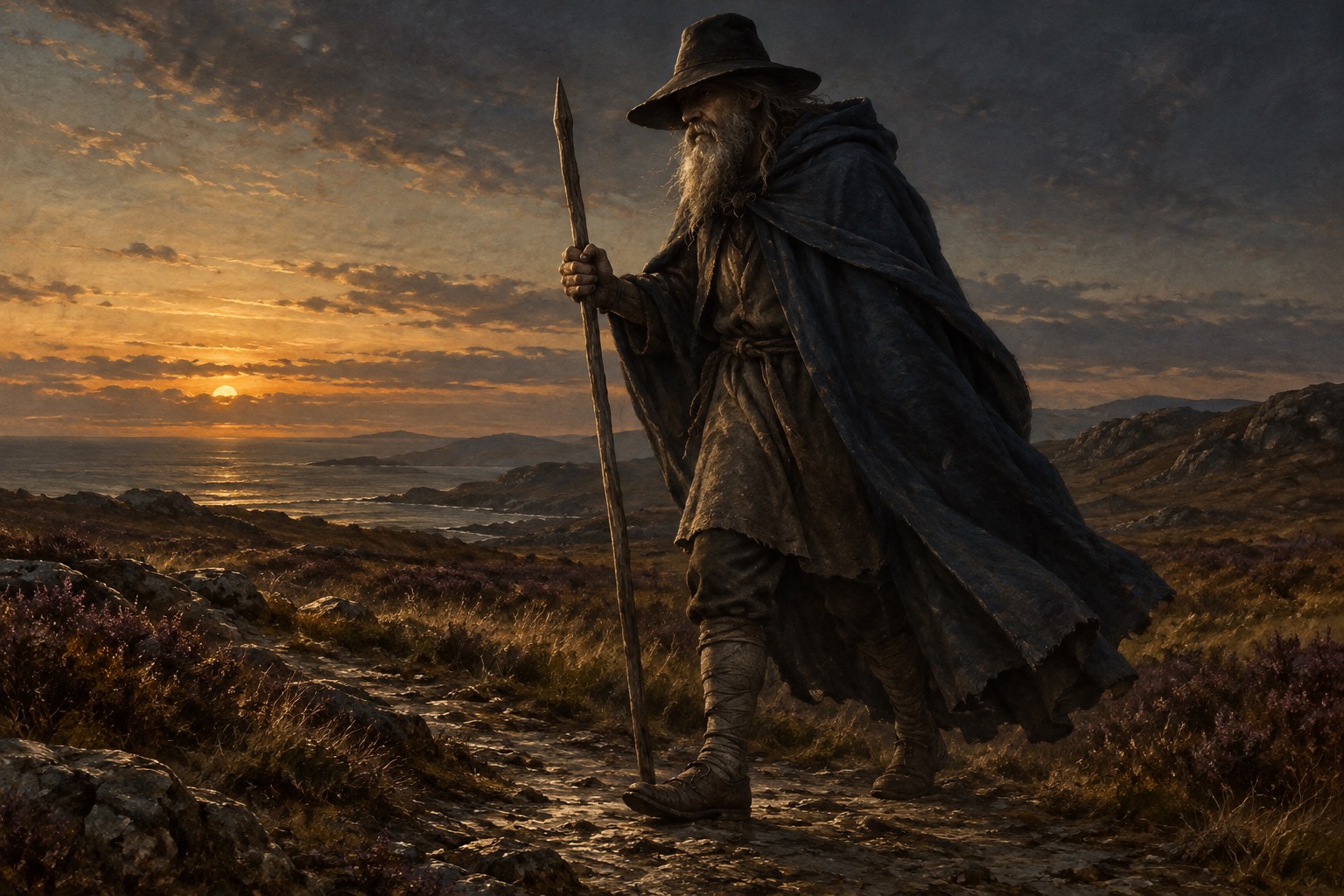
So when a man in a dark blue cloak arrived whom the dogs would not touch, Geirröðr had him seized. He called himself Grímnir, “the hooded one”, and would say no more. The king set him between two fires to make him talk, and there he sat for eight nights. Only the king’s ten-year-old son, Agnarr, named after his uncle, brought him a full horn to drink and said his father did wrong to torment an innocent man.
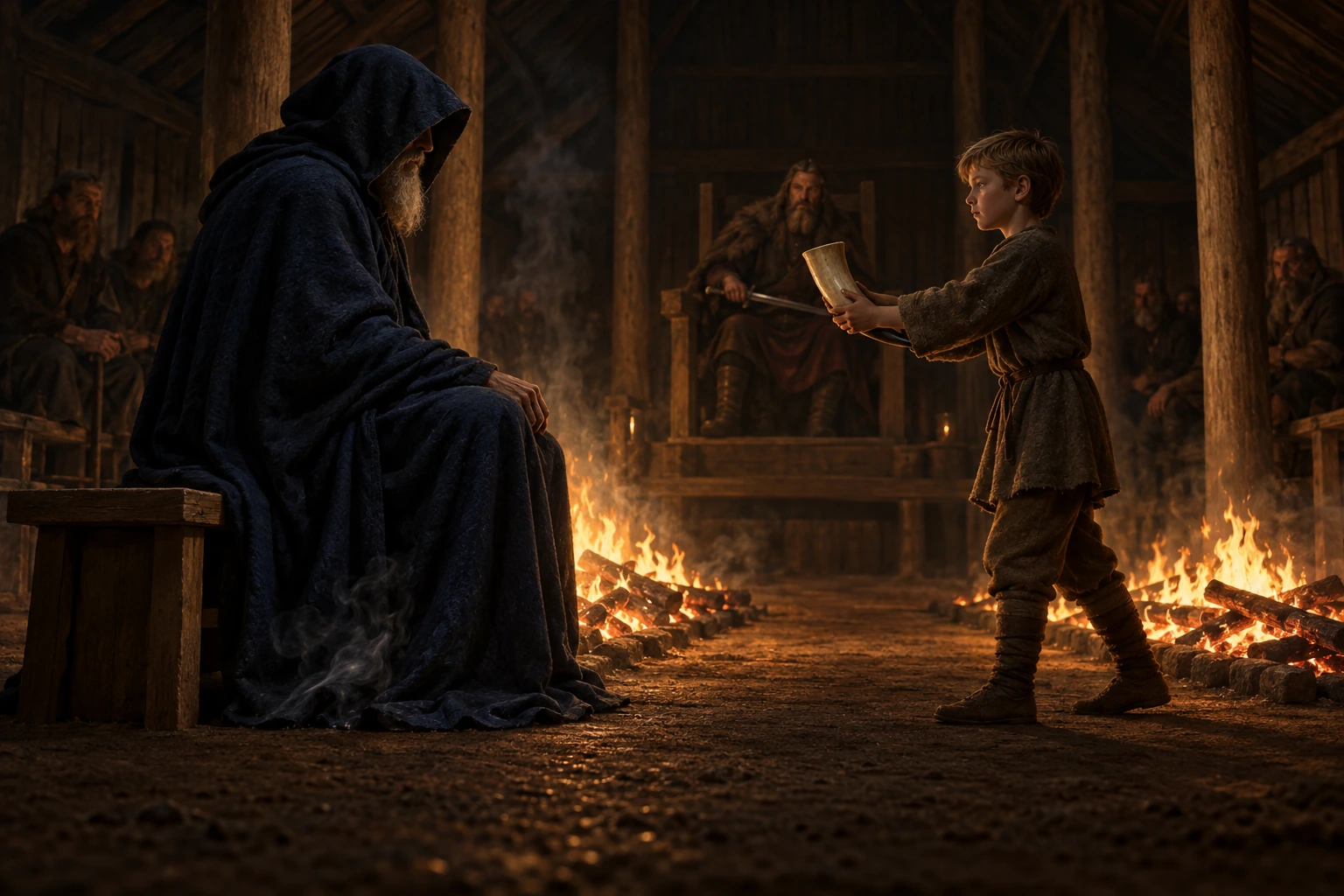
The fire had come so close that Grímnir’s cloak was burning. Then he began to speak. He blessed the boy: “for a single drink shalt thou never receive a greater gift as reward” (stanza 3, in Bellows’s words). He described the halls of the gods, Valhalla, the ravens and the world tree, and then his own names (stanzas 46–50): Grímr and Gangleri, “the wanderer”, Herjann, Hárr, Síðhöttr, “broad hat”, Alföðr, Valföðr and dozens more. “I have never been called by a single name since I went among the peoples,” he says (stanza 48). Snorri explains why (Gylfaginning 20): every people had to turn his name into its own tongue in order to call on him, “but some occasions for these names arose in his wanderings”. And at last Grímnir says: “Now I am called Odin” (stanza 54).
Geirröðr was sitting with his sword across his knees, half drawn. When he heard that Odin was there, he rose to take him from the fire. The sword slipped from his hand, hilt down; the king stumbled, fell forward onto the blade and died. Odin vanished, and Agnarr ruled there for a long time.
1-5 The Wanderer in the Broad Hat
Odin goes among gods, giants and men in disguise again and again. In the Vafþrúðnismál he visits a giant famed for his wisdom, calling himself Gagnráðr, and wins a contest of knowledge with a question only he can answer: what Odin said into his son’s ear before the funeral pyre burned. In the Baldrs draumar he saddles his eight-legged horse Sleipnir, whose strange birth Snorri tells in Gylfaginning 42, and rides down toward Hel under the name Vegtamr, to wake a dead seeress and ask about his son Baldr’s dreams.
The sagas give him his costume. In the Völsunga saga a tall, old, one-eyed stranger walks barefoot into King Völsungr’s hall in a spotted cloak and a broad hat, drives a sword up to the hilt into the tree that grows in the middle of the hall, and leaves. Only the king’s son Sigmundr can pull it out (chapter 3). Years later, in Sigmundr’s last battle, a man with a broad hat, a blue cloak and one eye comes against him with a spear, and Sigmundr’s sword breaks on it. Dying, Sigmundr says that “Odin does not want us to draw the sword” (chapters 11–12).
2 Where the Story Is Written Down
- The Codex Regius of the Eddic poems, an Icelandic manuscript that Bellows describes as “written as early as 1300”. It opens with the Völuspá and the Hávamál, and has the Vafþrúðnismál and Grímnismál soon after. The Hávamál survives in no other manuscript. A second text of the Völuspá, in the Hauksbók of about 1300, leaves out the stanzas about Odin’s eye (28–34 in Bellows). The poems are older than the books: Bellows put the Völuspá around the middle of the 10th century, and Taniguchi Yukio, in the Nipponica encyclopedia, gives the Eddic poems a range of the 9th to the 12th centuries.
- Snorri Sturluson’s Edda. Snorri, an Icelandic chieftain and poet killed in 1241, built Gylfaginning, “the beguiling of Gylfi”, as a dialogue: a Swedish king disguised as an old man named Gangleri questions three figures called High, Equally High and Third. Snorri quotes the Völuspá and the Grímnismál and fills the gaps in prose. In his Prologue, Odin is a man from Troy. His translator Arthur Gilchrist Brodeur noted in 1916 that “many scholars consider” the Prologue spurious, though he himself took it as part of the work.
- Heimskringla, the history of the kings of Norway that most scholars, Brodeur wrote, accept as Snorri’s. It opens with Ynglinga saga, in which Odin is a king from Asia. Two sagas of the legendary past, the Völsunga saga and the Gautreks saga, show him in disguise among men.
- Saxo Grammaticus, Gesta Danorum, a Latin history of Denmark that the introduction to Elton’s translation says was “probably finished by about 1208”. Saxo’s Odin is a man falsely worshipped as a god.
3 Competing Versions
- Why the eye? The Völuspá gives no reason. Snorri: for one drink from a well where wisdom is stored. Bellows, in a note, even wondered whether the eye was the sun.
- Who is Mímir? In Gylfaginning 15, the keeper of a well. In Ynglinga saga (chapter 4), a wise man the Æsir gave as a hostage to the Vanir, who cut off his head and sent it back. Odin smeared the head with herbs so that it would not rot and sang charms over it, and it spoke to him and told him many secrets; he carried it with him (chapter 7). The Völuspá knows the head too: when the end comes, “Odin speaks with Mím’s head” (stanza 46; 47 in Bellows). When Snorri retells that stanza, Odin rides to Mímir’s well instead (Gylfaginning 51).
- Which tree, and what did he win? The Hávamál names no tree. Editors such as Bellows take it to be Yggdrasil, a name he explains as “the Horse of Othin”; Yggr is one of Odin’s names (Grímnismál 54). What he wins is the runes. The next stanza adds the nine songs and the mead, but Bellows thought it had strayed in from the story of the mead of poetry.
- Hanged and speared for Odin. In the Gautreks saga (chapter 7), Odin, disguised as one Hrosshárs-Grani, gives the warrior Starkaðr a spear that looks like a reed stalk. Starkaðr puts a noose of calf’s gut around King Víkarr’s neck as a mock sacrifice, pricks him with the stalk and says, “Now I give you to Odin.” The stalk becomes a spear, the gut a strong withy, and the king dies hanging from a tree. Saxo tells it too (book 6), but says he will not discuss the version in which the withies hardened like iron. And in Ynglinga saga (chapter 10), the dying Odin has himself marked with a spear point and claims all men who die by weapons.
- God or man? In the Prologue to Snorri’s Edda, Vóden, “whom we call Odin”, descends from a daughter of Priam of Troy, leaves “Turkland” with a great host of “men of Asia”, and sets up his sons as kings in Saxland, Denmark, Sweden and Norway. In Ynglinga saga he is the chief of Asaland, east of the river Tanais, a conquering warrior who settles in Sweden and dies in his bed. Saxo (book 1) calls him a man “credited over all Europe with the honour, which was false, of godhead”; when Frigg had the gold stripped from his statue, he went into exile in shame. And the Lombard historian Paul the Deacon, in the late 8th century, writes that Wotan is said to have lived “not around this time but long before, not in Germany but in Greece” (1.9).
- Frigg wins the wager. In the Grímnismál she outwits her husband over their foster-sons. Paul the Deacon tells a similar contest, which he calls a “ridiculous tale” (1.8). The Vandals asked Godan for victory over the Winnili, and he promised it to whoever he saw first at sunrise. Frea, his wife, told the Winnili women to let down their hair and arrange it over their faces like beards, and to stand with their men where Godan looked out of his window to the east. “Who are these long-beards?” he asked, and Frea made him give the victory to the people he had just named: the Langobards.
4 History and Tradition
- Mercury and Wednesday. In the Germania (chapter 9), written at the end of the 1st century CE, Tacitus says that “Mercury is the deity whom they chiefly worship”, even with human victims on certain days, but gives no German name. Paul the Deacon makes the link: “Wotan … is he who among the Romans is called Mercury”. The Latin dies Mercurii, “Mercury’s day”, became Old English Wōdnesdæg, and one Old English text says so outright: “Wednesday’s name was from Mercury”. Old Norse had Óðinsdagr.
- Woden in England. Woden appears in most of the genealogies of the Old English royal houses; the Anglo-Saxon Chronicle says “from that Woden sprang all our royal kin”. In the Nine Herbs Charm, “Woden took nine glory-twigs” and struck the adder so that it flew into nine pieces.
- The Merseburg charm. In a manuscript of the 9th or 10th century at Merseburg Cathedral, Phol and Wodan go into the wood and Balder’s foal sprains its foot. Goddesses sing charms over it: Sinthgunt and Sunna, then Friia and Volla, names close to those of Frigg and her maid Fulla. Then Wodan sings, “as he well knew how”: bone to bone, blood to blood, limb to limb.
- His name in gold. More than 1,000 bracteates, gold pendants of the 400s and 500s, are known, and many show a man’s head over a four-legged animal, probably a horse. For decades Karl Hauck read these as Odin; one of his studies links them to “the second Merseburg charm and its pictorial counterparts”. The Kunsthistorisches Museum in Vienna catalogues one, with a raven and a horse with twisted legs, as “healing of a horse by the god Odin?”. On a bracteate from the Vindelev hoard, found near Jelling in Denmark and dated to the 400s, the runologist Lisbeth Imer and the linguist Krister Vasshus read “he is Odin’s man”: the oldest example of his name found anywhere so far, they write, about a century older than a brooch from Nordendorf in southern Germany. But they take the man shown to be a king, pictured like a Roman emperor on a medallion.
- Lejre. A silver figure, 1.75 cm tall, found at Lejre on Zealand in 2009 and dated to the 900s, sits on a high seat with two birds, probably ravens. Kasper H. Andersen and Tom Christensen note that it could be Odin on Hliðskjálf with Huginn and Muninn, that others have proposed Frigg, and conclude that Odin is the likelier reading.
- Uppsala. Adam of Bremen, writing about 1075, describes a temple at Uppsala with images of Thor, Wodan and Fricco: “Wodan, that is, fury, wages wars”. In war, sacrifice is made to Wodan. Every nine years, nine males of every kind of creature are offered and their bodies hung in the grove beside the temple; dogs and horses hang there beside men.
- A god who rose. Taniguchi Yukio lists several theories: that Odin became the chief god only in the Viking Age, as the god of rulers praised by court poets, or that he belongs to an Indo-European pattern of gods of sovereignty, ritual and magic.
5 Related Stories
- Yggdrasil: The World Tree That Suffers More Than Men Know: Mímir’s well lies under one of its roots, and editors such as Bellows see it in the windy tree of the Hávamál.
- Valkyries and Valhalla: The Choosers of the Slain and Odin’s Hall: the hall Grímnir describes from between the fires, and the dead warriors Snorri calls “the sons of his adoption”.
- Baldr: The Death of the Shining God: Odin’s son. It is to learn about Baldr’s dreams that Odin rides to Hel as Vegtamr, and it is what he said into Baldr’s ear on the pyre that the giant Vafþrúðnir cannot tell.
- The Odyssey: Ten Years on the Way Home from Troy: the Prologue to Snorri’s Edda makes Odin a descendant of Priam’s daughter and brings the Æsir north from Troy; Gylfaginning says of Ásgard, “men call it Troy”. The comparison is Snorri’s own.
- Thoth: The Ibis God of Writing and the Moon: Roman writers gave the two gods one name. Cicero’s fifth Mercury is Thoth, and Paul the Deacon writes that Wotan “is he who among the Romans is called Mercury”. Odin took up the runes; Thoth wrote for the gods. Beyond that Roman name, we link them for the theme.
6 Sources
- Hávamál, Völuspá, Grímnismál, Lokasenna, Old Norse text, ed. Guðni Jónsson: heimskringla.no, heimskringla.no, heimskringla.no, heimskringla.no
- Henry Adams Bellows (trans.), The Poetic Edda, 1923: Voluspo, Hovamol, Vafthruthnismol, Grimnismol, Lokasenna, Baldrs Draumar, General Introduction
- Edward Pettit (ed. and trans.), The Poetic Edda: A Dual-Language Edition (Open Book Publishers, 2023), introduction, on the date of the Codex Regius: OBP
- Snorri Sturluson, The Prose Edda, trans. Arthur Gilchrist Brodeur, 1916: Introduction, Prologue, Gylfaginning
- Snorri Sturluson, Ynglinga saga, chapters 2–10, trans. Samuel Laing, 1844, and Old Norse text: Wikisource, heimskringla.no
- Völsunga saga, chapters 3 and 11–12, trans. Eiríkr Magnússon and William Morris, and Old Norse text; Gautreks saga, chapter 7, ed. Guðni Jónsson and Bjarni Vilhjálmsson: Wikisource, Wikisource, heimskringla.no, heimskringla.no
- Saxo Grammaticus, The Danish History, books 1 and 6, trans. Oliver Elton: Project Gutenberg
- Tacitus, Germania 9, trans. Alfred John Church and William Jackson Brodribb, 1876, and Latin text; Paul the Deacon, Historia Langobardorum 1.8–9, Latin text; Adam of Bremen, Gesta Hammaburgensis ecclesiae pontificum 4.26–27, ed. J. M. Lappenberg, 1876: Wikisource, The Latin Library, The Latin Library, archive.org
- The Merseburg charms, Merseburg Cathedral Chapter, Cod. 136, fol. 85r: German Wikisource; Bosworth and Toller, An Anglo-Saxon Dictionary, “Wóden” and “Wódnes-dæg”: Charles University, Charles University
- Lisbeth M. Imer and Krister S. K. Vasshus, “Verdens ældste Odin fundet i Vindelev”, 2023: Videnskab.dk; Karl Hauck, publications “Zur Ikonologie der Goldbrakteaten”: University of Münster; Kunsthistorisches Museum, Münzkabinett 23221aα: khm.at
- Kasper H. Andersen and Tom Christensen, “Odin-figuren fra Lejre, ca. 950”: lex.dk
- Taniguchi Yukio, “オーディン” and “北欧神話”, Nipponica and Heibonsha World Encyclopedia: Kotobank, Kotobank
Cover and illustrations: AI-generated images made for Arcana. They are interpretations, not historical artworks.