Thoth: The Ibis God of Writing and the Moon
Ra left Thoth in his place in the night sky, and the Egyptians made the ibis-headed god the scribe of the gods. A Ptolemaic tale tells what became of the prince who stole the book Thoth wrote with his own hand.
- Type: myth, the god of writing, reckoning and the moon
- Culture: ancient Egypt; later the Greek and Roman world, where he became Hermes Trismegistus
- Earliest texts: the Pyramid Texts (from the pyramid of Unas, about 2350 BCE) already call on him; the stories told here come from a New Kingdom royal tomb, a Ptolemaic papyrus, and Greek writers from Plato (4th century BCE) to Plutarch (about 100 CE)
- Key figures: Thoth (Djehuti), Ra, Theuth and King Thamus, Naneferkaptah, Setne Khamwas, Hermes Trismegistus
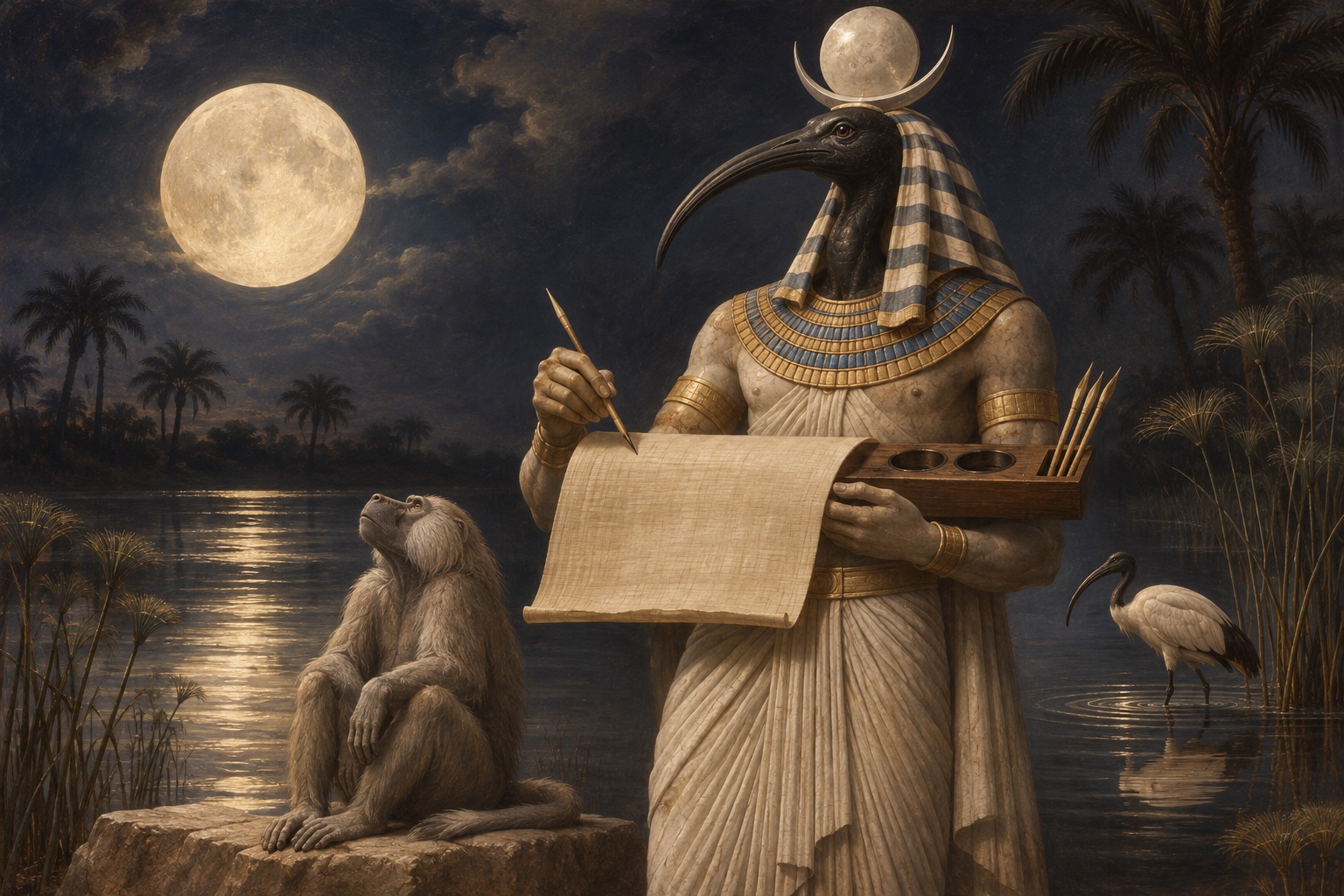
Thoth was the scribe of the gods. He had the head of an ibis or the shape of a baboon, he reckoned time by the moon, and scribes prayed to him to make them good at their trade. The Egyptians called him Djehuti. The Greeks saw in him their own Hermes, and from that meeting came Hermes Trismegistus, the “thrice-great” teacher whose books were still being argued over in the 17th century.
Did the Egyptians say Thoth invented writing? They made him its master. Their texts call him “lord of divine words” and the scribe of the gods, and the Heibonsha encyclopedia names him the inventor of the calendar, of writing and of annals. But the best-known scene in which he offers letters to people is Greek: in Plato’s Phaedrus, Theuth shows them to a king, and the king is not impressed.
1 The Telling
No Egyptian text tells Thoth’s life from beginning to end. Here are four stories about him, each from a different text and a different age.
1-1 In Ra’s Place
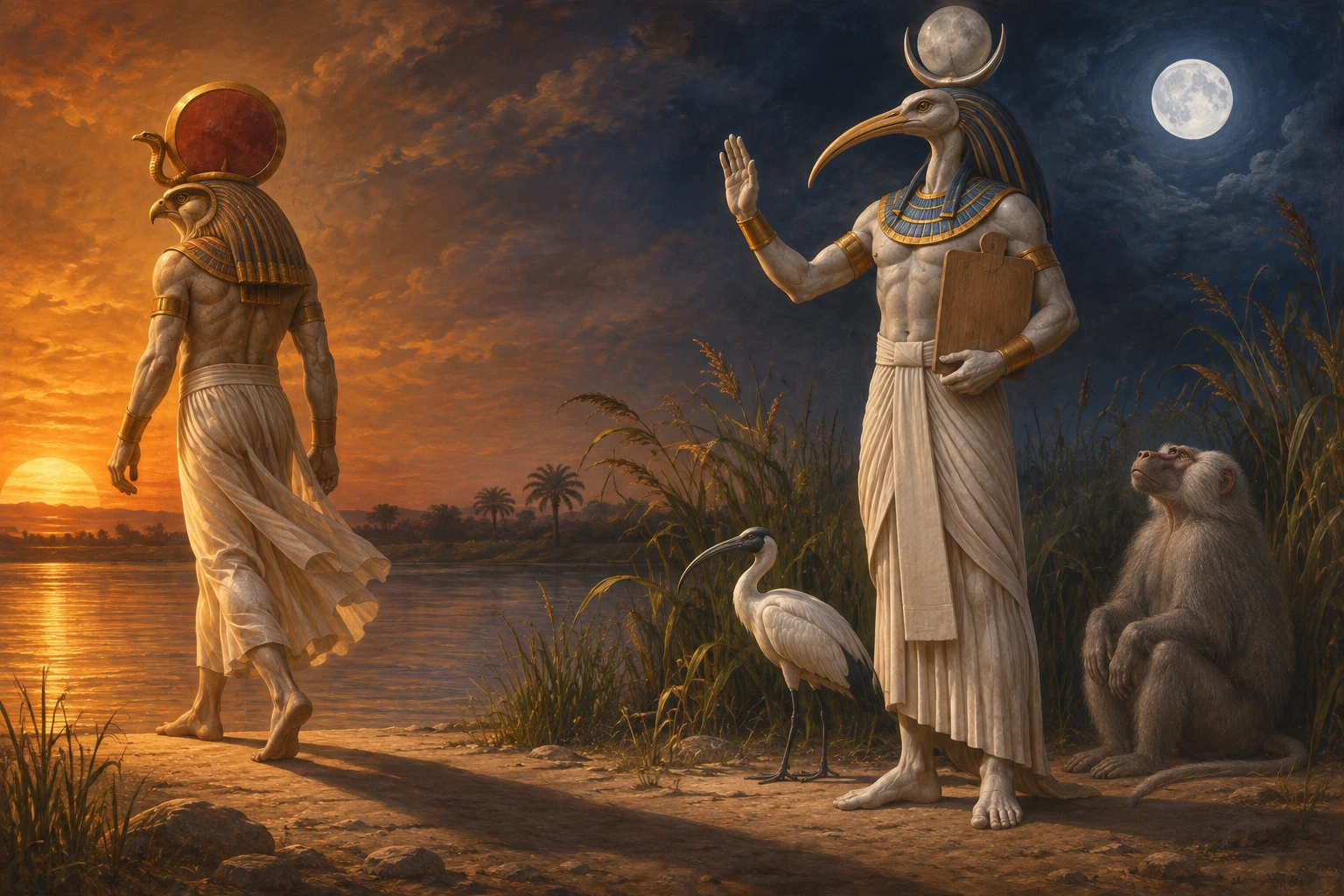
In the Book of the Heavenly Cow, which E. A. Wallis Budge translated in 1912 from the walls of a small chamber in the tomb of Seti I, the sun god Ra has grown weary of rebellious mankind. The first part of the book, his anger and what came of it, belongs to The Eye of Ra. Afterwards Ra decides to go far away, to bring light to the Duat, the world below.
He calls for Thoth. Thoth is to write down those who are there and punish those who rebelled. “Thou shalt be in my place,” Ra tells him, and he is to be called the “Asti of Ra”, the one who stands in Ra’s place.
Then Ra gives him his forms, each by a play on Egyptian words, which Budge prints beside his English. Ra gives him power to send (hab), “thereupon shall come into being the Ibis (habi) bird of Thoth”. He gives him power to embrace (anh) the two heavens with his rays, and so comes “the Moon-god (Aah) of Thoth”. He gives him power to drive back (anan) the peoples of the north, and so comes “the dog-headed Ape (anan) of Thoth”. “Thou art now in my place,” Ra ends, “in the sight of all those who see thee.”
1-2 Five Days Won at Draughts
Plutarch tells another story of the moon in On Isis and Osiris (chapter 12), and calls Thoth by his Greek name, Hermes. The Sun had cursed the goddess Plutarch calls Rhea, so that she could give birth in no month and no year. Hermes, who loved her, played draughts with the Moon and won from her “the seventieth part of each of her periods of illumination”. From his winnings he made five days and added them to the 360 of the year. The Egyptians, Plutarch says, kept them as the birthdays of the gods: on them were born Osiris and his brothers and sisters, whose story Osiris tells.
1-3 Theuth and the King
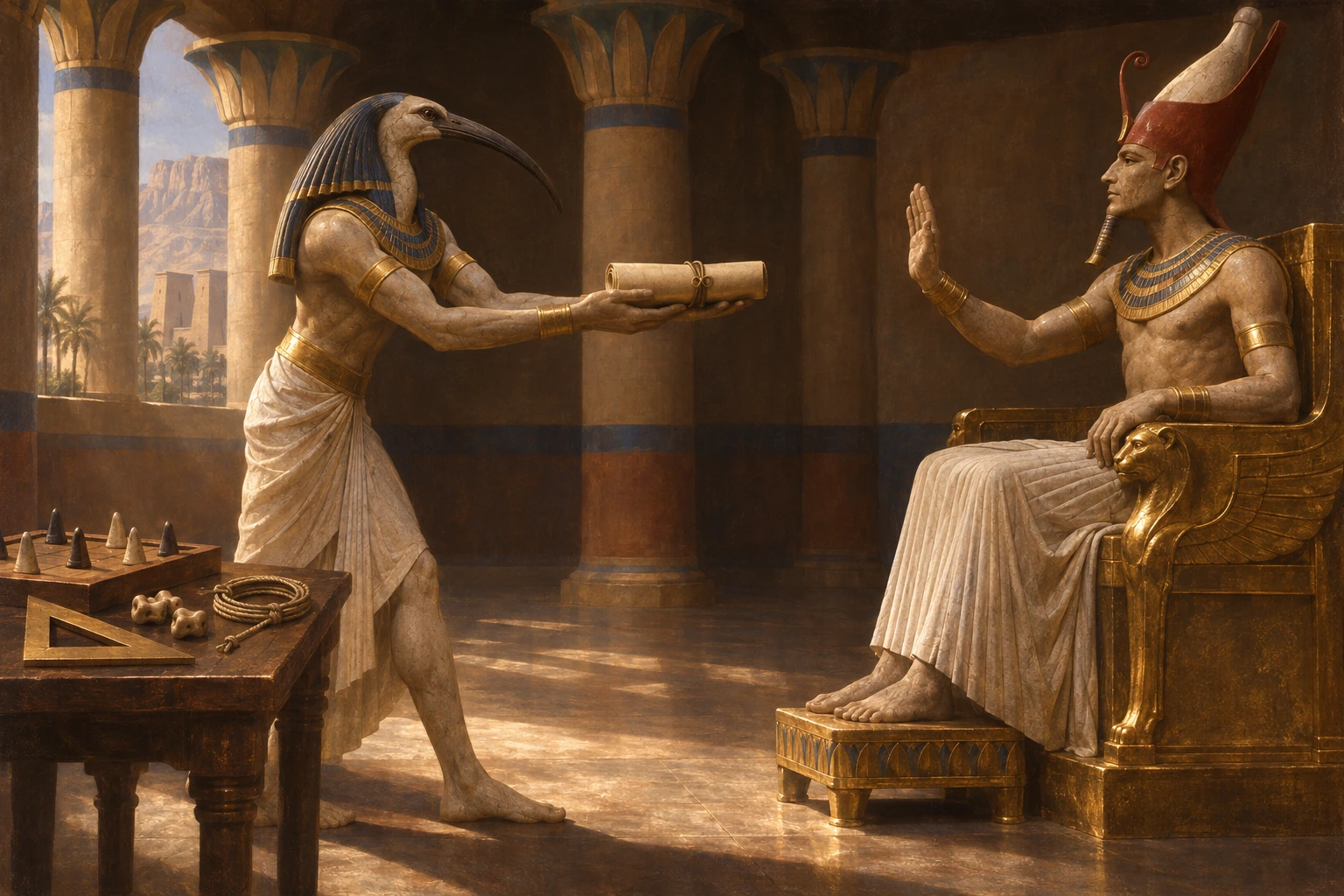
In Plato’s Phaedrus (274c–275b), Socrates tells a story he says he heard. At Naucratis in Egypt lived one of the old gods of that country, “the one whose sacred bird is called the ibis”, and his name was Theuth. He invented numbers and arithmetic, geometry and astronomy, draughts and dice, “and, most important of all, letters”. He took his inventions to Thamus, king of all Egypt, who lived in Thebes; the Greeks, Socrates adds, call that god Ammon.
Thamus praised some of the arts and found fault with others. When they came to letters, Theuth promised that they would make the Egyptians wiser and improve their memories: “it is an elixir of memory and wisdom that I have discovered”. The king answered that the one who invents an art is not the one to judge it. Letters would bring forgetfulness, because people would trust marks outside themselves instead of their own memory. “You have invented an elixir not of memory, but of reminding,” he said. Readers would seem to know much and would know little.
Phaedrus does not believe a word of it: “Socrates, you easily make up stories of Egypt or any country you please.”
1-4 The Book in the River
The first tale of Setne Khamwas is a Demotic story on a papyrus of the Ptolemaic period, quoted here in F. Ll. Griffith’s translation of 1900. Its hero is a real man turned into a legend: Khamwas, a son of Ramesses II and high priest of Ptah at Memphis, who lived about 1250 BCE.
Setne has found the tomb of a prince of long ago, Naneferkaptah, and in it a book. The ghost of the prince’s wife, Ahwere, tells him what the book has cost them. An old priest once told Naneferkaptah where to find “the book which Thoth wrote with his own hand”. Its first spell would let him enchant heaven, earth, the underworld, the mountains and the seas, and understand what the birds and the creeping things say. Its second would let him, even dead, take his form on earth again and see the sun and the moon rise.
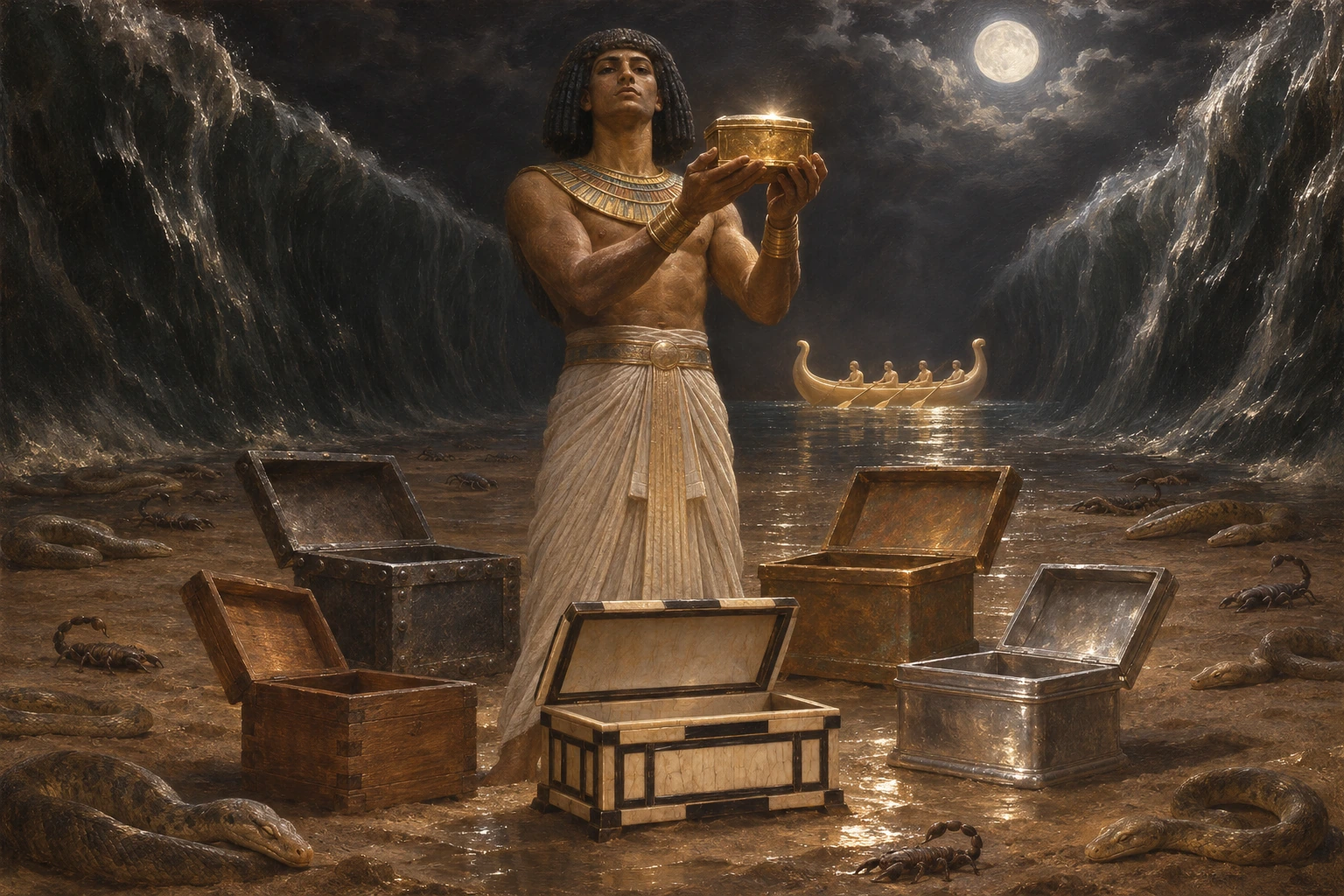
The book lay in the middle of the water at Coptos, in a box of iron. Inside it was a box of bronze, then one of wood, one of ivory and ebony, one of silver, and in the box of gold the book. Serpents, scorpions and reptiles lay around it for miles, and an endless snake was coiled about the box.
Naneferkaptah sailed south with Ahwere and their son Merib. He made a boat of wax with its crew, gave them life with a spell, and they rowed for three days. He threw sand before him, and the water parted. He bound the reptiles with a spell and fought the endless snake: twice he killed it and twice it came back, and the third time he cut it in two and put sand between the pieces. He opened box after box and read the book. Then he copied it onto new papyrus, dissolved the copy in beer and water and drank it, and knew everything that was in it.
Thoth found out and pleaded before Ra: the man had broken into his chamber, taken his box and killed its guard. A divine power came down from heaven. On the way home Merib fell from the boat and drowned, then Ahwere, and then Naneferkaptah, who had bound the book to his body. It was buried with him at Memphis.
Setne still wanted it. He played draughts with the ghost for the book and lost three games; after each he sank into the floor, to his feet, to his waist, to his ears. His brother brought him the amulets of Ptah, and he sprang up, seized the book and left the tomb. Then came a beautiful woman, Tabubu, for whom he signed away all he owned and even let his children be killed, until he came to himself naked in the road. His children were alive: it had been, Griffith thought, a vision sent by the magic of Naneferkaptah. Setne took the book back with “a fork and stick in thine hand, and a censer of fire on thine head”, as Pharaoh ordered, and brought Ahwere and Merib from Coptos to lie beside the prince.
2 Where the Story Is Written Down
- The Pyramid Texts, carved inside royal pyramids from Unas onward. In them, Budge noted in 1904, Thoth appears only as “a helper of the deceased kings”; they never describe his office.
- The Book of the Heavenly Cow, painted in New Kingdom royal tombs. Budge translated the copy in the tomb of Seti I, on the west bank at Thebes.
- The Book of the Dead. In the judgement of spell 125, Thoth stands by the balance with his reed pen and palette and writes down the verdict (The Weighing of the Heart tells it). Spell 94 is “of praying for an ink-pot and for a palette”. In the Papyrus of Nu (British Museum EA 10477), the dead man says: “I have brought the ink-pot and the palette as being the objects which are in the hands of Thoth … Behold me in the character of a scribe!”
- Scribes’ prayers, kept as New Kingdom school exercises. Papyrus Anastasi V begins “Come to me, Thoth, thou lordly ibis, thou god, for whom yearneth Hermopolis. Letter-writer of the Nine Gods”. In Papyrus Sallier I, Thoth is a “sweet well” in the desert, “closed to him that findeth words to say” and “open to him that keepeth silence” (Adolf Erman’s collection, trans. Aylward M. Blackman, 1927).
- The first tale of Setne Khamwas, Papyrus Cairo CG 30646, in Demotic. Its first two pages are lost. Griffith dated the hand to the last century of Ptolemaic rule or the first of the Roman empire. He reads the prince’s name Neneferkaptah; this post follows Miriam Lichtheim’s later translation, Naneferkaptah.
- Greek and Latin writers. Besides Plato and Plutarch: Diodorus of Sicily (1st century BCE, 1.16) makes Hermes the inventor of the alphabet and the “priestly scribe” of Osiris, and Cicero names his Egyptian name, Theuth (On the Nature of the Gods 3.56).
- The Hermetica, Greek treatises in which Hermes Trismegistus teaches his pupils. Walter Scott, who edited them in 1924, dated most to the 3rd century CE and some to the 2nd.
- A Demotic “Book of Thoth”: a dialogue between Thoth and “the one who loves knowledge”, pieced together from many papyri of the 1st and 2nd centuries CE and first published by Richard Jasnow and Karl-Theodor Zauzich in 2005. We know the edition only through Kevin van Bladel’s review in the Bryn Mawr Classical Review. Asked what writing is, Thoth answers: “Writing is a sea. Its reeds are a shore” (as van Bladel quotes it).
3 Competing Versions
- Whose son? In the Book of the Heavenly Cow, Ra summons him and makes him his deputy. Later inscriptions, Budge reports, call him “self-created, to whom none hath given birth”. In Plutarch he is the lover of the goddess who bore Osiris, and “many writers”, Plutarch says, held Isis to be his daughter (chapters 3 and 12).
- Who invented letters, and where? Plato’s Theuth lives at Naucratis. In Diodorus, Hermes also gave the lyre three strings, one for each season. Cicero turns the story around: his fifth Mercury killed Argus and “fled in exile to Egypt, where he gave the Egyptians their laws and letters”; the Egyptians called him Theuth. Plutarch makes Hermes “the inventor of grammar and music” (chapter 3).
- Ibis or baboon? Both, and the moon too: in the Heavenly Cow all three come from Ra’s words. In the judgement vignettes, Budge describes the dog-headed ape sitting on top of the balance to watch the pointer while the ibis-headed Thoth writes. Plutarch adds that the ibis’s black and white feathers “picture the moon in its first quarter” (chapter 75).
- Thoth’s errands. Among his titles Budge lists “judge of the two combatant gods”, Horus and Seth, and Plutarch’s Hermes pleads Horus’s cause; their trial is told in Horus and Seth. In the Demotic Myth of the Sun’s Eye (2nd century CE), a little “dog-monkey”, sometimes identified as Thoth’s son, coaxes the angry goddess home with fables (The Eye of Ra).
- How many books? Clement of Alexandria, a Christian teacher who died about 215 CE, counts “forty-two books of Hermes” that the priests learned and carried in procession: thirty-six holding “the whole philosophy of the Egyptians” and six on medicine. Iamblichus reports that Seleucus counted twenty thousand books of Hermes, and Manetho 36,525 (On the Mysteries 8.1).
4 History and Tradition
- Hermopolis. Thoth’s chief city was Khemenu, which the Greeks called Hermopolis and which is el-Ashmunein today. The name, Budge explains, means “the city of the Eight Gods”, after the eight gods of its creation story; Atum compares it with the others. The Heibonsha encyclopedia notes the remains of a temple built by Ramesses II, and, at Tuna el-Gebel, the city’s cemetery, underground galleries of ibis and baboon mummies.
- Millions of ibises. Tuna el-Gebel holds about four million mummified sacred ibises, and the animal cemetery at Saqqara about 1.75 million, laid down at some ten thousand a year (Sally Wasef and colleagues, 2019). Most were offerings to Thoth, killed and wrapped for pilgrims from the 26th Dynasty (664–525 BCE) until about 250 CE, and most of all between 450 and 250 BCE. A priest, Hor of Sebennytos, wrote in the 2nd century BCE of feeding some 60,000 ibises “clover and bread”. But the mummies’ DNA is as varied as that of wild African ibises today, so the authors think most birds were wild ones tamed for a short time, not bred on large farms.
- The scribe’s companion. A small granodiorite statue in the Metropolitan Museum of Art (29.2.16, about 1300–1080 BCE) shows a scribe sitting cross-legged with a papyrus open on his lap, and the baboon of Thoth crouching on his shoulders behind his head.
- The month of Thoth. Cicero already knew Theuth as “the name in the Egyptian calendar for the first month of year”. On the nineteenth day of that month, Plutarch writes, people kept the festival of Hermes, eating honey and a fig and saying “A sweet thing is Truth” (chapter 68). The Coptic church calendar still begins with the month Thout, named, as the Coptic Orthodox site St-Takla explains, after Thoth.
- Hermes Trismegistus. Budge traced “thrice great” to Thoth’s Egyptian titles, and the Demotic Book of Thoth, van Bladel reports, calls him wr wr wr, “thrice great”. Marsilio Ficino’s Latin translation of the Greek Corpus Hermeticum, printed at Treviso in 1471, made Hermes a sage of the time of Moses, older than Plato. In 1614 Isaac Casaubon showed that the treatises were falsely attributed, written, he judged, about the end of the 1st century CE, partly from Plato and partly from Christian scripture. How much in them is Egyptian is still argued: A.-J. Festugière saw nothing, while Jean-Pierre Mahé and Garth Fowden found more.
A lost “Book of Thoth” holding the secrets of the gods is a favourite of novels and websites. No such single book is known. The magic book of the Setne tale belongs to a story, and in it the book goes back into the tomb. The Egyptians did credit Thoth with many books: Clement counts forty-two, and the dialogue its modern editors call “the Book of Thoth” is a lesson for scribes. The name passed to the tarot in 1781, when Court de Gébelin’s Monde primitif declared the cards an Egyptian book and a companion essay in the same volume headed its first section “Livre de Thot”. Aleister Crowley’s The Book of Thoth (1944) is a book about tarot.
5 Related Stories
- The Weighing of the Heart: The Judgement of the Dead: the judgement in which Thoth, reed pen in hand, writes down the verdict while the heart is weighed.
- Osiris: The Murdered King Who Rules the Dead: Plutarch’s Hermes again. He won the five days on which Osiris was born, and spoke for Horus before the gods.
- Odin: The God Who Gave an Eye for Wisdom: Roman writers gave the two gods one name. Cicero’s fifth Mercury is Thoth, and Paul the Deacon writes that Wotan “is he who among the Romans is called Mercury”. Odin took up the runes; Thoth wrote for the gods. Beyond that Roman name, we link them for the theme.
- Ganesha: How the God of Beginnings Got His Elephant Head: another god who writes. In one passage of the Mahābhārata, Ganesha takes down the poem at Vyāsa’s dictation. We have not found a scholar who compares the two; we link them for the theme.
6 Sources
- Book of the Heavenly Cow (“The Legend of the Destruction of Mankind”), chapter IV, trans. E. A. Wallis Budge, Legends of the Gods (1912): Project Gutenberg
- Plutarch, On Isis and Osiris, chapters 3, 12, 19, 68 and 75, trans. Frank Cole Babbitt (Loeb, 1936): LacusCurtius, LacusCurtius
- Plato, Phaedrus 274c–275b, trans. Harold N. Fowler (Loeb, 1925): Perseus
- The first tale of Setne Khamwas (Papyrus Cairo CG 30646), trans. F. Ll. Griffith, Stories of the High Priests of Memphis: The Sethon of Herodotus and the Demotic Tales of Khamuas (Oxford: Clarendon Press, 1900), pp. 13–41, and trans. Miriam Lichtheim: archive.org, attalus.org
- Book of the Dead, spells 94 and 125, trans. E. A. Wallis Budge (1901): archive.org, vol. 1, archive.org, vol. 2
- Prayers to Thoth (Papyrus Anastasi V 9.2 ff., Papyrus Sallier I 8.2 ff.), in Adolf Erman, The Literature of the Ancient Egyptians, trans. Aylward M. Blackman (1927), pp. 305–306: archive.org
- Diodorus Siculus 1.16, trans. C. H. Oldfather (Loeb, 1933), and Cicero, On the Nature of the Gods 3.56, trans. H. Rackham (Loeb, 1933): LacusCurtius, LacusCurtius
- Clement of Alexandria, Stromata 6.4, trans. William Wilson (Ante-Nicene Fathers 2, 1885): New Advent; Iamblichus, On the Mysteries 8.1, trans. Thomas Taylor (1821, reprinted 1895): archive.org; The Myth of the Solar Eye (Papyrus Leiden I 384): attalus.org
- E. A. Wallis Budge, The Gods of the Egyptians (1904), vol. 1, pp. 400–404: archive.org; Walter Scott, Hermetica, vol. 1 (1924), pp. 31–32 and 41–42: archive.org
- Kevin van Bladel, review of Richard Jasnow and Karl-Theodor Zauzich, The Ancient Egyptian Book of Thoth (2005), Bryn Mawr Classical Review 2006.05.19: bmcr.brynmawr.edu
- Sally Wasef et al., “Mitogenomic diversity in Sacred Ibis Mummies sheds light on early Egyptian practices”, PLOS ONE 14 (2019): journals.plos.org
- The Metropolitan Museum of Art, “Statue of a scribe with a baboon” (29.2.16): metmuseum.org
- Antoine Court de Gébelin, Monde primitif, vol. 8 (1781): archive.org; Aleister Crowley, The Book of Thoth (1944; reprint 1991): archive.org
- Paul the Deacon, Historia Langobardorum 1.9, Latin text: The Latin Library; “Tout Month”, Coptic Synaxarium: St-Takla.org
- “トート”: Kotobank
Cover and illustrations: AI-generated images made for Arcana. They are interpretations, not historical artworks.