Ganesha: How the God of Beginnings Got His Elephant Head
Pārvatī made a son to guard her door, and Shiva, who did not know him, cut off his head. That is the best-known answer to why Ganesha has an elephant's head. The Purāṇas give at least three others.
- Type: myth, the birth of a god and how he got his elephant head
- Culture: India (Hindu tradition); taken into Buddhism and worshipped in Japan as Kangiten
- Earliest texts: the Purāṇas, among them the Matsya, Varāha, Śiva and Brahmavaivarta Purāṇas, none of them securely dated; no image of Ganesha older than the 5th century has been found
- Key figures: Ganesha (Gaṇeśa, Gaṇapati, Vināyaka), Pārvatī, Shiva, Vishnu, Brahmā, Śani, Paraśurāma
In Hindu worship Ganesha comes first. Before a birth rite, a journey, trade or a battle, says the Brahmāṇḍa Purāṇa, worship the elephant-faced god, and everything you undertake will succeed. The Purāṇas agree that he must be honoured first. They do not agree on how he got his head.
Why does Ganesha have an elephant’s head? It depends on the text. In the Śiva Purāṇa, Shiva cut off the boy’s head, and the gods gave him the head of the first creature they met in the north, an elephant with one tusk. In the Brahmavaivarta Purāṇa, the baby’s head was severed by one glance from Śani, the planet Saturn. In the Varāha Purāṇa, Shiva cursed a radiant youth to have an elephant’s face. In the Matsya Purāṇa, Pārvatī shaped him with an elephant’s face from the start.
1 The Telling
This follows the Śiva Purāṇa, Rudra Saṃhitā, Kumāra Khaṇḍa, chapters 13 to 18, in the Sanskrit text on Sanskrit Wikisource; quotations are our own translations. The god Brahmā tells the story to the sage Nārada, and he begins with a warning. Because the ages of the world differ, Ganesha’s birth is told in more than one way: in one telling, his head was cut off when Śani looked at him. What follows is the birth told in the Śveta kalpa, the “White Age”.
1-1 A Guard of Her Own
After Shiva and Pārvatī married and went to Mount Kailāsa, Pārvatī’s companions Jayā and Vijayā pointed something out to her. Shiva’s attendants, the gaṇas, led by Nandin and Bhṛṅgin, were beyond counting, and every one of them obeyed Shiva. Not one was hers. She should make one of her own.
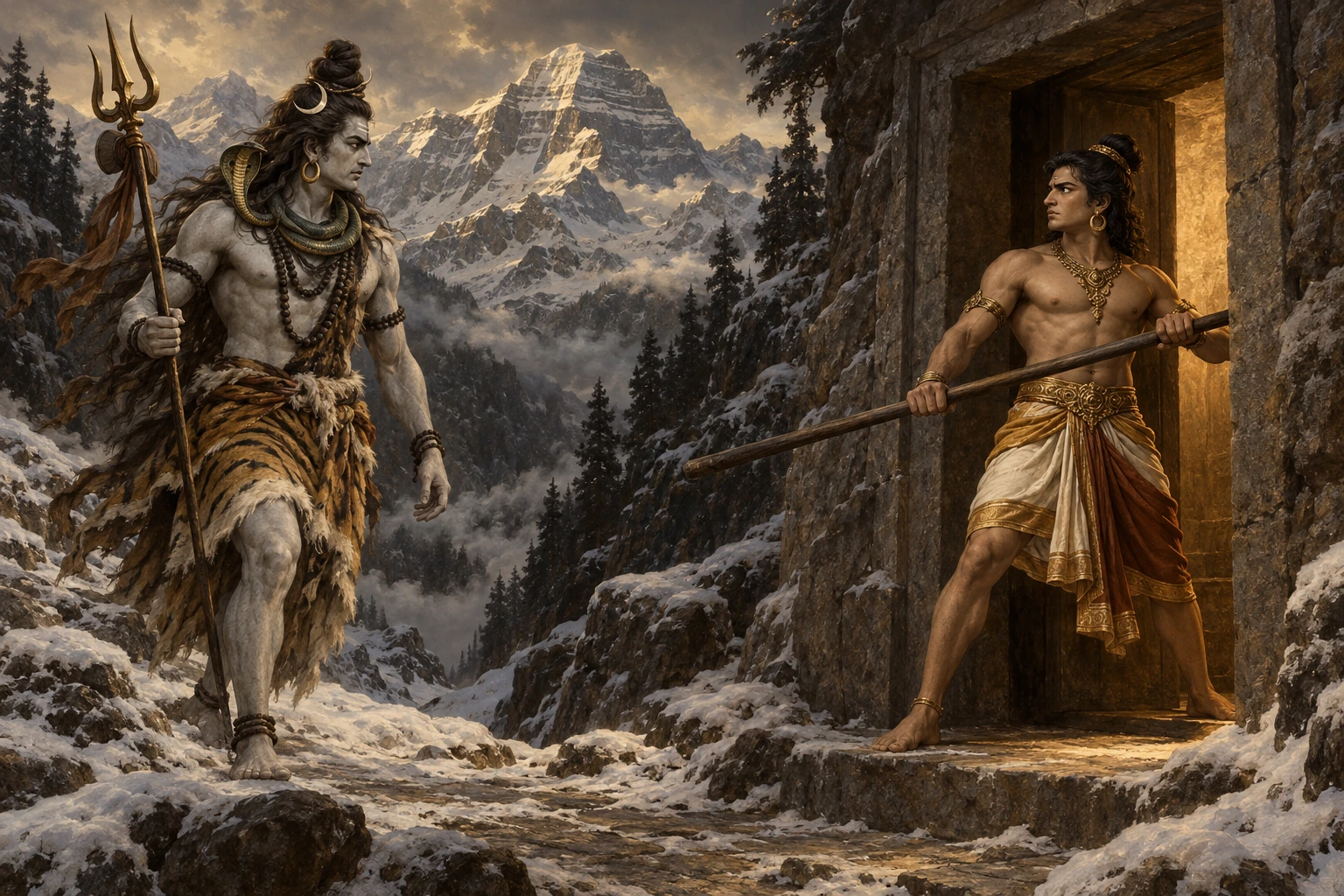
She took their advice to heart. Once, while she was bathing, Shiva scolded Nandin aside and walked in, and she rose up in embarrassment. So she shaped a man from the dirt she had washed from her body: faultless in every limb, handsome and very strong. She dressed and adorned him and said: “You are my son. You are mine, and I have no one else here.” She gave him a stout staff and set him at her door. No one was to come in without her leave.
1-2 The Boy at the Door
Shiva came to the door. The boy did not know him and would not let him pass, because his mother was bathing. “Fool,” said Shiva, “I am Shiva, the husband of the mountain’s daughter. I am going into my own house.” The boy struck him with the staff.
Shiva sent his gaṇas, and the boy drove them off with threats. Shiva hesitated. The boy was Pārvatī’s own man; but if Shiva gave way, people would say he was ruled by his wife. So he ordered a fight. Pārvatī heard the quarrel, resolved not to yield, and sent word to her son: he had done right, and must let no one in by force.
1-3 The Battle
Nandin seized one of the boy’s feet and Bhṛṅgin the other. He threw them off, took up an iron club and beat down the whole host. Brahmā came to make peace, saying he was a Brahmin who brought peace, not war, and the boy tore at his beard; Brahmā fled. The gods came with Indra, and Pārvatī made two powers, śaktis, who caught their weapons in their mouths. Of them all, only Shiva’s son Skanda stood his ground.
Shiva decided that the boy could only be overcome by a trick. Vishnu fought him and kept him busy. The boy struck Shiva’s hand, and the trident fell; he knocked Shiva’s bow to the ground. Then, while the boy was fighting Vishnu, Shiva came at him from the north, trident in hand, and cut off his head.
1-4 The Head from the North
Pārvatī’s grief turned to fury. She made hundreds of thousands of śaktis and ordered them to devour the gods, the sages, everyone. No one, not even Brahmā, Vishnu or Shiva, could stand before her. The sages praised her as Mother of the World until she answered: if my son lives, is honoured among you and is made overseer of all, the destruction stops.
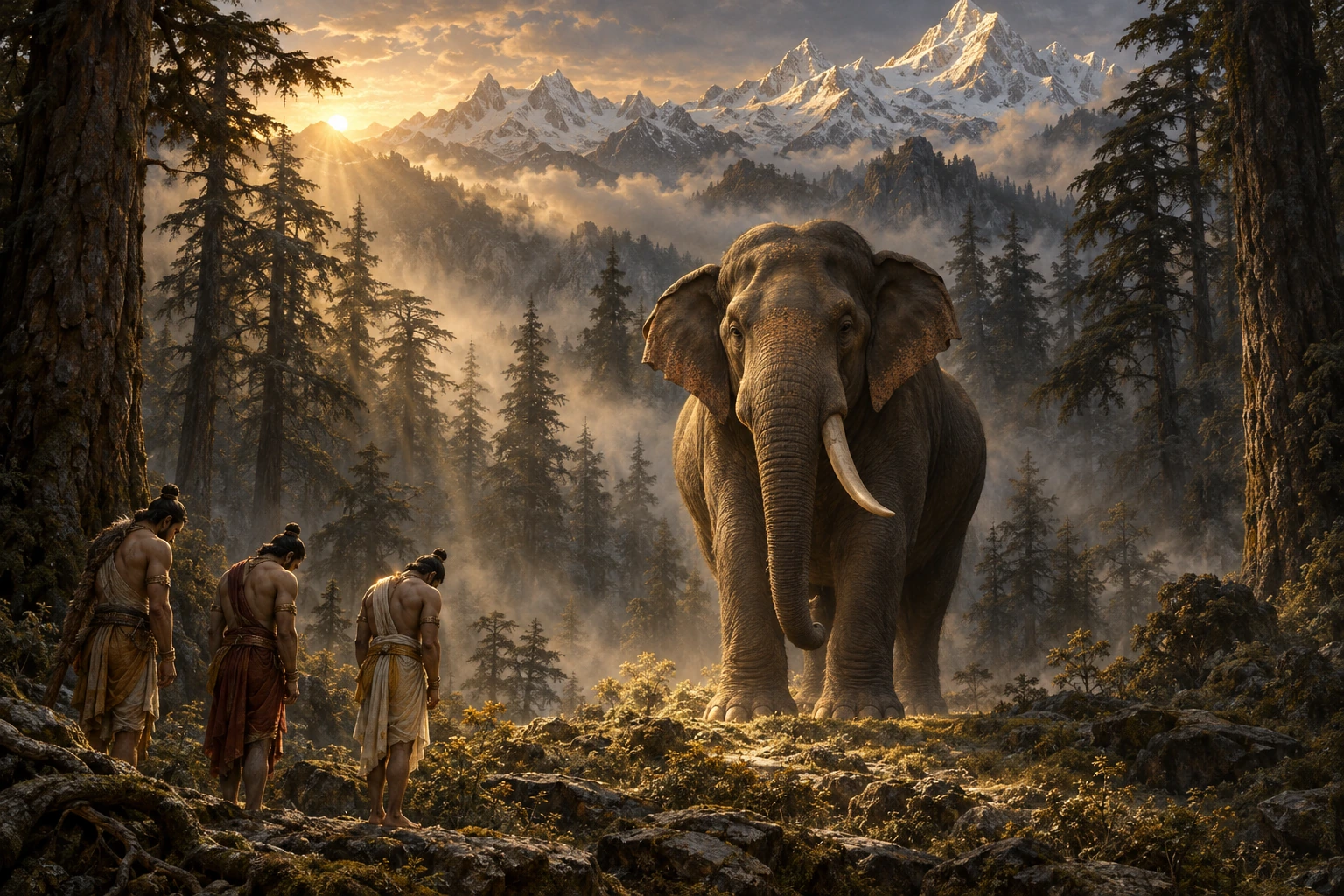
Shiva told the gods: “Go north. Bring back the head of the first one you meet, and join it to the body.” The first they met was an elephant with one tusk. They washed the body, set the head on it and sprinkled it with water charged with Vedic mantras. The boy got up “as if from sleep”: elephant-faced, deep red, cheerful and radiant.
1-5 Worshipped First
Pārvatī held him close. Since she saw vermilion (sindūra) on his face, she said, people would always worship him with vermilion. Shiva laid his hand on the boy’s head: “This is my other son.” Then Brahmā, Vishnu and Shiva together declared that he must be worshipped as they were: worship him first, then us, for worship that leaves him out loses its fruit. Shiva made him chief of all his gaṇas, Gaṇeśa, and said his name would be the best of all for destroying obstacles.
Last, Shiva named the day. The boy had come into being on the fourth lunar day (caturthī) of the month of Bhādrapada, at moonrise, in the first watch of the night. Let him be worshipped on that day each year, with blades of dūrvā grass.
2 Where the Story Is Written Down
- The Purāṇas. Ganesha’s birth is told in these Sanskrit compendia of myth and ritual, not in the epics. Their dates are uncertain. The ones used here:
- the Śiva Purāṇa, Rudra Saṃhitā 2.4.13–18 (section 1);
- the Brahmavaivarta Purāṇa, whose third book, the Gaṇapati Khaṇḍa, is named after him. It tells the Śani story (3.11–12), where the elephant head came from (3.20) and how he lost a tusk (3.43);
- the Varāha Purāṇa, chapter 23, and the Matsya Purāṇa, 154.500–505, with much shorter versions;
- the Brahmāṇḍa Purāṇa, which tells the tusk story again (2.3.42).
- Images. The Sanskritist Kamimura Katsuhiko writes that no image of Ganesha made before the 5th century has been found, that his cult arose around the 6th, and that the Mahābhārata and the Rāmāyaṇa have no notable myth of him. He was a local god, Kamimura says, later tied to the mythology of Shiva.
- The scribe of the Mahābhārata. In K. M. Ganguli’s 1884 translation (Book 1, section 1), Brahmā tells the poet Vyāsa to think of Ganesha as his scribe. Ganesha agrees on one condition: “provided my pen do not for a moment cease writing.” Vyāsa adds his own: wherever Ganesha does not understand, he must stop writing. So Vyāsa knit some verses so tight that “even the omniscient Ganesa took a moment to consider”.
- The critical edition published in Pune leaves the episode out of its text and prints it in an appendix (App. I, No. 1).
- Its editor, V. S. Sukthankar, explains why in his Prolegomena (1933). The passage is missing from the Southern manuscripts, and the Bengali version has “not the remotest trace” of it. “Only a very late interpolation in some inferior Devanāgarī manuscripts” tells it, “a fantastic story that we may ignore with an easy conscience”. He cites earlier critics, among them Moriz Winternitz (1898).
3 Competing Versions
- Why the elephant head?
- Śiva Purāṇa: Shiva beheads the boy at the door, and the gods bring the head of the first creature they meet. The text itself mentions the Śani version and assigns it to another age.
- Brahmavaivarta Purāṇa (3.11–12): Śani kept his eyes lowered. Lost in meditation on Krishna, he had once failed to look at his wife, and she cursed him: whatever he looked at would be destroyed. Pārvatī laughed and told him to look at her and her baby. He looked at the child’s face from the corner of his left eye, and the head was severed. It went to Goloka, Krishna’s heaven, and entered Krishna. Vishnu rode Garuḍa north to the river Puṣpabhadrā, found an elephant asleep with its head to the north, cut off the head with his discus and joined it to the child. Pārvatī cursed Śani to lose the use of a limb, then softened the curse: he would be only “a little lame”.
- Varāha Purāṇa (23): the gods asked Shiva for someone to put obstacles in the way of wrong deeds. Shiva gazed at Umā (Pārvatī) and laughed, and a radiant youth sprang from his face, so handsome that Umā could not stop looking at him. Angered, Shiva cursed him: “You will be elephant-faced and pot-bellied, with snakes for your sacred thread.” He became Vināyaka, lord of the obstacle-makers.
- Matsya Purāṇa (154.500–505): Pārvatī, longing for a son, rubbed her body with scented oil and powder, shaped the paste into a man with an elephant’s face, and put him in the Ganges. He grew to fill the world. Both the goddess and the river called him “son”, the gods worshipped him as Gāṅgeya, “son of the Ganges”, and Brahmā made him lord of the Vināyakas.
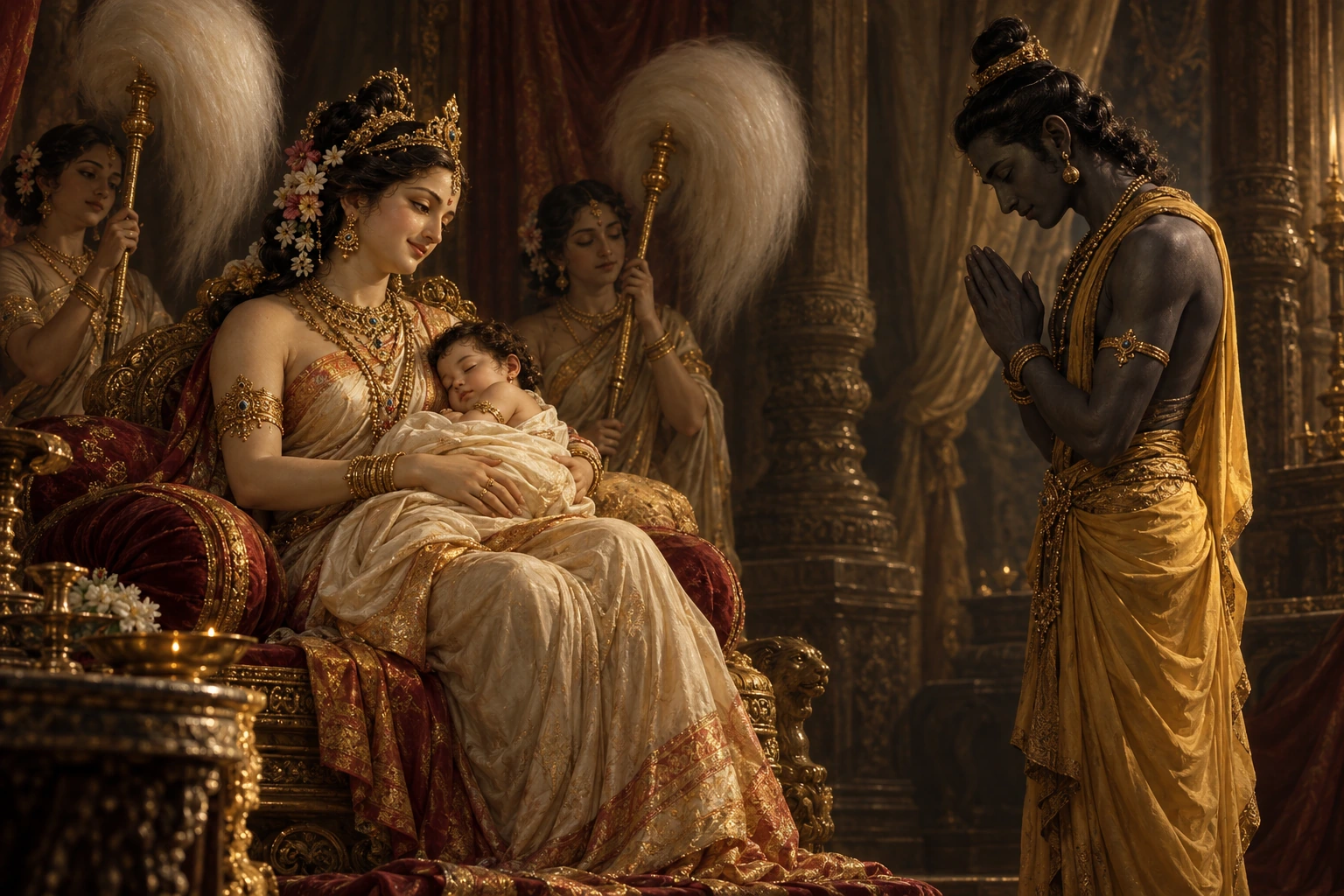
- Why that elephant? In the Brahmavaivarta (3.20), the sage Durvāsas gave Indra a pārijāta flower from Nārāyaṇa: whoever wore it on his head would be free of obstacles and worshipped first among the gods. Indra, distracted by the apsaras Rambhā, put it on his elephant’s head instead. The elephant left Indra for the forest, and that is the head Vishnu took.
- How did he lose a tusk? In the Śiva Purāṇa the elephant already had one. In the Brahmavaivarta (3.43) and the Brahmāṇḍa (2.3.42), Paraśurāma tried to force his way past Ganesha to see Shiva and threw the axe Shiva had given him. Ganesha would not let his father’s weapon fail, so he took it on his left tusk, which broke off. Hence his name Ekadanta, “One-Tusk”. The Mahābhārata passage, in Ganguli’s translation, speaks of a pen and says nothing of a tusk.
- Whose son? In the Śiva and Matsya Purāṇas, Pārvatī makes him alone. In the Varāha, he is born from Shiva alone, “risen from Rudra’s face”.
4 History and Tradition
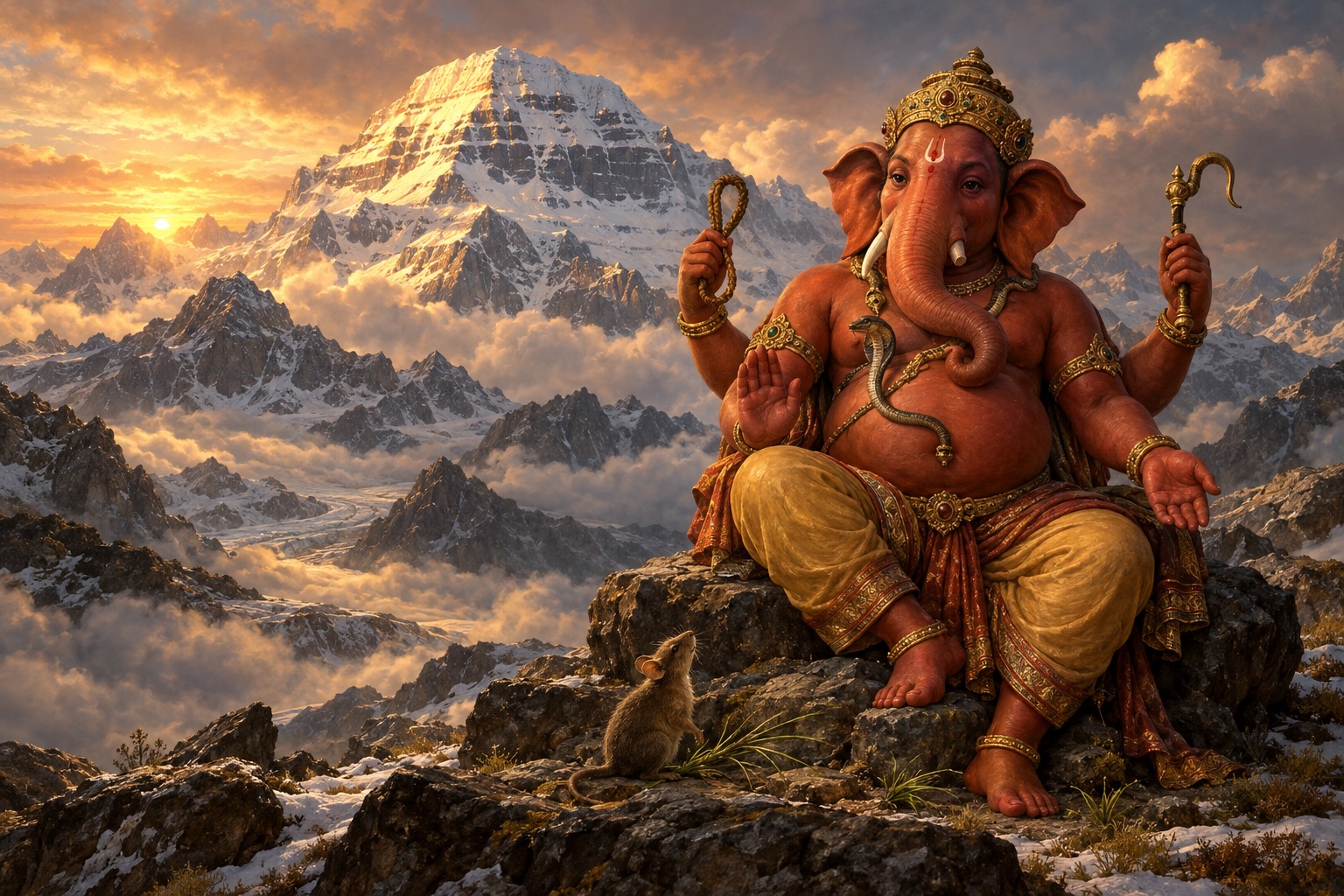
- The mouse. Ganesha’s mount is a mouse. In the Brahmāṇḍa Purāṇa’s story of the goddess Lalitā, he rides it in battle and crushes the demon Gajāsura. The Purāṇa chapters above do not say how he came by it. Far older, the White Yajurveda gives the mouse to Rudra, the name the Śiva Purāṇa itself uses for Shiva: “This, Rudra, is thy share, the rat thy victim” (3.57, trans. Griffith, 1899).
- Gaṇeśa Caturthī. The Śiva Purāṇa sets a yearly vow on his birthday, the fourth lunar day of Bhādrapada (section 1-5). His public festival, Gaṇeśa Caturthī, “Ganesha’s Fourth”, lasts ten days and ends with the images carried in procession and immersed in water; in 2025 it began on 27 August. Bal Gangadhar Tilak turned the family festival of Pune into a public one: neighbourhoods paid for large images on pavilions, and the songs carried politics. His newspaper Kesari asked in 1896: “Why shouldn’t we convert the large religious festivals into mass political rallies?” Sources differ on the year: Maharashtra’s culture minister put it at 1893, MANAS, a UCLA site on Indian history and culture, at 1894. In July 2025 Maharashtra declared the public Ganeshotsav its state festival.
- Japan. Through Esoteric Buddhism, Ganesha became Kangiten (歓喜天) or Shōten (聖天). He is shown alone, or as two elephant-headed figures embracing. In one account, the Vināyakas were demons who made obstacles, until the bodhisattva Kannon took a woman’s form and married their chief, turning him into a remover of obstacles. Worshippers offer daikon radish and sweets. Hōzan-ji (Ikoma Shōten) in Nara and Matsuchiyama Shōten in Asakusa, Tokyo, are still centres of his cult.
- Vietnam. In 1903 the French School of the Far East found a standing sandstone Ganesha, 95 cm tall, at tower E5 of Mỹ Sơn. Dated to about the 7th–8th century, it has been in the Museum of Cham Sculpture in Đà Nẵng since 1918 and became a National Treasure in 2020. Images of Ganesha belong to both the Champa and the Óc Eo cultures.
Ganesha is sometimes said to be in the Rigveda, because hymn 2.23 begins gaṇānāṃ tvā gaṇapatiṃ havāmahe, “we call on you, lord of the hosts”. The hymn is addressed to Brahmaṇaspati, the lord of prayer, and in 10.112 gaṇapati is Indra. Neither describes an elephant-headed god.
5 Related Stories
- The Churning of the Ocean: Gods, Demons and the Nectar of Immortality: the same sage, the same gift, the same elephant. In the Viṣṇu Purāṇa (1.9), Indra puts a garland from Durvāsas on his elephant’s head, the elephant throws it to the ground, and the sage’s curse leads to the churning. In the Brahmavaivarta, Indra puts a flower from Durvāsas on his elephant’s head, and that head ends up on Ganesha. We have found no scholar who links the two passages; the motif is simply shared.
- Durga and Mahishasura: The Goddess and the Buffalo Demon: in the Brahmavaivarta, Ganesha’s mother is called Durgā, and in the Śiva Purāṇa the sages calm her fury by praising her as Caṇḍikā.
- Osiris: The Murdered King Who Rules the Dead: two gods whose bodies are made whole again, Osiris with a likeness in place of the one part Isis never found, Ganesha with an elephant’s head. We have not found a scholar who compares the two; we link them for the theme.
- Shiva: The Destroyer and the Dancer: Parvati’s husband. In the Śiva Purāṇa, Shiva cuts off the head of the boy who bars his door, then has him given an elephant’s, as Daksha is given a goat’s. We have found no scholar who links the two; the motif is simply shared.
- Kurukshetra: The War of the Mahābhārata: the war of the Mahābhārata. The story that Ganesha wrote the poem down at Vyasa’s dictation is, like Draupadi’s prayer and Abhimanyu in the womb, a passage the critical edition moved out of its text.
6 Sources
- Śiva Purāṇa, Rudra Saṃhitā, Kumāra Khaṇḍa 2.4.13–18, Sanskrit text: Sanskrit Wikisource
- Brahmavaivarta Purāṇa, Gaṇapati Khaṇḍa 3.11–12, 3.20 and 3.43, Sanskrit text: Sanskrit Wikisource
- Varāha Purāṇa, chapter 23, Sanskrit text: Sanskrit Wikisource
- Matsya Purāṇa 154.500–505, input by Oliver Hellwig from the Caukhamba edition (1954): GRETIL
- Brahmāṇḍa Purāṇa 2.3.42 and Lalitopākhyāna 27, Venkatesvara Press edition: GRETIL
- Viṣṇu Purāṇa 1.9, Venkatesvara Press edition (1910): GRETIL
- V. S. Sukthankar, Prolegomena to the critical edition of the Mahābhārata, Ādiparvan (Pune, 1933), pp. LI, LIII, LX, LXXV: GRETIL
- K. M. Ganguli (trans.), The Mahabharata, Book 1, section 1 (1884), pp. 5–6: Wikisource
- Rigveda 2.23.1 and 10.112.9, Aufrecht’s text: GRETIL; trans. Ralph T. H. Griffith: IntraText
- Ralph T. H. Griffith (trans.), The Texts of the White Yajurveda (Benares, 1899), 3.57: archive.org
- “Ganpati Festival”, MANAS: UCLA
- “Ganeshotsav declared as ‘State Festival of Maharashtra’”, PTI, 10 July 2025: The Week
- “Đà Nẵng có thêm 2 hiện vật được công nhận bảo vật quốc gia”, 2 January 2021: Báo Văn Hóa
- Kamimura Katsuhiko, “ガネーシャ”, Sekai daihyakka jiten: Kotobank; “歓喜天” and “聖天”: Kotobank, Kotobank
Cover and illustrations: AI-generated images made for Arcana. They are interpretations, not historical artworks.