The Dashavatara: The Ten Avatars of Vishnu
A fish that outgrew every pond, a boar that lifted the earth on its tusk, a dwarf who asked a king for three steps of land: again and again, Vishnu comes down into the world. Ten of these descents are famous, but the texts have never fully agreed on which ten.
- Type: myth cycle, the descents (avatāras) of the god Vishnu
- Culture: India (Hindu tradition, above all the worship of Vishnu)
- Earliest texts: the fish, the boar and the dwarf already appear in the Vedic prose texts called Brāhmaṇas; the Mahābhārata (books 3 and 12) has early lists; the Bhāgavata Purāṇa (about the 10th century) counts more than twenty; Jayadeva’s Gītagovinda (12th century) sings the ten best known today
- Key figures: Vishnu as Matsya, Kurma, Varaha, Narasimha, Vamana, Parashurama, Rama, Krishna or Balarama, the Buddha and Kalki; Manu, Prahlada, King Bali
When the world is in danger, Vishnu does not send help. He comes down himself: as a fish, a tortoise, a boar, a man with a lion’s face, a dwarf. Each of these comings is an avatāra, a “descent”, the word English borrowed as “avatar”.
Why does Vishnu keep coming down? The Bhagavad Gītā gives the classic answer, in Krishna’s words: “Whenever dharma fails and adharma rises, I send myself forth. To protect the good, to destroy the wicked, to make dharma firm, I come into being age after age” (4.7–8, our translation). Yet its verses speak only of Krishna “coming into being” (saṃbhavāmi) and do not count the descents. The counting came later, and it never came out quite the same.
1 The Telling
No single text tells all ten. We follow the order of the hymn that opens Jayadeva’s Gītagovinda, and for each descent the text that tells it most fully, usually the Bhāgavata Purāṇa (Sanskrit text on GRETIL; translations ours).
1-1 Matsya, the Fish
At the end of an earlier age of the world, says the Bhāgavata (8.24), Brahmā fell asleep, and a demon, Hayagriva, stole the Vedas that slipped from his mouth. Vishnu took the form of a tiny fish.
The royal sage Satyavrata, lord of the Dravidas, was offering water in the river Kritamala when the fish appeared in his cupped hands and begged him not to throw it back among creatures that eat their own kind. He took it home in his water pot. In one night it outgrew the pot; it outgrew a larger vessel, then a pond, then a lake. When he put it in the sea, it pleaded that the sea monsters would eat it, and the king understood: “Surely you are Hari himself, Nārāyaṇa.”
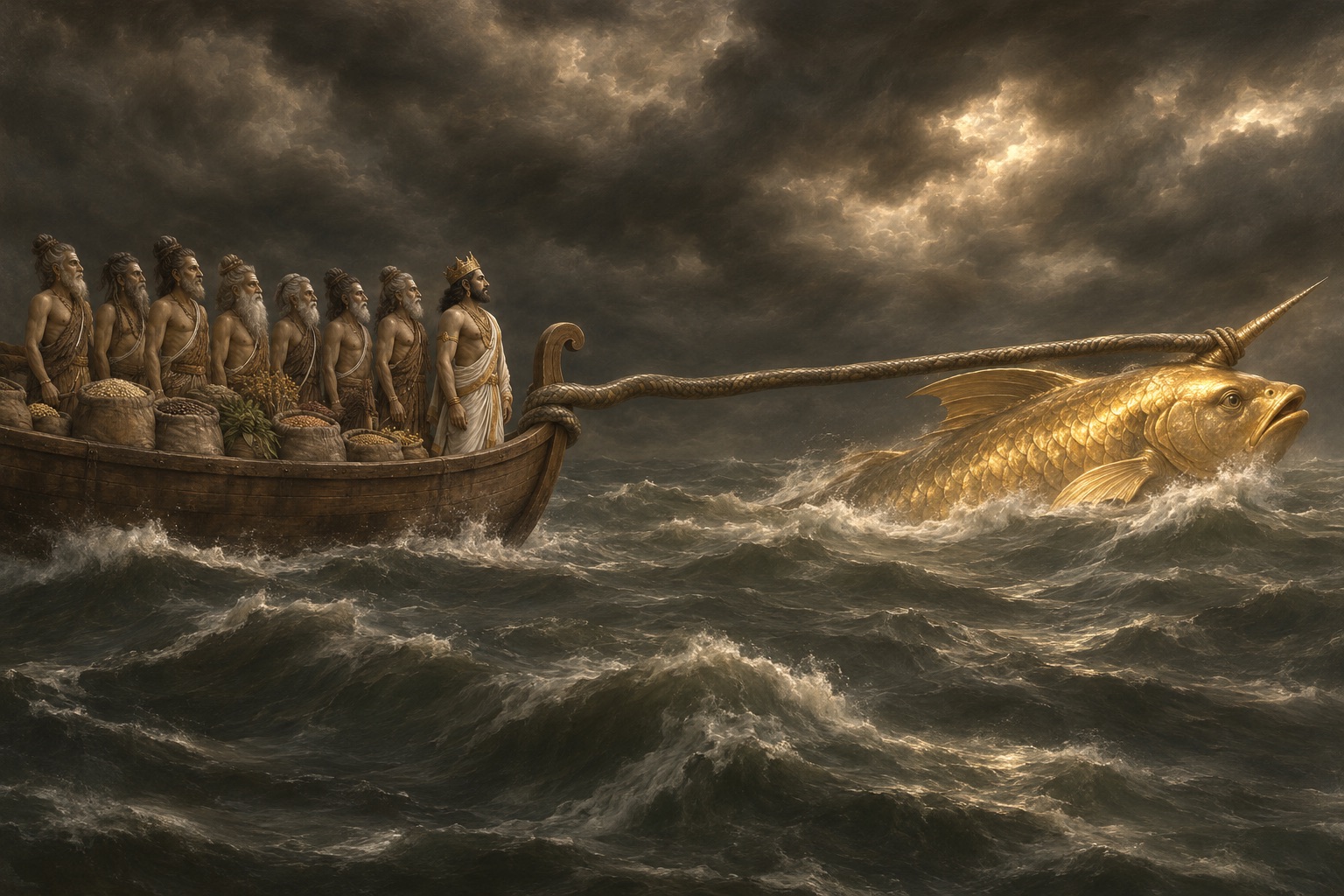
In seven days, the fish told him, the three worlds would sink into the ocean of dissolution. A great boat would come: he was to board it with the seven sages, every herb and every seed, and tie it to the fish’s horn with a great serpent for a rope. The flood rose, the boat came, and a golden fish with a single horn appeared. All through Brahmā’s night it towed the boat and taught the king. Then it killed Hayagriva and gave the Vedas back, and Satyavrata became Manu Vaivasvata, the Manu of our age.
The second descent, Kurma, the tortoise who bore Mount Mandara on his back while gods and asuras churned the ocean, has a post of his own (section 5).
1-2 Varaha, the Boar
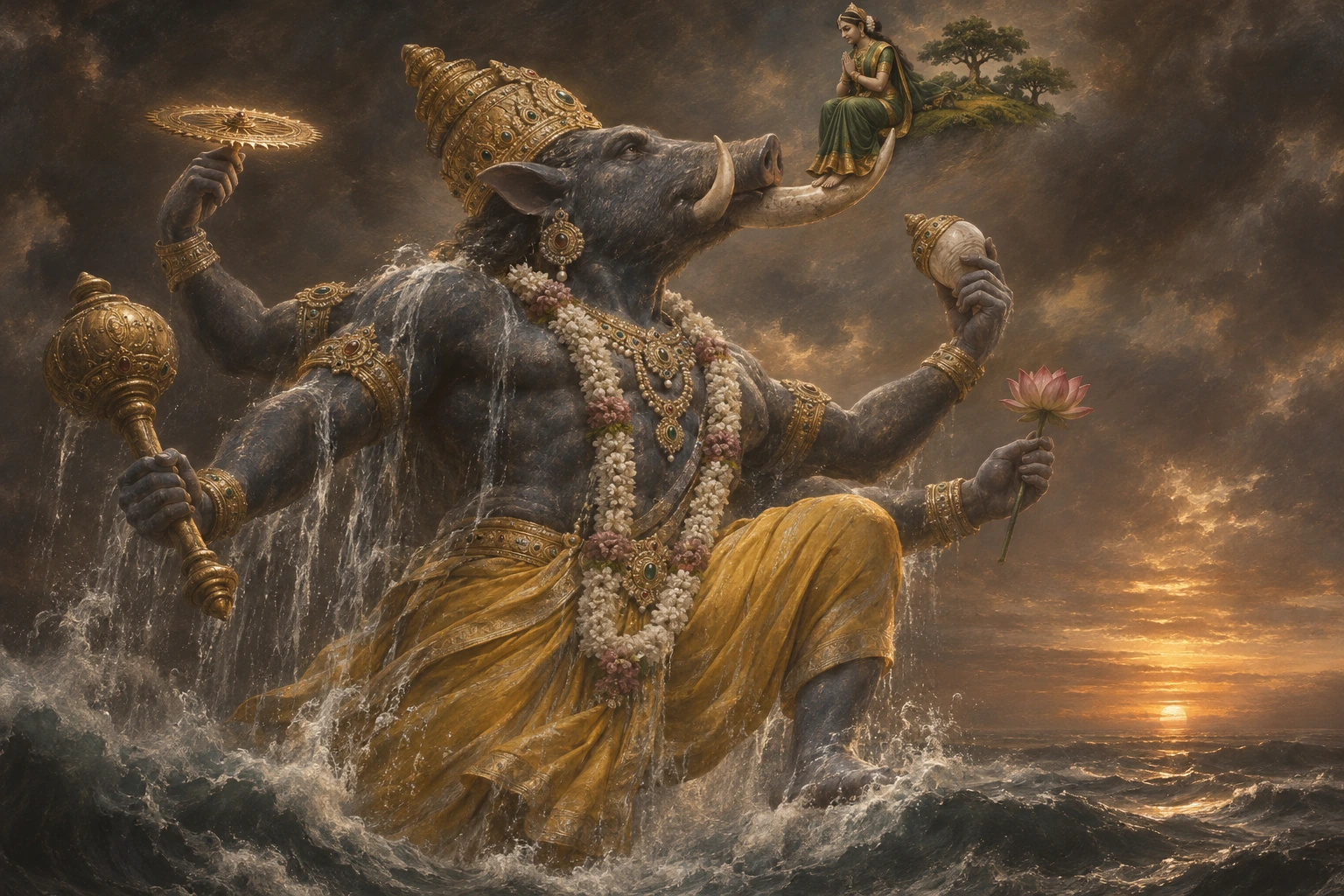
Once the earth herself sank into the waters (3.13). As Brahmā wondered how to raise her, a boar no bigger than a thumb came out of his nostril. In a moment it was the size of an elephant, then of a crag, and Brahmā knew it for the Lord of sacrifice. The boar roared, sniffed out the earth’s trail, dived and found her at the bottom of the abyss. He rose with her on his tusk, “like a lotus, leaves and all, on the tusk of a great elephant coming out of the water”. A demon barred his way with a mace, and the boar killed him. Elsewhere the Bhāgavata names him: Hiranyaksha.
1-3 Narasimha, the Man-Lion
Hiranyaksha’s brother, Hiranyakashipu, practised austerities until Brahmā granted him a boon (7.3): he would not die by any creature Brahmā had made, not indoors or outdoors, not by day or by night, not on the ground or in the sky, not by man or beast, not by any weapon.
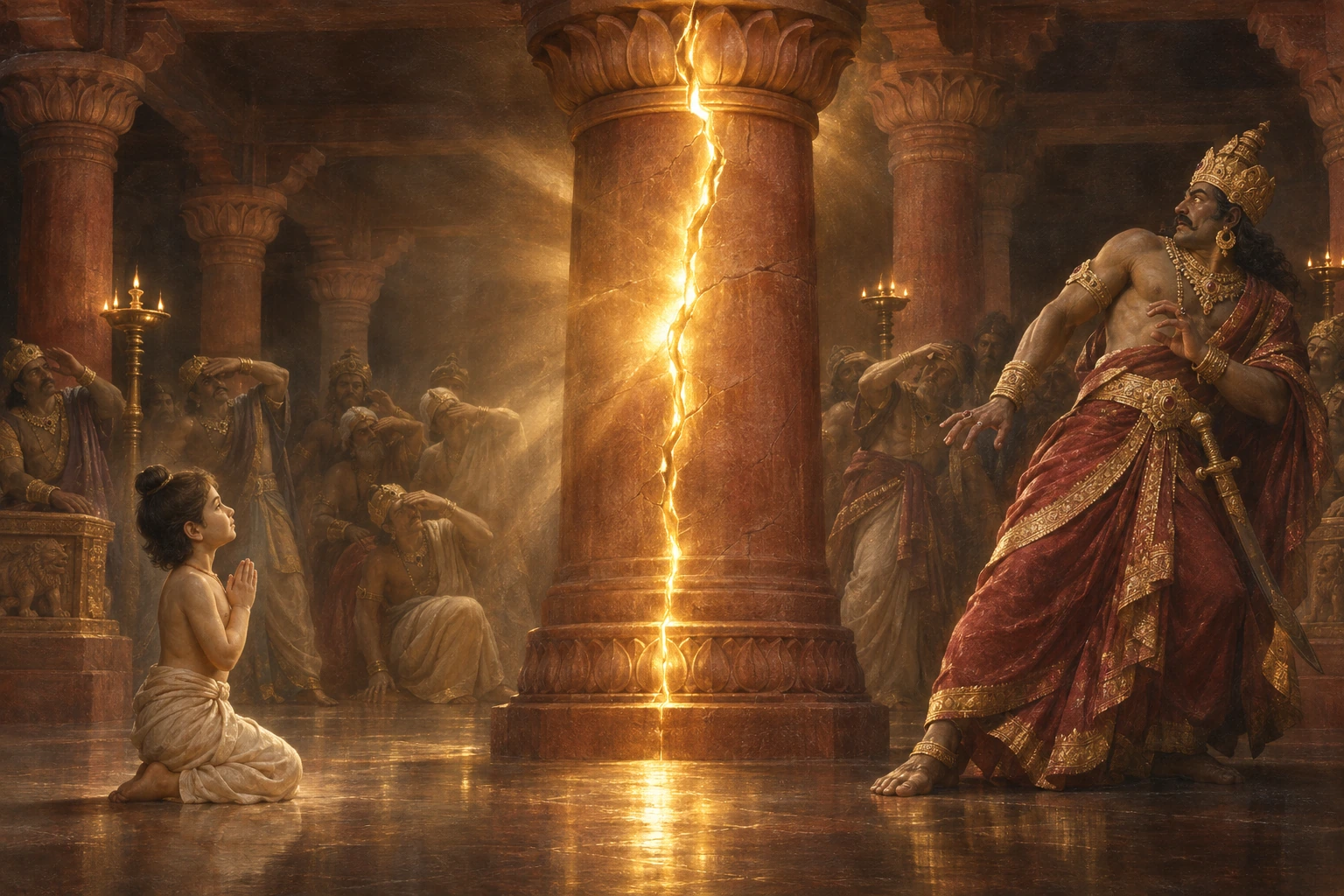
His son Prahlada, a boy of five, would worship no one but Vishnu, his uncle’s killer. His father had him stabbed with spears, sent elephants and serpents against him, poisoned him and threw him from heights, and nothing harmed him (7.5). At last, in his hall, Hiranyakashipu asked where this lord of the world was: if he is everywhere, why is he not in this pillar? He struck the pillar with his fist. A terrible sound came out of it, and then a form “neither beast nor man”, a lion’s face on a man’s body. They fought, and the Man-Lion laid the demon across his thighs in the doorway and tore him open with his claws (7.8).
1-4 Vamana, the Dwarf
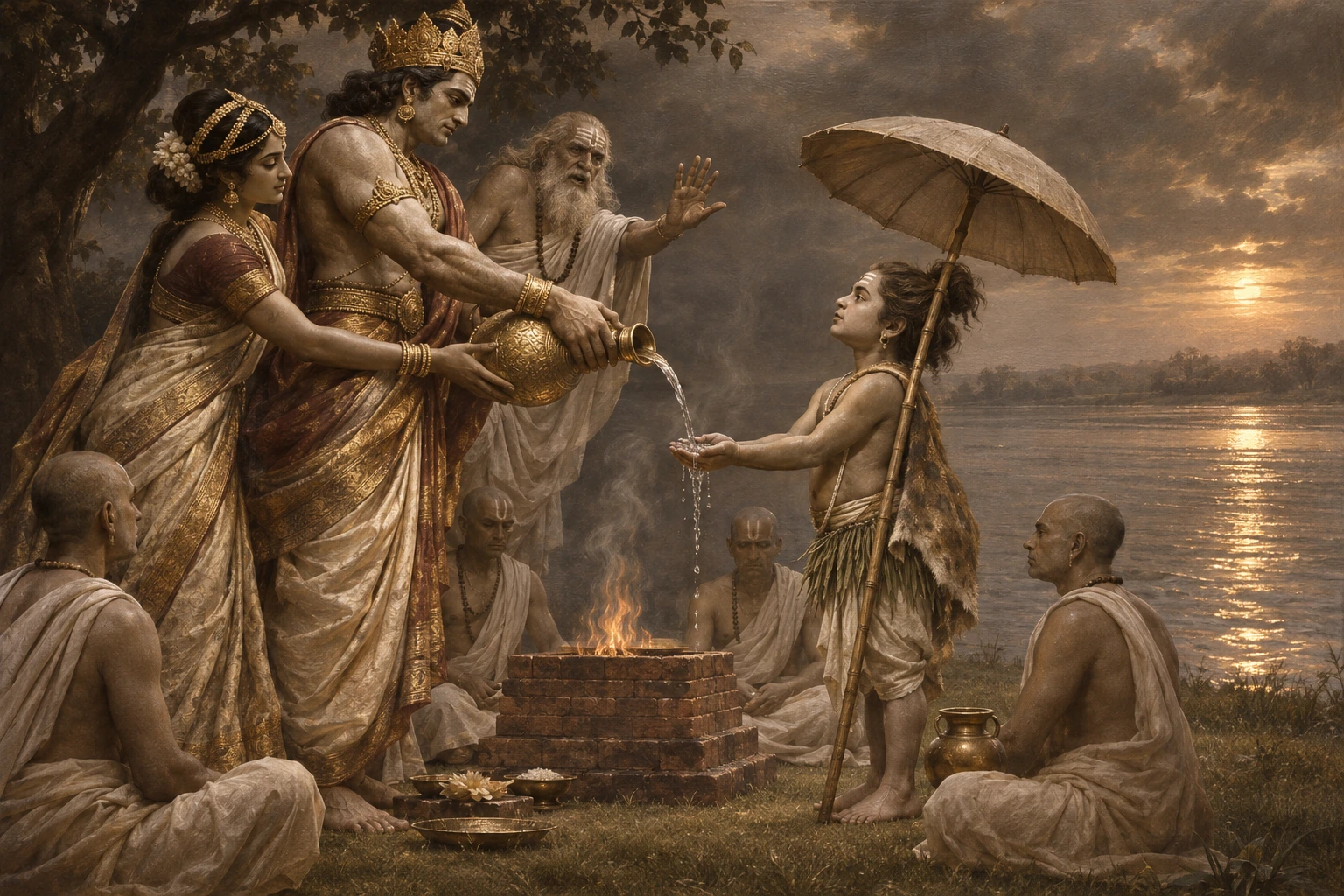
Prahlada’s grandson Bali, king of the asuras, had taken the three worlds from Indra. Vishnu was born as a son of Aditi and came to Bali’s horse sacrifice on the Narmada as a dwarf brahmin boy, with a parasol, a staff and a water pot (8.18–22). Bali washed his feet and offered him cows, gold, villages, elephants. The boy asked only for the ground he could cover in three of his own steps. Bali called it a child’s request. His priest Shukra warned him that this was Vishnu, who would take the three worlds in three strides, but Bali would not break his word: his queen brought a golden pitcher, and he poured the water that sealed the gift.
Then the dwarf grew until the universe was inside his body. One step covered the earth, the second heaven, and there was no room for a third. Bali bowed: “Set your third step on my head.” Vishnu sent him to Sutala, a world below built by the craftsman of the gods, and promised to guard him there himself.
1-5 Parashurama, Rama with the Axe
The sixth is a brahmin warrior. In the Mahābhārata (3.116–117 in the critical edition), Rama, youngest son of the sage Jamadagni, beheads his mother at his father’s order, then asks as his reward that she live again and remember nothing. When King Kartavirya Arjuna carries off the calf of the family’s sacrificial cow, Rama cuts off the king’s thousand arms, and the king’s sons kill Jamadagni. Rama then empties the earth of the warrior class twenty-one times, gives it to the sage Kashyapa and withdraws to Mount Mahendra, where the Pandavas meet him: he is still alive in the epic.
1-6 Rama, Krishna, Balarama, the Buddha
The seventh is Rama of Ayodhya, the prince of Vālmīki’s Rāmāyaṇa who kills Ravana: see Rama and Sita: The Rāmāyaṇa. Krishna, the cowherd of Vrindavan and Arjuna’s charioteer, is the eighth or the ninth, depending on the list: see Krishna: The Cowherd God. In Jayadeva’s hymn the eighth is instead Balarama, Krishna’s elder brother, who carries a plough; in the Mahābhārata the two brothers come from two of Nārāyaṇa’s own hairs, one white and one black (1.189.31). Jayadeva’s ninth is the Buddha, and there the texts pull in different directions (section 3).
1-7 Kalki, Who Is Still to Come
The Mahābhārata (3.186) gives the four ages of the world, the yugas, 4,000, 3,000, 2,000 and 1,000 years, each with a dawn and a dusk: twelve thousand years in all, and a thousand such rounds make one day of Brahmā. Later reckoning counts them as years of the gods, each worth 360 human years, so that the last age, the Kali Yuga, lasts 432,000 years. Each age is worse than the one before, and by the traditional count the Kali Yuga began in 3102 BCE: it is our own.
At its end, says the Bhāgavata (12.2), Vishnu will be born as Kalki in the house of the brahmin Vishnuyashas, in the village of Shambhala. Riding the swift horse Devadatta, sword in hand, he will destroy the robbers who rule as kings in vast numbers (the text says koṭiśaḥ, “by the koṭi”, and a koṭi is ten million), and the first and best age will begin again.
2 Where the Story Is Written Down
- The Vedic texts know the pieces but not the set. In the Rigveda (1.154), Vishnu “measured out the earthly regions”, “thrice setting down his footstep, widely striding” (Griffith, 1896). In the Śatapatha Brāhmaṇa (1.2.5), the asuras grant the gods “as much as this Vishnu lies upon”, and “Vishnu was a dwarf”. The same text has Manu’s fish (1.8.1) and a boar, Emusha, who raised the earth when she was “of the size of a span” (14.1.2.11). In the Taittirīya Saṃhitā (7.1.5) it is Prajapati, the creator, who, “becoming a boar”, seized her.
- The Mahābhārata has no fixed list. In book 3 (3.100) the gods praise Nārāyaṇa as the boar, the man-lion and the dwarf, and for “other deeds whose number is not known” (our translation). In book 12 (12.326) Vishnu foretells his births: in the Pune critical edition, the boar, the man-lion, the dwarf, the two Ramas and Krishna, then a swan and a horse-headed form. Some manuscripts add a verse: “Fish, tortoise, boar, man-lion and dwarf; Rāma, Rāma and Rāma; Krishna and Kalki: these are the ten.” K. M. Ganguli’s translation, which follows the vulgate, counts a swan, a tortoise, a fish, the boar, the man-lion, the dwarf, the two Ramas, Krishna and Kalki (Santi Parva, section 340).
- The Bhāgavata Purāṇa lists more than twenty descents in one chapter (1.3), from the boy-sages called the Kumaras to Kalki, numbering Rama and Krishna as the nineteenth and twentieth, with the physician of the gods and the enchantress Mohini among them. Then it adds that “the descents of Hari are beyond counting, like thousands of streams from a lake that never runs dry”, and that “Krishna is the Lord himself” (1.3.26, 28).
- The Gītagovinda opens with a song whose stanzas each name one form and end “Victory, Hari, lord of the world!” The verse after it bows to Krishna, “who takes these ten forms”. Edwin Arnold put it into English verse in The Indian Song of Songs (1875). In Japanese there is the annotated translation by Ogura Yasushi and Yokochi Yūko (Hindūkyō no seiten nihen, Tōyō Bunko, 2000), which we know from the library catalogue and have not read.
Surveying the epic in 1915, E. Washburn Hopkins concluded that “the theory of Avatars is still developing in the epic”, and that it kept growing afterwards, “till the epic ten became twenty or more”.
3 Competing Versions
- Who was the fish? In the Śatapatha Brāhmaṇa it has no name. It says “Rear me, I will save thee!” and pulls Manu’s ship by its horn to “yonder northern mountain” (Eggeling’s translation, 1882). In the Mahābhārata (3.185) it reveals itself at the end: “I am Brahma, the Lord of all creatures” (Ganguli, Vana Parva, section 186). Only in the Purāṇas is it Vishnu.
- Who was the boar? Prajapati in the Taittirīya Saṃhitā, Emusha with Prajapati as his lord in the Śatapatha, Vishnu in the epic and the Purāṇas. “Pre-epic is the idea that a creator-god appears in animal form”, Hopkins writes, “Prajapati as boar and tortoise.”
- Which ten? The eighth and ninth places move most. The Mahābhārata’s vulgate has Rama and Krishna, with a swan at the head of the list; its extra verse, Balarama (the third Rama) and Krishna; the inscription at Mamallapuram (section 4), Balarama and the Buddha, with no Krishna; the Gītagovinda, the same pair, since its Krishna is the one who takes all ten forms. Japanese encyclopedias give Krishna and the Buddha. The older edition of the Heibonsha World Encyclopedia calls that set “the most common”, while noting that the kinds and the number of avatars “vary”.
- Why the Buddha? The Bhāgavata (1.3.24) says he will be born when the Kali age has begun, “to bewilder the enemies of the gods”. Jayadeva gives him the opposite motive: “Ah, you condemn the Vedic rules of sacrifice, tender-hearted one, for they teach the killing of animals” (1.13, our translation). In Arnold’s verse: “Thou bad’st our altars be no more imbrued / With blood of victims.”
- Who is Kalki? In the Mahābhārata (3.188–189) he is a brahmin named Kalki Vishnuyashas, born in the village of Sambhala, a king who conquers by dharma; the passage does not say he is Vishnu. In the Bhāgavata (12.2), Vishnuyashas is his father, and Kalki is Vishnu himself.
4 History and Tradition
- Udayagiri. In cave 5 of the Udayagiri hills near Vidisha, in Madhya Pradesh, a boar-headed Vishnu lifts the goddess of the earth from the bottom of the sea, in high relief in a niche 3.9 m high and 6.7 m wide. An inscription dates the neighbouring cave 6 to 401 CE, under a vassal of the Gupta king Chandragupta II (Koezuka Takashi, in the Heibonsha World Encyclopedia). The Ashmolean Museum calls it “the great Boar panel of the early Gupta period”, the culmination of the boar-headed images that began at Mathura under the Kushans.
- Mamallapuram. In the Adivaraha cave, above a relief of a god who is half Shiva and half Vishnu, a Pallava inscription lists “the Fish, the Turtle, and the Boar, the Man-Lion and the Dwarf, Rāma, Rāma, and Rāma, Buddha and Kalkin: such are the ten” (Emmanuel Francis’s translation). H. Krishna Sastri, who published it in 1926, dated its letters to about the 8th century, and noted that “sometimes this well known verse is recited with Krishna substituted for Buddha”. The DHARMA project reports K. R. Srinivasan’s view (1964) that it is the oldest list of the ten in any inscription.
- Onam. In Kerala, Bali is Mahabali, a good king loved by his people. Kerala’s tourism department tells how Vishnu let him visit his subjects once a year, and how, during the ten days of Onam, “the people of Kerala eagerly await their beloved king”.
- A song. Each song of the Gītagovinda is headed with its rāga and tāla, its melody and rhythm (Tanaka Otoya, in the Heibonsha World Encyclopedia). Arnold kept the headings: “What follows is to the Music Mâlava and the Mode Rupaka.”
“The Buddha is the ninth avatar” is how many lists put it, as if there were no other order. It is Jayadeva’s order, and the Mamallapuram inscription counts him too. But the Mahābhārata’s lists leave him out, its extra verse puts Krishna where the inscription has the Buddha, and in the Bhāgavata’s list he comes after Rama and Krishna, once the Kali age has begun.
5 Related Stories
- The Churning of the Ocean: Gods, Demons and the Nectar of Immortality: Kurma, the second descent. In the critical edition of the Mahābhārata the tortoise is Akūpāra, a king of tortoises, not Vishnu. The Bhāgavata’s list counts not only the tortoise but also Dhanvantari, who rises from the sea with the amṛta, and the enchantress Mohini.
- The Descent of the Ganga: The River That Fell from Heaven: in the Bhāgavata (8.21.4), when the dwarf’s stride reaches the world of Brahmā, Brahmā washes his foot with water from his pot, and that water becomes the river of heaven. Jayadeva, too, praises the water from the dwarf’s toenail that makes people pure.
- Utnapishtim: The Flood Survivor, and the Older Atrahasis: another flood, another boat, and one man warned in time, who takes on board the seed of living things. Whether the stories are related is an old question that we do not try to settle here; we link them for the theme.
- The Legend of the Suns: Five Worlds and How Each Ended: ages of the world, one after another. The Aztec ages each end in a catastrophe; the Indian ages run down and begin again. We have not found a scholar who compares the two; we link them for the theme.
6 Sources
- Bhāgavata Purāṇa, books 1, 3, 7, 8 and 12, Sanskrit text: GRETIL
- Mahābhārata, critical edition, 1.189, 3.100, 3.116–117, 3.185–189 and 12.326, with variant passages, and the Bhagavad Gītā (6.26.7–8): GRETIL, GRETIL, GRETIL, GRETIL
- K. M. Ganguli (trans.), The Mahabharata, Vana Parva, section 186, and Santi Parva, section 340: Project Gutenberg, Project Gutenberg
- Jayadeva, Gītagovinda 1.5–16, Barbara Stoler Miller’s edition: GRETIL; Edwin Arnold (trans.), “Hymn to Vishnu”, in Indian Poetry (1904 impression): Project Gutenberg
- Julius Eggeling (trans.), The Satapatha-Brâhmana, part 1 (Sacred Books of the East 12, 1882), 1.2.5 and 1.8.1, and part 5 (SBE 44, 1900), 14.1.2.11: archive.org, archive.org
- A. B. Keith (trans.), The Veda of the Black Yajus School, entitled Taittiriya Sanhita, part 2 (Harvard Oriental Series 19, 1914), 7.1.5: archive.org; Ralph T. H. Griffith (trans.), The Hymns of the Rigveda, 1.154: Wikisource
- E. Washburn Hopkins, Epic Mythology (Strassburg, 1915), § 148: archive.org
- H. Krishna Sastri, Two Statues of Pallava Kings and Five Pallava Inscriptions in a Rock-Temple at Mahabalipuram (Memoirs of the Archaeological Survey of India 26, 1926), pp. 5–6: archive.org
- DHARMA project: Emmanuel Francis (ed.), “Mahābalipuram, list of avatāras in the Ādivarāha cave”; Dániel Balogh (ed.), “Udayagiri Cave 6 Inscription of the Time of Candragupta II”: dharmalekha.info, dharmalekha.info
- Ashmolean Museum, “Figure of Varaha, the Boar incarnation of Vishnu” (EA1969.43), quoting J. C. Harle and Andrew Topsfield, Indian Art in the Ashmolean Museum (1987): Eastern Art Online
- Kaitei shinban Sekai daihyakka jiten (Heibonsha): Koezuka Takashi, “ウダヤギリ”; “ユガ”; Tanaka Otoya, “ギータゴービンダ” and “バーガバタ・プラーナ”; “アバターラ”, with the older edition’s “インド神話” and the Britannica Kokusai Daihyakka Jiten: Kotobank, Kotobank, Kotobank, Kotobank, Kotobank
- Department of Tourism, Government of Kerala, “Story of Mahabali”: keralatourism.org
Cover and illustrations: AI-generated images made for Arcana. They are interpretations, not historical artworks.