Rama and Sita: The Exile, the Abduction and the Many Rāmāyaṇas
A prince is sent into the forest for fourteen years, a demon king carries off his wife, and an army of monkeys helps him win her back. That is Vālmīki's Sanskrit Rāmāyaṇa, one telling among hundreds that reach from the Tamil country and Bangkok to a Vietnamese tale of a yaksha king.
- Type: epic, a prince’s exile and the rescue of his wife
- Culture: India (Hindu tradition); retold across South and Southeast Asia, and known in Vietnam and Japan
- Earliest text: the Sanskrit Rāmāyaṇa attributed to Vālmīki, in seven books; the legend took shape in the last centuries BCE and the poem reached its present form around the 2nd or 3rd century CE, books 1 and 7 being the latest
- Key figures: Rama, Sita, Lakshmana, Ravana, Dasharatha, Kaikeyi, Bharata, Hanuman, Sugriva, Jatayu, Valmiki
The Rāmāyaṇa tells how it was born. The sage Valmiki saw a hunter shoot one of a pair of krauñca birds, and as the hen cried over her mate, his grief came out of him in a new kind of verse, the śloka. In that metre he went on to tell the story of Rama (book 1, chapter 2). Tradition calls him the first poet.
Does it end with the homecoming? Book 6 does: Rama is crowned in Ayodhya and rules in peace. But the seventh book goes on. Rama hears the people gossip about Sita, sends her away while she is pregnant, and years later she asks the Earth to take her back. Many scholars think that book was added later (section 2).
1 The Telling
This follows Vālmīki’s Rāmāyaṇa book by book, with the chapter numbers of the critical edition published in Baroda (section 2).
1-1 Book 1: Four Princes and a Bow
King Dasharatha of Ayodhya had no son. After a great sacrifice his three queens bore him four: Rama, son of Kausalya; Bharata, son of Kaikeyi; and Lakshmana and Shatrughna, sons of Sumitra (1.17). The sage Vishvamitra took Rama and Lakshmana away to guard his sacrifice from demons, telling them old stories on the road. At Mithila, King Janaka showed them a bow of Shiva’s that no one could string. He had found his daughter while ploughing a field, rising from the furrow, and named her Sita, “furrow” (1.65). Rama strung the bow “as if in play”, drew it, and it broke in the middle with a crash like thunder (1.66). Sita became his wife.
1-2 Book 2: Kaikeyi’s Two Boons
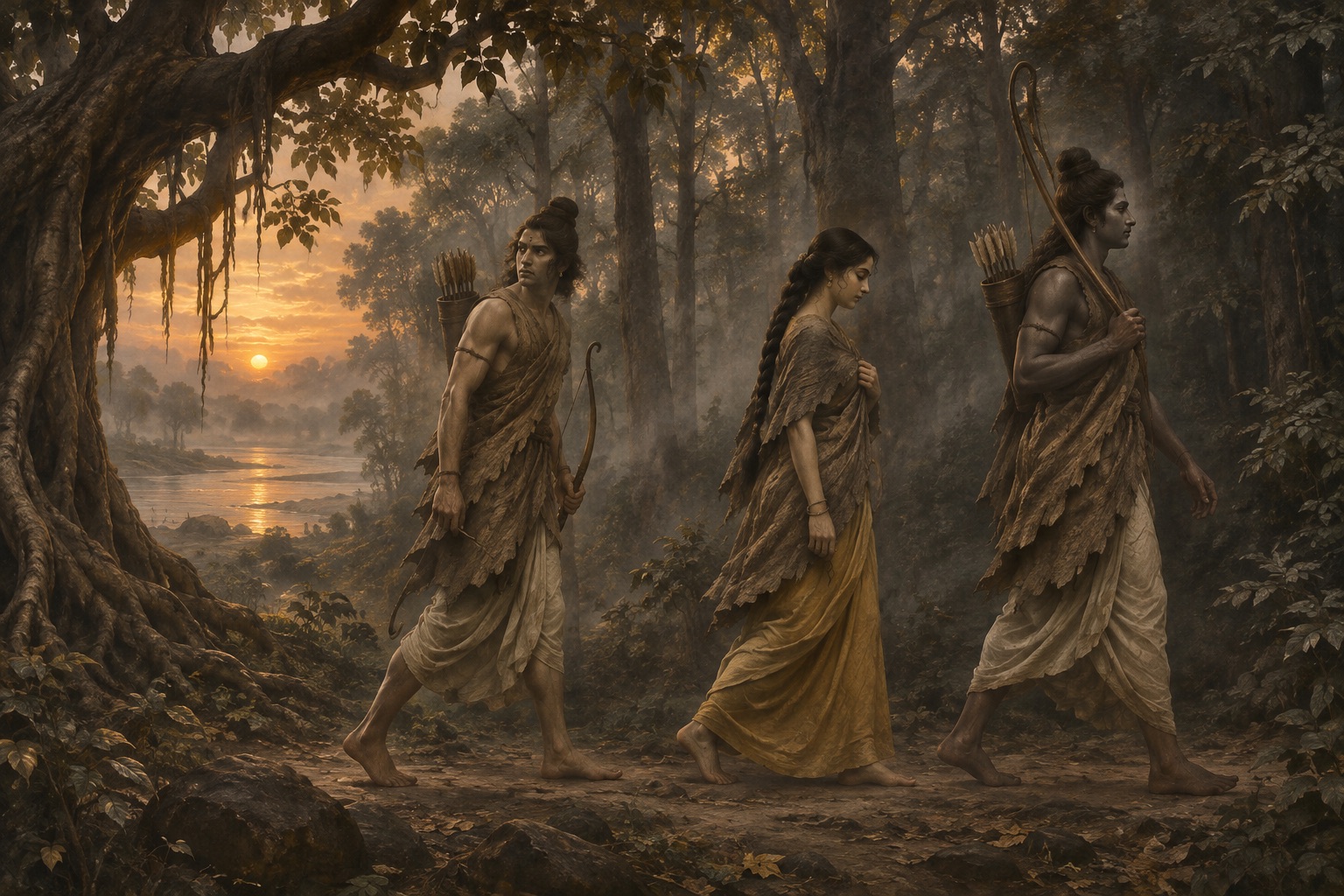
Dasharatha chose Rama as his heir. But Queen Kaikeyi’s maid Manthara reminded her of two boons the king had promised her long ago, when she carried him wounded out of a battle between the gods and the demons (2.9). Kaikeyi lay down in the “chamber of anger” and claimed them: Bharata was to be consecrated in Rama’s place, and Rama was to live in the Dandaka forest “for nine and five years”, in bark and deerskin, with the matted hair of an ascetic (2.10). Bound by his word, the king gave in. Rama went without protest, and Sita and Lakshmana went with him. Dasharatha soon died of grief. As a young man he had shot an ascetic’s son by mistake, and the boy’s father had cursed him to die grieving for a son (2.57–58). Bharata refused the throne and went into the forest to bring Rama back, but Rama would not break his father’s word. So Bharata carried Rama’s gold-adorned sandals home on his head, installed them as king, and governed in their name from the village of Nandigrama (2.104–107).
1-3 Book 3: The Golden Deer
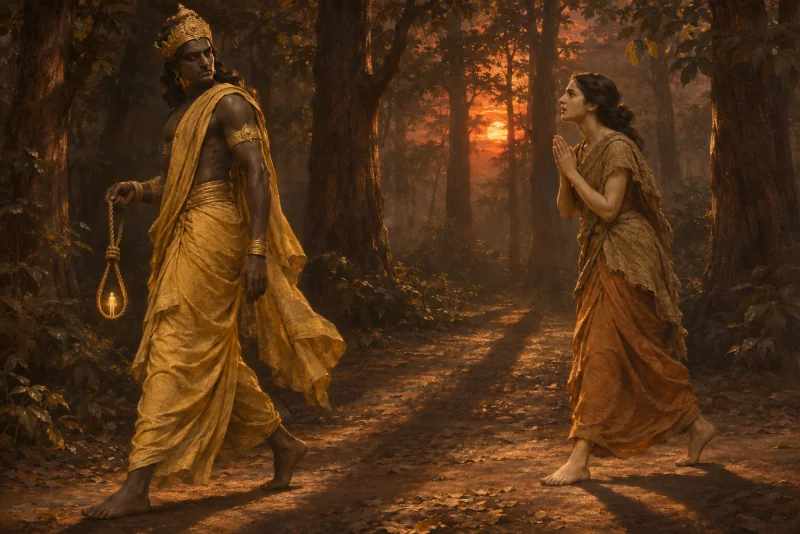
In the forest, the ten-headed demon king of Lanka, Ravana, resolved to carry Sita off. His follower Maricha took the form of a deer made of gold and jewels and grazed by their hermitage (3.40). Sita begged for it. Rama chased it deep into the forest and shot it, and the dying Maricha cried out in Rama’s own voice: “Ah, Sita! Ah, Lakshmana!” (3.42). Sure that Rama was in danger, Sita drove Lakshmana after him with bitter words.
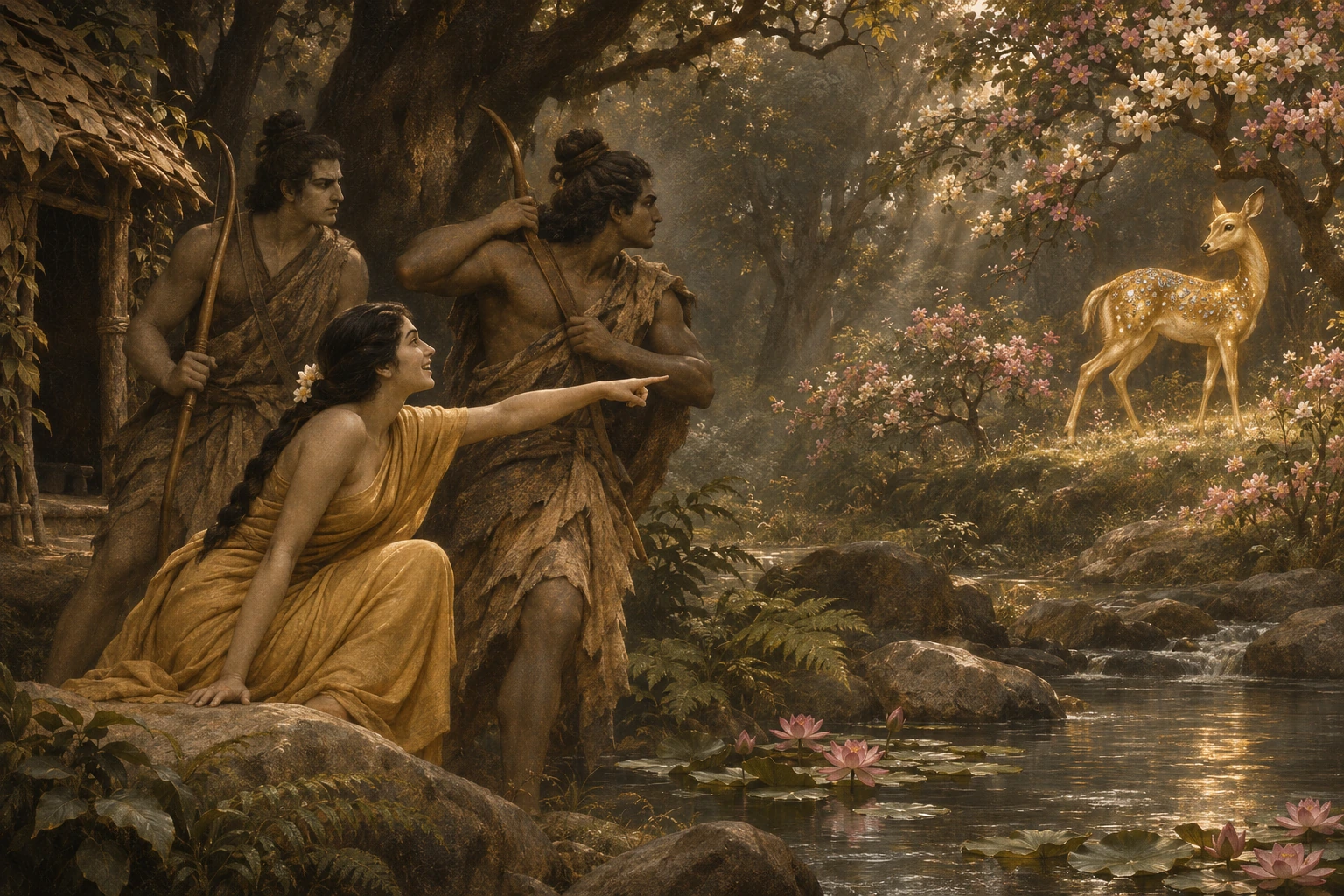
Then Ravana came to her disguised as a wandering ascetic, in ochre robes, with an umbrella and a water pot (3.44). When she refused him, he took his own huge form, seized her and carried her off through the sky in a golden chariot drawn by donkeys (3.47). The old vulture Jatayu, a friend of Rama’s father, broke Ravana’s bow and chariot, until Ravana cut off his wings with a sword (3.49). Rama found him dying, and Jatayu could tell him only that Ravana had gone south (3.64).
1-4 Books 4 and 5: The Monkeys
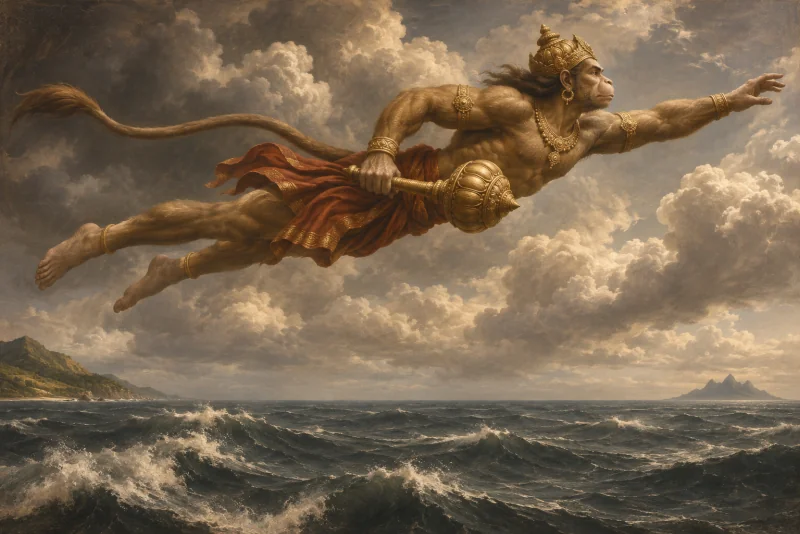
At Lake Pampa the brothers met Hanuman, a minister of the exiled monkey king Sugriva. Hanuman kindled a fire with two sticks, and Rama and Sugriva walked around it to seal their friendship (4.5). Sugriva’s brother Vali had taken his wife and his kingdom. When the two brothers fought, Rama shot Vali in the chest from where he stood hidden among the trees (4.12, 4.16), and the dying Vali reproached him for it (4.17). King again, Sugriva sent his monkeys, the vanaras, to search the four quarters of the earth. In book 5 Hanuman leaps the sea, finds Sita in Ravana’s Ashoka grove and sets Lanka alight; his own post tells it.
1-5 Book 6: The War
Rama threatened to dry up the ocean with his arrows (6.14). The Ocean rose from the waves and told him that the monkey Nala, son of the gods’ craftsman Vishvakarman, could build a bridge. The monkeys threw in trees and rocks, and Nala laid a causeway a hundred yojanas long and ten wide (6.15). The army crossed to Lanka.
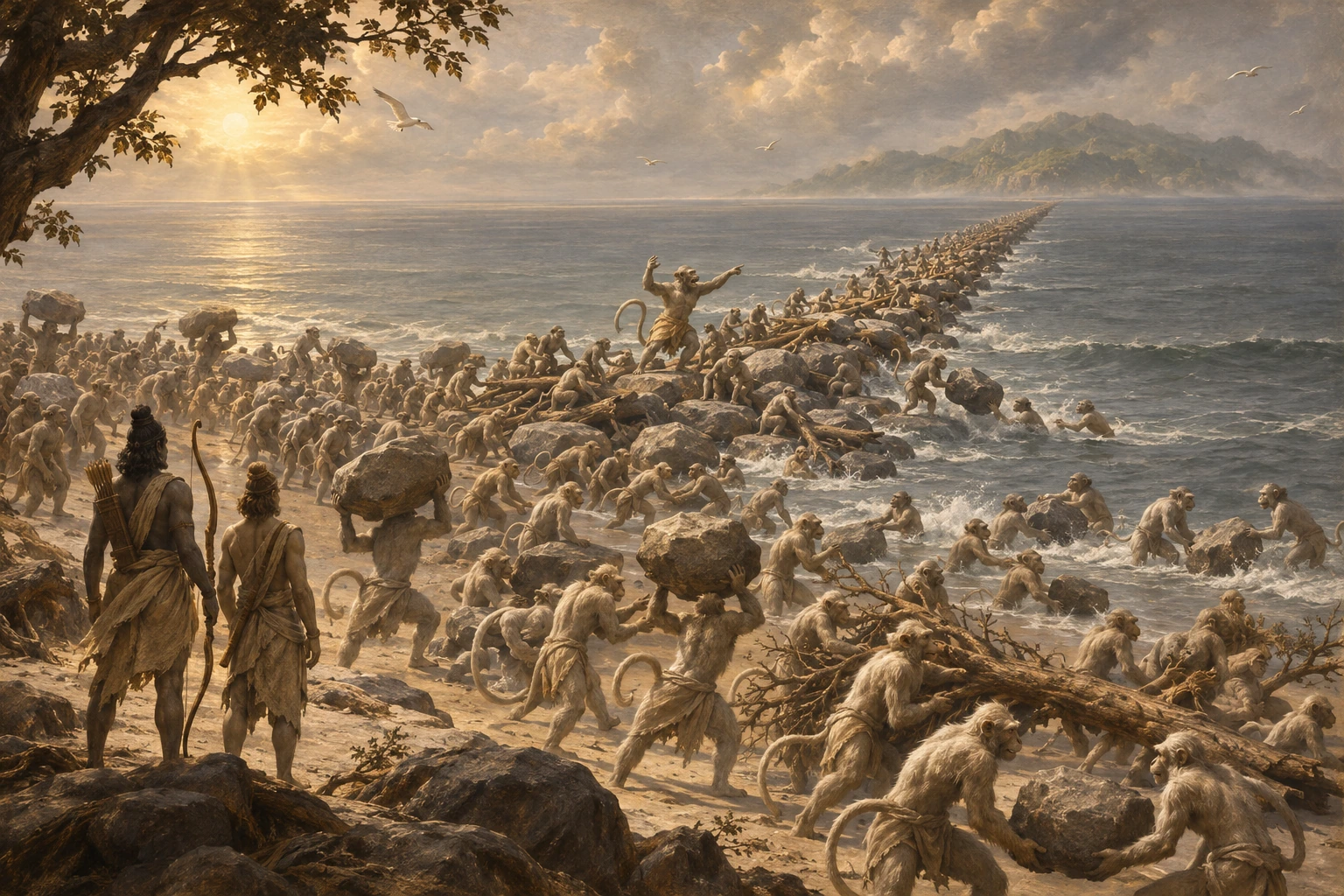
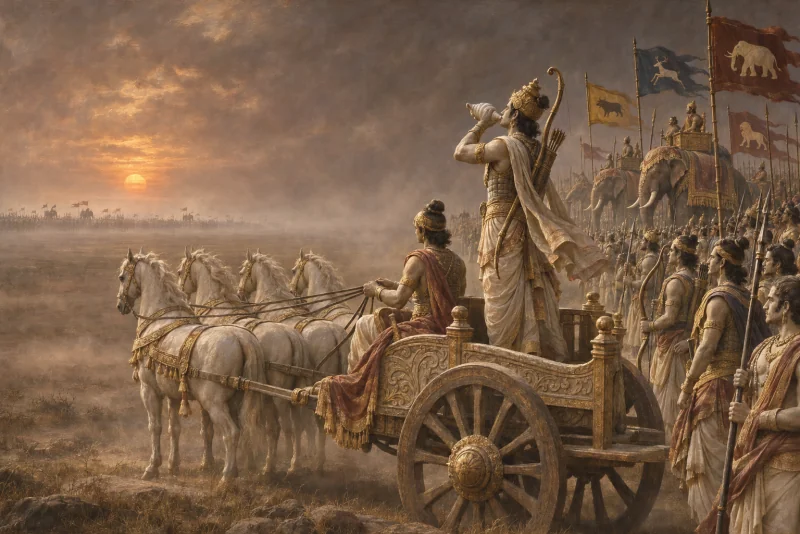
The war was long, and when Lakshmana was struck down, Hanuman fetched healing herbs from the Himalaya (6.89). At last Rama faced Ravana, riding the chariot of Indra with Indra’s charioteer Matali (6.90). Each head of Ravana’s that Rama cut off grew back (6.96). Then Matali reminded him of the weapon of Brahmā, and Rama loosed an arrow that the sage Agastya had given him. It pierced Ravana’s heart, sank into the earth and returned to its quiver, and Ravana fell dead from his chariot (6.97). His brother Vibhishana, who had come over to Rama, was made king of Lanka (6.100).
1-6 The Ordeal by Fire
Sita was brought before Rama in front of the army. He told her he had fought not for her but to wipe the stain from his family’s name, and that no man of good birth takes back a woman who has lived in another man’s house: she was free to go where she pleased (6.103). Sita answered him, then asked Lakshmana to build a pyre. She walked around Rama, prayed to the fire, “So, universal witness, Fire, / Protect my body on the pyre”, as Griffith translates it, and walked into the flames (6.104).
The gods appeared and told Rama that he was the god Nārāyaṇa, that is, Vishnu. “I think of myself as a man, Rama, son of Dasharatha,” he answered (6.105). Then Agni, the fire god, rose from the pyre with Sita unharmed in his arms, her garland still fresh, and declared her pure. Rama said he had never doubted her, but the three worlds had to see it (6.106). They flew home in the aerial chariot Pushpaka, and Rama was consecrated king (6.109–116).
1-7 Book 7: Sita Returns to the Earth
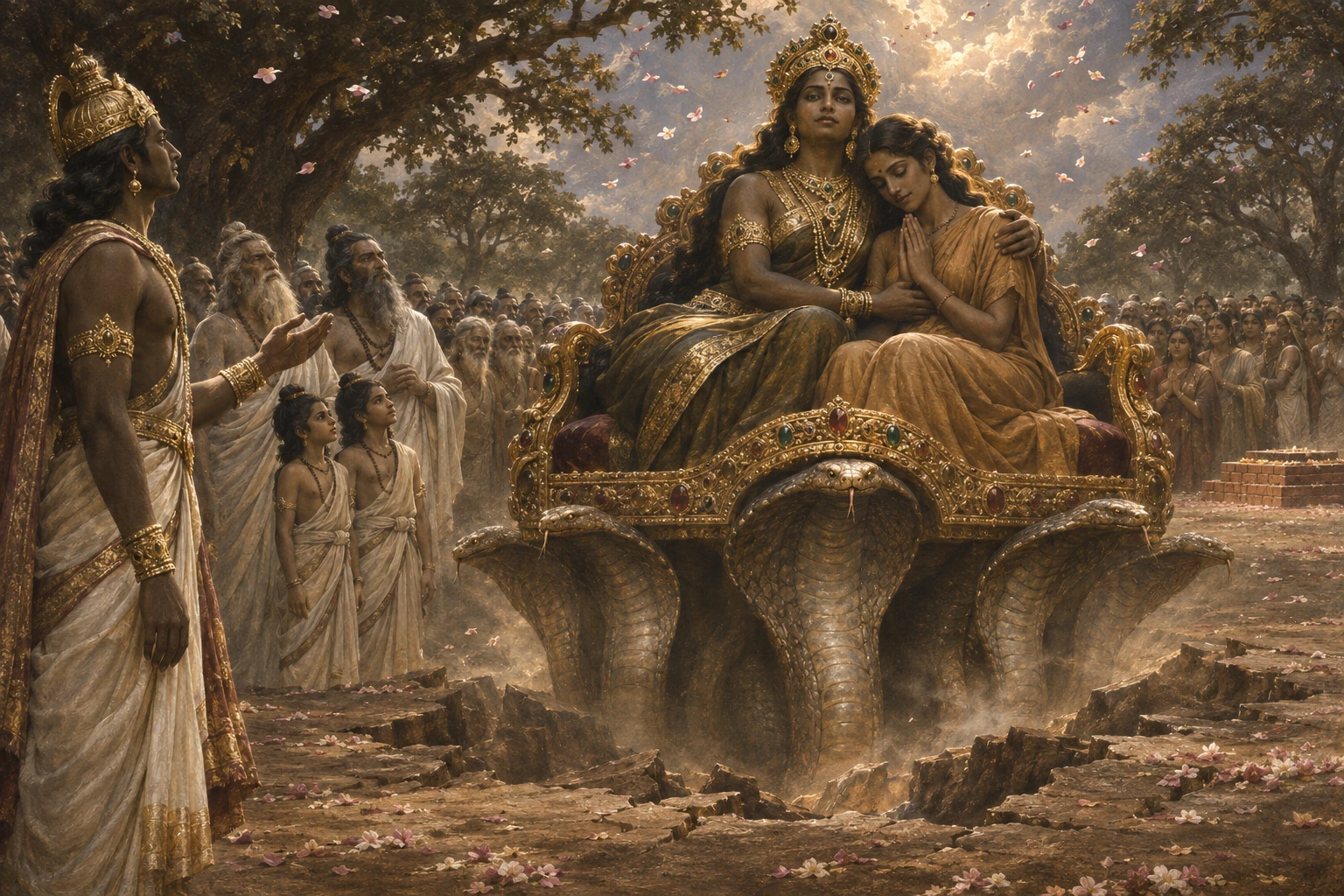
Years later, when Sita was expecting a child, Rama asked a companion what the people said, and heard: how could the king take back a wife whom Ravana had held on his lap? “We too will have to put up with it in our wives” (7.41–42). Rama had Lakshmana leave Sita by the hermitage of Valmiki, on the river Tamasa beyond the Ganga (7.44–47). There she bore twin sons, and Valmiki named them Kusha and Lava, after the kuśa grass and its cut tips with which he blessed them (7.58). When Rama held a horse sacrifice, Valmiki sent the boys to sing “the whole Rāmāyaṇa” at its gates (7.84). Rama sent for Sita. Before the gods and the assembled people, dressed in ochre, she swore: “As I have never thought of anyone but Rama, even in my mind, so may the goddess Earth open for me.” A heavenly throne rose out of the ground on the heads of serpents. The Earth took Sita in her arms, seated her on it, and went down with her into the world below (7.88).
2 Where the Story Is Written Down
- Vālmīki’s Rāmāyaṇa has seven books (kāṇḍas): Bāla (“childhood”), Ayodhyā, Araṇya (“forest”), Kiṣkindhā (the monkey kingdom), Sundara (“beautiful”), Yuddha (“war”) and Uttara (“last”), about 24,000 verses in all. Japanese encyclopedias date its present form to the end of the 2nd century (Nipponica) or about the 3rd (Heibonsha).
- Books 1 and 7 are later. Tanaka Otoya (Nipponica) holds that the original poem was books 2 to 6, and that books 1 and 7, added around the 2nd century, made Rama an incarnation of Vishnu and brought in many side stories. A. K. Ramanujan notes that some scholars argue this, citing the summary of their views in Robert Goldman’s introduction to book 1 (1984), and points to Sheldon Pollock for the opposite view.
- Griffith’s translation. Ralph Griffith’s English verse translation (1870–1874) stops at book 6. He called book 7 “merely an appendix or a supplement” and gave only a summary, borrowed from Gorresio and Muir. He quotes E. B. Cowell: the last book “bears the same relation to the Rámáyaṇa as the Cyclic poems to the Iliad”.
- The critical edition. The Oriental Institute in Baroda published a text compared across the manuscripts, under the general editor G. H. Bhatt, between 1958 and 1975. It has 606 chapters (sargas), from 76 in book 1 to 116 in book 6 and 100 in book 7. Other editions number them differently: Griffith’s book 6 has 130 cantos, and Nakamura Ryōshō’s complete Japanese translation (Heibonsha, Tōyō Bunko, seven volumes, 2012–2013) follows the popular Bombay edition of 1909.
- Buddhist and Jain tellings are also old: the Pali Dasaratha Jātaka, which some scholars date before Vālmīki and others after (Frank Reynolds finds the evidence “not conclusive”), and the Jain Paumacariya of Vimalasūri (section 3).
3 Competing Versions
- Ahalya. In Vālmīki (1.47–48), the sage Gautama curses his wife to live unseen in his hermitage, eating only air, until Rama comes. In Kamban’s Tamil poem she is turned to stone, and Rama’s feet bring her back to life: motifs missing from Vālmīki which, Ramanujan writes, are found in South Indian folklore and earlier Tamil poems.
- Which Sita was carried off? In Tulsīdās’s Rāmcaritmānas, before the golden deer appears, Rama tells Sita to hide in the fire, and only “an image of herself” is left for Ravana to take. In the ordeal “her shadow and the stain of social disgrace” burn away (book 3 and book 6, in F. S. Growse’s translation).
- How did Ravana die? In Vālmīki, by one arrow through the heart. In Tulsīdās, Vibhishana tells Rama that Ravana lives “by virtue of the nectar that abides in the depth of his navel”. Rama looses thirty-one arrows: one dries up the navel, the others strike off the heads and arms.
- Sita’s birth. In Vālmīki she rises from a furrow. In the Thai Ramakien, as Ramanujan summarizes it, she is Ravana’s own daughter: a prophecy says she will cause his death, so he throws her into the sea, and the sea goddess carries her to Janaka.
- Sister or wife? In the Dasaratha Jātaka (no. 461), Rama, Lakkhaṇa and Sītā are brothers and sister, sent to the Himalaya for twelve years to escape their stepmother. There is no Ravana. Rama’s straw slippers rule in his place, knocking together when a case is judged wrongly, and on his return he makes Sita his queen. “Here Sita is the hero’s sister, not his wife,” notes its translator, W. H. D. Rouse.
- Who kills Ravana? In Vimalasūri’s Jain telling, Ravana is noble and learned, and it is Lakshmana who kills him, Ramanujan writes. Rama, a soul in his last birth, is loath to kill anything.
- Why was Sita banished? In Vālmīki, because of gossip. In the Ramakien, a daughter of the demoness Surpanakha, out for revenge, enters Sita’s service and gets her to draw Ravana’s picture. Rama, jealous, orders her death, and Lakshmana spares her (Ramanujan).
- The Vietnamese telling. In the Lĩnh Nam chích quái, “The Tale of the Yaksha King” (夜叉王傳) makes the yaksha king of Diệu Nham, “the ten-headed king”, carry off Bạch Tĩnh, wife of Prince Vi Tư, whose father is King Thập Xa, “Ten Chariots”, as the name Daśaratha means. Vi Tư leads his monkeys, uproots mountains to fill the sea, kills the yaksha and brings her home. The prince’s land is the kingdom of the monkey spirits, which, the tale ends, “is today’s Champa”. Its translator Eric Henry calls it “basically a summary retelling of the central situation” of the Rāmāyaṇa.
4 History and Tradition
- Valmiki in Champa. A sandstone pedestal of the 7th century from Trà Kiệu, in Quảng Nam, now in the Vietnam National Museum of History in Hanoi, records in Sanskrit that King Prakāśadharma restored a place of worship of “the primordial poet” Vālmīki, “from whose anguish was born the verse that Brahmā praised”. Its editors, Arlo Griffiths and Dominic Goodall, note that the inscription echoes phrases of book 1.
- Kamban and Tulsīdās. Kamban wrote his Tamil Irāmāvatāram, “the incarnation of Rama”, in the 12th century, and in it Rama is clearly a god (Ramanujan). Tulsīdās began his Rāmcaritmānas, “the lake of Rama’s deeds”, in Awadhi in 1574 (by the reckoning of the Encyclopedia of Religion and of Philip Lutgendorf; F. S. Growse’s introduction converts the same year to 1575). He dates it himself: in Ayodhya, on Rama’s birthday in the month of Chaitra, in the year 1631 of the Vikrama era.
- Southeast Asia. The Thai Ramakien was compiled at the court of King Rama I (r. 1782–1809), in 1797 as Chris Baker dates it, and owes much to Kamban: many of its names are Tamil, not Sanskrit (Ramanujan). Episodes of Rama I’s version are painted on the murals of the Lacquer Pavilion, now at Suan Pakkad Palace in Bangkok. In Cambodia the Reamker tells of Prince Ream, Seda and the demon king Reap, and its battle of Lanka runs along the north half of Angkor Wat’s west gallery (Okada Tomoko). The Malay Hikayat Seri Rama survives in a manuscript that Archbishop Laud bought before 1633, now in the Bodleian Library in Oxford.
- Japan. The story reached China in Buddhist scriptures such as the Liudu ji jing (六度集經), and through them Japan, where the Hōbutsushū retells it (Nipponica). The Liudu ji jing was translated by the monk Kang Senghui, whose father had moved to Jiaozhi, today’s northern Vietnam, to trade (Gaoseng zhuan).
- Ramlila and Dussehra. Every autumn, in the festival season of Dussehra, hundreds of towns and villages across northern India stage the Ramlila, “Rama’s play”, mostly from Tulsīdās’s poem, over ten to twelve days; at Ramnagar it lasts a month. UNESCO first proclaimed it part of the world’s intangible heritage in 2005. On Dussehra itself, effigies of Ravana, his son Meghnad and his brother Kumbhakarna, stuffed with firecrackers, are burned in open grounds.
“The Rāmāyaṇa” is often spoken of as one book. A. K. Ramanujan’s essay “Three Hundred Rāmāyaṇas” (written for a conference in 1987, published in 1991) took its number from Camille Bulcke’s count of tellings, and warned that the title “is not to be taken literally”: over a thousand had been counted in Kannada alone. Ramanujan preferred “tellings” to “versions”, a word that implies an original. In 2011 the Academic Council of Delhi University dropped the essay from its undergraduate history syllabus, after protests by students who called it “anti-Hindu”.
5 Related Stories
- Hanuman: The Monkey Who Leapt the Sea: the hero of book 5, with the leap to Lanka, Sita in the Ashoka grove, the burning city and the mountain of herbs.
- The Dashavatara: The Ten Avatars of Vishnu: Rama as one of Vishnu’s avatars, as Brahmā tells him after the ordeal and as books 1 and 7 repeat.
- The Descent of the Ganga: The River That Fell from Heaven: one of the stories Vishvamitra tells the young Rama and Lakshmana on the road, in book 1.
- The Trojan War: The Apple, the Ships and the Horse: E. B. Cowell compared the Rāmāyaṇa’s last book to the Cyclic poems that told what came before and after the Iliad. Beyond his comparison of the poems, we link the two wars for a carried-off queen as a shared theme.
6 Sources
- Vālmīki, Rāmāyaṇa, critical edition, books 1–7, as entered by Muneo Tokunaga and revised by John Smith, one file per book: GRETIL; the printed edition (Oriental Institute, Baroda), vol. I, fasc. 1 (1958) and vol. VII, fasc. 3 (1975), as reviewed in the Journal of the Royal Asiatic Society: Cambridge Core, Cambridge Core
- Ralph T. H. Griffith (trans.), The Rámáyan of Válmíki (1870–1874), book 6, cantos 118–120, and the note on the Uttarakáṇḍa: Project Gutenberg
- F. S. Growse (trans.), The Rámáyana of Tulsi Dás (Allahabad, 1914), books 1, 3 and 6: archive.org
- W. H. D. Rouse (trans.), The Jataka, vol. 4 (Cambridge, 1901), no. 461: archive.org
- A. K. Ramanujan, “Three Hundred Rāmāyaṇas: Five Examples and Three Thoughts on Translation”, and Frank E. Reynolds, “Rāmāyaṇa, Rāma Jātaka, and Ramakien”, in Paula Richman (ed.), Many Rāmāyaṇas (University of California Press, 1991): UC Press E-Books
- Lĩnh Nam chích quái, 夜叉王傳 (recension of Vũ Quỳnh and Kiều Phú): zh Wikisource; Eric Henry (trans.), “Plucked-up Tales”, book 2, Rising Asia Journal 6.2: rajraf.org
- Arlo Griffiths and Dominic Goodall (eds.), “C. 173 Pedestal from Trà Kiệu”, Corpus of the Inscriptions of Campā: ISAW, New York University
- “ラーマーヤナ” (Tanaka Otoya in Nipponica; Kamimura Katsuhiko in Heibonsha’s World Encyclopedia): Kotobank; Nakamura Ryōshō (trans.), 『新訳ラーマーヤナ』: CiNii; Gaoseng zhuan (Liang dynasty), book 1, “Kang Senghui”: zh Wikisource
- Philip Lutgendorf, The Life of a Text: Performing the Rāmcaritmānas of Tulsidas (University of California Press, 1991), p. 8: UC Press E-Books Collection
- Velcheru Narayana Rao, “Tulsīdās”, Encyclopedia of Religion: Encyclopedia.com
- Chris Baker, review of The Thiri Rama, ed. Dawn F. Rooney, Journal of the Siam Society 108, part 1 (2020), pp. 200–203: ThaiJO; Patricia M. Young, “The Lacquer Pavilion in its First Reign Context”, Journal of the Siam Society 107.1 (2019): Siam Society
- Okada Tomoko, 「アンコール遺跡観光で触れるカンボジア文学」, Asia Map vol. 2 (Ritsumeikan University): ritsumei.ac.jp; Malay Concordance Project, “Hikayat Seri Rama”: ANU
- UNESCO, “Ramlila, the traditional performance of the Ramayana”: ich.unesco.org; “In pictures: Good wins over evil on Dussehra”, Al Jazeera, 14 October 2013: aljazeera.com
- “DU council to confirm ban on Ramanujan’s Ramayana essay”, Deccan Herald, 20 March 2012: deccanherald.com
Cover and illustrations: AI-generated images made for Arcana. They are interpretations, not historical artworks.