Savitri and Satyavan: The Wife Who Argued with Death
Savitri chose a husband who had one year to live, and when Yama came for him she followed the god of death and talked until he let him go. The epic tells it to praise a faithful wife, but what wins the day is her argument.
- Type: epic tale, a wife who wins her husband back from death
- Culture: India (Hindu tradition), kept alive by a yearly women’s rite
- Earliest text: the Mahābhārata, Book 3, chapters 277 to 283 of the Pune critical edition; the epic reached roughly its present form around the 4th century CE
- Key figures: Savitri, Satyavan, Yama, King Ashvapati of the Madras, King Dyumatsena of the Shalvas, the sages Narada and Markandeya
Every year, in the month of Jyeṣṭha, married women in much of India fast for their husbands’ long lives and wind thread around a banyan tree in Savitri’s name. The tale behind the rite is told in the Mahābhārata: a princess chooses her own husband, learns that he will die within a year, and when the god of death comes for him, she walks after him and argues.
Did Savitri trick Yama with three wishes? Not in the Mahābhārata. There Yama grants her five boons. Four times he says “anything but his life”, and four times he grants a boon because her words please him. Then he offers one “beyond compare”, with no exception, and she asks for Satyavan. Only then does she point out that he has already promised her a hundred sons by her husband.
1 The Telling
This follows the Mahābhārata, Book 3, chapters 277 to 283 of the critical edition published in Pune. The quotations are our own translations of the Sanskrit.
1-1 A Daughter from the Goddess
The Pandava brothers are in exile in the forest, and their wife Draupadi has been carried off by a king and rescued. The eldest, Yudhishthira, asks the sage Markandeya whether there was ever a woman as devoted as Draupadi. Markandeya answers with a story.
Ashvapati, king of the Madras, had no children. For eighteen years he kept strict vows and made a hundred thousand offerings with the sāvitrī, the Vedic verse to the sun god Savitṛ, which was also worshipped as a goddess. At last the goddess Sāvitrī rose from his sacred fire. He asked for sons; she promised him, by Brahmā’s leave, a daughter “full of splendour”. The girl was named Savitri after the goddess, and she grew so radiant that no man dared ask for her hand.
1-2 She Chooses
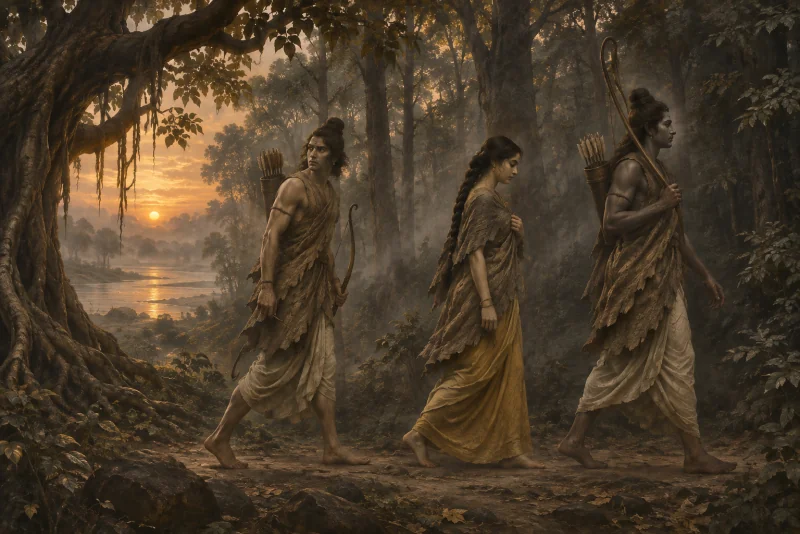
So her father told her: “Seek a husband yourself, one equal to you in virtue.” Savitri set out in a golden chariot with his old ministers and toured the forest hermitages of royal sages.
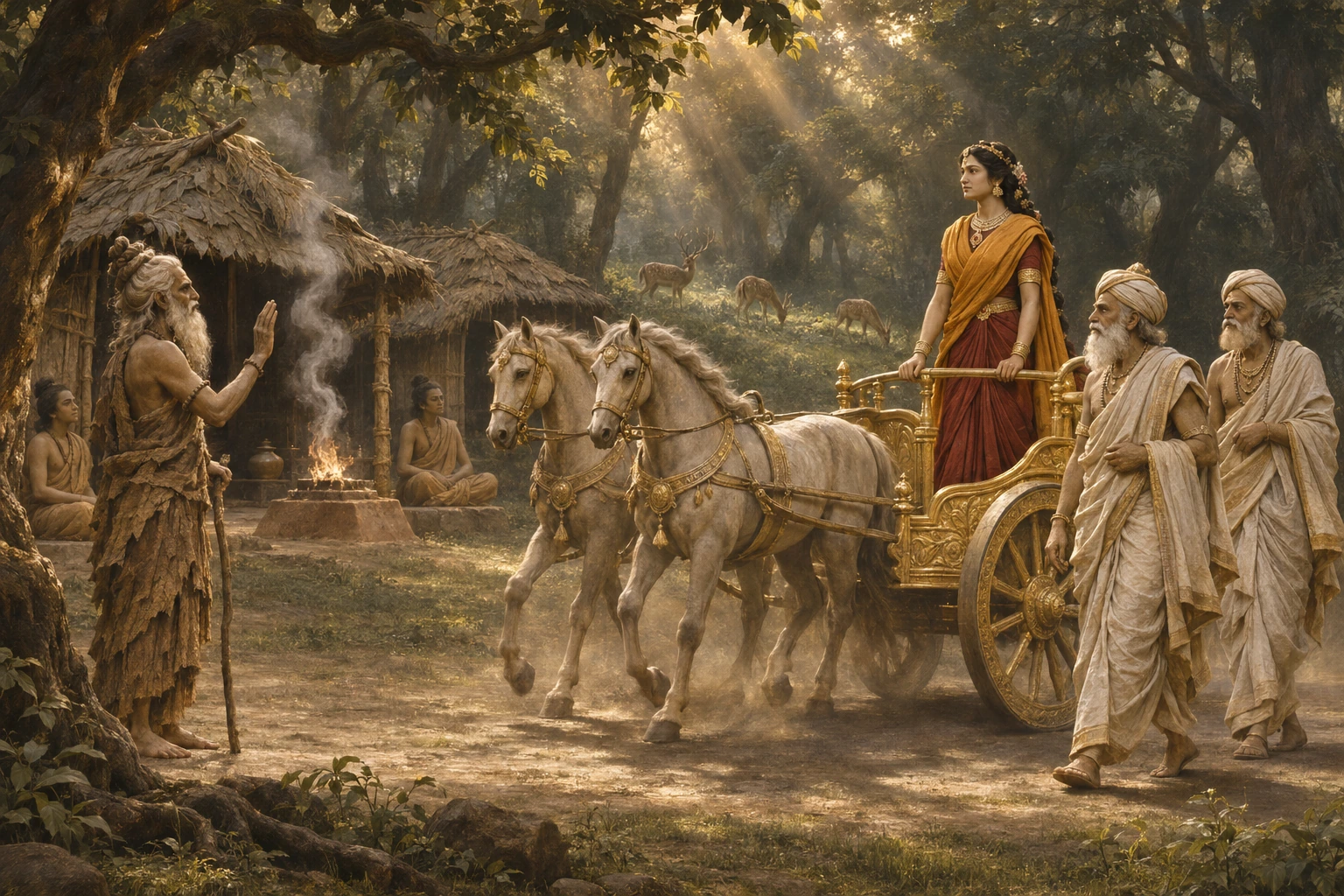
She came home to find the sage Narada with her father, and named her choice: Satyavan, son of Dyumatsena, a king of the Shalvas who had gone blind and been driven from his kingdom, and who now lived in the forest. Narada was dismayed. Satyavan was named for truth, because his father and mother both spoke it; as a boy he made horses of clay and painted them. He had every virtue and one fault: within a year from that day he would die.
“Go, Savitri, and choose another,” said her father. She answered: “An inheritance is divided once, a daughter is given once, once a man says ‘I give’. Long-lived or short-lived, I have chosen my husband once. I will not choose a second. The mind decides, then the voice speaks, then the deed is done: my mind is my measure.” Narada approved, and the wedding was held at Dyumatsena’s hermitage.
1-3 The Last Day
Savitri took off her jewels and dressed in bark and ochre cloth. But Narada’s words stayed with her, and she counted the days. Three days before the day he was to die, she began a three-night vow, fasting and standing day and night “like a post of wood”. On the last morning she would not eat: “I will eat when the sun has set, once I have my wish.” When Satyavan took his axe to gather fruit, she insisted on going with him. Her father-in-law let her go: since she came to them, he said, she had never asked for anything.
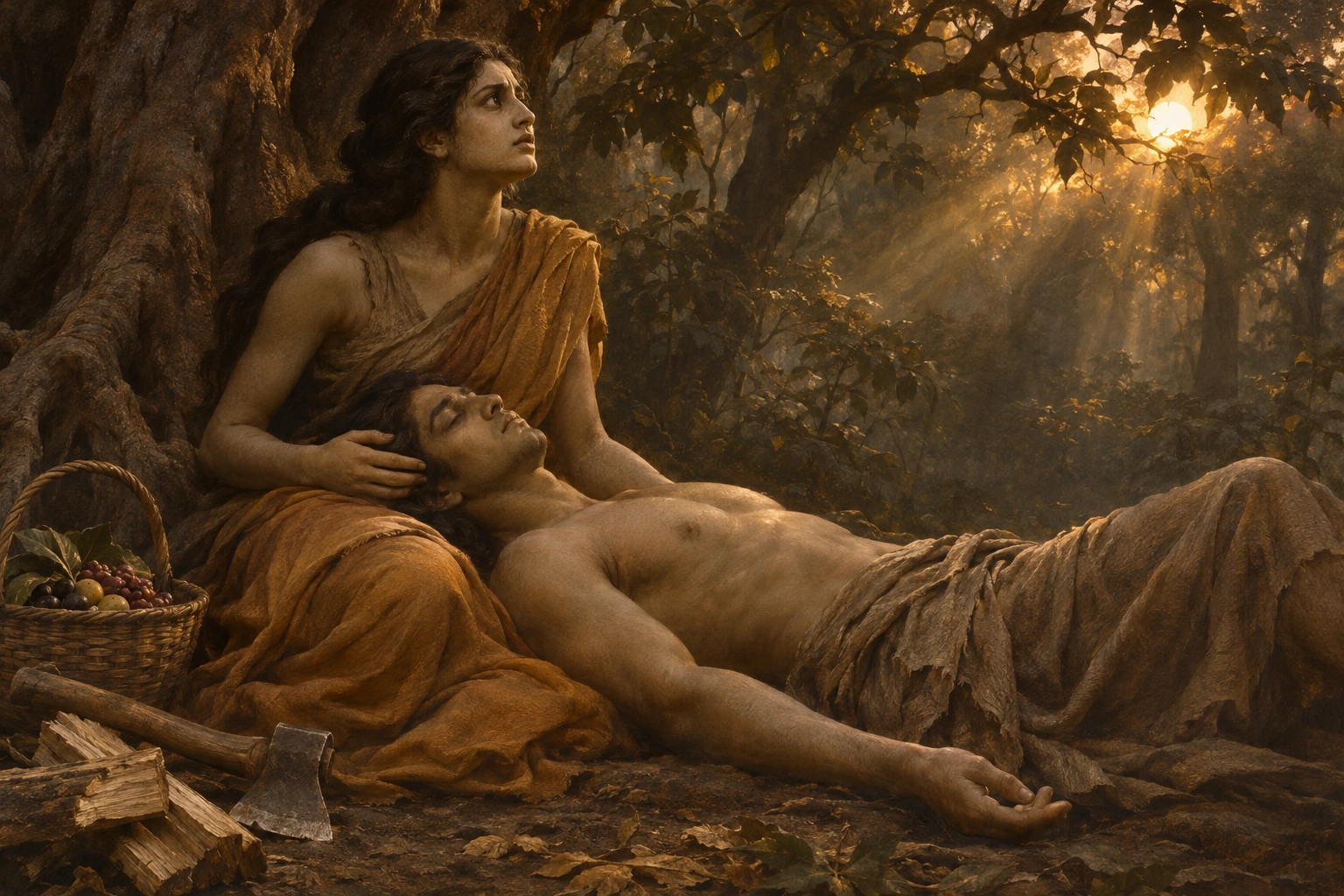
Satyavan filled his basket and began to split wood. He broke into a sweat, his head ached “as if pierced by spears”, and he lay down with his head in Savitri’s lap.
1-4 Yama
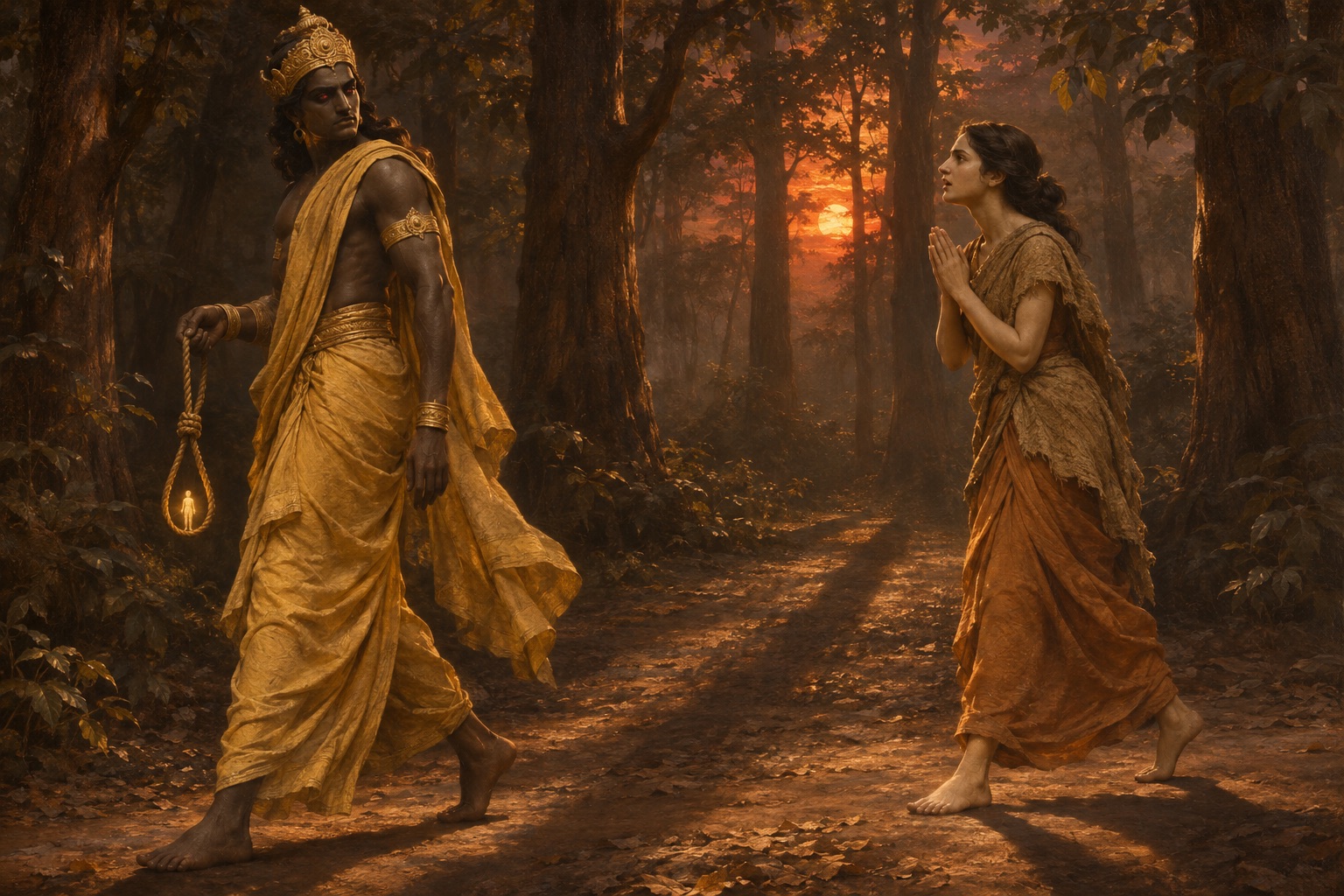
Then she saw a man in yellow garments, crowned, radiant as the sun, dark yet shining, red-eyed, with a noose in his hand. She laid her husband’s head down and asked him with joined hands who he was. “You are devoted to your husband and rich in austerity,” he said, “so I speak to you. I am Yama.” Satyavan was too good to be fetched by his servants, so he had come himself. He drew out of the body a person the size of a thumb, bound in his noose, and set off towards the south. Savitri followed.
“Turn back and perform his funeral rites,” said Yama. “You have come as far as anyone can.” She answered: “Where my husband is led, there I must go: that is the eternal law.” Seven steps taken together make a friendship, she said, and as a friend she would tell him something. And she spoke about dharma, the right way to live.
1-5 Five Boons
Yama was pleased with words so correct “in vowel, syllable, consonant and reasoning”, and offered any boon but Satyavan’s life. She asked for her father-in-law’s sight. He told her to go home; she walked on, talking, and won his kingdom back, then a hundred sons for her own father. “I have never heard such words from anyone but you,” said Yama, and granted a fourth boon: a hundred sons for Savitri and Satyavan.
Still she talked: the good, she said, lead the sun by their truth and hold up the earth by their austerities. “The more you speak,” said Yama, “the deeper my devotion to you. Choose a boon beyond compare.” She chose: “Let Satyavan live. Without my husband I am as good as dead. You yourself gave me a hundred sons, and you are taking my husband. Let him live, and your word will come true.” Yama loosened the noose and promised Satyavan four hundred years of life.
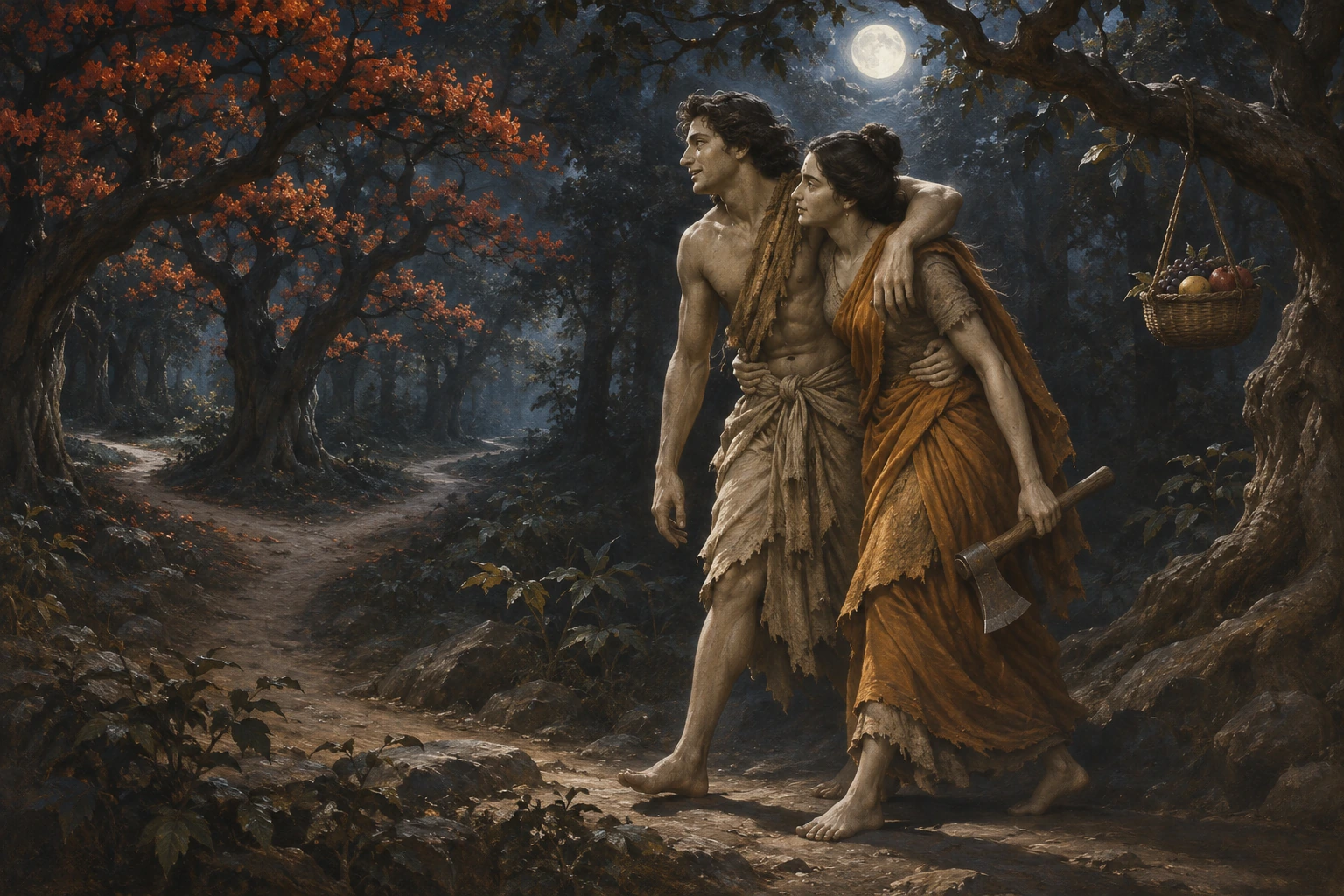
Savitri went back to the body, and Satyavan woke in her lap. “Where is the dark man who was dragging me away?” It was night, and jackals were howling. Savitri tied up her hair, hung the fruit basket on a branch, took the axe, put his arm over her left shoulder and led him home by moonlight.
At that same hour Dyumatsena regained his sight. To the hermits Savitri told everything: “He gave me five boons.” The next morning the Shalvas came to fetch their king, “with sight or without”: the usurper had been killed by his own minister. Dyumatsena was crowned, and in time Savitri had her hundred sons. So, Markandeya ends, Draupadi will save you all, as Savitri did.
2 Where the Story Is Written Down
- The Mahābhārata, Book 3, the Āraṇyakaparvan or “Book of the Forest”. The epic grew over many centuries; the Japanese encyclopedia Nipponica dates its present form to around the 4th century CE. The Pune critical edition, chapters 277 to 283, gives the version above.
- K. M. Ganguli’s English translation (1883–1896) follows other manuscripts and heads these chapters the Pativrata-mahatmya Parva, “the greatness of the devoted wife”; W. J. Johnson’s (2005) calls them “The Glorification of the Faithful Wife”. Ganguli’s text ends with a promise that the critical edition keeps only among its variants: whoever hears the story with devotion “never meeteth with misery”. In Japanese it was translated from the Sanskrit by Nakamura Ryōshō (1988), and published by Kitagawa Hidenori and Hishida Kunio together with the story of Nala (1999).
- The Rāmāyaṇa knows the story too. When Rama means to go into exile without her, Sita tells him to know her as devoted to him as “Savitri to Satyavan, son of Dyumatsena” (Book 2, chapter 27 in the text on GRETIL; Canto 30 in Ralph Griffith’s translation).
- The name. Sāvitrī names the Vedic verse to Savitṛ, Rigveda 3.62.10, also called the gāyatrī, and that verse made a goddess, the wife of Brahmā. Monier-Williams’s dictionary (1899) adds that the princess “is regarded as a type of conjugal love”.
3 Competing Versions
- Five boons or three? The critical edition and Ganguli both have five, and Savitri counts them herself. Many retellings have three and a trick. In Swami Vivekananda’s telling, in California in 1900, the third boon cannot be granted without giving Satyavan back. The Government of Maharashtra’s page on the rite gives her three: her in-laws’ kingdom, a son for her father, and children, which puts Yama “in a dilemma”. In Gustav Holst’s opera Death offers a single wish, and she asks for “Life”.
- Yama’s robe is yellow in the critical edition, “red attire” in Ganguli.
- Why does Yama come himself? In the critical edition he explains it unasked. In Ganguli, Savitri asks him, since she had heard that his messengers fetch mortals. In Vivekananda the messengers cannot come near her, for “a zone of fire” surrounds her; that is in neither text.
- The banyan. The epic names no banyan; the trees it does name are the śāla under which Dyumatsena sits and a grove of palāśa on the path home. The banyan belongs to the rite. A collection of Gujarati folklore published in 1914 says “the death took place under a banyan tree, by worshipping which, Savitri succeeded in reviving her husband”. On the Maharashtra page she lays his body under a banyan, circles the tree, and he wakes.
- Whose family does she save? The Sanskritist Simon Brodbeck, in the abstract of a 2013 article, reads Savitri as a daughter meant to carry on her sonless father’s line, who “at the last minute” gives her allegiance to her husband’s line instead, becoming a devoted wife, a pativratā.
Savitri is often held up as a model of wifely obedience; Vivekananda called her “meek and faithful”. In the epic she chooses her own husband, refuses her father’s order to choose again, talks her way into the forest on her husband’s last day, and wins him back by arguing. Yama grants every boon for her words.
4 History and Tradition
- Vat Savitri and Vat Purnima. Every year in Jyeṣṭha, married women fast, worship a banyan (vaṭa), tie threads around it and walk around it, for their husbands’ long lives. In Maharashtra, Goa and Gujarat, among other states, it falls on the full moon and is called Vat Purnima. The Gujarat folklore of 1914 describes three days of fasting ending at the full moon, and women winding cotton thread at each turn around the tree.
- A model held up. Nipponica says Savitri’s faithfulness was long praised by Indian women as a model, and that her story is still recited at a yearly festival to pray for a happy marriage. Vivekananda closed his telling: “every girl in India must aspire to be like Savitri”.
- Opera and poem. Gustav Holst made the story a one-act chamber opera for three singers, Savitri, Satyavan and Death, first performed in London on 5 December 1916. Sri Aurobindo worked on his English epic Savitri: A Legend and a Symbol from 1916 until his death; the first part appeared in 1950 and the rest in 1951.
5 Related Stories
- Orpheus and Eurydice: The Look Back: another spouse who follows a husband or wife to the dead. Orpheus sings and, in the Roman tellings, loses Eurydice at the last moment; Savitri argues and wins. We have not found a scholar who compares the two stories; we link them for the theme.
- Jeoseung Saja: The Messengers of Death: Yama travelled. The Japanese encyclopedia Sekai Daihyakka Jiten explains that belief in King Yama reached China through Buddhist scriptures, which wrote his name 閻魔 or 閻羅, and that he became one of the Ten Kings of the dead; 閻羅 is Korea’s King Yeomra. In Korea his messengers fetch the dead; here Yama comes in person.
- Kurukshetra: The War of the Mahābhārata: Markandeya tells this story to comfort Yudhishthira during the exile that ends in the great war.
- Rama and Sita: The Exile, the Abduction and the Many Rāmāyaṇas: Sita names Savitri when she insists on following Rama into exile.
6 Sources
- Mahābhārata, critical edition, Āraṇyakaparvan 3.277–283, with variant passages: GRETIL
- K. M. Ganguli (trans.), The Mahabharata of Krishna-Dwaipayana Vyasa, Book 3, Pativrata-mahatmya Parva: Project Gutenberg; W. J. Johnson (trans.), Mahābhārata Book Three: The Forest, Volume Four (Clay Sanskrit Library, 2005): claysanskritlibrary.org
- Rāmāyaṇa, Ayodhyākāṇḍa 2.27.6: GRETIL; Ralph T. H. Griffith (trans.), Book II, Canto XXX: Wikisource
- Monier Monier-Williams, A Sanskrit-English Dictionary (1899), “sāvitrī”: Cologne Digital Sanskrit Dictionaries
- Simon Brodbeck, “The Story of Sāvitrī in the Mahābhārata: a Lineal Interpretation”, Journal of the Royal Asiatic Society 23.4 (2013), pp. 527–549, abstract: Cambridge Core
- Swami Vivekananda, “The Mahabharata”, lecture at the Shakespeare Club, Pasadena, 1 February 1900: Wikisource
- A. M. T. Jackson, Folk Lore Notes, Vol. I: Gujarat, ed. R. E. Enthoven (Bombay, 1914): Project Gutenberg
- Directorate of Tourism, Government of Maharashtra, “Vat Purnima”: maharashtratourism.gov.in- Gustav Holst, Sāvitri, Op. 25: IMSLP, Opera Scotland; Sri Aurobindo, Savitri: A Legend and a Symbol, publisher’s note: Sri Aurobindo Ashram
- Nakamura Ryōshō, 「インド古譚梵文和訳 サーヴィトリー姫物語」 (1988): CiNii; Kitagawa Hidenori and Hishida Kunio (trans.), 『ナラ王物語とサーヴィトリー姫物語』 (Sankibō Busshorin, 1999): CiNii
- “マハーバーラタ” (Nipponica), “閻魔” (Sekai Daihyakka Jiten): Kotobank, Kotobank
Cover and illustrations: AI-generated images made for Arcana. They are interpretations, not historical artworks.