Orpheus and Eurydice: The Look Back
Orpheus sang his way into the land of the dead and won his wife back on one condition, and a few steps from the light he looked back. That loss is first told by Roman poets; several Greek writers before them speak as if he brought her home.
- Type: myth, a descent to the land of the dead
- Culture: ancient Greece, with Orpheus a singer from Thrace; retold in Rome
- Earliest texts: Euripides’ Alcestis (438 BCE) alludes to the descent; the look back survives first in Latin poetry, above all Virgil’s Georgics (29 BCE); the fullest telling is Ovid’s Metamorphoses (around 8 CE)
- Key figures: Orpheus, Eurydice, Hades and Persephone, the Muse Calliope, Aristaeus, the women of Thrace
Orpheus could make oak trees follow him and stop the wheel of a man tormented in the underworld. With that voice he went down alive to the dead to ask for his wife, and the rulers of the dead said yes. Then, a few steps from daylight, he turned round. That is the story as the Romans told it, and the one that lasted. Whether the Greeks before them ended it that way is still argued.
Why did Orpheus look back? The two great Roman tellings give different answers. In Virgil, “a sudden madness” seizes him at “the very edge of the light”, and he forgets. In Ovid, he is afraid that she might falter, and he longs to see her. Neither poet makes it plain disobedience: Virgil calls it a fault that could be forgiven, “if the dead knew how to forgive”.
1 The Telling
This telling follows Ovid, Metamorphoses 10.1–85 and 11.1–84. Where Virgil’s Georgics 4.453–527, written some forty years earlier, tells it differently, the text says so. The quotations from both poems are our own translations of the Latin.
1-1 The Singer from Thrace
Orpheus was a Thracian, the son of the Muse Calliope and of Oeagrus (Apollodorus, Library 1.3.2). In the Argonautica of Apollonius of Rhodes, his songs charmed the rocks on the mountains and the course of rivers, and the wild oaks that stood in ordered rows at Zone, on the Thracian coast, were the ones he had led down from Pieria with his lyre (1.23–31). Pindar has him come “from Apollo”, “the father of songs”, to sail with Jason (Pythian 4.176–177), and on the way home from Colchis he drowned out the Sirens with his own song.
1-2 The Wedding and the Snake
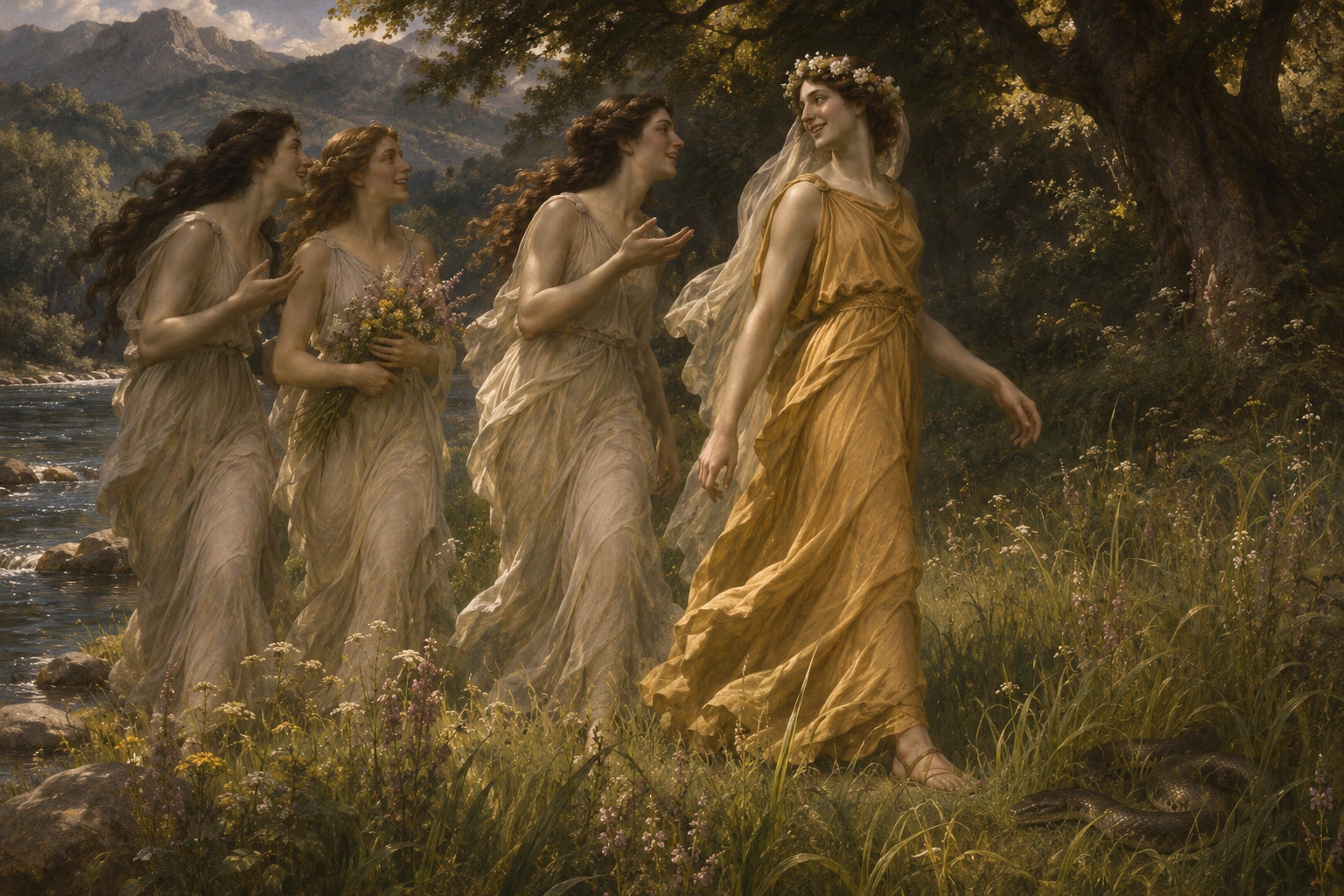
Hymenaeus, the god of weddings, came to the marriage of Orpheus and Eurydice, but he brought neither the solemn words nor a happy omen: his torch only sputtered and filled their eyes with smoke. Soon after, as the new bride wandered through the grass with a band of Naiads, the water nymphs, a snake bit her ankle, and she died (10.1–10). Virgil gives the death a cause. She was running from Aristaeus, a herdsman whose bees later died, and in her flight along the river she did not see the huge water snake lying in the tall grass of the bank. Her companions, the Dryads, filled the mountains of Thrace with their cries, and Orpheus, alone on the shore, sang of her to his lyre at daybreak and at nightfall (4.457–466).
1-3 The Song before the Throne
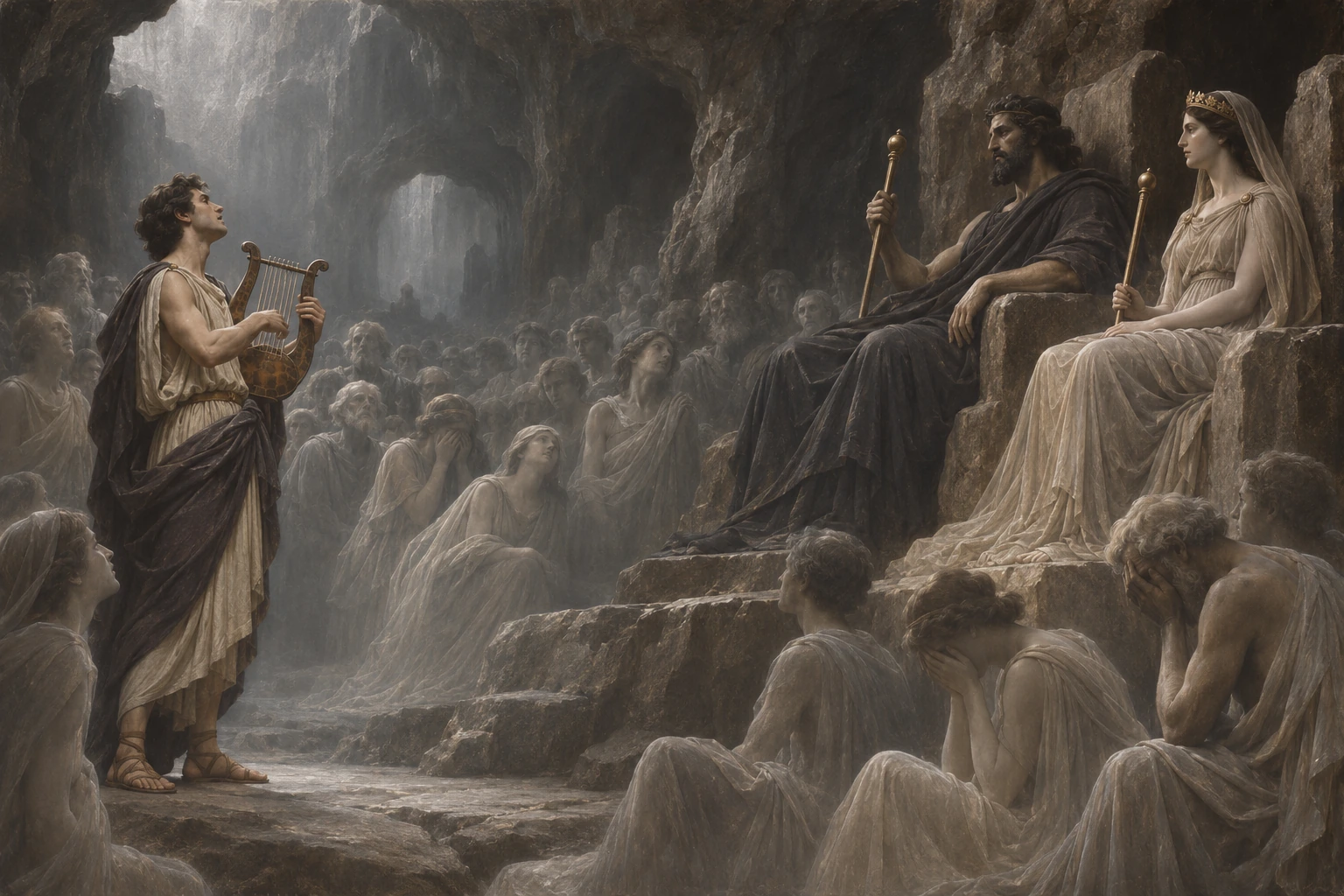
Orpheus dared to go down to the river Styx by the gate of Taenarus, passed among the weightless crowds of the dead, and came before Persephone and the lord of the shades. He had not come, he sang to his lyre, to see dark Tartarus, nor to chain the three-headed dog. His wife was the reason: a snake had taken her growing years. “Love has won.” If the old story of the stolen bride was true, Love had joined the king and queen of the dead as well. Everything mortal is owed to them, and Eurydice too would be theirs when she had lived out her years: “I ask a loan, not a gift.” If the Fates refused, he would not go back: “rejoice in the death of two” (10.11–39).
The bloodless souls wept. Tantalus stopped reaching for the water that ran from him, Ixion’s wheel stood still, the vultures left Tityus’s liver, the granddaughters of Belus set down their urns, and Sisyphus sat down on his stone. It is said that the cheeks of the Furies were wet with tears for the first time (10.40–46). In Virgil, the shades came up from the depths of Erebus as thick as birds in the leaves, and Cerberus held his three mouths open (4.471–484).
1-4 The Condition
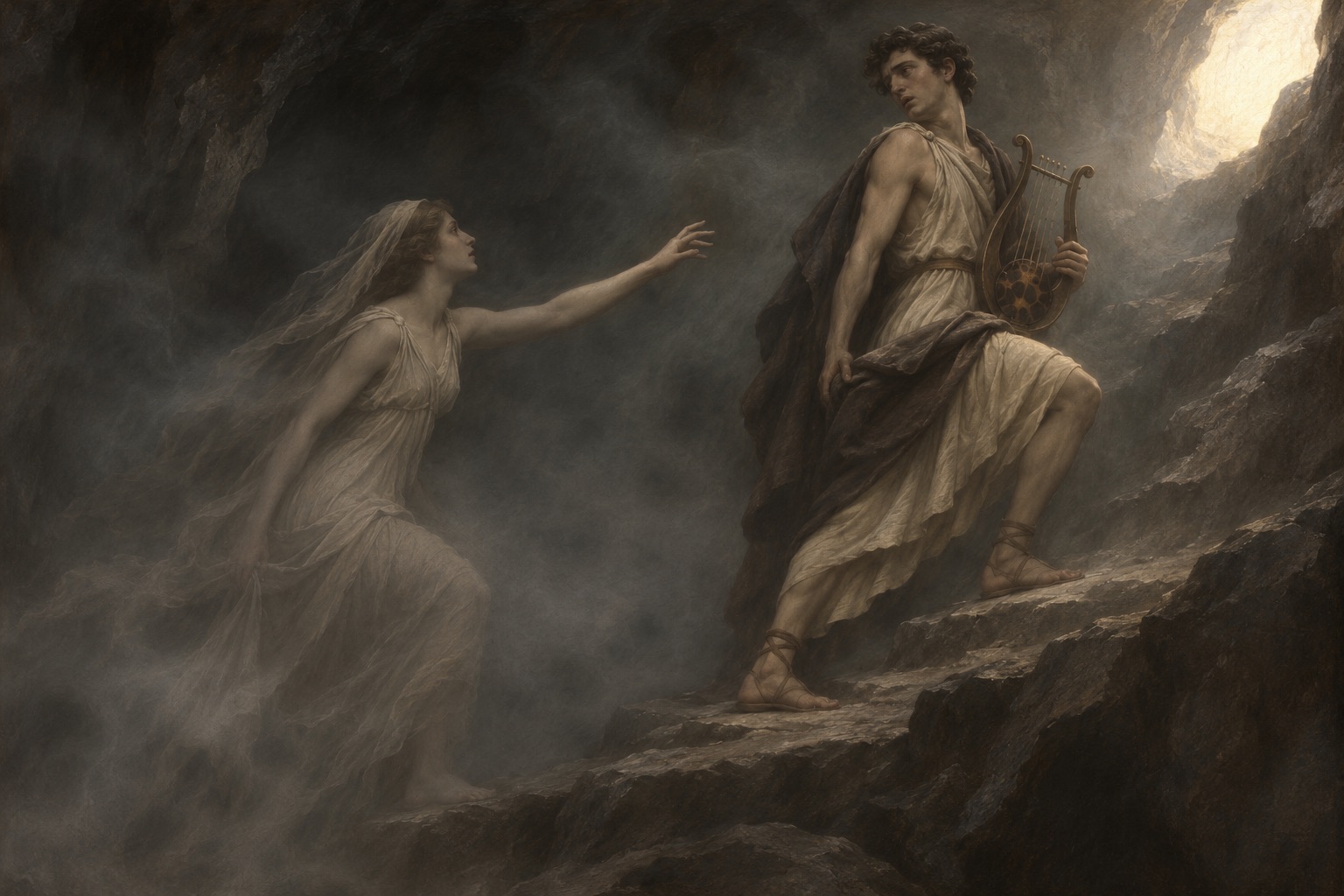
The queen and the king could not refuse. They called Eurydice, who was among the newly arrived shades and came with slow steps, still lame from her wound. Orpheus received her together with a condition: he must not turn his eyes back until he had left the valleys of Avernus, or the gift would be undone. They climbed in silence a steep, dark path thick with fog. They were not far from the edge of the upper world when, afraid that she might falter and longing to see her, he turned his eyes. At once she slipped back. She stretched out her arms, trying to be held and to hold him, and caught nothing but the yielding air. Dying a second time, she did not complain of her husband: “what could she complain of, except that she was loved?” She said a last “farewell”, which he barely heard, and fell back to where she had come from (10.46–63).
Virgil’s Orpheus has escaped every danger, with Eurydice following behind him, “for Proserpina had given this law”, when a sudden madness takes him. At the very edge of the light he stops, forgets, and looks back. Three times a crash is heard over the pools of Avernus, and Eurydice speaks: “What madness has ruined us both, poor me and you, Orpheus? … Farewell: I am carried off, wrapped in endless night, holding out to you hands that are, alas, no longer yours.” Then she is gone, like smoke into thin air (4.485–502).
1-5 Seven Days, Seven Months
The ferryman would not take Orpheus across a second time. For seven days he sat on the bank, unwashed and without food, living on grief and tears; then he withdrew to the mountains of Rhodope and Haemus, and for three years he turned away from the love of women (10.72–85). In Virgil he wept for seven months beneath a high cliff by the river Strymon, soothing tigers and leading the oaks with his song, like a nightingale in the poplar shade grieving for the nestlings a ploughman has stolen, and then wandered alone through the ice of the far north (4.507–520).

1-6 The Head and the Lyre
One day, as his songs drew the trees, the beasts and the rocks after him, the women of the Ciconians, a people of Thrace, saw him from a hilltop. They wore animal skins and were in the frenzy of the rites of Bacchus. “Look,” cried one, “here is the man who scorns us!” Their first spear and stone fell harmless, overcome by his song, until the shrieks, horns, drums and howling of the rite drowned out the lyre. Then they killed him (11.1–43). In Virgil, the Ciconian mothers, spurned by his grief, tore him apart in the night rites of Bacchus (4.520–522).
His head and his lyre were carried down the river Hebrus; the lyre made a mournful sound, the lifeless tongue murmured, and the banks answered. In Virgil the cold tongue was still calling “Eurydice”, and the whole river echoed her name (4.523–527). The sea carried head and lyre to Lesbos, near Methymna, where a snake reared to bite the head and Apollo turned it to stone with its jaws still open. The shade of Orpheus went down under the earth and found Eurydice in the fields of the blessed. There they walk together, now side by side, now she ahead, now he, “and Orpheus, safe at last, looks back at his Eurydice” (11.50–66). Bacchus punished the killing: he rooted the women to the ground and turned them into oaks (11.67–84).
2 Where the Story Is Written Down
- The oldest mentions. The earliest references to Orpheus, in the poets Ibycus and Simonides and in Pindar’s Pythian 4 (462 BCE), “mention only a legendary musician who has mysterious powers over nature”, writes M. Owen Lee. In the club house of the Cnidians at Delphi, Pausanias saw Polygnotus’s painting of the underworld: Orpheus sits in the grove of Persephone, holding his lyre and touching a willow (10.25.1, 10.30.6). Lee points out that Eurydice is not in it.
- Euripides, Alcestis (438 BCE). King Admetus, whose wife is dying in his place, says: “If I had the voice and music of Orpheus, so that I could charm Demeter’s daughter or her husband with song and fetch you from Hades, I would have gone down” (357–362, trans. Kovacs).
- Plato, Symposium 179d (around 385–370 BCE). One of the speakers, Phaedrus, says the gods sent Orpheus back “with failure from Hades, showing him only a wraith of the woman for whom he came”, because, being a lyre player, he had not dared to die for love as Alcestis did, but contrived to enter Hades alive. So they made him die at the hands of women. The commentator R. G. Bury notes that Phaedrus “modifies the usual story”.
- Isocrates, Hermesianax, the Lament for Bion. “Orpheus led the dead back from Hades”, writes the Athenian orator Isocrates in the 4th century BCE (Busiris 8). In the 3rd century BCE, the poet Hermesianax of Colophon has him “bring up from Hades” his wife, whom he calls Agriope, after persuading the great lords with his songs that she should take “the breath of gentle life” (quoted by Athenaeus, Deipnosophists 13.597b). And in the Lament for Bion, a Greek pastoral once attributed to Moschus, Persephone “once granted Orpheus his Eurydice’s return because he harped so sweetly” (trans. Edmonds).
- Diodorus of Sicily, Library of History 4.25.4 (1st century BCE): Orpheus enchanted Persephone with his song and persuaded her “to allow him to bring up his dead wife from Hades”, as Dionysus brought up his mother Semele.
- Virgil, Georgics 4.315–558 (29 BCE). The story is told inside another: the sea god Proteus tells it to Aristaeus, to explain why his bees have died. Eurydice’s companions, the nymphs, sent the plague; Aristaeus sacrifices to them and sends offerings to Orpheus, and from the bodies of the cattle a swarm of new bees pours out. Lee writes that the backward glance does not occur in literature until this poem and the Culex, a short poem handed down under Virgil’s name, whose author and date are uncertain. Ovid’s Metamorphoses 10.1–85 and 11.1–84 (finished around 8 CE) gives the telling in section 1.
- Apollodorus, Library 1.3.2. Pluto promised to send Eurydice up if Orpheus did not turn round “until he should be come to his own house”; he turned, and she went back. Orpheus also founded the mysteries of Dionysus, and after he was torn apart by the Maenads he was buried in Pieria.
3 Competing Versions
3-1 Did Orpheus Fail?
What is known is what the texts say. Before Virgil’s Georgics and the Culex, no surviving text makes Orpheus lose Eurydice by looking back. Plato’s speaker has him fail in another way, and Euripides, Isocrates, Hermesianax, the Lament for Bion and Diodorus never mention a second loss. Lee lists them and concludes that in them all “Orpheus is clearly thought to have been successful in resurrecting Eurydice”.
What is guessed is the story behind them. Marion Stewart, citing C. M. Bowra’s study of 1952, writes that the version in which Orpheus succeeds “was the dominant version in the classical world until the first century b.c.” Bowra himself set Diodorus aside, because he “does not say what the outcome was”. Lee proposes, in what he calls “a most tentative reconstruction”, that at first Orpheus was granted only a vision of Eurydice in Hades. John Heath (1994), whose article we know through Michael Lloyd’s in Greece & Rome, argued the opposite: Lloyd reports that he found no evidence for any version in which Orpheus brought her back to earth, and quotes his reason: in all of Greek myth, Alcestis is the only well-known person who dies and is returned to human life with no upheaval that the gods must then put right.
3-2 Where the Versions Disagree
- Who set the condition? Virgil: Proserpina, the Roman Persephone. Ovid: it comes with the gift, from the king and queen together. Apollodorus: Pluto, and the limit is Orpheus’s own house, not the daylight.
- A different place. Some told Pausanias that Orpheus went for his wife to Aornum in Thesprotis, where there was an oracle of the dead. He thought her soul was following him, turned round, lost her, and killed himself for grief (9.30.6).
- Her name. Plato names no one, and Hermesianax calls her Agriope. Eurydice means “wide-ruling”, and some scholars took it for a title of the queen of the dead; Lee reports that W. K. C. Guthrie thought the identification “doubtful”.
- Why was he killed? Virgil: the women were spurned by his grief. Ovid: he was “the man who scorns us”. Plato’s Phaedrus: it was the gods’ penalty for his cowardice. Pausanias: the Thracian women resented him for drawing their husbands after him, and dared the deed only when drunk; others said the god struck him with a thunderbolt for revealing the words of the mysteries (9.30.5). And J. G. Frazer reports, from the writer who took the name of Eratosthenes, that Orpheus honoured the Sun above Dionysus, who set the Bacchants on him; Aeschylus told it in a lost play, the Bassarids.
- His mother. Pausanias counts it among the “untruths believed by the Greeks” that Orpheus was the son of Calliope and went down alive to Hades for his wife (9.30.4).
4 History and Tradition
- The Orphic poems. Writings and rites went under Orpheus’s name. Herodotus mentions practices “called Orphic and Bacchic” (2.81); Plato’s Republic mocks the “bushel of books of Musaeus and Orpheus” with which some promised purification from sins (2.364e); Pausanias says the hymns of Orpheus were few and short, and that the Lycomidae chanted them at their rites (9.30.12). Lee notes that Orphic writings included poems called Descent to Hades, known only by their titles, and tablets buried in graves in southern Italy that give the soul directions for its journey below. The Derveni papyrus, found in 1962 in the remains of a funeral pyre in a tomb north of Thessaloniki, preserves large parts of a 5th–4th-century BCE “commentary” on an Orphic poem.
- The grave. The Thracians said that nightingales nesting on Orpheus’s grave sing more sweetly and loudly than others, and near Dion a pillar topped with a stone urn was said to hold his bones (Pausanias 9.30.6–7).
- The relief. A marble relief of Hermes, Eurydice and Orpheus survives only in copies of the Roman period. On the one in Naples (Museo Archeologico Nazionale, inv. 6727), each figure is named in Greek; Orpheus wears a Thracian cap, Eurydice rests her hand on his shoulder, and Hermes holds her wrist. The archaeologist Sir John Beazley told Bowra that the lost original could be dated only “between c. 430 and 400 B.C.” Whether it shows the second loss is disputed: Bowra, as Lee quotes him, found “too little distress for so tragic a catastrophe”, and the copy in the Louvre names the three figures Amphion, Antiope and Zethus.
- The first operas. Ottavio Rinuccini’s Euridice, set to music by Jacopo Peri and by Giulio Caccini for the wedding of Maria de’ Medici in Florence in 1600, ends with the couple reunited. Monteverdi’s L’Orfeo was first given in Mantua on 24 February 1607. Alessandro Striggio’s printed libretto ends with the Bacchantes coming for Orfeo; Monteverdi’s score, printed in Venice in 1609, ends instead with Apollo coming down to take his son to heaven.
- Gluck. Orfeo ed Euridice, to a libretto by Ranieri de’ Calzabigi, opened at the Burgtheater in Vienna on 5 October 1762. Orfeo looks back, sings “Che farò senza Euridice?”, and is about to kill himself when Amore, Love, brings her back to life. Teatro La Fenice calls it a “perfunctory happy ending”.
“Orpheus lost Eurydice because he looked back” is the story everyone knows, and it is often taken for the original. The look back first appears in Latin poetry, in Virgil’s Georgics and the Culex. Before them, Plato’s Orpheus fails in a different way, with a phantom, while Isocrates says that he “led the dead back from Hades” and Hermesianax that he brought his wife up. Whether an older Greek version had a happy ending is a guess that scholars still dispute.
5 Related Stories
- Jason and the Argonauts: The Voyage for the Golden Fleece: Orpheus is one of Jason’s crew, the first hero Apollonius names, and on the way home his song drowns out the Sirens.
- Persephone: The Pomegranate and the Seasons: the queen before whom Orpheus sings. In Ovid he reminds her of her own story: if the tale of the stolen bride is true, Love joined her to the king of the dead as well.
- Izanagi in Yomi: The Land of the Dead and the First Quarrel: Izanami dies giving birth to fire, and Izanagi follows her into the land of the dead. In his article “Myth” for the revised edition of Heibonsha’s World Encyclopedia, which we read on Kotobank, Yoshida Atsuhiko finds that story “exactly” like that of Orpheus and Eurydice, a husband who fails because he breaks the ban on looking at his wife, and suggests that Greek myths reached Japan by way of the Scythians and the Korean peninsula.
- The Sibyl of Cumae: The Prophetess and the Nine Books: before the Sibyl leads him down to the dead, Aeneas reminds her that Orpheus, “trusting his Thracian lyre”, could summon his wife’s shade (Aeneid 6.119–120). Going down is easy, she answers; coming back up to the air is the task.
- Savitri and Satyavan: The Wife Who Argued with Death: another spouse who follows the other to the dead. Orpheus sings; Savitri argues and wins her husband back. We have not found a scholar who compares the two stories; we link them for the theme.
6 Sources
- Virgil, Georgics 4.315–558, Latin text ed. J. B. Greenough (1900): Perseus; Aeneid 6.119–129, Latin text: The Latin Library
- Ovid, Metamorphoses 10.1–85 and 11.1–84 (Latin text of Hugo Magnus, 1892), trans. Brookes More (1922): Perseus, Latin text
- Plato, Symposium 179d–e, trans. Harold N. Fowler (Loeb, 1925), with R. G. Bury’s commentary (1909): Perseus; Republic 2.364e, trans. Paul Shorey: Perseus
- Euripides, Alcestis 357–362, trans. David Kovacs (Loeb, 1994): Perseus; Isocrates, Busiris 8, Loeb translation (credited on Perseus to George Norlin): Perseus
- Athenaeus, Deipnosophists 13.597b (Hermesianax), Greek text ed. Charles Burton Gulick (1927), trans. C. D. Yonge (1854): Perseus, Perseus; Lament for Bion, trans. J. M. Edmonds (Loeb, The Greek Bucolic Poets, 1912): Theoi
- Diodorus Siculus, Library of History 4.25.2–4, trans. C. H. Oldfather (Loeb, vol. II, 1935): LacusCurtius; Apollodorus, Library 1.3.2, trans. Sir James George Frazer (Loeb, 1921), with Frazer’s notes: Perseus
- Apollonius of Rhodes, Argonautica 1.23–34, trans. R. C. Seaton (1912): Theoi; Pindar, Pythian 4.176–177, trans. Diane Arnson Svarlien (1990): Perseus; Pausanias, Description of Greece 9.30.4–12, 10.25.1 and 10.30.6, trans. W. H. S. Jones and H. A. Ormerod (Loeb, 1918): Perseus; Herodotus, Histories 2.81, trans. A. D. Godley (Loeb, 1920): Perseus
- C. M. Bowra, “Orpheus and Eurydice”, The Classical Quarterly n.s. 2 (1952), 113–126, extract and notes: Cambridge Core; M. Owen Lee, “Mystic Orpheus: Another Note on the Three-Figure Reliefs”, Hesperia 33 (1964), 401–404: ASCSA
- Marion Stewart, “King Orphius”, Scottish Studies 17 (1973): University of Edinburgh; Michael Lloyd, “Death, Resurrection, and Realism in Euripides’ Alcestis”, Greece & Rome 72 (2025), 109–125, quoting John Heath, “The Failure of Orpheus”, TAPhA 124 (1994): doi.org
- Matthieu Réal, review of M. A. Santamaría (ed.), The Derveni Papyrus, BMCR 2019.10.40: bmcr.brynmawr.edu; Martijn Cuypers, BMCR 2000.04.22, on Hermesianax: bmcr.brynmawr.edu; Wilcox Classical Museum, University of Kansas, “Orpheus Relief”: wilcoxcollection.ku.edu
- Barbara Russano Hanning, “The Ending of L’Orfeo: Father, Son, and Rinuccini”, Journal of Seventeenth-Century Music 9 (2003): sscm-jscm.org; Teatro La Fenice, “Orfeo ed Euridice”: teatrolafenice.it; Music of the Baroque, “Orfeo ed Euridice: Synopsis”: baroque.org
- Yoshida Atsuhiko, “神話” (Myth), Kaitei shinban Sekai daihyakka jiten (Heibonsha World Encyclopedia, revised edition), as published on Kotobank: Kotobank
Cover and illustrations: AI-generated images made for Arcana. They are interpretations, not historical artworks.