The Sibyl of Cumae: The Prophetess and the Nine Books
She sang Apollo's answers from a cave above the Bay of Naples, led Aeneas down to the dead, and in Ovid asked for as many years as grains of dust in her hand but forgot to ask for youth. Rome guarded the books said to be hers for centuries; the Sibylline Oracles read today are not those books.
- Type: legend, a prophetess of Apollo, her cave and Rome’s books of oracles
- Culture: Cumae, the Greek city on the Bay of Naples, and Rome
- Earliest texts: Greek writers of the 4th–3rd century BCE already place a sibyl at Cumae; the fullest tellings are Latin: Varro’s lost Antiquities (1st century BCE) for the books, and Virgil’s Aeneid, books 3 and 6, left unfinished at his death in 19 BCE
- Key figures: the Sibyl (Deiphobe in Virgil), Apollo, Aeneas, King Tarquin, the priests who kept the books
On the acropolis of Cumae, above the Bay of Naples, stood a temple of Apollo, and in the rock below it, the Romans believed, a woman sang the god’s answers. Virgil made her the guide who takes Aeneas down to the dead. Ovid made her a woman who asked for long life and forgot to ask for youth. And Rome kept under guard, on the Capitol, books she was said to have sold to one of its kings.
Was Sibyl her name? No, it was a title. The Roman scholar Varro wrote that “all prophetesses were called by the ancients Sibyls”, and he counted ten of them, from Persia to Tibur; the one at Cumae was the seventh (quoted by Lactantius, Divine Institutes 1.6, in William Fletcher’s translation). Virgil calls her Deiphobe, daughter of Glaucus (Aeneid 6.36). Others called her Amalthea, Herophile, Demophile or Demo.
1 The Telling
The fullest picture of the Sibyl at work is in Virgil’s Aeneid. Her own story is told by Ovid, and the story of her books by Roman antiquarians. Line numbers follow the Latin text on The Latin Library. Quotations from Virgil are from J. W. Mackail’s prose translation of 1885; other quotations are our own translation unless a translator is named.
1-1 Leaves in the Wind
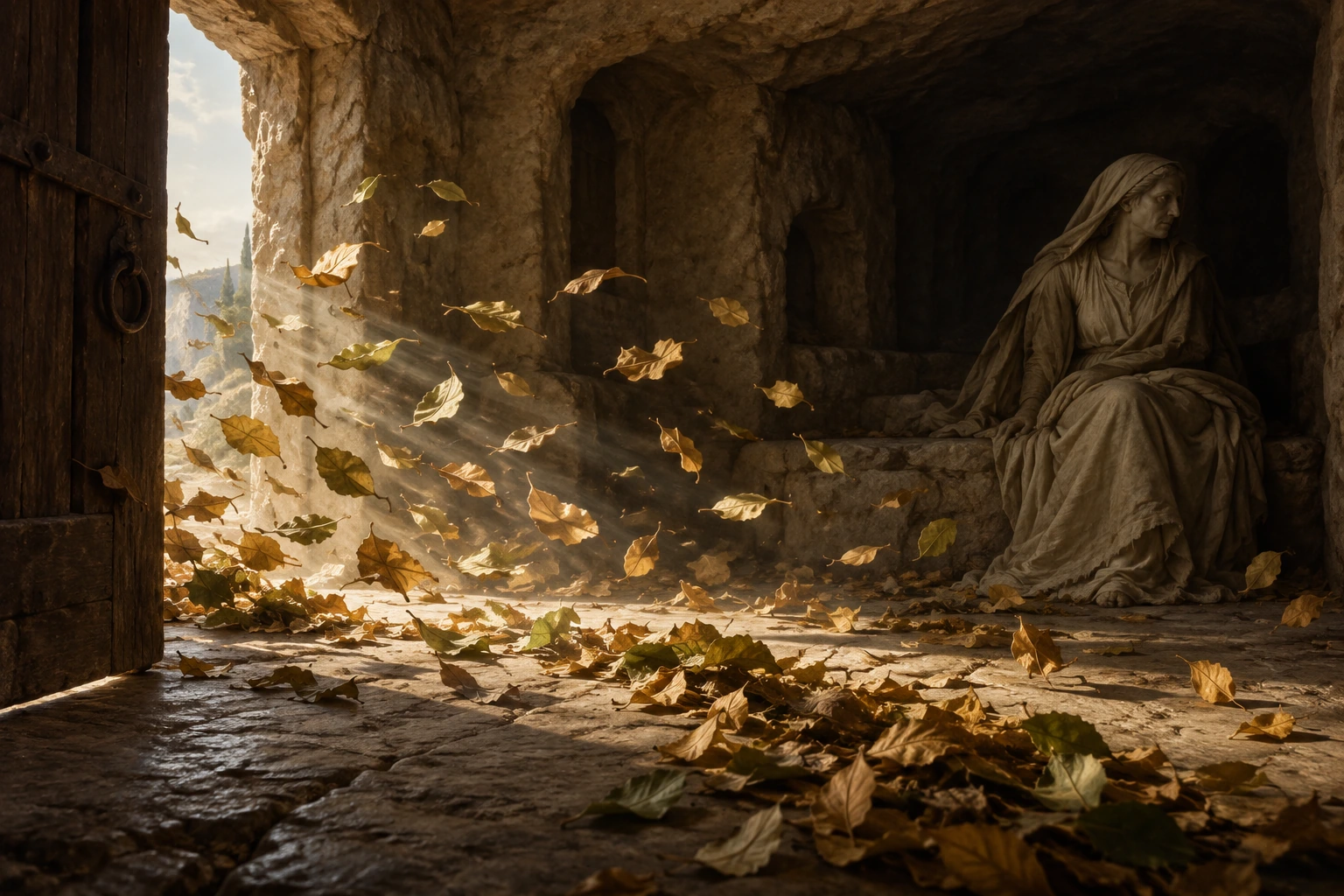
Aeneas first hears of her at Buthrotum in Epirus, from Helenus, a son of Priam who now rules Greek towns there and speaks for Apollo. When you come to Cumae, Helenus tells him, to the haunted lakes and the woods of Avernus, you will see “the raving prophetess who deep in the rock chants of fate, and marks down her words on leaves” (3.441–444).
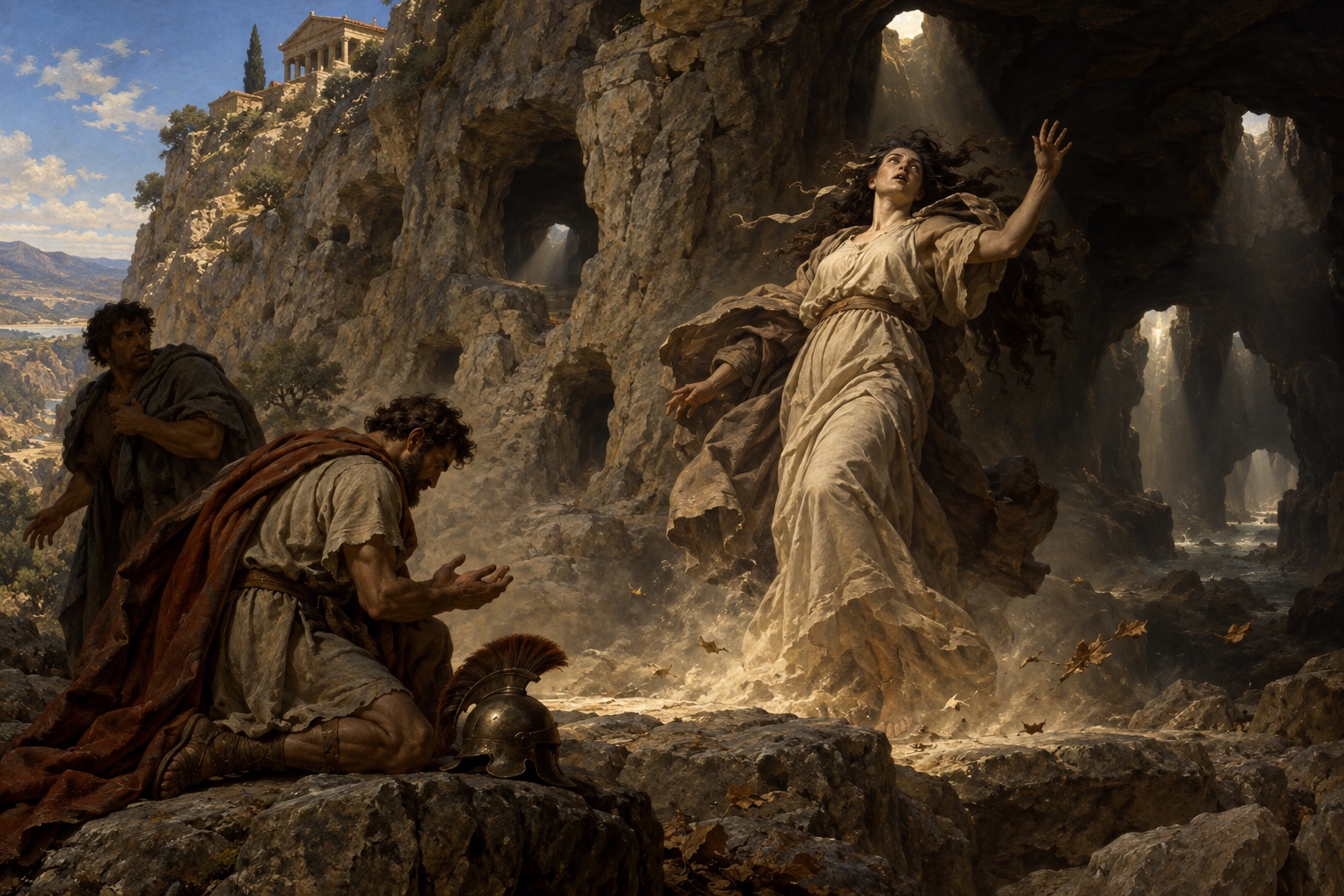
She sorts the leaves into order and shuts them away in the cave. But when the door turns on its hinge and a light wind blows in, the leaves scatter, and she never troubles to catch them as they flutter about the rock, or to put the verses together again: “men depart without counsel, and hate the Sibyl’s dwelling” (3.445–452). Whatever the delay, Helenus says, go to her and beg her to speak the oracles herself (3.453–460).
1-2 The Doors of Daedalus
The Trojans land on “Euboïc Cumae’s coast” (6.2). While his men hunt for firewood and water, Aeneas climbs to the heights where Apollo rules and to “the lone mystery of the awful Sibyl’s cavern depth” (6.9–11). The temple, Virgil says, was built by Daedalus. Fleeing King Minos of Crete on wings he had made, he came down on the Chalcidian citadel of Cumae, dedicated his wings to Apollo and carved the story of Crete on the doors: the death of Androgeos, the Athenians drawing lots each year to send seven of their sons, Pasiphae and the bull, the Minotaur and the labyrinth. Twice he tried to carve the fall of his son Icarus in gold; “twice the father’s hands dropped down” (6.14–33).
1-3 “The God, Lo! The God!”
Achates comes back with the priestess, Deiphobe, daughter of Glaucus, who tells Aeneas this is no time for looking at pictures and orders a sacrifice of seven bullocks and seven ewes (6.34–41). The cave is cut into the side of the Euboean cliff. A hundred wide passages lead into it, a hundred mouths, “whence peal forth as manifold the responses of the Sibyl” (6.42–44). At the threshold she cries: “It is time to enquire thy fate: the god, lo! the god!” Her face and colour change, her hair falls loose, her breast heaves, she seems to grow taller, and her voice no longer sounds mortal (6.45–51).
Aeneas prays to Apollo for a home in Latium. He promises Apollo and Trivia a temple of solid marble, and the Sibyl a sanctuary in his kingdom where chosen men will keep her oracles; only let her not write them on leaves, “lest they fly disordered, the sport of rushing winds” (6.56–76). The prophetess, “not yet tame to Phoebus’ hand”, rages through the cave to shake the god from her breast, and the more she fights, the more he tames her raving mouth. The hundred doors swing open of themselves, and her answer comes through the air (6.77–82). The Trojans will reach Lavinium, but wish they had not: “Wars, grim wars I discern, and Tiber afoam with streams of blood.” Another Achilles waits in Latium, and again a foreign bride will be the cause. “Yield not thou to distresses, but all the bolder go forth to meet them” (6.83–97).
1-4 The Golden Bough
Aeneas asks one thing: to go down and see his father Anchises. “Easy is the descent into hell,” she answers (facilis descensus Averno); the door of Dis stands open night and day, “but to recall thy steps and issue to upper air, this is the task and burden” (6.103–129). First he must find a bough with leaves and stem of gold, hidden in a dark tree and sacred to the Juno of the underworld, Proserpina. No one may go below the earth without it, and when it is torn off another grows. If fate calls him, it will come away easily; if not, no strength and no steel will break it. And first he must bury a friend who lies dead without his knowing (6.136–155).
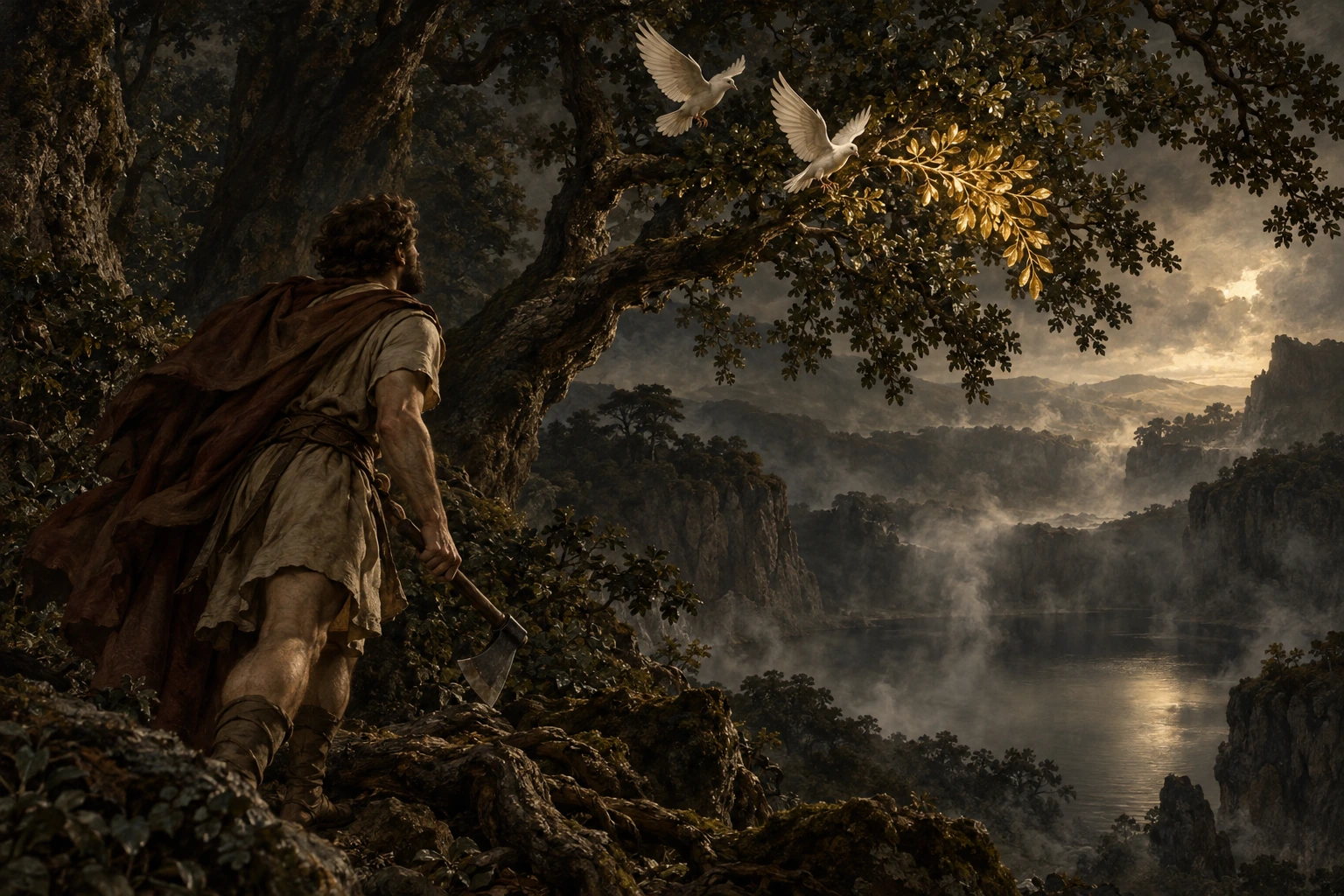
The friend is Misenus, Hector’s trumpeter, drowned by the jealous sea god Triton for challenging the gods with his conch (6.162–174). While the Trojans cut trees for his pyre, Aeneas prays for the bough to show itself. Two doves, his mother Venus’s birds, lead him to the reeking jaws of Avernus and settle on a holm-oak, where gold gleams among the branches like mistletoe in winter: “so the foil tinkled in the light breeze.” Aeneas breaks it off eagerly, though Virgil says it lingered (cunctantem), and carries it to the Sibyl (6.183–211).
1-5 The Guide
When Misenus is buried, the Sibyl sacrifices at a deep cave by a black lake and calls on Hecate. At dawn the ground groans and dogs howl in the dark. “Apart, ah keep apart, O ye unsanctified!” she cries, tells Aeneas to draw his sword, “now is need of courage”, and plunges into the cave with Aeneas at her heels (6.236–263). Below, she knows the way. She shows the angry ferryman Charon the bough hidden in her robe (6.405–407), throws the dog Cerberus a cake of honey and drugged meal (6.417–423), and has Aeneas set the bough on the threshold of Proserpina’s palace (6.628–636); Anchises sends them both back through the gate of ivory (6.897–898). What Aeneas sees among the dead belongs to his own story.
1-6 A Thousand Years Without Youth
Ovid, in the Metamorphoses, tells the descent in a few lines, and in his version the Sibyl herself points out the golden bough (14.101–119). On the way back Aeneas promises her a temple. “I am no goddess,” she answers, and tells him why she is still alive (14.120–131). Apollo loved her and, hoping to win her with gifts, told her to choose whatever she wished. She scooped up a heap of dust and asked for as many birthdays as there were grains in it, and forgot to ask that the years be young. He offered her those too, and youth without end, if she would yield to him. She refused and stayed unmarried. She has lived seven centuries and must still see three hundred harvests and three hundred vintages to match the dust. Her body will shrink until no one sees her, and Apollo will not know her or will deny that he loved her. “Yet I shall be known by my voice; my voice the fates will leave me” (14.132–153).
1-7 The Nine Books
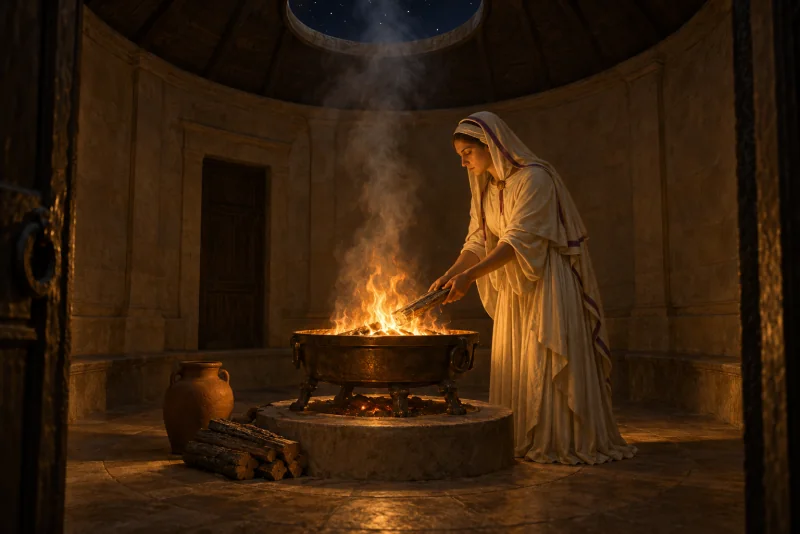
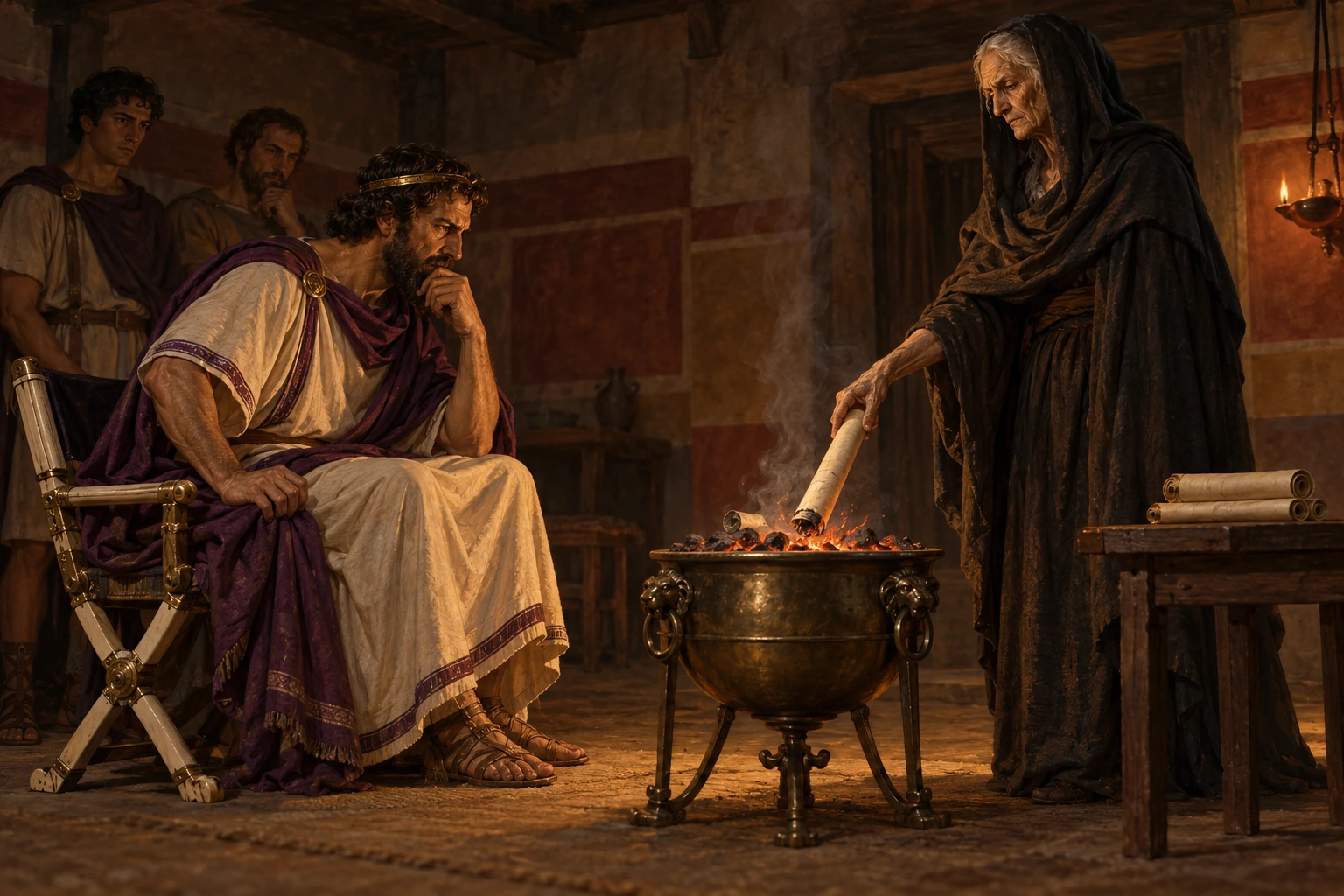
Aulus Gellius found this story “in ancient annals” (Attic Nights 1.19, trans. J. C. Rolfe). An old woman, “a perfect stranger”, brought King Tarquin the Proud nine books of oracles and asked an immense price; “the king laughed her to scorn, believing her to be in her dotage”. She set a lighted brazier before him, burned three, and asked the same price for six. He laughed even more. She burned three more and calmly asked the same price for the last three. Now Tarquin grew thoughtful, and paid for three what she had asked for all nine. She was never seen again, and the three books were placed in a shrine and called Sibylline.
2 Where the Story Is Written Down
- Greek writers of the 4th and 3rd centuries BCE already knew of a sibyl at Cumae, among them a book of marvels attributed to Aristotle and the poet Lycophron, according to the Enciclopedia dell’Arte Antica.
- Varro (1st century BCE) told the story of the books and listed the ten sibyls in his Antiquities of Divine Matters, dedicated to Julius Caesar as chief pontiff. The work is lost; Dionysius and the Christian writer Lactantius (Divine Institutes 1.6) quote it.
- Virgil, Aeneid 3.441–460 and book 6. Virgil worked on the poem for more than ten years until his death in 19 BCE, and Augustus had it published unfinished (Heibonsha World Encyclopedia).
- Dionysius of Halicarnassus, Roman Antiquities 4.62, a Greek history of early Rome whose preface dates itself to 7 BCE (1.3.4, with Cary’s note). For the books, “I am following the account given by Terentius Varro in his work on religion”.
- Ovid, Metamorphoses 14.101–153, and Petronius, Satyricon 48 (section 4).
- Pliny the Elder, Natural History 13.88, in a passage arguing, against Varro, that books on papyrus are very old; and Aulus Gellius, Attic Nights 1.19, the version told above.
3 Competing Versions
- Which king? Varro, as Lactantius quotes him, names Tarquinius Priscus, the fifth king of Rome. Dionysius, though he says he follows Varro, sets the sale under Tarquinius Superbus, the king later driven from power (4.62–63); so do Gellius and Pliny.
- How many books? Nine, burned three at a time, in Dionysius, Gellius and Varro, who adds the price: three hundred gold philippei. Pliny says she brought three, burned two herself, and the third burned with the Capitol “in Sulla’s time”, and he opens the sentence with “all agree” (inter omnes vero convenit, 13.88).
- Who was she? Dionysius has “a certain woman who was not a native of the country”, Gellius an old stranger; neither calls her a sibyl. In Varro she is the Sibyl of Cumae herself. The commentator Servius notes that it is uncertain whose oracles they were: Virgil says the Cumaean’s, Varro the Erythraean’s (on Aeneid 6.72). Her name was Deiphobe, daughter of Glaucus, in Virgil; Amalthea, “termed by some Herophile, or Demophile”, in Varro; Demo, according to Hyperochus, a historian of Cumae quoted by Pausanias (Description of Greece 10.12.8).
- Maiden or crone? Virgil calls her both virgo, maiden (6.45, 6.104), and longaeva sacerdos, the long-lived priestess (6.321, 6.628). Ovid’s Sibyl is both: she refused Apollo, and grew old.
- Who found the bough? In Virgil, Venus’s doves; in Ovid, the Sibyl, who tells Aeneas to tear it from its trunk (14.113–115).
- Where did she end? The Cumaeans could show Pausanias’s source no oracle of hers, only a small stone urn in a sanctuary of Apollo that held, they said, her bones. A Christian treatise once attributed to Justin Martyr says the guides at Cumae spoke of “a certain coffer made of brass in which they said that her remains were preserved” (Hortatory Address to the Greeks 37, trans. Marcus Dods). In Petronius she is still alive, in a jar.
4 History and Tradition
- Cumae. Strabo calls it “the oldest of all the Sicilian and the Italiote cities”, founded by settlers from two cities of Euboea, Chalcis and Cyme (Geography 5.4.4, with the note of its translator H. L. Jones); the Japanese Britannica dates it to about 750 BCE. The Parco archeologico dei Campi Flegrei now gives the great temple on the summit, long called the Temple of Jupiter, to Apollo, which, it says, lends credit to Virgil’s Daedalus.
- The “Cave of the Sibyl”. In 1932 Amedeo Maiuri excavated a long gallery cut in the tuff of the acropolis and named it the Antro della Sibilla: its side openings recalled the “hundred mouths”, and three small rooms at its end suited an oracle. The Enciclopedia dell’Arte Antica of 1959 still took it for an archaic Greek work and the Sibyl’s cave. Today the Park reads it as a military gallery cut in the Samnite period, between the late 4th and early 3rd century BCE, trapezoidal at first, its floor lowered in Roman times, and says that it cannot be the famous cave. Maiuri’s biographer in the Dizionario Biografico degli Italiani writes that “Virgilian suggestions”, above all about the Sibyl, led him into “some misinterpretation”. Where the oracle really was is unknown; the 1994 Enciclopedia mentions a proposal, “with a wide margin of doubt”, for the so-called Greek Cistern near the Temple of Apollo.
- The keepers. Tarquin gave the books to two men, Dionysius says; later they lay underground in the Capitoline temple in a stone chest, and “there is no possession of the Romans, sacred or profane, which they guard so carefully” (4.62.4–5, trans. Earnest Cary). The two became ten, five patricians and five plebeians (Livy 6.37, 6.42; 367 BCE in Rolfe’s note to Gellius), and after Sulla fifteen, the quindecimviri sacris faciundis. The Senate ordered them consulted in civil strife, after defeats, or when prodigies appeared. In the war with Veii, consulting them led to the first lectisternium, eight days of couches spread for Apollo, Latona, Diana, Hercules, Mercury and Neptune (Livy 5.13); in the war with Hannibal, they called for the Idaean Mother to be brought from Pessinus, whose sacred stone King Attalus handed over (29.10–11).
- Burned and gathered again. The books burned with the Capitoline temple in 83 BCE (Dionysius 4.62.6, with Cary’s note). Verses were sought at Erythrae, Samos and Ilium, in Africa, Sicily and the Italian colonies, and priests sorted the true from the false (Tacitus, Annals 6.12); the envoys to Erythrae brought back “about a thousand verses written out by private persons” (Fenestella, quoted by Lactantius). The genuine verses were acrostics, which to Cicero proved careful writing, not frenzy: “let us keep the Sibyl under lock and key” (On Divination 2.111–112, trans. W. A. Falconer). He also records a false rumour that one of the Fifteen, Lucius Cotta in Falconer’s note, would declare from them that the man who was king in fact must be made king in name, meaning Caesar (2.110).
- Augustus. As chief pontiff he burned more than two thousand books of prophecy, kept only the Sibylline ones, sorted even those, and placed them “in two gilded cases under the pedestal of the Palatine Apollo” (Suetonius, Augustus 31.1, trans. J. C. Rolfe); the Heibonsha World Encyclopedia gives the year as 12 BCE. Servius saw Aeneas’s vow of a marble temple to Apollo (6.69) as Virgil “mixing in history”: the temple Augustus built on the Palatine.
- The last answer and the end. In 363 CE the books, consulted on the emperor Julian’s order, said he must not leave his frontiers that year (Ammianus Marcellinus 23.1.7, trans. Rolfe). He marched into Persia and was killed there (25.3). The pagan poet Rutilius Namatianus accuses the general Stilicho: “ere this he burned the fateful books which brought the Sibyl’s aid” (On His Return 2.51–52, trans. J. Wight Duff and Arnold M. Duff), and his translators note that Rutilius “is the sole authority” for it.
- The jar. At the dinner in Petronius’s Satyricon, the rich host Trimalchio boasts: “For I myself saw with my own eyes the Sibyl at Cumae hanging in a jar, and when the boys said to her, ‘Sibyl, what do you want?’, she answered, ‘I want to die’” (48). The last words are Greek in the Latin text. T. S. Eliot put the passage, untranslated, at the head of The Waste Land (1922).
- Michelangelo. The Cumaean Sibyl is one of five sibyls on the Sistine Chapel ceiling, painted between 1508 and 1512, enthroned between the prophets Isaiah and Daniel. The Vatican Museums explain that the sibyls, “although belonging to the pagan world, are represented here because of their prophetic gifts”.
The Sibylline Oracles (Oracula Sibyllina), Greek prophecies in hexameters printed since 1545, are sometimes taken for the books Rome kept. They are not. The Roman books were secret, burned in 83 BCE and, by Rutilius’s account, burned again. The Catholic Encyclopedia of 1912 describes the Oracles as verses that Jews in Alexandria began composing in the 2nd century BCE, “attributing them to the sibyls”, later joined by Christian ones; the Jewish Encyclopedia of 1906 adds that “the words of the pagan sibyl have been almost entirely lost”. The mix-up is old: Lactantius believed that verses praising one God were among those the envoys brought back from Erythrae, and the fragments he quotes are printed in modern editions of the Oracles.
5 Related Stories
- Aeneas: The Trojan Who Became Rome’s Ancestor: the rest of the journey, and what Aeneas sees among the dead, his father’s parade of future Romans.
- Numa and Egeria: The King and the Water Nymph: Pliny tells two stories of old books side by side. Just before the Sibyl’s books, he tells of the books found in Numa’s coffin on the Janiculum and burned by a praetor (Natural History 13.84–88).
- The Odyssey: Ten Years on the Way Home from Troy: Odysseus, too, goes to consult the dead. Kubo Masaaki writes that Virgil is said to have taken the Odyssey as his model for the first half of the Aeneid, and that book 6 in particular is built in close awareness of Homer.
- Gilgamesh: The King Who Tried to Escape Death: Gilgamesh wins a plant that gives back youth and loses it to a snake; the Sibyl is given a thousand years and no youth at all. We link them for the theme.
- Delphi: The Oracle and the Navel of the World: Apollo’s great oracle in Greece, where the Pythia gave his answers. At Delphi too there was a rock where “the first Sibyl is said to have been seated”, and the speakers in Plutarch’s dialogue stop beside it (On the Pythian Responses 398c).
6 Sources
- Virgil, Aeneid 3 and 6, Latin text: The Latin Library, The Latin Library; trans. J. W. Mackail (Macmillan, 1885): Project Gutenberg; Servius on Aeneid 6.69–72, ed. Georg Thilo: Perseus
- Ovid, Metamorphoses 14; Petronius, Satyricon 48; Livy 5, 6 and 29; Tacitus, Annals 6.12; Lactantius, Divine Institutes 1.6, Latin texts: The Latin Library, The Latin Library, The Latin Library, The Latin Library, The Latin Library
- Lactantius, Divine Institutes 1.6, trans. William Fletcher (Ante-Nicene Fathers 7, 1886); Pseudo-Justin, Hortatory Address to the Greeks 37, trans. Marcus Dods (Ante-Nicene Fathers 1, 1885): New Advent, New Advent; Pausanias, Description of Greece 10.12, trans. W. H. S. Jones and H. A. Ormerod: Perseus
- Dionysius of Halicarnassus, Roman Antiquities 1.3 and 4.62, trans. Earnest Cary (Loeb, 1937 and 1939): LacusCurtius
- Aulus Gellius, Attic Nights 1.19, trans. J. C. Rolfe (Loeb, 1927, revised 1946): LacusCurtius
- Pliny the Elder, Natural History 13.84–88, Latin text ed. Mayhoff: Latin Wikisource
- Cicero, On Divination 2.110–112, trans. W. A. Falconer (Loeb, 1923); Strabo, Geography 5.4.4, trans. H. L. Jones (Loeb, 1923); Suetonius, Augustus 31, trans. J. C. Rolfe (Loeb, 1913); Ammianus Marcellinus 23.1 and 25.3, trans. J. C. Rolfe (Loeb, 1940): LacusCurtius, LacusCurtius, LacusCurtius, LacusCurtius
- Rutilius Namatianus, De reditu suo 2.41–60, trans. J. Wight Duff and Arnold M. Duff (Loeb, Minor Latin Poets, 1934): LacusCurtius; T. S. Eliot, The Waste Land: Project Gutenberg
- Parco archeologico dei Campi Flegrei, “Parco Archeologico di Cuma” and the festival brochure Antro (2022): pafleg.cultura.gov.it, pafleg.cultura.gov.it; Enciclopedia dell’Arte Antica, “Cuma”, by W. Johannowski (1959) and F. Ceci (1994), and P. G. Guzzo, “Maiuri, Amedeo”, Dizionario Biografico degli Italiani (2006): Treccani, Treccani, Treccani
- Vatican Museums, “Ceiling” and “Sibyls and Prophets”: museivaticani.va, museivaticani.va
- Patrick Healy, “Sibylline Oracles”, Catholic Encyclopedia (1912); Richard Gottheil and Samuel Krauss, “Sibyl”, Jewish Encyclopedia (1906): New Advent, jewishencyclopedia.com
- Heibonsha World Encyclopedia: “シビュラ” by Mizutani Tomohiro, “アエネーイス”, and “オデュッセイア” by Kubo Masaaki; “クマエ”, Britannica International Encyclopedia: Kotobank, Kotobank, Kotobank, Kotobank
Cover and illustrations: AI-generated images made for Arcana. They are interpretations, not historical artworks.