The Capitoline Geese: The Birds That Woke the Capitol
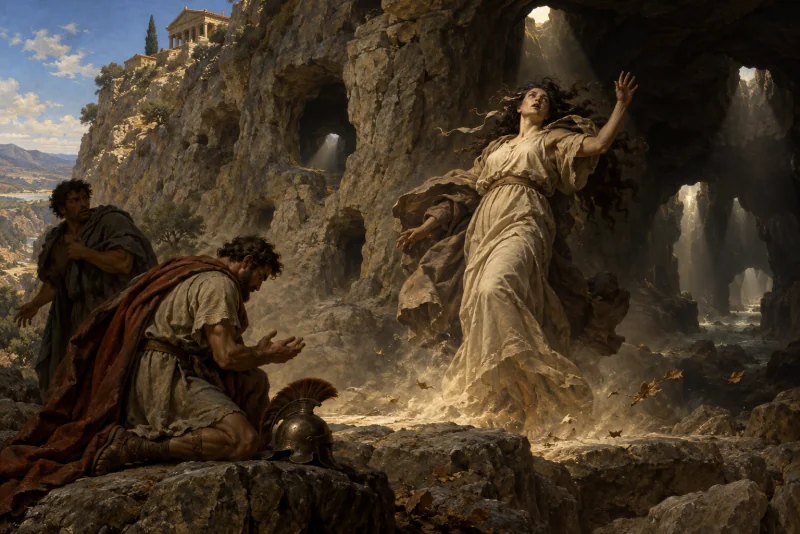
The Gauls had taken Rome and were climbing its last hill in the dark when Juno's sacred geese woke the defenders. Livy tells the story in full, but Polybius, the oldest historian whose account survives, says only that the Gauls made a treaty and went home.
- Type: legend, the capture of Rome by the Gauls and the night the Capitol held
- Culture: ancient Rome; the event is dated 390 BCE by the traditional (Varronian) reckoning, about 387/386 BCE by the Greek reckoning that Polybius follows
- Earliest texts: Greek notices of the 4th century BCE, by Heraclides Ponticus and Aristotle, known only through Plutarch; a short account in Polybius (2nd century BCE); the full story in Book 5 of Livy’s History of Rome (Ab urbe condita), written under Augustus
- Key figures: Brennus, Marcus Manlius, Marcus Furius Camillus, Pontius Cominius, Marcus Papirius, Quintus Sulpicius, the sacred geese of Juno
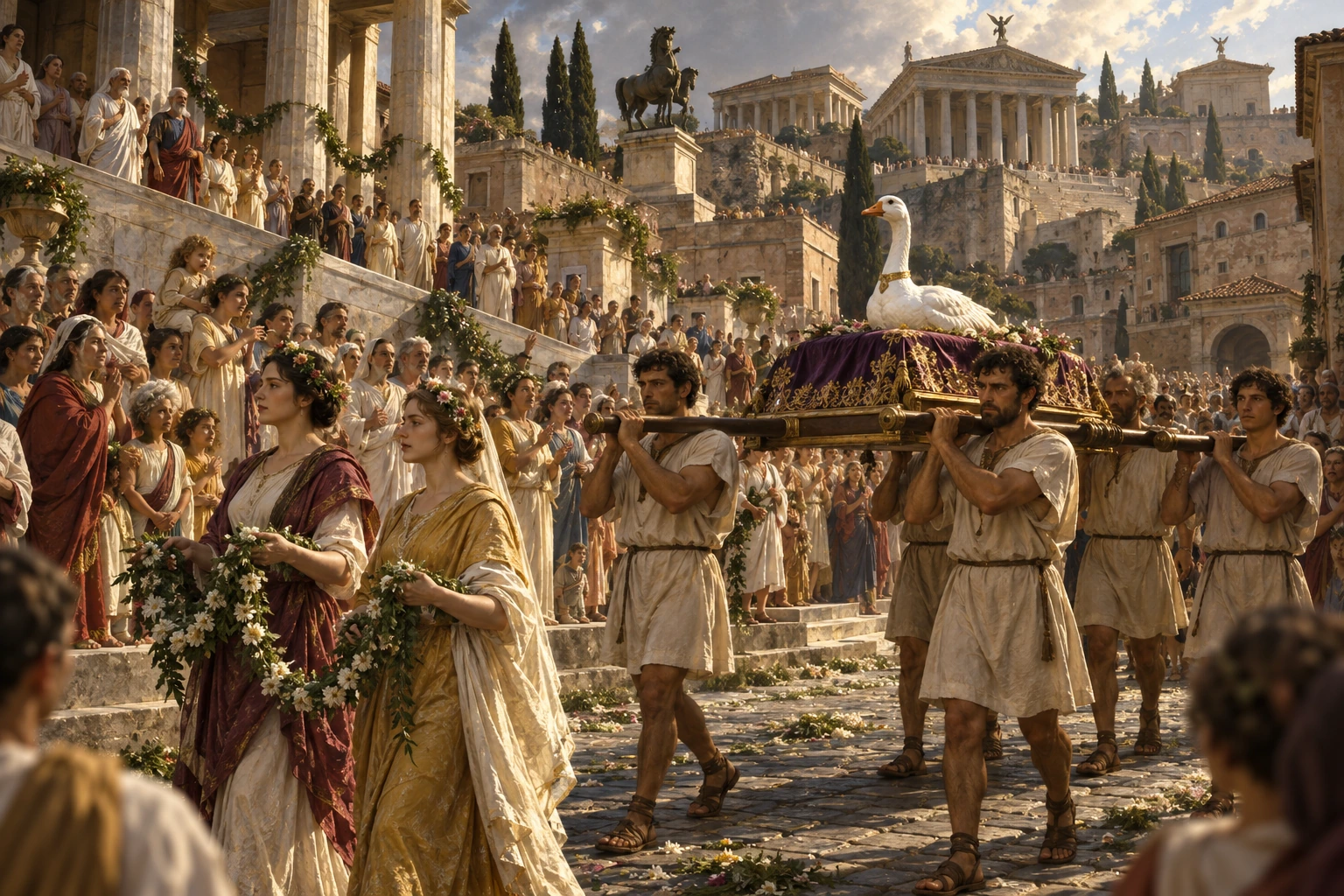
Centuries after the event, in the days of Pliny and Plutarch, the Romans still carried a goose through their city in a litter, on a costly coverlet, and put dogs to death. Both rites remembered one night, when the Gauls held the whole of Rome but its citadel and were climbing the cliff in silence, and only the geese heard them.
Did the geese save Rome? Only its last stronghold, and only for one night. In Livy’s telling the Gauls already held the rest of the city, and stayed until hunger forced the Romans to buy them off with gold. Livy, the poets and the rites remembered the geese; Polybius, the oldest surviving historian to tell the story, does not mention them at all.
1 The Telling
This is the version of Livy, in the History of Rome 5.33–55, written under Augustus. Book and chapter numbers are the standard ones. Short quotations are from B. O. Foster’s translation (Loeb, 1924).
1-1 The Envoys at Clusium
The Senones, the most recent of the Gallic peoples to settle in northern Italy, were besieging the Etruscan city of Clusium. The Clusines asked Rome for help. Rome sent no army, only three sons of Marcus Fabius Ambustus as envoys, and when the talks broke down the three took up arms against the Gauls, against the law of nations. Quintus Fabius killed a Gallic chieftain in front of both armies. The Gauls demanded that the Fabii be handed over. The senate agreed that they were in the right, but left the matter to the people, and the people elected the three brothers military tribunes for the next year. So the Gauls marched on Rome (5.35–36). Livy also reports the story that they had first crossed the Alps for love of Italian wine, brought in by a man of Clusium named Arruns. He does not deny that Arruns, or some other Clusine, led them to Clusium, but notes that Gauls had come into Italy two hundred years before (5.33).
1-2 The Allia
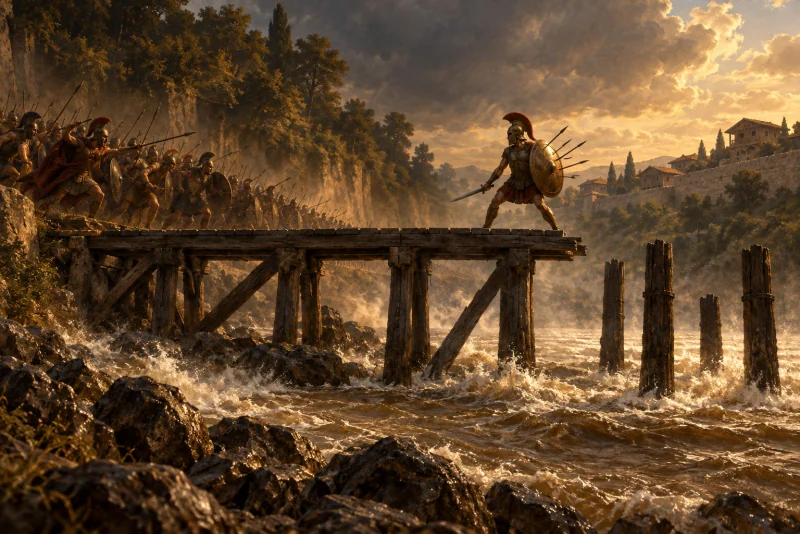
The Romans met the Gauls at the river Allia, eleven miles from the city. Their commanders chose no ground for a camp, built no rampart, and took neither auspices nor omens (5.37–38). Brennus, the Gallic chieftain, struck first at the reserves on a low hill to the right, and the Roman line broke before it had fought. The left wing fled to the river, where many drowned in their armour, and most of the survivors escaped to Veii. The right wing ran to Rome and up to the citadel, without even shutting the gates (5.38).
1-3 The Old Men in Their Chairs
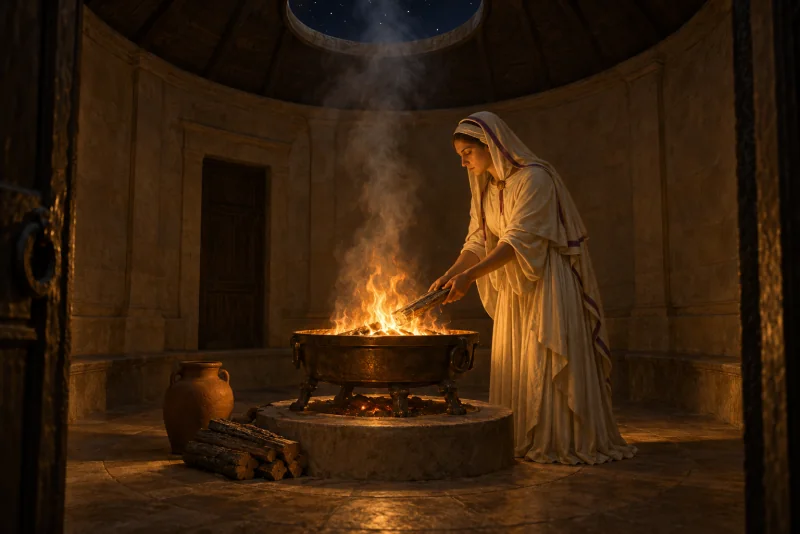
The men of fighting age, the senate and their families took grain and arms up to the Capitol. The Vestals and the flamen of Quirinus buried some of the sacred objects in jars and carried the rest to Caere (5.39–40). The old men stayed below. Those who had held the highest offices put on the robes worn in triumphs and sat on their ivory chairs in their houses, waiting. Some say, Livy adds, that the chief priest Marcus Folius dictated a prayer in which they devoted themselves to death for their country (5.41).
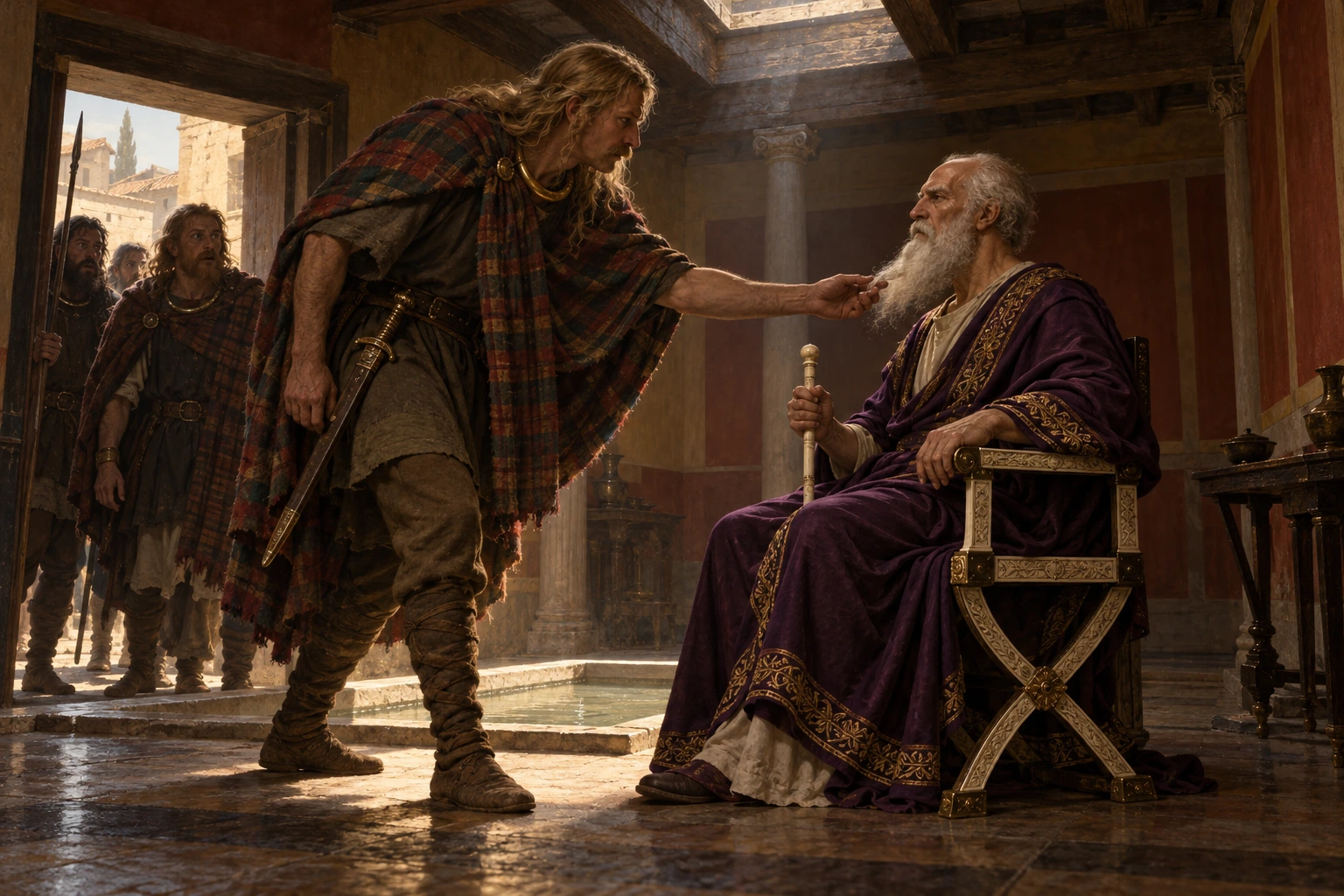
The Gauls entered by the Colline Gate, which stood open, and found the streets empty. The plebeians’ houses were shut, but the halls of the nobles stood open, and in them sat men who seemed, in Foster’s words, “most like to gods”. The Gauls stood before them as before statues, until one of them stroked the long beard of Marcus Papirius. Papirius struck him on the head with his ivory staff, and was the first to be killed. Then the others were killed where they sat, and the houses were plundered and burned (5.41).
1-4 The Messenger on the Cork
An assault on the Capitol was thrown back half-way up the slope, and the Gauls settled down to a siege (5.43). Camillus, the conqueror of Veii, was living in exile at Ardea; he led the men of Ardea out by night and cut down a Gallic band asleep in its camp (5.43–45). The Romans gathered at Veii wanted him as their general, but would not act without the senate on the Capitol. So a young man named Pontius Cominius floated down the Tiber at night on a strip of cork, climbed the steep cliff that the Gauls had left unguarded, and brought the army’s message. The senate voted to recall Camillus and make him dictator. Livy prefers to believe that Camillus did not leave Ardea until the law was passed (5.46).
1-5 The Geese
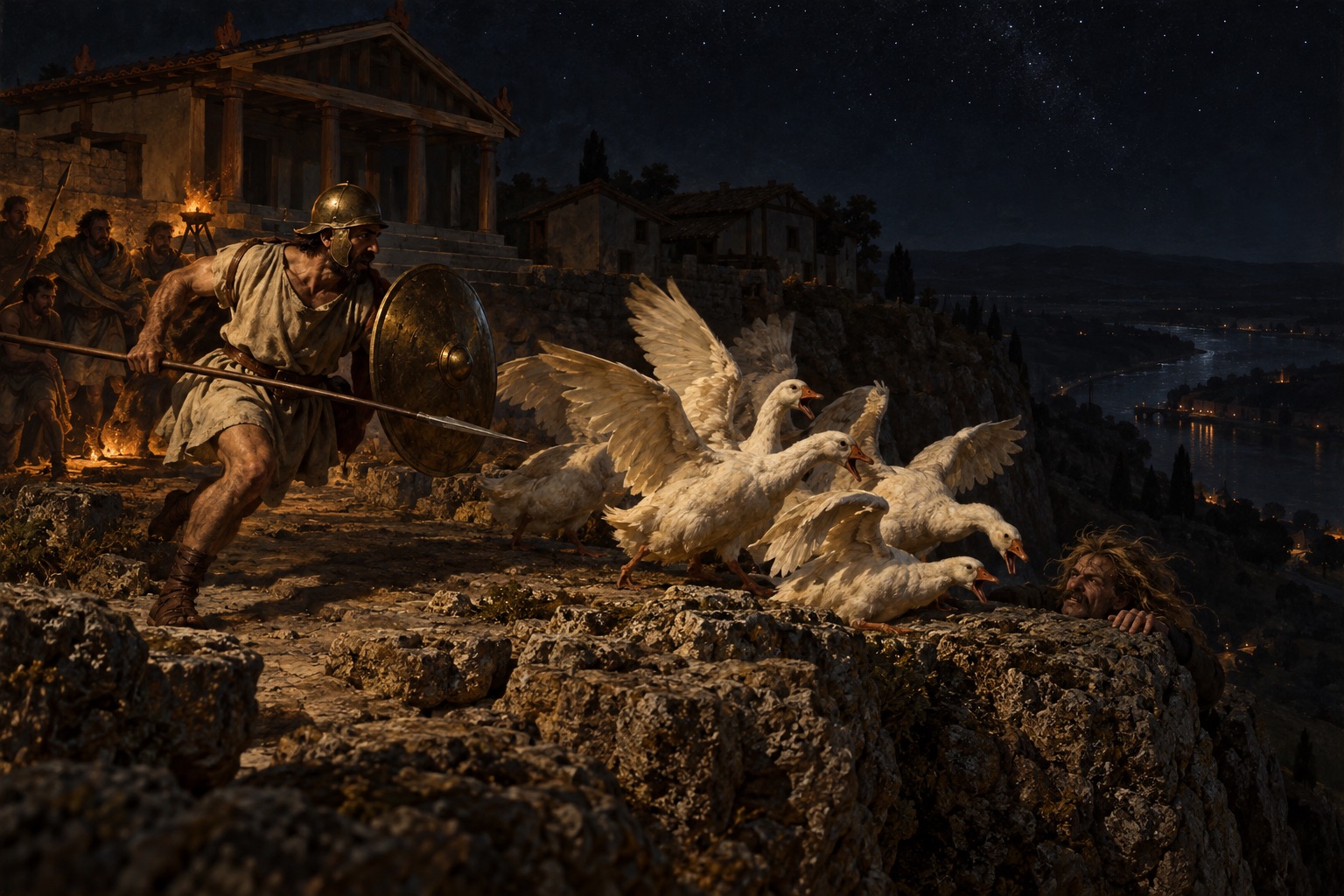
Either the Gauls had seen the messenger’s tracks, or they had found for themselves an easy way up by the rock of Carmentis. On a starlit night they sent an unarmed man ahead, passed their weapons up from hand to hand, and pulled one another up the rock in such silence that neither the sentries nor the dogs, “creatures easily troubled by noises in the night”, woke (5.47).
But the geese did. They were sacred to Juno, and so, “notwithstanding the dearth of provisions”, they had not been eaten. Their cackling and the beating of their wings woke Marcus Manlius, consul three years before. He seized his weapons, strode past his bewildered comrades and, with the boss of his shield, knocked down the Gaul who had already reached the top. The man fell back on those behind him, and the others, with javelins and stones, sent the climbers down the cliff. In the morning every soldier brought “half a pound of spelt and a gill of wine” to Manlius’s house on the citadel, a small gift that meant much in a famine. The tribune Quintus Sulpicius had the sentry on that stretch of wall thrown down from the rock (5.47).
1-6 Woe to the Conquered
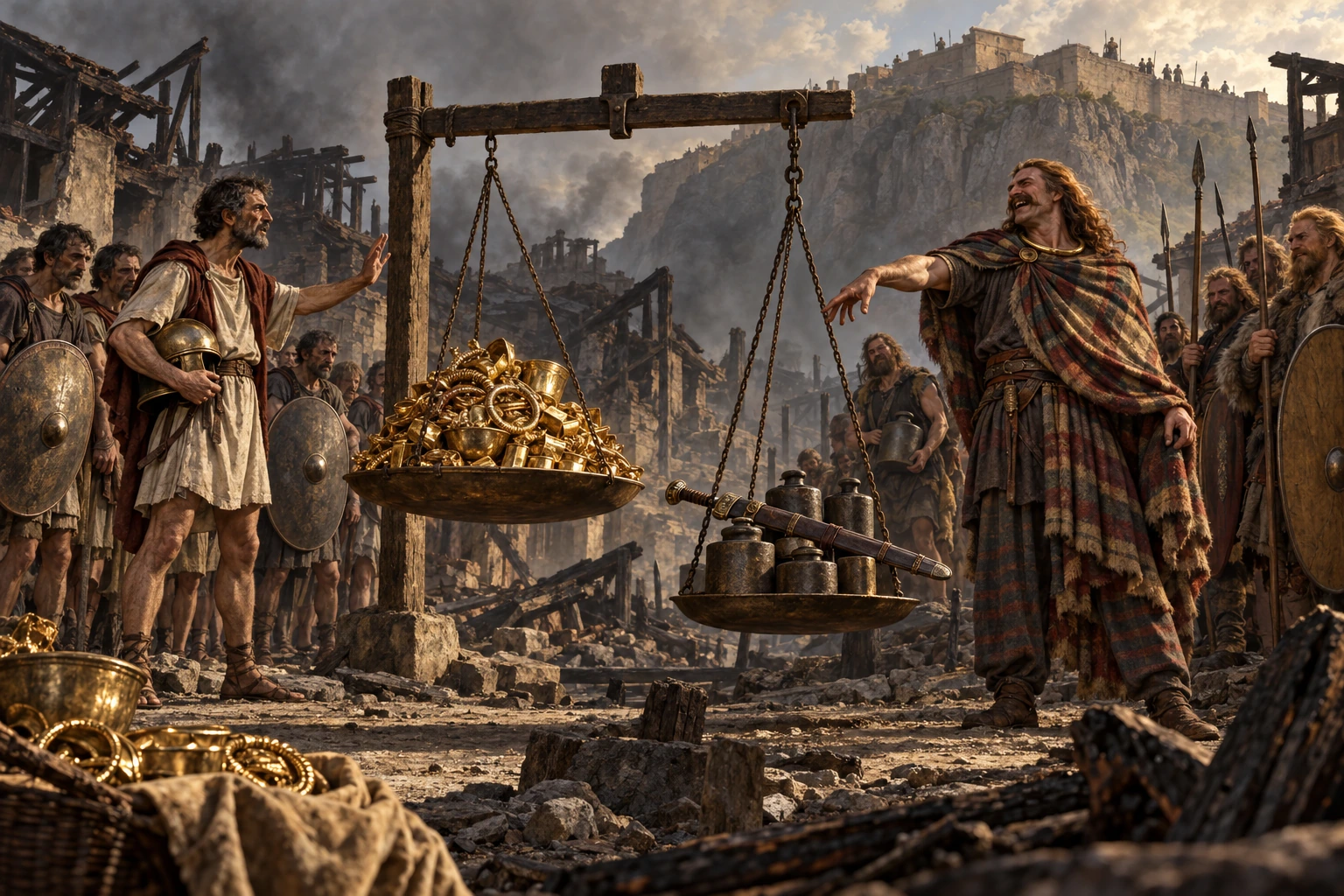
Hunger pressed both sides. The Gauls, camped among the ashes in the summer heat, died of disease and burned their dead in heaps, at a place later called the Gallic Pyres. It is said, Livy writes, that the Romans threw bread down from the Capitol to show they were not starving (5.48). But they were. The tribune Sulpicius met Brennus, and the price was fixed at a thousand pounds of gold. The Gauls brought false weights. When the tribune protested, Brennus threw his sword onto the scale, and the Romans heard words they could not bear: “Woe to the conquered!” (5.48). In Latin, vae victis; Plutarch says the words passed at once into a proverb (Camillus 28).
1-7 Iron, Not Gold
Before all the gold had been weighed, the dictator arrived. Camillus ordered the gold taken away and the Gauls to leave: the agreement, he said, had been made without him by a lesser magistrate after he had been appointed, and was not valid. He told his men to win their country back “with iron instead of gold” (5.49). The Gauls were routed in the ruined streets, and again at the eighth milestone on the road to Gabii, where not one was left to carry the news home. In the soldiers’ songs at his triumph Camillus was hailed as “a Romulus and Father of his Country and a second Founder of the City” (5.49). The gold taken back was laid beneath Jupiter’s chair on the Capitol (5.50). When the tribunes urged the people to move to Veii, Livy says, a centurion crossing the Forum settled it: “Standard-bearer, fix your ensign; here will be our best place to remain.” Rome was rebuilt in haste, with no care for straight streets, and Livy blamed that haste for the old sewers that in his day ran under private houses (5.55).
2 Where the Story Is Written Down
- Greek notices of the 4th century BCE, known only through Plutarch (Camillus 22). Heraclides Ponticus, who lived not long after, wrote of a report from the West that an army of Hyperboreans had taken “a Greek city called Rome” by the Great Sea. Aristotle knew that the Gauls had taken the city, but called its saviour “Lucius”. Plutarch points out that Camillus’s first name was Marcus.
- Polybius, a Greek historian of the 2nd century BCE. He dates the capture by Greek events: the nineteenth year after the battle of Aegospotami, the sixteenth before Leuctra, the year of the Peace of Antalcidas (1.6). The Gauls held the whole city but the Capitol, but an invasion of their own land by the Veneti drew them away, so they made a treaty and went home (2.18). Later in his history, Gallic envoys recall that their ancestors held Rome for seven months and went home with their spoil (2.22). He has no geese, no Camillus, and no name for the Gallic leader.
- Diodorus Siculus, 1st century BCE, Library of History 14.113–117. Here the “sacred geese of Hera” give the alarm; Hera is the Greek name he uses for Juno.
- Livy, History of Rome 5.33–55, the fullest telling; the sequel is in 6.1, 6.11–20 and 7.28.
- Virgil and Ovid. On the shield that Vulcan makes for Aeneas, Manlius stands before the temple on the citadel, and a silver goose, fluttering through gilded colonnades, cries that the Gauls are at the threshold. They come up through the thickets with golden hair, striped cloaks and gold at their milk-white necks, each with two Alpine javelins and a long shield (Aeneid 8.652–662). In Ovid, Mars pleads with Jupiter for the besieged, Jupiter tells them to throw down their bread, and an altar is raised to Jupiter the Baker (Fasti 6.349–394); the geese are those “that would save the Capitol with their wakeful voice” (Metamorphoses 2.538–539).
- Plutarch, Life of Camillus 15–30 and 36, and On the Fortune of the Romans 12; Pliny the Elder, Natural History 10.51 and 29.57; and Servius, the late-antique commentator on Virgil, on Aeneid 8.652–655.
3 Competing Versions
- How did the Gauls leave?
- Livy and Plutarch: Camillus arrives while the gold is being weighed and drives them out.
- Polybius: they made a treaty and went home, because the Veneti had invaded their land. Plutarch, citing Polybius, says the treaty was made with Camillus (Fortune of the Romans 12); Polybius names no one.
- Diodorus: the Romans paid the thousand pounds. Later Camillus caught the Gauls besieging Veascium, an ally of Rome, and took back the gold (14.116–117).
- Strabo: the people of Caere defeated the Gauls on their way home, in Sabine country, and took the ransom (5.2.3).
- Suetonius: it was said that Livius Drusus brought the gold back from his province in Gaul, and that it had not been taken from the Senones “by Camillus, as tradition has it” (Tiberius 3).
- The city taken. Livy has the Gauls enter the day after the battle, Polybius and Plutarch three days after, Diodorus on the fourth day. Livy’s old men wait in their own houses; Plutarch’s sit in the Forum, led by the chief priest Fabius, where Livy has Marcus Folius (Camillus 21–22).
- The geese. Livy: they had been spared in spite of the famine. Plutarch: they were neglected and hungry, and so slept lightly (Camillus 27). Servius speaks of a single goose, which a private citizen had given to Juno. Livy’s Manlius knocks one Gaul down with his shield; in Plutarch and Diodorus he uses his sword as well, and two Gauls go down before him.
- Brennus is named only by Livy and Plutarch. He is not the Brennus who led the Gauls against Delphi in 279 BCE and took his own life in the retreat (Pausanias 10.19–23). The historian Plinio Fraccaro rejected the idea, held by some modern scholars such as Theodor Mommsen, that later Roman annalists borrowed that Brennus’s name for the leader whom Polybius and Diodorus leave unnamed.
- Which year? By the Varronian reckoning, 390 BCE. Polybius’s synchronisms point to 387/386 BCE, and Diodorus also places the capture in the year of the peace between the Greeks and the Persian king (14.117). Gaetano De Sanctis wrote “probably 386”.
4 History and Tradition
- The black day. The Romans named 18 July the Day of the Allia and did no public or private business on it. It was also the day on which the Fabii had been massacred at the Cremera, long before (Livy 6.1). In 69 CE the emperor Vitellius issued an edict on public ceremonies on that date, and Rome took it as a bad omen (Tacitus, Histories 2.91).
- Geese and dogs. In Pliny’s time the censors’ first contract was for the feeding of the geese (Natural History 10.51). Every year, he writes, dogs were put to death between the temples of Juventas and Summanus, for the same reason (29.57). In Plutarch’s day there was still a procession: a dog put to death on a stake, and a goose “perched in state upon a costly coverlet in a litter” (Fortune of the Romans 12). Servius says it was done on the anniversary of the night.
- Manlius’s fall. A few years later, in 384 BCE by the traditional dating, Manlius took up the cause of debtors and was accused of aiming at kingship (Livy 6.11–20). Livy says he could find in no author what proofs of that charge were brought. On the Field of Mars, within sight of the Capitol, the people could not bring themselves to condemn him. The trial was moved to the Peteline grove outside the walls, where the Capitol could not be seen, and there he was condemned. The tribunes threw him from the Tarpeian Rock, so that “the same spot served to commemorate extraordinary fame and the extremity of punishment” (6.20). No patrician was to live on the citadel again, and the Manlii resolved that none of them would be called Marcus. “How well, great gods,” Ovid writes, “would he have fallen in that fight” (Fasti 6.187).
- Juno Moneta. In 345 BCE the dictator Lucius Furius vowed a temple to Juno Moneta in a battle against the Aurunci. It was built on the citadel, on the site of Manlius’s house, and dedicated the next year (Livy 7.28), on 1 June 344 BCE, according to Foster’s note to Livy 6.20. Ovid, who puts it on the Kalends of June, calls the founder Camillus (Fasti 6.183–186). Livy, writing under Augustus, speaks of “the temple and mint of Moneta”. The church of Santa Maria in Aracoeli now stands on the northern summit of the Capitoline, where Italy’s Ministry of Culture places the temple.
- History behind the legend. Livy himself drew a line at the sack: records before it were few, and most of them, he says, perished when the city burned. From then on he promised “a clearer and more definite account” (6.1). The historian T. J. Cornell finds “good reason to doubt the picture of extensive destruction and loss of life” in the Roman accounts, and suggests that the physical damage to the city was superficial and that the civilians had been evacuated. He also reports the argument that the story of a quick recovery is at odds with Polybius, and that Diodorus does not mention Camillus’s victories. In the Heibonsha encyclopedia, Hirata Ryūichi writes that most of Camillus’s offices and triumphs are legend, but that his capture of Veii around 396 BCE and a victory over the Volsci around 387 BCE are regarded as certain; that he drove off the Gauls is “also said”. What can still be seen is the wall Rome built afterwards. Rome’s city tourism office dates the circuit that survives to the mid-4th century BCE, after the Gallic invasion, and says it was built of tufa from the Grotta Oscura quarries that Rome worked after it took Veii.
A popular story says that the word “money” comes from the geese’s warning. It does come from this hill, but not from the geese. It goes back to Latin moneta, “mint”, named after Juno Moneta, at whose temple Rome’s coins were struck. That temple was vowed in 345 BCE, more than forty years after the geese, and Rome’s first coins were struck about 320–310 BCE, at Naples. Ancient writers explained the name in other ways: Cicero by a voice from Juno’s temple on the citadel that, at the time of an earthquake, called for the sacrifice of a pregnant sow; the Byzantine lexicon called the Suda by advice about money in the war with Pyrrhus. None of the ancient writers we have read ties it to the geese.
5 Related Stories
- Romulus and Remus: The Twins and the She-Wolf: in Rome’s first war Tarpeia let the Sabines into the citadel that Manlius later saved (Livy 1.11), and Varro says the Tarpeian Rock, from which Manlius was thrown, kept her name.
- Horatius at the Bridge: One Man Holds the Sublician Bridge: on Virgil’s shield of Aeneas, Cocles tearing down the bridge comes just before Manlius on the citadel (Aeneid 8.650–653). Both are stories of one man holding a way into Rome.
- Mars: The Father of Rome: in Ovid’s Fasti, it is Mars who pleads with Jupiter for the besieged Capitol, and Jupiter who sends the bread.
- Vesta: The Hearth Goddess and Her Virgins: the Vestals carried Rome’s sacred objects to Caere during the siege, and in Ovid Jupiter tells Vesta to make the Romans’ little grain seem plenty.
6 Sources
- Livy, History of Rome 5.33–55, 6.1, 6.11–20, 6.32 and 7.28, trans. B. O. Foster (Loeb, vol. 3, 1924): archive.org; Latin text: The Latin Library
- Plutarch, Life of Camillus, trans. Bernadotte Perrin (Loeb, 1914), and On the Fortune of the Romans 12, trans. F. C. Babbitt (Loeb, 1936): LacusCurtius, LacusCurtius
- Polybius, Histories 1.6, 2.18 and 2.22, trans. W. R. Paton (Loeb, 1922): LacusCurtius
- Diodorus Siculus, Library of History 14.113–117, trans. C. H. Oldfather (Loeb, 1954): LacusCurtius
- Strabo, Geography 5.2.3, trans. H. L. Jones (Loeb, 1923), and Suetonius, Tiberius 3, trans. J. C. Rolfe (Loeb, 1913): LacusCurtius, LacusCurtius
- Virgil, Aeneid 8.650–662; Ovid, Fasti 6.183–190 and 6.349–394, and Metamorphoses 2.538–539; Tacitus, Histories 2.91; Varro, On the Latin Language, Book 5; our translations from the Latin: The Latin Library, The Latin Library
- Pliny the Elder, Natural History 10.51 and 29.57, Latin text (Mayhoff): LacusCurtius; Servius on the Aeneid 8.652–655 (Thilo): Perseus
- Cicero, On Divination 1.101 and 2.69, trans. W. A. Falconer (Loeb, 1923), and the Suda, “Moneta” (mu 1220), trans. David Whitehead: LacusCurtius, Suda On Line
- Pausanias, Description of Greece 10.19–23, trans. W. H. S. Jones and H. A. Ormerod (Loeb, 1918): Perseus
- T. J. Cornell, “The recovery of Rome”, The Cambridge Ancient History VII.2 (Cambridge, 1990), chapter summary: Cambridge Core
- Enciclopedia Italiana: P. Fraccaro, “Brenno” (1930), G. De Sanctis, “Allia” (1929); Enciclopedia dell’Arte Antica, “Moneta” (1995): Treccani, Treccani, Treccani
- “Moneta”, Treccani vocabulary, and W. W. Skeat, An Etymological Dictionary of the English Language (new edition, 1910), “Mint (1)” and “Money”: Treccani, archive.org
- Ministero della Cultura, “Santa Maria in Aracoeli”: cultura.gov.it; Roma Capitale, “Mura Serviane”: turismoroma.it
- Hirata Ryūichi, “カミルス”, Heibonsha World Encyclopedia: Kotobank
Cover and illustrations: AI-generated images made for Arcana. They are interpretations, not historical artworks.