Romulus and Remus: The Twins and the She-Wolf
Twin boys were left to drown in the Tiber, a she-wolf gave them suck, and one of them died when the walls of Rome went up. The Romans told the story in several versions side by side, and the famous bronze wolf may be medieval.

- Type: founding legend: twins exposed at birth, a city founded, a founder who becomes a god
- Culture: ancient Rome and Latium, told by Latin and Greek writers
- Earliest texts: a statue of the wolf and twins set up in Rome in 296 BCE (Livy 10.23) and silver coins of 269–266 BCE; the lost Greek history of Fabius Pictor (late 3rd century BCE) and the Annals of Ennius, known from quotations; the full tellings come from the age of Augustus, in Livy, Dionysius of Halicarnassus and Ovid, and later from Plutarch
- Key figures: Romulus, Remus, Rhea Silvia, Numitor, Amulius, Faustulus, Acca Larentia, Titus Tatius, Tarpeia, Hersilia
Every 21 April, Rome celebrates its birthday. The date comes from a story the Romans told about themselves and never quite believed: twin boys left to drown, a she-wolf that fed them, and a quarrel over omens that ended with one brother dead. Livy, who wrote the best-known version under Augustus, warned his readers at the outset that these tales were “rather adorned with poetic legends than based upon trustworthy historical proofs”, and that he meant “neither to affirm nor to refute” them (preface 6).
Did Romulus kill Remus? In the version Livy calls “the commoner story”, yes: Remus jumped over the new walls to mock his brother, and Romulus killed him. But Livy gives another version first, in which Remus “was struck down in the affray” after the omens, and no killer is named (1.7.2). Dionysius of Halicarnassus thought the brawl the likeliest account, and in Ovid the blow is struck by a man called Celer, while Romulus hides his tears.
1 The Telling
This retelling follows book 1 of Livy’s History of Rome, chapters 3–16 in the standard numbering, with quotations from B. O. Foster’s translation (Loeb, 1919). Details from Dionysius of Halicarnassus (trans. Earnest Cary, Loeb, 1937), Plutarch’s Life of Romulus (trans. Bernadotte Perrin, Loeb, 1914) and Ovid’s Fasti (our translation from the Latin; line numbers of the Latin Library text) are marked where they come in.
1-1 The Twins in the River
Aeneas’s son Ascanius founded Alba Longa below the Alban Mount, and his descendants ruled there for generations (1.3; their story belongs to Aeneas). King Proca left the ancient kingdom to his elder son, Numitor, but the younger, Amulius, drove his brother out and killed his male children. Numitor’s daughter, Rhea Silvia, he made a Vestal, “under pretence of honouring her”, so that she would never have children (1.3.10–11; on the Vestals see Vesta). Plutarch begins differently: Amulius divided the inheritance into the kingdom and the treasure brought from Troy, let Numitor choose the kingdom, and then used the treasure to take it from him (3.2).
The Vestal was raped and gave birth to twin sons. She named Mars as their father, Livy says, “whether actually so believing, or because it seemed less wrong if a god were the author of her fault” (1.4.2; on the god see Mars). Amulius had her chained and thrown into prison, and ordered the babies to be put in the river. The Tiber happened to be in flood, spread out in still pools over the low ground, so the king’s men left the basket at the edge of the overflow, where the fig tree called Ruminalis stood in Livy’s day, hoping the babies would drown even in shallow water (1.4.3–5). Ovid gives the servants tears: one of them, setting the twins down, says that their mother has become “a mother and childless in one day” (Fasti 2.387–404).
1-2 The She-Wolf and the Woodpecker
The water went down and left the basket on dry ground. A she-wolf came down from the hills to drink, turned towards the crying, and gave the babies her teats “so gently, that the keeper of the royal flock found her licking them with her tongue” (1.4.6). Plutarch adds a woodpecker that brought them food and watched over them; both creatures were sacred to Mars, and that, he says, is why the mother was believed (4.2). Ovid asks who does not know that the infants grew on a wild beast’s milk, “and that a woodpecker often brought food to the abandoned boys” (Fasti 3.53–54). The herdsman was Faustulus, who carried the twins to his hut and gave them to his wife Larentia, the Acca Larentia of Plutarch and Ovid, to bring up (1.4.7).
In Dionysius the wolf, when the shepherds came shouting, walked calmly away into a cave on the side of the Palatine, by a spring in a wood sacred to Pan. That cave was the Lupercal. In his day it was still shown, built up against the hill, with a bronze group of a she-wolf suckling two infants, “of ancient workmanship”, nearby (1.79.7–8). The fig tree took its name, Plutarch thought, from ruma, an old word for the teat (4.1); Livy and Ovid say it had once been called Romularis, or Romula (1.4.5; Fasti 2.411–412).
1-3 Numitor Restored
The boys grew up hunting in the hills, robbing robbers and sharing the spoils with the shepherds (1.4.8–9). On the Palatine, Livy says, the Lupercalia was held even then, a rite brought from Arcadia by Evander in which young men ran naked. During the festival some robbers lay in wait; Romulus fought them off, but Remus was caught, accused before Amulius of raiding Numitor’s lands, and handed over to Numitor for punishment (1.5.1–5). Faustulus had long suspected that he was raising the king’s grandchildren, and now fear made him tell Romulus; Numitor, looking at his prisoner, had come to the same thought. Romulus sent his shepherds to the palace by different roads, Remus came with a band from Numitor’s house, and Romulus killed the king. The twins hailed their grandfather as king of Alba (1.5.5–1.6.2). In Plutarch the proof is the trough itself, with bronze bands “engraved with letters now almost effaced” (7.6).
1-4 Six Vultures and Twelve
The twins decided to found a city where they had been exposed and brought up. Being twins, they could not settle the matter by age, so they agreed to let the gods choose by augury, the reading of birds. Romulus took the Palatine as his place to watch from, Remus the Aventine (1.6.3–4). Remus saw his sign first, six vultures; then twelve appeared to Romulus. Each was hailed king by his own followers, one side claiming the honour for being first, the other for the number of birds (1.7.1).
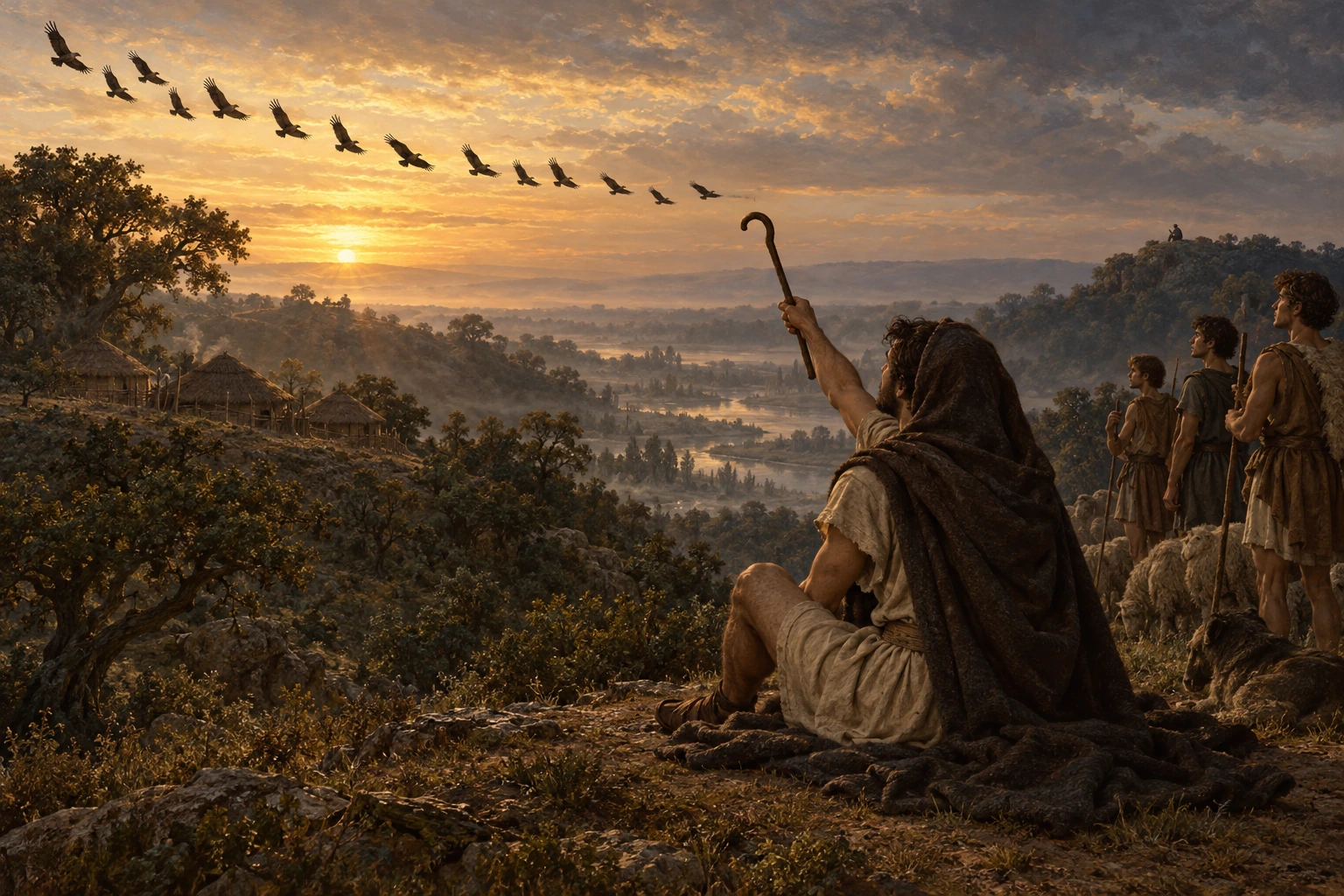
The oldest telling of the scene is in verse. Cicero quotes lines from the Annals of the poet Ennius, Rome’s history in epic verse. In our translation: the brothers, “eager for the kingdom”, watch for the birds; “they contended whether they should call the city Roma or Remora”; the people wait as the crowd at the races watches the starting gates for the consul’s signal. Then, as the golden sun rises, twelve “sacred bodies” of birds come down from the sky, and Romulus sees that the throne is his (On Divination 1.107–108).
1-5 The Furrow and the Wall
Ovid describes the founding rite, held on the feast of Pales: a pit dug down to solid ground, filled with the fruits of the earth and with soil from the neighbouring land, and an altar built over it; then Romulus, pressing on the plough handle, marked out the line of the walls with a furrow, behind a white cow yoked with a snow-white ox (Fasti 4.819–826). Plutarch adds that men summoned from Etruria taught him the sacred rules, and that the plough was lifted and carried over the places where gates would be (11.1–3).
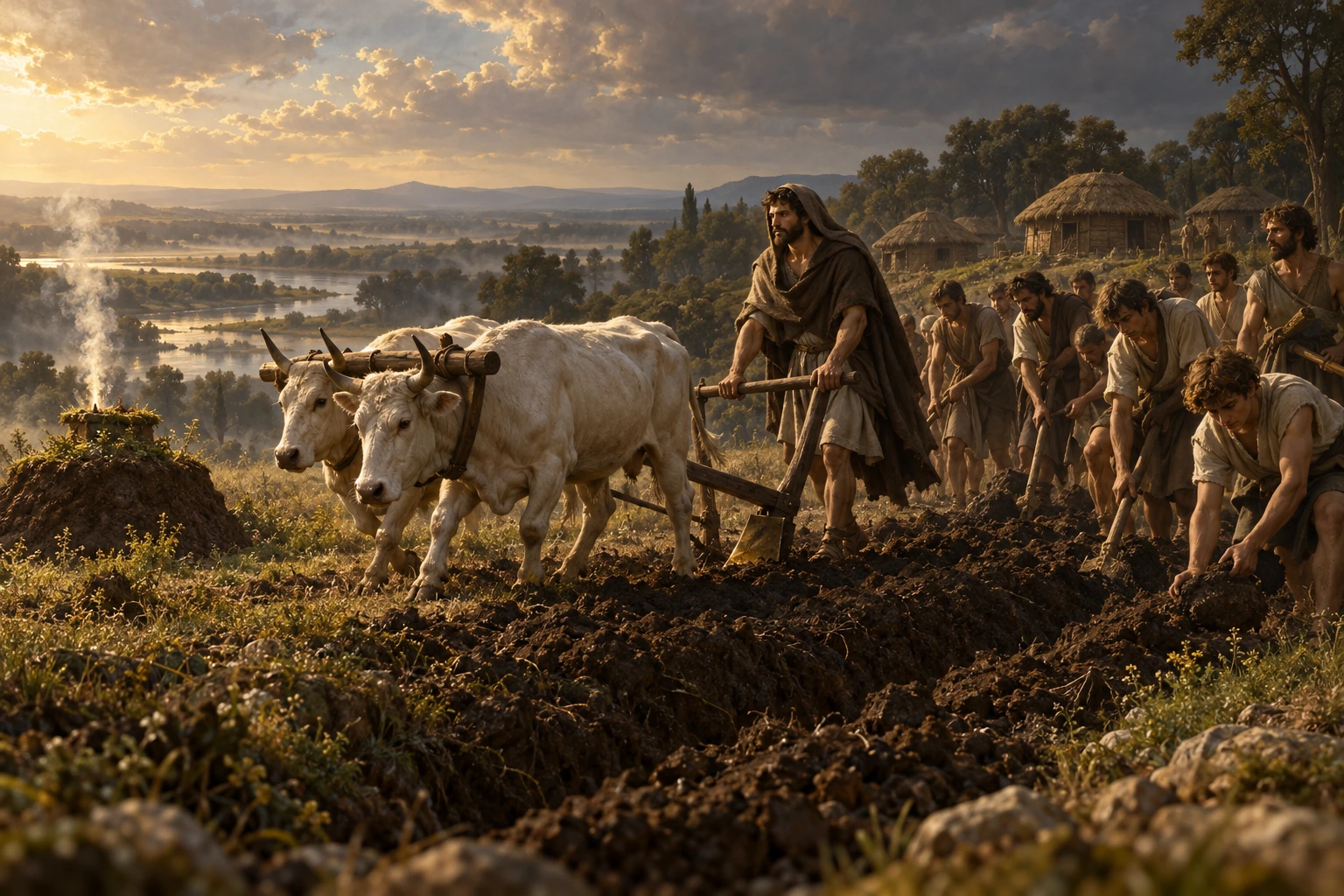
There Remus died. Livy tells it both ways, one sentence each. Either the quarrel over the birds came to blows and “Remus was struck down in the affray”, or, in “the commoner story”, Remus leaped over the new walls in mockery, and Romulus killed him in anger, adding: “So perish whoever else shall leap over my walls!” (1.7.2). “Thus Romulus acquired sole power, and the city, thus founded, was called by its founder’s name” (1.7.3).
1-6 The Sabine Women
To fill the city, Romulus opened a sanctuary on the hill between two groves (the Capitoline, Foster notes), and fugitives came from the peoples around, “without distinction of bond or free” (1.8.5–6). But there were no women, and the neighbours would not let their daughters marry Romans (1.9.1–5). So Romulus announced games for the equestrian Neptune, the Consualia. The neighbours came to see the new city, the Sabines with their wives and children, and when the show began the young Romans seized the unmarried girls. The parents fled, calling on the gods whose festival had been betrayed, and Romulus told the captured women that they would be lawful wives, sharing the Romans’ property, their citizenship and their children (1.9.6–16). Their towns went to war one after another. Romulus killed the king of Caenina in battle and carried his armour up the Capitol to Jupiter Feretrius, the first temple in Rome (1.10), and his wife Hersilia persuaded him to pardon the women’s parents (1.11.2–3).
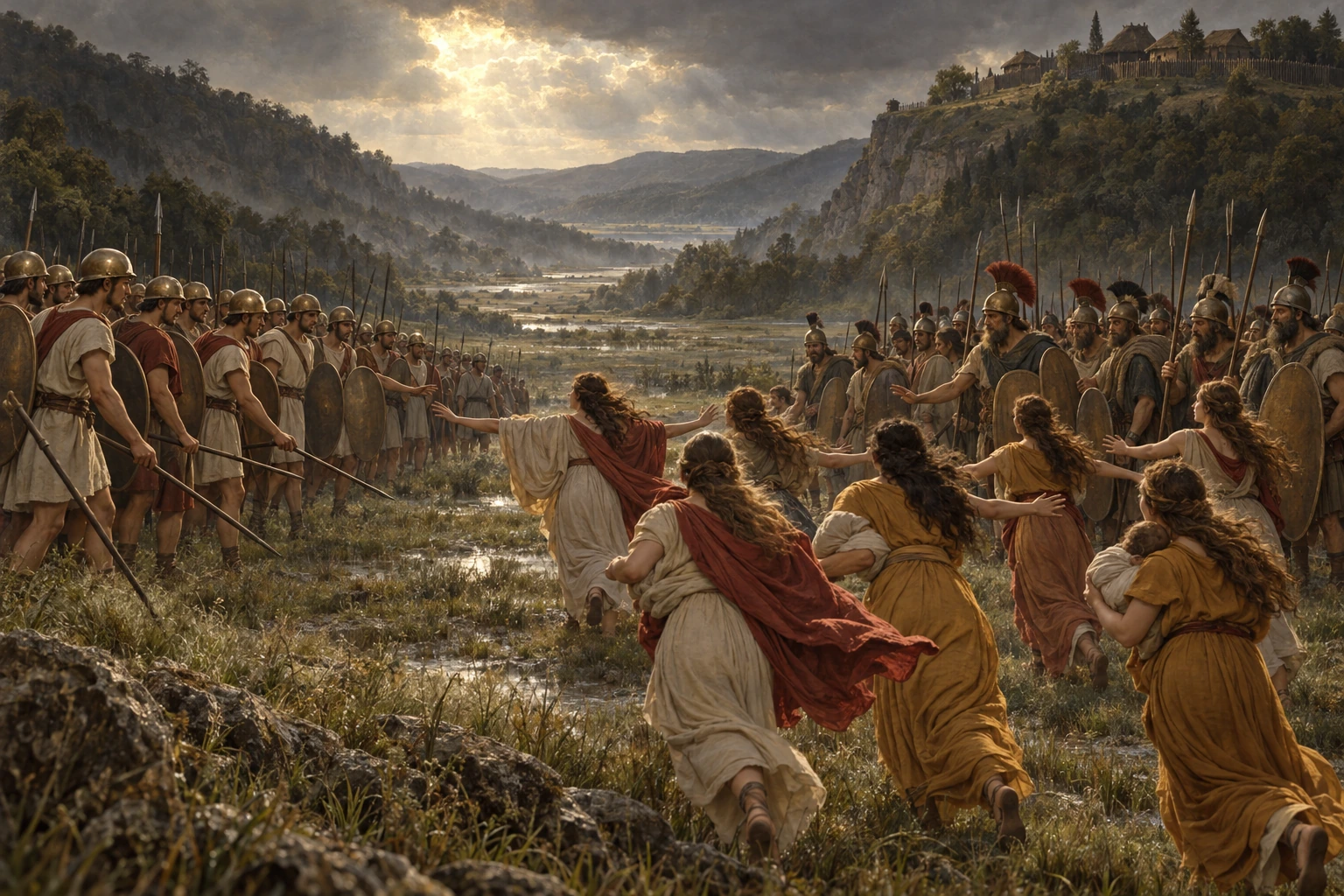
The Sabines under their king, Titus Tatius, came last, and came by trickery. Tarpeia, the unmarried daughter of the Roman commander of the citadel, had gone outside the walls to fetch water, and was bribed with gold to let armed men in; once inside, they crushed her under their shields. Livy reports the tales: that she had asked for what they wore on their left arms, meaning their gold bracelets, and got their shields, or that she had asked for the shields themselves (1.11.6–9). In Ovid’s Fasti it is the god Janus who then stops the Sabines at a gate with a jet of hot spring water (Janus). The armies fought in the marshy valley between the Palatine and the Capitol, where the Forum would one day stand, and when the Romans broke, Romulus vowed a temple to Jupiter the Stayer (1.12). Then the Sabine women, “with loosened hair and torn garments”, ran in among the flying weapons, between their fathers and their husbands: “turn your anger against us”, Livy has them say; “we are the cause of war” (1.13.1–3). The leaders made one people out of two, the citizens were called Quirites after the Sabine town of Cures, and Romulus and Tatius ruled together until Tatius was killed at Lavinium (1.13.4–8, 1.14.1–2).
1-7 Quirinus
Years later, Romulus was reviewing the army on the Campus Martius, near the swamp of Capra, when a storm broke and hid him in a cloud, “and from that moment Romulus was no more on earth”. The senators said he had been caught up on high, and the soldiers hailed him as a god; Livy notes the other rumour, which went about “in very obscure terms”, that the senators had torn him to pieces. Then Proculus Julius swore that Romulus had come down from the sky at dawn with a message: “my Rome shall be the capital of the world” (1.16). In Ovid, Mars asks Jupiter for his son, and Proculus meets Romulus by moonlight on the road from Alba Longa, taller than a man, and is told that the Romans must bring incense to “the new Quirinus”; temples were built, and the Quirinal hill took his name (Fasti 2.481–512). In Plutarch, Romulus says it himself: “I will be your propitious deity, Quirinus” (28.2).
2 Where the Story Is Written Down
- The Ogulnii’s statue, 296 BCE. In that year, by the traditional dating, the aediles Gnaeus and Quintus Ogulnius used fines from moneylenders to set up, by the Ficus Ruminalis, “images of the infant founders of the city under the teats of a she-wolf” (Livy 10.23, our translation). Nicholas Purcell calls it “the first completely unambiguous attestation of the developed saga”.
- Coins and a mirror. A silver didrachm struck at Rome in 269–266 BCE shows the head of Hercules on one side and the she-wolf suckling the twins on the other (type RRC 20/1). A bronze mirror from Bolsena, probably made at Praeneste in the 4th century BCE and now in the Musei Capitolini, has the suckling of the twins at its centre; the museum takes it as proof that the Etruscans knew the myth.
- The first histories. Plutarch says the common version was first published among the Greeks by Diocles of Peparethus, and that Fabius Pictor followed him in most points (3.1). Fabius, the oldest Roman historian, a senator sent to consult the oracle at Delphi in 216 BCE, wrote in Greek, and his work is lost. Dionysius says that Cincius, Cato, Piso and most others followed Fabius (1.79.4). The poet Ennius (239–169 BCE) told the history of Rome in the eighteen books of his Annals; the augury survives because Cicero quoted it.
- Livy, History of Rome 1.3–16, begun between 27 and 25 BCE, and Dionysius of Halicarnassus, a Greek who lived in Rome from 30 BCE, Roman Antiquities 1.76–2.56. Where the old authors disagree he often gives both versions, and “each of my readers will decide for himself which to believe” (1.79.3).
- Ovid’s Fasti, a poem on the festivals of the Roman calendar, which stops at June because Augustus banished him in 8 CE: the wolf and the Lupercal (2.381–424), Quirinus (2.475–512), the founding at the Parilia (4.807–862).
- Plutarch (about 46–after 119 CE), Life of Romulus, paired with his Life of Theseus. He names his sources as he goes, and admits that some readers suspect the story’s “fictitious and fabulous quality” (8.7).
3 Competing Versions
- Who killed Remus? In Livy, someone in the brawl, or Romulus (1.7.2). Dionysius thought the brawl likeliest: Faustulus threw himself unarmed between the fighters and died, and Romulus, in grief, wanted to die too until Larentia comforted him. In the other story he knew, Remus leaped the new wall and Celer, the overseer of the work, killed him with a mattock (1.87). Plutarch: Romulus, or Celer (10.1). In Ovid, Romulus orders Celer to kill anyone who crosses the wall or the furrow; Remus, not knowing, mocks the low wall and jumps, and Celer strikes him with a spade. Romulus swallows his tears in public, then weeps at the pyre: “Brother, taken from me against my will, farewell” (Fasti 4.837–852).
- Who won the augury? In Livy each side claimed the win. Dionysius and Plutarch both report that Romulus cheated, claiming a sign before he had seen one, and that the twelve vultures came anyway (Dionysius 1.86.3–4; Plutarch 9.5). In Ovid there is no quarrel: the brothers keep to their agreement (Fasti 4.817–818). In Ennius it is Romulus who watches from the Aventine. And Remus’s own site was the Aventine (Livy; Plutarch, who calls it Remonium), or Remoria, a hill about thirty stades from Rome (Dionysius 1.85.6).
- A wolf, or a woman nicknamed Lupa? Livy: “Some think that Larentia, having been free with her favours, had got the name of ‘she-wolf’ among the shepherds” (1.4.7); Foster notes that lupa could mean “courtesan”. Dionysius tells the whole story without wonders: Numitor swapped the babies, and Laurentia, a former prostitute, was the “Lupa” (1.84). Plutarch knows the double meaning too (4.3).
- The father and the mother. One of Ilia’s suitors, Amulius himself in armour, or the god of the grove (Dionysius 1.77.1–2); Plutarch reports the story of Amulius in armour (4.2). Rhea Silvia was put to death at once, or kept in a secret prison until Amulius died (Dionysius 1.79.2).
- Romulus’s end. Dionysius calls the murder by the senators the “more plausible” account (2.56.3–4). Plutarch says he vanished on the Nones of July, “leaving no certain account” of his death (27.3).
4 History and Tradition
- The year. Dionysius lists the founding dates that historians gave: Timaeus, 38 years before the first Olympiad; Cincius, the fourth year of the twelfth; Fabius, the first year of the eighth; Cato, 432 years after the Trojan War; Polybius, the second year of the seventh (1.74). His translator converts them to 813, 728, 747, 751 and 750 BCE. The scholar Varro set his friend Tarutius to cast Romulus’s horoscope backwards from the events of his life, and Tarutius found that Rome was founded on the ninth day of the Egyptian month Pharmuthi (Plutarch 12.3–6). In 238 CE Censorinus still counted the years of the city “from the Parilia”, by Varro’s reckoning, and made his own year the 991st (On the Birthday 21.4–6): by that traditional (Varronian) dating, Rome was founded in 753 BCE. Varro also recorded an augur, Vettius, who read the twelve vultures as twelve centuries, 1,200 years, for Rome (17.15).
- 21 April and the Parilia. The founding day was the Parilia, the shepherds’ feast of Pales (Plutarch 12.1; Ovid, Fasti 4.819–820). Plutarch says the feast was older than the city; Dionysius could not tell (1.88.3). In April 1923 a decree-law signed by the king and by Mussolini as prime minister made 21 April, “the day commemorating the founding of Rome”, a holiday for “the celebration of labour”, and abolished the de facto holiday of 1 May.
- The Lupercalia. Held on 15 February, “the third dawn after the Ides” in Ovid (Fasti 2.267). Plutarch describes it: goats and a dog were sacrificed, two youths of noble birth were touched on the forehead with a bloody knife and wiped with wool dipped in milk, and the Luperci ran about wearing only a girdle, striking the people they met with thongs cut from the goats’ skins; young wives welcomed the blows, believing they helped conception. The runners started where Romulus was said to have been exposed (21.3–5). Augustus lists the Lupercal among the buildings he made (Res Gestae 19).
- The Palatine and the Lupercal. The hill has been lived on since the 10th–9th century BCE. A village of oval huts, with walls of wattle and daub and thatched roofs on wooden posts, stood on its south-western corner, the Cermalus, until the late 7th century (Parco archeologico del Colosseo). One hut there was shown in antiquity as the hut of Romulus and repaired whenever storms damaged it (Dionysius 1.79.11), and Augustus built his house next to these huts. Andrea Carandini, who excavated the north slope of the hill for twenty years, dates a wall there to the second quarter of the 8th century BCE and holds that Romulus really founded Rome about 750 BCE; his reviewer in the Bryn Mawr Classical Review calls this view controversial. The Heibonsha World Encyclopedia gives the more usual reading: apart from the archaeological fact of a settlement on the Palatine in the 8th century BCE, the tradition can hardly be taken as history, and Romulus was more likely invented from the name of Rome. In November 2007 Italy’s culture minister, Francesco Rutelli, called a newly found grotto under the Palatine, near Augustus’s house, “a mythological place which has finally become real”. Fausto Zevi of Sapienza University replied that the vaulted, mosaic-covered room looked like a nymphaeum or dining room of a palace, and that the Lupercal must have lain elsewhere, near the temple of the Great Mother.
- A late twin? T. P. Wiseman, in Remus: A Roman Myth (1995), argued that Remus entered the story in the late 4th and early 3rd century BCE, when the plebeians won a share of power and a second founder stood for them. Reviewing the book, Nicholas Purcell found it “exciting and persuasive” but the claim “too strong”.
- The Capitoline Wolf. The bronze stood at the Lateran, the popes’ residence, from at least the 10th century, as a symbol of papal justice, and came to the Capitol with the ancient bronzes that Pope Sixtus IV gave the city in 1471. The twins were added later, attributed by some to Antonio del Pollaiuolo, and turned it into the “Mater Romanorum”. The Musei Capitolini date the wolf to the 5th century BCE, from “Etruscan or Magna Graecia workshops”, and add that it “originally had probably nothing to do with the legend”. A note in the 1937 Loeb Dionysius still called it “almost certainly” the wolf on the Capitol that lightning struck in 65 BCE, when, Cicero says, the gilded infant Romulus “gaping at the wolf’s teats” was hit (Against Catiline 3.19). In the 1930s the city government gave full-size copies to cities around the world, Cincinnati among them in 1931, and Mussolini’s regime used the image in its propaganda.
The Capitoline Wolf is often called an Etruscan bronze of the 5th century BCE, twins and all. The twins are not ancient: the museum itself says they were added after the statue reached the Capitol in 1471. The wolf’s own date is disputed. The museum keeps the 5th century BCE, and in the papers of a debate held at Sapienza University in 2008 Giovanni Colonna called it “a Roman monument of the beginning of the Republic”. But the restorer Anna Maria Carruba argued in 2006 that it was cast in one piece, in the medieval way, and radiocarbon dating of organic residue in its casting core, published by Lucio Calcagnile’s team in 2019, puts it in the 11th–12th century CE. A thermoluminescence study in 2021 agreed.
5 Related Stories
- Aeneas: The Trojan Who Became Rome’s Ancestor: Livy opens the twins’ story with Aeneas’s son founding Alba Longa, and Numitor, Amulius and Rhea Silvia descend from him.
- Mars: The Father of Rome: Rhea Silvia named Mars as the father, and Plutarch says the wolf and the woodpecker were his creatures. If any people may trace its founder to a god, Livy writes, it is the Romans, who name Mars (preface 7).
- Vesta: The Hearth Goddess and Her Virgins: Rhea Silvia was a Vestal, and Plutarch reports a tradition that Romulus himself, not Numa, appointed the virgins who guarded the sacred fire (22.1).
- Janus: The Two-Faced God of Doorways: in Ovid’s Fasti, Janus tells the poet how he held back the Sabines of Titus Tatius with a hot spring (1.259–276).
- The Founding of Tenochtitlan: The Eagle on the Cactus: in Mexico, too, a sign in nature, an eagle on a cactus, showed where the city should stand, and the sources disagree on the year. We have not found a scholar who compares the two stories; we link them for the theme.
6 Sources
- Livy, History of Rome, preface and 1.3–16, trans. B. O. Foster (Loeb, 1919); Latin text of book 10: Perseus, The Latin Library
- Dionysius of Halicarnassus, Roman Antiquities 1.74–88 and 2.56, trans. Earnest Cary (Loeb, 1937): LacusCurtius, LacusCurtius
- Plutarch, Life of Romulus, trans. Bernadotte Perrin (Loeb, 1914): LacusCurtius
- Ovid, Fasti 1.259–276, 2.267, 2.381–424, 2.475–512, 3.53–54 and 4.807–862, Latin text: The Latin Library, The Latin Library
- Cicero, On Divination 1.107–108 (quoting Ennius) and Against Catiline 3.19, Latin text; Censorinus, On the Birthday 17.15 and 21.4–6, Latin text; Augustus, Res Gestae 19, trans. F. W. Shipley (Loeb, 1924): The Latin Library, The Latin Library, LacusCurtius, LacusCurtius
- RRC 20/1, Coinage of the Roman Republic Online; Musei Capitolini, “Lupa Capitolina”; Francesca Ceci and Giorgia Pellini, “Le Lupe di Roma” (2023): American Numismatic Society, museicapitolini.org, Musei in Comune
- L. Calcagnile and others, “Solving an historical puzzle: Radiocarbon dating the Capitoline she wolf”, Nuclear Instruments and Methods in Physics Research B 455 (2019); M. Martini and A. Galli, “Thermoluminescence Analysis of the Clay Core of Bronze Statues”, Applied Sciences 11 (2021); G. Bartoloni (ed.), Lupa capitolina: nuove prospettive di studio (L’Erma di Bretschneider, 2010), the papers of the Sapienza debate of 28 February 2008; M. Rissanen, review, Arctos 45 (2011): doi.org, doi.org, Torrossa, JYX
- Associated Press, “Ancient Rome’s she-wolf statue not so ancient?”, 11 July 2008; Rossella Lorenzi, “Roman Icon Actually Younger Than the City”, 25 June 2012: nbcnews.com, livescience.com
- Parco archeologico del Colosseo, “Palatium: living on the Palatine”; UPI, “Dig yields shrine to Roman twins’ she-wolf”, 21 November 2007; Fausto Zevi, interview in la Repubblica, 23 November 2007: colosseo.it, phys.org, web.archive.org
- Nicholas Purcell and John Van Sickle, reviews of T. P. Wiseman, Remus: A Roman Myth (Cambridge, 1995); Jeremy B. Lefkowitz, review of A. Carandini, Rome: Day One (Princeton, 2011): BMCR, BMCR, BMCR
- Regio decreto-legge 19 aprile 1923, n. 833; Turismo Roma, “Natale di Roma 2026”: Normattiva, turismoroma.it
- Treccani, Enciclopedia on line: “Ennio, Quinto”, “Livio, Tito”, “Dionisio di Alicarnasso”, “Ovidio Nasone, Publio”, “Plutarco”, “Fabio Pittore, Quinto”, “Censorino”: Treccani, Treccani, Treccani, Treccani, Treccani, Treccani, Treccani
- Hirata Ryūichi, “ロムルス”, Heibonsha World Encyclopedia, Kotobank; Japanese translations: Iwaya Satoshi, Rōma kenkoku irai no rekishi 1 (Kyoto University Press, 2008); Yaginuma Shigetake, Eiyūden 1 (Kyoto University Press, 2007); Takahashi Hiroyuki, Saireki (Kokubunsha, 1994; Kōdansha Gakujutsu Bunko, 2025): NDL, NDL, NDL, NDL
Cover and illustrations: AI-generated images made for Arcana. They are interpretations, not historical artworks.