Vesta: The Hearth Goddess and Her Virgins
In a small round temple in the Forum, with no statue of the goddess in it, six priestesses kept the fire on which Rome's safety was thought to depend. They were chosen as little girls, bound for thirty years, and kept the flame until the end of the 4th century CE.
- Type: a goddess and her cult: the fire that must not go out, the round temple and the Vestal Virgins
- Culture: ancient Rome, from the kings (by tradition) to the end of the 4th century CE
- Earliest texts: Cicero, Livy, Dionysius of Halicarnassus and Ovid’s Fasti, of the 1st century BCE and the reign of Augustus; later Plutarch’s Life of Numa and Aulus Gellius
- Key figures: Vesta, the Vestal Virgins, the pontifex maximus, Priapus, Aemilia, Tuccia, Lucius Caecilius Metellus
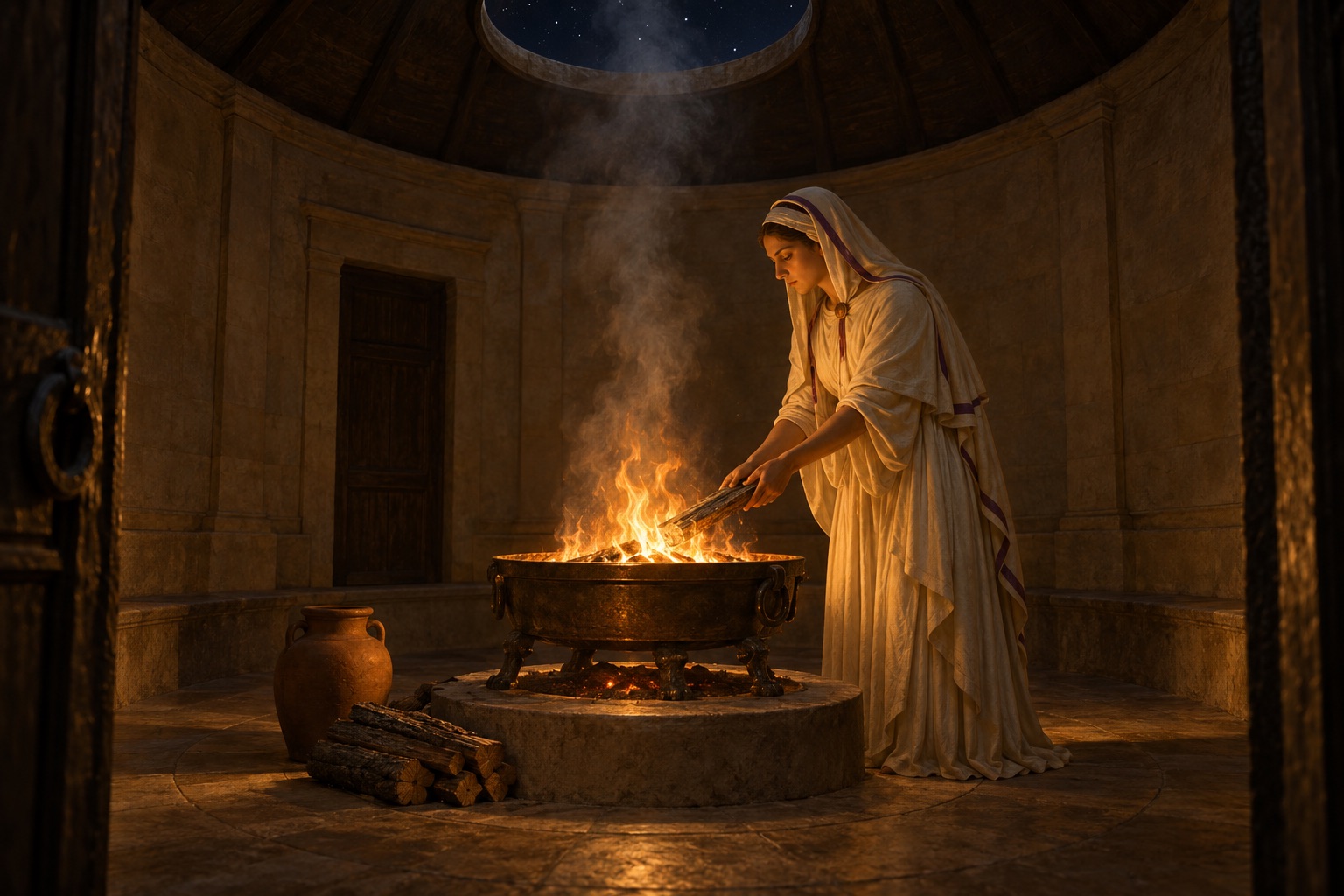
Rome’s most sacred fire burned in a small round building at the edge of the Forum, and there was no statue beside it. “Understand Vesta as nothing but living flame,” Ovid told his readers. Its priestesses, six of them in later times, were taken from their families as little girls, and they kept that fire for the city from the reign of King Numa, by Roman tradition, until the 390s CE.
Did Vesta’s fire really never go out? It was never supposed to, and when it did the Romans took it as an omen of the city’s destruction (Dionysius 2.67.5). Livy records one night in 206 BCE when it went out: the Vestal on watch was flogged on the pontiff’s orders, though Livy says it was “human negligence”, not a sign from the gods (28.11). And once a year it was renewed on purpose: on 1 March, Ovid writes, “a new fire is said to be made in the hidden shrine” (Fasti 3.143–144).
1 The Telling
There is no single story of Vesta. The longest account is in Ovid’s Fasti, a poem on the Roman calendar, under 9 June, the day of the Vestalia (book 6, lines 249–468, numbered as in The Latin Library’s text). The historians Livy and Dionysius of Halicarnassus and the biographer Plutarch describe her priestesses. Quotations from Ovid, Livy, Cicero, Valerius Maximus and the Theodosian Code are our own translations from the Latin.
1-1 Nothing but Living Flame
Ovid begins with a prayer. He felt the goddess near, he says, but did not see her: “you were not to be looked upon by a man” (6.251–254). Rome had celebrated its birthday forty times when the goddess who guards the flame was given a temple, the work of the peaceful King Numa; its roof was then thatch, its walls woven wicker (6.257–262).
The temple was round, and Ovid explains why: Vesta is the same as the earth, the earth is a ball hanging at the centre of the universe, and so in her temple “no corner juts out” (6.267–282). She was one of the three daughters of Saturn and Ops; Juno and Ceres married, but she would not have a husband (6.285–288). “Understand Vesta as nothing but living flame, and you see no bodies born of flame” (6.291–292). For a long time, Ovid admits, he foolishly thought the temple held statues of Vesta; then he learned that there were none under its curved dome, only a fire that never dies (6.295–298). His Vesta also stands at the beginning of things. Her name, he suggests, comes from vi stando, “standing by her own force”, and the Greek name may have the same cause. The hearth once stood at the front of the house, and from it, he thinks, comes vestibulum, the entrance; and so “in praying we address Vesta first, who holds the first place” (6.299–304).
1-2 The Donkey That Woke the Goddess
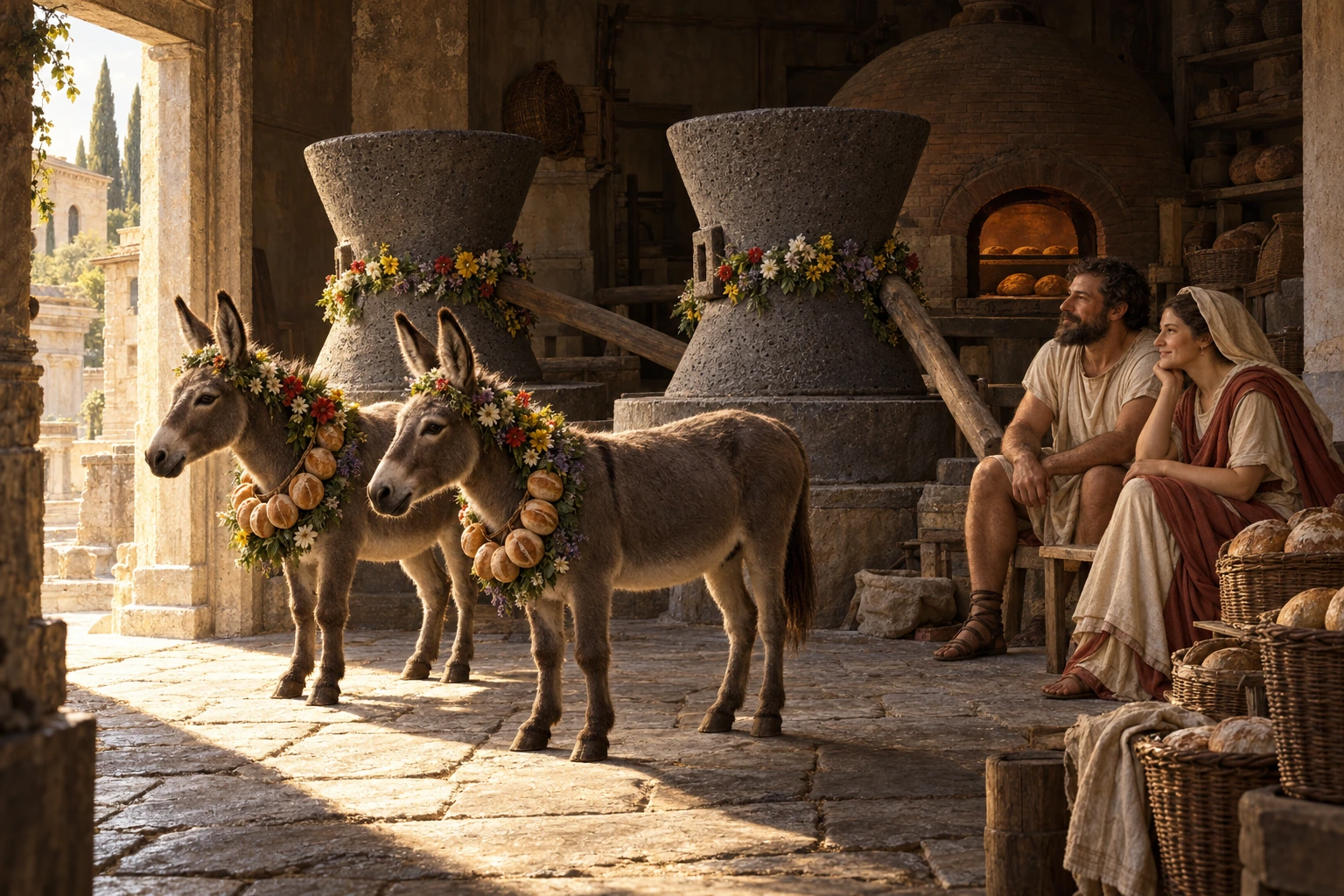
On the Vestalia, Ovid writes, “look, loaves hang from garlanded donkeys, and flowery wreaths cover the rough millstones” (6.311–312). Farmers once baked their bread in the ashes of the hearth, so the bakers honour the hearth, its mistress, and the donkey that turns the mill (6.313–318).
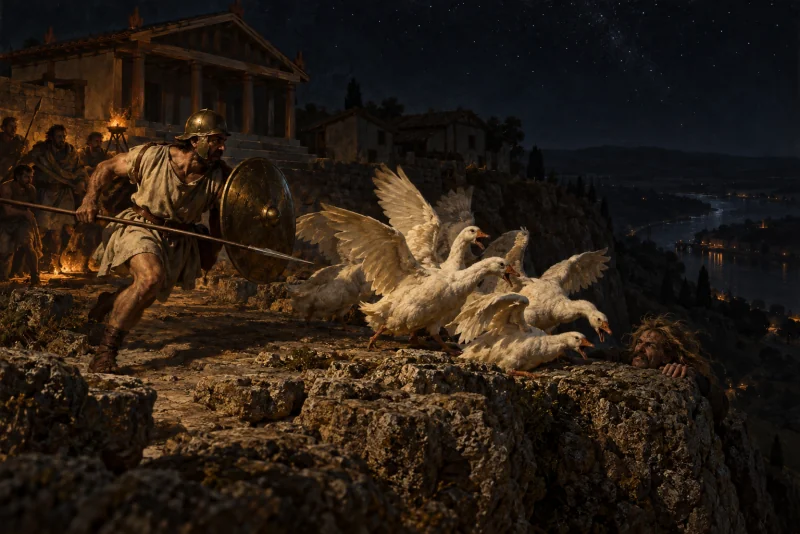
Then Ovid tells “a short tale full of fun” to the shame of Priapus, the red-faced guardian of gardens (6.319–348). The goddess Cybele, crowned with towers, invited the gods to a feast on Mount Ida, with satyrs and nymphs, and old Silenus came though no one had asked him. They drank through the night; some danced, some wandered the valleys, some slept. Vesta lay down on the grass and slept peacefully, her head on a pillow of turf. Priapus was roaming after nymphs and goddesses. He saw Vesta. Whether he took her for a nymph or knew who she was is uncertain, Ovid says, “but he himself denies he knew”. He crept towards her on tiptoe, his heart pounding. But Silenus had left his donkey by a murmuring stream, and just then it brayed. The goddess woke in fright, the whole company came running, and Priapus escaped through their hands. His town of Lampsacus sacrifices donkeys to him; Vesta, remembering, hangs necklaces of bread on the donkey, and on her day the mills fall silent.
1-3 What the Temple Hid
Dionysius was sure the temple held more than fire: “there are indeed some holy things, unknown to the public, kept by the virgins”, but what they were, he would not inquire too curiously (2.66.6). Some said they were sacred objects from Samothrace, carried to Troy by Dardanus and to Italy by Aeneas; others, the Palladium, the image that fell from heaven at Troy (2.66.5). Plutarch adds the story of two small jars, one open and empty, the other full and sealed (Camillus 20). Ovid tells the Palladium’s story (6.419–436). When Ilus had just built the walls of Troy, an image of armed Minerva leapt down from the sky onto the citadel, and Apollo’s oracle said: “Guard the heavenly goddess, and you will guard the city: she will carry the rule of the place with her.” Diomedes took it from Troy, or Ulysses, or Aeneas: “the doer is uncertain; the thing is Roman. Vesta guards it.”
In 241 BCE, during the First Punic War, the temple burned, and while the Vestals fled, the pontiff Lucius Caecilius Metellus went into the flames and carried the sacred things out (Dionysius 2.66.4; Ovid 6.437–454; the year is Platner’s). Pliny the Elder says he spent his old age blind, having lost his sight in that fire when he snatched the Palladium (7.141). In the fire of 191 CE, the historian Herodian writes, the image of Pallas was seen by men for the first time since it came from Troy, as the Vestals carried it along the Sacred Way to the emperor’s palace (1.14.4–5).
1-4 “I Take Thee, Amata”
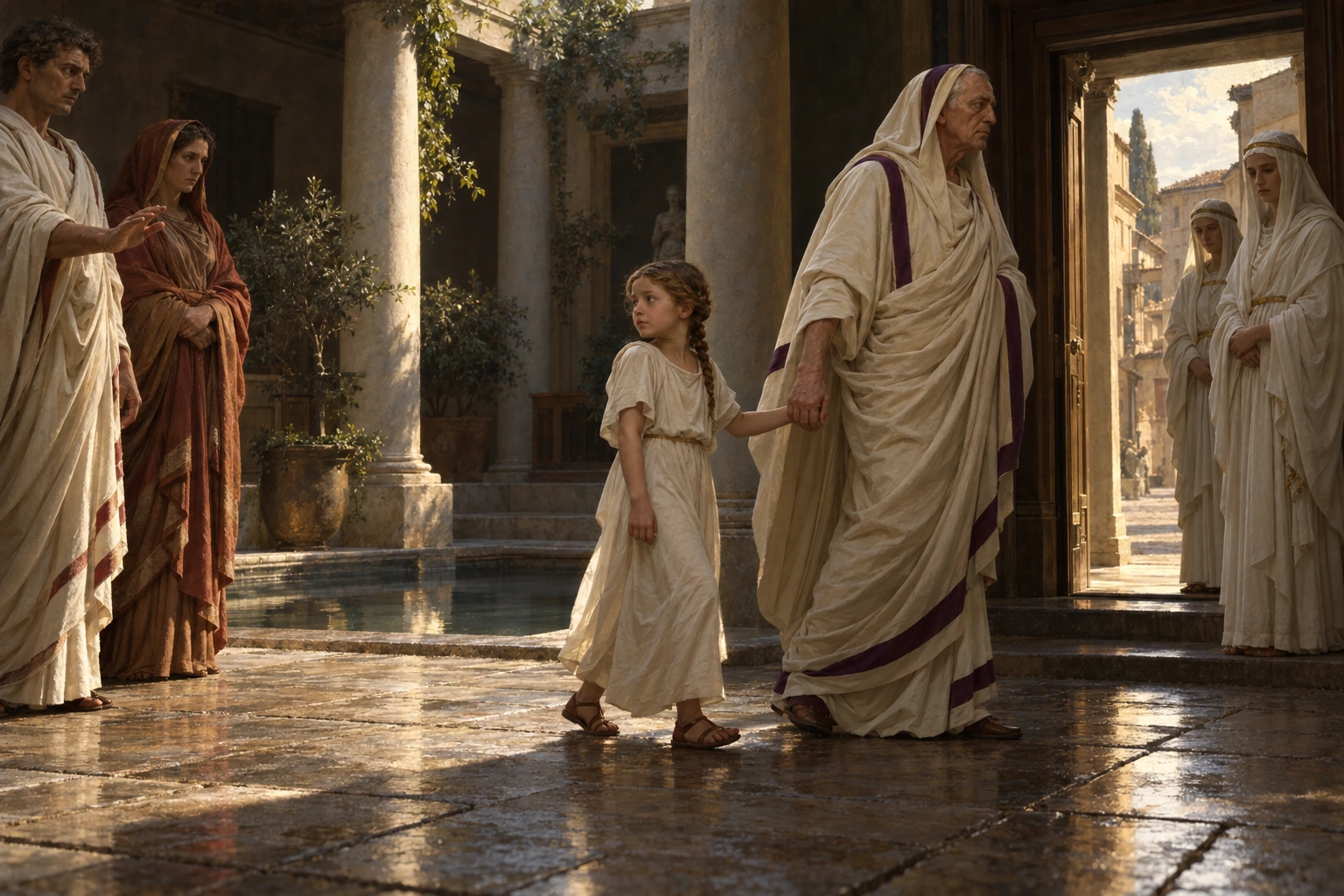
Aulus Gellius collected the rules for choosing a Vestal from the jurist Antistius Labeo and others. She had to be between six and ten years old, with both parents living, free of any impediment of speech or hearing or other bodily defect, and her parents must not have been slaves (1.12.1–5). Under a Papian law the pontifex maximus named twenty girls and one was chosen by lot; but in Gellius’s day a man of good birth could simply offer his daughter (1.12.11–12). Tacitus describes one choice, in 19 CE. Two men offered their daughters to replace Occia, who had presided over the rites for fifty-seven years; the emperor Tiberius preferred the daughter of Domitius Pollio, because her parents were still married, and gave the other girl a dowry of a million sesterces (Annals 2.86).
She was “taken”, Gellius explains, because the pontifex grasped her by the hand and led her from her father “as if she had been taken in war”. The formula, from the first book of the historian Fabius Pictor, ran: “I take thee, Amata, … to be priestess of Vesta” (Rolfe’s translation, 1.12.13–14). Every new Vestal was called Amata, “because there is a tradition that the first one who was chosen bore that name” (1.12.19). At once she passed out of her father’s control and gained the right to make a will (1.12.9).
1-5 Thirty Years
Plutarch says Numa first consecrated two Vestals, Gegania and Verenia, then added Canuleia and Tarpeia, and King Servius two more, making the six of later times. They vowed chastity for thirty years: ten to learn their duties, ten to perform them, ten to teach them. Then any who wished could lay down the office and marry. Few did, and those were said to have been unhappy, so that “until old age and death they remained steadfast in their virginity” (Numa 10.1–2; Dionysius 2.67.2).
Their privileges were great. A Vestal could make a will in her father’s lifetime and manage her affairs without a guardian. The fasces were carried before her in public. A criminal she met by chance on his way to execution was spared, if she swore the meeting was accidental, and anyone who passed under her litter was put to death (Numa 10.3). Romans of his day believed, Pliny writes, that a Vestal’s prayer could hold a runaway slave to the spot, if he had not yet left the city (28.13).
For lesser faults the pontifex scourged a Vestal (Dionysius 2.67.3; Numa 10.4). One who broke her vow was buried alive. She was carried through a silent Forum on a closed litter to the Colline Gate, led down into a small underground room with a couch, a lamp and a little bread, water, milk and oil, and the entrance was filled with earth (Dionysius 2.67.4; Numa 10.4–7). Livy says the place where the Vestal Minucia was buried was called the Campus Sceleratus, the Wicked Field, “from the unchastity, I believe” (8.15). After Cannae, in 216 BCE, two Vestals, Opimia and Floronia, were found guilty: one was put to death at the Colline Gate “as is the custom”, the other took her own life, and Floronia’s lover was beaten to death (22.57). Ovid gives the reason for the earth: the guilty Vestal is buried in the one she wronged, for “Earth and Vesta are the same divinity” (6.459–460).
1-6 Aemilia and Tuccia
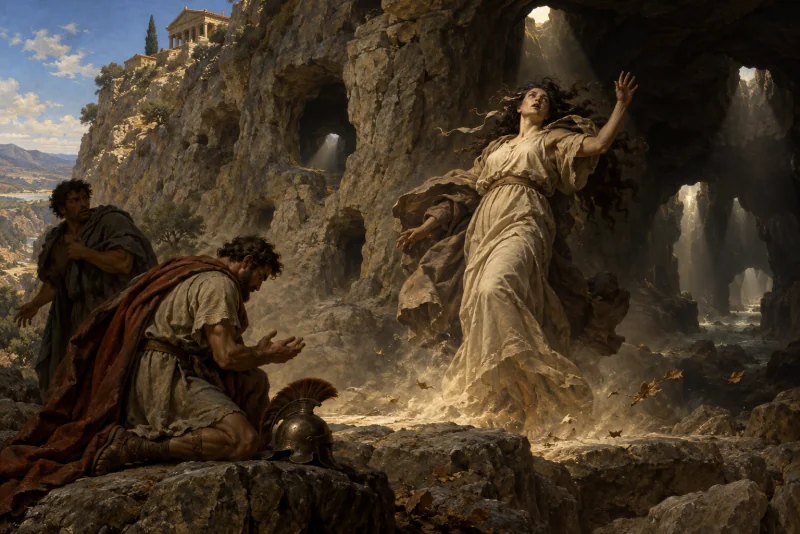
Dionysius tells of two Vestals the goddess saved. Once the fire went out while Aemilia, who was in charge of it, had left it to a newly chosen girl, and the pontiffs began to ask whether a Vestal had been unchaste. Aemilia stretched out her hands to the altar, begged Vesta to defend her if she had served her purely for nearly thirty years, and threw the band of her linen dress onto the altar. From ashes long cold, a great flame flared up through the linen (2.68).
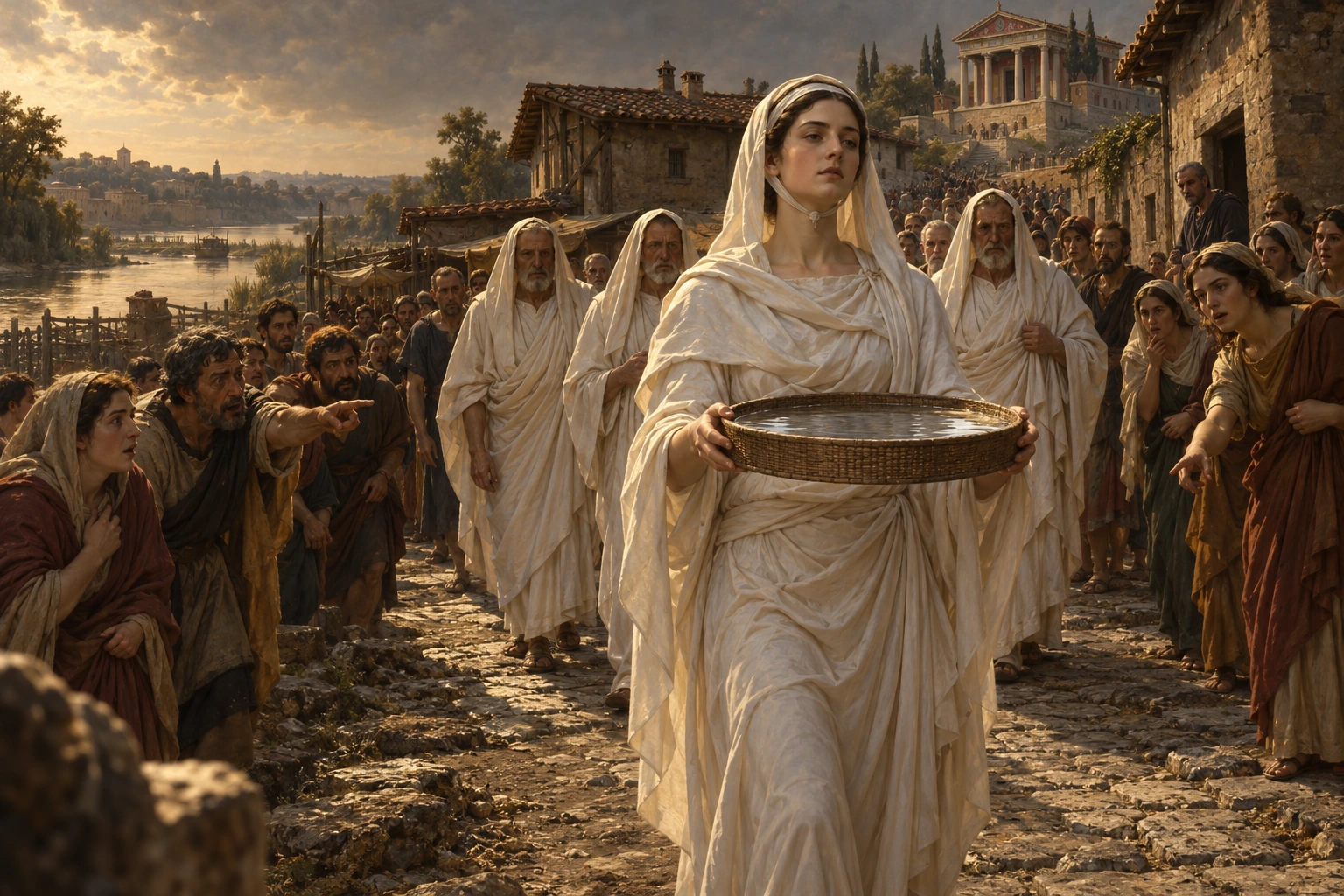
The second story is “still more wonderful and more like a myth”. Tuccia, falsely accused, said only that she would clear herself by deeds. With the pontiffs’ consent, and the whole city following, she went to the Tiber, drew up water in a sieve, carried it to the Forum and poured it out at the pontiffs’ feet. Her accuser was never found, alive or dead (2.69). In Valerius Maximus she prays: “Vesta, if I have always brought chaste hands to your rites, let me draw water from the Tiber with this and carry it to your temple” (8.1.abs.5).
2 Where the Story Is Written Down
- Ovid, Fasti, a poem on the Roman year that covers only January to June: Vesta’s passage under 9 June (6.249–468), the sweeping of her temple on 15 June (6.713–714), the new fire of 1 March (3.141–144).
- Livy, History of Rome (Ab urbe condita): Numa chooses virgins for Vesta, “a priesthood from Alba”, and pays them from the public treasury (1.20). Before the Gauls take the city, the priest of Quirinus and the Vestals bury some of the sacred things in jars and carry the rest away (5.40). Camillus speaks of “the eternal fires of Vesta” and the image kept in her temple “as the pledge of empire” (5.52).
- Dionysius of Halicarnassus, Roman Antiquities 2.64–69: a Greek historian who lived in Rome under Augustus, on the founding, the hidden objects, the rules, Aemilia and Tuccia.
- Plutarch, Life of Numa 9–11 and Life of Camillus 20: the fire, the number of Vestals, the thirty years, the privileges and the punishments.
- Cicero, On the Nature of the Gods 2.67, where the Stoic Balbus, one of the speakers, derives Vesta’s name from the Greek Hestia; Aulus Gellius, Attic Nights 1.12, on the choosing, from the jurists Labeo and Capito and the historian Fabius Pictor; and the anecdotes of Valerius Maximus (1.1.6–7, 8.1.abs.5), Pliny the Elder (Natural History 7.141, 28.12–13) and Tacitus (Annals 2.86).
- On the end of the order: the laws of the Theodosian Code (16.10.10 and 16.10.12), the letters of Ambrose of Milan, the Greek historian Zosimus (New History 5.38), and inscriptions.
3 Competing Versions
- Who founded the temple? Some gave it to Romulus, Dionysius says; he himself gives it to Numa, and thinks Romulus would not have trusted the fire to virgins after what happened to his own mother (2.65–66).
- How many Vestals? Plutarch: two, then four under Numa, six from Servius (Numa 10.1). Dionysius: four, later six (2.67.1). Ambrose, in the 380s CE: “Hardly are seven Vestal Virgins received” (Letter 18.11).
- Why round? Ovid: because Vesta is the earth, and the earth is a ball (6.267–282). Plutarch: not the earth but the whole universe, at whose centre the Pythagoreans place fire (Numa 11.1). The Parco archeologico del Colosseo suggests the round huts of archaic Rome.
- First or last? Ovid: “we address Vesta first” (6.304). Cicero’s Balbus: “every prayer and every sacrifice ends with this goddess, because she is the guardian of the innermost things” (2.67).
- Vesta or Lotis? Ovid tells nearly the same story in book 1. There the sleeper is the nymph Lotis, and the donkey that woke her is killed for it: that, he says, is why donkeys are sacrificed to Priapus (1.391–440).
- No image? Ovid found no statue in the temple, and Platner’s Topographical Dictionary (1929) follows him. But Republican coins show the round temple with what the Parco calls “a probable depiction of the goddess on top”, and a shrine at the entrance of the House of the Vestals may have held her statue.
- The hidden things. The Historia Augusta says that the emperor Elagabalus broke into Vesta’s inner shrine and tried to carry off “the sacred shrine”, but took an earthenware one that the chief Vestal had shown him to deceive him; several had been made exactly alike, so that no one could take the true one (Elagabalus 6.7–9, trans. Magie).
- Aemilia and Tuccia. In Dionysius, Aemilia herself is under suspicion and throws her own linen on the altar; Valerius Maximus tells it as the rescue of Aemilia’s pupil, with “the finest linen she had” laid on the hearth (1.1.7). Was Tuccia saved? Dionysius, Valerius Maximus and Pliny say so; Pliny adds that her prayer still survived, and dates the sieve to the year 519 of the city, in the 230s BCE (28.12). But the summary of Livy’s lost book 20, which covers those years, says: “Tuccia, a Vestal virgin, was condemned for unchastity.”
- The sweepings. Ovid: on 15 June the Tiber carries Vesta’s refuse to the sea (6.713–714). Varro: it is carried by the Capitoline slope to a set place (On the Latin Language, book 6).
4 History and Tradition
- The Vestalia. The festival ran from 7 to 15 June, says the Parco archeologico del Colosseo, and the temple was then open only to women, who came barefoot; Ovid tells of the Vestalia under 9 June. On the festival he saw a matron coming down barefoot from the Nova Via to the Forum, and an old woman told him the custom went back to when the Forum was a marsh (6.395–414). Until the temple was swept out on 15 June, the wife of the priest of Jupiter told him, she could not comb her hair, cut her nails or touch her husband, and his daughter had better wait to marry (6.219–234).
- The temple today. The temple in the Forum was rebuilt many times after fires, and what survives belongs to the restoration by the empress Julia Domna after the fire of 191 CE: a round concrete podium about fifteen metres across, once faced with marble. In 1929 Alfonso Bartoli, director of excavations on the Palatine and the Forum, began to rebuild about a sixth of it in artificially aged travertine, with 89 pieces of ancient marble found in earlier digs. The Parco writes that Bartoli was “considerably motivated” by the fascist regime’s ties to imperial Rome, and to Vesta as its symbol.
- The House of the Vestals. Next to the temple, the Vestals’ house is built around a courtyard with three pools, once surrounded by a two-storey portico. Statues of chief Vestals stand there today as copies; a mill and an oven can be made out among the rooms. One base, dated 364 CE, has the Vestal’s name chiselled away, all but a C. Tradition links it with a Vestal Claudia who, in a poem by the Christian Prudentius, enters the church of St Lawrence; the Parco notes that the line can be read in different ways.
- The end of the order. In 382 CE the emperor Gratian withdrew the state’s payments to the Vestals and to the public rites. In 384 the senator Symmachus asked for them back, and Ambrose, bishop of Milan, argued against him (Letter 18). The last Vestal known from an inscription is the chief Vestal Coelia Concordia, whose statue was set up in 385. Laws issued in the names of Theodosius and his co-emperors in 391 and 392 banned sacrifice, and even the private honouring of “the Lar with fire” (Theodosian Code 16.10.10, 16.10.12). Platner dates the closing of the temple to 394, and the Parco says that after 394 the sacred fire was put out for ever; another of its pages gives 391 for the closing of the temples.
- The last Vestal. Zosimus, a pagan historian writing more than a century later, tells how Serena, the niece of Theodosius, took a necklace from the statue of Rhea in the temple of the Mother of the Gods, and “an aged woman, who was the only one remaining of the vestal virgins” cursed her, her husband and her children. Years later, during Alaric’s siege of Rome, Serena was strangled, and Zosimus calls it justice (5.38). He sets the scene after Theodosius defeated Eugenius; the Parco places it around 389.
The Vestal Virgins are often said to have served for life. They did not have to. Dionysius and Plutarch both give their term as thirty years, after which a Vestal could lay aside her fillets and marry (Dionysius 2.67.2; Numa 10.2), and the Parco archeologico del Colosseo gives the same thirty years. Many chose to stay: Occia presided over the rites for fifty-seven years (Tacitus, Annals 2.86). Even Ambrose, mocking them, spoke of their “prescribed time of virginity” (Letter 18.11).
5 Related Stories
- Romulus and Remus: The Twins and the She-Wolf: their mother Rhea Silvia was a Vestal at Alba Longa. Livy says her uncle Amulius chose her “under the pretence of an honour” and so took from her the hope of children “by perpetual virginity” (1.3).
- Numa and Egeria: The King and the Water Nymph: the king to whom Livy, Dionysius and Plutarch give the temple and the order. Plutarch adds that the Vestals purified their temple every day with water from a spring Numa declared holy (Numa 13.2).
- Aeneas: The Trojan Who Became Rome’s Ancestor: on the night Troy falls, in the Aeneid, Hector’s ghost gives Aeneas the city’s holy things and household gods, and brings out “the fillets and mighty Vesta and the eternal fire” from the inner shrine (2.293–297).
- Mount Olympus: The Real Mountain Where the Gods Lived: Cicero’s Balbus takes Vesta’s name from the Greek Hestia, the goddess who, in Plato’s Phaedrus, “alone remains in the house of the gods”. Plutarch points to a difference: in Greece the undying fires were kept “not of virgins, but of widows past the age of marriage” (Numa 9.5).
- Athena: Born from Her Father’s Head: the Greek goddess behind the Palladium. In Apollodorus, Athena made the image in the likeness of her friend Pallas after Pallas fell to her blow, and Zeus threw it down to Ilus at Troy (Library 3.12.3).
6 Sources
- Ovid, Fasti 1.391–440, 3.141–144 and 6.219–468, 6.713–714, Latin text: The Latin Library, book 3, book 1
- Dionysius of Halicarnassus, Roman Antiquities 2.64–69, trans. Earnest Cary (Loeb, 1937): LacusCurtius
- Plutarch, Life of Numa 9–13 and Life of Camillus 20, trans. Bernadotte Perrin (Loeb, 1914): LacusCurtius, LacusCurtius
- Aulus Gellius, Attic Nights 1.12, trans. J. C. Rolfe (Loeb, 1927): LacusCurtius
- Livy 1.3, 1.20, 5.40, 5.52, 8.15, 22.57, 28.11 and Periochae 19–20; Cicero, On the Nature of the Gods 2.67; Valerius Maximus 1.1, 8.1; Varro, On the Latin Language 6; Virgil, Aeneid 2.293–297, Latin texts: The Latin Library, Cicero, Valerius Maximus, Varro, Virgil
- Pliny the Elder, Natural History 7.141 and 28.12–13, Latin text (Mayhoff): LacusCurtius
- Tacitus, Annals 2.86, trans. John Jackson (Loeb, 1931); Historia Augusta, Elagabalus 6, trans. David Magie (Loeb, 1924); Herodian 1.14, trans. Edward C. Echols (1961): LacusCurtius, LacusCurtius, Livius
- Zosimus, New History 5.38 (anonymous translation, London, 1814); Ambrose, Letter 18, trans. H. de Romestin (1896); Theodosian Code 16.10.10 and 16.10.12: tertullian.org, New Advent, Université Grenoble Alpes
- Parco archeologico del Colosseo, “Tempio di Vesta e Casa delle Vestali”, “L’Aedes Vestae” (in Italian and English) and the teaching booklet Vesta; S. B. Platner and T. Ashby, A Topographical Dictionary of Ancient Rome (1929), “Vesta, aedes”: colosseo.it, colosseo.it, colosseo.it, colosseo.it, LacusCurtius
- On Gratian and Symmachus: W. Smith (ed.), Dictionary of Greek and Roman Biography and Mythology, “Symmachus”, Perseus; “Symmachus, Relatio III”, Judaism and Rome, heurist.huma-num.fr; Coelia Concordia (CIL VI 2145): EAGLE
Cover and illustrations: AI-generated images made for Arcana. They are interpretations, not historical artworks.