Aeneas: The Trojan Who Became Rome's Ancestor
Aeneas carried his father out of burning Troy, left Dido in Carthage and won a bride in Latium by war. Virgil made him the ancestor of the Romans, but Greek writers had brought him west centuries earlier, and in the Roman story he never founds Rome.
- Type: epic and founding legend, a Trojan refugee who becomes the ancestor of the Romans
- Culture: ancient Rome and Latium, built on a Greek tradition
- Earliest texts: Homer’s Iliad and the Homeric Hymn to Aphrodite know him as a Trojan prince whose line will rule; Greek historians of the 5th century BCE bring him west; in Latin, Naevius and Ennius (3rd–2nd century BCE, in fragments); the whole story is Virgil’s Aeneid, written between 29 and 19 BCE
- Key figures: Aeneas, Anchises, Venus, Ascanius (Iulus), Creusa, Juno, Dido, Latinus, Lavinia, Turnus, Pallas
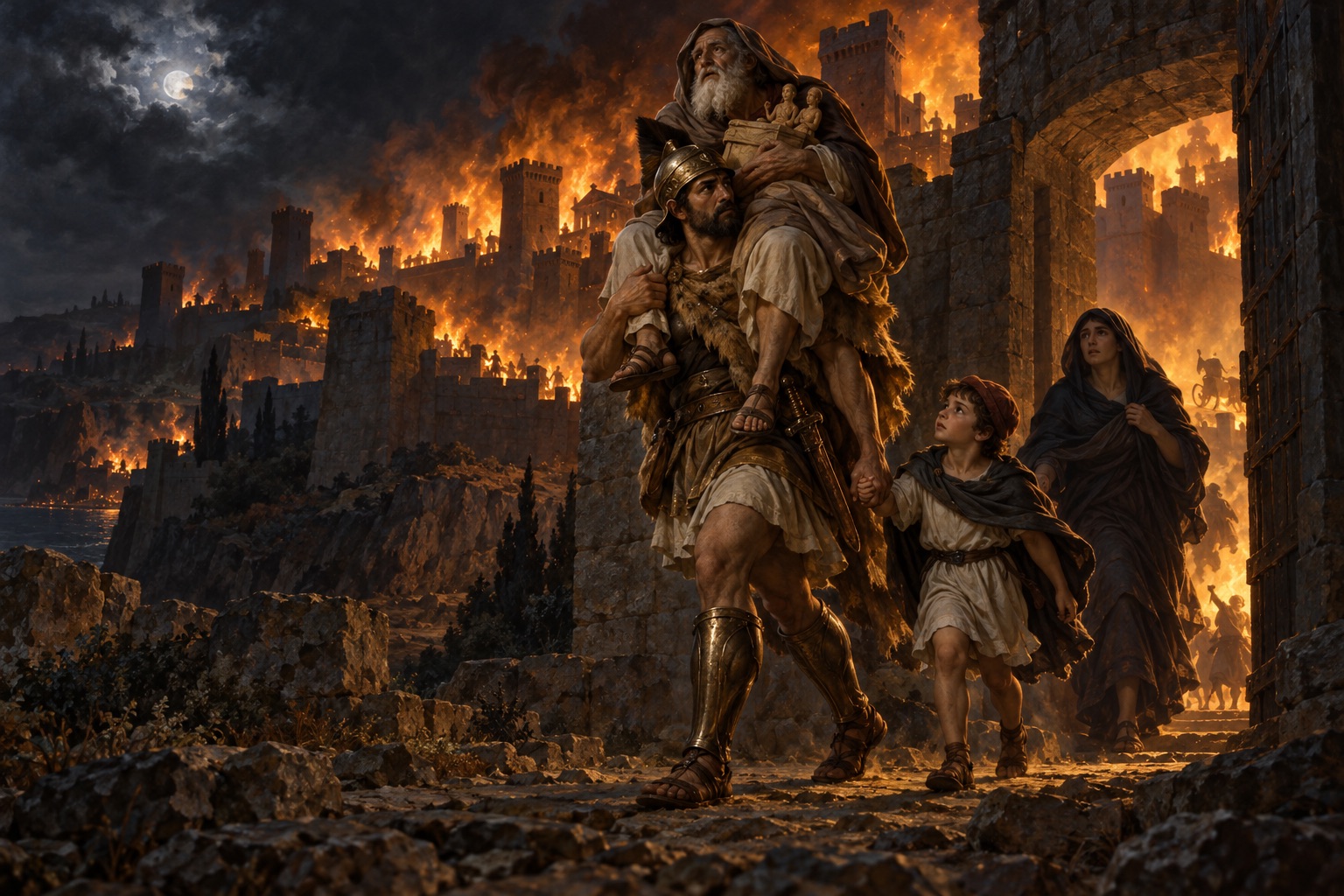
In the Forum of Augustus, in the heart of Rome, a group of statues showed a man carrying his old father on his shoulders and leading his small son by the hand. The inscription below called him the first king of the Latins. That is how Rome remembered its ancestor: not as the man who built the city, but as the refugee whose descendants would.
Is Aeneas in Homer? Yes, but Homer never sends him west. In the Iliad he is a Trojan prince, the son of Aphrodite and Anchises (5.311–313). When Achilles is about to kill him, Poseidon lifts him out of the battle, because “it is ordained unto him to escape, that the race of Dardanus perish not without seed”, and foretells: “now verily shall the mighty Aeneas be king among the Trojans, and his sons’ sons that shall be born in days to come” (20.302–308, trans. A. T. Murray).
1 The Telling
This follows Virgil’s Aeneid. Book and line numbers are those of the Latin text in The Latin Library; quotations are from J. W. Mackail’s prose translation of 1885. Virgil begins in the middle, with a storm that throws the Trojans onto the coast of Africa, and lets Aeneas tell the fall of Troy and the years at sea to Queen Dido (books 2–3). Here the events are told in order.
1-1 The Last Night of Troy
On the night the Greeks take the city, the ghost of Hector comes to Aeneas in his sleep. Troy is lost, he says; “Troy commends to thee her holy things and household gods”, and Aeneas must find a city for them across the sea. Then he carries out of the inner shrine “the chaplets and strength of Vesta, and the everlasting fire” (2.289–297).
Aeneas fights in the burning streets, then runs home for his father. “Up then, beloved father, and lean on my neck; these shoulders of mine will sustain thee” (2.707–708). Anchises takes the holy objects and the household gods in his hands, since Aeneas, fresh from killing, may not touch them until he has washed in running water. Aeneas throws a lion skin over his shoulders and lifts his father; little Iulus holds his right hand, and his wife Creusa follows behind (2.717–725).
In the dark side streets Creusa is lost, and he does not look back until they reach an old temple of Ceres outside the walls (2.735–744). He runs back into the city. Her ghost meets him, taller than in life: “Long shall be thine exile”, but he will come to Hesperia, “where Lydian Tiber flows”, and “a kingdom, and a king’s daughter for thy wife” await him there (2.780–784). Three times he tries to put his arms round her neck, and three times the shape slips through his hands (2.792–794). At dawn he finds a crowd of refugees waiting, lifts his father again and makes for the mountain (2.796–804).
1-2 Years at Sea
They build a fleet and try Thrace, then Delos, where Apollo answers: “Seek out your ancient mother; hence shall the house of Aeneas sway all regions, his children’s children” (3.94–98). The commentator Servius notes that “this line is Homer’s” (our translation): it is Poseidon’s prophecy, widened from the Trojans to every land. They take the mother for Crete, until the household gods appear in a dream and correct them. The land is Hesperia, which men now call Italy, the country Dardanus came from (3.163–171). At Buthrotum they find Hector’s brother Helenus ruling Greek cities (3.294–297). At Drepanum in Sicily Anchises dies: “here, best of fathers, you leave me” (3.707–711, our translation).
1-3 Dido
A storm sent by Juno drives them to Africa, where Dido, a queen who fled her brother in Tyre, is building Carthage (1.340–341). During a hunt a storm scatters the riders, and “Dido and the Trojan captain take refuge in the same cavern”. Earth and Juno give the sign, the nymphs cry out on the mountain, and “that day opened the gate of death and the springs of ill”: Dido “calls it marriage, and with this name veils her fall” (4.160–172).
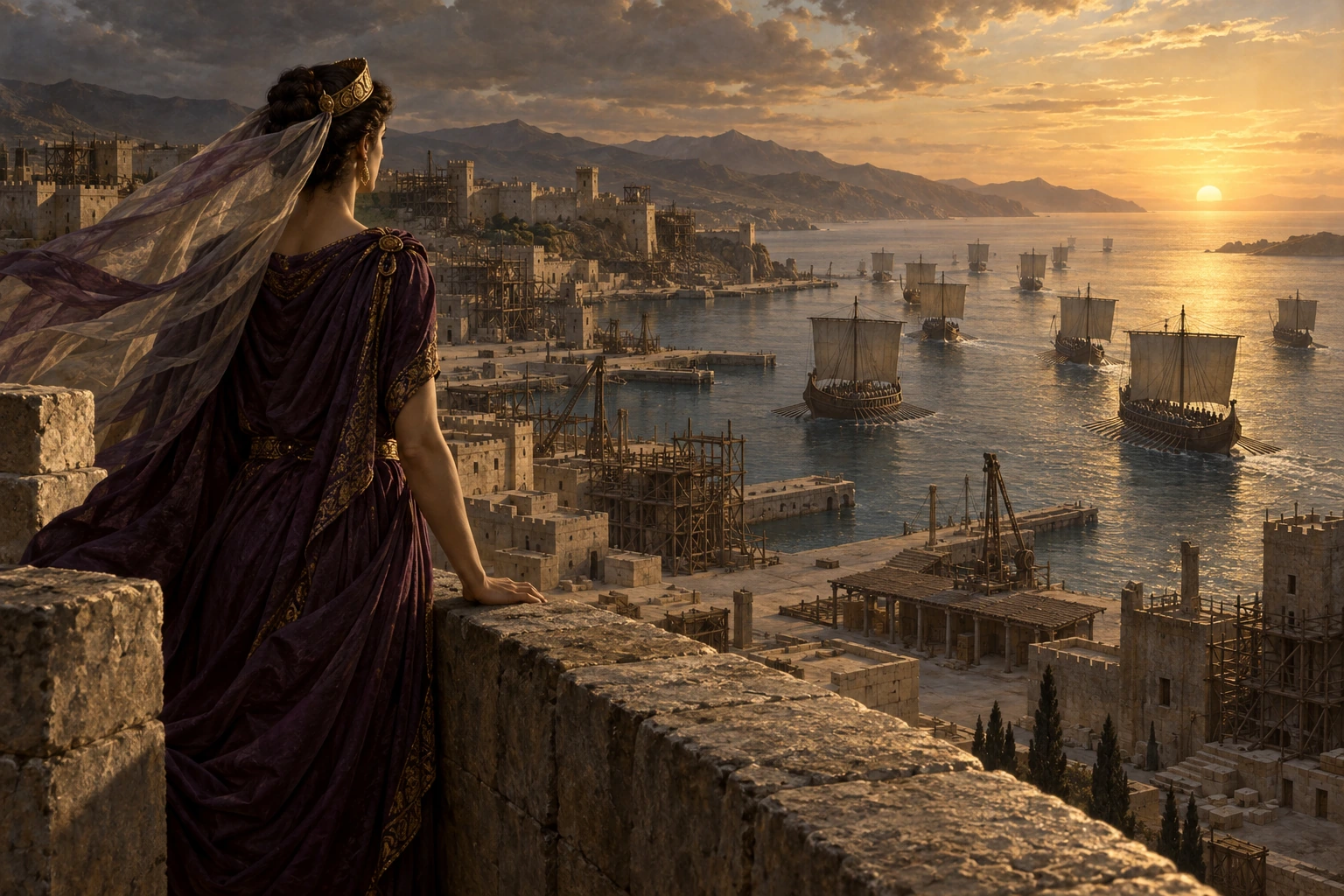
Jupiter sends Mercury, who finds Aeneas building Carthage’s walls. If glory does not move him, let him think of Ascanius, to whom the kingdom of Italy and the Roman land are owed (4.265–276). Aeneas tells Dido that he never offered marriage, and “Not of my will do I follow Italy” (4.338–361). At dawn she sees from her watch-tower “the fleet standing out under squared sail” and the harbour empty (4.584–591). She curses him: “Arise out of our dust, O unnamed avenger, to pursue the Dardanian settlement with firebrand and steel”, shore against shore, to their children’s children (4.622–629). Then she climbs the pyre she has built and falls on his Trojan sword (4.642–665).
1-4 The Games in Sicily
A year after Anchises died, the Trojans are back in Sicily, and Aeneas holds games at his tomb (5.45–50). Four ships race; their captains will found Roman houses, Mnestheus the Memmii, Sergestus the Sergii, Cloanthus the Cluentii (5.116–123). A foot race, a boxing match and an archery contest follow, and last the boys ride a mock battle. Ascanius, Virgil says, taught it to Alba Longa; “on from them mighty Rome received it… and now it is called Troy, and the boys the Trojan troop” (5.596–602). Meanwhile Juno sends Iris to the Trojan women, weary of the sea, and they set the ships on fire (5.604–663). Aeneas leaves the old and the tired in a new town, Acesta (5.715–718, 755–758).
1-5 The Underworld
At Cumae the Sibyl leads him down to the dead (her part is told in her own story). There he meets Dido. He weeps, “unwillingly, O queen, I left thy shore”, but she keeps her eyes on the ground and goes back without a word to her first husband, Sychaeus (6.450–476). Anchises shows him the souls who will be born as his descendants: Silvius, his son by Lavinia, the kings of Alba Longa, Romulus, Caesar and all the line of Iulus, and Augustus, who will bring the golden age back to Latium (6.756–797). Others will work bronze and marble better: “be thy charge, O Roman, to rule the nations in thine empire… to be merciful to the conquered and beat the haughty down” (6.847–853). Aeneas leaves by the ivory gate, the gate of false dreams (6.893–898).
1-6 Latium
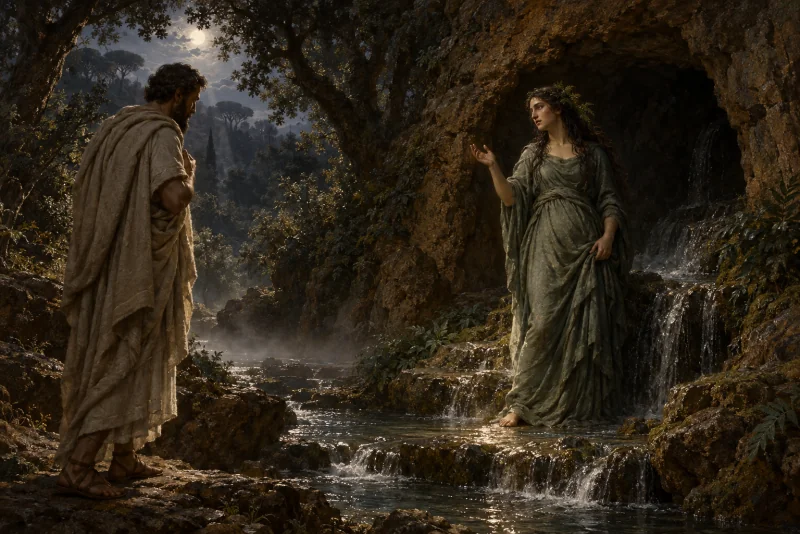
They land at the mouth of the Tiber and eat their meal on flat wheat cakes. When the food runs out they eat the cakes too, and Iulus jokes: “Ha! Are we eating our tables too?” Aeneas hears a prophecy come true: “here is home; this is our native country” (7.107–122). The king, Latinus, a great-grandson of Saturn, has one child, Lavinia, courted by Turnus, the young prince of the Rutulians (7.45–57, 7.409). Fire has been seen in her hair, and the oracle of Faunus has told Latinus to give her to a foreigner (7.71–101), so he welcomes the Trojans. Juno will not have it: “if the powers of heaven are inflexible, I will stir up Acheron” (7.312). Her Fury, Allecto, sets Queen Amata and Turnus against them, and war begins (7.341–410).
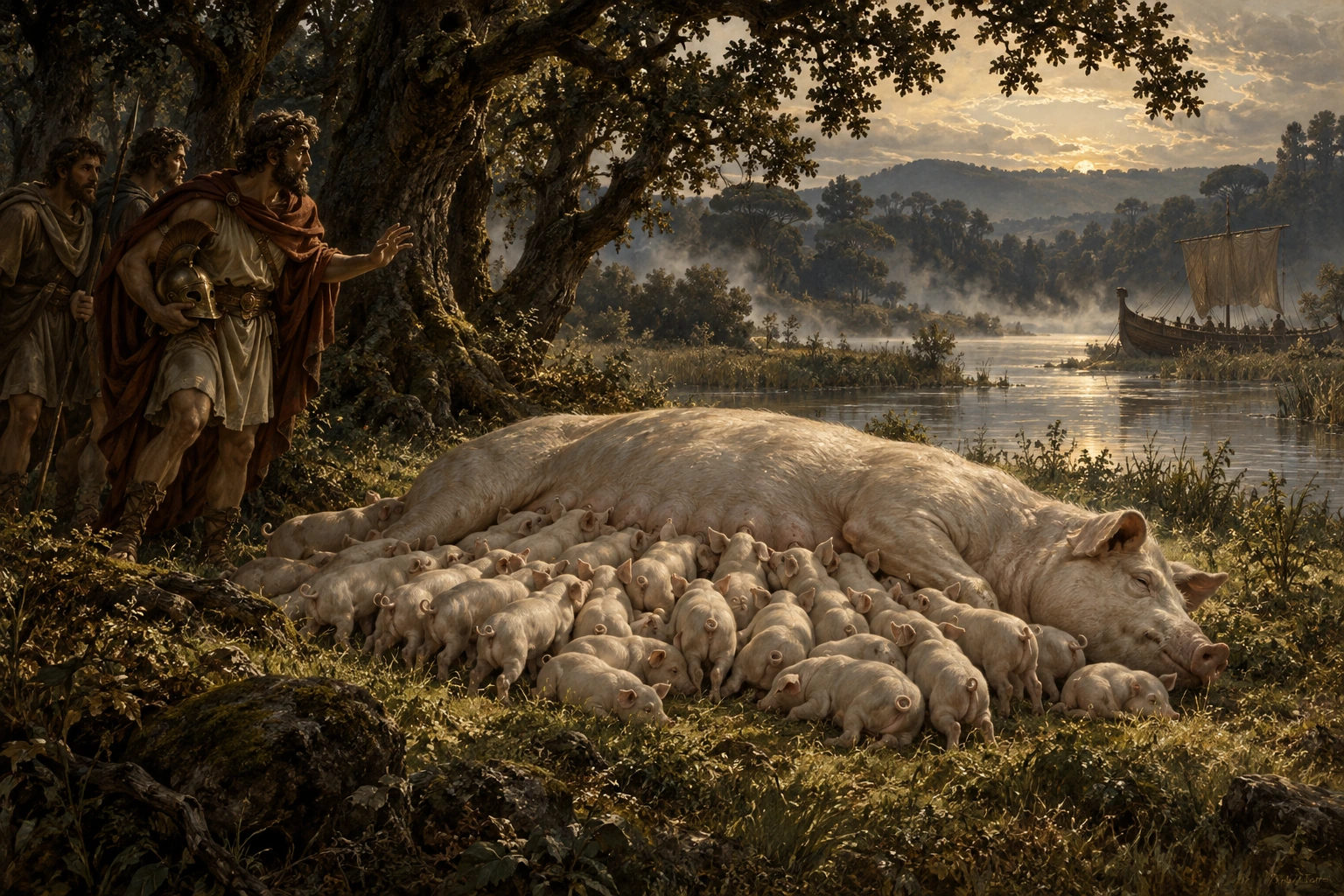
The river god Tiberinus gives Aeneas a sign: under the holm oaks on the bank he will find a white sow with thirty white young, and in thirty years Ascanius will found Alba, the “White” city (8.36–48). He finds her and sacrifices her to Juno (8.81–85).
1-7 The Last Scene
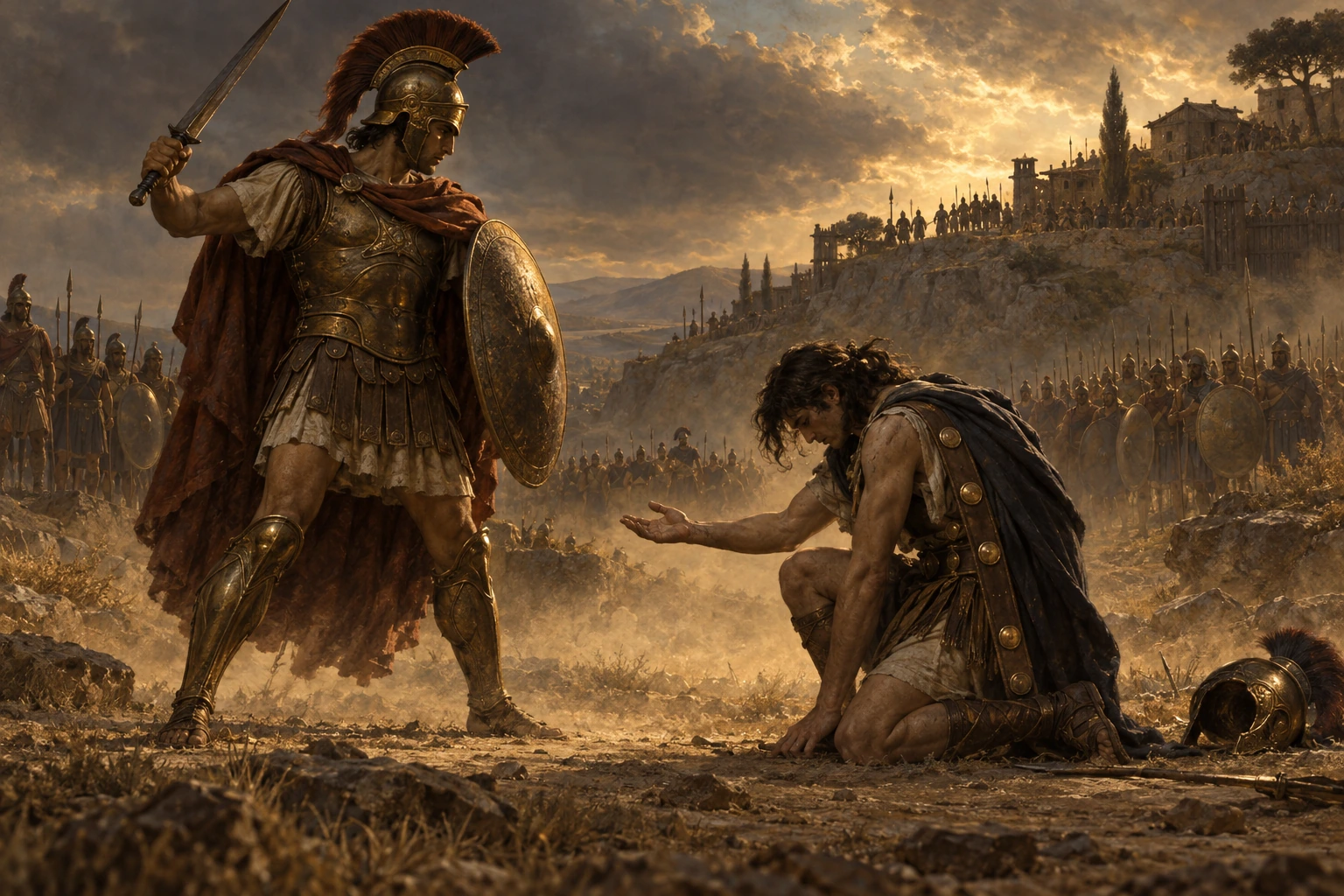
In the war Turnus kills young Pallas, son of Aeneas’s ally Evander, and takes his sword-belt (10.479–500). Before the last duel Aeneas swears that Latinus will keep his arms and his royal power, and the Trojans will build a city that Lavinia will name (12.190–194). In heaven Juno gives way on one condition: the Latins keep their name, their language and their dress, and the name of Troy is let fall. Jupiter agrees (12.819–840). Turnus, wounded, begs: “Lavinia is thine in marriage; press not thy hatred farther.” Aeneas hesitates, sees Pallas’s belt on Turnus’s shoulder, and kills him. The poem ends there: “the life with a moan flies indignantly into the dark” (12.930–952).
There is no wedding and no city. The rest is in Jupiter’s promise to Venus: three years’ reign in Latium, thirty for Ascanius, “now called Iulus”, who moves the kingdom to Alba Longa, then three hundred years of kings until Ilia bears twins to Mars. “I have given them dominion without end” (1.263–279).
2 Where the Story Is Written Down
- Homer, Iliad 5 and 20 (see above). The Homeric Hymn to Aphrodite tells how the goddess lay with Anchises on Mount Ida and promised “a dear son who shall reign among the Trojans, and children’s children after him”. She names him Aeneas for the “awful grief” (Greek ainos, “awful”) of sharing a mortal’s bed (196–199, trans. Hugh G. Evelyn-White). Hesiod’s Theogony has the same birth “on the peaks of Ida” (1008–1010).
- Sophocles, in a lost play, Laocoön, already showed “Aeneas, his sire upon his shoulders borne” (fragment quoted by Dionysius 1.48.2, trans. Earnest Cary).
- Greek historians. Hellanicus of Lesbos, of the 5th century BCE, told the flight in his Troica: Aeneas held the citadel, sent the women, children and old people ahead to Mount Ida, and left under a truce with his father and his gods (Dionysius 1.46–48). Timaeus of Sicily, whose history ran down to 289 BCE, learned at Lavinium that the holy objects kept there were iron and bronze heralds’ staffs and a Trojan earthenware jar (1.67.4). Ferdinando Castagnoli writes that it was above all through Timaeus that the arrival in Latium and the Trojan origin of Rome took hold.
- Naevius fought in the First Punic War, died about 201 BCE, and linked the origins of Rome with Aeneas in his epic The Punic War (Treccani). The commentary that goes under the name of Servius quotes from its first book the flight of Anchises and Aeneas, with “many mortals” following them (on Aeneid 2.797). Macrobius says that Virgil’s opening storm, with Venus complaining to Jupiter and Jupiter consoling her, is “taken whole from Naevius” (Saturnalia 6.2.31, our translation).
- Ennius (239–169 BCE) began his Annals, eighteen books of Roman history, with the arrival of Aeneas (Treccani). Cato the Censor (234–149 BCE) told the story in prose in his Origins, which survive in fragments (section 3).
- Virgil (70–19 BCE) worked on the Aeneid from 29 BCE until his death (Treccani). The ancient Life of Virgil calls it “as it were a mirror of both the poems of Homer” (21), and says he drafted it first in prose in twelve books, then put it into verse piece by piece, in no particular order (23). Dying at Brundisium, he kept calling for his book-boxes to burn it himself. His friends Varius and Tucca revised it on Augustus’s orders, and Varius published it, leaving the unfinished lines as they were (37–41). Pliny: “the deified Augustus forbade the burning of Virgil’s poems, against the modesty of his will” (Natural History 7.114, our translation).
- Livy (History of Rome 1.1–3, begun between 27 and 25 BCE), Dionysius of Halicarnassus (Roman Antiquities 1.45–73; Cary dates its preface to 7 BCE) and Ovid (Metamorphoses 14) tell it in their own ways (section 3).
3 Competing Versions
- Who founded Rome? Dionysius collects the Greek answers. Hellanicus said that Aeneas came to Italy from the land of the Molossians with Odysseus (some manuscripts read “after Odysseus”) and founded the city, naming it after Rhome, a Trojan woman who led the others in burning the ships; Damastes of Sigeum agreed. Cephalon of Gergis named Romus, a son of Aeneas, and Callias made Rhome the wife of Latinus (1.72). Some Roman writers made Romulus and Remus sons of Aeneas, or of his daughter (1.73). The Servian commentary adds that Eratosthenes made Romulus a son of Ascanius, and that “Naevius and Ennius hand down that Romulus, founder of the city, was the grandson of Aeneas through his daughter” (on 1.273, our translation).
- Hero or traitor? Menecrates of Xanthus said that Aeneas betrayed Troy to the Greeks out of hatred for Paris (Dionysius 1.48.3). Livy writes that the Greeks spared Aeneas and Antenor because both had always argued for peace and for giving Helen back (1.1).
- Did he reach Italy at all? Some Greek writers made him die in Thrace, or settle in Arcadia; others had him go home to reign at Troy, which Dionysius blames on a misreading of Homer’s prophecy (1.49, 1.53).
- Peace or war? Livy gives two traditions: Latinus was beaten in battle and then made an alliance, or the two kings met before any battle and made a treaty. Then Turnus, to whom Lavinia had been promised, made war; Latinus fell, and Aeneas fell in a second war against Turnus and the Etruscan king Mezentius (1.1–2). In Cato’s version, as the Servian commentary gives it, Latinus died in the first battle, Turnus fled to Mezentius, Aeneas and Turnus were both “carried off” in the renewed war, and Ascanius then killed Mezentius in single combat (on 1.267).
- Who was Latinus? In Virgil, the son of Faunus (7.47–49); in Dionysius, the son of Hercules, passing as Faunus’s son (1.44.3); in Hesiod, a son of Odysseus and Circe (Theogony 1011–1013).
- Whose son was Ascanius? Livy will not decide (“for who could speak decisively about a matter of such extreme antiquity?”) whether the Iulus claimed by the Julian house was Lavinia’s son or an elder son born to Creusa at Troy (1.3). In Dionysius, Ascanius was once called Euryleon, and Iulus is Ascanius’s son, from whom the Julii descend (1.65, 1.70).
- How did Aeneas end? Livy: after his last battle, his tomb is by the river Numicius, and “He is addressed as Jupiter Indiges” (1.2). Dionysius: his body was never found, and the Latins built him a hero-shrine inscribed “To the father and god of this place, who presides over the waters of the river Numicius” (1.64.4–5). Ovid: Venus has the river god wash away all that was mortal in him, and makes him a god (Metamorphoses 14.600–608).
- Dido and the dates. The Servian commentary objects that Aeneas could never have seen Carthage, which was founded only seventy years before Rome (on 1.267). Timaeus dated Carthage’s founding to 813 BCE, in Cary’s reckoning (Dionysius 1.74.1). Whether Naevius already told of Aeneas and Dido is debated (Treccani).
4 History and Tradition
- Four hundred missing years. Eratosthenes put the fall of Troy in 1183 BCE (Cary’s note on Dionysius 1.74). Cato put the founding of Rome 432 years after the Trojan War (Dionysius 1.74.2), and the traditional (Varronian) date is 753 BCE; Censorinus credits Varro with settling the reckoning (De die natali 21.5–6). Aeneas cannot be Romulus’s grandfather. Giuseppe Lugli called the twelve kings of Alba “a learned reconstruction”, made “to fill the space of about 430 years” and to ennoble Rome’s origins (Enciclopedia Italiana, 1929, our translation). Dionysius counts Romulus seventeenth in descent from Aeneas (1.45.3). Virgil’s Jupiter gives 3 + 30 + 300 years, and Servius already asked why three hundred, when the Alban kings had reigned four hundred (on 1.272).
- Etruria. The Vatican Museums display Athenian vases from tombs at Vulci, of the late 6th and early 5th centuries BCE, with scenes of Aeneas and Anchises, “understood, assimilated and reworked by the Etruscan society of the time”. Castagnoli lists an Etruscan red-figure amphora in Munich and a gem in Paris of the early 5th century, and terracotta statuettes from Veii, which he dates to “the 5th or 4th century BCE” (our translation).
- Lavinium. At Pratica di Mare, south of Rome, excavators found a four-sided hero-shrine with a large tapering tufa doorway, built in the 4th century BCE over a tomb of the 7th century rich in bronzes and pottery (Castagnoli, Enciclopedia dell’Arte Antica, 1973). Paolo Sommella identified it in 1971–72 with the shrine in Dionysius 1.64. That identification, Maria Fenelli writes, “has found wide agreement, but also perplexity and deep-rooted opposition”, and “the debate is still open” (1995, our translation). Varro says that bronze statues of the sow and her young still stood in public at Lavinium, and that the priests showed the sow’s body, kept in brine (On Agriculture 2.4, our translation).
- Iulus and the Julii. In a funeral speech for his aunt, Julius Caesar traced “the Julii, the family of which ours is a branch, to Venus” (Suetonius, Julius 6.1, trans. J. C. Rolfe). He wore high red shoes like the old kings of Alba, “for he claimed that he was related to them through Iulus”, and in 46 BCE he dedicated his new forum with a temple of Venus “as the founder of his family” (Cassius Dio 43.43.2 and 43.22.2, trans. Earnest Cary). In the Aeneid the Trojan Caesar is “Julius, inheritor of great Iülus’ name” (1.288).
- Augustus. In the Forum of Augustus, the central niche of the northern exedra held Aeneas with Anchises, Ascanius and the household gods, with the kings of Alba in the niches beside him and Romulus in the southern exedra (Museo dei Fori Imperiali). A piece of the base, which the museum dates to 2 BCE, reads, as restored, “Aeneas, first King of the Latins, reigned for three years”. Ovid has Mars come down to his new temple and see “Aeneas laden with his dear burden, and so many ancestors of the Julian nobility” (Fasti 5.563–564, our translation). Augustus often staged the boys’ game of Troy (Suetonius, Augustus 43.2). On the Ara Pacis, voted by the senate in 13 BCE and dedicated in 9 BCE (Res Gestae 12, with F. W. Shipley’s note), one panel has long been read as Aeneas sacrificing before the temple of the household gods (Castagnoli, 1960); Paul Rehak argued in 2001 that the man sacrificing is King Numa.
Two things are often said: that Virgil invented Aeneas’s voyage to Italy, and that Aeneas founded Rome. Neither holds. Greek writers had brought him west by the 5th century BCE (Hellanicus, in Dionysius 1.72), and Naevius and Ennius told it in Latin nearly two centuries before Virgil. And in the Roman story he founds Lavinium; Rome comes centuries later, with Romulus. It was some Greek writers who made Aeneas himself the founder of Rome; others, Naevius and Ennius among them, gave the honour to his son or grandson.
5 Related Stories
- The Odyssey: Ten Years on the Way Home from Troy: the other long voyage home from Troy. The ancient Life of Virgil calls the Aeneid “a mirror of both the poems of Homer”, Hellanicus brought Aeneas to Italy together with Odysseus (Dionysius 1.72.2), and Hesiod makes Latinus a son of Odysseus.
- Romulus and Remus: The Twins and the She-Wolf: the end of the line of Alban kings that begins with Aeneas’s son. The twins, the she-wolf and the founding of Rome are told there.
- The Sibyl of Cumae: The Prophetess and the Nine Books: Aeneas’s guide to the underworld. Her prophecy and the golden bough are told there.
- Vesta: The Hearth Goddess and Her Virgins: Hector’s ghost hands Aeneas “the strength of Vesta, and the everlasting fire” (2.296–297), and Dionysius says the Palladium Aeneas brought to Italy was kept by the Vestals (1.69.4).
- The Trojan War: The Apple, the Ships and the Horse: the war Aeneas escapes, from the judgment of Paris to the wooden horse. In the summary of the lost Cypria, Aphrodite sends Aeneas to sail with Paris.
6 Sources
- Virgil, Aeneid, Latin text: The Latin Library; trans. J. W. Mackail (Macmillan, 1885): Project Gutenberg
- Homer, Iliad 5.280–317 and 20.273–339, trans. A. T. Murray (Loeb, 1924), with the Greek text: Perseus; Homeric Hymn to Aphrodite 196–199 and Hesiod, Theogony 1008–1016, trans. Hugh G. Evelyn-White (Loeb, 1914): Perseus, Perseus
- Dionysius of Halicarnassus, Roman Antiquities 1.44–74, trans. Earnest Cary (Loeb, 1937), with his notes: LacusCurtius, LacusCurtius, LacusCurtius; Livy, History of Rome 1.1–3, trans. Canon Roberts (Dutton, 1912): Perseus
- Servius, commentary on the Aeneid, on 1.267–273, 2.797 and 3.98, ed. G. Thilo: Perseus; Macrobius, Saturnalia 6.2.31: LacusCurtius
- Suetonius, Life of Virgil, Julius 6.1 and Augustus 43.2, trans. J. C. Rolfe (Loeb, 1914): LacusCurtius, LacusCurtius; Pliny, Natural History 7.114: LacusCurtius; Cassius Dio 43.22 and 43.43, trans. Earnest Cary (Loeb, 1916), and Res Gestae 12, trans. F. W. Shipley (Loeb, 1924): LacusCurtius, LacusCurtius
- Ovid, Metamorphoses 14.600–608 and Fasti 5.563–566; Varro, On Agriculture 2.4: The Latin Library, The Latin Library, The Latin Library; Censorinus, De die natali 21: LacusCurtius
- Treccani: F. Castagnoli, “Enea” (1960) and “Lavinio” (1961, 1973), and M. Fenelli, “Lavinio” (1995), Enciclopedia dell’Arte Antica; G. Lugli, “Alba Longa”, Enciclopedia Italiana (1929); “Nevio, Gneo”, “Ennio, Quinto”, “Catone, Marco Porcio”, “Virgilio Marone, Publio”, “Livio, Tito”: Enea, Lavinio, Alba Longa, Nevio, Ennio, Catone, Virgilio, Livio
- Mercati di Traiano – Museo dei Fori Imperiali, “Piece from a statue plinth with Aeneas inscription” (FA 1197) and “The exedras”: mercatiditraiano.it, mercatiditraiano.it; Vatican Museums, “Rooms IX and X. Guglielmi Collection”: museivaticani.va
- Paul Rehak, “Aeneas or Numa? Rethinking the Meaning of the Ara Pacis Augustae”, The Art Bulletin 83.2 (2001), 190–208: KU ScholarWorks
- Japanese translations: Oka Michio and Takahashi Hiroyuki (Kyoto University Press, 2001); Izui Hisanosuke (Iwanami Bunko, 1976, two volumes): NDL Search, NDL Search
Cover and illustrations: AI-generated images made for Arcana. They are interpretations, not historical artworks.