The Trojan War: The Apple, the Ships and the Horse
A quarrel among three goddesses, a queen carried off from Sparta and ten years of siege: no single ancient poem tells the whole Trojan War. Homer's Iliad covers about fifty days of it, and the wooden horse is not among them.
- Type: heroic legend, the war of the Greeks against Troy
- Culture: ancient Greece; retold by the Romans
- Earliest texts: Homer’s Iliad and Odyssey, usually placed in the 8th century BCE; the other poems of the Epic Cycle (the Cypria, the Aethiopis, the Little Iliad, the Sack of Ilion) are lost, and known from a later prose summary and a few quotations; the fullest surviving account of the fall is book 2 of Virgil’s Aeneid (written 29–19 BCE)
- Key figures: Peleus, Thetis, Eris (Strife), Paris (Alexandros), Helen, Menelaus, Agamemnon, Iphigenia, Achilles, Hector, Priam, Odysseus, Laocoön, Sinon
The Greeks told the Trojan War as a chain of poems, each taking up the story where another left off. Only two links survive whole, and neither tells the war from beginning to end: the Iliad is the story of one quarrel in the tenth year, the Odyssey the story of one man’s return. The rest of the chain is lost, and we know it mostly from a summary made centuries later.
Why did the Trojan War happen? The poem that told its beginning, the Cypria, gave a reason above the human ones. Its summary opens: “Zeus plans with Themis to bring about the Trojan war”. A quotation from the poem says why: the earth was weighed down by “the countless tribes of men”, and Zeus resolved to relieve it “by causing the great struggle of the Ilian war” (fragment 3, trans. Hugh G. Evelyn-White). The goddesses’ quarrel and the loss of Helen were how the plan was carried out. The ancient commentator who quoted those lines was explaining the fifth line of the Iliad: “thus the plan of Zeus came to fulfillment”.
1 The Telling
No ancient writer tells the whole war. This follows the order of the Epic Cycle as a writer named Proclus summarized it, in Hugh G. Evelyn-White’s translation (1914), with Homer’s Iliad and Odyssey in A. T. Murray’s translation for the parts they tell. Details from later writers are named where they come in.
1-1 The Wedding and the Judgment
Zeus and Poseidon had both wanted the sea goddess Thetis, until Themis foretold that her son would be mightier than his father. So she was married to a mortal, Peleus, and the gods feasted at the wedding on Mount Pelion (Apollodorus, Library 3.13.5). The Iliad remembers it: all the gods came, Hera tells Apollo, and he sat at the feast with “thy lyre in thy hand” (24.59–63).
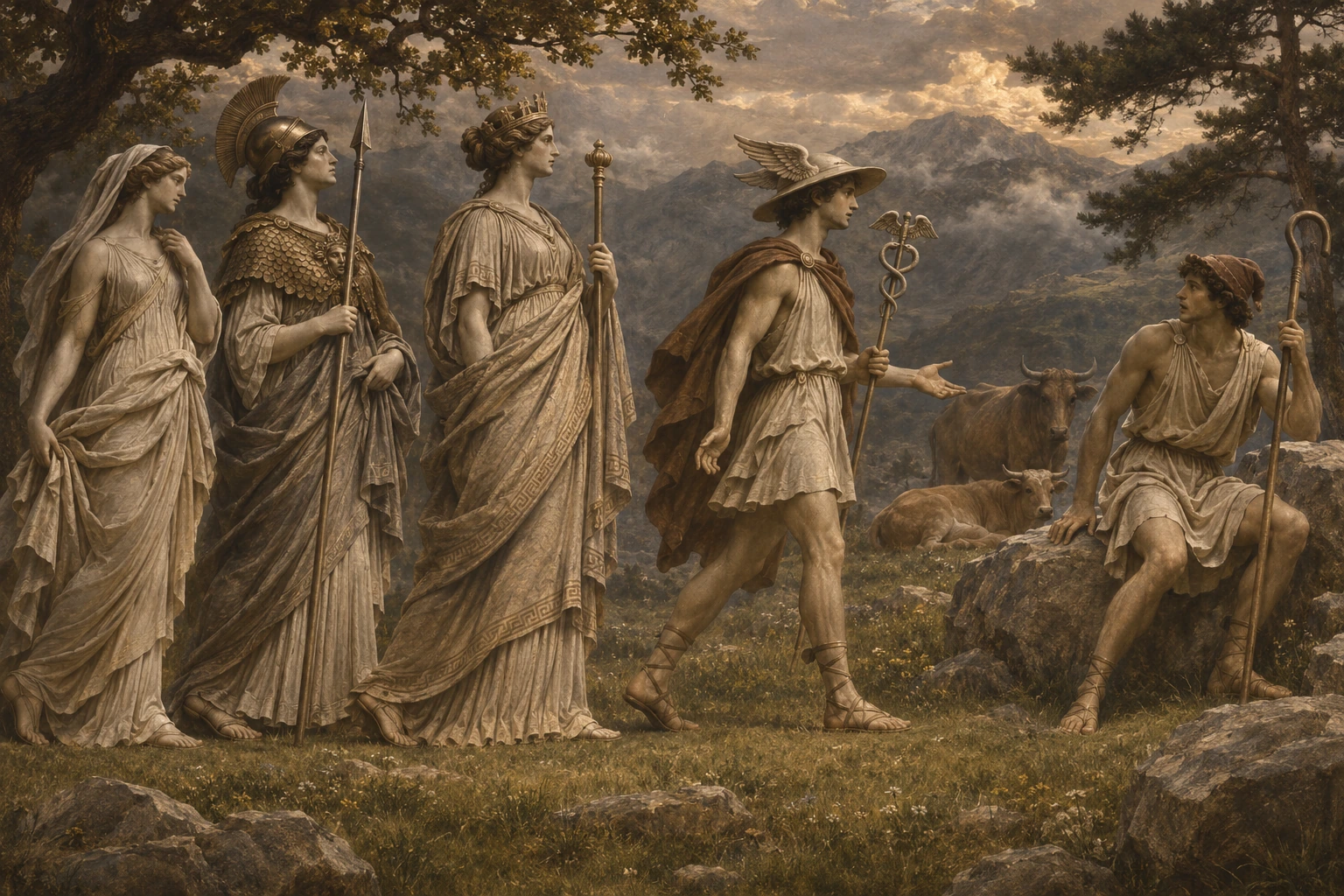
In the Cypria, Strife arrives while the gods are feasting “and starts a dispute between Hera, Athena, and Aphrodite as to which of them is fairest”. At Zeus’s command Hermes leads the three to Paris, a son of King Priam of Troy, also called Alexandros, on Mount Ida. Apollodorus gives their offers: kingship over all men from Hera, victory in war from Athena, the hand of Helen from Aphrodite (Epitome 3.2). Paris chose Aphrodite. The Iliad mentions the judgment only once, near its end: he “put reproach upon those goddesses when they came to his steading” (24.29–30).
1-2 Helen and the Oath
Helen was a daughter of Zeus; her mother was Leda in Apollodorus (3.10.7), Nemesis in the Cypria (fragment 8). When she was of age, the princes of Greece came to Sparta to court her. In the Hesiodic Catalogue of Women, her mortal father Tyndareus took no gift from any of them until all had sworn that if anyone carried her off by force, the rest would “follow after and make him pay the penalty”. Then Menelaus won her, “because he gave the greatest gifts” (fragment 68). Apollodorus says the oath was Odysseus’s idea (3.10.9).
Paris built ships, sailed to Sparta and was Menelaus’s guest. When Menelaus left for Crete, Aphrodite brought Paris and Helen together, and they sailed away by night with “very great treasures”. The goddess Iris told Menelaus. He and his brother Agamemnon, king of Mycenae, reminded the princes of their oath, and the leaders of Greece gathered for war. Odysseus pretended to be mad to stay at home, until Palamedes seized his baby son Telemachus and the pretence gave way.
1-3 Aulis and the Nine Years
The army gathered at Aulis, on the shore facing Chalcis. During a sacrifice a serpent darted from the altar, ate eight young sparrows and their mother, and was turned to stone. The seer Calchas read the sign: “so shall we war there for so many years, but in the tenth shall we take the broad-wayed city” (Iliad 2.303–330).
In the Cypria the first voyage went wrong: the Greeks sacked Mysia, taking it for Troy, and a storm scattered them. When they gathered at Aulis a second time, Agamemnon shot a stag “and boasted that he surpassed even Artemis”. The goddess sent stormy winds that kept the fleet in port, and Calchas told them to sacrifice Agamemnon’s daughter Iphigenia. She was sent for on the pretence of a marriage to Achilles. In the Cypria, Artemis snatched her away to the land of the Tauri, made her immortal, and left a stag on the altar in her place. In other tellings there is no rescue (section 3).
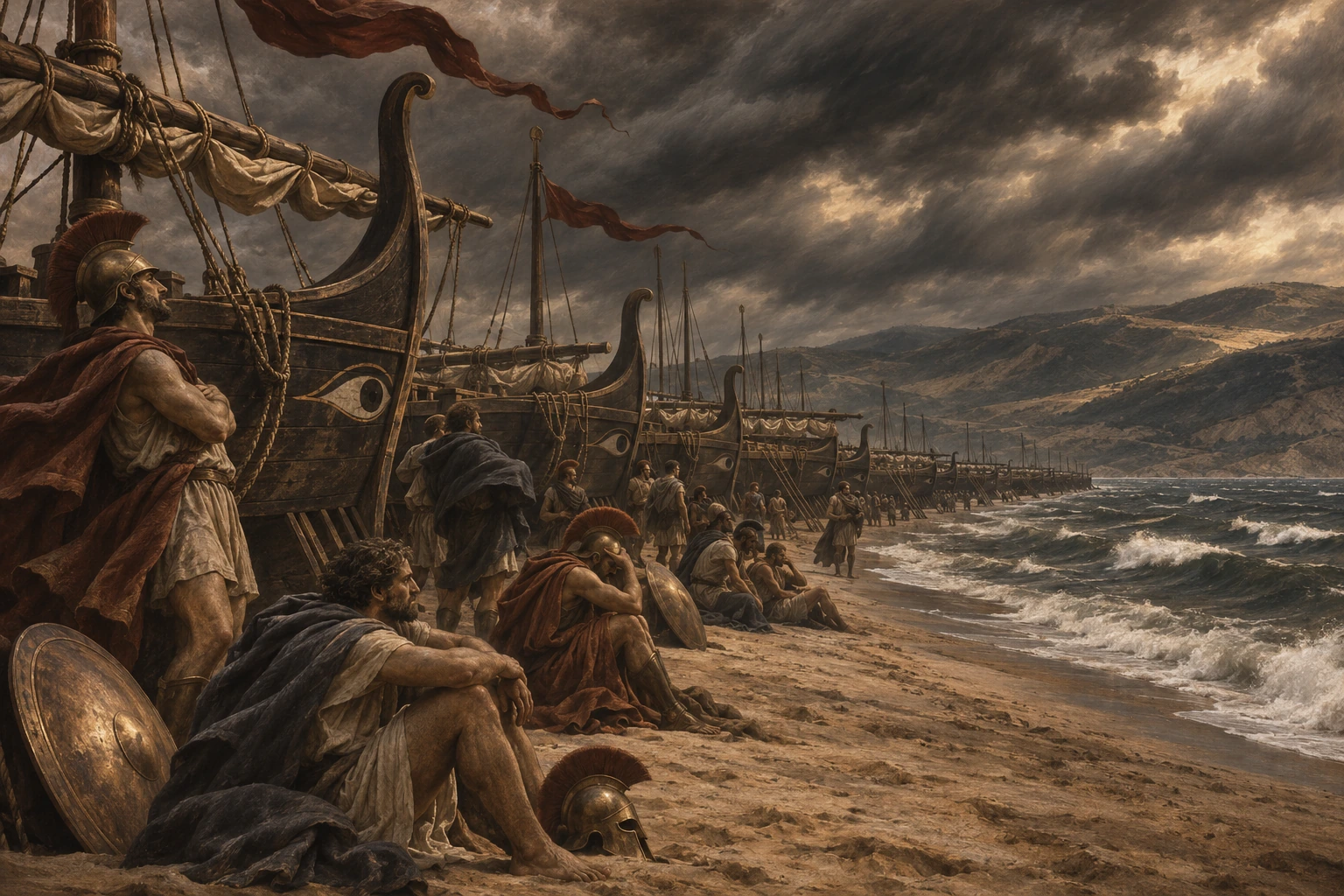
On the way to Troy, Philoctetes was bitten by a snake and left on Lemnos “because of the stench of his sore”. At Troy, Protesilaus, the first Greek to land, was killed by Priam’s son Hector, and Achilles killed Cycnus, a son of Poseidon. Envoys demanded Helen and the treasure; the Trojans refused. For years the Greeks besieged the city and raided the land around it. Achilles sacked Lyrnessus and Pedasus, and from the spoils he received Briseis as his prize, and Agamemnon Chryseis. The Cypria ended with “the plan of Zeus to relieve the Trojans by detaching Achilles from the Hellenic confederacy”. There the Iliad begins.
1-4 The Anger of Achilles
“The wrath sing, goddess, of Peleus’ son, Achilles” (1.1). Agamemnon will not give Chryseis back to her father, a priest of Apollo, and the god sends a plague. Forced to let her go, Agamemnon takes “the fair-cheeked Briseis” from Achilles instead (1.184), and Achilles withdraws from the fighting. His mother Thetis begs Zeus to honour him, and Zeus lets the Trojans drive the Greeks back to their ships. Achilles refuses Agamemnon’s offer of amends (book 9). His friend Patroclus goes out in Achilles’s armour and is killed by Hector (book 16). Achilles returns to the war, kills Hector (book 22), and drags the body.
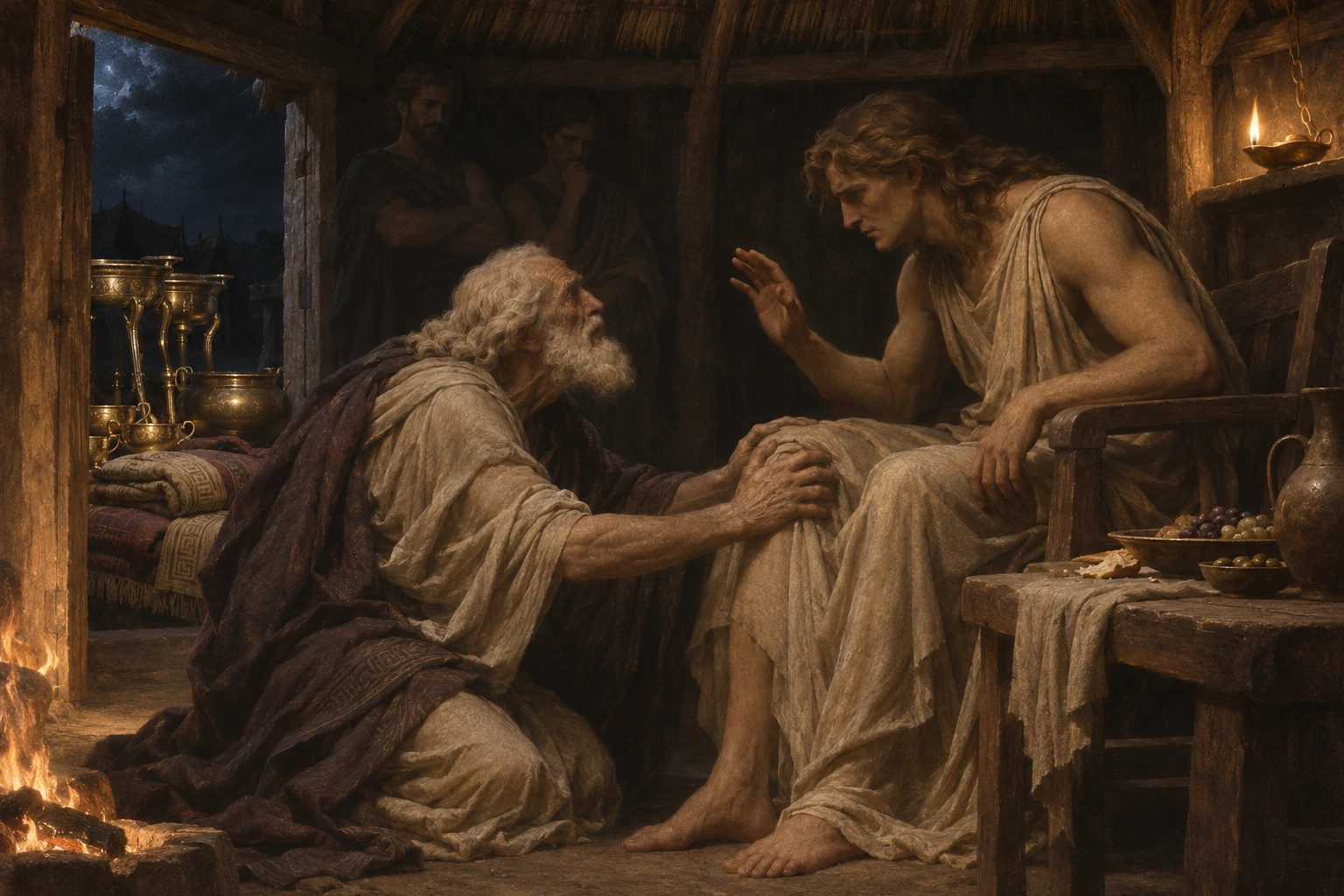
Then, by night, the old king Priam comes to Achilles’s hut with a ransom. He clasps Achilles’s knees “and kissed his hands, the terrible, man-slaying hands that had slain his many sons”, and asks him to remember his own father (24.477–487). Achilles gives the body back. The poem ends with the Trojans burying their prince: “On this wise held they funeral for horse-taming Hector” (24.804).
1-5 The Death of Achilles
Achilles knew the price. His mother had told him of “twofold fates”: a long life at home, or imperishable renown at Troy (9.410–416). The dying Hector named the day “when Paris and Phoebus Apollo shall slay thee… at the Scaean gate” (22.359–360). In the Aethiopis, after killing the Amazon Penthesileia and Memnon, son of the Dawn, Achilles chases the Trojans into the city and “is killed by Paris and Apollo”. Ajax carries the body to the ships while Odysseus holds off the Trojans, and Thetis comes with the Muses and her sisters to mourn her son. His armour was given to Odysseus, and Ajax, driven mad, killed himself (Little Iliad).
1-6 The Horse
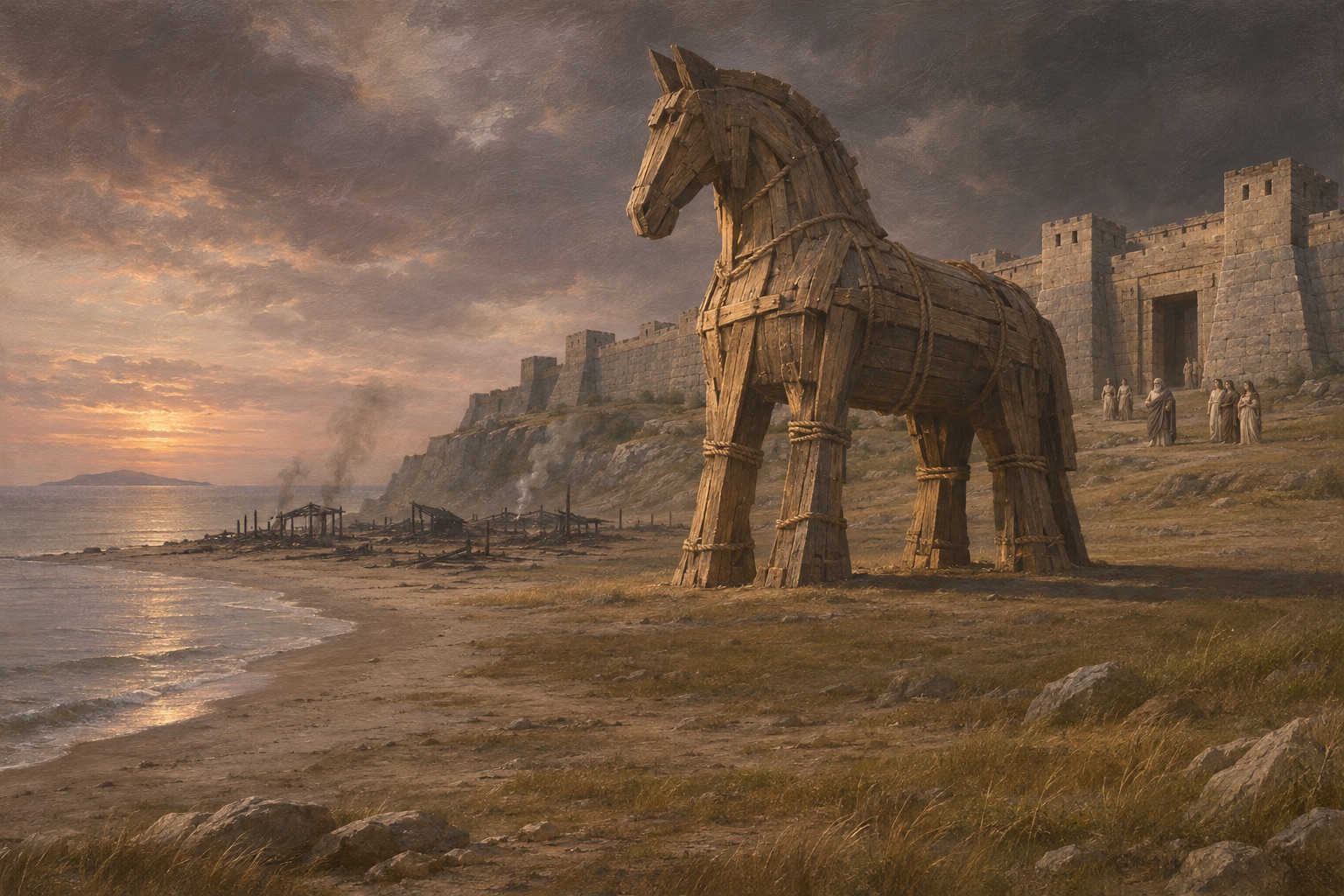
In the Little Iliad, the Trojan seer Helenus, taken prisoner, told the Greeks how Troy could be taken. Philoctetes was brought from Lemnos and killed Paris in single combat, and Achilles’s son Neoptolemus came from Scyros. Then “Epeius, by Athena’s instruction, builds the wooden horse”. Odysseus went into Troy disguised as a beggar, and with Diomedes carried off the Palladium, the image of Athena that kept the city safe. The best men climbed into the horse; the rest burned their huts and sailed to Tenedos. The Trojans, “supposing their troubles over”, pulled down part of their wall, took the horse into the city and feasted.
The Odyssey adds the scenes around it. The Trojans argued over three choices: “to cleave the hollow timber”, to throw it from the rocks, or to let it stand as an offering to the gods (8.505–510). Helen walked round it three times, calling the chieftains by name in their wives’ voices, and Odysseus held shut the mouth of one man who would have answered (4.271–289). Inside, the other leaders wept and trembled; Neoptolemus kept gripping his sword, begging to be let out (11.523–532).
1-7 The Sack
In the Sack of Ilion, two serpents killed the priest Laocoön and one of his sons, and the followers of Aeneas, alarmed, withdrew to Mount Ida. Sinon, who had got into the city by a trick, raised the fire signal; the fleet sailed back from Tenedos, and the men in the horse came out. Neoptolemus killed Priam at the altar of Zeus. Menelaus killed Deiphobus, who had married Helen after Paris died, and took her back to the ships. Ajax son of Oileus dragged Cassandra from the image of Athena, and the image came away with her. The Greeks burned the city, sacrificed Priam’s daughter Polyxena at Achilles’s tomb, and killed Hector’s small son Astyanax; Neoptolemus took Hector’s wife Andromache as his prize. As they sailed away, Athena was already planning their ruin at sea. What came after, for Aeneas and for Odysseus, is told in their own stories.
2 Where the Story Is Written Down
- Homer’s Iliad. Twenty-four books; the Japanese encyclopedia Nipponica counts 15,693 lines and says the poem covers “about fifty days” near the end of the ten-year siege. It knows the larger story without telling it: nine years have passed (2.134), Paris has judged the goddesses (24.29–30), and Achilles’s death is foretold but never told.
- Homer’s Odyssey speaks of the horse three times, through Menelaus (4.271–289), the singer Demodocus (8.492–520) and Odysseus himself (11.523–532).
- The Epic Cycle. Other poets told the rest: the Cypria (eleven books, ascribed to Stasinus of Cyprus) everything before the Iliad; the Aethiopis (five books) and the Sack of Ilion (two), ascribed to Arctinus of Miletus, and the Little Iliad (four), ascribed to Lesches, what came after. All are lost. We know them from quotations and from the prose summaries in a handbook, the Chrestomathy of Proclus. Their translator Evelyn-White held that they were later than Homer and “written round” the Iliad and the Odyssey. Later handbooks, the Library ascribed to Apollodorus (Epitome 3–5) and the Latin Fabulae ascribed to Hyginus, tell the war in order.
- Tragedy. The Athenian playwrights of the 5th century BCE took plots from these stories. In Aeschylus’s Agamemnon the chorus remembers Aulis; Euripides’s Helen follows a version in which Helen never reached Troy (section 3).
- Virgil’s Aeneid, book 2, gives the fullest surviving account of the last night, in Aeneas’s words: a horse “the size of a mountain”, built “by the divine art of Pallas” (2.15, our translation), Laocoön’s spear, Sinon’s lies and the serpents from Tenedos. Aeneas calls his people the men whom “not ten years nor a thousand ships brought down” (2.197–198, trans. J. W. Mackail); Apollodorus counts 1,013 ships (Epitome 3.14).
- In Japanese and Vietnamese. Matsudaira Chiaki’s Japanese translation of the Iliad is in Iwanami Bunko (1992, two volumes). Phan Thị Miến’s Vietnamese translation, Iliat, was published by Văn học in Hanoi (first printing, 1966).
3 Competing Versions
- Was there an apple? Not in the summary of the Cypria, where Strife only “starts a dispute”, although Evelyn-White’s introduction speaks of “the apple of discord”. J. G. Frazer notes in his edition of Apollodorus that the golden apple “first appears in late writers, such as Lucian and Hyginus”. Apollodorus has Strife throw “an apple as a prize of beauty” (Epitome 3.2). In Hyginus she was the one goddess not invited, and threw the apple in from the door, saying that whichever was the most beautiful should pick it up (Fabulae 92, our translation). Lucian (about 125–200 CE) writes words on it: hē kalē labetō, “let the beautiful one take it”, rendered “For the Fair” by the Fowlers (Dialogues of the Sea-Gods 5). Frazer gives the words as “Let the fair one take it” or “The apple for the fair”. The familiar “to the fairest” is the wording of none of the texts we opened.
- Did Helen go to Troy? In the Iliad she watches from the walls, and the old men say it is “small blame” that Trojans and Achaeans should suffer so long for such a woman (3.156–158). But Plato says the poet Stesichorus, struck blind for speaking ill of her, recanted: “thou didst not go within the well-oared ships, nor didst thou come to the walls of Troy” (Phaedrus 243a). Egyptian priests told Herodotus that she spent the war in Egypt with King Proteus, and he believed them: had Helen been in Troy, the Trojans would have given her back (2.113–120). In Euripides’s Helen, Hera gives Paris “an image, alive and breathing”, while Hermes carries the real Helen to Egypt (31–48).
- Did Iphigenia die? Homer never names her: Agamemnon’s daughters in the Iliad are Chrysothemis, Laodice and Iphianassa (9.145), and a note on Sophocles says the Cypria made them four (fragment 14). In the Cypria Artemis saves her. In the Hesiodic Catalogue, Pausanias reports, she “was not killed but, by the will of Artemis, became Hecate” (fragment 71). In Aeschylus’s Agamemnon there is no rescue: her father “hardened his heart to sacrifice his daughter”, she is gagged so that she cannot curse the house and lifted over the altar “as if she were a young goat”, and the chorus stops: “What happened next I did not see and do not tell” (224–248, trans. Herbert Weir Smyth). There Artemis is angry not at a boast but at an omen, two eagles, the two kings, tearing a pregnant hare: “An abomination to her is the eagles’ feast” (134–138).
- Ten years, or twenty? In the Iliad, “nine years of great Zeus have gone by” (2.134), yet at Hector’s funeral Helen says “this is now the twentieth year” since she left home (24.765). Apollodorus reports that “it is said that the war lasted twenty years”, counting eight years between the failed first voyage and the second gathering at Aulis (Epitome 3.18).
- The heel. Homer and the Cycle summaries say nothing of a heel or of the Styx. Apollodorus has Achilles “shot with an arrow in the ankle by Alexander and Apollo” (Epitome 5.3), and tells of a different attempt at immortality: Thetis held the baby in the fire by night and anointed him with ambrosia by day, until Peleus saw and cried out (3.13.6). The oldest text we found with the river is the unfinished Achilleid of the Roman poet Statius, from the late 1st century CE: Thetis armed her son at birth “with the stern waters of Styx – ay, would I had wholly!” (1.269–270, trans. J. H. Mozley). In Hyginus, Apollo, in the likeness of Paris, shoots him in the talus, the ankle or heel, “which he is said to have had mortal” (Fabulae 107), and the Virgil commentator Servius says why: dipped by his mother in the Stygian marsh, Achilles was invulnerable “except the part by which he was held” (on Aeneid 6.57; both our translations).
- Who was inside, and who died? Apollodorus puts fifty men in the horse, “or, according to the author of the Little Iliad, three thousand” (Epitome 5.14). The serpents kill Laocoön and one of his two sons in the Sack of Ilion, his sons alone in Apollodorus (Epitome 5.18), and Laocoön and both sons in Virgil (2.212–224).
4 History and Tradition
- Hisarlik. The site taken for Troy is the mound of Hisarlik, near the Dardanelles in north-western Turkey. Frank Calvert (1828–1908), a consul living in the area, suspected Troy lay there, bought part of the hill and dug in 1863 and 1865. In 1868 he persuaded Heinrich Schliemann, who began digging illegally in 1870 and officially in 1871. Taking the lowest layer for Homer’s Troy, Schliemann drove a wide trench through the hill and destroyed later buildings on the way (Schliemann Museum, Ankershagen).
- Nine cities. Schliemann’s collaborator Dörpfeld in 1893–94 and the American Blegen in 1932–38 sorted the mound into cities from about 3000 BCE to Roman times, now numbered Troy I to IX. Heibonsha’s World Encyclopedia dates Troy VI, with its great walls, to about 1800–1300 BCE, has an earthquake end it, and makes the short-lived Troy VIIa that followed the city of the Trojan War’s time. The site has been on UNESCO’s World Heritage List since 1998 (Daijisen).
- A lower town. Manfred Korfmann of the University of Tübingen, who directed new excavations from the late 1980s, found a lower town south and east of the citadel, ringed by a ditch cut into the bedrock: Troy was “about fifteen times larger than previously thought”. It “appears to have been destroyed around 1180 B.C.”, he wrote, “probably by a war the city lost”: there are traces of fire, some skeletons and heaps of sling bullets. “But this does not mean that the conflict was the war” (Archaeology, 2004). Eratosthenes, the ancient scholar of chronology, put the fall of Troy in 1183 BCE (Earnest Cary’s note on Dionysius 1.74).
- Wilusa. Hittite texts name a land called Wilusa in western Anatolia, which the specialist in Anatolian languages J. D. Hawkins calls “identified with the archaeological site of Troy”. Its ruler Alaksandu made a treaty with the Hittite king Muwatalli II (about 1295–1272 BCE), and a Hittite king’s letter to the king of Ahhiyawa, now “widely accepted” as the Hittite name for the Mycenaean Greeks, says that Wilusa was once a bone of contention between them. The philologist Joachim Latacz argues that Homer’s Ilios must once have been Wilios.
- What the ground can and cannot tell. Archaeology shows a large, walled city at Hisarlik, burned around the time Greek tradition gave for the war, in a land over which the Hittites and Ahhiyawa had quarrelled. It cannot show that there was a Helen, an Achilles or a ten-year siege. Korfmann’s picture was itself attacked: in 2001 the Tübingen historian Frank Kolb called his Troy as a great trading hub “completely absurd” and the dense lower town a fantasy (our translation). After a symposium at Tübingen in February 2002, four scholars, Hawkins among them, judged that “the criticisms of Korfmann are themselves considerably exaggerated” (Anatolian Studies, 2002). To anyone who said the war really happened there, Korfmann wrote, his answer would be: “Why not?”
- Horses in bronze and stone. On the Acropolis of Athens, Pausanias saw the Wooden Horse in bronze, with heroes peeping out. He thought the real one had been “a contrivance to make a breach in the Trojan wall” (1.23.8). Near Sparta he was shown the Tomb of the Horse, where Tyndareus made the suitors swear standing on the pieces of a sacrificed horse (3.20.9).
The wooden horse is often said to be in the Iliad. It is not: the poem ends with Hector’s funeral, before Achilles dies and before Troy falls. The horse is in the Odyssey (4.271–289, 8.492–520, 11.523–532), in the Cycle’s Little Iliad and Sack of Ilion, and above all in Virgil, whose Laocoön warns: “I fear the Grecians even when they offer gifts” (Aeneid 2.49, trans. J. W. Mackail).
5 Related Stories
- The Odyssey: Ten Years on the Way Home from Troy: the return from the city this story leaves in flames. At the court of the Phaeacians, Odysseus asks the singer Demodocus for the song of the wooden horse, and weeps as he hears it (8.492–531).
- Aeneas: The Trojan Who Became Rome’s Ancestor: the last night seen from inside the walls. In the Cypria summary Aphrodite sends Aeneas to sail with Paris, and in the Sack of Ilion his followers leave for Mount Ida as soon as the serpents strike. Virgil keeps him in the burning city until he carries his father out.
- Jason and the Argonauts: The Voyage for the Golden Fleece: Peleus sailed on the Argo. In Apollonius of Rhodes, Thetis, who had left him, comes to him to guide the ship past the Wandering Rocks, and the poet recalls why she left: he cried out when he saw her holding their baby in the fire (Argonautica 4.842–879).
- Heracles: The Twelve Labours and the Pyre on Mount Oeta: Troy had been sacked once before. In the Iliad Heracles’s son Tlepolemus recalls that his father came “by reason of the mares of Laomedon with but six ships” and “sacked the city of Ilios” (5.640–642). And Philoctetes, who killed Paris, did it with Heracles’s bow (Apollodorus, Epitome 5.8).
- Kurukshetra: The War of the Mahābhārata: the war at the core of the Mahābhārata. Winternitz saw there an old heroic poem in which, “as in the Iliad and in the Nibelungen-song”, a war of annihilation is the subject.
6 Sources
- Homer, Iliad 1.1–32, 1.181–187, 2.110–141, 2.299–335, 3.154–165, 5.635–646, 9.144–145, 9.410–416, 22.355–363 and 24.22–804, trans. A. T. Murray (Loeb, 1924): Perseus; Odyssey 4.265–289, 8.469–534 and 11.519–537, trans. A. T. Murray (Loeb, 1919): Perseus
- Proclus, Chrestomathia, summaries of the Cypria, the Aethiopis, the Little Iliad and the Sack of Ilium, with their fragments, and Hesiod, Catalogue of Women, fragments 68 and 71, in Hesiod, the Homeric Hymns, and Homerica, trans. Hugh G. Evelyn-White (1914): Project Gutenberg
- Apollodorus, Library 3.10.7–9 and 3.13.5–6, and Epitome 3.1–35 and 5.1–23, trans. J. G. Frazer (Loeb, 1921), with Frazer’s notes: Perseus, Perseus
- Aeschylus, Agamemnon 104–257, trans. Herbert Weir Smyth (Loeb, 1926): Perseus; Euripides, Helen 1–60, trans. E. P. Coleridge: Perseus; Plato, Phaedrus 243a, trans. Harold N. Fowler (Loeb, 1925): Perseus; Herodotus, Histories 2.113–120, trans. A. D. Godley (1920): Perseus
- Virgil, Aeneid 2, Latin text: The Latin Library; trans. J. W. Mackail (1885): Project Gutenberg; Servius on Aeneid 6.57, ed. G. Thilo: Perseus
- Hyginus, Fabulae 92 and 107, Latin text: The Latin Library; Statius, Achilleid 1, trans. J. H. Mozley (Loeb, 1928): Theoi; Lucian, Dialogues of the Sea-Gods 5, trans. H. W. and F. G. Fowler (Clarendon Press): Project Gutenberg, Greek text: Wikisource
- Apollonius of Rhodes, Argonautica 4.842–879, trans. R. C. Seaton: Theoi; Pausanias, Description of Greece 1.23.8 and 3.20.9, trans. W. H. S. Jones and H. A. Ormerod (Loeb, 1918): Perseus; Dionysius of Halicarnassus, Roman Antiquities 1.74, with Earnest Cary’s notes: LacusCurtius
- Manfred Korfmann, “Was There a Trojan War?”, with Joachim Latacz, “Evidence from Homer”, and J. D. Hawkins, “Evidence from Hittite Records”, Archaeology 57.3 (2004): archaeology.org, archaeology.org, archaeology.org; D. F. Easton, J. D. Hawkins, A. G. Sherratt and E. S. Sherratt, “Troy in recent perspective”, Anatolian Studies 52 (2002), 75–109: Cambridge Core
- “Tübinger Althistoriker wirft Troja-Forscher Korfmann Irreführung vor”, wissenschaft.de, 25 July 2001: wissenschaft.de; Schliemann Museum Ankershagen, “Calvert and Schliemann – the discoverers of Troy”: schliemann-museum.de
- “イリアス” (Nipponica) and “トロイア” (Daijisen; Heibonsha’s World Encyclopedia): Kotobank, Kotobank; Matsudaira Chiaki’s translation (Iwanami Bunko, 1992): NDL Search; Phan Thị Miến’s translation (Văn học, 1966): Hanoi University of Culture library
Cover and illustrations: AI-generated images made for Arcana. They are interpretations, not historical artworks.