Daedalus and Icarus: Between the Sun and the Sea
Daedalus built the labyrinth on Crete, then wings of feathers and wax to escape the king who held him there. He told his son to fly neither too high nor too low, and the sea where Icarus fell still bears his name.
- Type: myth, a craftsman’s escape and his son’s fall
- Culture: ancient Greece, from Athens to Crete and Sicily; retold in Rome
- Earliest texts: Homer’s Iliad (8th–7th century BCE) already names Daedalus as the maker of a dancing floor at Knossos; Herodotus (5th century BCE) knows that Minos died in Sicily hunting him; the flight is told in full by the historian Diodorus (1st century BCE), who calls it a myth, and by the Roman poet Ovid, around the turn of the era
- Key figures: Daedalus, his son Icarus, his nephew Talos (or Perdix), King Minos, Queen Pasiphaë, King Cocalus of Sicily and his daughters
The Greeks remembered Daedalus as the first great craftsman: the maker of statues that seemed to see and walk, of the labyrinth on Crete and, at the last, of wings. His story is a run of escapes, from Athens after a murder, from Crete through the air, from a king who followed him across the sea to Sicily. The one who did not escape was his son.
Did the Greeks believe that Daedalus really flew? Not all of them. The historian Diodorus first tells a plainer escape: Pasiphaë gave Daedalus a ship, and Icarus fell into the sea and drowned as he went ashore too recklessly on an island. Only then does Diodorus give the wings, which he includes, he says, “even though the myth is a tale of marvel”. At Thebes, the traveller Pausanias was told that Daedalus had invented sails, to outrun the oared ships of Minos.
1 The Telling
The flight is told here as Ovid tells it in book 8 of his Metamorphoses, a Latin poem finished around 8 CE; line numbers follow Hugo Magnus’s Latin text (1892), and quotations from Ovid are our own translation. For the murder in Athens and the end in Sicily, which Ovid only touches on, the details come from the Library, a Greek handbook of myths that goes under the name of Apollodorus, in J. G. Frazer’s translation.
1-1 The Pupil
Daedalus was an Athenian, says Apollodorus, “an excellent architect and the first inventor of images”. His sister’s son, Talos, was his pupil. The boy found the jawbone of a snake and sawed through a thin stick with it, and Daedalus, afraid that the pupil would outdo the master, threw him down from the Acropolis. The body was found. Daedalus was tried before the court of the Areopagus, was condemned, and fled to King Minos in Crete (3.15.8).
1-2 The Cow and the Labyrinth
In Crete, for Queen Pasiphaë, whom Poseidon had made to desire a bull, Daedalus built a hollow wooden cow, and the child she bore was the Minotaur (Apollodorus 3.1.4; its story is told in Theseus and the Minotaur). In Ovid, Minos decides to hide this “shame of the family” in a house of many turnings, and Daedalus builds it. The poet compares it to the river Maeander in Phrygia, which plays in its clear waters, flows back and forth and turns to meet itself. So Daedalus filled countless paths with wandering, and could hardly find his own way back to the entrance, “so deceptive was the building” (8.155–168).
Later, Apollodorus says, the king’s daughter Ariadne asked Daedalus how to get out of the labyrinth, and on his advice she gave Theseus a thread (Epitome 1.8–9). When Minos learned that Theseus had escaped, he shut Daedalus up in the labyrinth with his son Icarus, whom Naucrate, a slave woman of Minos, had borne him (Epitome 1.12).
1-3 Feathers, Thread and Wax
In Ovid there is no cell. Daedalus is tired of Crete and of his long exile, longs for the place where he was born, and is “shut in by the sea”. “He may block the land and the waves,” he says, “but the sky at least is open: we will go that way. Minos may own everything; he does not own the air” (8.183–187).
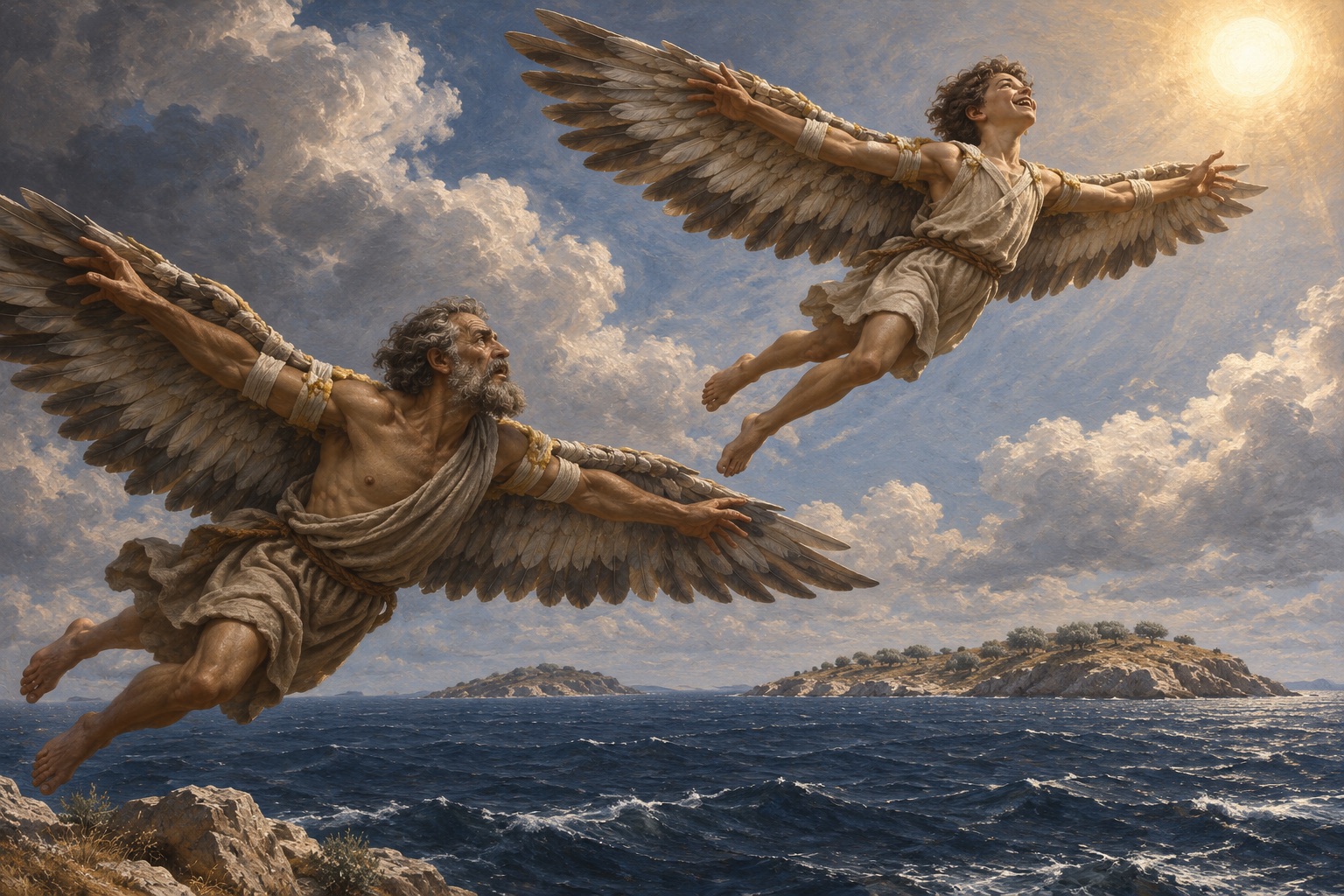
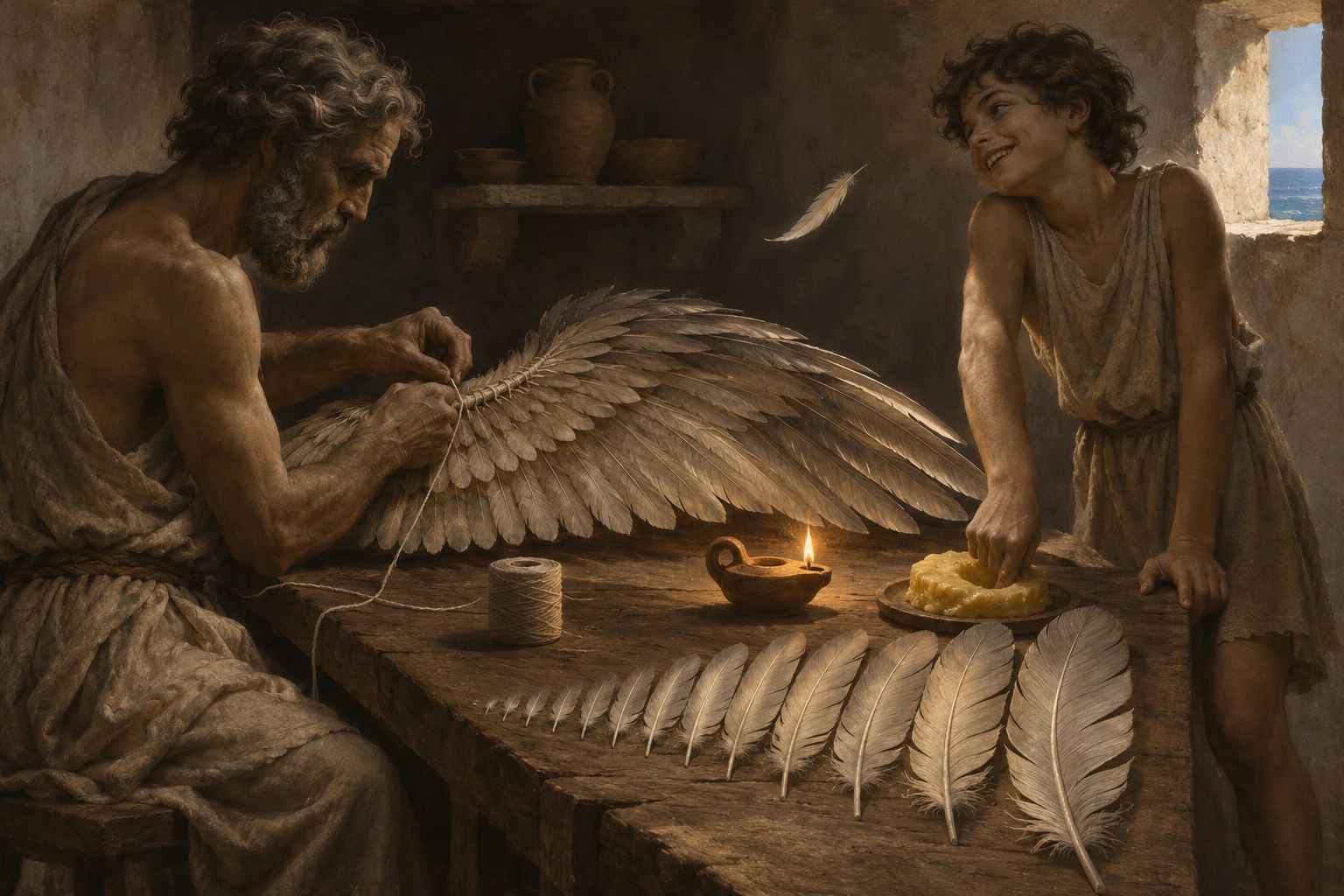
So he turned his mind to unknown arts and remade nature. He laid feathers in a row, beginning with the smallest, each longer than the one before, so that they seemed to grow on a slope, the way a shepherd’s pipe rises from reeds of unequal length. He tied them in the middle with thread and at the base with wax, and bent them into a gentle curve, like the wings of real birds (8.188–195).
The boy Icarus stood beside him, not knowing that he was handling his own danger. Smiling, he snatched at feathers stirred by the wandering breeze, or softened the yellow wax with his thumb, and with his play got in the way of his father’s wonderful work. When it was finished, Daedalus balanced himself on the two wings and hung in the moving air (8.195–202).
1-4 The Warning
Then he taught his son. “I warn you, Icarus, to keep to the middle course. If you go lower, the water will weigh down your feathers; if higher, the fire will burn them. Fly between the two.” He was not to steer by the stars, by Boötes, the Bear or Orion’s drawn sword: “take your way with me as your guide” (8.203–208). As he fitted the wings to the boy’s shoulders, the old man’s cheeks were wet and his hands trembled. He kissed his son, kisses “never to be repeated”, and flew ahead, afraid for the one behind him, like a bird leading its young out of a high nest into the air, and he kept looking back at his son’s wings (8.208–216). Below them a fisherman with his quivering rod, a shepherd leaning on his staff and a ploughman on the handle of his plough looked up, stood amazed, and took them for gods who could travel the sky (8.217–220).
1-5 The Fall and the Partridge
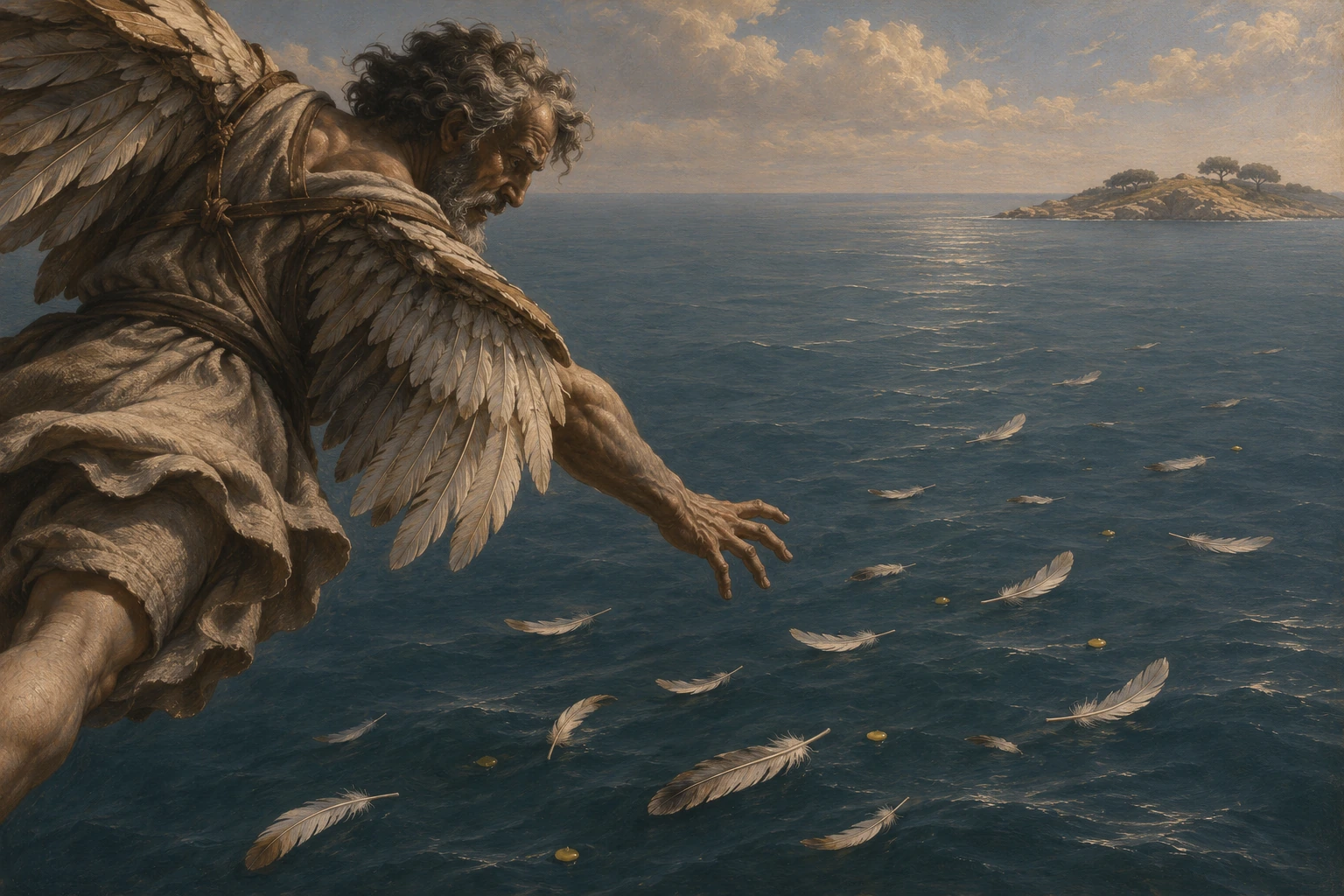
Juno’s island of Samos was already on their left, Delos and Paros behind them, Lebinthos and Calymne, rich in honey, on the right, when the boy began to delight in his bold flight. He left his guide and, drawn by a longing for the sky, climbed higher. The nearness of the scorching sun softened the fragrant wax that held the feathers. The wax melted; he beat his bare arms, and without his oars of feathers he caught no air. Calling his father’s name, he fell, and the dark blue water closed over his mouth. The sea took its name from him (8.220–230).
“The unhappy father, a father no longer,” called: “Icarus, Icarus, where are you? Where shall I look for you?” Then he saw feathers on the waves. He cursed his own arts and laid the body in a tomb, and the land was named after the one buried there (8.231–235).
As he buried his son, a chattering partridge watched from a muddy ditch, clapped its wings and sang for joy. It was a new bird then, never seen before, “a lasting reproach to you, Daedalus”. His sister had given him her son to teach, a boy of twelve with a quick mind. Taking the spine of a fish as his model, the boy cut teeth into iron and invented the saw; he was also the first to join two iron arms at one pivot, so that one stood still while the other drew a circle. Daedalus envied him, threw him headlong from Minerva’s sacred citadel and lied that he had slipped. But Pallas, who favours the gifted, caught him in mid-air and clothed him in feathers. The bird kept the name he had before, perdix, the partridge, but not his daring: it never flies high or nests in treetops, and lays its eggs in hedges, fearing heights, “remembering the old fall” (8.236–259).
1-6 The Shell
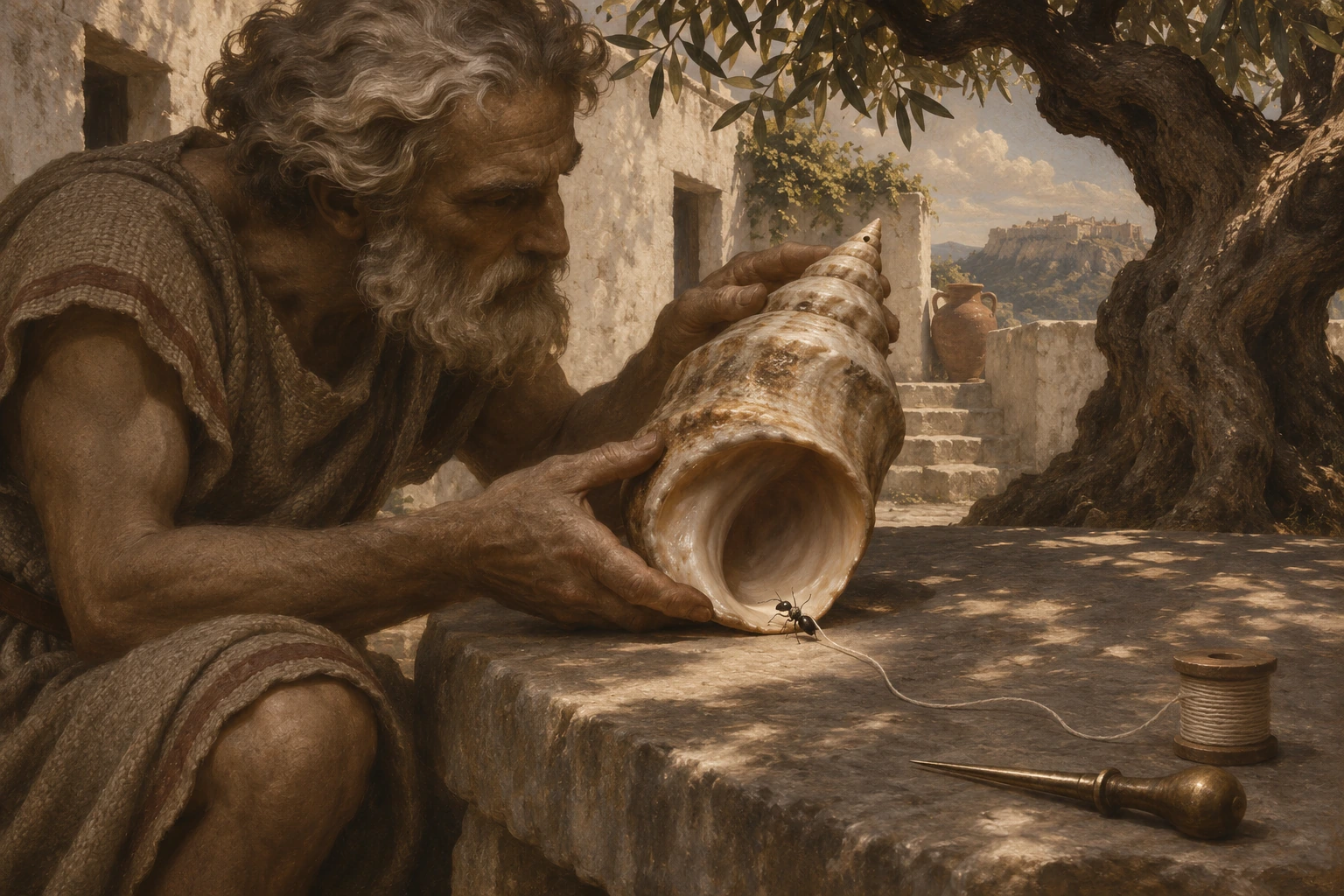
The land of Etna, Sicily, took in the weary Daedalus, and its king Cocalus took up arms for his suppliant (8.260–262). Apollodorus tells how Minos found him. Minos pursued Daedalus, and in every country he searched he carried a spiral shell and promised a great reward to anyone who could pass a thread through it, “believing that by that means he should discover Daedalus”. At Camicus in Sicily, at the court of Cocalus, he showed the shell. Cocalus took it, promised to thread it and gave it to Daedalus, who tied a thread to an ant, bored a hole in the shell and let the ant pass through. When Minos saw the threaded shell, he knew that Daedalus was there and demanded him. Cocalus promised to hand him over and gave a feast; but after his bath Minos “was undone by the daughters of Cocalus”, and some say he died when boiling water was poured over him (Epitome 1.13–15).
2 Where the Story Is Written Down
- Homer, Iliad 18.590–592 (8th–7th century BCE). On the shield of Achilles, the god Hephaestus makes “a dancing-floor like unto that which in wide Cnosus Daedalus fashioned of old for fair-tressed Ariadne”. There is no son and no flight. In the 2nd century CE Pausanias saw at Knossos “Ariadne’s Dance, mentioned by Homer”, carved in relief on white marble (9.40.3).
- Herodotus, Histories 7.169–170 (5th century BCE): “Minos, it is said, went to Sicania, which is now called Sicily, in search for Daedalus, and perished there by a violent death.” The Cretans then besieged Camicus for five years.
- Sophocles wrote a play, The Camicians, on Daedalus at the court of Cocalus. It is lost. Frazer notes that later writers quote it for the threading of the shell, and that it called the nephew Perdix (notes on Library 3.15.8 and Epitome 1.15).
- Diodorus Siculus, Library of History 4.76–79 (1st century BCE): the fullest Greek account, from the nephew to Minos’s tomb in Sicily, with the escape by ship told before the wings (section 3).
- Ovid tells the flight twice. In the Art of Love (2.21–96), Daedalus first begs Minos to let him go home, “let my father’s land receive my ashes”, and is refused. The warning names the same two dangers and one more, the winds. Icarus cries out as he falls, “Father, O father, I am carried away!”, and the passage ends: “the earth covers his bones; the sea has his name.” Ovid tells it to make a point about love: Minos could not hold back a man’s wings, and the poet means to hold the winged god himself (2.97–98). The Metamorphoses (8.152–262), retold in section 1, adds the labyrinth and the partridge.
- Strabo, Geography 14.1.19: the island of Icaria, beside Samos, “whence was derived the name of the Icarian Sea”, is named after Icarus, who fell there when, “on rising too close to the sun, his wings slipped off, since the wax melted”.
- Virgil, Aeneid 6.14–33 (19 BCE): Daedalus comes down at Cumae in Italy, dedicates his wings to Apollo and builds him a temple. On its doors he carves the story of Crete; twice he tries to carve his son’s fall in gold, and twice his father’s hands drop.
- Apollodorus, Library 3.1.4 and 3.15.8, and the Epitome 1.8–15 (1st or 2nd century CE): retold in section 1.
- Pausanias, Description of Greece (2nd century CE): the nephew’s tomb in Athens, the escape by sail, Icarus’s grave (sections 3 and 4).
3 Competing Versions
- Talos, Calos or Perdix? Apollodorus names the nephew Talos, and his mother, Daedalus’s sister, Perdix. Diodorus also calls him Talos and makes him the inventor of the potter’s wheel, of the saw, which he copied from a snake’s jaw, and of the tool for drawing a circle; Daedalus was caught burying him and said he was burying a snake (4.76.4–7). Pausanias saw “the tomb of Calos” on the way from the theatre to the Acropolis (1.21.4). In Ovid the boy learns the saw from a fish’s spine and becomes the partridge. Frazer notes that Sophocles already called him Perdix, and that in another tradition Perdix was the mother, honoured with a sanctuary beside the Acropolis.
- Why was Daedalus a prisoner? In Apollodorus, Minos shuts him in the labyrinth for helping Theseus. In Diodorus, he flees because Minos threatened him over the cow. Pausanias says only that Minos condemned him “on some charge” and threw him into prison with his son (7.4.6). Ovid’s Daedalus is in no cell: the sea is his prison.
- Wings or sails? In Diodorus, Pasiphaë gives him a ship, and Icarus falls into the sea while “disembarking onto the island in a reckless manner”; the sea is named Icarian and the island Icaria. Then Diodorus gives the wings as told by “certain writers of myths”: Pasiphaë hides Daedalus, Minos has every boat on the island searched, and Daedalus makes wings “marvellously fitted together with wax” (4.77.5–9). In Pausanias, father and son flee in small boats, and Daedalus invents sails “to take advantage of a favorable wind and outsail the oared fleet of Minos”; Icarus’s boat overturns, “as he was a clumsy helmsman” (9.11.4–5).
- Who buried Icarus? In Ovid, his father. In Pausanias, the current carried the body to an island off Samos, then without a name, where Heracles found it, recognized it and buried it; a small mound still stood on a promontory in Pausanias’s day (9.11.5).
- Where did Daedalus come down? Apollodorus: safely at Camicus in Sicily. Virgil: first at Cumae, in Italy. Pausanias puts Cocalus at Inycus, another city of Sicily (7.4.6).
- How did Minos die? Herodotus says only that he died by violence. Apollodorus: undone after his bath by the daughters of Cocalus, or drenched with boiling water. Diodorus: Cocalus kept him too long in the hot water, then told the Cretans that he had slipped and fallen in (4.79.2). Pausanias: the daughters, who admired Daedalus’s art, plotted Minos’s death to please him (7.4.6).
4 History and Tradition
- The name. Daidalos means “skilfully wrought”, writes Itō Teruo in the Japanese encyclopedia Nipponica, where Daedalus is taken as a symbol of the crafts of Athens. Diodorus says that Daedalus was the first to carve statues with open eyes, legs apart in a stride and arms held out, where earlier sculptors had made them with closed eyes and arms at their sides; and that after the murder he first fled to a deme of Attica whose people were called Daedalidae after him (4.76.3, 4.76.7). His translator, C. H. Oldfather, notes that it was probably made up mostly of craftsmen who claimed descent from him.
- Statues shown as his. Pausanias found wooden images said to be by Daedalus at Thebes and Lebadeia, at Olus and Knossos in Crete, and on Delos. “I know of no other works of Daedalus still in existence,” he writes (9.40.3–4). Of a Heracles at Corinth he says that all this artist’s works, “although rather uncouth to look at, are nevertheless distinguished by a kind of inspiration” (2.4.5).
- Sicily. Diodorus lists works Daedalus was said to have built there: a reservoir near Megaris, a city on a rock at Camicus with a narrow, winding way up, a steam grotto at Selinus that cured the sick, a wall on the crag of Eryx and a golden ram for its Aphrodite (4.78). The place where Minos landed was named Minoa after him. His men buried him in a two-storey tomb with a shrine of Aphrodite above the bones, and when Theron ruled Acragas the bones were given back to the Cretans (4.79.1–4).
- The Icarian Sea. Strabo describes Icaria as an island without harbours, three hundred stadia round, with a temple of Artemis, “used by Samians mostly for the grazing of cattle”. Pausanias: “After this Icarus are named both the island and the sea around it” (9.11.5).
- The painting in Brussels. Landscape with the Fall of Icarus, in the Royal Museums of Fine Arts of Belgium (inv. 4030), has Ovid’s ploughman, shepherd and fisherman in it. The ploughman, bent over his plough, holds the foreground, and a shepherd gazes at the empty sky; Icarus is only two legs in the waves, and a partridge sits on a mound above the sea. Dominique Allart and Christina Currie (2013) write that the composition is generally credited to Pieter Bruegel the Elder, but that the canvas, which surfaced at a London gallery and was bought in 1912 as a copy, is not by his hand: radiocarbon dating in 1998 placed the canvas between 1555 and 1635, most probably after Bruegel’s death in 1569, and the underdrawing is the work neither of Bruegel nor of his son Pieter Brueghel the Younger. They call it an old copy of a lost original. A second version, on panel, in the Van Buuren Museum in Brussels, is also a copy, and shows Daedalus in the sky the shepherd is watching.
- Auden. W. H. Auden saw the painting in Brussels and wrote “Musée des Beaux Arts”, in December 1938, Langdon Hammer believes; it was collected in Another Time (1940). In it, in “Brueghel’s Icarus”, everything turns away “quite leisurely” from the disaster.
“Don’t fly too close to the sun” is the lesson usually drawn from Icarus, and it is only half of what his father told him. In Ovid, Daedalus names two dangers: go too low, and “the water will weigh down your feathers”; too high, and “the fire will burn them”. “Fly between the two” (Metamorphoses 8.203–206). Apollodorus gives the same double warning: not too high, or the sun will melt the glue, and not too near the sea, or the damp will loosen the feathers (Epitome 1.12). And in Diodorus’s account of the wings, the sea is what saves Daedalus: he flies close to it, “repeatedly wetting the wings”.
5 Related Stories
- Theseus and the Minotaur: The Labyrinth: the monster that Daedalus’s labyrinth was built to hold, and the thread that led Theseus out of it, given to Ariadne, in Apollodorus, on Daedalus’s advice.
- The Sibyl of Cumae: The Prophetess and the Nine Books: in the Aeneid, Daedalus comes down at Cumae, dedicates his wings to Apollo and carves the story of Crete on the temple doors. Twice he tries to carve his son’s fall, and twice his hands fail him.
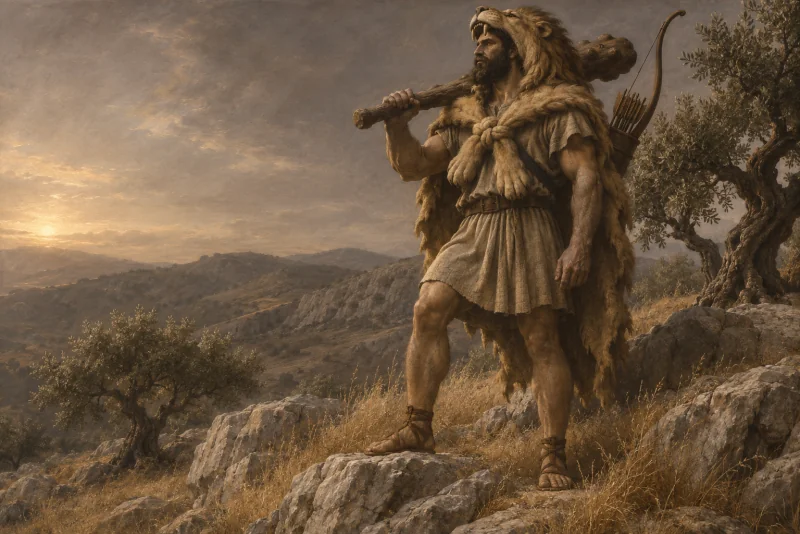
- Heracles: The Twelve Labours and the Pyre on Mount Oeta: in Pausanias, it is Heracles who finds the drowned Icarus washed up on the island off Samos, recognizes him and buries him.
6 Sources
- Ovid, Metamorphoses 8.152–262, Latin text ed. Hugo Magnus (1892), and trans. Brookes More (1922): Perseus, Perseus
- Ovid, Art of Love 2.21–98, Latin text: The Latin Library
- Apollodorus, Library 3.1.4 and 3.15.8, and Epitome 1.8–15, trans. Sir James George Frazer (Loeb, 1921), with Frazer’s notes: Perseus, Perseus
- Homer, Iliad 18.590–592, trans. A. T. Murray (Loeb, 1924): Perseus
- Herodotus, Histories 7.169–170, trans. A. D. Godley: Perseus
- Diodorus Siculus, Library of History 4.76–79, trans. C. H. Oldfather (Loeb, vol. III, 1939): LacusCurtius
- Strabo, Geography 14.1.19, trans. H. L. Jones (Loeb): Perseus
- Pausanias, Description of Greece 1.21.4, 2.4.5, 7.4.5–6, 9.11.4–5 and 9.40.3–4, trans. W. H. S. Jones and H. A. Ormerod (Loeb, 1918): Perseus
- Virgil, Aeneid 6.14–33, Latin text: The Latin Library
- Dominique Allart and Christina Currie, “Trompeuses séductions. La Chute d’Icare des Musées royaux des Beaux-Arts de Belgique à Bruxelles”, CeROArt (2013), author’s postprint: ORBi, University of Liège; Royal Museums of Fine Arts of Belgium, Historical Archives, file 5231, on the purchase of inv. 4030 in 1912: fine-arts-museum.be
- Langdon Hammer, “W. H. Auden (cont.)”, ENGL 310: Modern Poetry, lecture 23: Open Yale Courses
- Itō Teruo, “ダイダロス”, Nipponica: Kotobank
- Japanese translations: Nakamura Zen’ya’s Metamorphoses (Iwanami Bunko, 2 vols.) and Takatsu Harushige’s Apollodorus (Iwanami Bunko, 1953): NDL Search, NDL Search
Cover and illustrations: AI-generated images made for Arcana. They are interpretations, not historical artworks.