Theseus and the Minotaur: The Labyrinth
A prince from Troezen sailed to Crete among the young Athenians sent to the Minotaur, came out of the labyrinth by Ariadne's thread, and forgot to change his sail on the way home. Plutarch, who tells the story most fully, also reports a Cretan version in which the Minotaur was a general named Taurus.
- Type: heroic legend, a monster killed in a maze
- Culture: ancient Greece, above all Athens; the story runs from Troezen and Athens to Knossos in Crete
- Earliest texts: a Linear B tablet from Knossos may name a “Mistress of the Labyrinth”; Homer (8th–7th century BCE) knows Ariadne, Theseus and Daedalus’s work at Knossos; the fullest telling is Plutarch’s Life of Theseus (late 1st or early 2nd century CE)
- Key figures: Theseus, his mother Aethra, Aegeus king of Athens, Medea, Minos king of Crete, Pasiphaë, the Minotaur (Asterion), Ariadne, Daedalus, Dionysus
Plutarch opens his Life of Theseus with a map. Geographers, he says, crowd the lands they know nothing about onto the edges of their maps, with notes such as “What lies beyond is sandy desert without water and full of wild beasts”. Going back as far as Theseus, he had reached that edge himself: a land “full of marvels and unreality, a land of poets and fabulists”. He told it all the same, hoping, as he put it, to make Fable “submit to reason and take on the semblance of History”.
Did Theseus abandon Ariadne? The ancient tellers did not agree. In Catullus and Hyginus he leaves her asleep on the island of Dia. In Apollodorus, Diodorus and Pausanias the god Dionysus takes her from him. In the Odyssey, the oldest mention, she never reaches Athens at all: Artemis kills her on Dia “because of the witness of Dionysus”. Plutarch, who collects still more versions, admits that they “do not agree at all”.
1 The Telling
This telling follows Plutarch, a Greek biographer of the late 1st and early 2nd century CE, in his Life of Theseus (chapters 3–22), in Bernadotte Perrin’s translation (Loeb, 1914). For the monster and the thread, which Plutarch passes over quickly, it follows the Library of Apollodorus and its Epitome, in J. G. Frazer’s translation (Loeb, 1921).
1-1 The Sword under the Rock
Aegeus, king of Athens, had no children, and the priestess at Delphi gave him an obscure command: “Loose not the wine-skin’s jutting neck, great chief of the people, until thou shalt have come once more to the city of Athens.” On his way home he turned aside to Troezen, in the Peloponnese, and told the oracle to its wise king, Pittheus. Pittheus understood it, and persuaded or beguiled Aegeus into lying with his daughter Aethra. Apollodorus adds that Poseidon lay with her the same night (3.15.7).
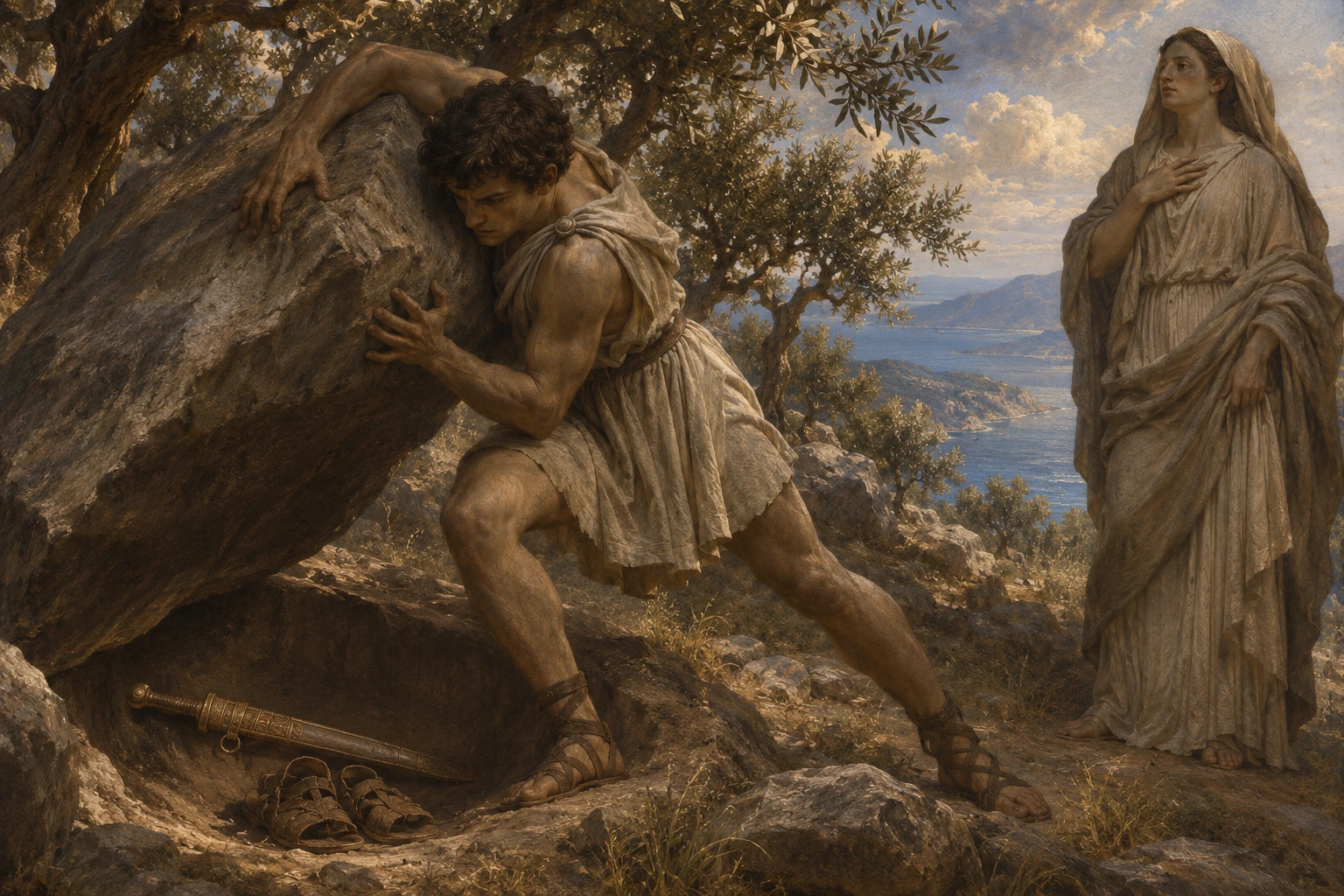
Before he left, Aegeus hid a sword and a pair of sandals under a great rock with a hollow just large enough for them. If Aethra bore him a son, and the boy could lift the rock once he was grown, she was to send him to Athens with the tokens, in secret: Aegeus feared his fifty nephews, the sons of Pallas, who despised him for having no heir. Pittheus let it be said that the child, Theseus, was a son of Poseidon, the patron god of Troezen. When the young man was ready, Aethra took him to the rock, and he “easily raised it up”. At Troezen they told Pausanias that he was sixteen (1.27.8).
1-2 The Road to Athens
His mother and grandfather begged him to go by sea. He took the land road, which robbers had made deadly, because he longed to equal the deeds of his kinsman Heracles. At Epidaurus he killed Periphetes the Club-bearer and kept the club. On the Isthmus he killed Sinis the Pine-bender “in the very manner” in which Sinis had killed others. He went out of his way to kill the sow of Crommyon, which some said was really a woman robber. On the borders of Megara he threw Sciron, who kicked travellers into the sea, down the cliffs; at Eleusis he out-wrestled Cercyon; and a little farther on he made Procrustes fit his own bed, as Procrustes had made strangers fit it (chapters 6–11).
In Athens, Medea was living with Aegeus. She had fled there from Corinth and promised to cure his childlessness with her sorceries. She knew who the stranger was, Aegeus did not, and she persuaded the old king to poison him at a feast. When the meat was served, Theseus drew his sword as if to carve, so that his father would see it. Aegeus knew the sword, dashed down the cup and acknowledged his son before the citizens (chapter 12). In Apollodorus, Aegeus first sends the stranger against the bull of Marathon, and afterwards Theseus drives Medea out (Epitome 1.5–6).
1-3 The Tribute
Years before, Androgeos, a son of Minos, king of Crete, had been killed in Attica, treacherously, it was believed. Minos made war on Athens; then barrenness and plague struck the land and its rivers dried up. The god told the Athenians that their suffering would end if they appeased Minos, and they agreed to send him, every nine years, seven youths and as many maidens. In “the most dramatic version”, says Plutarch, the young people were killed in the Labyrinth by the Minotaur, or wandered there unable to find the way out until they died (chapter 15).
Apollodorus tells where the monster came from. Minos had kept back a bull that Poseidon sent him from the sea to be sacrificed, and the god in anger made the queen, Pasiphaë, desire it; she bore Asterius, “who was called the Minotaur” (Pausanias calls him Asterion, 2.31.1). He had the face of a bull, but the rest of him was human, and Minos, on the advice of oracles, shut him up in the Labyrinth, a building “that with its tangled windings perplexed the outward way” (3.1.3–4). It was made by the Athenian craftsman Daedalus, whose story is told in Daedalus and Icarus.
When the third tribute came due, the Athenians grumbled that Aegeus, the cause of their trouble, alone had no share in the punishment. Theseus offered himself without waiting for the lot. Twice before, the ship had sailed with a black sail, since no one expected the young people back. This time Aegeus gave the pilot a white sail as well: if Theseus came home safe, he was to hoist it (chapter 17).
1-4 Ariadne’s Thread
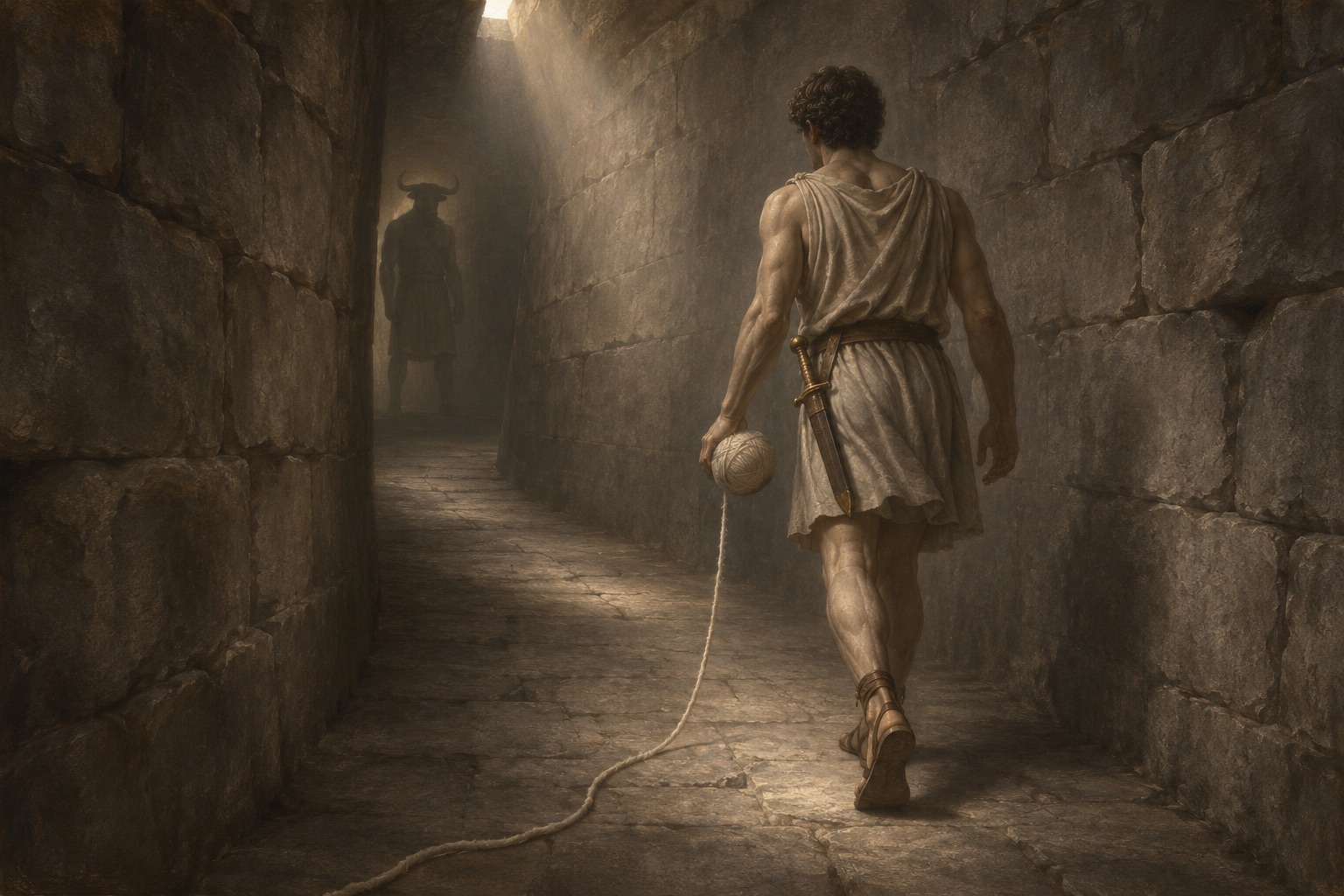
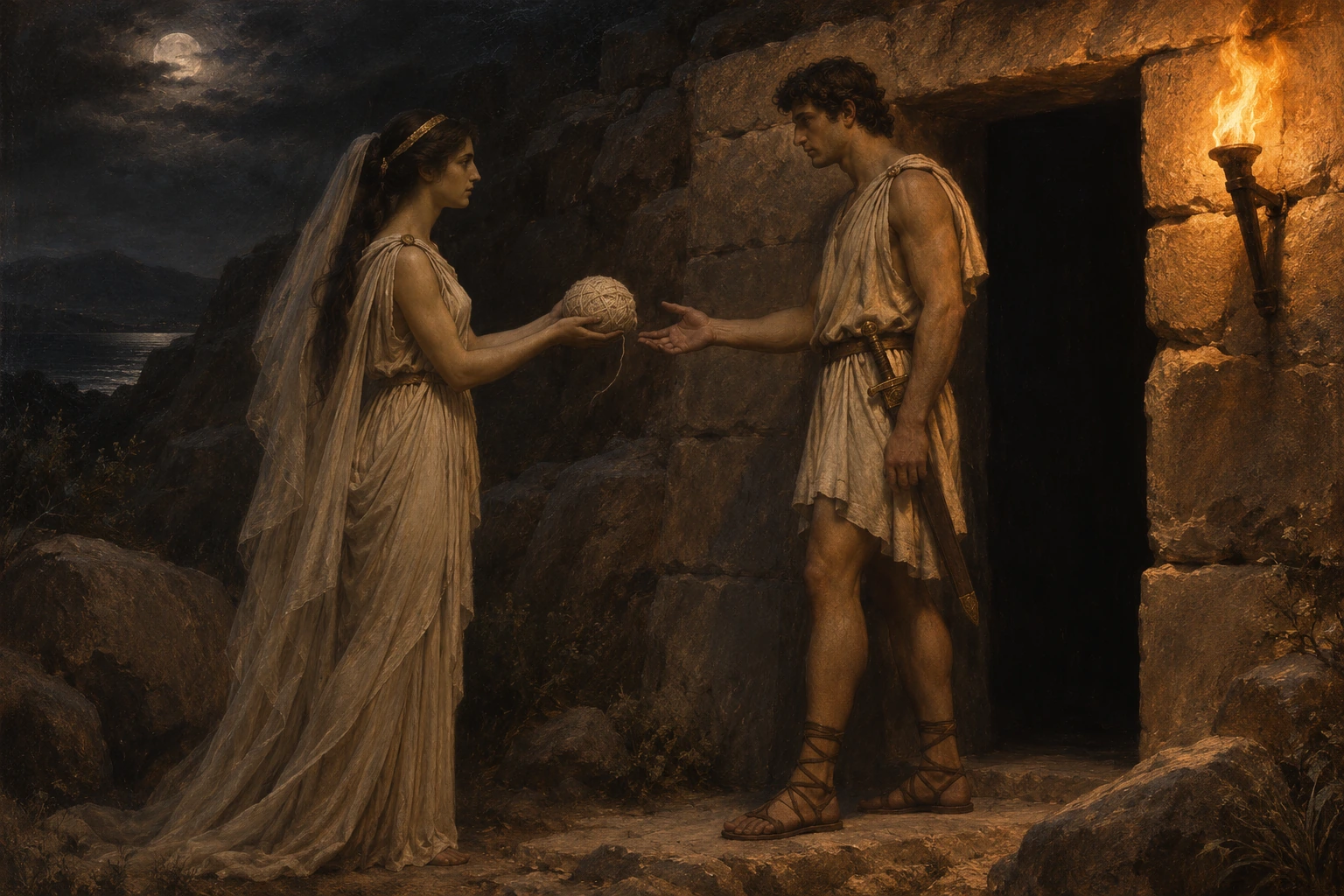
In Crete, Minos’s daughter Ariadne fell in love with Theseus. In Apollodorus she offers to help him if he will take her to Athens as his wife, and when he has sworn it, she asks Daedalus how to get out of the Labyrinth. On his advice she gave Theseus a ball of thread. He tied it to the door and let it run out behind him as he went in. At the far end of the Labyrinth he found the Minotaur and killed him with his fists, then followed the thread back to the door. That night he sailed with Ariadne and the young Athenians to Naxos (Epitome 1.8–9). Plutarch adds, from the writer Pherecydes, that Theseus also holed the bottoms of the Cretan ships so that no one could follow (chapter 19).
1-5 Naxos and the Black Sail
On Naxos, says Apollodorus, Dionysus fell in love with Ariadne and carried her off. On the way home Theseus put in at Delos, sacrificed to Apollo and, with the young people he had saved, danced a dance that the Delians still performed in Plutarch’s day, “an imitation of the circling passages in the Labyrinth”. They called it the Crane (chapter 21).
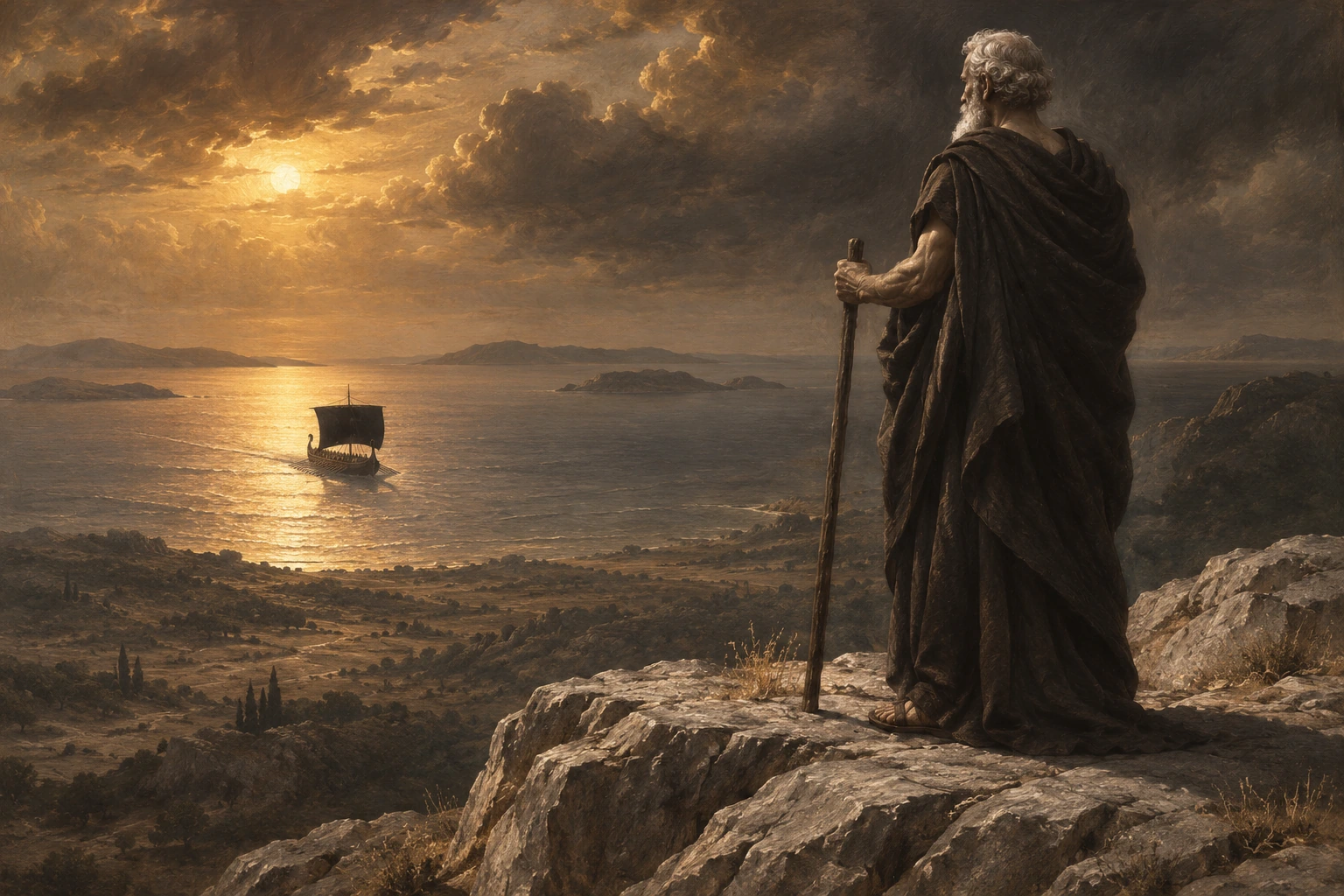
As they drew near Attica, Theseus and his pilot forgot, “such was their joy and exultation”, to hoist the white sail. Aegeus saw the black one and, in despair, “threw himself down from the rock and was dashed in pieces”. Theseus landed at Phalerum and made the sacrifices he had vowed; the herald he sent up to the city came back with the news of the king’s death, and they all went up to Athens lamenting. Theseus buried his father and became king (chapter 22).
2 Where the Story Is Written Down
- A tablet from Knossos. Linear B tablet Gg 702 lists offerings to “all the gods” and to da-pu₂-ri-to-jo po-ti-ni-ja. Palmer read the first word as labyrinthoio, “of the Labyrinth”, since d and l interchange in some pre-Greek words. John Chadwick, in 1957, called the identification “extremely attractive”, though the interchange was “not yet certainly confirmed on the tablets”. On that reading, a “Mistress of the Labyrinth” received an amphora of honey. The Greek Ministry of Culture dates the Knossos tablets to the 14th century BCE.
- Homer. The Iliad (18.590–592) compares a dance on Achilles’s shield to “a dancing-floor like unto that which in wide Cnosus Daedalus fashioned of old for fair-tressed Ariadne”. In the land of the dead Odysseus sees “fair Ariadne, the daughter of Minos of baneful mind, whom once Theseus was fain to bear from Crete” (Odyssey 11.321–325). Neither passage mentions the Minotaur.
- Hesiod, Theogony 947–949: Dionysus made Ariadne his wife, and Zeus made her “deathless and unageing”.
- Catullus, poem 64 (1st century BCE). On the coverlet of a marriage bed is woven Ariadne on the shore of Dia, watching Theseus sail away; the poet tells the tribute, the thread, the forgotten sail and Aegeus’s fall, and shows Bacchus coming to look for her (lines 50–264).
- Diodorus of Sicily, Library of History 4.59–62 and 4.77 (1st century BCE); Virgil, Aeneid 6.14–33, where the doors Daedalus carves at Cumae show the whole story (see The Sibyl of Cumae); Ovid, Metamorphoses 8.152–182.
- Plutarch, Life of Theseus, paired with his Life of Romulus. He names his authorities as he goes: Philochorus, Hellanicus, Cleidemus, Demon, Pherecydes, the poet Simonides and others.
- Apollodorus, Library 3.1.3–4 and 3.15.7–3.16.2, a handbook usually placed in the 1st or 2nd century CE. The full text breaks off in the middle of Theseus’s journey, after Sinis; the story goes on in a shorter version, the Epitome (1.1–11). In Latin, the Fabulae that go under the name of Hyginus tell it in brief (37–43).
3 Competing Versions
- Every nine years, or every year? Plutarch (15.1), Diodorus (4.61.3) and Ovid (“the third lot, repeated after nine years”, 8.171, our translation) say every nine years. Apollodorus (3.15.8), Virgil (septena quotannis, “seven each year”, 6.21) and Hyginus (41) say every year. Plutarch and Apollodorus both send Theseus with the third tribute.
- Chosen or a volunteer? In Plutarch, Theseus offers himself. Apollodorus has both: he “was numbered among those” to be sent, “or, as some affirm, he offered himself voluntarily”. Hellanicus, as Plutarch reports him, says there was no lot: Minos came and picked the young people himself, and picked Theseus first (17.3).
- How did the Minotaur die? Apollodorus: by Theseus’s fists. Catullus: Theseus threw him down as a storm uproots an oak or a pine on Mount Taurus, the beast “tossing its horns in vain” (64.105–111). Ancient commentators on Homer, as Frazer sums them up, credit Pherecydes with a version in which Theseus finds the Minotaur asleep, seizes him by the hair and sacrifices him to Poseidon. On the throne of Apollo at Amyclae, Pausanias could not say why the Bull of Minos was shown “bound, and being led along alive by Theseus” (3.18.11).
- Whose was the thread? Apollodorus: Daedalus suggested it. Virgil: Daedalus himself, pitying the princess, gave the thread (6.28–30). Hyginus: Theseus came out “on Ariadne’s advice, winding back the thread” (42, our translation).
- No monster at all. Philochorus, as Plutarch tells it, said the Cretans called the Labyrinth only a prison. The young Athenians were prizes at funeral games for Androgeos, and the champion was Minos’s harsh general Taurus, “Bull”; Theseus beat him at wrestling, and Minos gave the young people back (16.1, 19.2–3). Aristotle thought they lived out their lives as slaves in Crete. Cleidemus made it a war, in which Theseus killed Minos’s son Deucalion “at the gate of the Labyrinth” (19.6). Pausanias wrote of “the so-called Bull of Minos, whether this was a man or a beast” (1.24.1).
- Ariadne. Homer: killed by Artemis. Hesiod: Dionysus’s wife, made immortal. Catullus and Hyginus: left asleep on Dia; in Hyginus, Theseus thinks she will bring him shame at home. Apollodorus, Diodorus and Pausanias: taken by Dionysus. Plutarch adds that she hanged herself; or lived on Naxos with a priest of Dionysus, because Theseus loved another woman, Aegle; or died on Cyprus before her child was born; and that the Naxians told of two Ariadnes (20). As for Dia, Diodorus says it was the old name of Naxos (4.61.5); Frazer, following the commentator Merry, preferred the islet of Dia off the north coast of Crete, which Theseus would pass on his way to Athens.
- The sail. Theseus forgot it for joy (Plutarch), for grief over Ariadne (Apollodorus, Diodorus, Pausanias), or because Jupiter granted Ariadne’s prayer for vengeance (Catullus 64.202–248). Simonides, quoted by Plutarch, made the signal of safety not white but “a scarlet sail dyed with the tender flower of luxuriant holm-oak”. The Greek writers, and Catullus, have Aegeus fall from the Acropolis; Hyginus has him throw himself into the sea, “from which the Aegean Sea is named” (43, our translation). Of the writers Frazer lists, only Hyginus and two later Latin ones have the sea.
4 History and Tradition
- An Athenian Heracles. Plutarch’s Theseus sets out to equal Heracles, and Diodorus calls his deeds on the road “Labours” (4.59.1). Itō Teruo, in the Japanese encyclopedia Nipponica, writes that the tales of Theseus’s prowess closely resemble those of Heracles, and that his legend seems to have grown up to give Athens a national hero to set against the Dorian Heracles.
- The ship and Delos. The Athenians kept Theseus’s thirty-oared ship until the time of Demetrius of Phalerum, at the end of the 4th century BCE, putting in new timbers as the old ones rotted, so that philosophers argued over whether “it remained the same” (Plutarch 23.1). In Plato’s Phaedo (58a–c), the Athenians had vowed to Apollo to send a mission to Delos every year if the young people came home. No one could be executed while the ship was away, and so Socrates “passed a long time in prison between his trial and his death”.
- What Pausanias saw (2nd century CE): near Troezen, the “Rock of Theseus” (2.32.7); on the Acropolis, a bronze group of the legend, “everything in bronze except the rock” (1.27.8), and a statue of Theseus fighting the Bull of Minos (1.24.1); and by the temple of Wingless Victory, where “the sea is visible”, the place where Aegeus threw himself down (1.22.4–5).
- The bones. In 476–475 BCE Delphi told the Athenians to bring home the bones of Theseus. On the island of Scyros, Cimon found the coffin of “a man of extraordinary size”, with a bronze spear and a sword, and Athens received it “as though Theseus himself were returning to his city” (Plutarch 36).
- Knossos. The site was discovered in 1878 by Minos Kalokairinos, and Arthur Evans excavated it from 1900 to 1931, says the Greek Ministry of Culture. Evans restored much of the palace: columns of concrete where the imprints of wooden ones had been found and, from the 1920s, with the architect Piet de Jong, reinforced concrete. The Ashmolean Museum calls the restoration perhaps the most controversial part of his work. Visitors were already shown a labyrinth there in antiquity: in Philostratus’s Life of Apollonius (4.34, 3rd century CE), Knossos is the place “where a labyrinth is shown”.
- Coins. Knossos struck coins from about 470 BCE with the Minotaur on one side and, on the other, four meanders standing for the Labyrinth, writes the numismatist Mariusz Mielczarek; a square labyrinth followed, and between 200 and 67 BCE a round one. Harvard Art Museums holds a stater of 300–270 BCE with a square labyrinth (1.1965.1986). Yokoyama Tadashi, in the Heibonsha World Encyclopedia, dates the earliest labyrinth pattern on the coins of Knossos later, to about the 2nd century BCE; the sources differ. Ancient labyrinth patterns, he notes, are a single path with no forks.
“The palace of Knossos was the Labyrinth” is often said, as if the excavators had found it. The identification is Arthur Evans’s. He took the double axe, labrys, cut on the palace blocks, as a key to the name, and wrote: “There can be little doubt that it was the great Palace itself.” In the ancient texts the Labyrinth is a building that Daedalus made to shut the monster away. Diodorus says it “has entirely disappeared”, Pliny that “not a vestige is left”, and travellers before Evans looked for it in a quarry near Gortyn.
5 Related Stories
- Daedalus and Icarus: Between the Sun and the Sea: the builder of the Labyrinth. In Apollodorus, once Theseus has escaped, Minos shuts Daedalus up in it with his son (Epitome 1.12).
- Heracles: The Twelve Labours and the Pyre on Mount Oeta: the hero Theseus wanted to equal. Pausanias and Diodorus say the bull of Marathon was the Cretan bull that Heracles brought to the Peloponnese for one of his labours, and Pausanias adds that it killed Androgeos (1.27.10).
- Jason and the Argonauts: The Voyage for the Golden Fleece: Medea flees from Corinth to Athens at the end of Jason’s story, and in Theseus’s story she is the wife of Aegeus who plots to poison the stranger.
- Romulus and Remus: The Twins and the She-Wolf: Plutarch paired the two founders in his Parallel Lives, because both “were of uncertain and obscure parentage, and got the reputation of descent from gods”.
6 Sources
- Plutarch, Life of Theseus, trans. Bernadotte Perrin (Loeb, 1914), with Perrin’s notes: LacusCurtius
- Apollodorus, Library 3.1.2–4, 3.15.7–3.16.2 and Epitome 1.1–12, trans. Sir James George Frazer (Loeb, 1921), with Frazer’s notes: Theoi, Theoi, Perseus
- Homer, Iliad 18.590–592, trans. A. T. Murray (Loeb, 1924), and Odyssey 11.321–325, trans. A. T. Murray (Loeb, 1919): Perseus, Perseus; Hesiod, Theogony 947–949, trans. Hugh G. Evelyn-White (Loeb, 1914): Perseus
- Catullus, poem 64, trans. Leonard C. Smithers (1894), and Latin text: Perseus, Perseus
- Diodorus Siculus, Library of History 1.61, 4.59–62 and 4.77, trans. C. H. Oldfather (Loeb, 1933 and 1935): LacusCurtius, LacusCurtius
- Virgil, Aeneid 6.14–33, trans. Theodore C. Williams (1910), and Latin text, ed. J. B. Greenough (1900): Perseus, Perseus
- Ovid, Metamorphoses 8.152–182, trans. Brookes More (1922), and Latin text, ed. Hugo Magnus (1892): Perseus, Perseus
- Hyginus, Fabulae 37–43, Latin text: The Latin Library
- Pausanias, Description of Greece 1.22.4–5, 1.24.1, 1.27.8–10, 2.31.1, 2.32.7 and 3.18.11, trans. W. H. S. Jones and H. A. Ormerod (Loeb, 1918): Perseus
- Pliny the Elder, Natural History 36.19 (36.84–93), trans. John Bostock and H. T. Riley (1855): Perseus; Plato, Phaedo 58a–c, trans. Harold North Fowler (Loeb, 1966 printing): Perseus; Philostratus, Life of Apollonius of Tyana 4.34, trans. F. C. Conybeare (Loeb, 1912): Livius
- Arthur Evans, The Palace of Minos at Knossos, vol. I (London, 1921), pp. 4–6 and 533: archive.org
- John Chadwick, “Potnia”, Minos 5 (1957): Universidad de Salamanca; “Labyrinth”, Daidalika, Hellenic Mediterranean University: daidalika.hmu.gr
- Hellenic Ministry of Culture and Sports, “Knossos”: odysseus.culture.gr; Andrew Shapland, “Rebuilding the Palace of Minos at Knossos”, Ashmolean Museum: ashmolean.org
- Mariusz Mielczarek, “More on the Labyrinth on the Coins of Knossos”, Studies in Ancient Art and Civilization 17 (2013): akademicka.pl; Harvard Art Museums, “Stater of Knossos” (1.1965.1986): harvardartmuseums.org
- Itō Teruo, “テセウス”, Nipponica, and Yokoyama Tadashi, “迷宮”, Heibonsha World Encyclopedia: Kotobank, Kotobank
Cover and illustrations: AI-generated images made for Arcana. They are interpretations, not historical artworks.