Kurukshetra: The War of the Mahābhārata
A game of dice costs five brothers their kingdom and their wife's dignity, and eighteen days of war at Kurukshetra win it back. To win, they break the rules of battle, and the poem never lets them forget it.
- Type: epic, a war between cousins for one kingdom
- Culture: India (Hindu tradition); retold across South and Southeast Asia
- Earliest texts: the Sanskrit Mahābhārata, attributed to Vyasa, which took its present form between about the 4th century BCE and the 4th century CE; the war fills books 6 to 10 of its eighteen
- Key figures: the five Pandavas (Yudhishthira, Bhima, Arjuna, Nakula, Sahadeva), Draupadi, Duryodhana and his brothers the Kauravas, Bhishma, Drona, Karna, Krishna, Ashvatthaman
The Mahābhārata is the story of a family that destroys itself. Two sets of cousins claim one kingdom, a game of dice turns the quarrel into a feud, and in eighteen days on the plain of Kurukshetra almost everyone dies. The side that wins is the side the poem loves, and the poem still makes it look at what it did.
Did the war really happen? Perhaps, but only the poem tells of it. Moriz Winternitz (1927) thought it “probably” a historical event, “though we hear of it only in the Mahābhārata”. Hara Minoru, in the Heibonsha World Encyclopedia, places a family war over the Bharatas’ land at Kurukshetra around the 10th century BCE. The poem itself sets it “at the juncture of the Kali and Dvāpara ages” (1.2.9).
1 The Telling
This follows the critical edition of the Mahābhārata published in Pune; the numbers are its book, chapter and verse. Where other manuscripts, and K. M. Ganguli’s English translation, tell it differently, section 3 says so.
1-1 Two Sets of Cousins
King Pandu, under a sage’s curse, could not father children without dying (1.109). So his wives called on gods: Dharma, Vayu and Indra gave Kunti three sons, Yudhishthira, Bhima and Arjuna, and the twin Ashvins gave Madri the twins Nakula and Sahadeva. These five are the Pandavas. Pandu’s blind elder brother Dhritarashtra had a hundred sons by Gandhari, the eldest Duryodhana: the Kauravas. Both fathers were sons of Vyasa (1.100), so the poet of the Mahābhārata is the grandfather of both sides.
Over them stood Bhishma, their grand-uncle, who had sworn never to marry (1.94). His mother was the river goddess Ganga, whose own story is The Descent of the Ganga. The brahmin Drona taught all the princes to fight. And Kunti had borne a son before her marriage, by the Sun: Karna, born wearing armour and earrings. She cast him away on the water, and a charioteer and his wife raised him (1.104). He grew up to be Duryodhana’s friend, not knowing who his brothers were. The five Pandavas shared one wife, Draupadi.
1-2 The Dice Game
Book 2 tells how Duryodhana won everything without a battle. His uncle Shakuni threw the dice for him (2.53.15). Yudhishthira staked and lost his wealth, his kingdom, his brothers and himself. Then Shakuni reminded him of one stake left: Draupadi (2.58.31). Yudhishthira staked her and lost.
Duryodhana’s brother Duhshasana dragged her into the hall by her hair, in a single garment, during her period (2.60.15–25). She asked Yudhishthira, and then the whole assembly: “Whom did you lose first, yourself or me?” (2.60.7, our translation). If Yudhishthira had already lost himself, could he still stake her? Bhishma said that dharma was too subtle for him to answer (2.60.40). Karna called her a woman with many husbands and told Duhshasana to strip her and the Pandavas (2.61.35–38). Duhshasana pulled at her garment, and another just like it appeared, again and again, until he sat down, “tired and ashamed” (2.61.40–48).
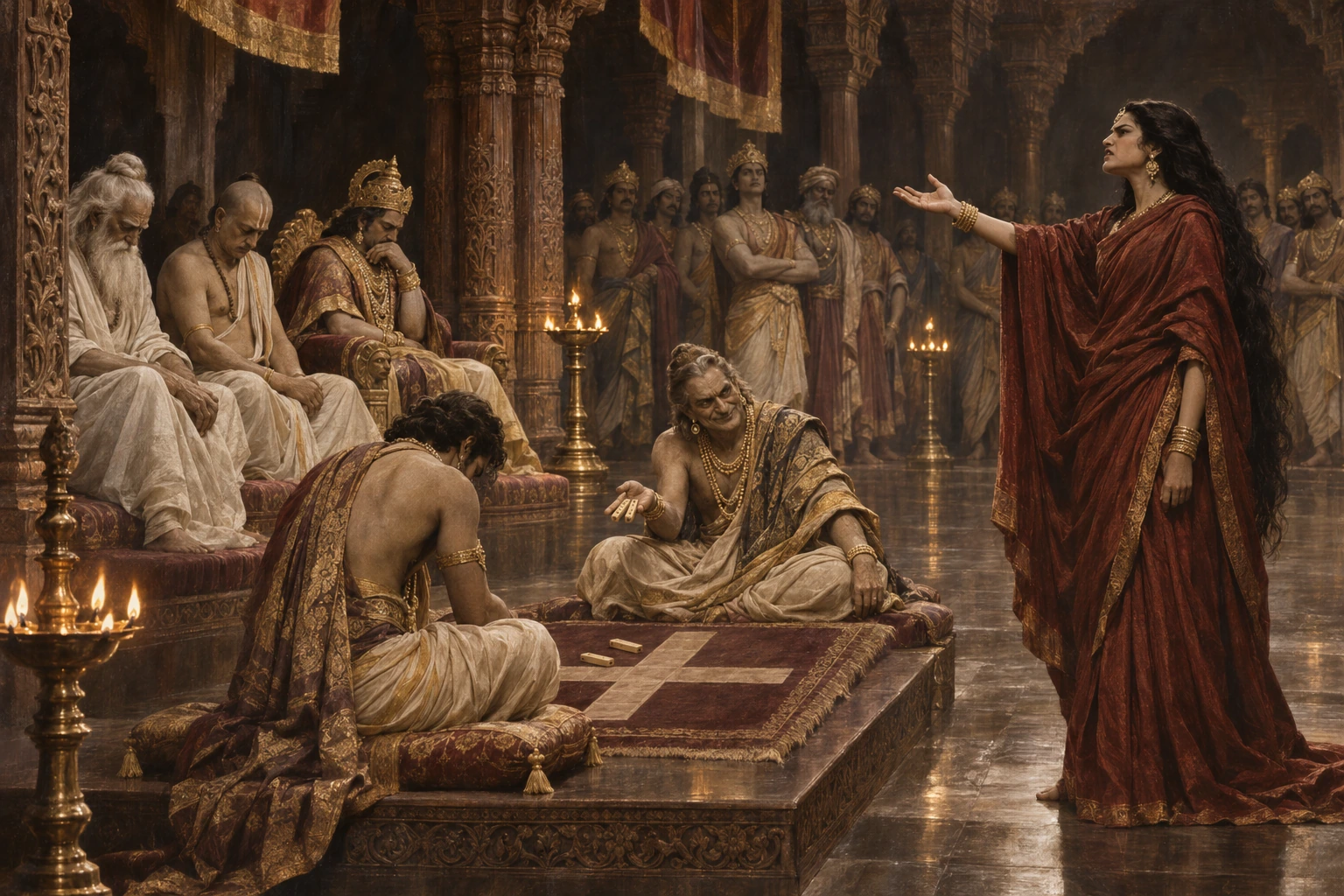
Bhima swore to tear open Duhshasana’s chest and drink his blood (2.61.44–46). When Duryodhana bared his left thigh to Draupadi, Bhima swore to break it with his mace (2.63.12–14). Then a jackal howled in the king’s fire-hall, and Dhritarashtra, frightened, offered Draupadi a boon. She asked for Yudhishthira’s freedom, then for the four others with their chariots and bows. She refused a third: two boons, she said, are a warrior’s wife’s due (2.63.27–35). But Yudhishthira played once more, on new terms: the losers would live twelve years in the forest and a thirteenth unrecognized among people (2.66.18–19). He lost again.
1-3 Exile and Embassy
The Pandavas spent twelve years in the forest (book 3) and the thirteenth in disguise at the court of King Virata (book 4). Then they asked for their kingdom back. Yudhishthira would settle for five villages (5.31.19–20). Krishna, their cousin and ally, went to Hastinapura to make peace. Duryodhana answered that he would not give up “even as much land as the point of a sharp needle would pierce” (5.125.26, our translation), and plotted to seize Krishna. Krishna laughed, and gods blazed from his body (5.129).
As he left, Krishna told Karna who his mother was, and Karna stayed with Duryodhana (5.138–141). Kunti went to him herself. He promised to spare four of her sons, but not Arjuna: she would still have five sons, with Karna or with Arjuna (5.144.20–22).
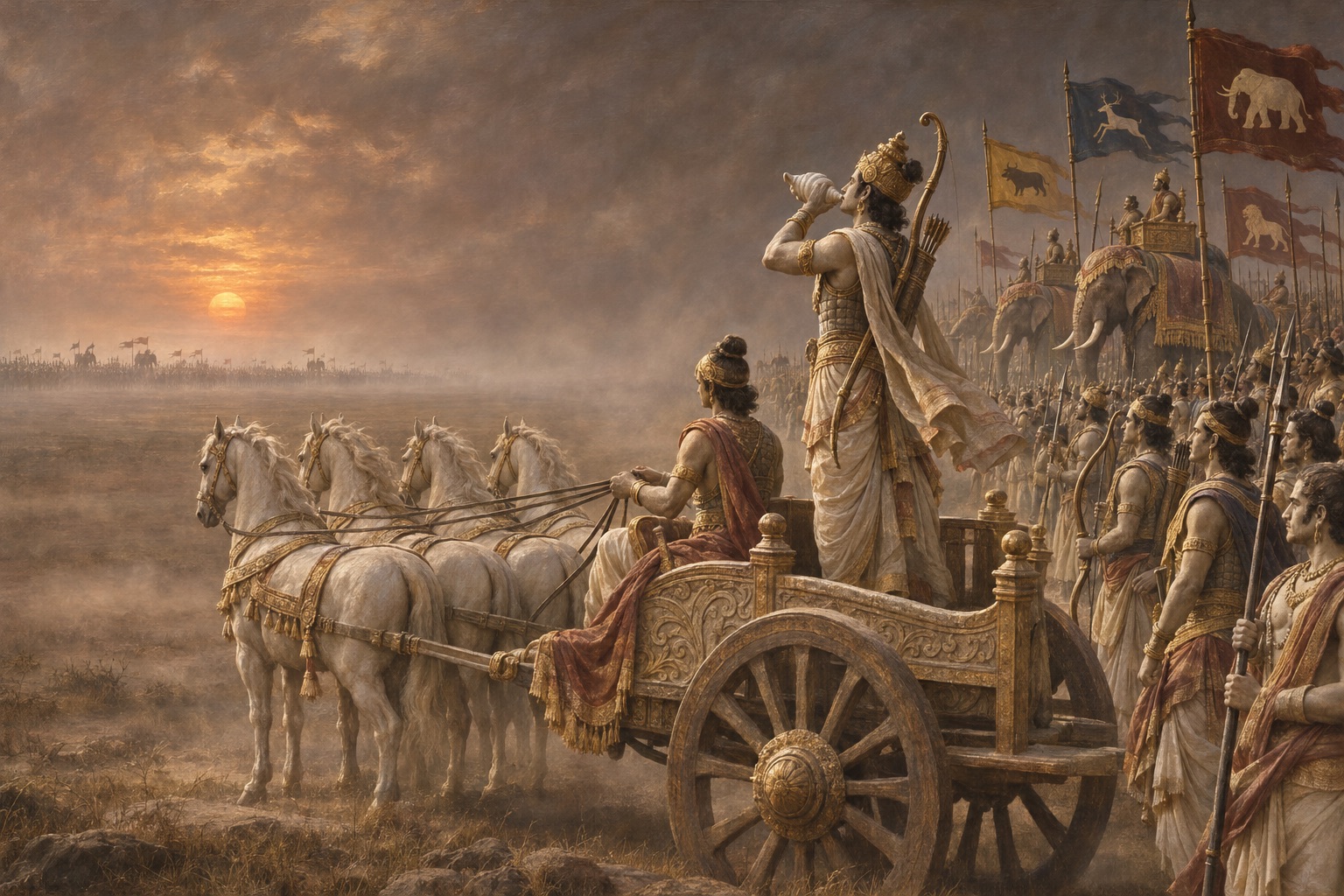
Eleven armies gathered for Duryodhana and seven for the Pandavas (5.152.23). Before the first arrow, Arjuna saw his teachers and kinsmen in the other line and let his bow drop (6.23.47). Krishna, who drove his chariot, answered him in the 700 verses of the Bhagavad Gītā (6.23–40); that teaching is told in Krishna: The Cowherd God.
1-4 Bhishma and Drona
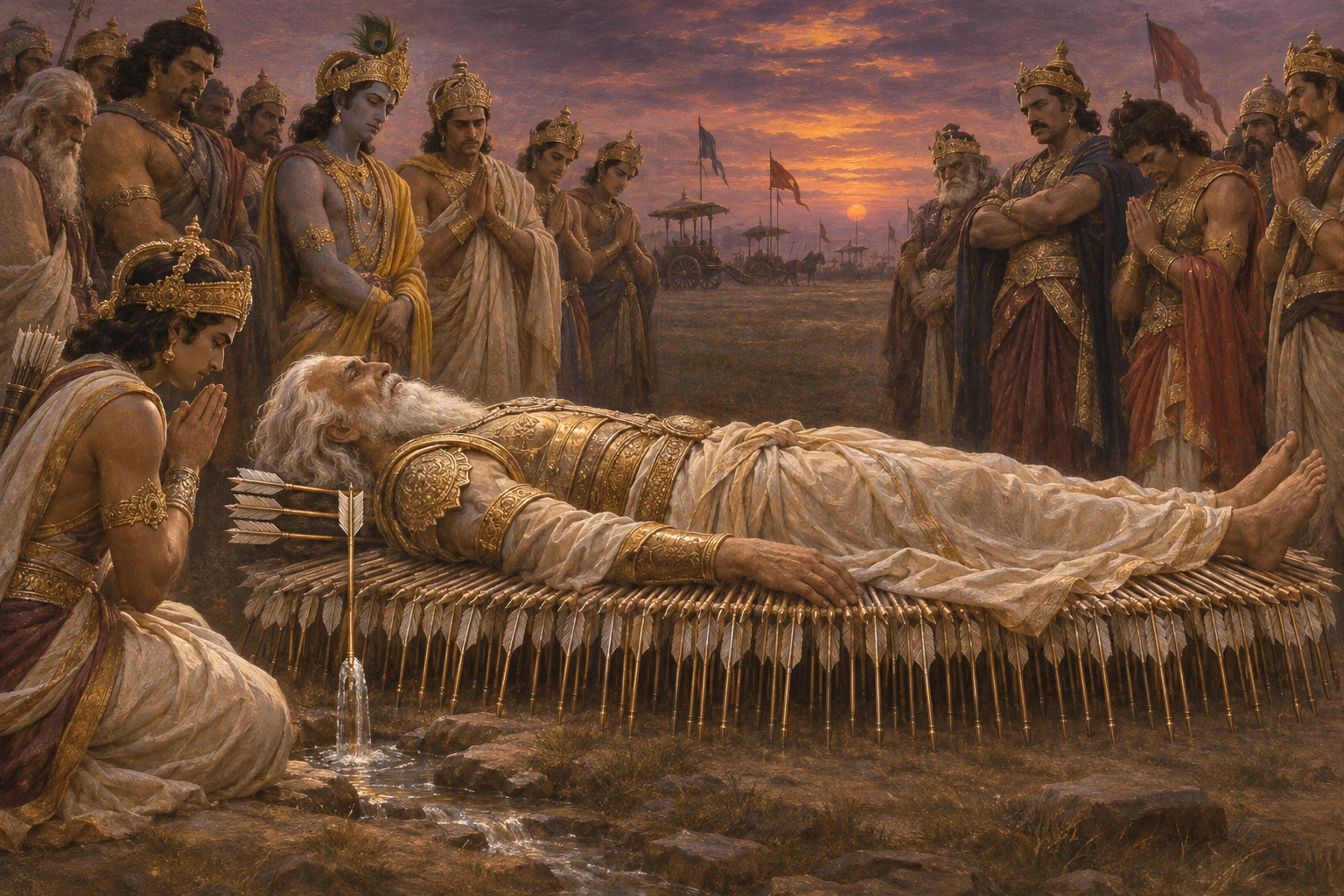
For ten days Bhishma led the Kauravas, and no one could stand against him. So the Pandavas went to him and asked how he could be killed. He told them. He would not fight Shikhandin, who had been born a woman and later became a man; let Arjuna put Shikhandin in front and shoot from behind him (6.103.73–79). On the tenth day it was done. Bhishma fell from his chariot before sunset with so many arrows in him that his body did not touch the ground: he lay on a bed of arrows (6.114.81–85). The sun was in its southern course, and Bhishma, who by his father’s boon could choose the hour of his death, held on to life until it turned north (6.114.88–100). He asked for a pillow, and Arjuna gave him three arrows under his head. He asked for water, and Arjuna shot an arrow into the earth beside him, and a cool spring rose (6.115.39–44; 6.116.18–23).
Drona took command and drew up his army in the wheel formation (cakravyūha). Arjuna’s young son Abhimanyu knew how to break into it, but “I cannot get out,” he said, “if anything goes wrong” (7.34.19, our translation). He broke in, and six warriors surrounded him. Duhshasana’s son killed him with a mace (7.32.19; 7.48.12–13). Against Drona himself, Krishna told Arjuna to “set dharma aside” and find a way to win; Arjuna refused, the others agreed, Yudhishthira reluctantly (7.164.68–70, our translation). Bhima killed an elephant named Ashvatthaman and shouted that Ashvatthaman was dead. Drona, whose son had that name, asked Yudhishthira, who never lied. Yudhishthira said “slain”, and then, indistinctly, “the elephant” (7.164.106). His chariot, which had always run four fingers above the ground, touched the earth. Drona laid down his weapons and sat in meditation, and Draupadi’s brother Dhrishtadyumna cut off his head (7.165.35–54).
1-5 Karna and Duryodhana
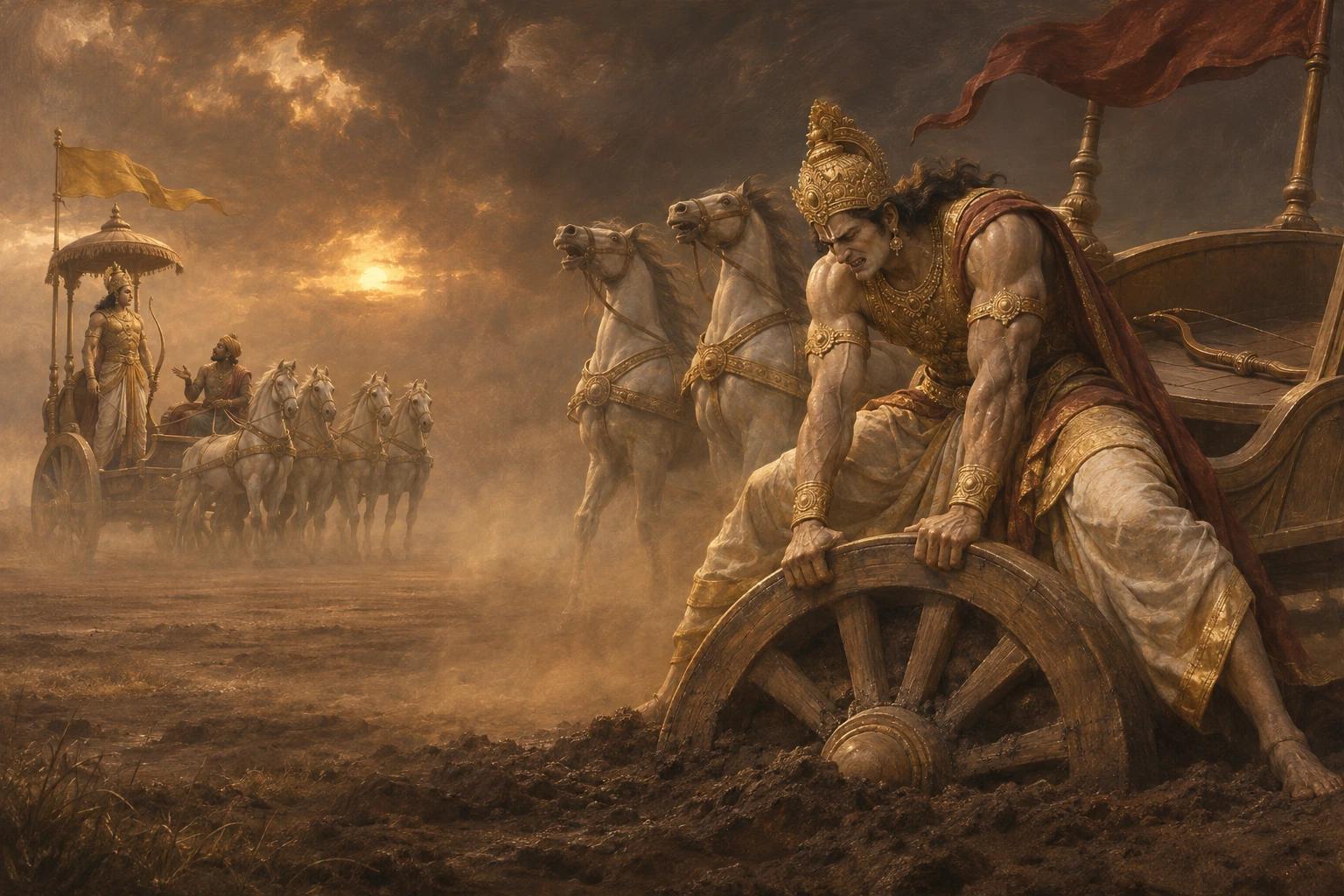
Bhima killed Duhshasana and, as he had sworn in the dice hall, drank his blood (8.61.10–11). Then Karna met Arjuna. In the middle of the fight the earth swallowed one wheel of Karna’s chariot, as a brahmin whose calf he had once killed had cursed (8.29.31–33; 8.66.59). Karna stepped down to lift it and begged Arjuna to wait: a warrior does not strike a man in trouble (8.66.60–65). Krishna answered for Arjuna. Where was Karna’s dharma, he asked, when Draupadi stood in the hall in one garment, or when Shakuni, a master of dice, beat Yudhishthira, who knew nothing of them (8.67.1–5)? Arjuna’s arrow cut off Karna’s head (8.67.33).
On the eighteenth day Duryodhana, his armies gone, hid in a lake and made its water stand still by magic (9.28.52). The Pandavas taunted him out, and he fought Bhima with the mace. Krishna said Bhima could not win by the rules (9.57.4). Arjuna slapped his own thigh where Bhima could see it, and Bhima smashed Duryodhana’s thighs (9.57.18; 9.57.43–44). Krishna’s brother Balarama, who had taught them both, cried shame: no one may strike below the navel (9.59.5–6). Lying broken, Duryodhana asked, “Who has had a better end than I?” (9.60.47, our translation). Flowers fell on him from the sky, the celestial musicians played, and the Pandavas felt ashamed (9.60.51–54).
1-6 The Night Raid and After
Three Kaurava warriors were left: Drona’s son Ashvatthaman, Kripa and Kritavarman. That night Ashvatthaman saw an owl kill sleeping crows (10.1.36–42). He went into the Pandava camp while the other two guarded its gates. He killed Dhrishtadyumna like an animal, then Shikhandin, Draupadi’s five sons and the sleeping army (10.8). He brought the news to Duryodhana: seven men were left on the Pandava side, three on theirs. Duryodhana died content (10.9.47–55).
Book 11 is the women’s grief on the field. Gandhari cursed Krishna: since he had let the cousins kill one another, his own kin would perish in the thirty-sixth year (11.25.40–41). Yudhishthira gave the dead as 1,660,020,000 (11.26.9), and Kunti told her sons, at last, that Karna had been their elder brother (11.27.11). Yudhishthira became king. Bhishma taught him from his bed of arrows through books 12 and 13 and died after fifty-eight nights (13.153.27; 13.154.5). Years later Dhritarashtra, Gandhari and Kunti died in a forest fire (15.45), Krishna’s people destroyed one another (book 16), and the brothers and Draupadi walked toward the mountains and fell one by one (book 17). In heaven, Yudhishthira found Duryodhana seated in splendour (18.1.4).
2 Where the Story Is Written Down
- The Mahābhārata has eighteen books (parvans). The war fills books 6 to 10, named after Bhishma, Drona, Karna, Shalya (the last commander) and the night raid. In the Heibonsha World Encyclopedia, Hara Minoru treats books 12 and 13 as later additions; the Nipponica notes that the main story takes up only about a fifth of the whole. Winternitz concluded that the poem reached its present form no earlier than the 4th century BCE and no later than the 4th century CE.
- Frames. The poem says it was composed by Vyasa, recited by his pupil Vaiśampāyana at King Janamejaya’s snake sacrifice, and retold by the bard Ugraśravas to sages in the Naimiṣa forest (1.1.1–11). Inside the war books a third narrator speaks: Vyasa gives Sanjaya, Dhritarashtra’s charioteer, divine sight, so that he can tell the blind king everything that happens on the field (6.2.9–11).
- The vulgate. What Sukthankar called the “Vulgate” is the Devanāgarī text with the commentary of Nīlakaṇṭha, who lived in the last quarter of the 17th century. Ganguli’s translation (1883–1896) follows “the Bengal texts” for the first half and “the printed Bombay edition” for the second, with Nīlakaṇṭha as a guide, his preface says.
- The critical edition. Between 1919 and 1966 the Bhandarkar Oriental Research Institute in Pune compared 1,259 manuscripts. The aim, V. S. Sukthankar wrote in his introduction to book 1, was “the oldest form of the text which it is possible to reach”. The oldest dated manuscript he collated was a Nepali one of 1511. Passages found in only some manuscripts went into the notes or appendices. A Japanese translation from this edition, by Kamimura Katsuhiko (Chikuma Gakugei Bunko, from 2002), reaches book 8, chapter 49.
- Length. A copper-plate grant of 533–34 from Khoh, in central India, already quotes the Mahābhārata as the śatasāhasrī saṃhitā, the “collection of a hundred thousand verses”. Winternitz counted 90,092 verses in the eighteen books of the Calcutta edition, and 106,466 with the Harivaṃśa, its appendix. The critical text is shorter: the institute’s website gives “89000+ verses”, while Nirmal Kanti Bhattacharjee, reviewing Bibek Debroy’s translation, puts it at “a little short of 75,000”.
3 Competing Versions
- Draupadi’s garment.
- In the critical text, no one is called on: as the garment is pulled away, “another garment of the same kind appeared, many times over” (2.61.41, our translation).
- Other manuscripts add a prayer, printed in the edition’s notes: Draupadi calls on Krishna, “Govinda, who dwells in Dvaraka”, to save her. Ganguli’s translation includes it, and there it is not Krishna who answers: “the illustrious Dharma, remaining unseen, covered her with excellent clothes of many hues”.
- Abhimanyu in the womb. Many retellings say Abhimanyu learned the wheel formation before he was born. In the critical text he says, “My father taught me how to break a formation” (7.34.19), and Ganguli’s text agrees (Drona Parva, section 33). Only a passage found in some manuscripts, in the notes, has him say that he heard it “from Krishna’s mouth” while still in the womb (7.34.18, starred passage 259).
- How long is the poem, by its own account? The critical text says that Vyasa made “the Bhārata of twenty-four thousand verses”, without the side stories (1.1.61). The line that calls it a hundred thousand verses is in the notes. So is a passage that, “rather fantastically” in Winternitz’s words, gives Vyasa a poem of six million verses, three million of them for the gods and one hundred thousand for humans. And Sukthankar found the southern manuscripts much longer than the northern: for book 1, about 8,460 stanzas in the vulgate and 9,984 in a southern edition.
- Fair fight or foul? The poem argues with itself. Bhishma tells the Pandavas how to kill him. Krishna says outright that Drona and Duryodhana cannot be beaten by the rules. Balarama calls Bhima’s blow a breach of them. And when the sky honours the dying Duryodhana, Krishna answers his shamed allies: these great warriors “could not have been killed by you in a straight fight”, so “I devised these means” (9.60.57–58, our translation).
4 History and Tradition
- Kurukshetra. The plain lies in the state of Haryana, north of Delhi. Winternitz noted that Kurukṣetra, the “Kuru land”, is already named in the Yajurveda and the Brāhmaṇas. The Bhagavad Gītā opens on “the field of dharma, the field of the Kurus” (6.23.1, our translation). The epic also calls the battlefield Samantapañcaka, after five lakes that Parashurama once filled with the blood of warriors (1.2.3–9). The Heibonsha World Encyclopedia describes Kurukshetra as a place of pilgrimage, where crowds bathe in the great tank during solar eclipses, and Haryana Tourism says its sacred circuit measures about 48 kos.
- Jyotisar. Here, by local belief, Krishna spoke the Gītā to Arjuna. Haryana Tourism says Śaṅkarācārya is said to have identified the spot in the 9th century; a king of Darbhanga raised a stone platform round its banyan tree in 1924, and a chariot showing the teaching of the Gītā was installed on it in 1967. At Narkatari, the Bhishma Kund is believed to be the spring that Arjuna’s arrow opened. At the Brahma Sarovar, lamps are offered for the Gita Jayanti festival every year, in late November or early December.
- Cambodia and Champa. About 600 CE, Winternitz noted, an inscription from Cambodia records regular public readings of the Mahābhārata from manuscripts given for the purpose. At Angkor Wat, built in the 12th century, the southern half of the west side of the outer gallery shows the battle between the Kaurava and Pandava armies. And a Sanskrit stele set up at Mỹ Sơn by the Cham king Prakāśadharma (dated Śaka 579, which R. C. Majumdar’s edition gives as 657 CE; other authors give 658) tells how the brahmin Kauṇḍinya planted at Bhavapura, in Cambodia, a spear “which he had obtained from Drona’s son Aśvatthāmā”, and married a naga princess, founding a royal line.
“The longest poem in the world” is a common description: the Japanese Britannica calls the Mahābhārata “the largest in the world in volume”. It depends on what is counted. A śloka, its usual verse, is two lines of sixteen syllables. The Kyrgyz Manas is counted in lines: the version written down from one singer, Sayakbay Karalaev (1894–1971), has 500,553. Tibetan Gesar singers are counted in volumes and hours: one, Grags pa (1906–1986), recorded 998 hours. The figures measure different things: a written text on one side, what a single singer could perform on the other.
5 Related Stories
- Krishna: The Cowherd God: Arjuna’s charioteer and the voice of the Bhagavad Gītā, who in this war claims the stratagems as his own (9.60.58). Gandhari’s curse in book 11 foretells his death.
- The Descent of the Ganga: The River That Fell from Heaven: Bhishma is Ganga’s son. When he falls she sends sages in the form of geese to him (6.114.90), and after his death she rises weeping from the river: he whom Parashurama could not defeat, she says, was killed by Shikhandin (13.154.18–21).
- Ganesha: How the God of Beginnings Got His Elephant Head: the story that Ganesha wrote the Mahābhārata down at Vyasa’s dictation. Like Draupadi’s prayer and Abhimanyu in the womb, it is a passage the critical edition moved out of its text.
- The Trojan War: The Apple, the Ships and the Horse: Winternitz saw at the core of the Mahābhārata an old heroic poem in which, “as in the Iliad and in the Nibelungen-song”, a war of annihilation is the subject. He also reports the Greek writer Dio Chrysostom’s claim that Indians sang Homer and knew “the sufferings of Priam”: some scholars took it to mean the Mahābhārata, while Jacobi thought a real Indian translation of Homer more probable.
6 Sources
- Mahābhārata, critical edition (Bhandarkar Oriental Research Institute, Pune, 1919–1966), books 1, 2, 5–11, 13, 15, 17 and 18, with the starred passages of the apparatus: GRETIL (one file per book)
- K. M. Ganguli (trans.), The Mahabharata (Calcutta, 1883–1896): Translator’s Preface and Sabha Parva, section 67: Project Gutenberg, Wikisource; Drona Parva, section 33: Project Gutenberg
- V. S. Sukthankar, Prolegomena to the critical edition, Ādiparvan (Pune, 1933), pp. VI–VII, XXX–XXXI, LXXXVI: GRETIL
- Bhandarkar Oriental Research Institute, “Mahabharata”: bori.ac.in
- M. Winternitz, A History of Indian Literature, vol. 1, trans. S. Ketkar (University of Calcutta, 1927), pp. 316–326, 465–466: archive.org
- J. F. Fleet, Inscriptions of the Early Gupta Kings and Their Successors (Corpus Inscriptionum Indicarum 3, 1888), no. 31, Khoh plates of the Mahārāja Sarvanātha, year 214, line 19: archive.org
- Nirmal Kanti Bhattacharjee, review of Bibek Debroy (trans.), The Mahabharata, vol. 1, The Book Review 34, no. 10 (October 2010): thebookreviewindia.org
- Kamimura Katsuhiko (trans.), 『原典訳 マハーバーラタ』, 8 vols. (Chikuma Gakugei Bunko, 2002–): CiNii
- R. C. Majumdar, Ancient Indian Colonies in the Far East, vol. 1, Champa (Lahore, 1927), book 3, inscription no. 12, p. 23: archive.org
- Gulmira Satybaldieva and Guljamal Ryskulova, “Peculiarities of Epic ‘Manas’ in Researching”, Sosyal Araştırmalar ve Davranış Bilimleri Dergisi 2 (2016): 24–29: DergiPark
- Yang Enhong, “A Comparative Study of the Singing Styles of Mongolian and Tibetan Geser/Gesar Artists”, Oral Tradition 13/2 (1998): 422–434: journal.oraltradition.org
- Haryana Tourism, “Kurukshetra”, “Jyotisar”, “Brahma Sarovar” and “Bhishma Kund, Narkatari”: haryanatourism.gov.in, Jyotisar, Brahma Sarovar, Bhishma Kund
- Hara Minoru, “マハーバーラタ”, Kaitei shinban Sekai daihyakka jiten; Tanaka Otoya, “マハーバーラタ”, Nihon daihyakka zensho (Nipponica); “マハーバーラタ”, Britannica International Encyclopaedia (Japanese), short entry: Kotobank
- Ōji Toshiaki, “クルクシェートラ”, Kaitei shinban Sekai daihyakka jiten: Kotobank
- Itō Shōji, “アンコール・ワット”, Kaitei shinban Sekai daihyakka jiten; Ishizawa Yoshiaki, “アンコール・ワット”, Nihon daihyakka zensho (Nipponica): Kotobank
Cover and illustrations: AI-generated images made for Arcana. They are interpretations, not historical artworks.