Krishna: The Cowherd God
Born in a prison, raised among cowherds, he stole butter, danced on a serpent and held up a mountain, then taught a warrior on a battlefield and died by a hunter's arrow. His childhood is barely in the Mahābhārata, and the Bhāgavata, the fullest telling of his youth, never names Radha.
- Type: myth, the life of a god born as a man, from a prison in Mathura to a forest by the sea
- Culture: India (Hindu tradition); Krishna is worshipped across South Asia and wherever Hindus have settled
- Earliest texts: the Mahābhārata (Krishna the prince and Arjuna’s charioteer, the Bhagavad Gītā); his childhood in its appendix, the Harivaṃśa, then in the Viṣṇu Purāṇa and book 10 of the Bhāgavata Purāṇa. A “Krishna, son of Devaki” is already named in the Chāndogya Upaniṣad
- Key figures: Krishna, his parents Devaki and Vasudeva, King Kamsa, his foster parents Yashoda and Nanda, his brother Balarama, the gopis (the cowherd women), Arjuna, the hunter Jara
He was born at midnight in a prison and carried across a river the same night. He grew up as a cowherd’s son, stole the butter, danced on a serpent’s hoods and held a mountain over his village for seven days. Then he left for the city, became a king, and on the morning of a great war told a frightened friend how to act without fear. Few gods have so many stories, and they were not all written down at the same time.
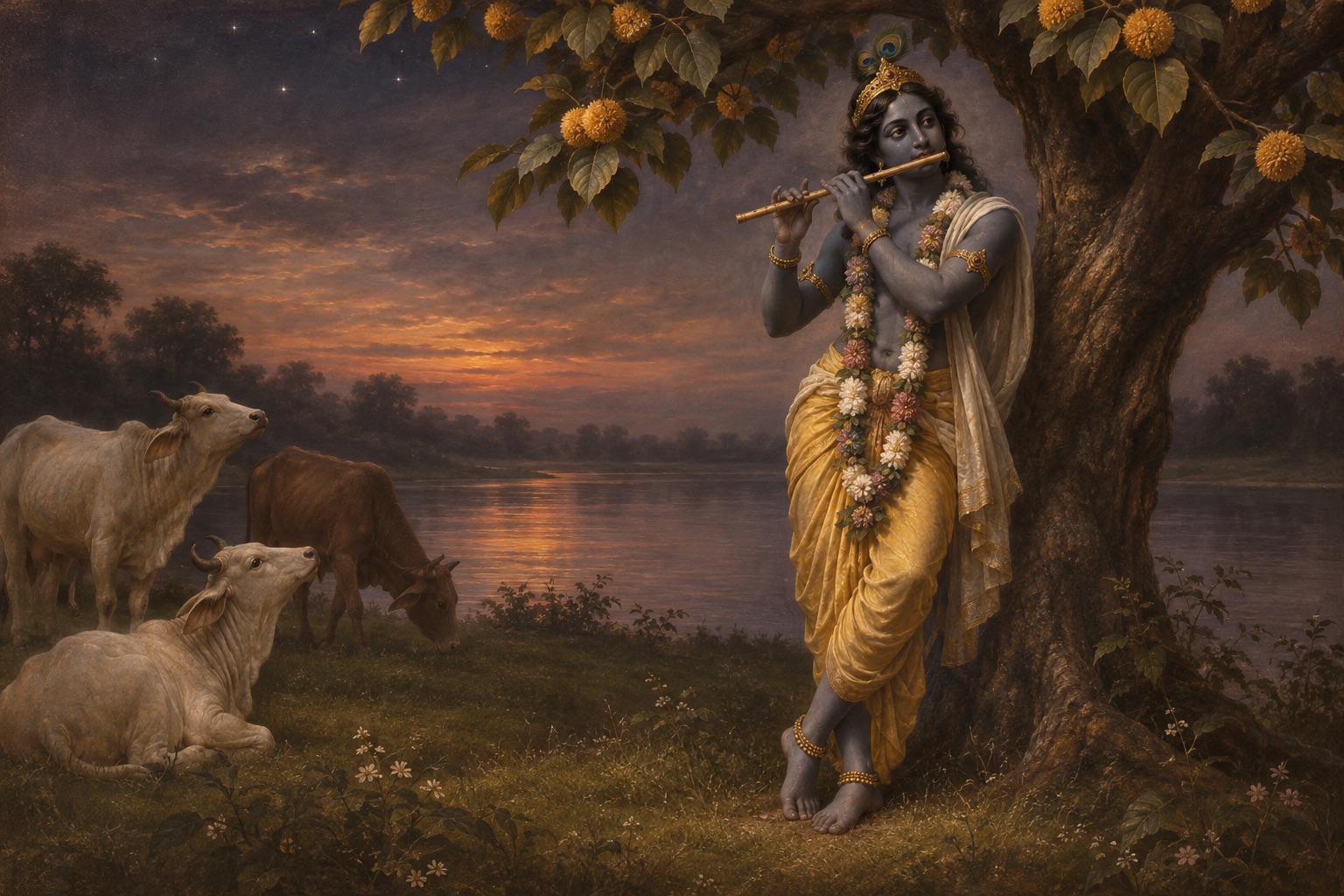
Why is Krishna painted blue? Because his name means “black” or “dark”. Kṛṣṇa is the Sanskrit word for the colour, and Monier-Williams’s dictionary notes that dark blue “is often confounded with black”. The Bhāgavata Purāṇa describes the newborn as lovely “as a dense rain cloud” (10.3.9). Painters made that darkness blue: “His dark skin led to his being named Krishna, meaning dark, and shown as blue,” the Cleveland Museum of Art writes of a Mewar painting of about 1705–10.
1 The Telling
Krishna’s youth is told here as the Bhāgavata Purāṇa tells it in book 10, the fullest telling and the one most retold. His teaching and his death follow the Mahābhārata in the Pune critical edition. Section 3 shows where the older Harivaṃśa differs.
1-1 The Eighth Child
King Kamsa of Mathura was driving the chariot at his sister Devaki’s wedding to Vasudeva when a voice from the sky spoke: “The eighth child of the woman you are driving will kill you, fool” (10.1.34). Kamsa seized her by the hair and drew his sword. Vasudeva saved her life by promising to give him every child she bore. Kamsa, who also threw his own father Ugrasena into prison and took his throne, put the couple in chains and killed each son as soon as it was born (10.1.66–69). When six were dead, Vishnu’s power of illusion, Yogamāyā, moved the seventh child from Devaki’s womb into that of Rohini, Vasudeva’s other wife, who lived among the cowherds. That child was Balarama, called Saṅkarṣaṇa, “the one drawn out” (10.2.4–13).
1-2 The Crossing
The eighth was born at midnight, “like the full moon rising in the east” (10.3.8). His parents saw a child with four arms holding the conch and the mace, the jewel Kaustubha at his throat, dressed in yellow silk. Devaki begged him to hide that form, and he became an ordinary baby. The guards fell asleep, the barred doors opened of themselves, and Vasudeva carried him out into the rain. The serpent Shesha followed, holding off the water with his hoods, and the flooded Yamuna made way for them “as the ocean did for the lord of Śrī” (10.3.46–50).
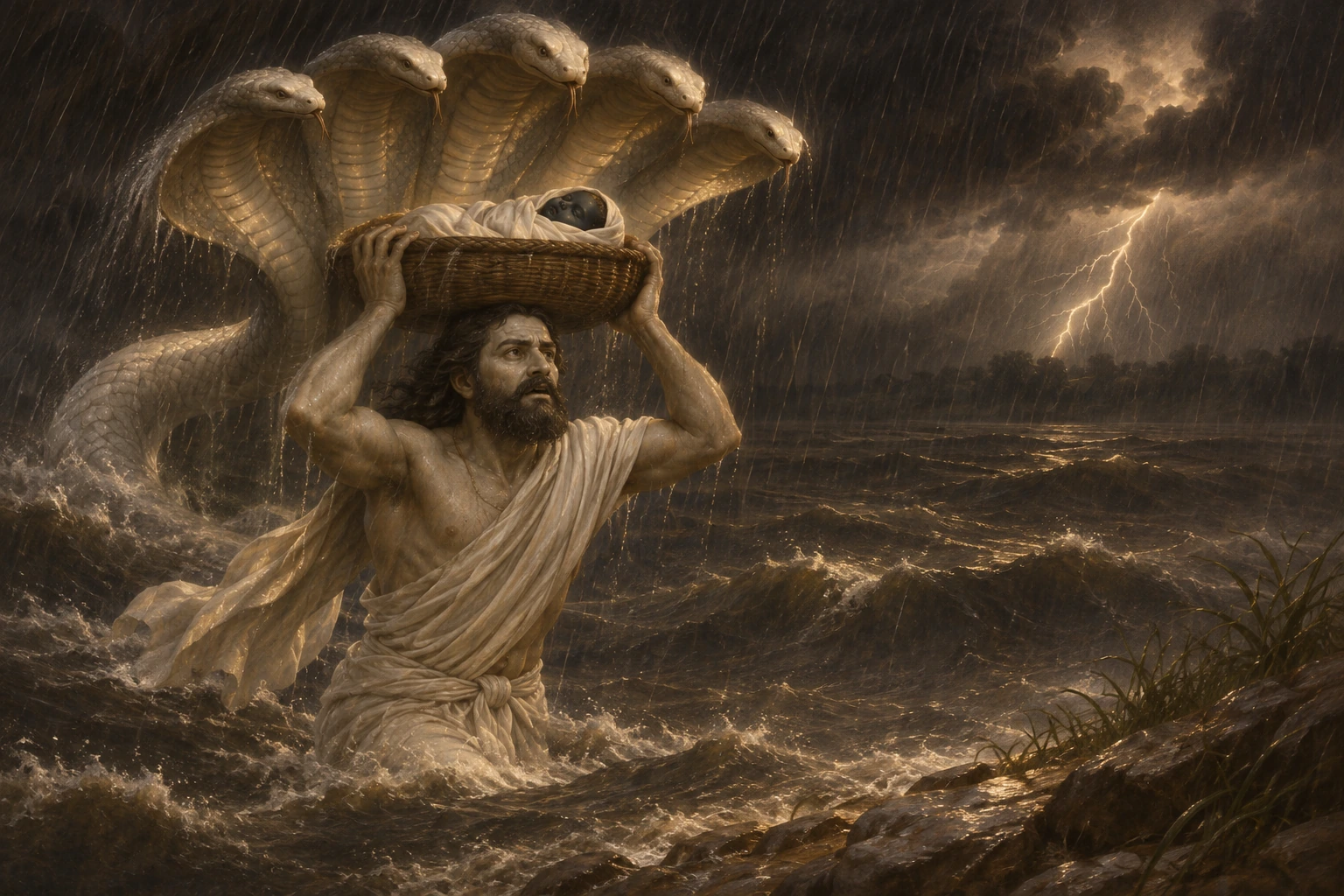
In the cowherd camp of Gokul everyone was asleep. Vasudeva laid his son beside Yashoda, the wife of the headman Nanda, took her newborn daughter and went back to his chains. When Kamsa came, Devaki begged him to spare a girl. He took the baby by the feet and swung her against a stone, but she slipped from his hands and rose into the sky as an eight-armed goddess. “What use is killing me, fool?” she said. “The one who will kill you has been born somewhere else” (10.4.7–12).
1-3 The Butter Thief
Kamsa sent Putana, a killer of infants, who flew to Gokul, took the form of a beautiful woman and gave the baby her poisoned breast. He drank out her life with the milk, and she fell dead in her own huge shape (10.6). As he grew, the cowherd women complained to Yashoda: he let the calves loose, stole the curds and milk, fed them to the monkeys and broke the pots (10.8.29). When his friends said he had eaten earth, she made him open his mouth, and inside it she saw the whole universe: the earth, the sky, the stars and herself (10.8.32–39). One day he smashed a pot of curds and sat on an upturned mortar feeding butter to a monkey. Yashoda tried to tie him to the mortar, but every rope she knotted was two fingers too short, until he saw how tired she was and let himself be tied (10.9.6–18). Dragging the mortar behind him, he pulled down two great arjuna trees (10.10).
1-4 Kaliya and Govardhan
The serpent Kaliya had poisoned a pool of the Yamuna. Krishna climbed a kadamba tree on the bank and jumped in. The serpent coiled around him, but he slipped free, climbed onto its broad heads and danced (10.16.6–26). Kaliya’s wives begged for his life, and Krishna sent him to the sea: the marks of his feet on Kaliya’s heads would keep Garuda, the snakes’ enemy, from harming him (10.16.60–67).
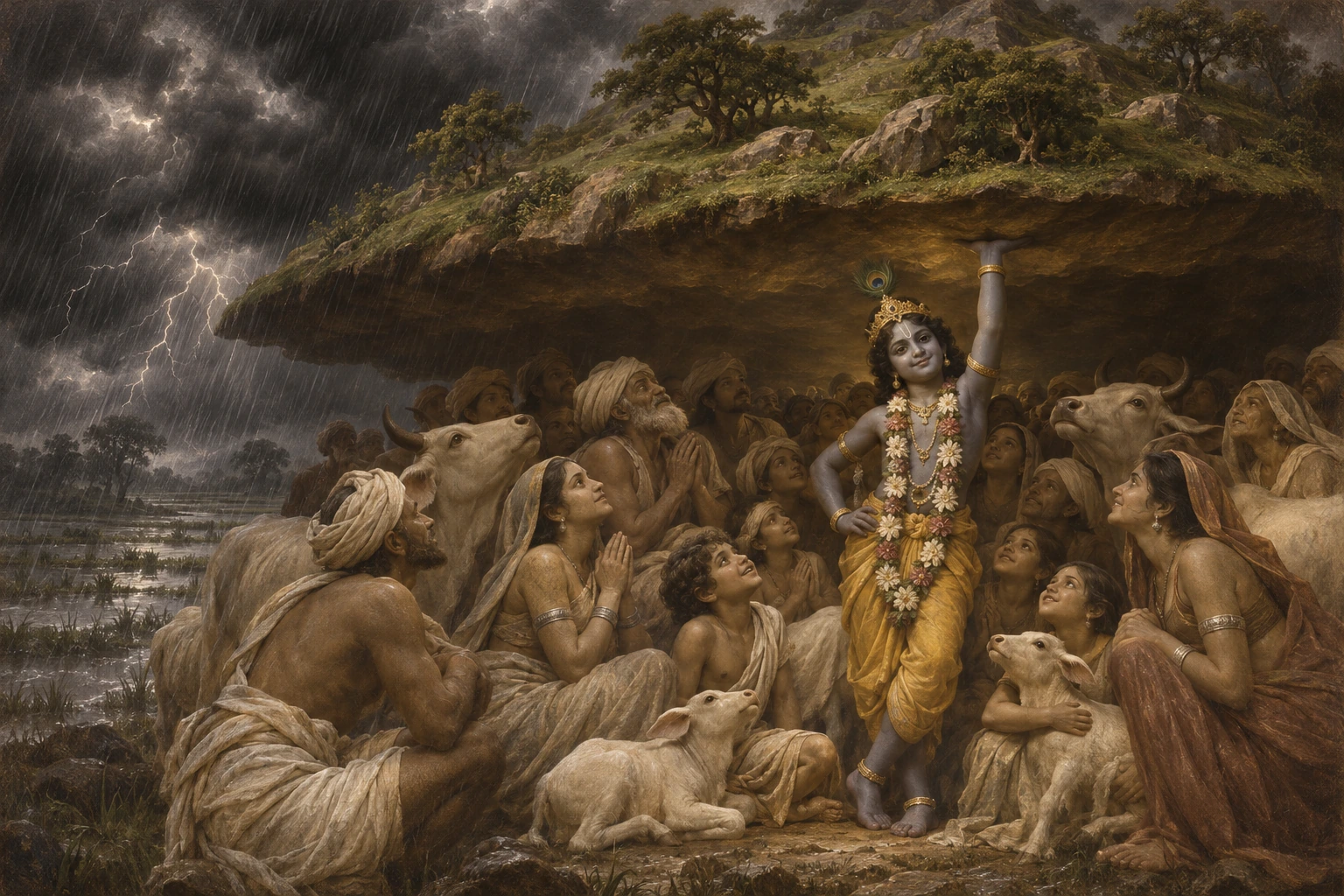
When the cowherds prepared an offering to Indra, Krishna persuaded them to honour their cows, the brahmins and the hill of Govardhan instead (10.24.25). Indra sent a storm. Krishna lifted the hill with one hand, “as a child holds up a mushroom”, and held it for seven days without moving while the village and its herds sheltered beneath, until Indra called back his clouds (10.25.19–24).
1-5 The Rāsa
On the autumn nights, when the jasmine was in bloom and the full moon rose, Krishna played his flute, and the gopis left their homes and husbands to go to him in the forest (10.29.1–8, 40). When they grew proud of his favour, he vanished (10.29.48). Searching, they found his footprints, and beside them a woman’s: “Surely the Lord was worshipped by her,” they said, “since Govinda (Krishna) left us and led her away alone” (10.30.28). She too was left, when she asked him to carry her (10.30.37–38). He came back to them all, and the rāsa began, a circle dance in which Krishna stood between every two women, each believing he was at her side (10.33.3).
1-6 Mathura and Dwarka
Kamsa sent Akrura to bring Krishna and Balarama to a festival in Mathura, meaning to have them killed there by an elephant or by his wrestlers (10.36.30–37). Krishna killed the elephant, and the brothers killed the wrestlers. Then Krishna leapt onto Kamsa’s high platform, seized him by the hair, threw him down into the arena and fell on him, and Kamsa died (10.44.34–38). Krishna freed his parents and made his grandfather Ugrasena king again (10.44.50; 10.45.12). He did not go back to Vrindavan: he sent his friend Uddhava with a message for the gopis (10.46). When Kamsa’s father-in-law Jarasandha, king of Magadha, had attacked Mathura seventeen times, Krishna had a fortress city built inside the sea, twelve yojanas across, and moved his people there: Dwarka (10.50.41–57).
1-7 The Song on the Battlefield
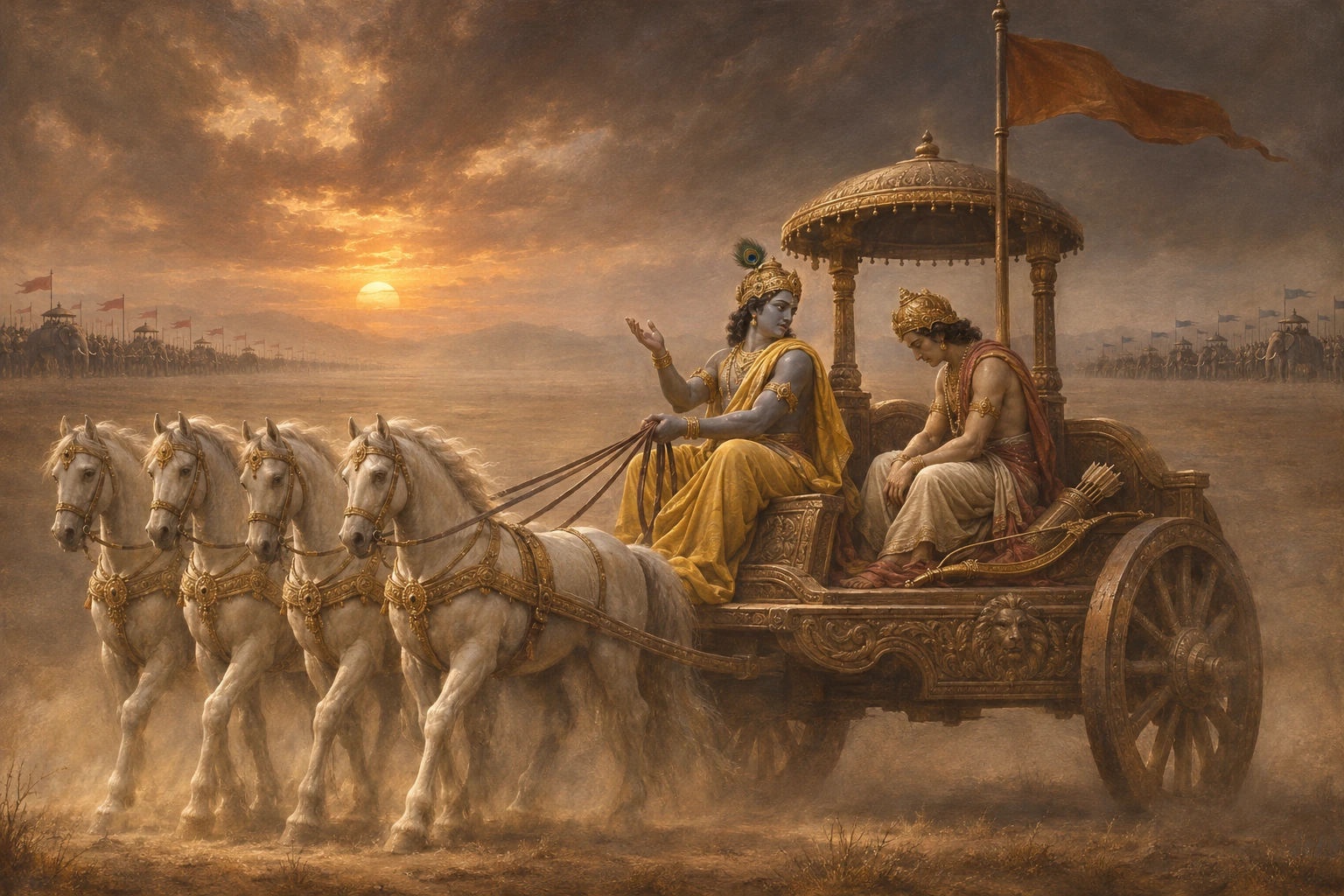
Years later, war broke out between the Pandava brothers and their Kaurava cousins (see Kurukshetra). Krishna had said he would bear no arms in the battle (5.7.17), but he drove Arjuna’s chariot. Between the two armies, Arjuna saw his teachers and kinsmen on the other side, dropped his bow and sat down in the chariot (Mahābhārata 6.23.47). The 700 verses that follow are the Bhagavad Gītā, “the Song of the Lord”. The self is never born and never dies, Krishna tells him, and is not killed when the body is (6.24.20). “Your right is to the action alone, never to its fruits” (6.24.47), or in Charles Wilkins’s translation of 1785, “Let the motive be in the deed, and not in the event.” Act from duty, without craving the outcome, and give every act to God in devotion (bhakti).
Then Krishna shows Arjuna his universal form, with countless mouths and eyes, brighter than “a thousand suns” rising at once in the sky, the warriors of both armies rushing into its jaws (6.33.10–30). “I am Time, the destroyer of mankind,” as Wilkins put it, “matured” (6.33.32).
1-8 The Hunter’s Arrow
After the war, Gandhari, the mother of the hundred Kauravas, cursed Krishna for letting her sons die: in the thirty-sixth year his own clan would destroy itself and he would die alone in the forest (11.25.41). In that year, some young men of his clan dressed his son Samba as a pregnant woman to mock visiting sages, and the sages foretold that he would bear an iron club to destroy them all (16.2). The club was ground to powder, but at Prabhasa on the coast, drunk and quarrelling, the clan fought with reeds that turned into iron clubs in their hands, and killed one another (16.4). Balarama left his body in the forest. Krishna lay down on the ground, absorbed in yoga. The hunter Jara, taking him for a deer, shot an arrow into the sole of his foot, then saw a man in yellow with many arms and fell at his feet. Krishna comforted him and rose to heaven, filling the sky with his light (16.5.19–21). When Arjuna had led the survivors away, the sea flooded Dwarka (16.8.40).
2 Where the Story Is Written Down
- The Chāndogya Upaniṣad (3.17.6) names a “Krishna, son of Devaki”, a pupil of the teacher Ghora Āṅgirasa. The text does not say whether he is our Krishna.
- The Mahābhārata, attributed to Vyasa, knows Krishna as a grown prince of the Yadavas, the Pandavas’ ally. It tells the Gītā (critical edition 6.23–40, exactly 700 verses) and his death (book 16, the Mausalaparvan). The childhood is there only in an insult: King Shishupala sneers that killing a bird as a baby is nothing, nor holding up for seven days a hill “the size of an anthill” (2.38.7–9).
- The Harivaṃśa, “the lineage of Hari”, the epic’s appendix, tells the childhood in full. The critical edition (P. L. Vaidya, Pune, 1969) keeps some 6,000 verses in 118 chapters. Its date is uncertain, but Arthur Macdonell (1900) pointed to an inscription of 462, or 532 at the latest, that already counts the epic at 100,000 verses, which it reaches only with the Harivaṃśa.
- The Viṣṇu Purāṇa, book 5 (translated by H. H. Wilson in 1840), tells the same life more briefly. The Bhāgavata Purāṇa, book 10, in 90 chapters, is the fullest and the most loved; book 11 tells the end. Japanese reference works date it to about the 10th century; the scholar Harsha Dehejia puts it “roughly” in the 9th.
- The Gītagovinda of Jayadeva, 12th century, a Sanskrit love poem of twelve cantos, made Radha its heroine (bubble below). Ogura Yasushi and Yokochi Yūko translated it into Japanese (2000).
3 Competing Versions
- Putana. In the Bhāgavata she is a demoness who takes a beautiful woman’s form (10.6.4–6). In the Harivaṃśa she is Kamsa’s nurse, who comes at midnight as a bird, a śakunī (50.20–24; 65.26). Shishupala, too, speaks of a bird killed in infancy.
- The river. The storm, Shesha’s hoods and the parting Yamuna are the Bhāgavata’s. In the Harivaṃśa’s critical text, Vasudeva simply carries the boy to Yashoda’s house (48.18–19); the river scene appears only in variant passages, in the Bhāgavata’s own words.
- The girl. In the Harivaṃśa she is dashed against a rock, but she is not crushed and rises as a four-armed goddess who foretells Kamsa’s death. Kamsa then begs Devaki’s forgiveness, and she gives it, blaming Time (48.28–50).
- The mortar. In the Harivaṃśa and the Viṣṇu Purāṇa, Yashoda ties him up because he and Balarama run wild through the camp, and the rope around his belly gives him the name Dāmodara, “rope-belly” (HV 51.12–36; ViP 5.6.11–19). The stolen butter is the Bhāgavata’s.
- The dance. In the Harivaṃśa (63.15–35), the young women defy their fathers, brothers and mothers to dance with him at night in pairs and circles, singing his deeds; no one vanishes. The Viṣṇu Purāṇa (5.13) and the Bhāgavata add the disappearance, the footprints and the unnamed favourite.
- The arrow. In the Mahābhārata, Krishna lies on the ground in yoga. In the Bhāgavata, he sits under a pipal tree with his right foot on his thigh, and Jara’s arrowhead is the last piece of the iron club, found in a fish’s belly (11.1.21–23; 11.30.27–34).
4 History and Tradition
- A Greek visitor. About 300 BCE, the Greek ambassador Megasthenes described an Indian “Herakles” honoured above all by the Sourasenoi, who held the cities of Methora and Cleisobora on a navigable river (Arrian, Indica 8, in J. W. McCrindle’s translation). Methora is Mathura, and Macdonell judged that by this Herakles “no other can be meant than Vishṇu and his incarnation Kṛishṇa”.
- The Gītā in English. Charles Wilkins’s The Bhagvat-Geeta, or Dialogues of Kreeshna and Arjoon was printed in London in 1785, with a letter from the governor-general Warren Hastings: writings like this “will survive when the British dominion in India shall have long ceased to exist”. It has been translated into Japanese by Tsuji Naoshirō (1950, 1980) and by Kamimura Katsuhiko (Iwanami Bunko, 1992).
- The cowherd in stone. Around Angkor Borei, in the Mekong delta of southern Cambodia, sculptors carved Krishna holding up Govardhan in sandstone, taller than a man. The Cleveland Museum of Art and the National Museum of Cambodia each hold one from the hill of Phnom Da, carved about 600, and a third, from Wat Koh, is somewhat later.
- Radha’s devotion. Chaitanya (about 1485–1533), a saint from Bengal, led processions that sang and danced in worship of Krishna and Radha. Dehejia describes how his followers rebuilt the Vrindavan of the texts on the ground, with places like Barsana, Radha’s birthplace in their telling.
- Janmashtami, Krishna’s birthday, falls on the eighth day of the dark half of the month of Shravan or Bhadrapada. Devotees fast and keep awake until midnight, the hour of his birth; then images of the infant are bathed, dressed and laid in cradles. The next day, in Mumbai and elsewhere, teams build human pyramids to break a pot of curds hung high above the street: the Dahi Handi.
Radha is so much a part of Krishna’s story that she is often thought to have been there from the start. She was not. Monier-Williams’s dictionary cites the Mahābhārata for one Rādhā, Karna’s foster mother, and Jayadeva’s poem for Krishna’s; of the tenth book of the Bhāgavata Purāṇa the scholar Harsha Dehejia says that “these are all gopis, there is no Radha there”. The Bhāgavata’s favourite gopi has no name, though the word the gopis use for her devotion, ārādhita, “worshipped”, comes from the same root as Rādhā. A Prakrit verse in the anthology of King Hāla already names her, as Rāhiā (verse 89 in Weber’s edition), and Jayadeva’s Gītagovinda, in the 12th century, made her Krishna’s beloved.
5 Related Stories
- Kurukshetra: The War of the Mahābhārata: the war in which Krishna drove Arjuna’s chariot and sang the Gītā: the cousins, the dice game, the eighteen days.
- The Dashavatara: The Ten Avatars of Vishnu: Krishna counted among Vishnu’s descents. In the hymn that opens Jayadeva’s Gītagovinda, though, all ten are forms of Keśava, a name of Krishna, and Balarama takes the eighth place.
- The Churning of the Ocean: Gods, Demons and the Nectar of Immortality: where the jewel Kaustubha came from. It rose from the churned ocean and went to Vishnu’s breast; the Bhāgavata puts it at the newborn Krishna’s throat.
- Heracles: The Twelve Labours and the Pyre on Mount Oeta: Megasthenes called Krishna “Herakles”, and Macdonell agreed that Krishna was meant. Both are babies who kill monsters sent against them, Heracles the serpents of Hera, Krishna the killers of Kamsa; that likeness we link as a shared theme.
6 Sources
- Bhāgavata Purāṇa, books 10 and 11, Sanskrit text: GRETIL
- Harivaṃśa, critical edition by P. L. Vaidya (Bhandarkar Oriental Research Institute, Pune, 1969), chapters 48–76: GRETIL
- Viṣṇu Purāṇa, critical text, book 5: GRETIL; H. H. Wilson (trans.), The Vishnu Purana (John Murray, London, 1840): archive.org
- Mahābhārata, critical edition, 2.38, 5.7, 6.23–40 (the Bhagavad Gītā), 11.25 and 16.1–8: GRETIL, GRETIL; Chāndogya Upaniṣad 3.17.6: GRETIL
- Charles Wilkins (trans.), The Bhagvat-Geeta, or Dialogues of Kreeshna and Arjoon (C. Nourse, London, 1785), with Warren Hastings’s letter of 4 October 1784: Bayerische Staatsbibliothek, on archive.org
- Jayadeva, Gītagovinda, after Barbara Stoler Miller’s edition (New York, 1977): GRETIL; Ogura Yasushi and Yokochi Yūko (trans.), 『ヒンドゥー教の聖典二篇』 (Tōyō Bunko, Heibonsha, 2000): CiNii
- Albrecht Weber (ed.), Das Saptaçatakam des Hâla (Brockhaus, Leipzig, 1881), verse 89: Bayerische Staatsbibliothek, on archive.org
- Arrian, Indica 8, trans. J. W. McCrindle, Ancient India as Described by Megasthenês and Arrian (1877): Wikisource; A. A. Macdonell, A History of Sanskrit Literature (1900): Wikisource, Wikisource
- Monier Monier-Williams, A Sanskrit-English Dictionary (1899), “kṛṣṇa” and “rādhā”: Cologne Digital Sanskrit Dictionaries
- “Traversing the Lives of Radha: In Conversation with Harsha Dehejia” (2015): Sahapedia
- Cleveland Museum of Art, “The Birth of Krishna, from a Sursagar of Surdas” (1984.65), “Krishna Lifting Mount Govardhan” (1973.106), and “The Cleveland Krishna”: clevelandart.org, clevelandart.org, clevelandart.org
- Ministry of Tourism, Government of India, “Janmashtami”: Incredible India
- Tsuji Naoshirō (trans.), 『バガヴァッド・ギーター』 (Kōdansha, 1980): CiNii; Kamimura Katsuhiko (trans.), 『バガヴァッド・ギーター』 (Iwanami Bunko, 1992): CiNii
- “クリシュナ”, “バガバッドギーター”, “バーガバタプラーナ”, “チャイタニヤ”: Kotobank, Kotobank, Kotobank, Kotobank
Cover and illustrations: AI-generated images made for Arcana. They are interpretations, not historical artworks.