Garuda: The King of Birds
To free his mother from slavery, the bird Garuda stole the drink of immortality from the gods and never tasted it. The Mahābhārata tells how he became Vishnu's mount and the enemy of every snake.
- Type: myth, the bird who steals the amṛta; the mount of a god
- Culture: India (Hindu tradition); taken into Buddhism across Asia; the state emblem of Thailand and Indonesia
- Earliest texts: the Rigveda has his names and a bird that brings the Soma; the Śatapatha Brāhmaṇa has the wager of Kadru and Suparṇī; the full story is in the Mahābhārata, Book 1
- Key figures: Garuda, his mother Vinata, her sister Kadru and the nagas, Aruṇa, the sage Kashyapa, Indra, Vishnu
In the Vishnu temples of South India, a winged figure stands facing the inner shrine, with a beak for a nose and his hands joined in worship. He is Garuda, the god’s mount. The Mahābhārata explains how a bird came to carry a god: he stole the drink of immortality to buy his mother’s freedom, and gave it away untasted.
Why is Garuda the enemy of snakes? Because their mother made his mother a slave. Kadru, the mother of the snakes, won a bet against her sister Vinata by a trick, and the snakes set the price of Vinata’s freedom: the amṛta of the gods. Garuda paid it. Then he asked Indra for one reward: that the snakes should be his food.
1 The Telling
This follows the Mahābhārata, Book 1, chapters 14 and 18 to 30 of the critical edition published in Pune. The bard Sauti tells it to the sage Śaunaka, in the section that explains why King Janamejaya’s sacrifice burned the snakes.
1-1 Two Sisters, Two Wishes
The sage Kashyapa offered a boon to each of his wives, the sisters Kadru and Vinata. Kadru asked for a thousand sons, nagas of equal splendour. Vinata asked for two sons stronger than all of Kadru’s, and her husband granted her “a son and a half”.
Kadru laid a thousand eggs and Vinata two, and servants kept them in warm pots for five hundred years. Kadru’s sons hatched; Vinata’s did not, and in her longing she broke one egg open. The son inside had only the upper half of a body. He cursed her: for her greed, she would be her rival’s slave for five hundred years, until her other son freed her, if she let him be born whole. Then he rose into the sky. He is Aruṇa, the red of dawn, seen every morning.
1-2 The Horse’s Tail
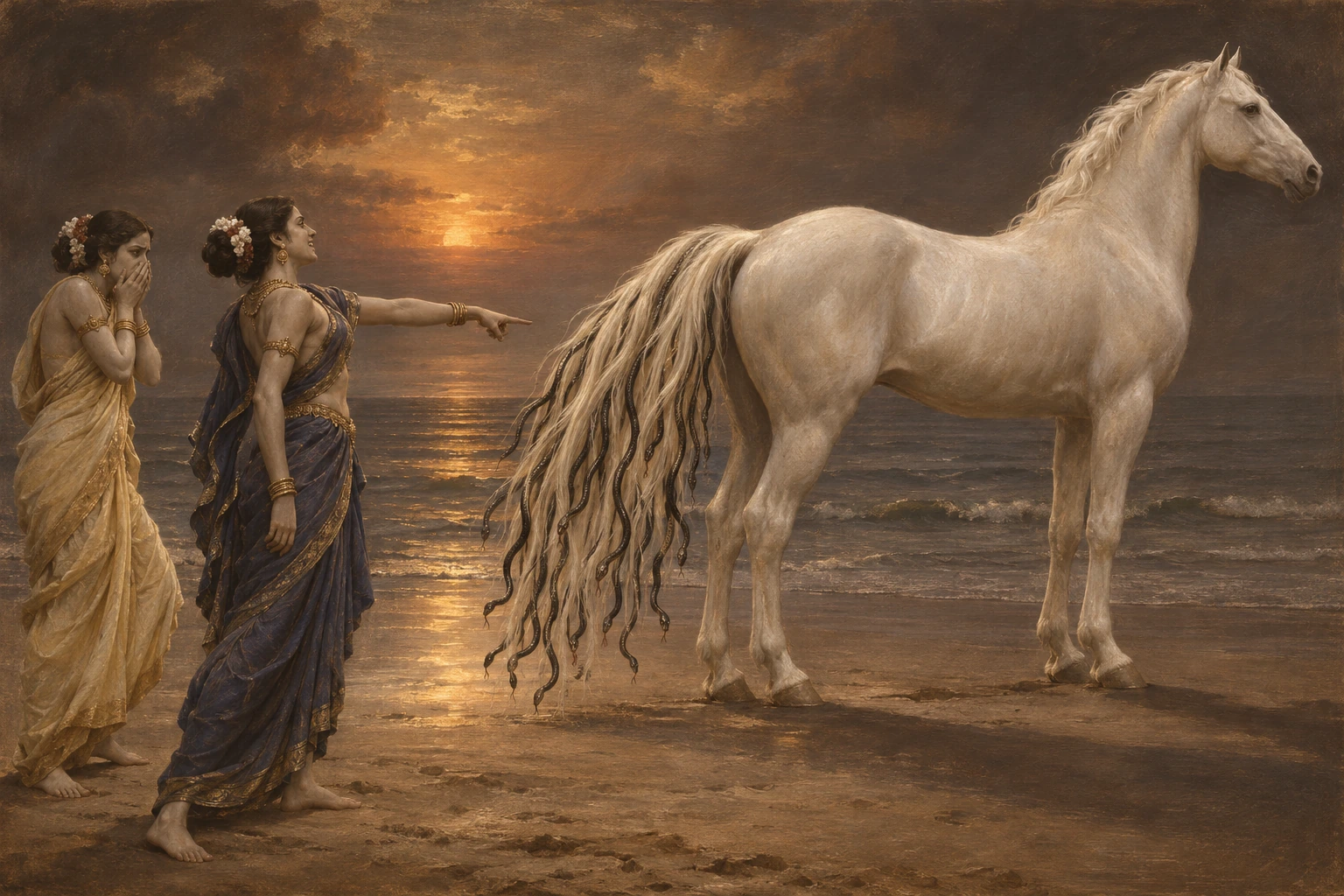
Here the poem tells the churning of the ocean, which we retell in The Churning of the Ocean. Out of it came Uccaihshravas, the king of horses. “What colour is he?” Kadru asked. “White,” said Vinata. “His tail is black,” said Kadru. “The loser becomes the other’s slave.”
That night Kadru ordered her sons to turn into black hairs on the horse’s tail. When they refused, she cursed them to burn in King Janamejaya’s sacrifice of snakes, and Brahmā approved, because the snakes had grown too many and too venomous. At sunrise the sisters crossed the ocean, past its monsters, its whirlpools and the fire beneath the sea, and came down beside the horse. Its tail was full of black hairs, and Vinata became Kadru’s slave.
1-3 Born Blazing
Garuda broke out of his egg without his mother’s help, blazing like a heap of fire, and grew at once to a vast size. The terrified gods ran to Agni, the fire god, but Agni said: “That is Garuda, as bright as I am.” They praised him as the lord of birds, and he drew in his radiance.
He found his mother a slave. Kadru made Vinata carry her, and Garuda the snakes, to an island. Garuda flew so near the sun that the snakes fainted. When he learned from Vinata that the bet had been “made false by the snakes with a trick”, he asked them the price of her freedom. “Bring the amṛta,” they said, “by force.”
1-4 The Elephant and the Tortoise
Vinata sent him to eat the Nishadas, who lived in a remote corner of the sea, but never a brahmin, who would burn in his throat like a live coal. Garuda opened his beak across their road and swallowed thousands. One brahmin stuck burning in his throat, and Garuda let him out with his Nishada wife.
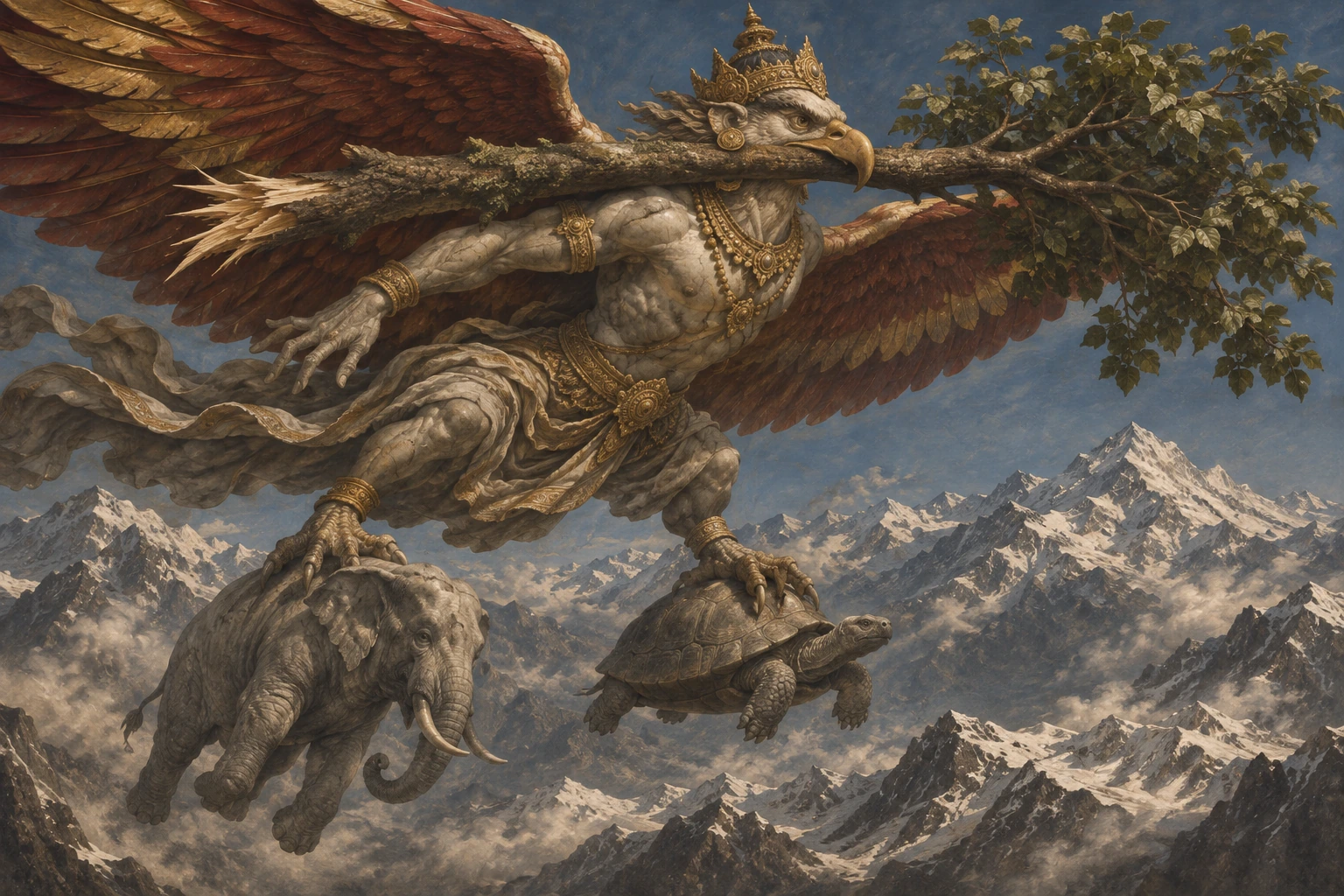
Still hungry, he went to his father. Kashyapa told him of two brothers who had quarrelled over their inheritance and cursed each other into an elephant, six yojanas tall, and a tortoise, ten around. Garuda seized one in each claw. He landed on a branch of a giant tree, a hundred yojanas long, and it broke. Hanging from it head down were the Vālakhilyas, sages the size of a thumb, so Garuda caught the branch in his beak and flew on. His father calmed the sages and they left; Garuda dropped the branch on an empty, snowbound mountain, shattering its peaks, and ate the elephant and the tortoise on the summit.
1-5 Why He Is King of Birds
In heaven Indra’s thunderbolt flared and meteors fell. Bṛhaspati, the gods’ teacher, told Indra the cause was his own fault. At a sacrifice of Kashyapa’s, Indra, carrying a mountain of firewood, had laughed at the thumb-sized Vālakhilyas floundering in the water of a cow’s hoofprint with a single leaf-stalk, and stepped over them. In anger they made offerings for a second Indra, a hundred times stronger. Kashyapa made peace: let the new one be “the Indra of the birds”. The fruit of that sacrifice went to Vinata, and her son was consecrated king of the birds.
1-6 The Theft
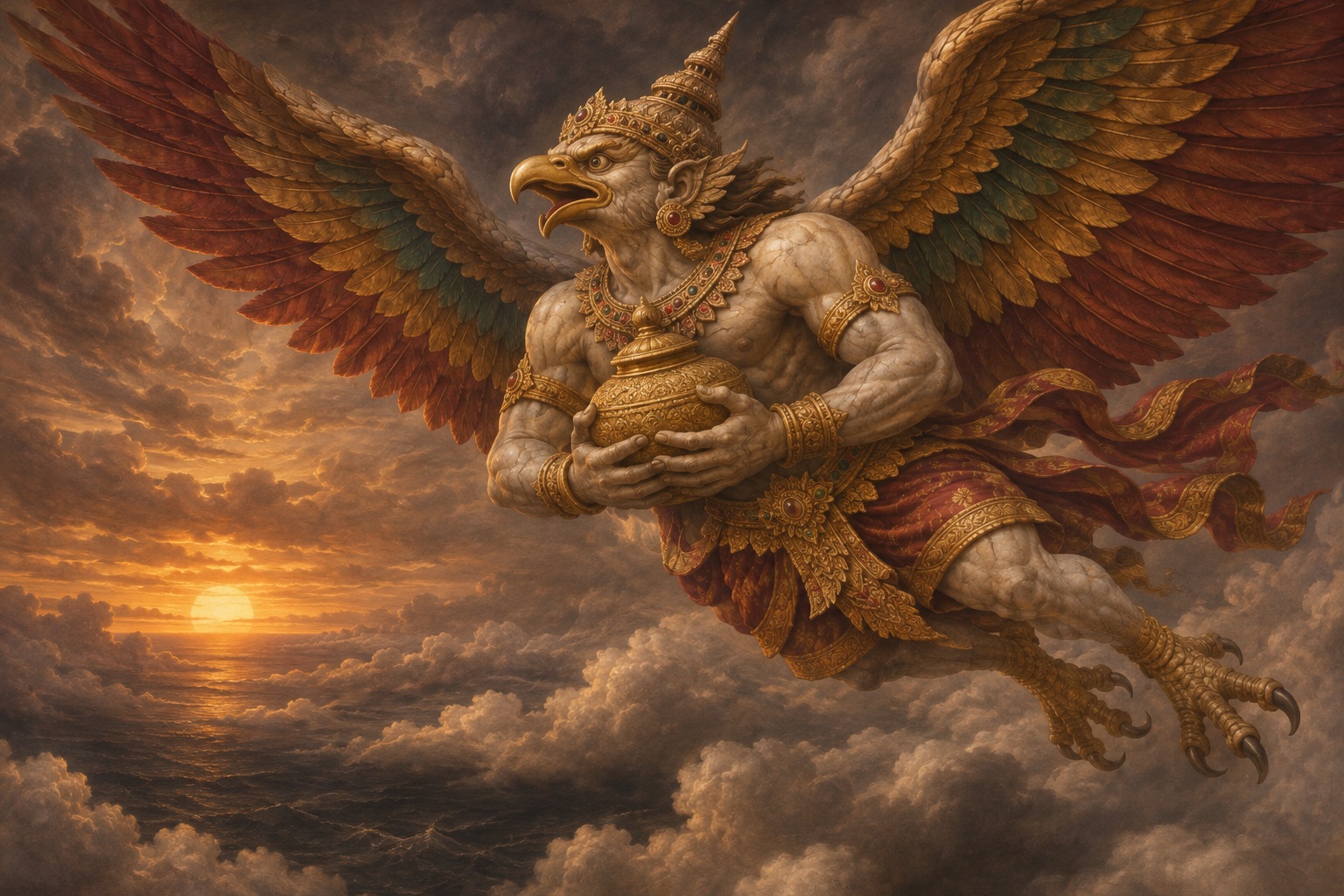
Garuda fell on the gods guarding the amṛta. He blinded them with dust until Vāyu, the wind, blew it away, and scattered them to the four quarters. He made himself eight thousand one hundred mouths, drank up rivers and put out the fire that ringed the amṛta. Shrinking and shining like gold, he slipped between the spokes of an iron wheel that spun beside it, its rim edged with razors. Beneath lay two serpents whose glance turned anyone to ash. He threw dust in their eyes, cut them in two, seized the amṛta and flew away, without drinking a drop.
1-7 Two Bargains
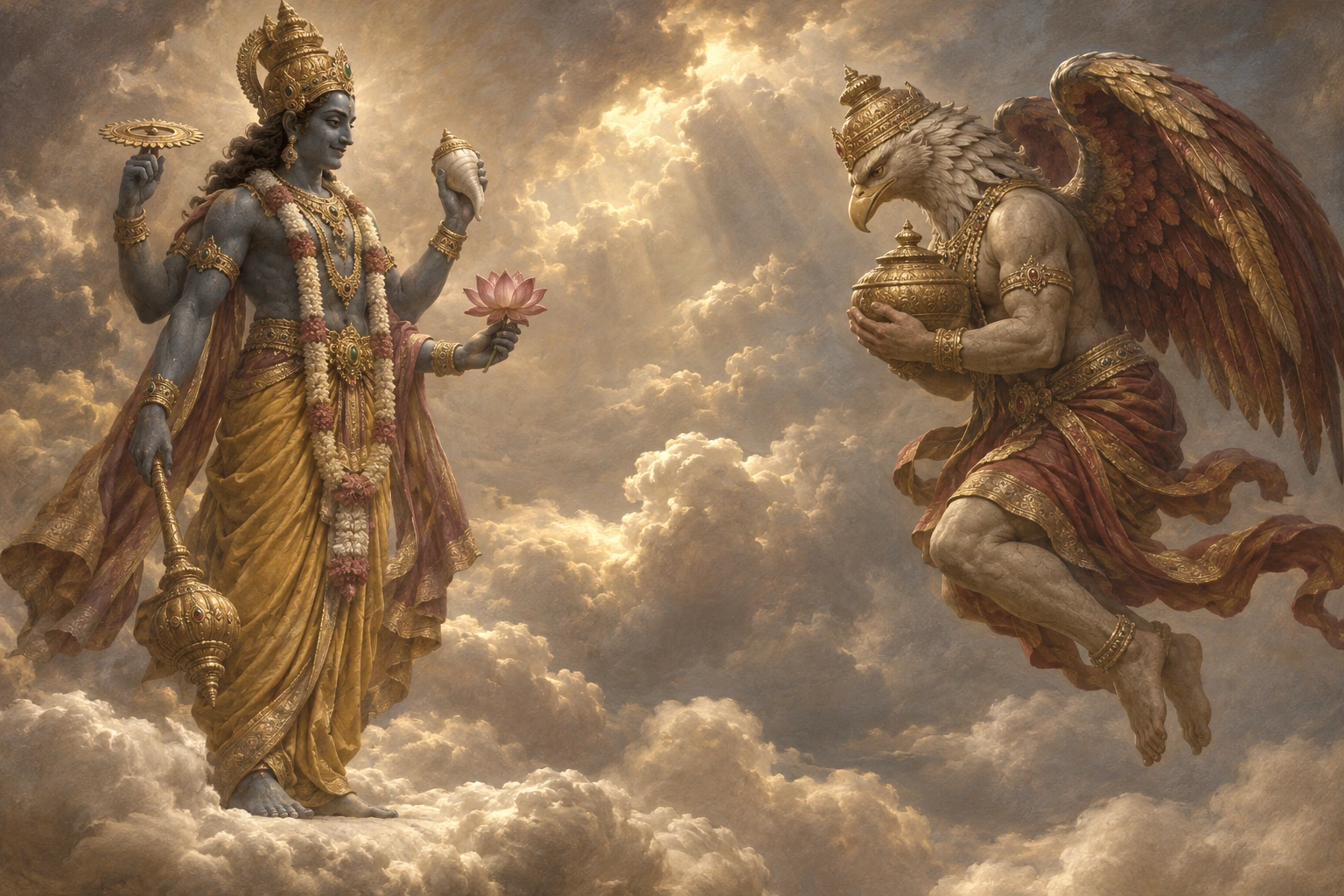
In the sky he met Vishnu, who was pleased that he had felt no greed for it. Garuda asked for two boons: to stand above Vishnu, and to be deathless without the amṛta. When Garuda offered a boon in return, Vishnu chose him as his mount and set him on his banner: “So you will stand above me.”
Indra struck him with the thunderbolt. Garuda laughed: it did not hurt, but to honour the sage from whose bone it was made, he let fall one feather. It was so beautiful that all creatures named him Suparṇa, “fair-feathered”. Indra asked for the amṛta back. Garuda would not hand it over, but said: “Where I set it down, you may take it.” Indra offered him a boon, and he asked that the snakes become his food.
He set the amṛta before the snakes on a bed of kusha grass and declared his mother free. While they went to bathe, Indra carried it back to heaven. The snakes licked the grass where it had lain, and their tongues split in two; the grass became holy. Garuda stayed in the forest with his mother, and lived on snakes.
2 Where the Story Is Written Down
- The Rigveda. Among the names the sages give to the One is “heavenly nobly-winged Garutman” (1.164.46, Ralph Griffith’s translation). A bird brings the Soma down from heaven for Indra, and when the archer Kṛśānu shoots at it, a feather falls (4.26–27). Arthur Anthony Macdonell (1897) noted that garutmat and suparṇa were already names of the sun-bird there, and thought Vishnu’s mount grew from the same idea.
- The Śatapatha Brāhmaṇa (3.6.2, Julius Eggeling’s translation, 1885). Kadru and Suparṇī, “the fair-winged”, bet on who can see further: a white horse at a post on the far shore of the ocean, and the wind tossing its tail. Suparṇī loses and must ransom herself with the Soma, which lies in heaven between two golden cups that snap shut at every blink. The text reads it as the sacrifice: the ocean is the altar, the horse is Agni.
- The Mahābhārata, Book 1. The full story. K. M. Ganguli’s English translation (1884, sections 16 and 20–34) follows other manuscripts than the critical edition. E. Washburn Hopkins wrote in 1915 that “the epic makes a typical roc out of him”, and called the theft of the Soma, after Johansson, “the oldest epic trait”.
- The Rāmāyaṇa. Garuda, uncle of Sagara’s sixty thousand sons, tells Anshuman how to save them (book 1), and in the war he frees Rama and Lakshmana from Indrajit’s arrows, which are snakes, sons of Kadru (6.40 in the critical text).
- The Garuḍa Purāṇa. In an extract from it, the Sāroddhāra, Vishnu answers Garuda’s questions about death and the rites for the dead. It “is used all over India at funeral ceremonies”, says its English edition of 1911.
3 Competing Versions
- Did the snakes cheat? In the critical text Kadru’s sons refuse and are cursed, yet the tail is full of black hairs, and Vinata says the snakes falsified the bet. Other manuscripts, which Ganguli follows, fill the gap: the snakes talk it over and obey, afraid their mother will burn them.
- Who fetches the Soma? In the Śatapatha Brāhmaṇa, Suparṇī gives birth to the metres, and one of them, Gāyatrī, brings it. In the Mahābhārata, Vinata’s son.
- Aruṇa is seen at dawn in the critical text, the sun’s forerunner; other manuscripts make him the sun’s charioteer. The sage of the thunderbolt is unnamed; Ganguli adds “Dadhichi” in brackets.
- How did he become Vishnu’s mount? In Book 1, by an exchange of boons. In Book 5 (chapter 103), the sage Kaṇva warns Duryodhana against pride with another story: Garuda, furious that Indra has given long life to a naga he meant to eat, boasts that he carries Vishnu and is stronger than any god. Vishnu lays his right arm on Garuda’s shoulder, and Garuda collapses under its weight, shedding his feathers, and begs forgiveness.
- His family. Aruṇa’s sons by Śyenī are Sampāti and Jaṭāyu (Mahābhārata 1.60), so Jaṭāyu, the vulture who fights Ravana for Sita, is Garuda’s nephew (Rāmāyaṇa 3.13).
4 History and Tradition
- Besnagar. A stone column in central India is inscribed as “the Garuḍa-standard of Vāsudeva, the god of gods”, made by Heliodoros, son of Dion, a Greek ambassador from King Antialkidas to King Bhāgabhadra. J. Ph. Vogel, who published it in the Archaeological Survey’s report for 1908–09, thought it once carried an image of Garuda and dated Antialkidas to about the middle of the 2nd century BCE.
- In the temples. H. Krishna Sastri (1916) describes Garuda in every Vaishnava temple of South India: a human figure “with a beak-shaped nose and with spreading wings”, arms folded in worship. As a processional bronze he kneels, a serpent on his head.
- Buddhism. Garuda became one of the eight kinds of beings who guard the Buddha’s teaching: in Chinese and Japanese 迦楼羅, or 金翅鳥, the golden-winged bird who eats dragons. At Kōfuku-ji in Nara, the dry-lacquer Karura of 734 is a warrior in armour with a great beak and bird’s eyes, but human ears and hair.
- Champa. At the Museum of Cham Sculpture in Đà Nẵng, a carving from tower E1 at Mỹ Sơn (7th–8th century) shows the birth of Brahmā with a Garuda at each end, human above and bird below. The museum also holds Garuda reliefs from Trà Kiệu, and pediments from Mỹ Sơn of Garuda overpowering a naga.
- Thailand. The Garuda seal, Phra Khrut Pha, goes back to the kings of Ayutthaya. Phraya Anuman Rajadhon tells that when Prince Naris redrew it for King Chulalongkorn, he left out the naga in Garuda’s grip: it was only food, and made him look greedy. A Royal Seals Act of 1911 made the Garuda the seal of the kingdom.
- Indonesia. The Garuda Pancasila, designed by Sultan Hamid II, was adopted by the cabinet on 11 February 1950. Government Regulation No. 66 of 1951 gives the golden bird 17 wing feathers and 8 tail feathers, for 17 August, and traces it to the temples of Java and the Garuda emblem of King Airlangga in the 11th century.
Garuda is often called an eagle: a Japanese encyclopedia defines Karura as “a deified eagle”. The epics name no species. He is “the bird”, the fair-feathered king of birds, and in the Rāmāyaṇa he strokes Rama’s face with his hands and wears garlands and spotless clothes. The Vedic bird that brings the Soma is a śyena, “falcon” in Griffith and “eagle” in Macdonell. In South India the Brahminy kite was called Garuda, and Indonesia’s regulation says only that its Garuda is “close to” the eagle.
5 Related Stories
- The Churning of the Ocean: Gods, Demons and the Nectar of Immortality: the same chapters of Book 1 tell both stories. The churning brings up the horse the sisters bet on and the amṛta Garuda steals, and that post’s note on the snakes licking the darbha grass is the end of this one.
- The Descent of the Ganga: The River That Fell from Heaven: in the Rāmāyaṇa, Garuda is the brother of Sumati, mother of Sagara’s sixty thousand sons, and tells Anshuman that only the Ganga can carry their ashes to heaven.
- Rama and Sita: The Exile, the Abduction and the Many Rāmāyaṇas: Jaṭāyu, the old vulture who dies fighting Ravana, is Garuda’s nephew.
- Tengu: The Goblins of the Mountains: Gorai Shigeru derived the crow-faced tengu from the Gigaku mask of Karura, Garuda’s Japanese name, the bird said to eat poisonous snakes.
6 Sources
- Mahābhārata, critical edition, 1.14–30 and 1.60, with variant passages, and 5.103: GRETIL, GRETIL; K. M. Ganguli (trans.), The Mahabharata, Book 1, sections 16 and 20–34 (1884): Wikisource
- Kamimura Katsuhiko (trans.), 『原典訳 マハーバーラタ』 1 (Chikuma Shobō, 2002), the Japanese translation from the critical edition: CiNii
- Rāmāyaṇa, critical text, 1.37–40, 3.13 and 6.40: GRETIL, GRETIL, GRETIL
- Rigveda 1.164 and 4.26–27, trans. Ralph T. H. Griffith: Wikisource; Julius Eggeling (trans.), The Śatapatha-Brāhmaṇa, part 2 (Sacred Books of the East 26, 1885), 3.6.2: archive.org
- A. A. Macdonell, Vedic Mythology (1897), §17 and §63: archive.org; E. Washburn Hopkins, Epic Mythology (1915), §12: archive.org
- Ernest Wood and S. V. Subrahmanyam (trans.), The Garuda Purana (Saroddhara) (1911): archive.org
- J. Ph. Vogel, “The Garuda Pillar of Besnagar”, Annual Report of the Archaeological Survey of India 1908–09: archive.org
- H. Krishna Sastri, South-Indian Images of Gods and Goddesses (1916), chapter 3: Wikisource; Edgar Thurston, Castes and Tribes of Southern India (1909), “Kondh”: Wikisource; F. E. Penny, On the Coromandel Coast (1908), chapter 23: Wikisource
- “迦楼羅”, Sadakata Akira and Sekiguchi Masayuki, “八部衆”, and Gorai Shigeru, “天狗”, on Kotobank: Kotobank, Kotobank, Kotobank; Japan Tourism Agency, multilingual commentary database, Kōfuku-ji, “迦楼羅像”: mlit.go.jp
- Museum of Cham Sculpture, Đà Nẵng: “The Birth of Brahma”, the Mỹ Sơn catalogue, and Jean-Yves Claeys’s excavations at Trà Kiệu: chammuseum.vn, chammuseum.vn, chammuseum.vn
- Phraya Anuman Rajadhon, Rueang phraratchalanchakon lae tra pracham tua pracham tamnaeng (Fine Arts Department, 1950): Thai Wikisource
- Government Regulation No. 66 of 1951 on the State Emblem, with its explanation: peraturan.bpk.go.id; “Kapan Garuda Pancasila Diresmikan sebagai Lambang Negara?”, Kompas.com (2022): kompas.com
Cover and illustrations: AI-generated images made for Arcana. They are interpretations, not historical artworks.