Tengu: The Goblins of the Mountains
In 637 a monk told the Japanese court that a roaring star was no meteor but a tengu, a "heavenly dog". Over the next thousand years the tengu became a kite that fooled the pious, the fallen soul of a proud monk, a mountain spirit that carried children away, and at last the red-faced, long-nosed figure still honoured on Kurama and Takao.
- Type: folk belief and legend, a spirit of the mountains
- Culture: Japan; the name came from China, where the tiangou (天狗), the “heavenly dog”, was a falling star
- Earliest texts: the Nihon Shoki (720), under the year 637; the tengu tales of the Konjaku monogatari shū (early 12th century); the Tengu-zōshi scrolls (1296)
- Key figures: the monk Min, the Chinese tengu Chira Eiju, Sōjōbō of Kurama and the boy Ushiwakamaru, Tarōbō of Atago, Emperor Sutoku, the boy Torakichi and the scholar Hirata Atsutane
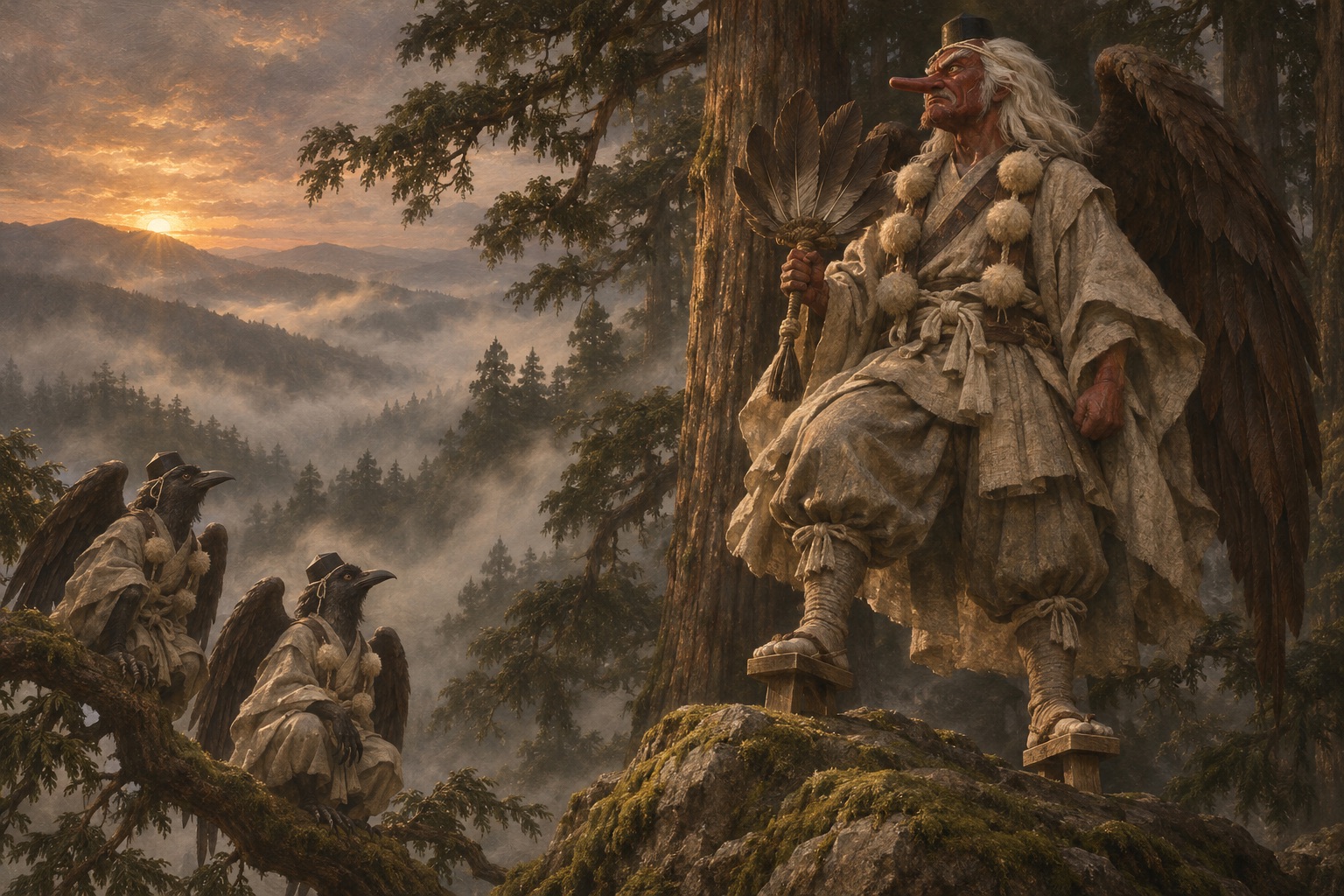
Today a tengu has a red face and a long nose. He wears the robe and the small black cap of a mountain ascetic, has wings on his back and carries a fan of feathers; a lesser kind, the crow tengu, has a beak. That figure took its final shape only in the Edo period. The word is a thousand years older. It came from China, where it named a falling star that barked like a dog, and on its way to the mountain shrines the Japanese tengu was a fox-like trickster, a kite that fooled the devout, the fallen soul of a proud monk, and the master who taught a boy the art of war.
Is a tengu a demon or a god? It depends on the century, and on the mountain. In the Konjaku monogatari shū tengu are enemies of the Buddha’s law, and holy monks send them packing. Medieval writers said that proud monks, and emperors who died in anger, were reborn as tengu. Yet Yakuōin, the temple on Mount Takao, some fifty kilometres west of central Tokyo, honours tengu as the attendants of its god, Izuna Daigongen, with the power to ward off disaster and bring good fortune.
1 The Telling
There is no single tengu story. These five episodes, each from its own source, show how the figure changed.
1-1 The Star That Barked
In the ninth year of Emperor Jomei, 637, on the twenty-third day of the second month, a great star flowed across the sky from east to west with a noise like thunder. Some said it was the sound of a falling star; others called it earth-thunder. Then the monk Min, who had studied in China, spoke: “It is not a falling star. It is a tengu. Its barking is like thunder.”
That is all the Nihon Shoki says. Min was using a Chinese word, tiangou, and in China, the yōkai scholar Kagawa Masanobu points out, the heavenly dog was an omen of war. A few lines later the chronicle records that the Emishi of the north rose in revolt that same year. Japanese readers glossed the word in their own language as amatsukitsune, the “heavenly fox”.
1-2 The Chinese Tengu on Mount Hiei
Five centuries later, the twentieth book of the Konjaku monogatari shū opens with a run of tengu tales. In one of them a mighty tengu of China, Chira Eiju, flies to Japan to test his strength against its monks. A Japanese tengu leads him to the stone stupa at Ōdake on Mount Hiei, the mountain of the Tendai school. Chira Eiju takes the shape of an old monk and crouches by the path, while his host hides in the thickets of the valley to watch.
The first to pass is the master Yokei, in a palanquin. The old monk vanishes: the palanquin, he explains afterwards, looked like a great blazing fire, because Yokei was reciting the spell of the realm of fire. Next comes Jinzen of Iimuro, reciting the mantra of the god Fudō, and a boy with an iron staff walks ahead of him and drives the old monk off. Last, coming up the mountain, is the head of the Tendai school, Jie of Yokawa, with twenty or thirty boys around him. Jie is only turning over a text of meditation in his mind, so the tengu does not hide deep enough. The boys find him in the valley, beat him and make him confess: “I am a tengu who has come over from China.” As they leave, each of them treads once on his back, and breaks it. The Japanese tengu carries him to a bathhouse at Unohara in the northern hills, heals his back with hot water and sends him home. A woodcutter who looked in that day saw two old monks bathing, and a stench gave him a headache.
The tales around it show what the tengu could do. In the reign of Emperor Daigo a Buddha appeared on top of a barren persimmon tree by the shrine of the road god at Gojō in the capital, shining and raining flowers, and the whole city came to worship. After six or seven days the minister Minamoto no Hikaru decided that “a true Buddha would not suddenly appear on a treetop like this; this must be the work of a tengu or some such”. He stared at it without blinking until it turned into a great kite with a broken wing and fell flapping to the ground. On Mount Ibuki, a holy man who knew nothing but the chant to Amida was carried off by a dazzling procession of Amida and his bodhisattvas. A week later, servant monks out cutting firewood found him tied naked to the top of a tall cedar, and he died out of his mind. He lacked wisdom, the book concludes, and so “he was deceived by tengu”.
1-3 The Golden Kite of Atago
Proud monks, it came to be said, did not go to paradise when they died: they fell into the realm of tengu. In 1296 an unknown artist made the Tengu-zōshi, seven scrolls that satirize the great temples of Nara and Kyoto one after another. Each text, as Haruko Wakabayashi sums it up, ends by saying that their monks’ pride in their temple and sect turns them into tengu.
The war tales add emperors. Retired Emperor Sutoku lost the Hōgen disturbance of 1156, was exiled to Sanuki and died there in 1164, and after his death he was feared as a vengeful spirit. The Hōgen monogatari, the tale of that war, says that in exile he spent three years copying five Mahayana sutras in his own hand and asked for them to be laid near the capital. When they were sent back, he swore to give them over to the realm of demons, “become a demon and vent my grudge”, wrote his vow at the end of the sutras and sank them in the sea. From then on he cut neither his nails nor his hair, and “through his grudge, while still alive, he took the form of a tengu”.
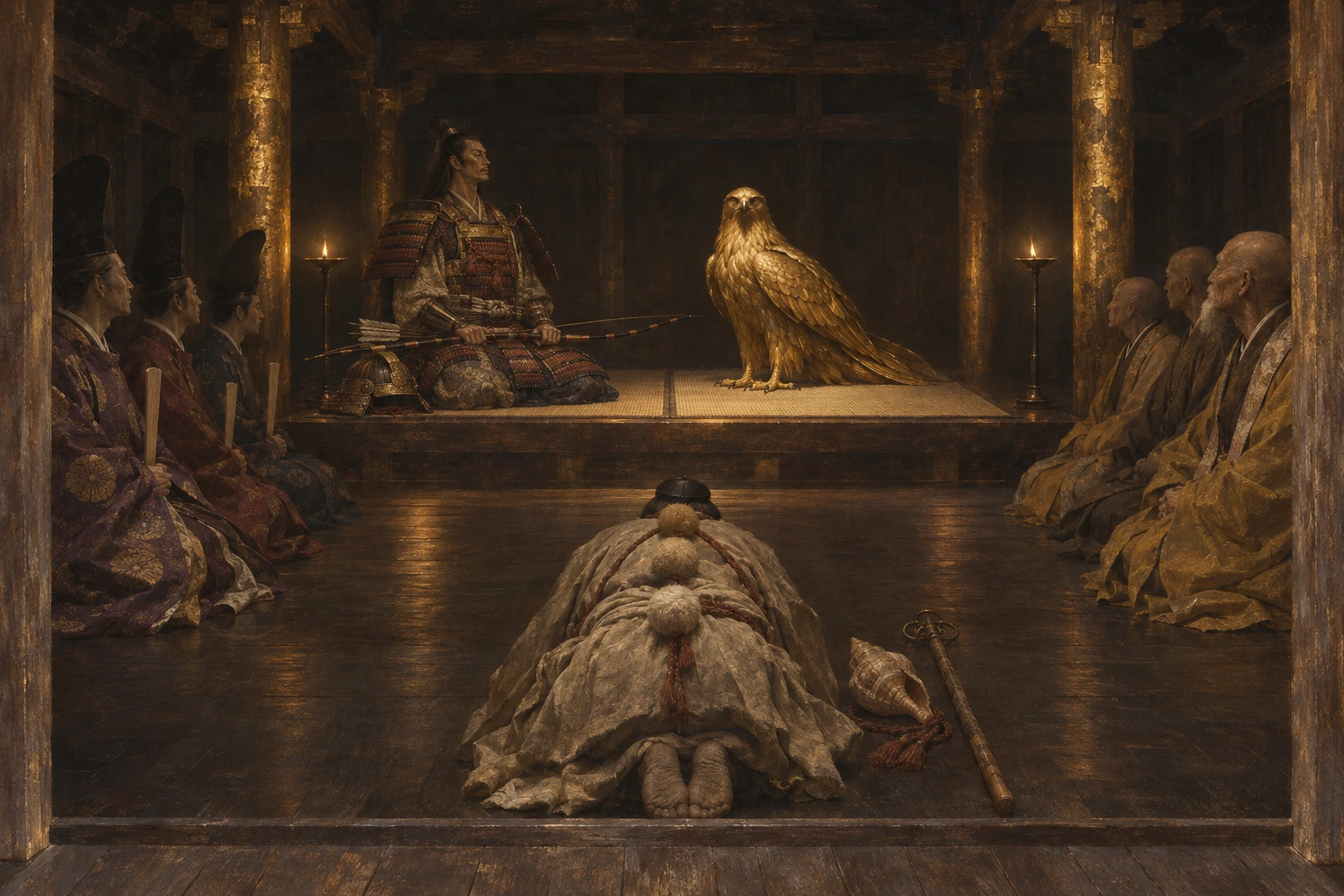
Book 27 of the Taiheiki, the chronicle of the 14th-century wars, seats him among the tengu. It tells of a mountain ascetic named Unkei, from Haguro in Dewa, who in 1349 falls in with an old ascetic of about sixty on his way to a temple in Kyoto. The old man offers to show him the holiest place in Japan and leads him up Mount Atago. Behind the main hall sits a company of men in court robes and monks in saffron. In the seat of honour is a great golden kite, its wings neatly folded; beside it waits a man eight feet tall with a great bow and arrows.
“The golden kite in the high seat is the Retired Emperor Sutoku,” his guide explains. The tall man is the archer Minamoto no Tametomo. On the left sit the deposed emperor of Awaji, the Empress Inoue, Go-Toba and Go-Daigo, “become the chiefs of the demon kings”, and beside them famous monks, Genbō, Shinzei, Jie and others, “likewise become great demon kings, gathered here to plan how to throw the realm into disorder”. The old monk who answers Unkei’s questions is Tarōbō of Atago. Then fire fills the hall, and Unkei finds himself standing under a tree on the old palace grounds. “Without doubt,” he concludes, “I had gone to the realm of tengu.”
1-4 The Great Tengu of Kurama
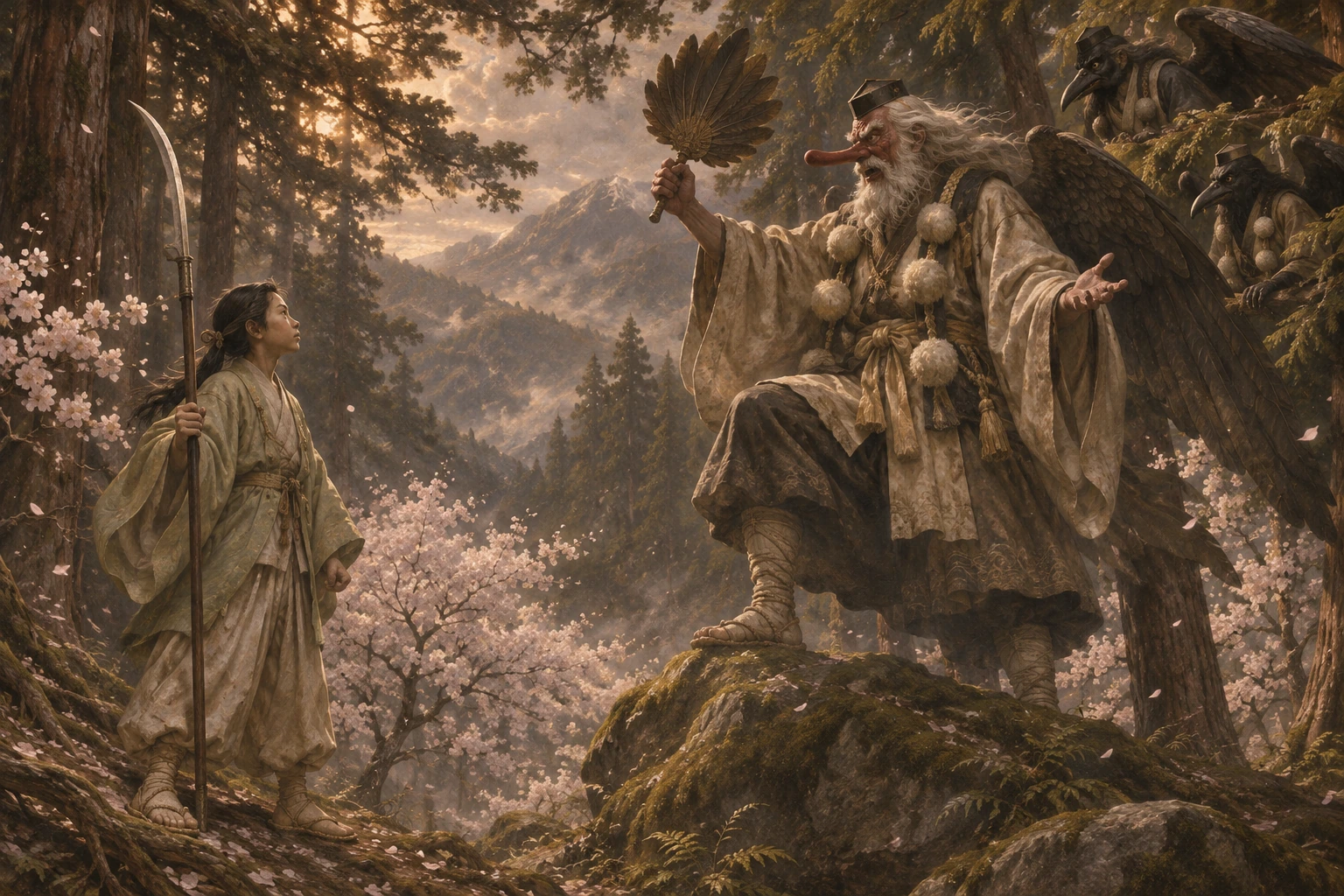
The Noh play Kurama tengu, attributed to Miyamasu, makes the tengu a teacher. Monks of Kurama, in the hills north of Kyoto, are viewing the cherry blossoms with their temple boys when a rough mountain ascetic sits down among them. Offended, they leave. One boy stays and speaks to him kindly: Shanaō, also called Ushiwakamaru, the orphaned son of Minamoto no Yoshitomo, shunned by the other boys because they belong to the ruling Taira and he to the defeated Minamoto. The ascetic takes him to see the blossoms of the hills, reveals that he is the great tengu of the mountain, and promises to teach him the art of war.
When the boy comes back, armed with a halberd, the great tengu appears with the tengu of every province. He tells how Zhang Liang of Han China earned the secrets of strategy by serving his master humbly, gives the boy those secrets, and promises to stand by him in his battles against the Taira. Then he flies off over the mountain in the evening. The boy grew up to be the general Minamoto no Yoshitsune, whose story belongs to a later post. The tengu of Kurama is called Sōjōbō; sōjō is one of the highest ranks of the Buddhist clergy.
1-5 The Boy Who Went with the Tengu
On the first day of the tenth month of 1820, the scholar Hirata Atsutane heard of a boy in Edo who had “been taken away by a so-called tengu for many years” and served as his messenger. He went to see him that same day. The boy was Torakichi, fifteen years old, named for the tiger because he was born in a tiger year, on a tiger day, at the hour of the tiger. Hirata wrote down his story in the Senkyō ibun, “Strange Things Heard of the Realm of the Immortals”.
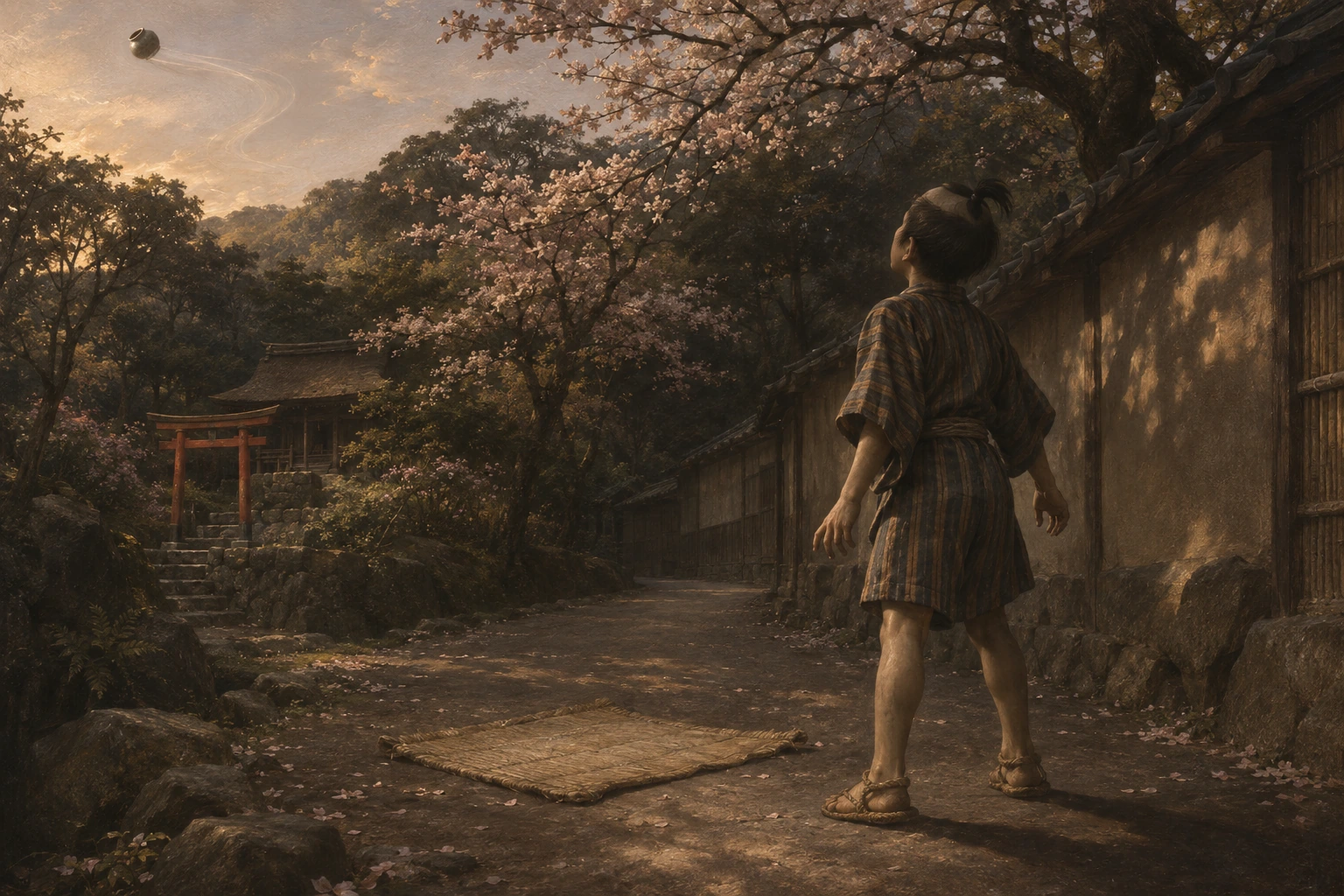
When Torakichi was seven, he said, he was playing near the Gojō Tenjin shrine at the foot of Ueno and saw an old man of about fifty, with a long beard, selling pills from a little jar a few inches across. When the old man had finished, he packed all his wares into the jar, stepped in after them, and the jar rose into the sky. Another day the old man asked whether Torakichi wanted to learn divination: if so, he should get into the jar. The boy felt himself go in, and before sunset he stood on a peak in Hitachi province, “a practice ground of tengu, they say”. When he cried for his parents, the old man carried him home on his back through the rushing wind and told him to tell no one.
For five years Torakichi went to and fro. His master, who settled on Mount Iwama in Hitachi, told him to say, if anyone asked, that his master was “as the world calls it, a tengu”, one of the thirteen tengu of Iwama, named Sugiyama Sōjō. Hirata took the boy into his own house and questioned him for years about the life of the mountain sages.
2 Where the Story Is Written Down
- China. The Shiji of Sima Qian, in its treatise on the heavens (“Tianguan shu”, chapter 27), describes the tiangou: it is “shaped like a great running star, with a sound; where it comes down to rest on the ground, it is like a dog”, and where it falls it looks from afar like flames blazing up to heaven; armies are broken and generals killed. The Shanhaijing gives the same name to something else: a beast of Mount Yin “like a wildcat with a white head”, whose cry sounds like “liu-liu” and which “can ward off evil”.
- The Nihon Shoki (720), book 23, under the ninth year of Jomei (637). W. G. Aston, who calls the monk Bin, notes that “the interlinear Kana has Ama no Kitsune, or the Celestial Fox”; the Nihon kokugo daijiten gives the reading amatsukitsune from the Kitano manuscript.
- The Genji monogatari (early 11th century). In the last chapter, “Yume no ukihashi”, the bishop of Yokawa guesses that the lost Ukifune had been “deceived and led away by something like a tengu or a tree spirit”.
- The Konjaku monogatari shū (early 12th century, compiler unknown), book 20. Its opening tales are about tengu: one from India who hears the sea chanting a Buddhist verse and follows the sound to Mount Hiei, the Chinese Chira Eiju, the false Buddha on the persimmon tree, the holy man of Ibuki, and more.
- The Tengu-zōshi (1296), seven scrolls. The date, the tenth month of 1296, stands in the preface of the Kōfukuji scroll. The monks of Kōfukuji, Tōdaiji, Enryakuji, Onjōji and Tōji, the mountain ascetics and the recluses are the seven kinds of tengu. The Tokyo National Museum holds the Enryakuji scroll and the Tōji scroll; the scroll called “All the Tengu Attain Buddhahood” is in the Nezu Museum. The Heibonsha World Encyclopedia suggests the author was a scholar-monk of the Tendai school; Wakabayashi finds the scrolls kindest to Onjōji.
- The Hōgen monogatari, book 3, Sutoku’s vow, read in the text printed in the Kōchū Nihon bungaku taikei (1925); and the Taiheiki (14th century), book 27, “Unkei’s Record of the Future”, which Unkei dates to the intercalary sixth month of 1349.
- The Noh Kurama tengu, a play still performed by all five schools, attributed to Miyamasu.
- Hirata Atsutane, Senkyō ibun (completed 1822). The Encyclopedia of Shinto (Mori Mizue) adds that Torakichi lived with Hirata for about seven years, then at twenty-two suddenly shaved his head and left him.
3 Competing Versions
- Dog, fox or bird? In China the tiangou is a star that comes to earth like a dog, or a white-headed wildcat. The Japanese gloss makes it a fox. The Konjaku unmasks a tengu as a kite, and the Taiheiki seats Sutoku as a golden kite. Kagawa traces the steps: from about the 10th century tengu were thought to bewitch people as foxes do; from the late Heian period they were imagined as birds, above all as kites.
- The same abbot on both sides. In the Konjaku, the boys of Jie of Yokawa break the Chinese tengu’s back. In the Taiheiki, Jie sits at Atago among the great demon kings.
- Who is Tarōbō? The Engyō manuscript of the Heike monogatari (1309–10), as quoted in the Nihon kokugo daijiten, speaks of one who “through a heart of great arrogance at once became the greatest tengu of Japan; he is called Tarōbō of Mount Atago”. Another legend, noted by Wada Shūjō in the Heibonsha World Encyclopedia, makes Tarōbō the monk Shinzei, who lost his peace of mind at the sight of the Somedono Empress and became a great tengu after his death.
- Enemy or guardian? The Nihon kokugo daijiten counts three kinds of tengu from the Middle Ages on: mountain gods who reward good and protect the Buddha’s law, such as Sōjōbō of Kurama, Tarōbō of Atago and Sanjakubō of Akiba; monks fallen through pride; and those who fell through grudges and rage.
- Where did the long nose come from? No one knows for sure. Gorai Shigeru derived the two kinds from two masks of Gigaku, the masked dance brought to Japan in the 7th century: the long-nosed Chidō, who went ahead of the procession to drive off evil, and the crow-faced Karura, the bird that eats poisonous snakes. A popular story credits the painter Kanō Motonobu (1476–1559) with the first long-nosed tengu, drawn from a creature he saw in a dream; Kagawa notes that a tengu said to be his survives, but the story cannot be checked. Long-nosed masks were older than the tengu who wears one: the Kyoto National Museum shows a processional mask, dedicated in 1408, that copies the high-nosed, red face of the god Sarutahiko.
4 History and Tradition
- Kurama. Kurama-dera worships Gohō Maōson, whom it calls the spirit king of the earth, at the Maōden in its inner precinct, and its own history page tells the legend that Ushiwakamaru studied the Buddha’s teaching by day and was taught the arts of war by tengu at night in the valley of Sōjōgatani. Gorai Shigeru saw a tengu in such “great demon kings” of the mountains’ inner sanctuaries, and called Kurama the most famous of the mountains where people pray, with awe, to the tengu’s power to drive off evil and bring good fortune.
- Takao. Yakuōin on Mount Takao, in Hachiōji, enshrines Izuna Daigongen, and calls the tengu his attendants. The temple adds that the mountain ascetic, after long training on the mountain, “is often identified with the tengu”. The Encyclopedia of Shinto notes that Izuna Gongen is drawn in a form like a tengu, riding a white fox.
- Atago. On Mount Atago, west of Kyoto, the god of the shrine was called Atago Gongen Tarōbō and was believed to look like a tengu (Nogami Takahiro). While gods and buddhas were worshipped together, the shrine itself writes, the tengu Tarōbō was enshrined in its inner sanctuary, today the Wakamiya. The shrine protects against fire, and those who climb to it on the night of 31 July are said to gain a thousand days’ protection from fire.
- Spirited away. When a child went missing, people said kamikakushi, “hidden by the gods”, and most often blamed tengu. The whole village went out beating gongs and drums and calling “Give back! Return!” (Komatsu Kazuhiko). The missing were often found in a tree or on a roof, their sandals neatly placed side by side where they vanished (Iijima Yoshiharu), and those who came back told of flying with the tengu. Inokuchi Shōji notes that in earlier times eagles or oni were said to carry people off, and that tengu cases multiply from the Edo period.
- Noises in the hills. The sound of a great tree crashing down where no tree has fallen (tengu-daoshi), loud laughter from an empty forest (tengu-warai) and stones flying from nowhere (tengu-tsubute) are all put down to tengu.
- A word for pride. In everyday Japanese, tengu ni naru, “to become a tengu”, means to grow conceited, and to “snap someone’s tengu nose” is to humble them.
Tengu did not always have long red noses. The Konjaku monogatari shū unmasks one as a kite with a broken wing, and the Taiheiki shows Emperor Sutoku as a golden kite. The long-nosed tengu, Kagawa Masanobu writes, became the usual image only in the Edo period. Even on the Noh stage, the great tengu of Kurama wears the ōbeshimi mask, with clamped lips, bulging golden eyes and flattened nostrils.
5 Related Stories
- Oni: The Ogres of Japan: the other great monster of Japanese folklore. Gorai Shigeru held that oni and tengu were alike forms of the mountain gods, and that the masks of both go back to the masks of Gigaku.
- Kitsune: The Fox in Japanese Folklore: the first Japanese reading of “tengu” was amatsukitsune, the “heavenly fox”, and in the 10th century tengu were feared for bewitching people as foxes do. Izuna Gongen, the god of the tengu of Mount Takao, rides a white fox.
- Kuniumi: Izanagi and Izanami Give Birth to Japan: the shrine on Mount Atago, home of the tengu Tarōbō, enshrines Izanami and Kagutsuchi, the fire god whose birth killed her (Nipponica). Because its god is the fire god, the Heibonsha Mypedia explains, people came to worship Atago as a protector against fire.
- Garuda: The King of Birds: Gorai Shigeru derived the crow-faced tengu from the Gigaku mask of Karura, the Japanese name of Garuda, the bird said to eat poisonous snakes.
6 Sources
- Nihon Shoki, book 23, Jomei 9 (original text): Wikisource
- W. G. Aston (trans.), Nihongi, 1896, book XXIII, with note 35: Wikisource
- Sima Qian, Shiji, chapter 27, “Tianguan shu” (original text with the old commentaries): Wikisource
- Shanhaijing, “Xishan jing” (original text): Wikisource
- Konjaku monogatari shū, book 20, tales 1, 2, 3 and 12, text of the Kōshō Konjaku monogatari shū: Yatanavi, Yatanavi, Yatanavi, Yatanavi
- Genji monogatari, “Yume no ukihashi”: Wikisource
- Hōgen monogatari, book 3, “Shin’in on-kyō shizume no koto”, in Kōchū Nihon bungaku taikei, vol. 14 (Kokumin tosho, 1925), pp. 97–99: NDL Digital Collections
- Taiheiki, book 27, “Unkei miraiki no koto”, Kokumin bunko text: Wikisource
- Hirata Atsutane, Senkyō ibun (1822), in Hirata Atsutane zenshū, vol. 8 (Naigai shoseki, 1933), pp. 361–369: NDL Digital Collections
- Kagawa Masanobu, “‘Tengu’: The Birdlike Demons that Became Almost Divine”, Nippon.com, 2022: nippon.com
- Haruko Wakabayashi, “The Dharma for Sovereigns and Warriors: Onjō-ji’s Claim for Legitimacy in Tengu zōshi”, Japanese Journal of Religious Studies 29/1–2 (2002): Nanzan Institute
- Heibonsha World Encyclopedia, Nipponica and Nihon kokugo daijiten on Kotobank: Gorai Shigeru, Iijima Yoshiharu and Inokuchi Shōji, “天狗”; Taguchi Eiichi and Tokue Motomasa, and Murashige Yasushi, “天狗草紙”; Komatsu Kazuhiko and Ōtō Tokihiko, “神隠し”; Yokomichi Mario and Masuda Shōzō, “鞍馬天狗”; Nogami Takahiro and Mypedia, “愛宕信仰”; “太郎坊”; “崇徳天皇”; Noguchi Takehiko, “仙境異聞”: Kotobank, Kotobank, Kotobank, Kotobank, Kotobank, Kotobank, Kotobank, Kotobank
- Encyclopedia of Shinto, Kokugakuin University: Mori Mizue, “Senkyōibun”; Itō Satoshi, “Izuna Gongen”
- the-noh.com, “Kurama-tengu”: the-noh.com; JAANUS, “ōbeshimi”: JAANUS
- Tokyo National Museum, Tengu-zōshi (Tōji and Daigoji scroll): ColBase; Kyoto National Museum, guide to the 2015 exhibition of masks: kyohaku.go.jp
- Kurama-dera, history: kuramadera.or.jp; Takaosan Yakuōin, “高尾山と天狗様”: takaosan.or.jp; Atago Shrine, “御由緒” and “千日詣り”: atagojinjya.jp, atagojinjya.jp
Cover and illustrations: AI-generated images made for Arcana. They are interpretations, not historical artworks.