Kitsune: The Fox in Japanese Folklore
A man of Mino married a woman who turned out to be a fox, and asked her to keep coming to sleep with him: that, says a book of about 822, is why the fox is called kitsune. Over the next thousand years the Japanese fox became a trickster, a wife, a messenger of the god Inari and, for some families, a stigma that lasted into modern times.

- Type: folklore: a shape-shifting animal, by turns omen, wife, trickster, messenger of the gods and possessing spirit
- Culture: Japan, from the 7th century to today; the nine-tailed fox came from China
- Earliest texts: the Nihon Shoki (720), omens of 657 and 659; the Nihon Ryōiki (about 822), book 1, tale 2; the Konjaku monogatari shū (early 12th century), books 16 and 27
- Key figures: the fox wife of Mino and her son, the girl of the Kaya River, Kaya no Yoshifuji, Kuzunoha, Tamamo-no-mae, the messengers of Inari
Japan’s oldest official history reports a white fox as good news and a fox biting off a vine as a bad sign. A century later a monk wrote down how a man married a fox. Between them, those first entries already hold most of what the fox would become in Japan: a sign from somewhere else, a wife who cannot stay, a trickster, a messenger of the gods, and for some families a curse that other people believed in.
Does kitsune mean “come and sleep”? That is how the Nihon Ryōiki, written about 822, explains the name. A man tells his fox wife to “come and sleep” with him; she “came and slept”, “and so she was named kitsune”. The word is older than the book, though: a glossary to a Buddhist sutra from the end of the 8th century already gives kitsune as the Japanese for “fox”.
1 The Telling
The fox has no single story. These are the oldest tales, in the order of the texts: the Nihon Ryōiki in the 1902 Gunsho ruijū printing, and the Konjaku monogatari shū in Haga Yaichi’s edition. The translations are ours.
1-1 The Wife from the Wide Field
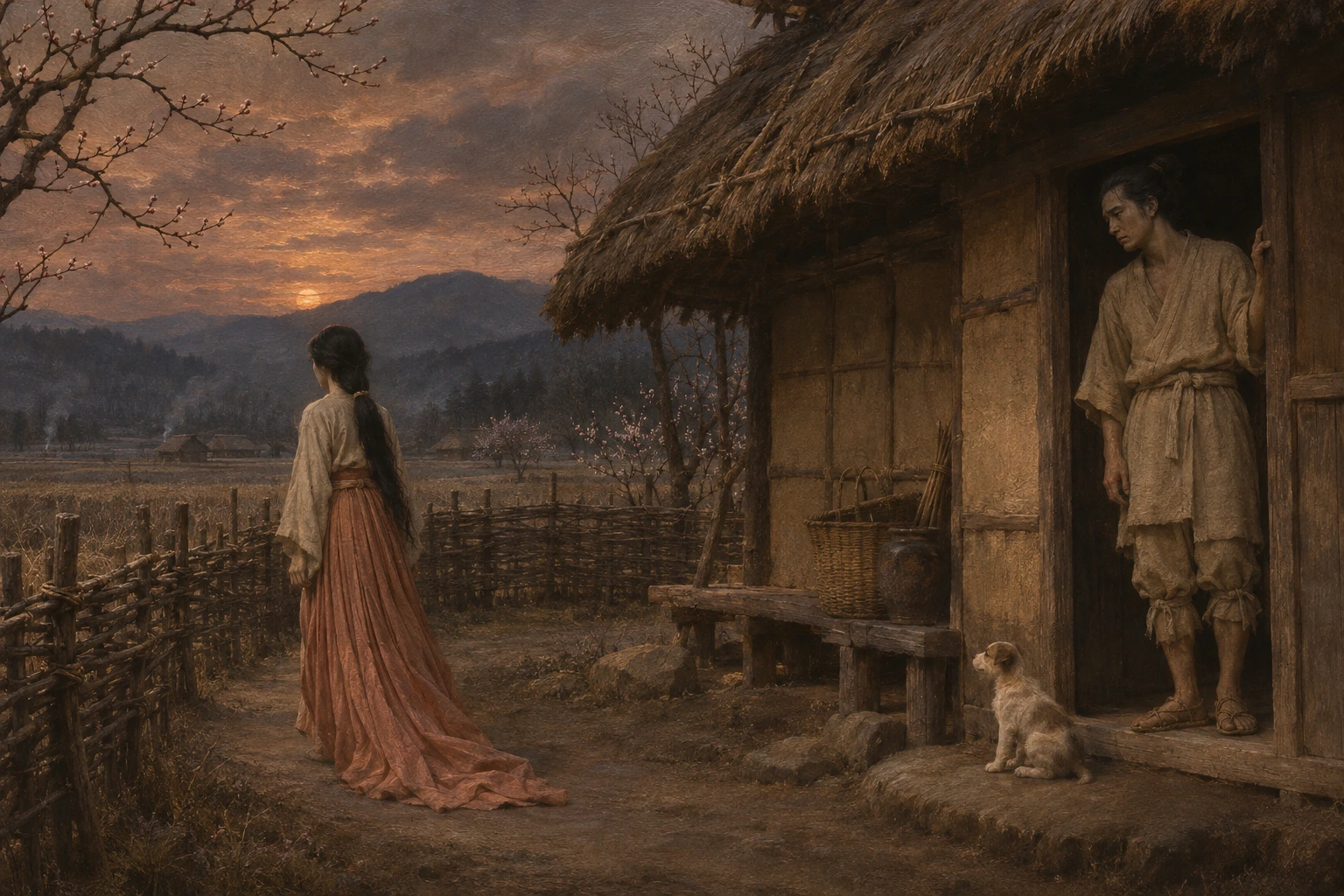
In the reign of Emperor Kinmei, in the 6th century, a man of Ōno district in Mino province set out on the road to find a good wife. In a wide field he met a beautiful woman, who made eyes at him. “Where are you going, young lady?” he asked. “I am going to look for a good match.” “Will you be my wife?” “I will.” He took her home, and before long she bore him a son.
On the 15th day of the 12th month the family’s dog had a puppy, and the puppy always bared its teeth and barked at the young wife. Frightened, she asked her husband to kill it. He was sorry for her, but he did not. In the second or third month, while the household was pounding rice, she took a snack to the women at the mortar. The puppy ran after her to bite her. In terror she turned into a fox and leapt up onto the fence.
Her husband said: “You and I have a child together, so I will not forget you. Come and sleep with me, always.” She did as he said and came and slept, “and so she was named kitsune”. She wore a skirt dyed red, “today’s peach-blossom skirt”, the text explains, and when he watched her go, trailing its hem, he made a poem: “All love has fallen on me, for the girl I glimpsed, faint as a jewel’s gleam, far off as she went.”
Their son was named Kitsune too, and he bore the clan name Kitsune no Atae. He was immensely strong and ran as fast as a bird flies. “That is the origin of the Kitsune no Atae of Mino.”
1-2 The Girl at the Kaya River
East of the temple of Ninna-ji, in Kyoto, ran the Kaya River. At dusk a pretty girl would stand on its bank and ask riders heading into the capital to let her ride behind them. After four or five hundred metres she would jump down and run, turn into a fox and flee, crying “kō, kō” (book 27, tale 41).
A young palace guard boasted that he would catch her. He took her up behind him and tied her to the saddle with a rope. In the dark he rode a long way round, found his attendants waiting at the gate, and brought her into the guardroom, where his fellow guards stood ready with bows. When he let her go she turned into a fox and fled, and the guards, the attendants and the torches all vanished: he was standing in the dark in the middle of Toribeno, the burial ground. He walked home and arrived at midnight.
A few days later he went back with real attendants and caught her again. This time they singed her fur off with torches and let her go. Ten days after that she was on the riverbank again, looking very ill. “I would like to ride,” she said, “but being burned is too much,” and she vanished. “That foxes take human shape,” the book comments, “has always been so.”
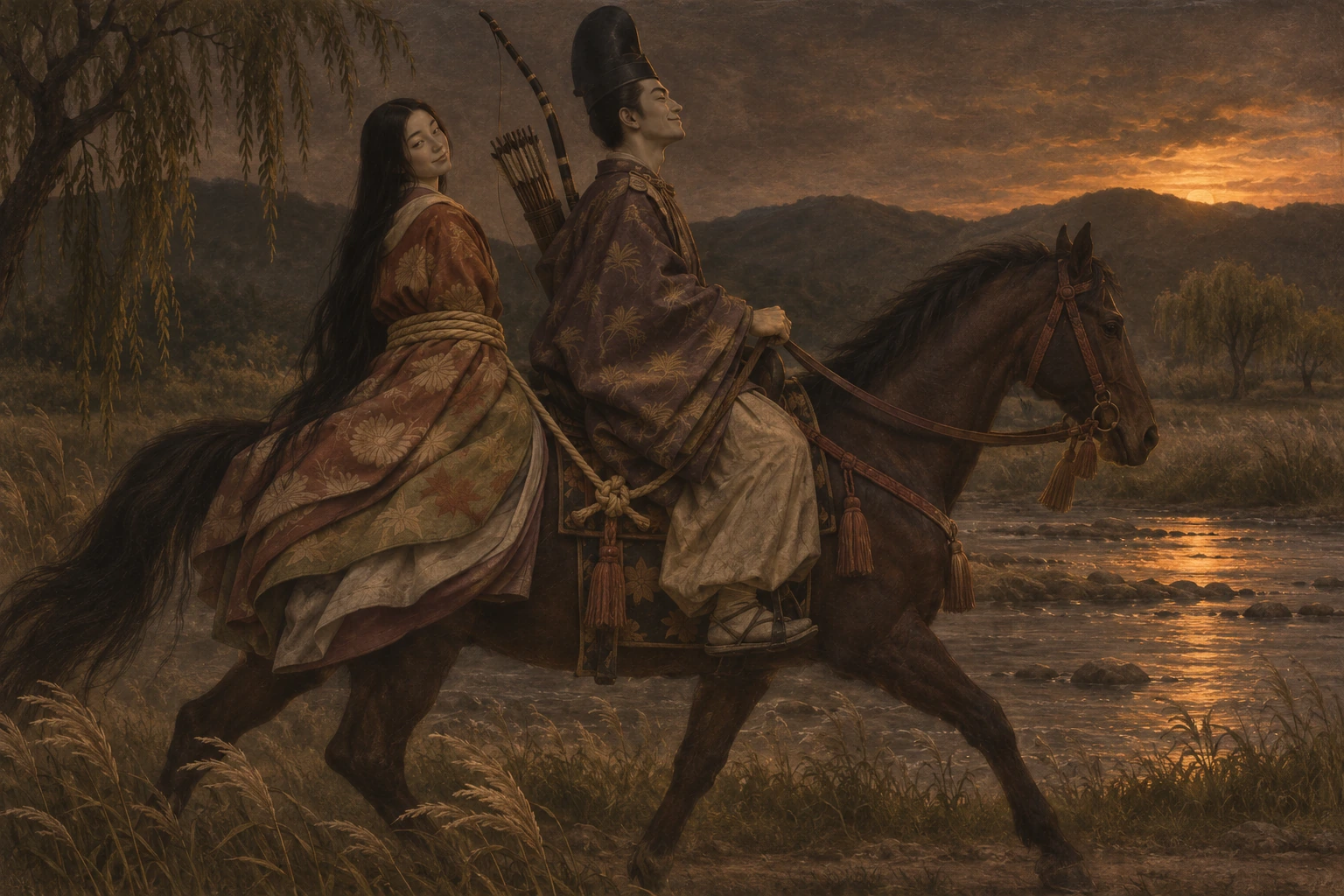
In the tales just before it, a fox disguised as a girl in the palace grounds (tale 38) and a fox that takes the shape of a man’s wife (tale 39) both escape the same way: they spray the man with foul-smelling urine and run off crying “kō, kō”.
1-3 Thirteen Days under the Storehouse
In the autumn of 896, Kaya no Yoshifuji of Ashimori, in Bitchū province, a man grown rich by dealing in coin, was alone because his wife had gone to the capital. At dusk he met a beautiful young woman, followed her to a fine house, became its son-in-law and had a son by her (book 16, tale 17). At home no one could find him. His brothers and his son had an image of the eleven-headed Kannon carved to his height and prayed to find at least his body. Then a man with a staff walked into Yoshifuji’s new house; everyone fled, and the man pushed him out through a narrow gap. Thirteen days after he vanished, something black, like a monkey, crawled out from under the family storehouse. It was Yoshifuji, and when they looked under the storehouse, many foxes ran away. He had thought thirteen years had passed, and the gap was only four or five sun, a hand’s breadth, high. The man with the staff was Kannon. The book says the story came from Miyoshi no Kiyoyuki, then governor of Bitchū.
1-4 The Fox’s Jewel
In a house beset by sickness, a spirit spoke through a medium: “I am a fox. I did not come to do harm. I only looked in, thinking food would be lying about, and I was caught” (book 27, tale 40). The medium took out a white jewel the size of a small orange and tossed it in the air, and a young retainer snatched it. The fox begged for it, swore to be his enemy forever, then promised to guard him “like a god” if he gave it back: “We never lie, and we never forget a kindness.” He gave it back. Later, walking home alone at night past the Ōtenmon gate, he was afraid and called “Fox, fox!” The fox came, crying “kō, kō”, led him by another way round a band of armed robbers, and vanished. Such animals, the book concludes, know gratitude; people often do not.
1-5 Two Later Foxes
The two most famous foxes of Japan came later, and each will have a post of its own. In Takeda Izumo’s puppet play Ashiya Dōman ōuchi kagami (1734), a white fox of the Shinoda forest in Izumi, saved by Abe no Yasuna, takes the shape of his beloved Kuzunoha, marries him and bears a son. Six years later the real Kuzunoha arrives, and the fox writes a poem on the paper screen, “If you long for me, come and look for me in Izumi, in the Shinoda forest, the kudzu leaf of regret”, and goes back to the forest; the boy grows up to be the diviner Abe no Seimei (921–1005). Tamamo-no-mae, in the medieval tale Tamamo no sōshi, is the favourite of the retired emperor Toba. When he falls ill, the diviner Abe no Yasunari reveals her as an eight-hundred-year-old fox with two tails from the moor of Nasu, and she is hunted down and shot there. In the Nō play Sesshōseki her spirit lives on in a stone on the moor that kills whatever comes near it.
2 Where the Story Is Written Down
- The Nihon Shoki (720). In the third year of Empress Saimei (657), the province of Iwami reported that a white fox had been seen: “a good omen”, notes the translator W. G. Aston. In her fifth year (659), “a fox bit off the end of a creeper which a labourer of the district of Oü held in his hand, and went off with it”; with a dog that left a dead man’s arm at a shrine, the chronicle counts it among the “signs that the Empress was about to die” (Aston’s translation).
- The word. A glossary to the Kegon sutra, made at the end of the Nara period, glosses 狐 as “in Japanese, kitsune” (岐都禰); the Nihon kokugo daijiten, which records the gloss, dates it 794.
- The Nihon Ryōiki (Nihon koku genpō zen’aku ryōiki), compiled about 822 by Kyōkai, a monk of Yakushiji: 116 tales, in Chinese, of good and evil repaid in this life. The fox wife is book 1, tale 2. Editions differ in small things: the 1902 printing writes the name 岐都禰 for the fox and for the son, while the edition by Nakada Norio, as quoted by Itō Yukiko, writes 支都禰 for the fox.
- The Konjaku monogatari shū (about 1120 or soon after, compiler unknown), Japan’s largest early collection of tales. Book 27, on spirits and strange beings, has five fox tales in a row (37–41); book 16 tells Kaya no Yoshifuji’s story as a miracle of Kannon.
- Later works. The Nō play Sesshōseki and the tale Tamamo no sōshi, both medieval and anonymous; Takeda Izumo’s play (1734); and Takai Ranzan’s illustrated novel Ehon sankoku yōfuden (1804), the “tale of the evil woman of three countries”.
3 Competing Versions
- Ancestress or demon? Chiba Tokuji writes that before the medieval period a fox ancestress, like that of the Kitsune no Atae, was told “without shame” as the proof of an old family. Then Chinese tales of the “golden nine-tailed fox” spread among the learned, the cult of the Buddhist deity Dakiniten joined them, and the fox’s power came to look demonic.
- One tail or nine? In the Chinese Classic of Mountains and Seas (Shanhaijing), on Qingqiu mountain lives a beast “like a fox with nine tails”; “its voice is like a baby’s; it eats people; whoever eats it is safe from sorcery”. In early China a nine-tailed fox was a sign of good rule, tied to marriage and many children, Kominami Ichirō explains, and Japan’s Engishiki (927) lists it among the good omens: “a divine beast; red, or white; its voice like a baby’s”. Later Chinese storytellers made King Zhou’s wicked consort Daji a golden nine-tailed fox. In the medieval tale, as Ueno Eiji summarizes it, Tamamo’s fox has two tails; the story of the golden nine-tailed fox, Nakayama Mikio writes, grew above all in the Edo period.
- Why does the wife leave? In the Nihon Ryōiki the husband asks her to keep coming, and the text does not say why she goes. In the later fox-wife tale (kitsune nyōbō), says Kojima Yoshiyuki, the fox is one the man once saved; found out, she leaves a poem naming where she lives, and her son grows up to be a great man, most often Abe no Seimei. Folklorists class her with the other non-human wives, the crane wife and the snake wife among them.
- What gives the fox away? A dog, in the Nihon Ryōiki; a stench and a cry, in the Konjaku. The enmity lasted: people possessed by a fox were said to fear dogs, Kojima notes, and to drive the fox out, people would borrow a wolf, “O-inu-sama”, from a shrine whose messenger is the wolf.
- What is fox fire? Nemoto Junkichi reports that a study published in 1977 explained most sightings by an unusual bending of light, most likely where mountain valleys open onto the plains. Iijima Yoshiharu notes that fox fires were seen at dusk or when the weather was turning, across rivers and at the edges of villages, the same places where foxes were said to trick people.
4 History and Tradition
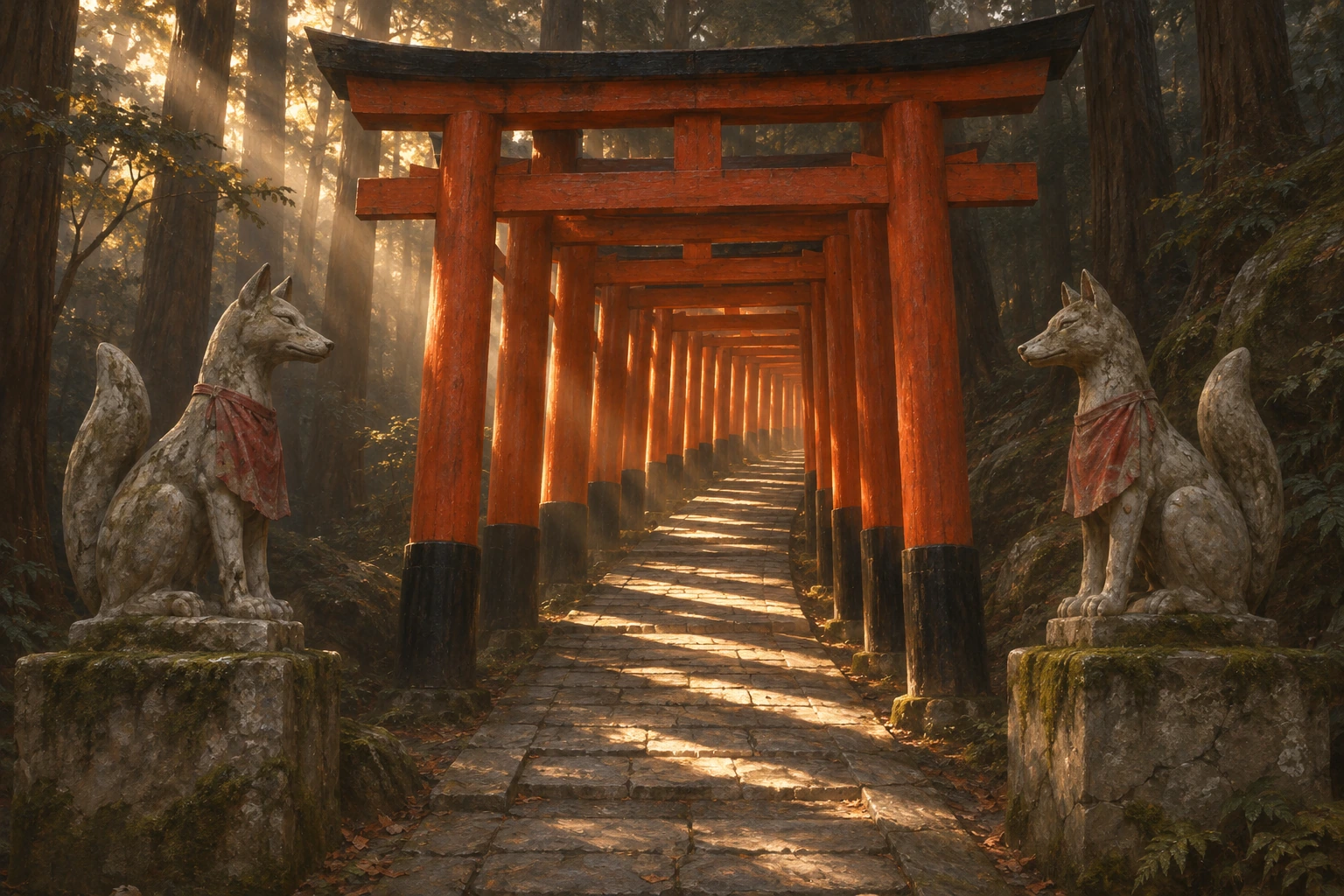
- Inari’s messengers. Fushimi Inari Taisha in Kyoto dates its founding to 711 and heads some thirty thousand Inari shrines. Its first god is Uka-no-mitama, whose name, Mitsuhashi Takeshi explains, means the spirit of rice. Murayama Shūichi writes that faith in the fox as the god’s messenger grew strong from the medieval period, and that Inari’s merger with Dakiniten probably came through the esoteric Buddhism of Tōji. Dakiniten had nothing to do with foxes at first, Hayami Tasuku explains; a forged sutra made her a fox spirit, and Edo-period images show her riding one.
- Fox fire and the fox’s wedding. Kitsunebi, “fox fire”, is a strange light seen at night in the hills. A line of them is “the fox’s wedding” (kitsune no yomeiri), a bridal procession of lanterns; the same name is given to rain that falls while the sun shines. In Edo the foxes of the whole Kantō region were said to gather on New Year’s Eve under a great enoki tree near Ōji Inari, dress there and go on to the shrine, and people read the next year’s harvest from their fires. Hiroshige drew the scene in his One Hundred Famous Views of Edo (1857). Since 1993, on New Year’s Eve, people in fox masks and make-up walk with lanterns from Shōzoku Inari, the shrine beside the tree, to Ōji Inari.
- Fox possession. Komatsu Kazuhiko notes that foxes taking human shape appear already in the Nihon Ryōiki, but foxes possessing people only from the medieval period; the Konjaku’s fox, speaking through a medium, is an early example. The possessed, most often women, were exorcised with prayers, smoked with pine needles or roughly treated. In 1907 the German physician Erwin Bälz described a farm woman he had treated for four weeks in the university hospital in Tokyo, through whom “the fox” mocked her doctors. He explained it by suggestion: one can be possessed only by a demon “whose existence one knows, and in whose power one believes”.
- Kitsune-mochi, “fox-owners”. In parts of Japan, certain families were said to keep foxes and send them into their neighbours. No one would marry into them, Bälz wrote; they were “avoided like the plague”. Hayami Yasutaka, born into such a family, studied those of Izumo in Tsukimono-mochi meishin (1956, with a preface by Yanagita Kunio), and Ishizuka Takatoshi wrote Nihon no tsukimono (1959). Ishizuka found that the families were not newcomers but a second wave of settlers who had come to outdo the first, and called the label “the tragic product” of the older families’ envy and suspicion. Shimane Prefecture’s human-rights policy names kitsune-mochi as a superstition peculiar to the prefecture, and says discriminatory attitudes over it remain.
- The killing stone. The Sesshō-seki is a real block of lava near the hot springs of Nasu Yumoto, where volcanic gas kills the insects that come close. Bashō wrote of it in Oku no hosomichi: “The stone’s poison has not yet died away; bees and butterflies lay dead in heaps, until the colour of the sand could not be seen.”
Inari is often called “the fox god”. Fushimi Inari Taisha, the head shrine, answers in its own FAQ: the god’s messengers are said to be foxes, but not the foxes of the hills; like the god they are invisible, so they are revered as white foxes, byakko-san. “Of course, Inari Ōkami is not a fox.” Folk belief has long run the two together, as Miyamoto Kesao notes, and in 1907 Bälz recorded that worship had passed from the goddess to the fox itself.
5 Related Stories
- Yuki-onna: The Snow Woman: another wife who is not what she seems, and who leaves once her secret is spoken. We link them for the theme.
- Tengu: The Goblins of the Mountains: in the Nihon Shoki’s entry for 637, the monk Min calls a roaring shooting star a tengu, a “heavenly dog”. The old reading written beside the text, Aston notes, makes it a “celestial fox”.
- Nüwa: The Serpent-Bodied Goddess Who Mended the Sky: in the Ming novel Investiture of the Gods, Nüwa takes revenge on King Zhou through a fox spirit, the consort Daji, whom Chinese storytellers made a golden nine-tailed fox. In the Japanese legend, Tamamo-no-mae’s fox had ruined kings in India and China before it reached Toba’s court.
- Lạc Long Quân and Âu Cơ: The Dragon, the Fairy and the Hundred Eggs: Vietnam has its own nine-tailed fox: Lạc Long Quân floods its den, which becomes West Lake in Hanoi. We have not found a scholar who compares it with the Japanese fox; we link them for the theme.
- Gumiho: The Nine-Tailed Fox of Korea: Korea received the same nine-tailed fox from China. In 1938 Choe Nam-seon set the Korean fox against the Japanese one, which became a wife, an ancestress and the messenger of Inari.
6 Sources
- Kyōkai, Nihon koku genpō zen’aku ryōiki, book 1, tale 2, in Gunsho ruijū, book 447 (Keizai Zasshisha, 1902), p. 24: archive.org
- Konjaku monogatari shū, book 16, tale 17, and book 27, tales 38–41, from Haga Yaichi’s Kōshō Konjaku monogatari shū (Fuzanbō, from 1913): Yatanavi, Yatanavi, Yatanavi, Yatanavi, Yatanavi
- Nihon Shoki, books 23 and 26 (original text): Wikisource; W. G. Aston (trans.), Nihongi, 1896, vol. 2, books XXIII and XXVI: Wikisource, Wikisource
- Shanhaijing, “Nanshan jing” (original text with Guo Pu’s notes): Wikisource
- Erwin Bälz, Ueber Besessenheit und verwandte Zustände, auf Grund eigener Beobachtungen (Vienna: M. Perles, 1907; offprint from the Wiener Medizinische Wochenschrift), pp. 24–29: archive.org
- Fushimi Inari Taisha, “よくあるご質問” and “ご祭神”: inari.jp, inari.jp
- Itō Yukiko, “日本思想における動物との〈倫理〉”, Nihon shisōshigaku 55 (2023): ajih.jp
- Takahashi Norihito, “「憑きもの筋」と近代”, Chiba daigaku Nihon bunka ronsō 6 (2005), on Ishizuka and Hayami: Chiba University; Hayami Yasutaka (1956) and Ishizuka Takatoshi (1959): CiNii, CiNii
- Shimane Prefecture, 島根県人権施策推進基本方針 (second revision, 2019), “迷信”: pref.shimane.lg.jp
- Heibonsha World Encyclopedia: Chiba Tokuji, “キツネ”; Komatsu Kazuhiko, “狐憑き”; Iijima Yoshiharu, “狐火”; Miyamoto Kesao, “稲荷信仰”; Murayama Shūichi, “伏見稲荷大社”; Hayami Tasuku, “荼枳尼天”; Kominami Ichirō, “九尾狐” and “妲己”; Ueno Eiji, “玉藻”; Nakayama Mikio, “玉藻前”; Yokomichi Mario, and Murai Isamu and Totsuka Hiromi, “殺生石”; Izumoji Osamu, “今昔物語集”; and “日本霊異記”: Kotobank, Kotobank, Kotobank, Kotobank, Kotobank, Kotobank, Kotobank, Kotobank, Kotobank, Kotobank, Kotobank, Kotobank, Kotobank
- Nipponica: Kojima Yoshiyuki, “キツネ” and “狐女房”; Nemoto Junkichi, “狐火”; Mitsuhashi Takeshi, “稲荷信仰”; Watanabe Shōgo, “異類婚姻譚”; Matsui Toshiaki, “芦屋道満大内鑑”; and the Nihon kokugo daijiten, “狐”: Kotobank, Kotobank, Kotobank, Kotobank
- Ōji Kitsune no Gyōretsu, official site, and GO TOKYO: kitsune.tokyo-oji.jp, gotokyo.org
Cover and illustrations: AI-generated images made for Arcana. They are interpretations, not historical artworks.