Gumiho: The Nine-Tailed Fox of Korea
Korea's oldest books know the fox as an omen, a demon in a monk's robe and, once, a mountain god who helped a famous monk. The gumiho who longs to become human, and counts the years or the livers until she does, comes mostly from television.
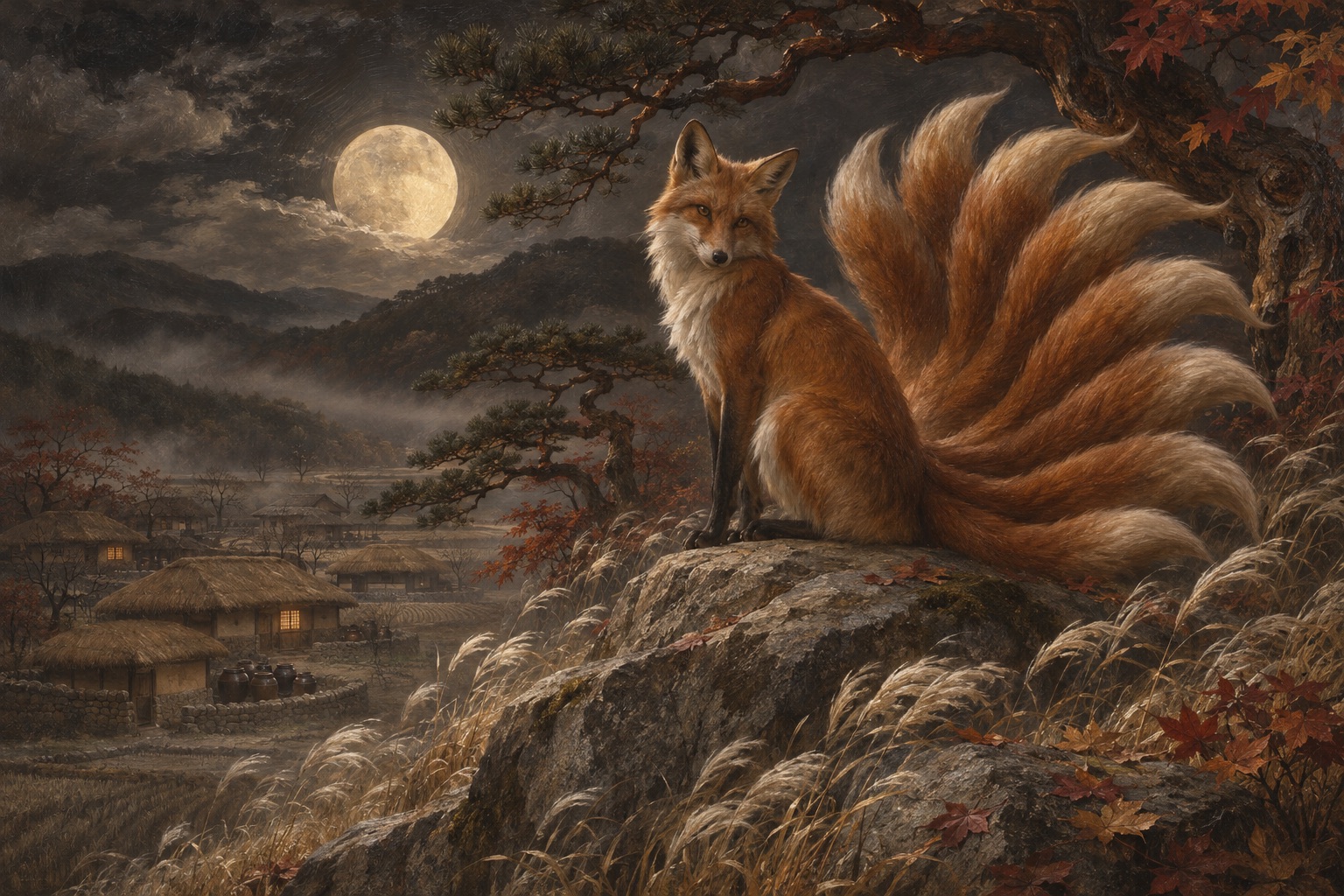
- Type: folklore: a shape-shifting fox, by turns omen, demon, mountain spirit and seductress
- Culture: Korea, from the 12th century to today; the nine-tailed fox came from Chinese books
- Earliest texts: the Samguk sagi (三國史記, 1145), fox omens at the courts of the Three Kingdoms; the Samguk yusa (三國遺事, 1280s), the tales of Geotaji and of the monk Wongwang; Yi Gyubo’s poem “The Old Shaman” (before 1241); folk tales written down from the 1920s
- Key figures: the archer Geotaji (居陁知) and the old fox disguised as a monk; the black fox of Mount Samgi; the schoolboy and the fox bead; the fox sister and her brother; the gumiho (九尾狐) of film and television
An old Chinese book of strange lands, the Classic of Mountains and Seas, puts a fox with nine tails in Qingqiu, the Green Hills, a country beyond the eastern sea. Koreans later used the same name, read Cheonggu, for their own country. “I have also heard that the nine-tailed fox is in Cheonggu,” wrote the Korean scholar-official Kim Yuk in the 17th century; “how is it that this creature lives so near my house?” Long before film and television made her a tragic heroine, the Korean fox had been an omen at court, a demon in a monk’s robe, a mountain god, and the girl on the road to the village school with a bead in her mouth.
Was every Korean fox a gumiho? No. The Samguk sagi and the Samguk yusa speak of “an old fox” or “a white fox” and never count its tails. Son Jin-tae, who published the tales he had collected in 1930, noted, as the researcher Kim Hwan-hee quotes him, that stories of the gumiho were told above all in the north, in Hamgyeong, Pyeongan and Hwanghae, and that in the south the same creature was simply called a fox. In 1938 the historian Choe Nam-seon wrote that all most Koreans knew of the fox was the proverb that calls a wicked person a gumiho.
1 The Telling
The Korean fox has no single story. These are its oldest appearances, in the order of the texts, and then two folk tales written down in the 20th century. The translations from Classical Chinese are ours.
1-1 The Fox of the Green Hills
“Three hundred li further east is the mountain of Qingqiu,” says the “Classic of the Southern Mountains” in the Shanhaijing. “There is a beast there like a fox with nine tails. Its voice is like a baby’s; it eats people; whoever eats it is safe from sorcery.” The chapter on the lands beyond the eastern sea has a country of Qingqiu whose “foxes have four legs and nine tails”. In early China, as the post on the Japanese fox explains, a nine-tailed fox was a sign of good rule, not a demon; Choe Nam-seon wrote that the ancient Chinese imagined it as an auspicious beast of the east, “somewhere around the Korean peninsula”. The Encyclopedia of Korean Culture gives this passage as the oldest record of the name Cheonggu, used for Korea since the Three Kingdoms period: it is in a decree of King Munmu in the Samguk sagi, in the title of the song anthology Cheonggu yeongeon, and on Kim Jeong-ho’s map of the country, the Cheonggu-do.
1-2 Omens at Court
Kim Busik’s Samguk sagi treats foxes as signs. In the autumn of King Chadae’s third year (148 by the traditional dates), the king of Goguryeo was hunting on the plain of Pyeongyu when a white fox followed him, crying. He shot at it and missed. A shaman told him: “The fox is an uncanny beast, no good omen, and a white one is stranger still. But heaven cannot speak in words, so it shows portents, to make the ruler fearful and set him on a new course. If you cultivate virtue, misfortune can be turned into fortune.” The king answered: “Bad is bad and good is good. You call it a portent, and then a blessing: what a liar you are!” And he had him killed.
In Baekje, in the first month of King Dongseong’s 23rd year (501), “an old woman of the capital turned into a fox and went away”. In the second month of 659, the year before the kingdom fell, “a crowd of foxes came into the palace, and a white fox sat on the desk of the chief minister”.
1-3 The Monk Who Came Down at Sunrise
The Samguk yusa sets this tale in the reign of Queen Jinseong of Silla (887–897). Yangpae, whom the text calls “the king’s youngest son”, was sent as envoy to Tang China, and because Baekje pirates were said to block the sea lanes he took fifty archers with him. At the island of Gokdo a storm held the ships for more than ten days. A diviner said the island had a sacred pond, and when offerings were laid beside it the water rose ten feet. That night an old man appeared to Yangpae in a dream: “Leave one good archer on this island, and you will have a fair wind.” The men wrote their names on fifty wooden slips and threw them into the water; the slip that sank bore the name of the soldier Geotaji. He was left behind, and the wind rose at once.
As Geotaji stood on the shore, the old man came up out of the pond. “I am the god of the Western Sea. Every day at sunrise a young monk comes down from the sky, chants a spell and walks three times round this pond, and my wife and I and all our children and grandchildren float helpless on the water. He takes my descendants’ livers and entrails and eats them. Only my wife, my daughter and I are left. He will come again tomorrow morning: I beg you, shoot him.” “The bow is my craft,” said Geotaji. He hid and waited. At sunrise the monk came down, chanted as before and reached for the old dragon’s liver. Geotaji’s arrow struck him, and the monk turned into an old fox, fell to the ground and died.

The grateful old man gave Geotaji his daughter. He turned her into a branch of flowers, which Geotaji tucked into his robe, and sent two dragons to carry the archer to the envoy’s ship and escort it to China. When the Chinese saw a Silla ship borne up by two dragons, the emperor declared that Silla’s envoys “must be no ordinary men” and seated them above his own ministers. Back home, Geotaji took the flower from his robe; it became a woman again, and they lived together.
1-4 The Black Fox of Mount Samgi
In book 4 Iryeon copies a life of the Silla monk Wongwang from an old edition of the Suijeon, a collection of tales now lost. At thirty, Wongwang went to live alone on Mount Samgi. A monk who practised spells built a hermitage nearby, and one night a spirit’s voice asked Wongwang to send the noisy neighbour away. The neighbour scoffed: why should he fear “the words of a fox-ghost”? That night there was a sound like thunder, and the mountain fell on his hermitage. “I am nearly three thousand years old,” the spirit told Wongwang, “and my powers are the greatest,” and it urged him to study the Buddhist teachings in China. He went, stayed eleven years, and came back in 600. When he asked to see the spirit’s true form, it told him to look at the eastern sky at dawn: an arm reached through the clouds to the edge of heaven. The spirit received the Buddhist precepts, and the two promised to help each other in every life to come. But “even with this body”, it said, “I cannot escape impermanence”. On the day it named, Wongwang went to the ridge and found “an old fox, black as lacquer”, gasping for breath; then it died.
1-5 The Fox Bead
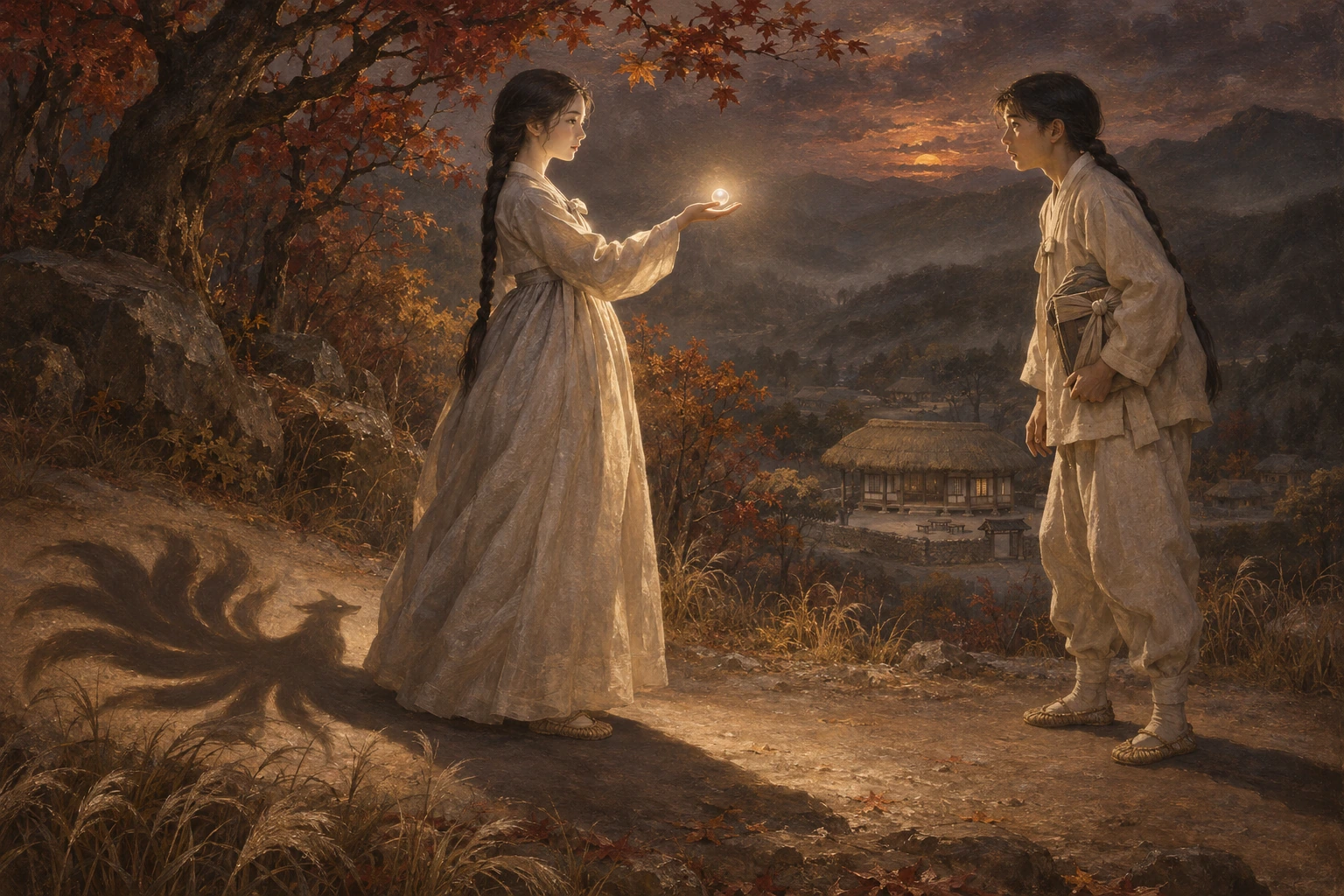
This folk tale, yeou guseul, is told across the country, says Jo Hee-woong in the Encyclopedia of Korean Culture, in two main forms. In the first, a boy on his way to the village school falls in love with a pretty girl who will not let him kiss her, and that tells him she is a gumiho. He threatens to leave her, she gives in, and he takes the bead from her mouth into his own. Had he looked at the sky first, he would have known the things of heaven; he looked at the ground, and knew only the things of earth. In the second, a fox that could rise to heaven if it killed a hundred schoolboys with its kiss comes at night to a school where a hundred boys are sleeping. It kisses ninety-nine; the hundredth escapes. Then she courts the boy who got away, and for days she passes her bead into his mouth and takes it back, and he grows weaker, until his teacher guesses she is a gumiho and tells him to swallow it. Both forms end the same way: “That is why people know the things of earth well, but not the things of heaven.” In different places the boy became a famous man: Jo Mok, a disciple of Yi Hwang, in Andong; the poet Yun Seon-do in Haenam.
1-6 The Fox Sister
The story of the fox sister, yeou nui, was told across Korea; this is how a 59-year-old man told it in Hoengseong, Gangwon province, in 1983. A rich man with seven sons and no daughter prayed on a famous mountain for a girl, and a girl was born. From the night of her birth, one of his many horses died every night. The eldest son kept watch and saw his baby sister crawl out of the parents’ room, turn three somersaults and become a fox. She dipped a forepaw in sesame oil, slid it into a horse from behind and pulled out its liver to eat. When he reported it, his parents cursed him for slandering his little sister; the second and third sons saw the same and were cursed too. The eldest brother’s wife made rice cakes for the youngest son and told him to flee. On the road he shared the cakes with three old men playing baduk; they gave him a fishhook, and with it he drew from a river a square blue stone that, struck at each corner, gave rice, a house, money and land. A maiden from the Dragon King’s palace came to keep house for him, and they married.
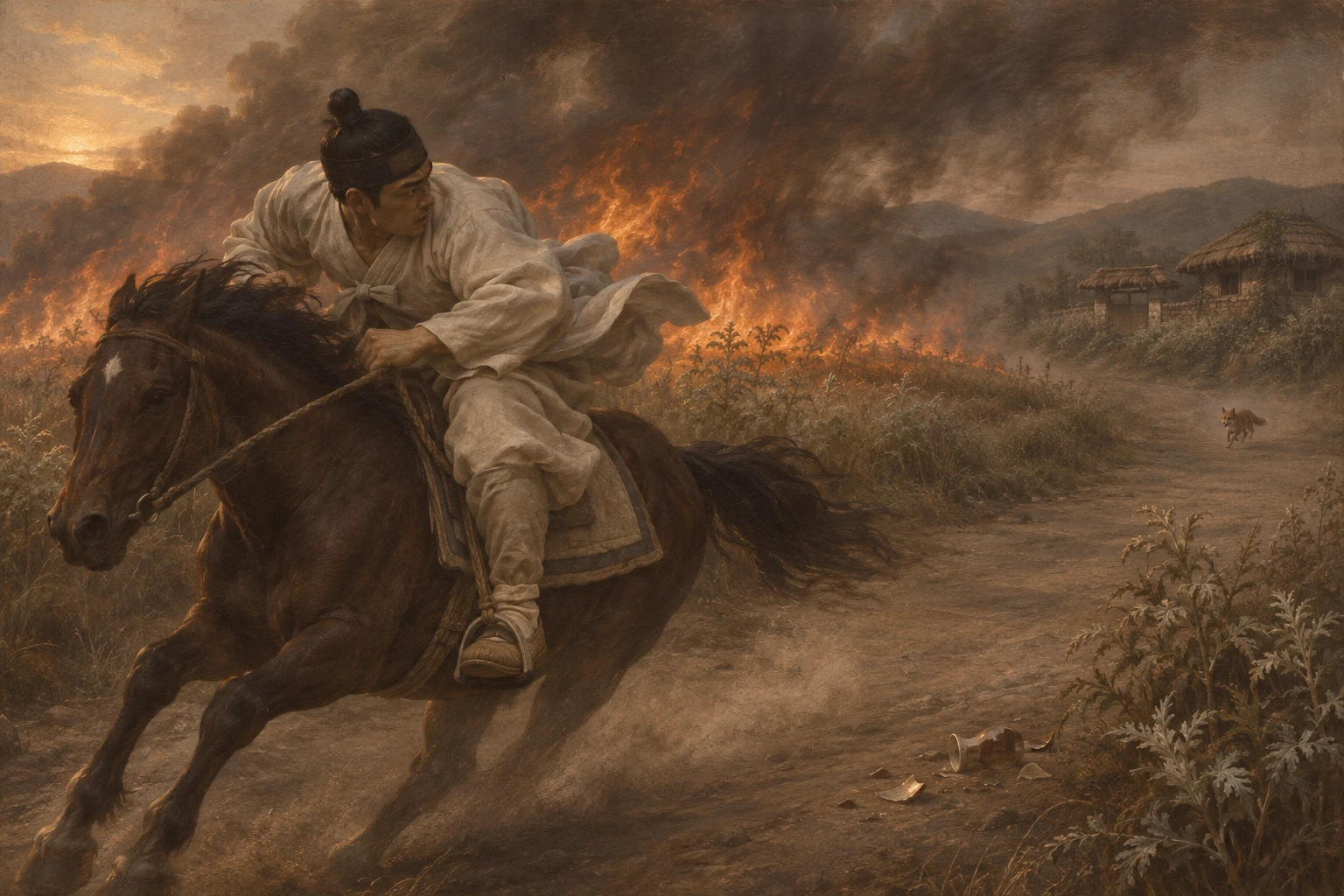
After three years he longed for home. His wife warned him that the fox had eaten all the horses and then the family, but she gave him a swift horse and three bottles: one of fire, one of water, one of blades. His home was a field of mugwort, and the fox crept out of the flue: “Brother! One more warm meal for me!” She turned back into a girl and served him a meal of human bones and blood. He sent her to pick lettuce and galloped away. When she caught up, he threw the bottles one by one: a plain of fire, a boundless sea, a forest of blades. Burned, soaked and cut, she still came on. He climbed a great zelkova, and she climbed after him and bit off his little toe. But his horse ran home without him, and his wife sent a flock of swifts, whose wings cut the fox’s neck.
2 Where the Story Is Written Down
- The Shanhaijing (Classic of Mountains and Seas), the Chinese book quoted in 1-1, with the nine-tailed fox of Qingqiu in three of its chapters.
- The Samguk sagi (1145), compiled by Kim Busik, the oldest surviving Korean history. Besides the omens in 1-2: in 739 “a fox cried in the palace of Wolseong, and dogs bit it to death” (Silla); in 756 a man who presented a white fox to the king was given a rank. In the tale of Ondal (book 45), the princess who seeks him out is told: “You cannot be human. You are a fox-ghost!”
- The Samguk yusa (1280s), by the monk Iryeon: Geotaji (book 2); Wongwang (book 4); in book 5, the monk Milbon heals Queen Seondeok when his six-ringed staff flies into her bedroom and pierces “an old fox” and the monk who had failed to cure her; in book 1, Gildal, one of the spirits led by Bihyeong, was given a post at court, then “turned into a fox and fled”, and Bihyeong had his spirits catch and kill him. Book 1 repeats the Baekje foxes of 659.
- Goryeo and Joseon writers. Yi Gyubo (1168–1241), in “The Old Shaman”, mocks the shamans of his neighbourhood: “If they are not thousand-year-old rats in their holes, they must be nine-tailed foxes in the woods.” Kim Yuk (1580–1658), in “The Old Fox”, describes the fox that “bows to the Dipper with a skull on its head”, becomes a beauty and drains young men, and asks for “a strong bow and a hundred arrows, to shoot the whole pack at once”. In one version of the novel Jeon U-chi jeon, printed in Seoul in 1847, the hero swallows a gumiho’s bead and gains his magic.
- The folk tale collections. For the fox bead, Jo Hee-woong cites Jeong In-seop’s Ondol yahwa (1927) and Son Jin-tae’s Chōsen mindanshū (Korean Folk Tales, 1930), both published in Japanese, and the Hanguk gubi munhak daegye (1980–1988), the survey of oral literature made by the Academy of Korean Studies. Son’s book also has, as Kim Hwan-hee lists them, a gumiho who takes revenge on a man who urinated on her skull, the fox sister and three brothers, and a thousand-year-old fox who seizes a mountain goddess’s place. The fox sister of 1-6 is in the Daegye.
3 Competing Versions
- Good omen or bad? In Silla a white fox could earn a man a rank. In Goguryeo, the shaman of 148 called the fox “an uncanny beast, no good omen”; in Baekje, foxes walked into the palace a year before the end.
- God or demon? Geotaji’s fox eats a dragon’s children; Wongwang’s fox is a mountain god who gives good advice and receives the precepts. Of the Korean classics she has read, Kim Hwan-hee finds this the only tale in which fox and people live in harmony, and suggests that Iryeon kept its kindness because he copied an older source, the Suijeon.
- What does the fox want? To eat, in most of the old tales. To rise to heaven, in the second fox bead. To become human, in a few: in a tale recorded in Yeongwol in 1984, a thousand-year-old fox asks a raccoon dog twice its age how to become human, is told to marry the ugliest man it can find, and is unmasked by the hero Gang Gam-chan. In the novel Seo Hwadam jeon, as Kim Hwan-hee quotes it, a fox of several hundred years wears a dead woman’s skull to seduce men “so as to become human forever”.
- A fox wife? China’s Taiping guangji and Liaozhai zhiyi and Japan’s Nihon ryōiki and Konjaku monogatari shū have loyal, loving fox wives. Kim Hwan-hee finds none in the Korean classics: the scholars who compare the three countries can cite only a tale told in Daegu in 1983, a variant of the centipede-wife tale.
- Fox or wolf? The fox sister’s story was known from Mongolia, and Wang Jieqing has found it in Chinese collections too. In China the monster sister is most often a wolf; in Korea she is always a fox, and the wife who saves the brother is a Korean touch.
4 History and Tradition
- A Korean difference. In “Animal Ghost Stories”, a newspaper series of 1938, Choe Nam-seon compared the three countries. The foxes of Korean legend, he wrote, are almost all wicked and harmful: there is nothing like the dignified fox immortals of China, nor the Inari of Japan who grants blessings, and in Korea the fox was never worshipped as a spirit.
- The television fox. KBS began its anthology of ghost stories, Jeonseol-ui gohyang (“Hometown of Legends”), in 1977, and its first gumiho, played by Han Hye-sook, came in 1979. Kim Hwan-hee could not find the film or script of 1979, and read Im Chung’s script as it was produced again in 1997: a gumiho marries a poor man and will become human if he keeps her secret for ten years; he tells it on the eve of the last day. She found no older tale like it. She traces its plot to Korean tales and to Lafcadio Hearn’s “Yuki-onna” as filmed by Kobayashi Masaki, a link made by Lee Myeong-hyeon and Noh Seong-hwan. “The Japanese snow woman crossed the sea and was reborn as the gumiho,” Noh writes, as she quotes him.
- Wanting to be human. In the series’ versions of the 1990s, writes Lee Myeong-hyeon, the gumiho is “a monster who wants to become human” by winning a man’s love, and fails when he betrays her. Film (Gumiho, 1994) and drama kept the theme. In 2020 Tale of the Nine Tailed made the gumiho a man, as the fox of the 1984 Yeongwol tale had already made itself.
- The real fox. In South Korea the red fox, once found everywhere but the islands of Jeju and Ulleung, is thought to have died out in the wild after 1980, hunted for its fur and poisoned by eating rats killed in the rat-extermination campaigns of the 1960s. A dead male found in Yanggu in 2004 raised hopes, and since 2012 a restoration programme has released foxes around Sobaeksan National Park.
A gumiho, it is often said, must eat a hundred human livers to become human. None of the old texts and tales we read says so. The Samguk yusa’s fox eats a dragon family’s livers, and the fox sister eats the horses’; neither wants to become anything. The only hundred is the fox bead’s hundred schoolboys, killed with a kiss so the fox can rise to heaven. The countdowns belong to the screen: ten years of silence in Im Chung’s script for the gumiho of 1979 (as it was produced in 1997), and in 2012 an MBC series about a gumiho who must eat the livers of a thousand men.
5 Related Stories
- Kitsune: The Fox in Japanese Folklore: Japan received the same nine-tailed fox from China, but also made the fox a wife, an ancestress and the messenger of Inari. It is the contrast Choe Nam-seon drew in 1938.
- Yuki-onna: The Snow Woman: Lee Myeong-hyeon and Noh Seong-hwan argue, as Kim Hwan-hee reports, that the 1979 television gumiho, the wife who leaves when her husband breaks his promise, borrowed her story from Kobayashi’s film of this tale.
- Nüwa: The Serpent-Bodied Goddess Who Mended the Sky: in the Ming novel, Nüwa’s revenge works through the fox spirit Daji. Korean tellers knew the type: Son Jin-tae recorded “The Fox Empress of China”, and a tale from Cheorwon makes a gumiho the wife of the warlord Gungye, according to Kim Hwan-hee.
- Lạc Long Quân and Âu Cơ: The Dragon, the Fairy and the Hundred Eggs: Vietnam’s nine-tailed fox is drowned by Lạc Long Quân, and its den becomes West Lake. We have not found a scholar who compares it with the Korean fox; we link them for the theme.
6 Sources
- Iryeon, Samguk yusa, book 2, “Jinseong yeodaewang, Geotaji”; book 4, “Wongwang seohak”; book 5, “Milbon choesa” (unscanned transcription on Chinese Wikisource that names no edition): Wikisource, Wikisource, Wikisource
- Iryeon, Samguk yusa, book 1, “Dohwanyeo Bihyeongnang” and “Taejong Chunchu-gong”, 1512 Gyujanggak print: Chinese Wikisource, Chinese Wikisource
- Kim Busik, Samguk sagi, books 9, 15, 26, 28 (from the Oksan Seowon print) and 45: Wikisource, Wikisource, Wikisource, Wikisource, Wikisource
- Shanhaijing, “Nanshan jing” (with Guo Pu’s notes), “Haiwai dongjing”, “Dahuang dongjing”: Wikisource, Wikisource, Wikisource
- Yi Gyubo, “Nomu-pyeon”, Dongguk Isangguk jeonjip, book 2: Wikisource; Kim Yuk, “Noho”, Jamgok seonsaeng yugo, book 1: Wikisource
- Choe Nam-seon, “Dongmul goedam”, Maeil sinbo, 5–13 April 1938: Korean Wikisource
- Hanguk gubi munhak daegye, vol. 2-7, “Yeou nuidongsaeng” (Hoengseong, recorded 20 July 1983), and vol. 2-9, “Gang Gam-chan janggun-gwa cheonnyeon mugeun yeou” (Yeongwol, 23 July 1984): Korean Studies Data Platform, Korean Studies Data Platform
- Encyclopedia of Korean Culture: Jo Hee-woong, 여우구슬 설화; Jeong Gu-bok, 청구; Lim Jeong-eun, 여우
- Son Jin-tae, 『朝鮮民譚集』 (Kyōdo Kenkyūsha, 1930) and Jeong In-seop, 『温突夜話』 (Nihon Shoin, 1927): NDL, NDL
- Kim Hwan-hee, Gumiho-wa seollyeo (“The Gumiho and the Snow Woman”, Brunch book, 2021–2022), chapters 1–4 and 8, quoting Son Jin-tae, Lee Myeong-hyeon (2012) and Noh Seong-hwan, “한국의 구미호와 일본의 설녀”, Il’eo ilmunhak 72 (2016): brunch.co.kr, brunch.co.kr, brunch.co.kr, brunch.co.kr, brunch.co.kr
- Lee Myeong-hyeon, “<傳說의 故鄕>에 나타난 구미호이야기의 확장과 변주”, Uri munhak yeongu 28 (2009), pp. 67–95, abstract: KCI
- Wang Jieqing, “<여우누이>와 중국의 妖妹型 설화의 비교”, Yeolsang gojeon yeongu 47 (2015), pp. 167–189, abstract: earticle
- Yonhap News, 7 November 2020, on the television gumiho: yna.co.kr; Jaegyeong Ilbo, 22 June 2012, on The Thousandth Man: jkn.co.kr
Cover and illustrations: AI-generated images made for Arcana. They are interpretations, not historical artworks.