Heungbu and Nolbu: The Swallow's Gourds
A poor man mends a swallow's broken legs and its gourd seed makes him rich; his greedy brother breaks a swallow's legs on purpose, and his gourds ruin him. Yet the story does not stop at Nolbu's ruin: the oldest copy and the great pansori libretto end with Heungbu taking his brother in.
- Type: folk tale, sung as pansori and written as a novel; a good and a bad brother, a grateful animal, and an imitation that fails
- Culture: Korea, late Joseon period
- Earliest texts: a manuscript copy, the Heungbo manborok, dated to about 1833; the pansori is first named in Song Man-jae’s poems Gwanuhui (觀優戲) of 1843
- Key figures: Heungbu (興夫), his elder brother Nolbu, their wives, a swallow, the Swallow Emperor of Gangnam, the general Zhang Fei
Sung in full, the pansori Heungbo-ga lasts about three hours, and much of it is comedy: a rich man saws open gourd after gourd, and each one lets out something worse than the last. The story behind it is one every Korean child knows. A poor younger brother mends a swallow’s broken legs and grows rich from the gourd seed it brings him; his greedy elder brother breaks a swallow’s legs on purpose, hoping for the same.
Where did the swallow find the seed? In the Seoul woodblock print it did not find it. The swallow flew home to Gangnam, “south of the river”, and told the Swallow Emperor what Heungbu had done. The emperor gave it a gourd seed carved in gold with the words “gourd that repays kindness”. The swallow whose legs Nolbu broke came back with a seed marked “gourd that repays a wrong”.
1 The Telling
This is the version of the Seoul woodblock print (Gyeongpan) in 25 leaves, as transcribed on Korean Wikisource. It gives the brothers no surname and sets them on the border of Gyeongsang and Jeolla provinces. The pansori texts call them Heungbo and Nolbo.
1-1 Two Brothers
Nolbu was the elder brother and Heungbu the younger. Nolbu took for himself all the fields their parents had shared out in their lifetime and drove Heungbu out to a hillside across the valley. There Heungbu built a hut of sorghum stalks so small that when he stretched out in it, his feet went into the yard and his backside out through the fence.
With his children starving, Heungbu went to beg his brother for rice or paddy. Nolbu listed every store he would not open for him, down to the cold rice he kept for his dog, then grabbed Heungbu by the back of the neck and beat him with a club. At home Heungbu told his wife that his brother had gone to Seoul. In the pansori as Park Rok-ju sang it, Nolbu’s wife adds her own blow, slapping Heungbu’s cheek with the paddle she was serving rice with.
Heungbu wove straw sandals from straw a rich neighbour gave him, and he and his wife hired themselves out for every kind of work. A local notable offered him thirty nyang to take a flogging in his place at the provincial office. Heungbu went, against his wife’s pleas, but a royal amnesty set the prisoners free, and he came home with nothing.
1-2 The Swallow
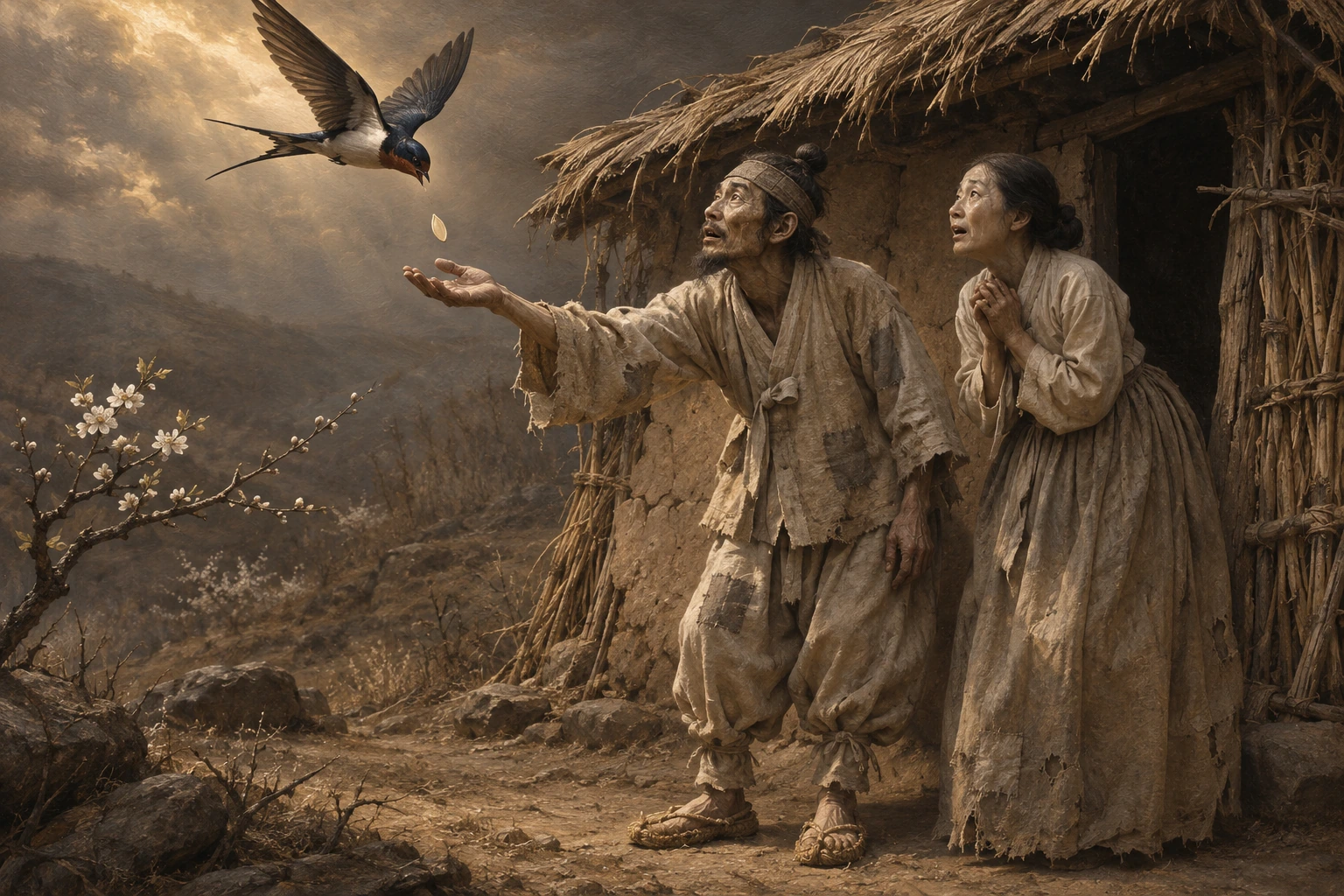
In spring a pair of swallows nested in Heungbu’s hut. A great snake got in and ate the chicks; one fell, caught its feet in the bamboo matting and broke both legs. Heungbu wrapped them in the skin of a croaker fish and bound them with thread his wife found for him. In ten days or so the legs had healed, and the swallow took its leave and flew to Gangnam.
There it told the Swallow Emperor how it had been saved. A bird that forgot such a kindness, said the emperor, could not hold up its head among its kind; he gave it a gourd seed to take back. On the third day of the third month the swallow circled Heungbu’s hut and dropped the seed at his feet. Carved on it in gold were the words bo-eun-pyo (報恩瓢), “gourd that repays kindness”.
1-3 Heungbu’s Gourds
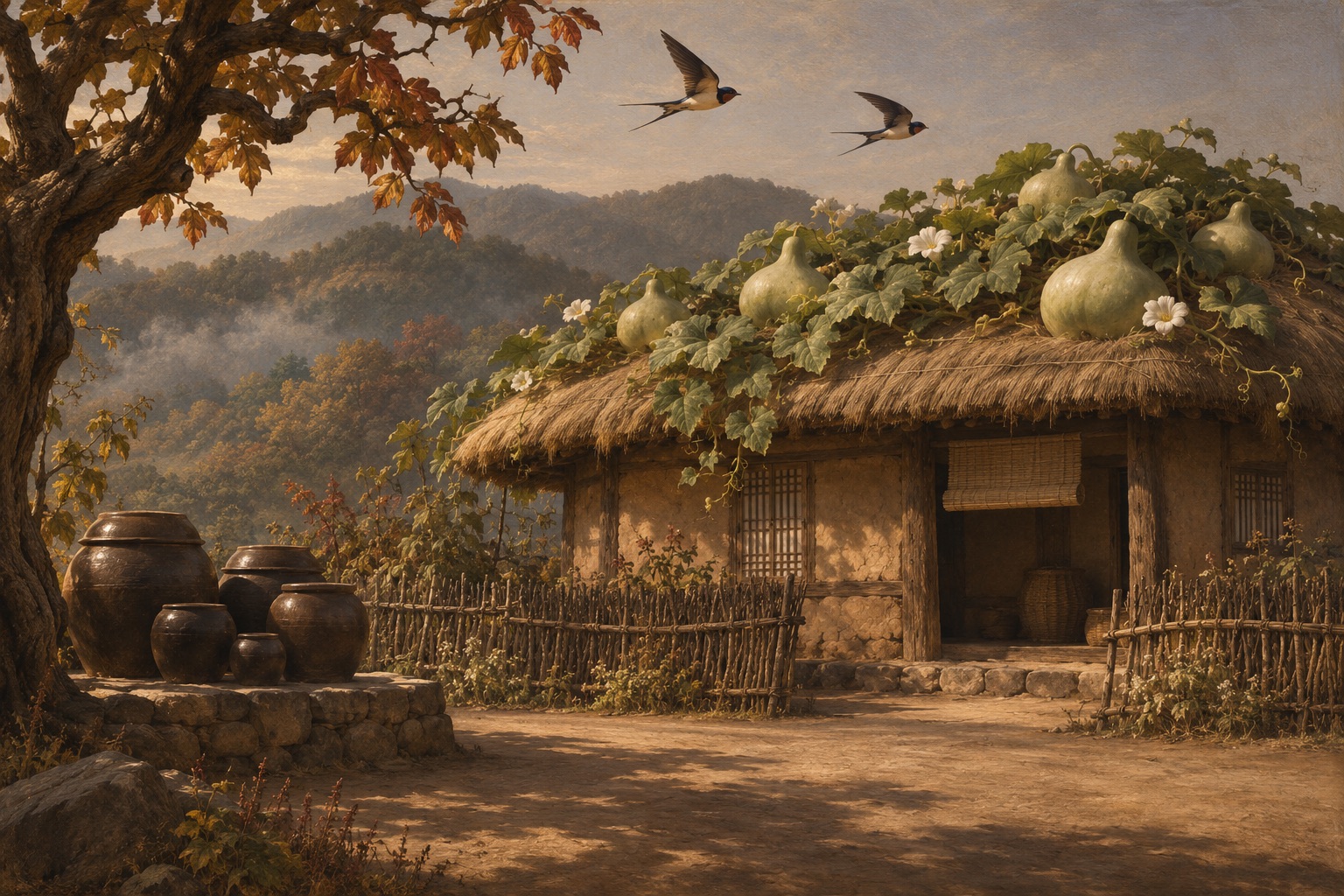
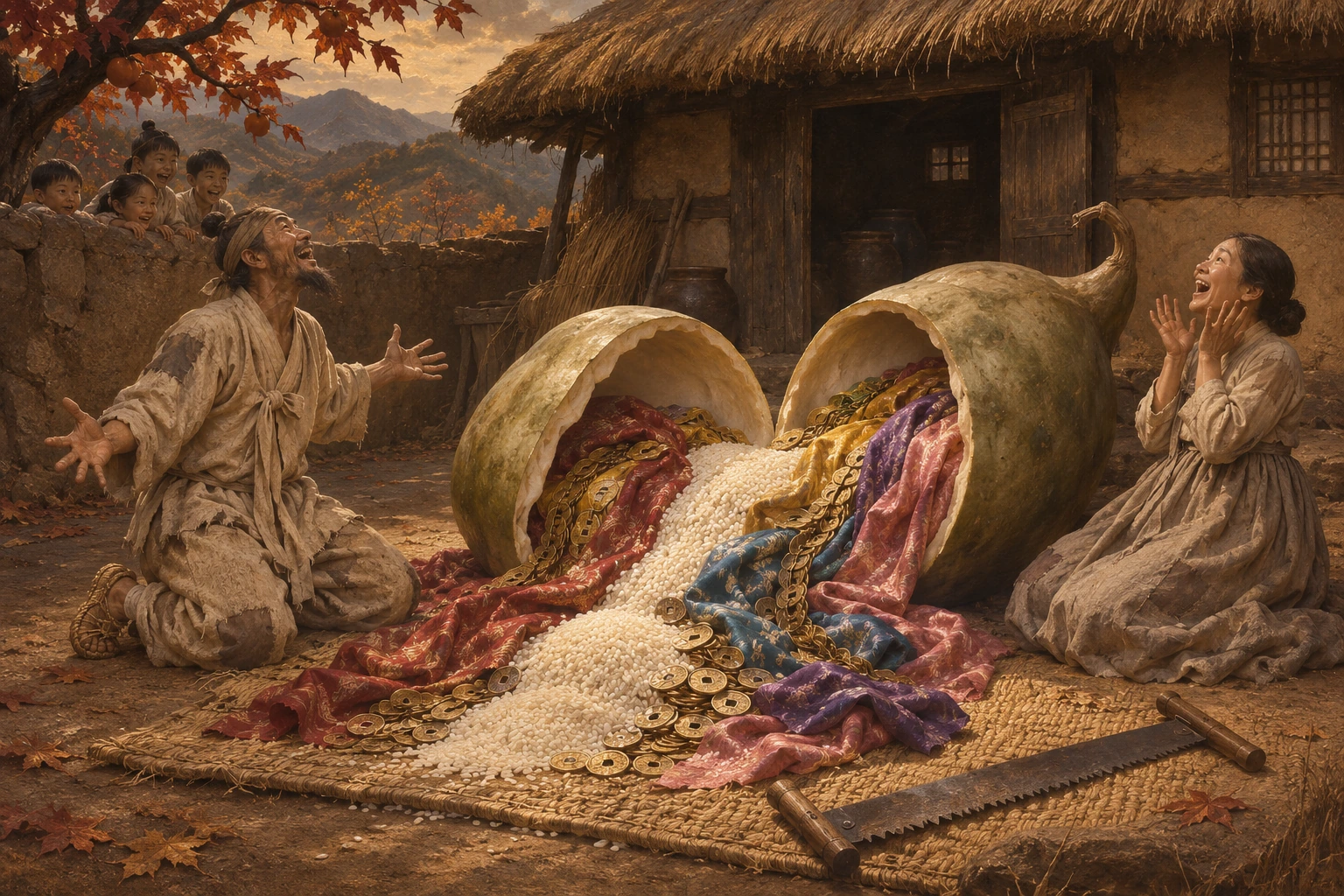
Heungbu planted the seed under the eaves, and by autumn four gourds hung there as big as boats. He and his wife sawed them open, singing seulgeun seulgeun topjil-iya, “back and forth, saw away”.
- From the first came two boys in blue with bottles of medicine: one to raise the dead, one to make the blind see, one to make the mute speak, an herb against age and a drug against death. Rice, said his wife, would do them more good.
- The second was full of household goods: chests and wardrobes, bedding, books, pots and bowls.
- From the third came carpenters, who built a house with granaries and stables, and grain and silks and servants to fill it.
- The fourth, a small one, his wife begged him not to open. Out stepped a beautiful woman who said she was Yang Guifei, sent by the Emperor of Gangnam to be his concubine. Heungbu was delighted, and his wife sulked.
1-4 Nolbu’s Swallow
Nolbu came to call and accused his brother of thieving by night. Heungbu told him everything. Nolbu demanded the flower-painted wardrobe (hwachojang) and carried it home on his back, repeating its name so as not to forget it, and forgot it jumping a stream.
From the depths of winter he waited for swallows. He went out with a net and mistook a crow for one, and he built nests all round his house. At last one swallow nested there, and one egg hatched. No snake came. So Nolbu took the chick in his own hands, snapped both its legs, cried “poor swallow!” and bound them up. On the ninth day of the ninth month the bird flew, limping, to Gangnam. The emperor, told what had happened, called Nolbu a man rich in fields who did not know his own brother, and sent back a seed carved bo-su-pyo (報讐瓢), “gourd that repays a wrong”.
1-5 Nolbu’s Gourds
More than ten gourds grew. Nolbu hired a sawyer at ten nyang a gourd. A troupe of zither players came out and wanted paying; then crowds of monks collecting alms; then a mourner who announced that Nolbu’s master was dead; then shamans from all eight provinces, who performed a gut in his yard and charged him five thousand nyang. A thousand noblemen produced papers showing his family had been their slaves for three generations, and he bought his freedom. Wandering entertainers took his land deeds, rowdies beat him, and blind men chanted sutras at him for a fee.
Then a voice thundered from inside a gourd: “I am Zhang Fei, General of Chariots and Cavalry, younger brother of Liu Xuande.” Heaven had sent him to kill Nolbu, he said, but a life like his was not worth taking. He made Nolbu pummel his legs and climb up to tread on his back until Nolbu slipped and fell on his face, and then went off, saying he forgave him.
1-6 The Ending
The sawyer slipped away. One gourd held nothing but pulp, and the soup Nolbu made from it tasted like nothing he had ever eaten. The last, a yellow one on the roof, burst in a storm of wind, and filth of every kind poured out until it was piled over the house. Nolbu beat his breast: had he known, he would have brought out a gourd bowl to beg with. And, the print ends, “the shameless fellow led his wife and children off to find Heungbu.”
The woodblock stops there. The other texts go on:
- The 1833 copy. Ruined and homeless, Nolbo goes out to beg. Heungbo hears of it, takes the couple into a room of his house and shares his food and clothes with them, “and Nolbo and his wife were grateful”. Heungbo passes the military examination and becomes the founder of the Deoksu Jang clan.
- Sin Jae-hyo. Zhang Fei spares Nolbo on condition that he reform, and promises to keep watch on him. Nolbo goes to Heungbo, who comforts him and gives him half of everything he owns, “the elder kind, the younger respectful”.
2 Where the Story Is Written Down
- The Heungbo manborok, a manuscript copy in the collection of Song Jun-ho, dated to about 1833. The Encyclopedia of Korean Culture calls it the oldest known version. It sets the story in the western village of Pyongyang.
- Song Man-jae’s Gwanuhui (“Watching the Players”), fifty poems he wrote when his son passed the state examination in 1843, because he could not afford to hire players for the celebration. Poems 9 to 20 describe the twelve pansori of his day, Heungbo-ga among them. Yi Yu-won’s Gwangeuk pallyeong also names it.
- The Seoul woodblock prints of the novel, Heungbu-jeon (興夫傳), in 25 leaves and in 20; the 20-leaf print was made from the 25. The copy in the Jangseogak library is a later printing and gives no date. The encyclopedia counts about 120 versions in all, in manuscript, woodblock and movable type, one of them in Classical Chinese.
- Sin Jae-hyo (1812–1884), a local official of Gochang and patron of singers, rewrote the pansori as Bak taryeong, “The Song of the Gourds”, probably in the 1870s. The encyclopedia calls it the most original version.
- The pansori. The encyclopedia names three lines handed down: Song Man-gap’s, kept by Park Rok-ju and Park Bong-sul, Kim Chang-hwan’s and Kim Yeon-su’s. The best-known passages include the swallow’s itinerary (jebi nojeonggi), the sawing of the gourds and the forgotten wardrobe.
3 Competing Versions
- Who are they? The woodblock gives no surname. Sin Jae-hyo makes them brothers named Bak; one printed edition, sons of a gentleman named Yeon. The 1833 copy names their father Jang Cheon, a poor man of Pyongyang.
- Why are they apart? In the woodblock and in Sin Jae-hyo, Nolbu keeps the inheritance. In the 1833 copy there is none. The poor parents have married both sons into rich households as live-in sons-in-law; Heungbo comes home with his wife to feed his starving parents, while Nolbo stays with his in-laws and never visits.
- The beating. Nolbu uses a club in the woodblock; in Park Rok-ju’s text his wife adds the rice paddle. Each time Heungbu covers for his brother: in the woodblock he says Nolbu was away in Seoul, in Sin Jae-hyo that robbers jumped him on the road.
- The swallow. The woodblock and Sin Jae-hyo have the snake in the nest. In the 1833 copy Heungbo finds the bird lame by the roadside on his way home with firewood.
- The seeds. In Sin Jae-hyo, Nolbo’s wife reads the second seed as “repay, enemy, wind” and begs him to throw it away. In the 1833 copy Nolbo, in his hurry, reads only the first character, and plants a seed of revenge believing it a seed of kindness.
- What comes out. Twelve gourds each in the 1833 copy. For Heungbo: silver, gold, coin, a tiled house of eighty-nine bays with “Heungbo’s house” on its signboard, servants and a concubine. For Nolbo: a nobleman who claims him as a slave, robbers, troupes of entertainers, bands of ghosts and others, and shamans. In Sin Jae-hyo, Zhang Fei arrives at the head of an army.
4 History and Tradition
- A Silla tale in a Chinese book. The Encyclopedia of Korean Culture says the tale of Bang-i is known as the source tale of the Heungbu-jeon. Duan Chengshi wrote it down in the 9th century in his Youyang zazu, as a story from Silla. Bang-i, the poor elder brother, is given seed that his rich younger brother has steamed so it cannot grow. One stalk grows all the same; a bird carries off its ear, and Bang-i, following it into the mountains, finds children in red who conjure food and wine by striking a rock with a golden awl. He takes the awl and grows rich. The younger brother copies him, and the spirits he meets pull his nose out as long as an elephant’s; he dies of shame. The good and the bad brother are the other way round, the encyclopedia notes, but the copying is the same.
- Where it came from. The encyclopedia’s article on the novel, by Heo Won-gi, sums up four answers: a native tale, a mix of native and foreign tales, a Mongolian tale, or a Buddhist one. A Mongolian tale, “The Girl Who Sawed a Gourd”, has long been named as the closest. Heo himself sees three old patterns joined: the good and bad brothers, the grateful animal, and the treasure that never runs out.
- The sparrow’s gratitude. The Japanese collection Uji shūi monogatari (about 1220) has, in book 3, a tale of a sparrow’s gratitude. An old woman nurses a sparrow with a broken back that a crow would have killed, and it brings her a gourd seed; the gourds are full of rice that never runs out. Her envious neighbour stones sparrows until she has broken the backs of three, and from her gourds come horseflies, bees, centipedes, lizards and snakes, which sting her children and sting her to death. Tanaka Akira, in the Nipponica encyclopedia, calls Heungbu-jeon “a story similar to the Japanese Tongue-Cut Sparrow”. In the Edo period Kyokutei Bakin and Kurosawa Okinamaro took the Uji shūi tale for the source of that Japanese tale.
- A picture of its age. The encyclopedia reports readings of Nolbu as one of the newly rich commoners of the late Joseon money economy, and of Heungbu as a poor farmer who could not even find land to rent. Its entry on Bang-i adds that some see the bad elder brother as a sign of the late Joseon inheritance rules, which favoured the eldest son.
- Heritage. Pansori was designated an Important Intangible Cultural Property of Korea in 1964, and was inscribed by UNESCO in 2003; the encyclopedia names Gang Do-geun and Park Rok-ju as the first holders for Heungbo-ga. A Japanese translation of Sin Jae-hyo’s texts by Kang Han-yeong and Tanaka Akira, Pansori, came out in Heibonsha’s Tōyō Bunko series in 1982.
- Namwon. In 1992 a study by Kyung Hee University’s folklore institute placed Heungbu’s birthplace in Inwol-myeon in Namwon and the place he grew rich in nearby Ayeong-myeon. Since 1993 Namwon has held a Heungbu festival, now every year on the ninth day of the ninth lunar month.
The tale is often told as ending with Nolbu ruined, and that is how the Encyclopedia of Korean Culture’s article on the pansori sums it up. The texts go one step further. The oldest copy, from about 1833, ends with Heungbu taking his destitute brother into his house, and Sin Jae-hyo’s libretto with Heungbu giving Nolbu half of all he owns. Even the Seoul woodblock, which stops soonest, leaves Nolbu on the road to his brother’s door.
5 Related Stories
- Dokkaebi: The Goblins of Korea: the goblins of Korean folk tales. In the spoken versions of the Bang-i tale, the encyclopedia notes, the poor brother gets his treasure club by frightening goblins with the crack of a hazelnut, as in the dokkaebi’s own club tale.
- Tấm and Cám: The Girl Who Came Back: a Vietnamese folk tale of two siblings, one persecuted and one favoured. The same chapter of Duan Chengshi’s Youyang zazu that holds Ye Xian, the oldest Cinderella, also holds the Silla tale of Bang-i.
- Mai An Tiêm: The Watermelon Island: a bird brings seeds to a man in need, and the fruit makes his fortune. We have not found a scholar who compares the two; we link them for the theme.
6 Sources
- Heungbu-jeon, Seoul woodblock print in 25 leaves, undated, Jangseogak copy (later printing): Korean Wikisource, Digital Jangseogak
- Heungbo manborok, manuscript copied about 1833, Song Jun-ho collection: Korean Wikisource
- Sin Jae-hyo, Heungbo-ga (Bak taryeong), modern transcription: Korean Wikisource
- Heungbo-ga, Dongpyeonje line of Park Rok-ju (published 1981): Korean Wikisource
- Duan Chengshi, Youyang zazu, sequel, book 1, the tale of Bang-i: Wikisource (Classical Chinese)
- Uji shūi monogatari, book 3, the sparrow’s gratitude, ed. Fujii Otoo (Tokyo, 1915): archive.org
- Encyclopedia of Korean Culture: 흥부전, 흥보가, 박타령, 방이 설화, 관우희, 송만재, 신재효, 판소리
- “興夫伝” (Heibonsha World Encyclopedia, Ōtani Morishige; Nipponica, Tanaka Akira), “舌切雀” (Heibonsha World Encyclopedia, Nomura Keiko) and “宇治拾遺物語” (Heibonsha World Encyclopedia, Konno Tōru): Kotobank, Kotobank, Kotobank
- Sin Jae-hyo, Pansori, trans. Kang Han-yeong and Tanaka Akira (Heibonsha, 1982): CiNii
- “흥부제”, Digital Namwon Culture Encyclopedia: grandculture.net
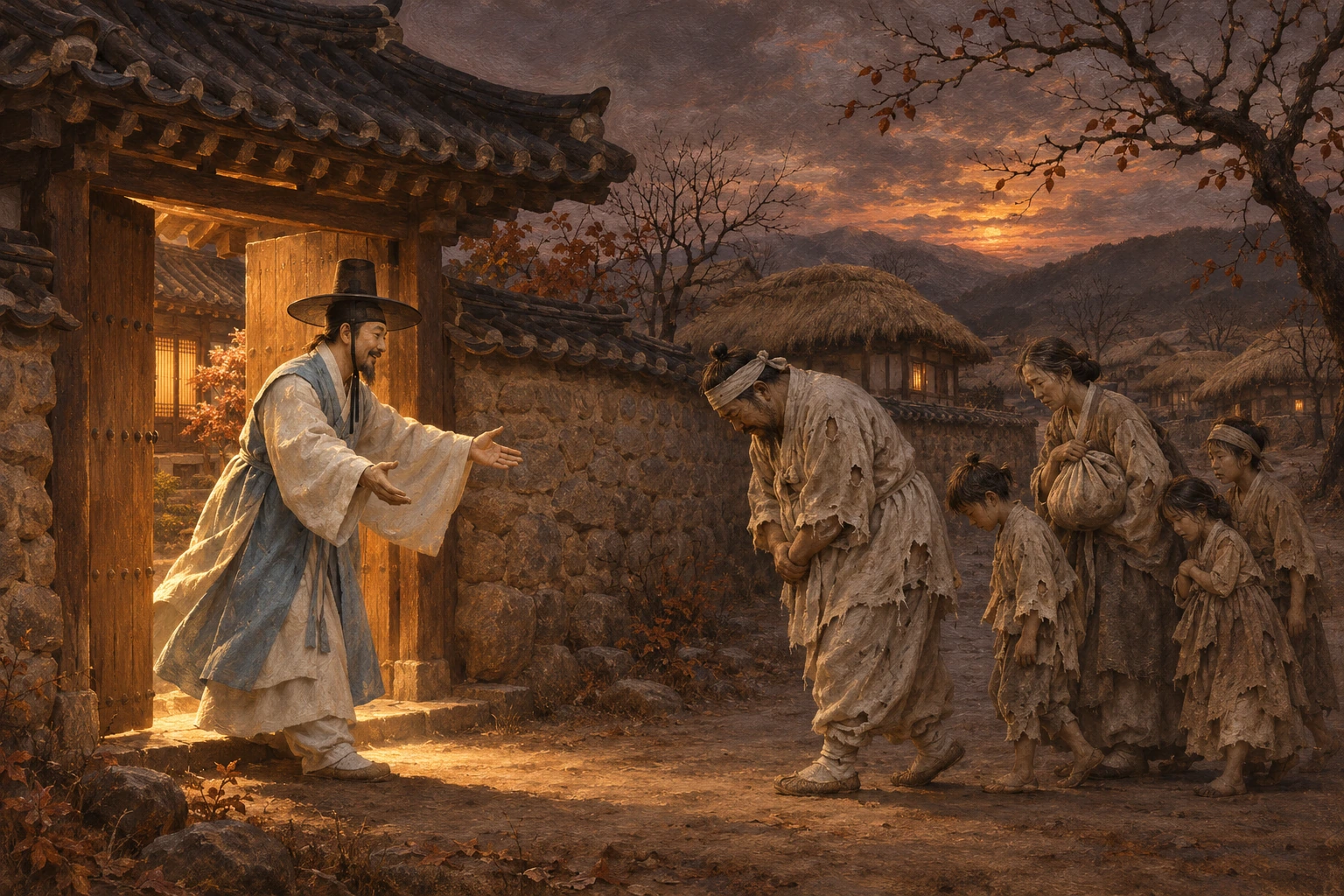
Cover and illustrations: AI-generated images made for Arcana. They are interpretations, not historical artworks.