Suro and Heo Hwang-ok: The Founder of Gaya and the Queen from Ayuta
A voice on a hilltop told nine chiefs to sing to a turtle, and six golden eggs came down from the sky. The first boy out founded Gaya, and his queen sailed in under a red sail from a land called Ayuta.
- Type: founding myth
- Culture: Gaya, a league of small kingdoms in the south-east of the Korean peninsula; its kingdom of Garak, or Geumgwan Gaya, stood at today’s Gimhae (42 CE by tradition, to 532)
- Earliest text: the Garak-guk gi (駕洛國記, “Record of Garak”), written in 1076 and lost; it survives only as the monk Iryeon abridged it in book 2 of the Samguk yusa (1280s)
- Key figures: Suro (首露), first king of Garak; his queen Heo Hwang-ok (許黃玉); the nine chiefs (九干); Seok Talhae (昔脫解)
Every spring and autumn, at a royal tomb in Gimhae, in the south-east of Korea, the descendants of a king who came down from the sky in a golden egg honour him and the queen who sailed to him across the sea. Their story comes from a single book, written a thousand years after the events it tells and known today only in abridgment.
Was Suro a Kim? The Garak-guk gi calls him only Suro. Under the reign of his son, a note quotes another book, the Gaehwang-nyeok: the royal house took the surname Kim, “gold”, “because the founder of the country was born from a golden egg”. The Gimhae Kim, one of Korea’s largest clans, count him as their first ancestor.
1 The Telling
This is the Garak-guk gi as Iryeon gives it in book 2 of the Samguk yusa. A note under its title says it was written in the Taikang years of King Munjong of Goryeo by a man of letters who governed Geumgwan, and that Iryeon “now abridges and includes it”.
1-1 The Voice at Gujibong
After the world was opened, the land had no name and no king. Nine chiefs, Ado-gan, Yeodo-gan, Pido-gan and six others, led the people: a hundred households, seventy-five thousand souls, who lived in the hills and fields, dug wells to drink and ploughed to eat.
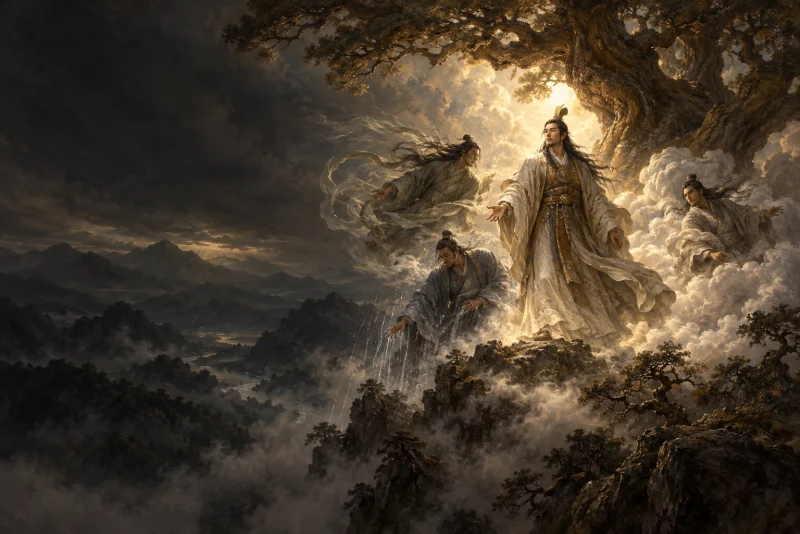
In 42 CE, in the third month, on the day of the spring purification by water, a strange voice called out from Guji, a hilltop to the north whose shape, a note says, was that of a crouching tortoise. Two or three hundred people gathered there. They heard a human voice, but saw no one.
“Is anyone here?” “We are here,” said the nine chiefs. “Where am I?” “At Guji.” “August Heaven has commanded me to rule this place, to make the country new and be its lord. That is why I have come down. Dig the earth at the top of the peak and sing: Turtle, turtle, put out your head. If you do not, we will roast you and eat you. Dance as you sing, and you will welcome a great king, and leap for joy.”
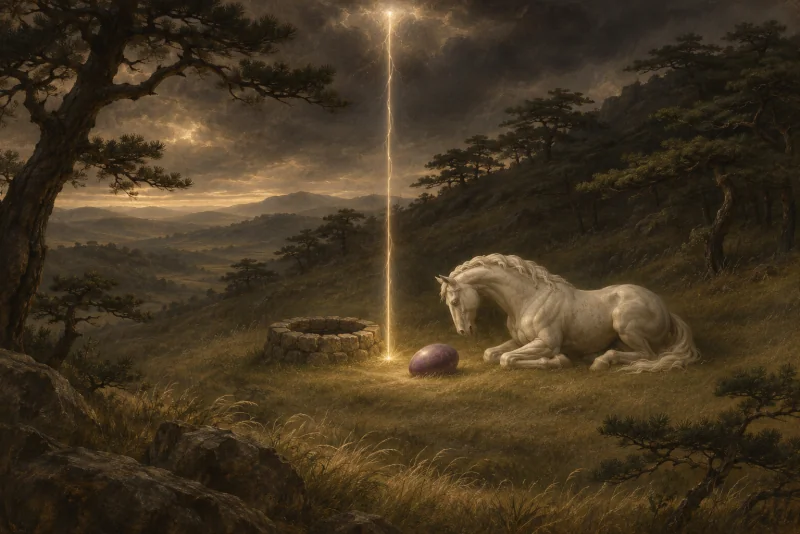
The chiefs did as the voice said. Soon they looked up and saw a purple cord hanging from the sky to the ground. At its end was a golden box wrapped in red cloth. Inside lay six golden eggs, round like the sun. Everyone bowed a hundred times. They wrapped the box again, carried it to Ado-gan’s house, set it on a couch, and went home.
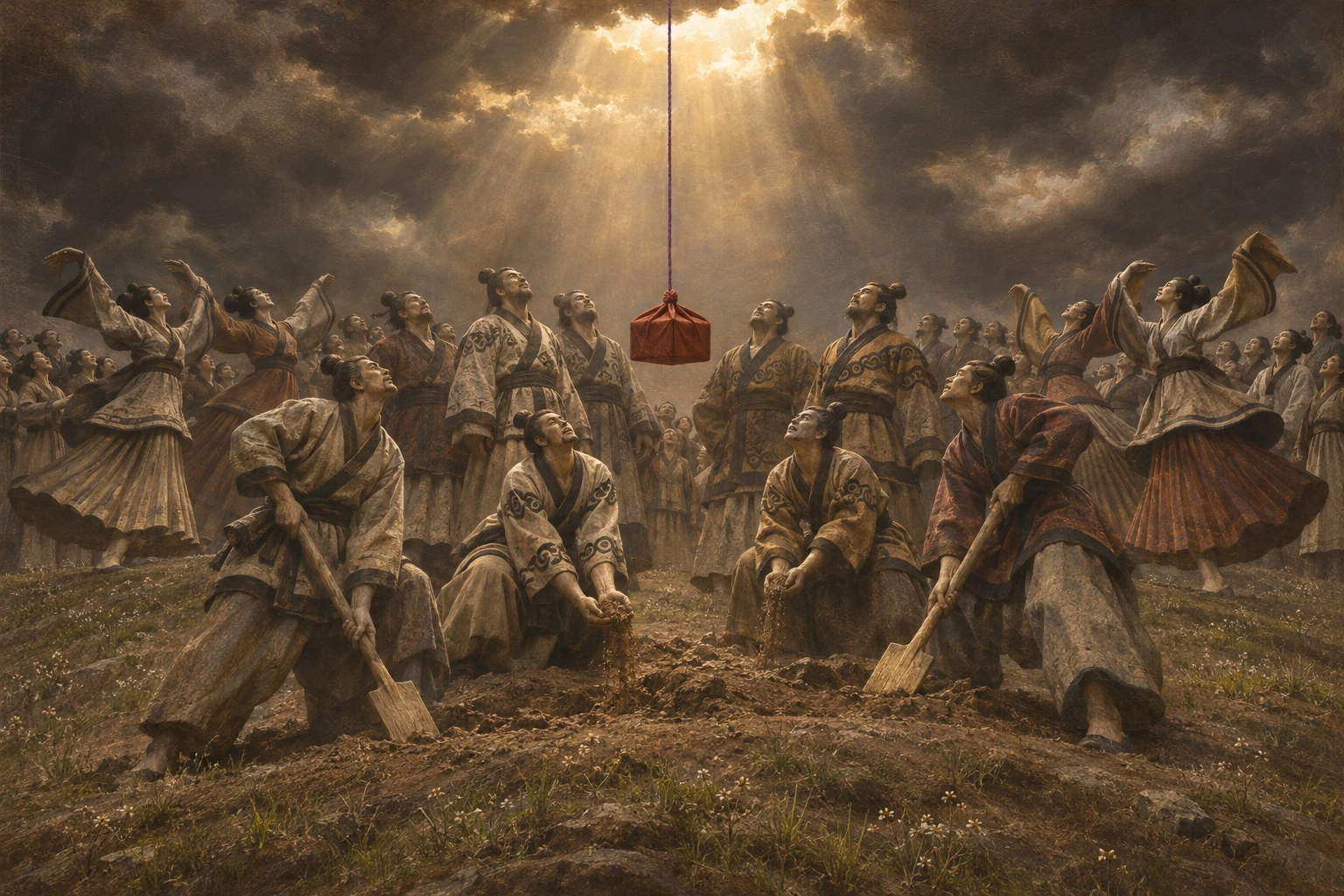
Twelve days later, at dawn, they gathered again and opened the box. The six eggs had become six boys, with splendid faces. The boys grew by the day. Within ten days or so they were nine feet tall, and the text compares the first of them to the founders and sages of China: tall as Tang of Shang, with the dragon face of the first Han emperor, the eight-coloured eyebrows of Yao and the double pupils of Shun. On the day of the full moon he took the throne. Because he “appeared first”, he was named Suro (首露). His kingdom was called Dae-Garak, or Gaya, and it was one of six Gayas: the other five boys went home to rule the other five. Suro had a temporary palace built, plain on purpose, with uncut thatch and earthen steps three feet high.
1-2 The Challenger from the Sea
In the second year he chose a site for his capital. “This land is as small as a smartweed leaf,” he said, “yet it is fine enough for the sixteen arhats to live in.” A wall of 1,500 paces went up, and the palace was finished in 44.
Then a man came from the sea. He was Talhae, born from an egg laid by the wife of King Hamdal of Wanha-guk, and he was three feet tall, with a head a foot around. He walked into the palace and told the king: “I have come to take your throne.” Suro answered that Heaven had made him king to bring peace to his people, and that he would neither defy Heaven nor hand his country to a stranger. “Then let us match our arts,” said Talhae.
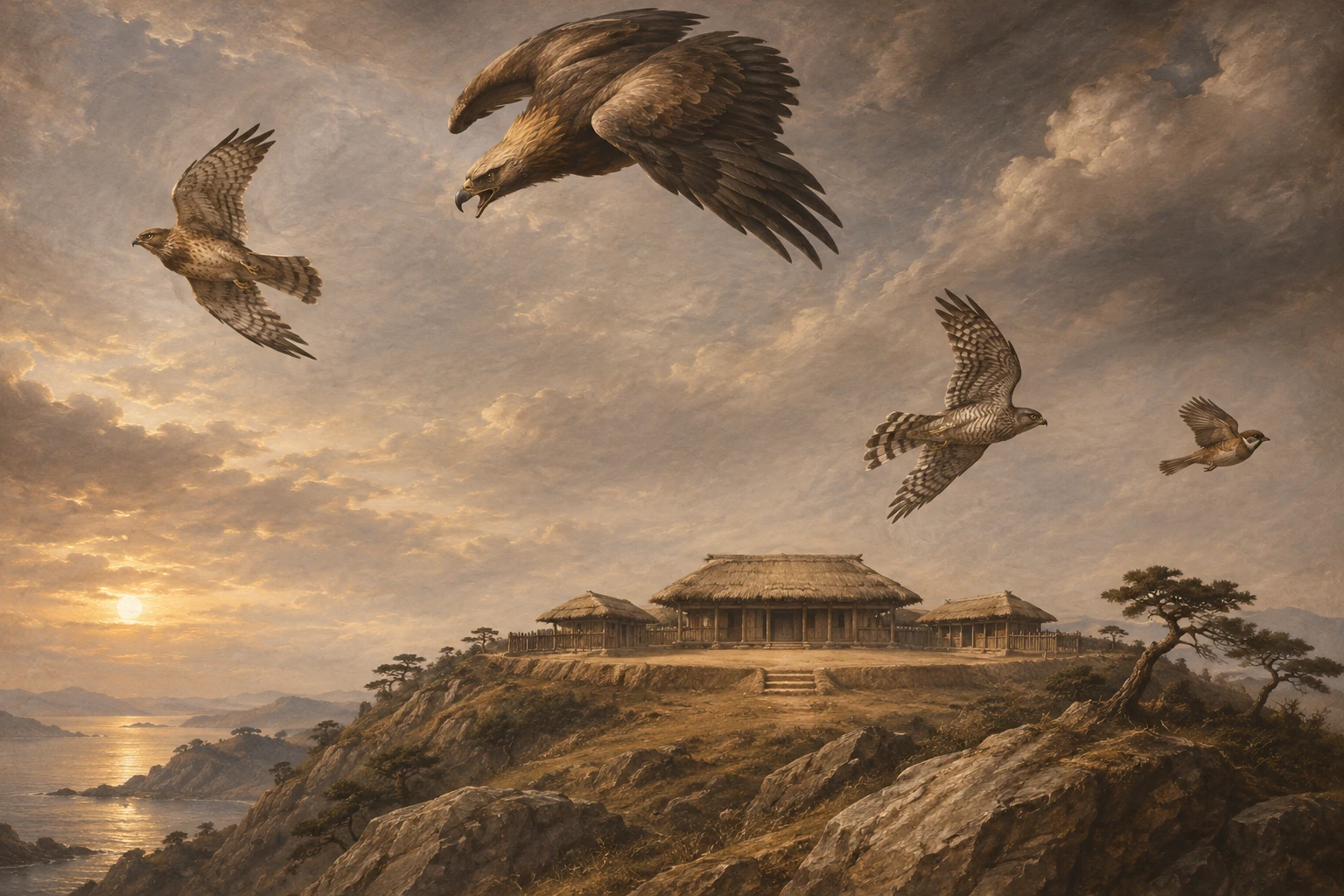
In an instant Talhae became a hawk, and the king an eagle. Talhae became a sparrow, and the king a sparrowhawk. Before a moment had passed, both were men again. Talhae bowed: “In this contest I was the hawk before the eagle, the sparrow before the sparrowhawk, and I escaped with my life. It is a sage’s mercy, that hates to kill. I cannot win your throne from you.” He left by the sea road the Chinese ships used. Suro, afraid he would stay and plot, sent five hundred ships after him, and Talhae fled into Gyerim, the land of Silla. The writer adds that Silla’s records tell this very differently.
1-3 The Red Sail
On the 27th day of the seventh month of 48, the nine chiefs begged Suro to choose a bride from among their daughters. “My coming here was Heaven’s command,” he said, “and so will my queen be. Do not worry.” He sent the chief Yucheon-gan with a light boat and a fine horse to wait on the island of Mangsan, and the chief Singwi-gan to the height of Seungjeom.
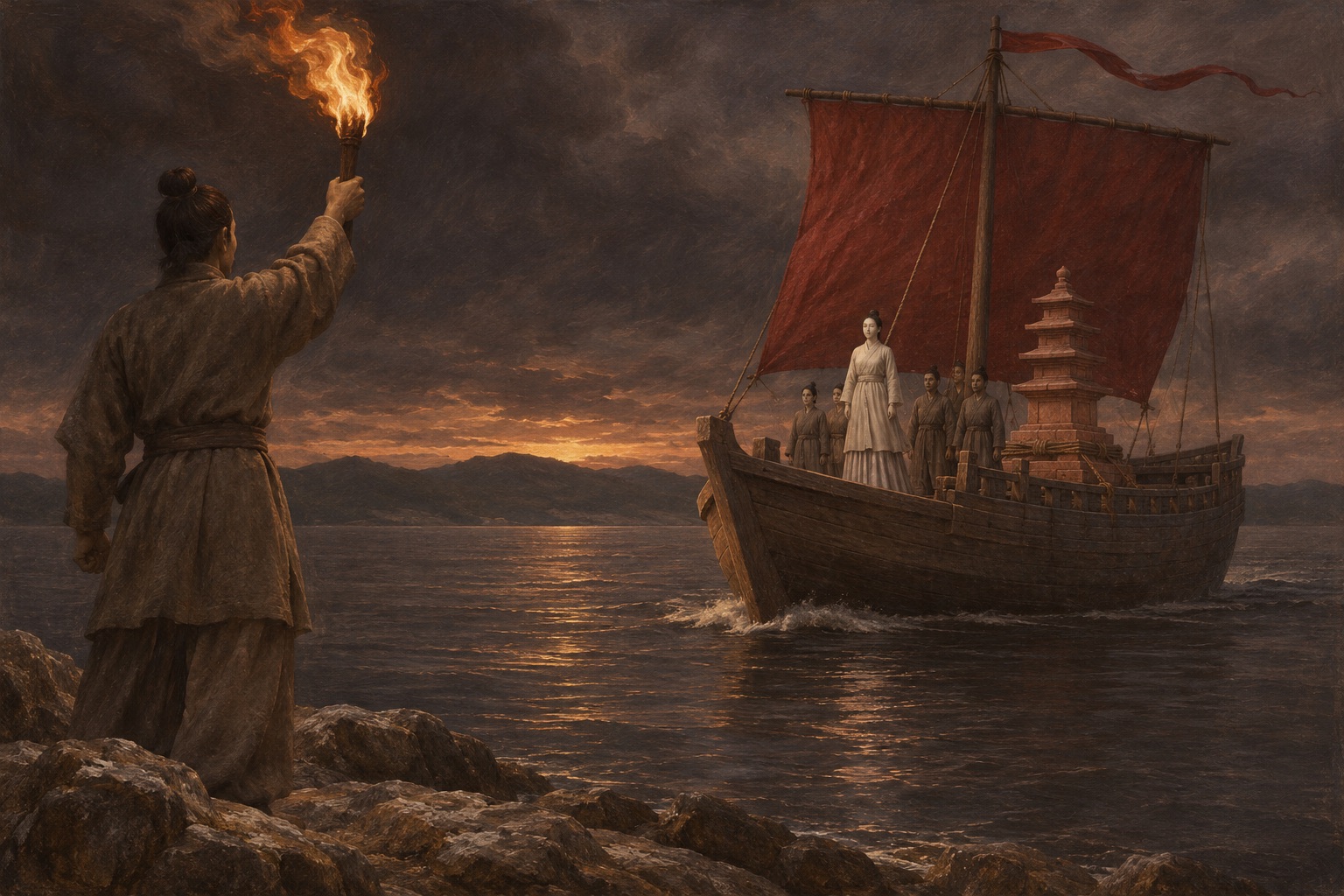
Suddenly, from the south-west of the sea, a ship with a red sail and a red flag came heading north. Yucheon-gan lit a torch on the island, and the people on the ship landed and came running. Singwi-gan ran to tell the king, who sent the nine chiefs with orchid oars and cassia paddles to bring the newcomer to the palace. She refused: “I have never met you. How could I follow you so lightly?”
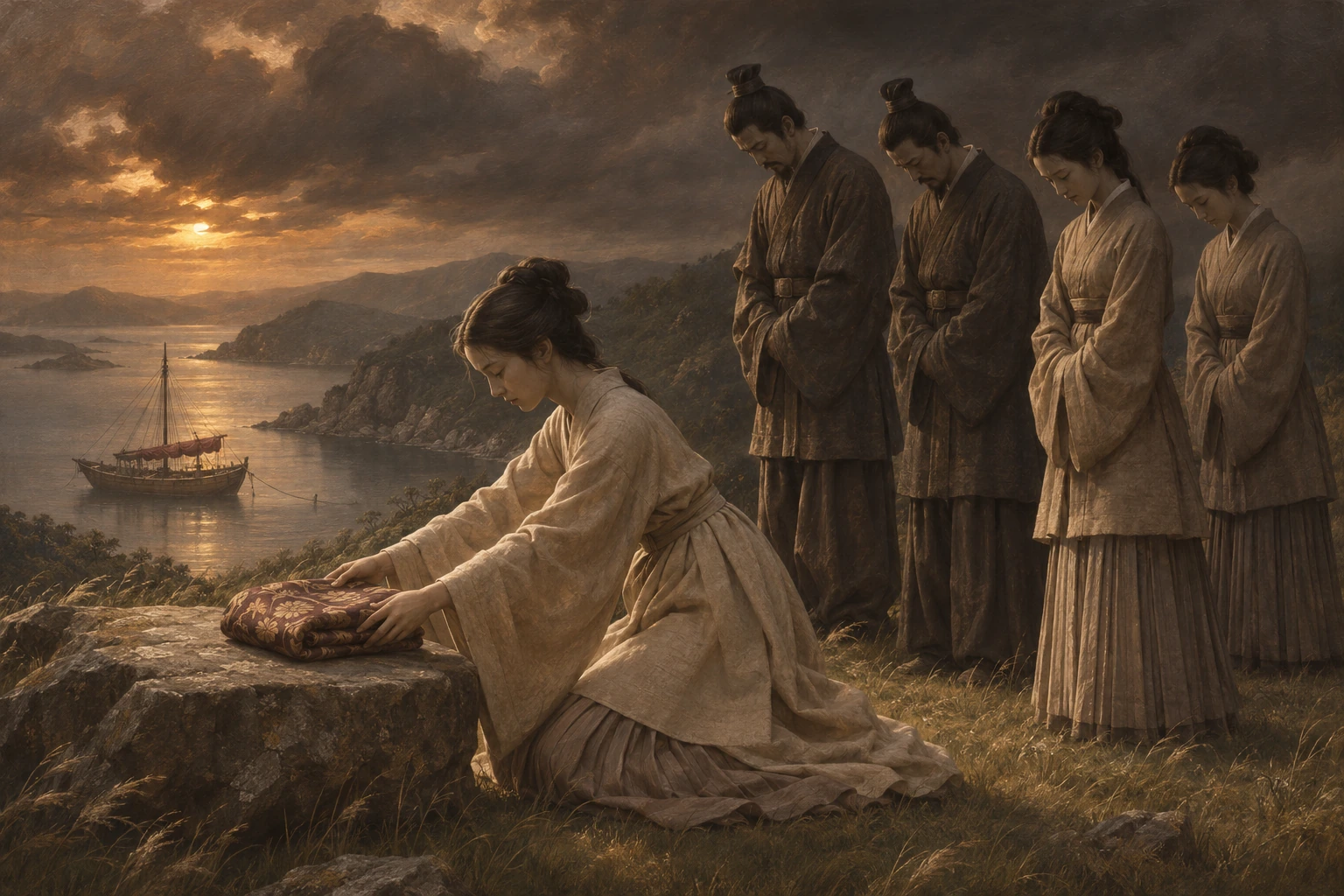
Suro agreed. He went out himself and had a curtained pavilion set up on a hillside sixty paces south-west of the palace. The ship moored at another harbour beyond the hill. She climbed a high hill to rest, took off the silk trousers she wore and gave them as an offering to the spirit of the mountain. With her came two officials, Sinbo and Jo Gwang, their wives Mojeong and Moryang, and servants, more than twenty people, and more brocade, silk, gold, silver, pearls and jade than could be counted.
1-4 The Princess of Ayuta
When they were alone, she told the king: “I am a princess of Ayuta (阿踰陀國). My surname is Heo and my name Hwang-ok, and I am sixteen. This year, in the fifth month, my father the king and my mother the queen told me that they had both seen the August Lord on High in a dream. He told them that Suro, the first king of Garak, had been sent down by Heaven, holy and divine, and had no queen yet: they must send their daughter to be his wife. Then he rose back to heaven. ‘His words are still in our ears,’ they said. ‘Leave us now and go.’” Suro answered that he had known beforehand that a princess was coming from afar, and so had refused his ministers. They spent two nights and a day together. He sent the fifteen boatmen home with ten measures of rice and thirty bolts of cloth each, and on the first day of the eighth month he brought his queen to the palace in his own carriage.
1-5 Heaven and Earth
Suro gave the chiefs new titles fit for officials, took his court ranks from Silla and the rest from Zhou and Han usage, and lived with his queen “as heaven has the earth, the sun the moon, and yang has yin”. She dreamed of bears, the omen of a son, and bore the crown prince Geodeung.
She died in 189, aged 157, and was buried on a slope north-east of Guji. The harbour where she landed was named Jupo, the hill where she offered the trousers Neunghyeon, and the shore where her red flag came in Gichulbyeon. The servants who had come with her pined for home and died one by one. Suro grieved over his lonely pillow. Ten years later, in 199, he died, aged 158, and was buried north-east of the palace in a mound one jang high and three hundred paces round.
2 Where the Story Is Written Down
- The Garak-guk gi. The text dates itself: it counts 878 years from the building of Suro’s tomb in 199 to “the second year of Taikang, the thirty-first year of the present king”, that is, 1076. Its author is not named. The Gimhae Kim clan has claimed him as Kim Yang-gam, which the Encyclopedia of Korean Culture calls uncertain; the historian Inoue Hideo names Kim Yang-il, governor of Geumju. The book is lost, and the encyclopedia calls it the only written source on Gaya’s history to survive, apart from notices in Chinese histories.
- What else Iryeon kept. A decree of 661 in which King Munmu of Silla calls Suro his ancestor in the fifteenth generation, through his mother, and gives land for his shrine; tales of the tomb’s guardians, a portrait that wept blood and a serpent more than thirty feet long; the line of kings down to the last, Guhyeong; and a yearly game on the 29th of the seventh month, when men raced on horseback and by boat to the old harbour, “the trace of Yucheon and Singwi hurrying to tell the king that the queen had come”.
- Book 1, “Five Gaya”. Iryeon quotes the record’s closing verse, “it let down a purple cord and six round eggs: five went to their towns, one stayed in this city”, and names the five.
- The Samguk sagi (1145) has no founding story. The life of the general Kim Yu-sin (book 41) says only that his ancestor in the twelfth generation, Suro, “came from no one knows where”, climbed Gubong in 42, looked out over the nine villages of Garak and founded Gaya there. In book 1, in 102, King Pasa of Silla sends for “Suro of Geumgwan, old and wise” to settle a border quarrel; slighted at the banquet that follows, Suro has his slave kill the chief of one of Silla’s six divisions.
- The Gujiga. The song to the turtle survives only in this four-line Chinese version. The Encyclopedia of Korean Culture lists many readings of it: a spell, a song to welcome a god, a song for a turtle divination, a rain charm. A song in book 2 of the Samguk yusa, sung in the 8th century to make a sea dragon give back the abducted Lady Suro, threatens the turtle in the same way: “If you do not give her up, we will catch you in a net, roast you and eat you.”
3 Competing Versions
- Talhae, two ways. In the Garak-guk gi Talhae loses a duel of shapes. In his own chapter in book 1 of the Samguk yusa, his ship first reaches Garak, where Suro and his people beat drums and shout to welcome it and try to keep it, but it sails away to Silla, where he will become its fourth king.
- Born of a mountain goddess. Choe Chiwon’s lost life of the monk Ijeong, as the gazetteer Sinjeung Dongguk yeoji seungnam (1530) quotes it, says that Jeonggyeon Moju, the goddess of Mount Gaya, was moved by the heavenly god Ibiga and bore two sons: Noejil Juil, king of Dae-Gaya at Goryeong, and Noejil Cheongye, king of Geumgwan, that is, Suro. The Encyclopedia of Korean Culture notes that this version is in neither the Samguk sagi nor the Samguk yusa, and that it is unclear whether it goes back to Gaya itself or was made after its fall.
- When did Gaya fall? The Garak-guk gi says 562, the Samguk sagi 532. Iryeon works out the difference, thirty years, and “keeps both”. Historians now date the surrender of Geumgwan to 532, and the fall of Dae-Gaya, the last of the league, to 562.
- How many sons? The Garak-guk gi names one, Geodeung. “Ten sons, two of whom took their mother’s surname” comes from the inscription that the scholar Heo Mok wrote for the back of the queen’s tombstone in the 1640s; their descendants, he says, became the Gongam and Hayang Heo clans.
4 History and Tradition
- Gaya was real. In the 3rd century the small state of Guya, at Gimhae, led the twelve small states that Chinese histories call Byeonhan, which traded their iron with the Chinese commanderies and the Wa of Japan. The Encyclopedia of Korean Culture calls the Suro myth the political ideology that proclaimed the state at Gimhae. Its article on Suro adds that some scholars read the golden descent as newcomers from the north joining the people of the Nakdong estuary, and the first of six eggs as Garak’s claim to lead the others. After the surrender, Gaya’s royal house lived on in Silla: Inoue Hideo notes that the general Kim Yu-sin and King Munmu’s mother came from it.
- A rite in words. The folklorist Kim Yeol-gyu reads the scene at Gujibong as a rite of welcoming a god: a voice from heaven speaks like a shaman’s oracle, and the people dance and sing to bring the god down. Inoue writes that in the 11th century the descent and the queen’s voyage were the rites of the town of Gimhae.
- The pagoda. The Garak-guk gi has no pagoda. Book 3 says the princess was first driven back by the anger of the sea god, until her father had her take a stone pagoda aboard. Iryeon describes it at the temple of Hogye-sa: five storeys, strangely carved, of a soft stone with faint red spots, “not of this land”. He adds that in Suro’s time “there was as yet no building of temples or honouring of the Dharma” in Korea; the first temples at Gimhae were built in 452, among them Wanghu-sa, where the king and queen had married. A magistrate of Gimhae later moved the stones to her tomb, where they stand today.
- The tombs. Suro’s tomb, Napneung, is a round mound about five metres high; the queen’s lies on a hill near Guji. Both were rebuilt in 1580 and became Historic Sites in 1963. Her stone of 1647 calls her “Queen Dowager Boju, of the Heo clan, consort of King Suro of Garak”. The shrine at the tomb took the name Sungseonjeon in 1878. Its rites were once held on the 3rd and 7th of the first month, the 5th of the fifth and the 5th and 15th of the eighth, the very days the Garak-guk gi lists; they are now held on the 15th of the third and ninth lunar months. The Gimhae Kim and the Heo attend together, and the rite has been an intangible cultural heritage of South Gyeongsang Province since 1990.
- One family. The Gimhae Kim, the Gimhae and Yangcheon Heo and the Inju Yi all count Suro and Heo Hwang-ok as ancestors, and by custom they did not marry one another. By Statistics Korea figures reported in 2008, the Gimhae Kim alone made up nearly a tenth of South Koreans.
- Where was Ayuta?
- The text. The Garak-guk gi says only Ayuta; book 3 says “Ayuta in the Western Regions”. In Chinese Buddhist writing Ayodhyā has almost the same name: the 7th-century pilgrim Xuanzang describes 阿逾陁國 as a land of over a hundred monasteries, where the masters Asaṅga and Vasubandhu taught.
- The theory. The children’s writer Lee Jong-gi first tied Ayuta publicly to the city of Ayodhya, in today’s Uttar Pradesh, after a visit in 1977 where he saw twin fish carved on its buildings. The archaeologist Kim Byeong-mo of Hanyang University, a Gimhae Kim, had been struck by the twin fish painted on the gate of Suro’s tomb since 1961. He traced the motif to a belief in sacred fish that began in Mesopotamia and spread through India and China, and his research tied the queen’s title, Boju, to a Heo clan shrine in Anyue, Sichuan, where her people are supposed to have stopped on the way. He set it out in Heo Hwang-ok Route: From India to Gaya (2008). In 2001 the joint clan association of the Kim and Heo set up a memorial stone in Ayodhya.
- The critics. For the archaeologist Kim Jeong-hak, the Indian Ayuta is an embellishment made after Buddhism reached Korea: the first tale probably had a queen who simply came from far across the sea. The historian Lee Yong-hyeon writes that Gaya before the 5th century could not have known the name, and that it was added because of its Buddhist fame, probably in Silla’s middle period. Kim Dae-sik points out that the title “Boju”, first recorded in 1469, and the twin fish, painted on the gate under King Jeongjo in the late 18th century, are both later than the Garak-guk gi, and cannot prove it. Buddhism itself is first recorded in Korea in 372, in Goguryeo.
Heo Hwang-ok is often called a princess of Ayodhya, in India, and is sometimes given the name Suriratna. The Samguk yusa calls her Heo Hwang-ok of Ayuta, in the “Western Regions”, and says no more. The link with the Indian city was first drawn publicly in 1977.
5 Related Stories
- Bak Hyeokgeose: The Egg-Born Founder of Silla: Silla’s own founder came from an egg beside which a white horse knelt, and Talhae, who lost his duel with Suro, became Silla’s fourth king. The Encyclopedia of Korean Culture compares the two myths: in both, the founder comes down from heaven to be the one lord of a league of clans that had no king.
- Jumong: The Archer Born from an Egg: the egg-born founder of Goguryeo. The Encyclopedia of Korean Culture places the Suro myth in the same family of “descent from heaven, birth from an egg” founding myths of the early Korean states.
- Amaterasu and the Rock Cave: The Day the Sun Hid: the sun goddess later sends her grandson Ninigi down from heaven to rule the land, with the mirror that drew her out of the cave. Inoue Hideo writes that the Gaya founding myth “is seen as the prototype” of that Japanese descent of the heavenly grandson.
- Lạc Long Quân and Âu Cơ: The Dragon, the Fairy and the Hundred Eggs: another founding myth in which a set of eggs brings forth brothers, one of whom becomes the first king. We have not found a scholar who compares the two; we link them for the theme.
6 Sources
- Iryeon, Samguk yusa, book 2, “Garak-guk gi”, unscanned transcription that names no edition (no scan of the 1512 print of book 2 is on Wikisource): Chinese Wikisource; punctuated text: Korean Wikisource
- Iryeon, Samguk yusa, book 1, “Five Gaya”, 1512 Gyujanggak print, with Korean translation: Korean Wikisource; “King Talhae”, 1512 Gyujanggak print: Chinese Wikisource
- Iryeon, Samguk yusa, book 3, “The Pasa stone pagoda of Geumgwan” and “Sundo brings Buddhism to Goguryeo”, unscanned transcription that names no edition: Chinese Wikisource
- Kim Busik, Samguk sagi, book 1, King Pasa, year 23, Oksan Seowon print, with Korean translation: Korean Wikisource; book 41, “Kim Yu-sin”: Chinese Wikisource
- Xuanzang, Records of the Western Regions, book 5, “Ayodhyā”: Chinese Wikisource
- Encyclopedia of Korean Culture: 가락국기, 김수로왕 신화, 수로왕, 허황옥, 구지가, 가야, 정견모주, 파사석탑, 김해 호계사, 김해 수로왕릉, 수로왕비릉, 김해 숭선전제례, 동성동본불혼
- Inoue Hideo, “駕洛国記” and “金海加羅”, Heibonsha World Encyclopedia: Kotobank, Kotobank
- Kim Jeong-seon, “김해 숭선전 벽화 연구”, Hangukhak yeongu 74 (2024), quoting Heo Mok’s inscription: Inha University
- Kim Dae-sik, “가락국기와 허황옥”, Pressian, 14 September 2005: pressian.com
- Seo Dong-cheol, “김해 김수로왕릉의 쌍어문”, Seoul Shinmun, 27 March 2008, on Lee Jong-gi and Kim Byeong-mo: seoul.co.kr
- Choe Chong-dae, “Legacy of Queen Suriratna”, The Korea Times, 7 December 2016: koreatimes.co.kr
Cover and illustrations: AI-generated images made for Arcana. They are interpretations, not historical artworks.