Amaterasu and the Rock Cave: The Day the Sun Hid
The sun goddess shut herself in a cave and the world went dark, until the gods hung a mirror on a tree and a goddess danced on an upturned tub so wildly that heaven shook with laughter. Japan's two oldest books do not agree on why she hid, or on what brought her out.
- Type: myth, the sun goddess hides and is drawn out again
- Culture: Japan, the Yamato court
- Earliest texts: Kojiki (712) and Nihon Shoki (720); retold in the Kogoshūi (807)
- Key figures: Amaterasu, Susanoo, Omoikane, Ame-no-Uzume, Ame-no-Tajikarao, Ame-no-Koyane, Futotama
The straw ropes hung at Shinto shrines have a famous first appearance. When the sun goddess was at last coaxed out of the cave where she had hidden, a god stretched a rope of straw behind her and told her she could not go back in. The rope ends the story. Before it come a brother’s rampage, an endless night, and eight hundred myriad gods laughing at once.
Did Amaterasu come out because she saw herself in the mirror? Only in the Kojiki, and even there the text never says she saw her own face. Ame-no-Uzume tells her that a deity “more illustrious” than she has come, two gods push the mirror towards her, and she steps out “more and more astonished” to gaze at it. In the main text of the Nihon Shoki the mirror just hangs on the tree, and what makes her peep out is Ame-no-Uzume’s merrymaking.
1 The Telling
This is the version of the Kojiki, completed in 712. Quotations are from Basil Hall Chamberlain’s English translation of 1882. Section 3 sets the Nihon Shoki beside it.
1-1 The Sister and the Brother
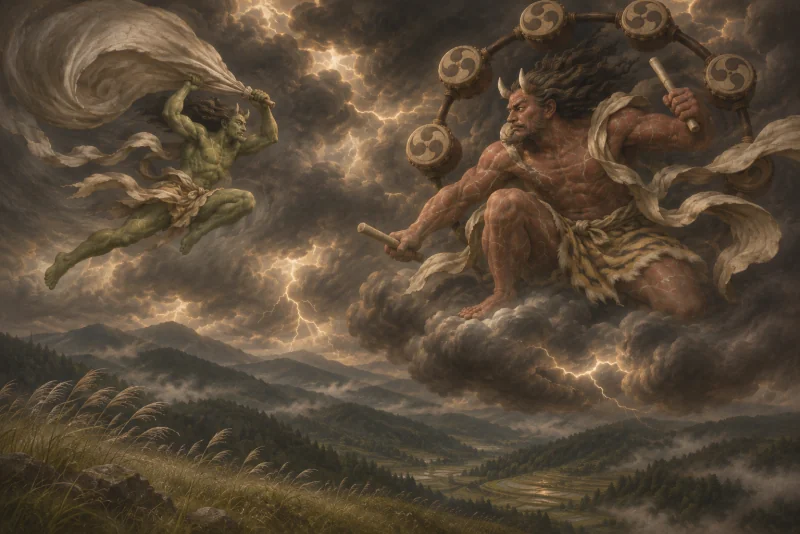
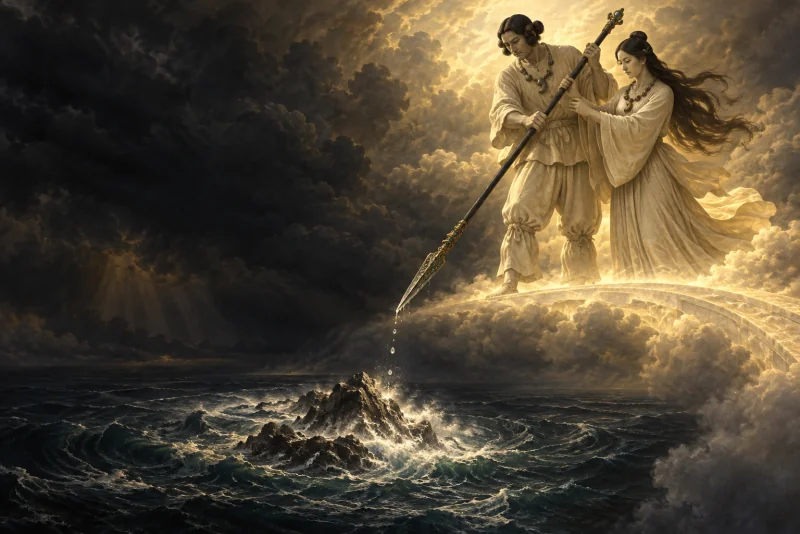
When Izanagi came back from the land of the dead and washed himself, Amaterasu, “Heaven-Shining”, was born from his left eye, the moon god Tsukuyomi from his right, and Susanoo from his nose. Izanagi gave Amaterasu the jewels of his necklace and told her to rule Takamagahara, the High Plain of Heaven. Susanoo was to rule the sea, but he wept until his beard reached his chest and the green mountains withered. He longed for the land of his dead mother, he said, and Izanagi drove him out.
Susanoo went up to heaven to take leave of his sister, and the mountains and rivers roared as he climbed. Sure that he had come to take her land, Amaterasu met him armed, with quivers of a thousand and of five hundred arrows. To prove his heart was clean, Susanoo proposed an oath, an ukei, in which each would produce children: from his sword came three goddesses, from her jewels five gods. “I have gotten delicate females,” he said, and declared himself the winner.
1-2 Victory Running Wild
“Impetuous with victory”, Susanoo broke down the ridges between Amaterasu’s rice fields, filled in the ditches, and strewed excrement in the hall where she partook of the feast of the new rice. Amaterasu “upbraided him not”. The excrement, she said, must be something he had vomited while drunk, and he broke the ridges because he grudged the land they took up.
He only grew worse. While she sat in the sacred weaving hall, seeing to the weaving of the gods’ garments, he broke a hole in the roof and dropped in a heavenly piebald horse he had flayed “with a backward flaying”. The heavenly weaving woman was so startled that she struck her genitals on her shuttle, and died.
1-3 Eternal Night
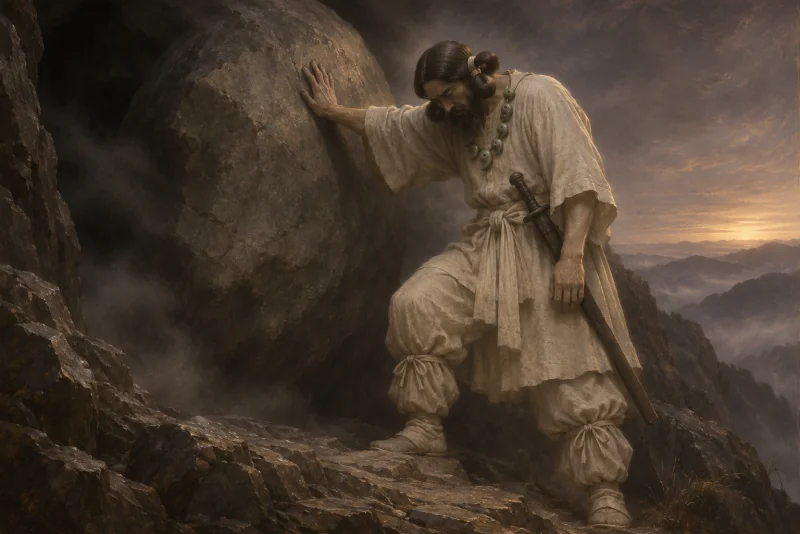
Amaterasu, “terrified at the sight”, opened the door of the Heavenly Rock-Dwelling, went in and shut herself away. Takamagahara went dark, and so did the land below, the Central Land of Reed Plains. “Eternal night prevailed.” The voices of the gods swarmed “like unto the flies in the fifth moon”, and every kind of calamity arose.
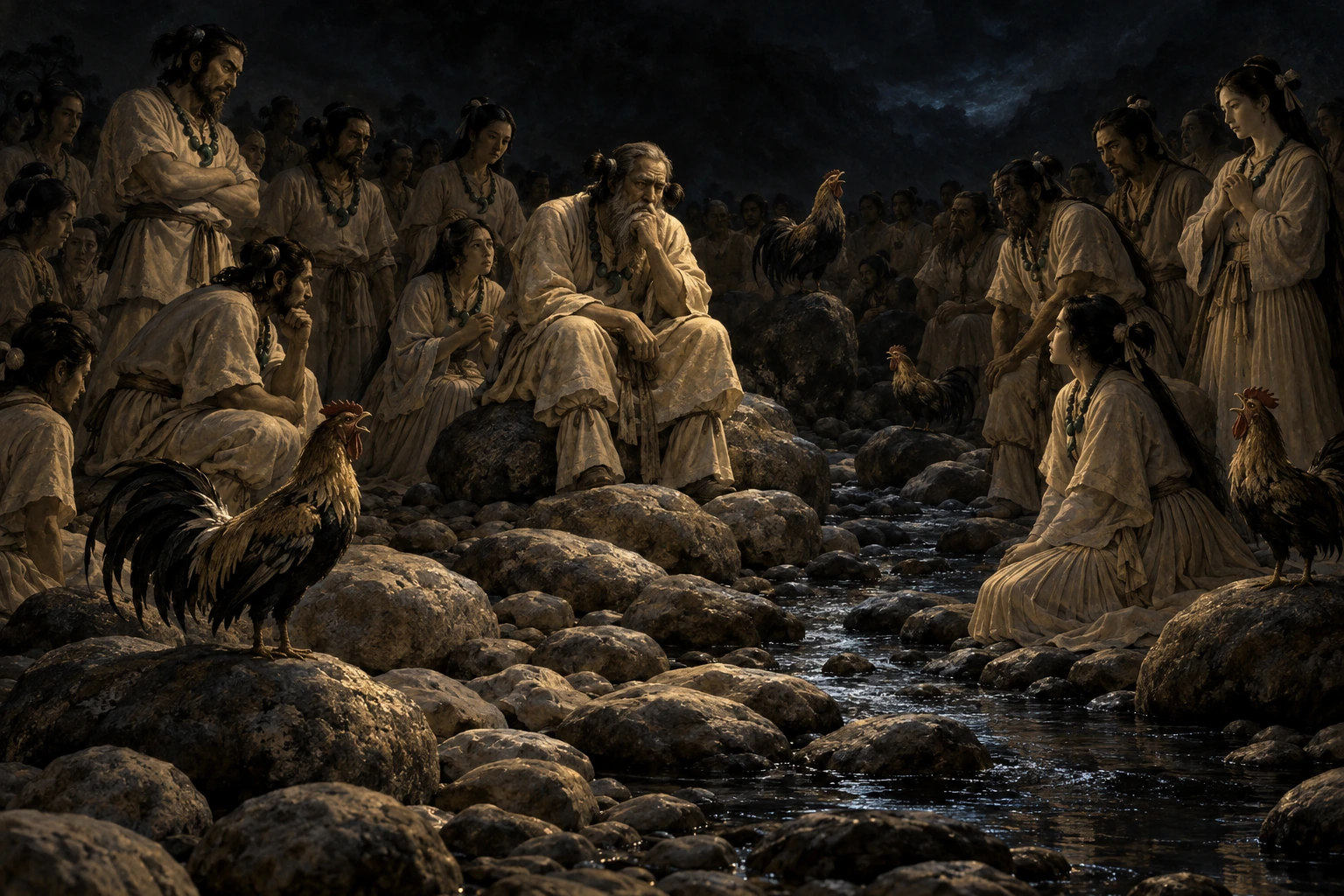
So the eight hundred myriad gods gathered in the dry bed of the Ame-no-Yasu, the Tranquil River of Heaven, and asked Omoikane, the “Thought-Includer”, to think of a plan.
1-4 The Plan
First they gathered the long-crying birds of Tokoyo, the Eternal Land, and made them cry; Chamberlain and Aston both take them to be roosters. With iron from the mines of heaven, the goddess Ishikoridome made a mirror, and Tamanoya made a long string of five hundred curved jewels, magatama. The gods Ame-no-Koyane and Futotama read the cracks in a stag’s shoulder blade burned over hahaka bark.
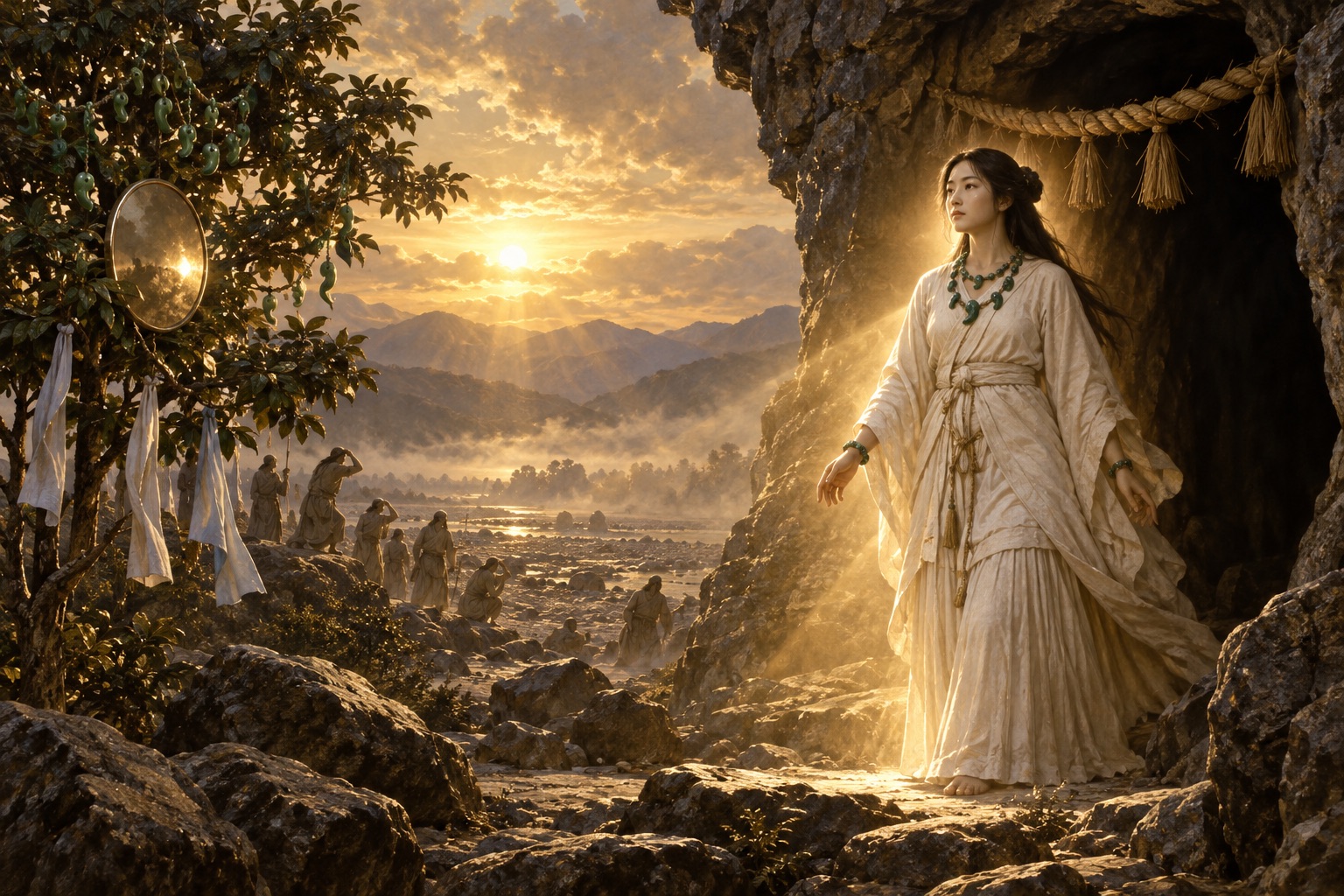
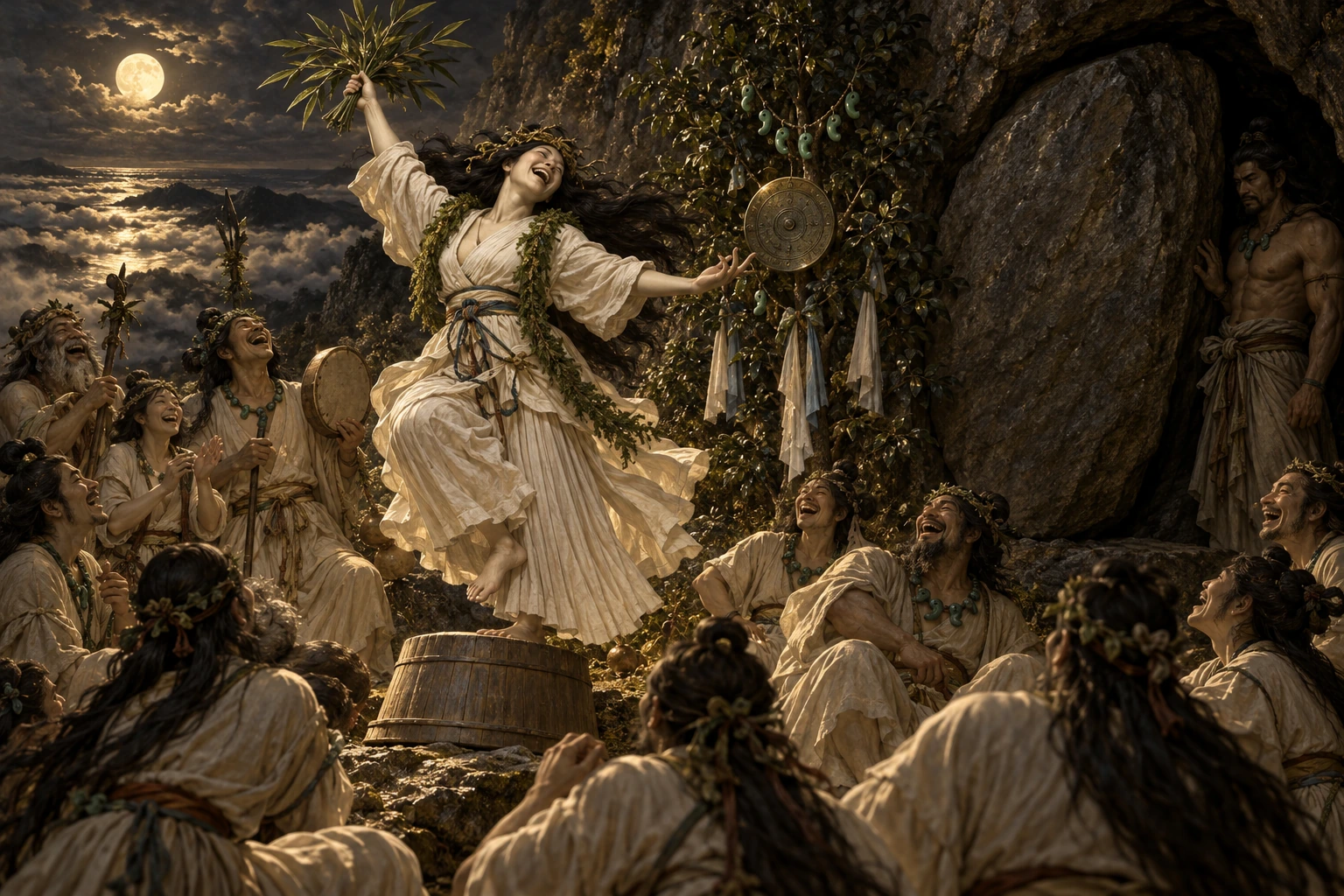
Then they dug up a many-branched sakaki tree on the heavenly Mount Kagu, roots and all. On its upper branches they hung the jewels, on the middle branches the mirror, the Yata no Kagami, and on the lower branches offerings of white and blue cloth. Futotama held up the tree, Ame-no-Koyane recited a solemn liturgy, and Ame-no-Tajikarao, “Heavenly Hand-Strength Male”, stood hidden beside the door.
1-5 The Dance and the Laughter
Ame-no-Uzume tied club moss across her shoulders as a sash, made a headdress of masaki vine and took a bunch of bamboo leaves in her hand. She turned a tub upside down before the door and stamped on it until it boomed. Then, “as if possessed by a Deity”, she pulled out her breasts and pushed her skirt-cord down to her private parts. The Plain of High Heaven shook, and the eight hundred myriad gods laughed together.
Amaterasu was puzzled. She opened the door a crack and asked from inside: with her hidden, heaven and earth should be dark, so why was Ame-no-Uzume making merry, and why were all the gods laughing? Ame-no-Uzume replied: “We rejoice and are glad because there is a Deity more illustrious than Thine Augustness.”
While she spoke, Ame-no-Koyane and Futotama pushed the mirror forward and showed it to Amaterasu. More and more astonished, she came out little by little to gaze at it, and Ame-no-Tajikarao took her hand and drew her out. At once Futotama stretched a straw rope, a shirikume-nawa, behind her: “Thou must not go back further in than this!” As Amaterasu came out, heaven and the land below grew light again.
1-6 Driven Out
Then the gods took counsel. They laid on Susanoo “a fine of a thousand tables” of offerings, cut off his beard, took his fingernails and toenails, and drove him out of heaven “with a divine expulsion”. The manuscripts disagree on whether the nails were cut or pulled out. After a short tale in which Susanoo kills the food goddess Ōgetsuhime, the Kojiki follows him down to Izumo, where the story of Yamata no Orochi begins.
2 Where the Story Is Written Down
- Kojiki (712). It calls the place 天石屋戸, the door of the heavenly rock dwelling, and tells the whole plan in one enormous sentence which, Chamberlain admitted, “does not properly hang together”.
- Nihon Shoki (720), book 1, section 7. The main text, in classical Chinese, calls the place 天石窟, the heavenly rock cave, and its door 磐戸, iwato. Three variants follow, each opening “in one writing it is said” (一書曰). Tosa Hidesato, in the Kokugakuin University commentary on the Kojiki, notes that all four use the same words, and that the name “Ama-no-Iwato” became the usual one only in the Heian period.
- Kogoshūi (807), by Inbe no Hironari. The Inbe, who traced their line to Futotama, had shared the court rituals with the Nakatomi, who traced theirs to Ame-no-Koyane. By Hironari’s day the Nakatomi had pushed them aside, and he wrote to restate his family’s claims.
- An older image. In the Man’yōshū (book 3, nos. 418–419), Princess Tamochi mourns Prince Kawachi, buried at Mount Kagami in Buzen: he has shut himself behind a “stone door”, and she wishes for the hand-strength to break it. For Tosa, this is the stone door of a tomb chamber, a trace of an older telling in which the cave carried the image of death.
3 Competing Versions
- Who was hurt in the weaving hall? Kojiki: the heavenly weaving woman, who dies. Nihon Shoki, main text: Amaterasu herself, who “wounded herself with the shuttle” (in Aston’s translation). First variant: the goddess Wakahirume, “Young Sun-Woman”, who falls from her loom and dies.
- Why did Amaterasu hide? Kojiki: from fear. Main text: she was “indignant”. First variant: she tells Susanoo, “Thou hast still evil intentions. I do not wish to see thee face to face.” Second variant: at her harvest feast she sits, unknowing, on excrement he has left under her seat, falls ill and is enraged.
- What brought her out? Kojiki: the laughter, the claim of a greater deity, and the mirror. Main text: Ame-no-Uzume’s merriment (“How then can Ama no Uzume no Mikoto be so jolly?”). Third variant: the beauty of the liturgy: “Though of late many prayers have been addressed to me, of none has the language been so beautiful as this.”
- Ame-no-Uzume’s dance. In the main text she holds a spear wound with eulalia grass, “skilfully performed a mimic dance”, lights fires and gives forth a divinely inspired utterance, with no word of uncovering herself. As Aston put it, the Kojiki gives other details “which the ‘Nihongi’ draws a veil over”.
- The mirror. In the first variant, Ishikoridome, told to make an image of the goddess, forges a sun-spear, and what comes of it is the deity of Hinokuma in Kii. In the second, the mirror strikes the door as it is put into the cave and takes a slight flaw, “which remains until this day. This is the great Deity worshipped at Ise.” The Kogoshūi has two mirrors: the flawed first one became the deity of Hinokuma, the second the deity of Ise.
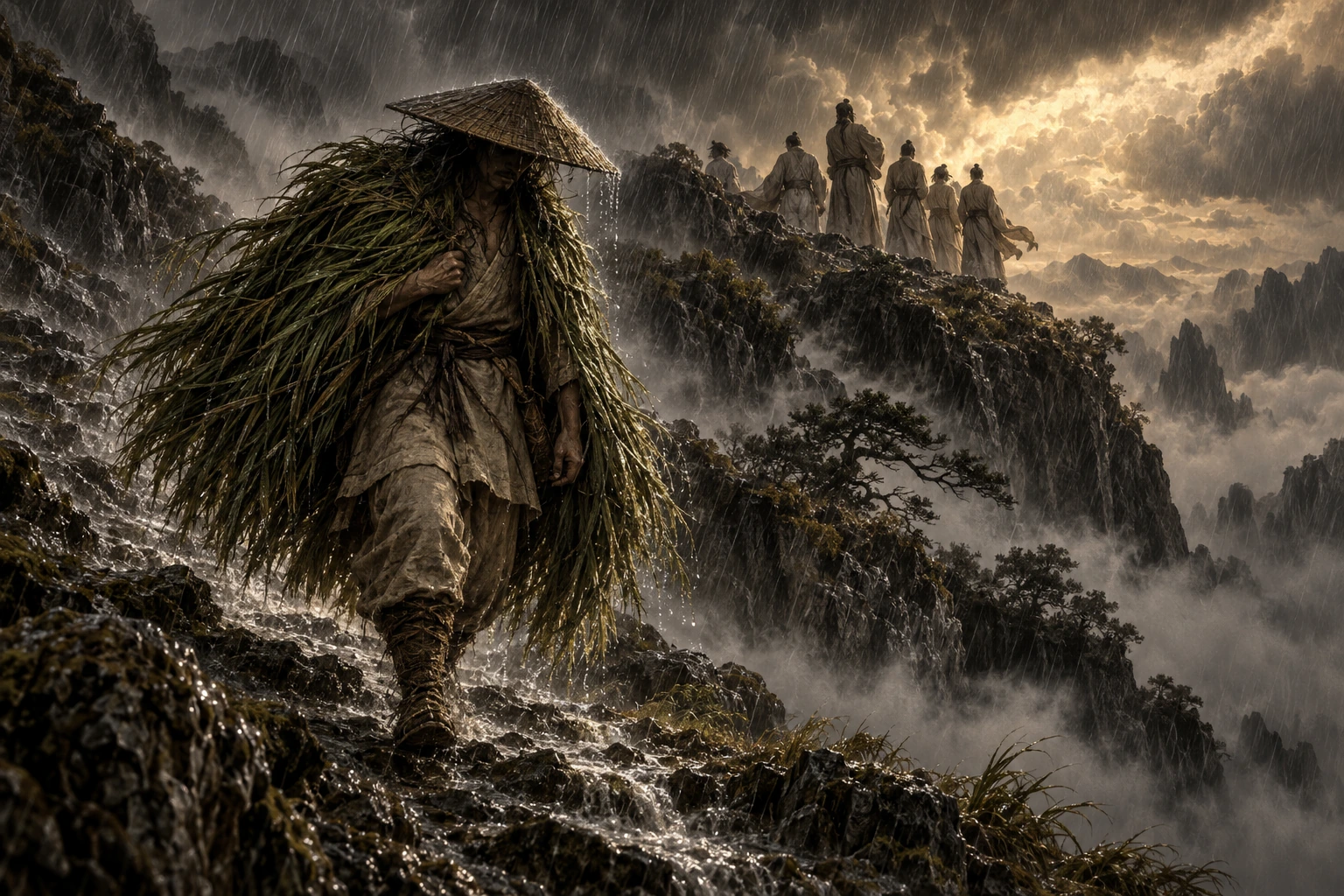
- Susanoo in the rain. The main text has his hair plucked out, or in another version his nails. The third variant goes on. Driven out in endless rain, Susanoo makes a broad hat and a raincoat of green grass and begs the gods for shelter, and all of them turn him away. That, it says, is why no one enters another’s house in a grass hat and raincoat: “This is an institution which has come down to us from remote antiquity.” Only after this does he climb back to see his sister and hold their oath.
4 History and Tradition
- Gods and clans. Five of these gods return when Amaterasu sends her grandson Ninigi down to rule the land: Ame-no-Koyane, Futotama, Ame-no-Uzume, Ishikoridome and Tamanoya. The Kojiki names them as ancestors of the Nakatomi, the Inbe, the Sarume, the mirror-makers and the jewel-makers, families who, as the historian Nishimura Kentarō notes in the Kokugakuin commentary, divided the court’s rituals among them.
- The mirror at Ise. With Ninigi, Amaterasu also sends the jewels and the mirror that had drawn her out, and the sword Kusanagi: “Worship this mirror as my own spirit.” Tradition holds that it was enshrined at Isuzu, the Inner Shrine of Ise, where the Yata no Kagami is the sacred object.
- The chinkonsai. The Kogoshūi traces the court’s “Spirit-quieting Ceremony”, the chinkonsai, to Ame-no-Uzume. Held for the emperor on the eve of the harvest feast, it is first recorded in the Nihon Shoki for 685; Sata Yoshihiko adds that some scholars reject the Kogoshūi’s origin story. Numabe Harutomo describes its high point: a shrine maiden stood on an upturned tub and struck it ten times with a spear.
- An eclipse? Yoshida Atsuhiko notes that eclipse myths of Indochina, too, give the sun and moon a violent younger brother, as Susanoo is the brother of Amaterasu and Tsukuyomi. Shirakawa Shizuka saw in the rites before the cave the same kind of magic as the drums beaten in China to save the sun in an eclipse. Kurazuka Akiko called the eclipse reading a popular misunderstanding.
- A winter rite. For Kurazuka, the myth reflects the chinkonsai, held near the winter solstice to renew the strength of the sun and of the ruler’s soul together. Yoshii Iwao reads the withdrawal as the sun goddess restoring her life force in order to be reborn. The Kokugakuin commentary also records the nature-myth reading, in which a storm hid the sun.
- The rope. Chamberlain (1882) and Aston (1896) both note that the shirikume-nawa is the rope now called shimenawa.
- Kagura. Ame-no-Uzume’s dance “is said to be the origin of the Kagura”, Aston wrote. In the villages of Takachiho, in Miyazaki, the night kagura is still danced from November to February: thirty-three dances, all night long, in a house chosen by lot. The masked dances retell the rock cave, among them “Tajikarao”, “Uzume” and “Totori”, the taking of the door. It was designated an Important Intangible Folk Cultural Property in 1978.
- The caves on earth. At Ama-no-Iwato Shrine in Takachiho, the West Main Shrine worships a cave in the cliff across the Iwato River as the rock dwelling itself, and a great cave upstream is said to be where the gods met. Ame-no-Iwato Shrine in Kashihara, Nara, at the foot of the earthly Mount Kagu, has no main hall and worships a hole in the rock. On Iheya, in Okinawa, the Kumaya cave is called the southern limit of the legend.
Takachiho is often called the place where this myth happened. The Kojiki and the Nihon Shoki set the cave in Takamagahara, in heaven. On earth, several caves claim it.
5 Related Stories
- Kuniumi: Izanagi and Izanami Give Birth to Japan: the story before this one. Izanagi and Izanami make the islands, and Izanagi’s return from the land of the dead leads to the birth of Amaterasu and Susanoo.
- Izanagi in Yomi: The Land of the Dead and the First Quarrel: the story just before this one. Izanagi follows Izanami into the land of the dead, flees, and washes himself when he is back; this story begins with that washing.
- Yamata no Orochi: Susanoo and the Eight-Headed Serpent: the story after it. Driven out of heaven, Susanoo comes down in Izumo and finds there the sword that Amaterasu will send down with the mirror and the jewels.
- Hou Yi and Chang’e: The Archer Who Shot the Suns and the Woman in the Moon: Yoshida Atsuhiko compared the rock cave with a Miao myth from south-west China. After an archer shot down nine of ten suns, the last one hid behind a mountain in fear, and only a rooster’s call brought it out.
- Ra and Apophis: The Serpent the Sun Must Defeat Every Night: in Egypt the sun vanishes every evening and must be brought safely through the dark. We have not found a scholar who compares the two myths; we link them for the theme.
6 Sources
- Kojiki, book 1, “Ame no iwaya” 1–3 and the sections around it, with the commentary of Taniguchi Masahiro, Tosa Hidesato and Nishimura Kentarō: Kokugakuin University Kojiki Viewer
- Basil Hall Chamberlain (trans.), Kojiki, 1882, §§XV–XVII: Wikisource
- Nihon Shoki, book 1, section 7, main text and variants (original text): Wikisource
- W. G. Aston (trans.), Nihongi, 1896, vol. 1, book I: Wikisource
- Inbe no Hironari, Kogoshūi (807), trans. Katō Genchi and Hoshino Hikoshirō (1924): Wikisource
- Heibonsha World Encyclopedia: Kurazuka Akiko, “天の岩屋戸” and “天照大神”; Yoshida Atsuhiko and Shirakawa Shizuka, “日食”; Numabe Harutomo, “鎮魂祭”: Kotobank, Kotobank, Kotobank, Kotobank
- Nihon Daihyakka Zensho (Nipponica): Yoshii Iwao, “天岩戸” and “八咫鏡”; Sata Yoshihiko, “鎮魂祭”; Watanabe Nobuo, “高千穂神楽”: Kotobank, Kotobank, Kotobank
- “天岩戸神社”, Nihon rekishi chimei taikei and Nipponica: Kotobank
- Ama-no-Iwato Shrine, Takachiho: amanoiwato-jinja.jp
- Iheya Village, “Kumaya cave”: Good Luck Trip
Cover and illustrations: AI-generated images made for Arcana. They are interpretations, not historical artworks.