Kuniumi: Izanagi and Izanami Give Birth to Japan
Japan's oldest book does not begin with a king but with brine: two gods stir the sea with a jewelled spear, circle a pillar, get it wrong once, and give birth to the islands.
- Type: myth, the making of the Japanese islands (kuniumi, “the birth of the land”)
- Culture: Japan, the Yamato court
- Earliest texts: Kojiki (712) and Nihon Shoki (720)
- Key figures: Izanagi, Izanami, the leech child Hiruko, the Eight Great Islands
At the start of the Kojiki there is no land to speak of. It is young, the text says, “like floating oil”, drifting like a jellyfish. Gods appear and vanish. Then two of them are handed a spear and told to make the world solid.
1 The Telling
1-1 The Spear and the Brine
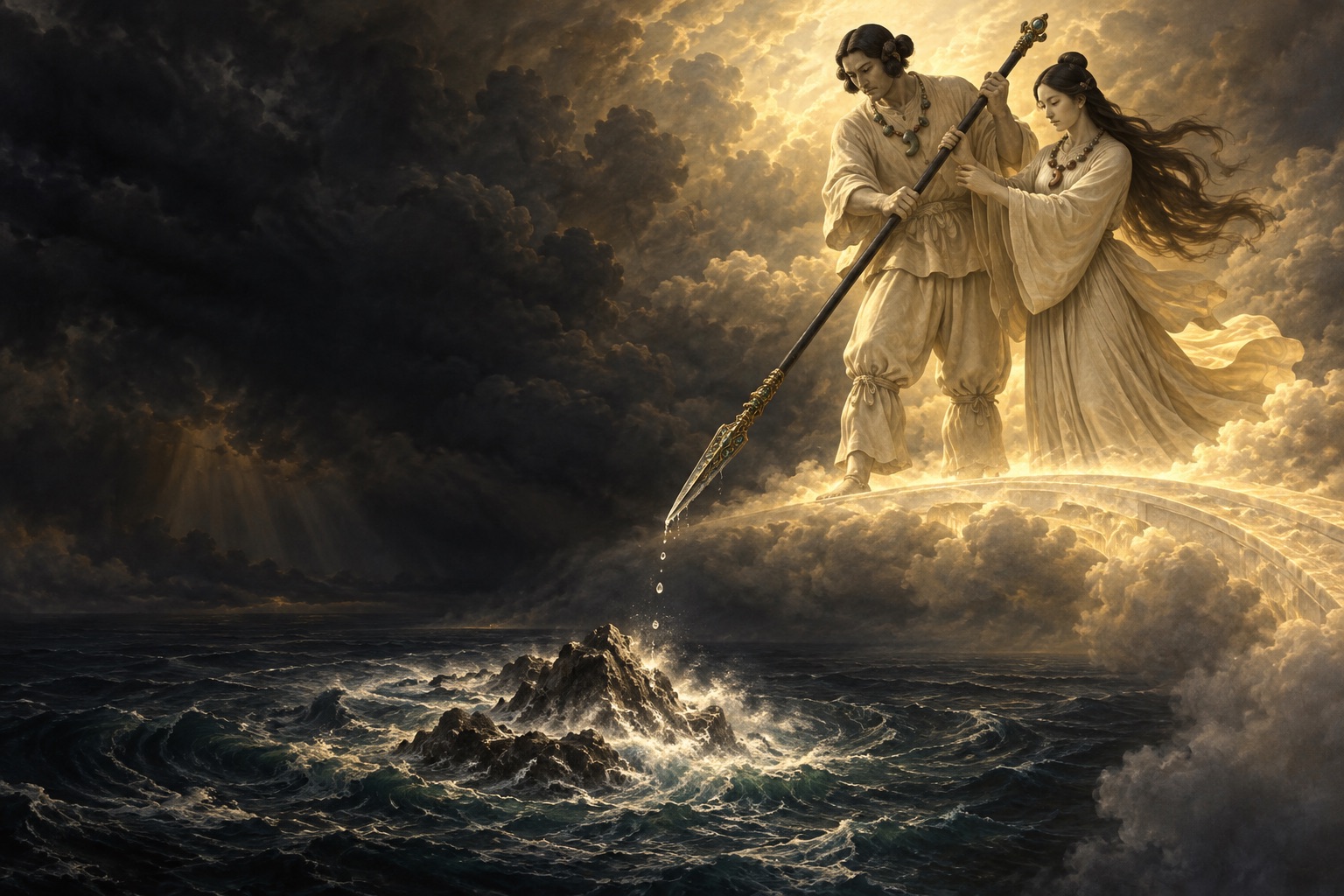
All the heavenly gods commanded Izanagi and Izanami, “He Who Invites” and “She Who Invites”, to repair and make firm the drifting land, and gave them a jewelled spear, the Ame-no-nuboko. Standing on the Floating Bridge of Heaven, the two lowered the spear and stirred the brine; the text even records the sound it made, koworo-koworo. When they drew the spear up, brine dripped from its tip and piled up into an island: Onogoro, the “self-congealed” island.
1-2 Around the Pillar
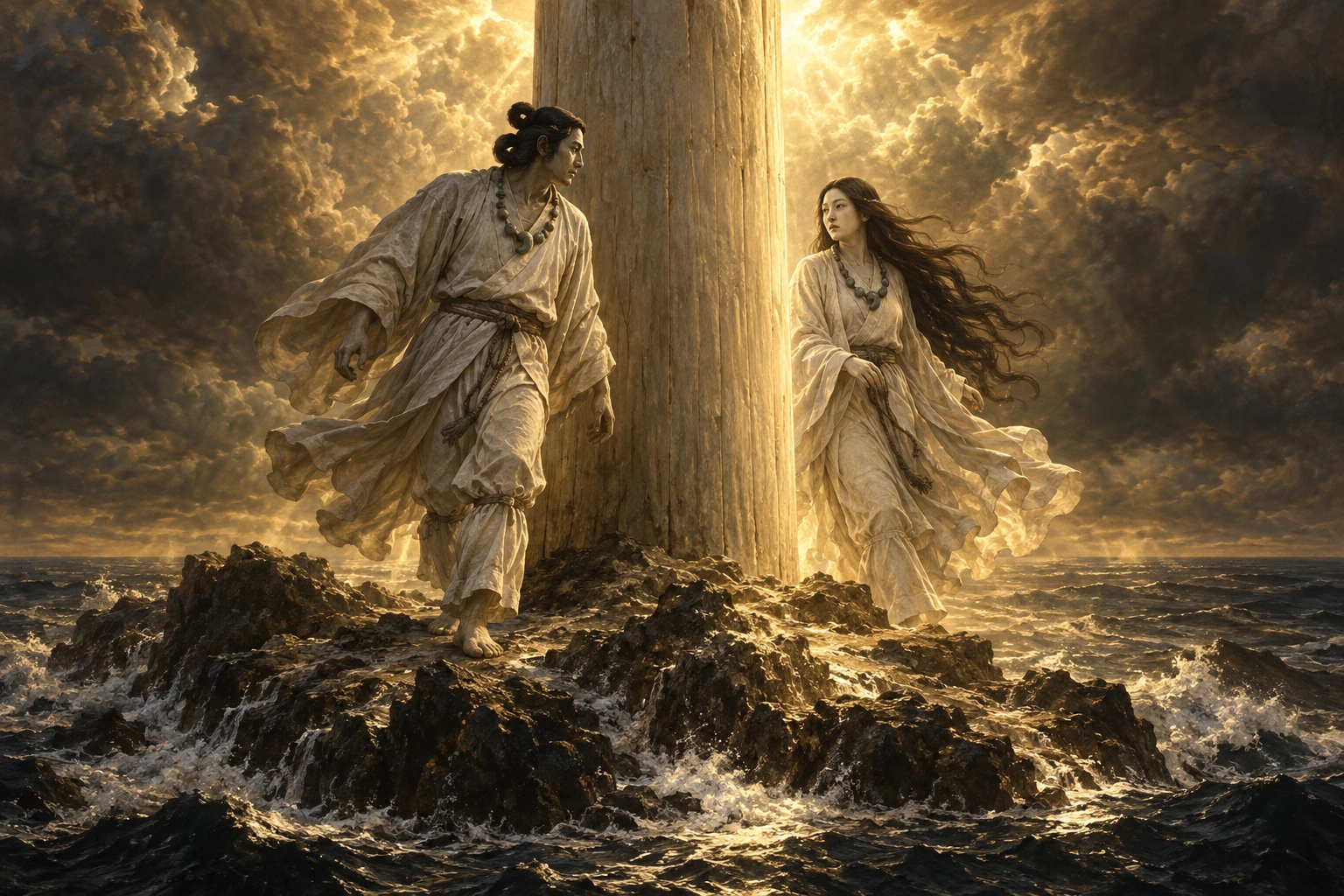
They came down to Onogoro and set up a heavenly pillar and a vast hall. Izanagi asked Izanami how her body was formed. She answered that it was complete except for one place that had not grown together. His, he said, had one place grown in excess, and he proposed that they join the two and give birth to the land.
They agreed to walk around the pillar and meet: she from the right, he from the left. When they met, Izanami spoke first: “Ah, what a fine young man!” Then he answered: “Ah, what a fine young woman!” Afterwards he remarked that it was not right for the woman to have spoken first.
1-3 The Leech Child
Their first child was Hiruko, the “leech child”. They placed him in a boat of reeds and let him drift away. Next came Awashima, the “foam island”. Neither was counted among their children.
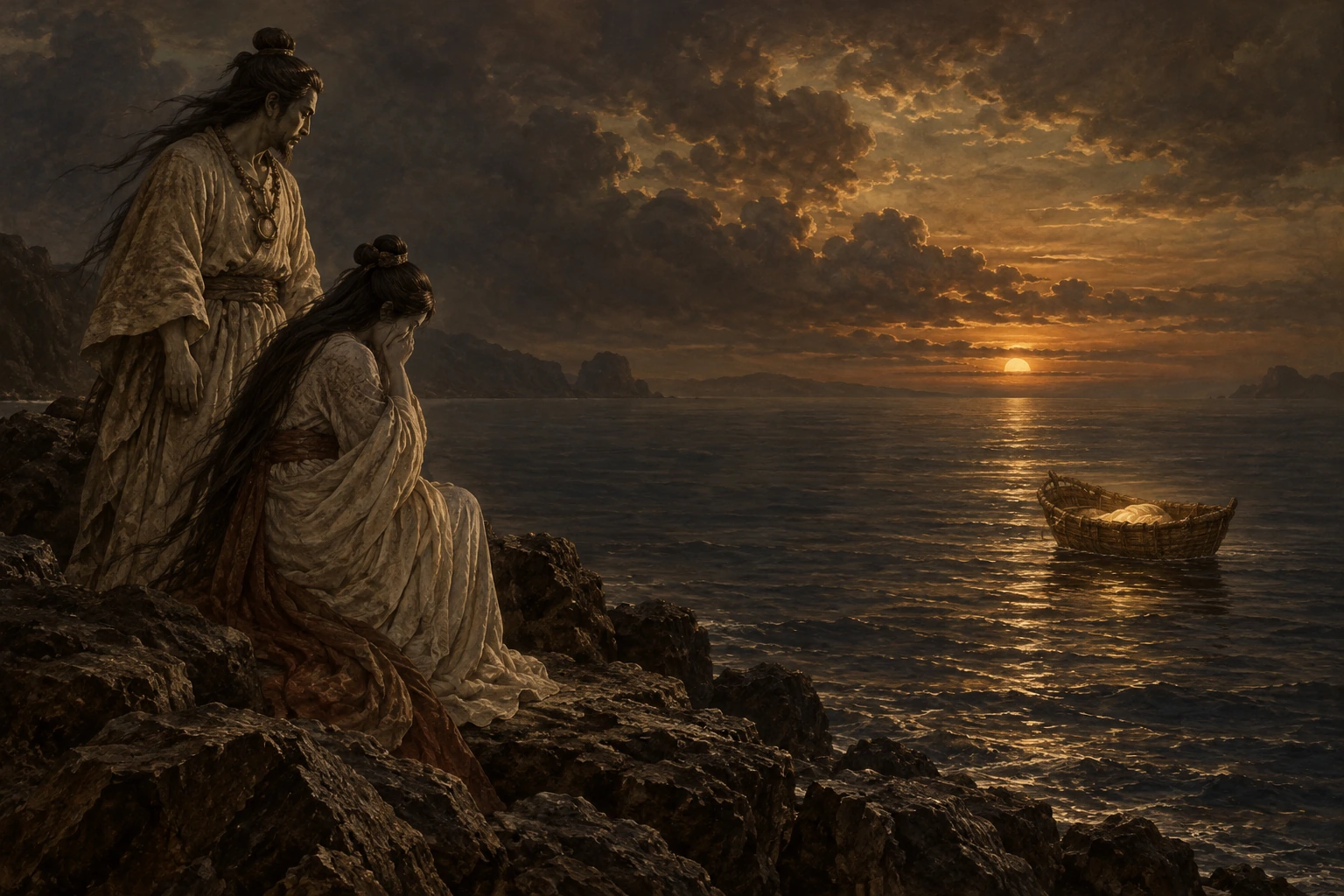
Unsure what had gone wrong, the pair went up to heaven to ask. The heavenly gods performed a divination, futomani, read from cracks in a heated deer’s shoulder blade, and gave their answer: it was not good because the woman had spoken first. So Izanagi and Izanami went back down and circled the pillar again, and this time Izanagi spoke first.
Later tradition did not leave Hiruko adrift. He came to be identified with Ebisu, the smiling god of fishermen and good fortune.
1-4 The Eight Great Islands
This time the births went well. In the Kojiki’s order they were:
- Awaji
- Iyo-no-futana, Shikoku: one body with four faces, for Iyo, Sanuki, Awa and Tosa
- Oki
- Tsukushi, Kyushu, also with four faces
- Iki
- Tsushima
- Sado
- Ōyamato-toyoakitsu, Honshu
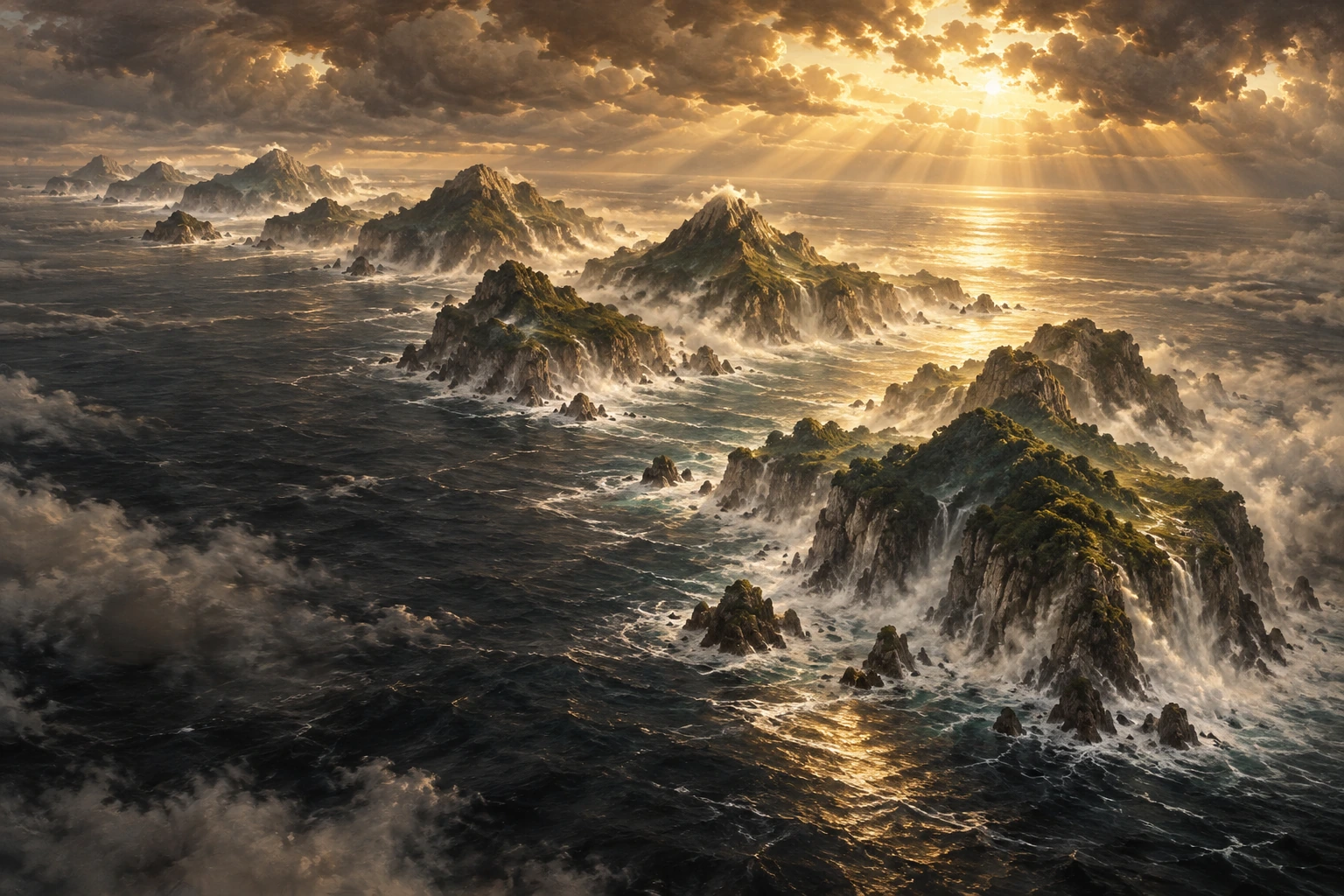
Because these eight were born first, the land is called Ōyashima-no-kuni, the Land of the Eight Great Islands. Six smaller islands followed, among them Shōdoshima and the Gotō islands.
1-5 After the Islands
Next the pair gave birth to gods: gods of the sea, the wind, the trees, the mountains. The last was the fire god Kagutsuchi, and his birth burned his mother. Izanami “withdrew”, a word the text uses for her alone, and she was buried on Mount Hiba, on the border of Izumo and Hōki. In all, the two had produced fourteen islands and thirty-five gods. Izanagi’s journey after her into the land of the dead, Yomi, is a story of its own.
2 Where the Story Is Written Down
The two oldest surviving Japanese books both tell it.
- Kojiki (Records of Ancient Matters, 712). Its preface tells how it was made:
- Emperor Tenmu found the records kept by the great families full of errors, and had a 28-year-old courtier, Hieda no Are, learn the genealogies and old words by heart.
- In the 9th month of 711, Empress Genmei ordered the scholar Ō no Yasumaro to write them down. He presented the finished work in the first month of 712.
- Nihon Shoki (Chronicles of Japan, 720). It was compiled under Prince Toneri and written in classical Chinese. Unusually, it often sets several versions of an episode side by side, each introduced as “a certain writing says…” (aru fumi ni iwaku, 一書曰).
Scholars of Japanese myth such as Ōbayashi Taryō point out that these books were made at court, and that they trace the imperial line back to the gods of heaven. The story of the land’s birth is also the opening chapter of a royal genealogy.
3 Competing Versions
The Nihon Shoki’s main text tells a noticeably different story from the Kojiki:
- No command. The pair decide for themselves: “Below, is there not a land?” They are called the yang god and the yin goddess, in the language of Chinese cosmology.
- No divination. When Izanami speaks first, Izanagi objects, “I am a man; by right I should speak first”, and they simply circle again.
- Awaji is not one of the eight. It is born first, but as the afterbirth (胞), “displeasing”, and named for that. The eight great islands begin with Honshu, and include Koshi and Kibi-no-ko. Tsushima, Iki and the smaller islands are said to have formed from sea foam.
- Hiruko comes later. He is born after the sun and moon deities. He still cannot stand at the age of three, so he is placed in a boat of camphor wood and given to the wind.
- Izanami does not die. In the main text she lives on. Her death by fire appears only in the alternative versions, one of which buries her at Arima in Kumano, in the province of Kii.
Among those alternative versions, the first is closest to the Kojiki: heavenly gods give the command, the leech child is set adrift in reeds, and there is a divination. In another, a wagtail shows the two gods how to couple.
4 History and Tradition
Onogoro is a mythic island. That has not stopped people from looking for it. Candidates have been proposed since medieval times:
- Nushima and Eshima off Awaji;
- Tomogashima;
- the hill of Onokoro Shrine in Minamiawaji.
None of them is documented.
Where Izanagi retired. The Nihon Shoki says that when his work was done, Izanagi built a “hidden palace” on Awaji. Izanagi Jingū in Awaji City says it stands on that very spot. The Kojiki manuscripts disagree about the place: some read Taga in Ōmi, around Lake Biwa, others Awaji.
Why the woman must not speak first. Some scholars connect the rule to a courtship custom seen in the Man’yōshū poems, in which the man calls first. Others see the Chinese ideal of male precedence. The left-and-right circling has even been matched to a Han-era Chinese saying recorded in the Chunqiu wei (Yuanming bao chapter): heaven turns to the left, earth to the right.
The pillar. It has been read as an axis of the world. Matsumae Takeshi suggested that the myth began among the fishermen of Awaji and grew as the court adopted it.
A wider family of myths. Ōbayashi Taryō and Yoshida Atsuhiko have compared Kuniumi with flood myths told from southern China to Southeast Asia. In those myths:
- a brother and sister survive alone;
- they circle a tree or a mountain before they marry;
- their first child is a lump of flesh or a malformed being.
As early as 1931, Matsumoto Nobuhiro pointed to Miao accounts of young people dancing around a tree to choose their partners.
5 Related Stories
- Lạc Long Quân and Âu Cơ: The Dragon, the Fairy and the Hundred Eggs: Vietnam’s founding couple, a marriage between water and land, and a parting. The Nihon Shoki uses the same character, 胞, for Awaji’s “afterbirth” that the Vietnamese texts use for Âu Cơ’s sac.
- Nüwa: The Serpent-Bodied Goddess Who Mended the Sky: China’s creator goddess. Han tomb art pairs her with Fuxi, their serpent tails entwined, and a Tang tale makes the first couple a brother and sister who married on Mount Kunlun.
- The Churning of the Ocean: Gods, Demons and the Nectar of Immortality: Indian gods churn the sea with a mountain. The mythologist Yoshida Atsuhiko argued that the stirring of the brine at Onogoro goes back to this “ocean-churning” type of myth.
- Dangun: The Bear, the Tiger and the First Korean Kingdom: Korea’s founding myth, whose divine descent from heaven has been compared with the Japanese one.
- Amaterasu and the Rock Cave: The Day the Sun Hid: what comes next. Izanagi washes after his return from the land of the dead, and the sun goddess Amaterasu and her brother Susanoo are born. Their quarrel drives her into a cave.
6 Sources
- Kojiki, book 1, sections on the making firm of the land, the marriage of the two gods and the birth of the land: Kokugakuin University Kojiki Viewer
- Basil Hall Chamberlain (trans.), Kojiki, 1882, preface and §§III–VII
- Nihon Shoki, book 1 (original text): Wikisource
- W. G. Aston (trans.), Nihongi, 1896, vol. 1, book I
- Encyclopedia of Shinto, Kokugakuin University: “Kuniumi”, “Izanagi”, “Izanami”, “Hiruko”
- Matsumae Takeshi, “Izanagi and Izanami”, Encyclopedia of Religion (1987)
- Ōbayashi Taryō, “日本神話”, Nihon Daihyakka Zensho (Nipponica): Kotobank
- Okabe Takashi, 「『古事記』における二つの始祖神話」, Seijo University Social Innovation Studies 14(2), 2019
Cover and illustrations: AI-generated images made for Arcana. They are interpretations, not historical artworks.