Kaguya-hime: The Princess from the Moon
A bamboo cutter finds a tiny girl in a glowing stalk, five noblemen fail at impossible quests, and the people of the moon take her home, leaving the emperor an elixir he has burned on Mount Fuji. It is Japan's oldest tale in prose, and it was not a folk tale: a learned man wrote it, and his name is lost.
- Type: tale (monogatari), the oldest in Japanese prose; a girl from the moon, five suitors, and how Mount Fuji got its name
- Culture: Japan, the Heian court
- Earliest texts: the Taketori monogatari, written in the late 9th or early 10th century (oldest dated manuscript 1570); a bamboo cutter already appears in the Man’yōshū (8th century); a shorter version is in the Konjaku monogatari shū (early 12th century)
- Key figures: Kaguya-hime, the bamboo cutter Sanuki no Miyatsuko and his wife, five suitors, the Mikado, the people of the moon
The Tale of Genji calls it “the ancestor of all tales”. The Taketori monogatari, the “Tale of the Bamboo Cutter”, is the oldest surviving tale written in Japanese prose, and it is full of jokes: each of the suitors’ failures ends in a pun. The last pun is a mountain. The emperor’s men climbed it in great numbers, so it was called Fuji, and the smoke of what they burned there, the tale says, still rises into the clouds.
Was Kaguya-hime born from a bamboo? The tale never says so. The bamboo cutter finds her already there, a tiny person about three sun tall, some 9 cm, sitting inside a stalk that glows. Near the end she tells him that she is “a person of the capital of the moon”, and the moon’s king explains that she was sent down for a while because she had committed a crime.
1 The Telling
This is the Taketori monogatari as it is printed in the Kokumin Bunko edition. The translations are ours.
1-1 The Girl in the Bamboo
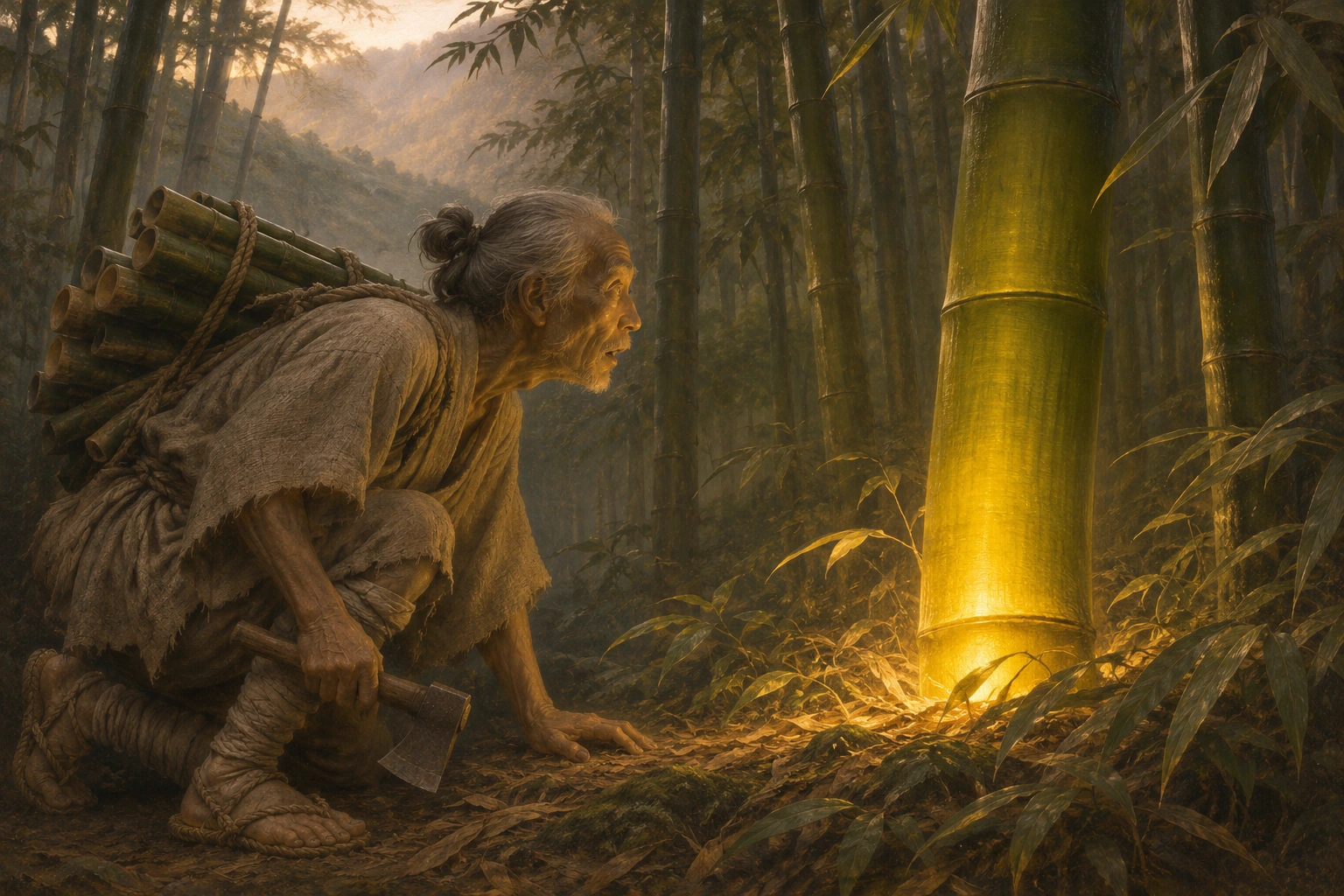
There was once an old man who cut bamboo in the hills and made it into all kinds of things. His name was Sanuki no Miyatsuko. One day he found a stalk whose base was shining. Inside it sat a tiny, lovely person about three sun tall. “You must be meant to be my child,” he said, and carried her home to his wife, who kept her in a basket because she was so small.
From then on, whenever he cut bamboo, he found gold hidden in the stalks, joint after joint, and he grew rich. The child shot up like a bamboo: in three months she was a grown woman. There was no dark corner left in the house, for her light filled it, and when the old man was ill or angry, one look at her made it pass. A man of the Inbe family, Mimurodo no Inbe no Akita, named her Nayotake no Kaguya-hime, “the shining princess of the supple bamboo”.
1-2 Five Impossible Gifts
Men high and low longed to see her. They stood at the fence by night and bored holes to peep through; from that time, the tale says, wooing was called yobai. Most gave up. Five did not: Prince Ishitsukuri, Prince Kuramochi, the Minister of the Right Abe no Miushi, the Grand Counsellor Ōtomo no Miyuki, and the Middle Counsellor Isonokami no Maro (Marotari in other texts).
The old man, past seventy, begged her to marry one of them. She agreed to take whoever brought her what she asked for:
- the Buddha’s own stone begging bowl, from India;
- a branch of the tree on Mount Hōrai, in the eastern sea, with roots of silver, a trunk of gold and fruit of white jewels;
- a robe made of the fur of the fire-rat, from China;
- the jewel that shines in five colours on a dragon’s neck;
- the cowrie shell, koyasu-gai, that a swallow keeps.
1-3 Five Failures
Prince Ishitsukuri waited three years, then brought a soot-black bowl from a mountain temple in Yamato. It gave not even a firefly’s light. He threw the bowl away and went on wooing: so, the tale says, a man without shame “throws away the bowl” (hachi), that is, his shame (haji). Prince Kuramochi hid for more than a thousand days with six master craftsmen, had the branch made, and told a long tale of storms and monsters on the way to Hōrai. Kaguya-hime was in despair until the craftsmen came to ask for their pay. He fled into the mountains and was never found.
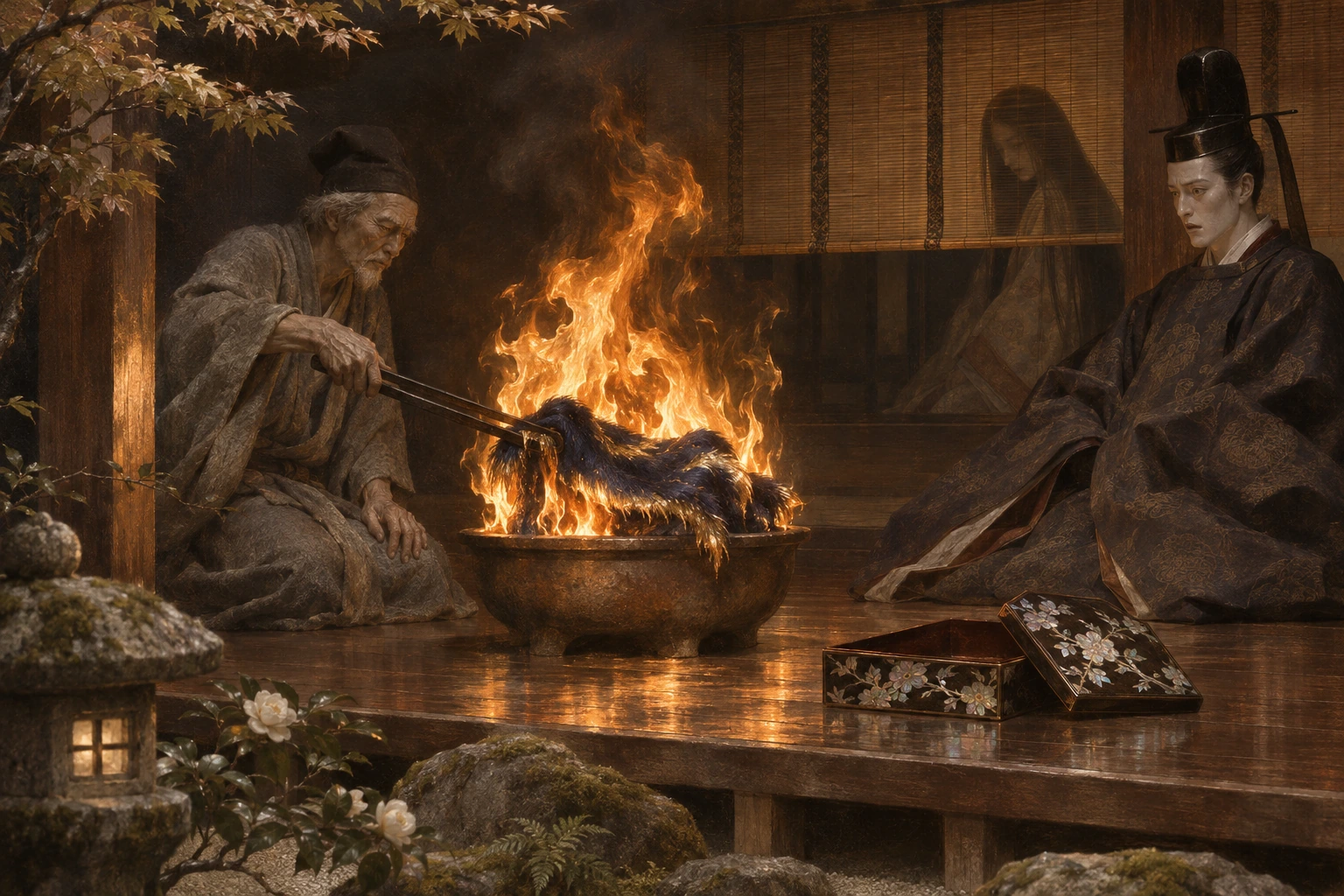
The minister bought the fire-rat robe from a Chinese merchant: deep blue, each hair tipped with gold. Kaguya-hime had it put in the fire, and it burned to nothing. The Grand Counsellor sent his men after the dragon, and they ran off with his money. He sailed himself, met a storm with thunder and lightning, prayed for his life, and was washed up at Akashi with his eyes swollen “like two plums”. The Middle Counsellor was hoisted in a basket to a swallows’ nest in the palace kitchens, closed his hand on something, and fell onto the cauldrons. In his hand was old swallow dung: no shell, kai nashi, and so, the tale says, a vain effort is kai nashi. His back was broken, and he died after answering her letter of sympathy.
1-4 The Mikado
The Mikado heard of her and sent a court lady, Nakatomi no Fusako, to look at her. Kaguya-hime would not come out: if she was disobeying the king’s command, she said, let him kill her. He promised the old man a court rank; she answered that if she were forced into service she would vanish. So the Mikado came on a pretended hunt, caught her sleeve and called for his palanquin, and she turned into a shadow before his eyes. Only when he gave up would she take her form again. For three years after, they wrote to each other.
1-5 The People of the Moon
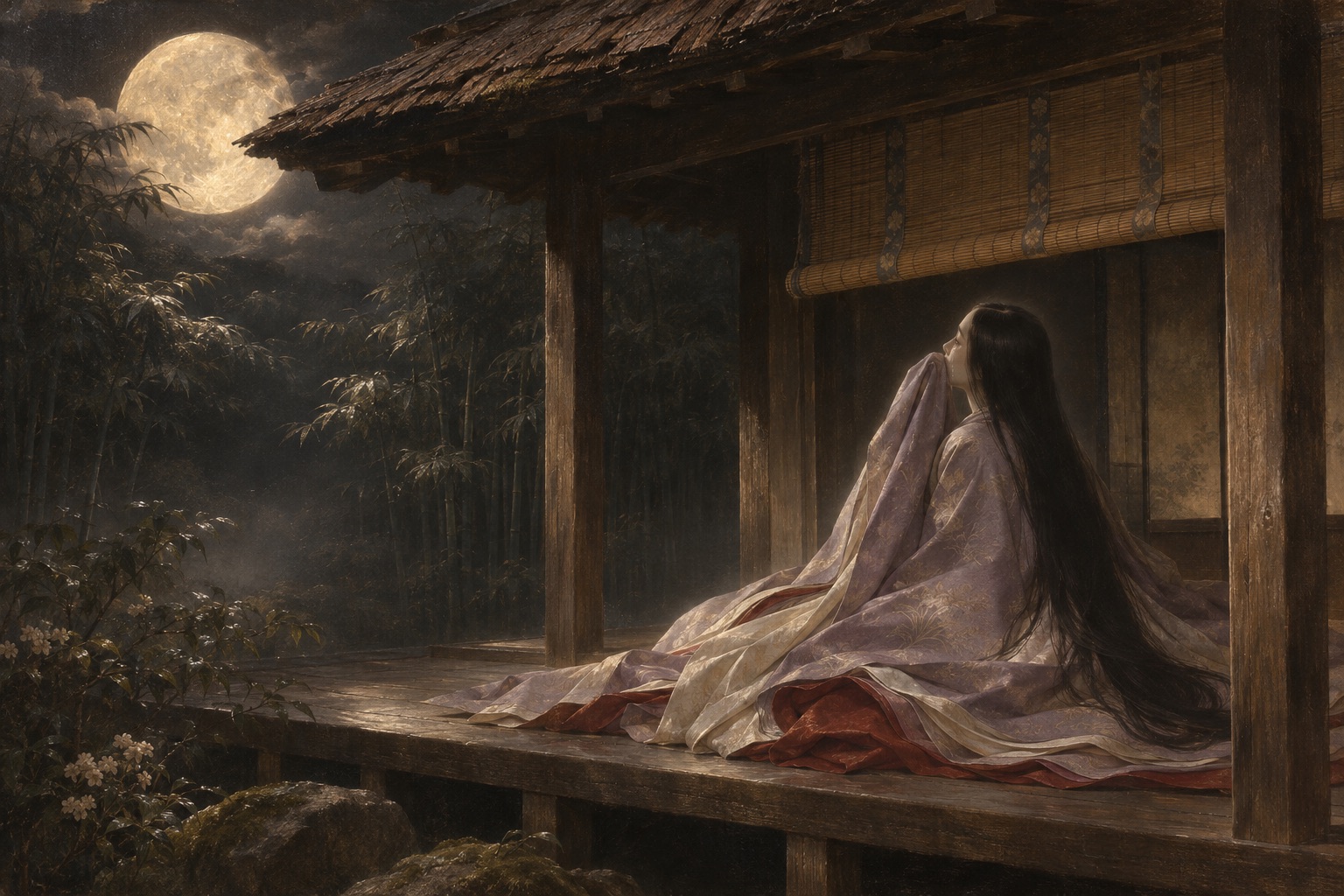
From the spring of the third year she sat looking at the moon and weeping. In the eighth month, near the full moon, she told the old man the truth: “I am not a person of this country. I am a person of the capital of the moon.” She had come “for a moment” by the moon’s reckoning, and many years had passed on earth. On the fifteenth night they would come for her. The people there were beautiful and never grew old, she said, and still she did not want to go.
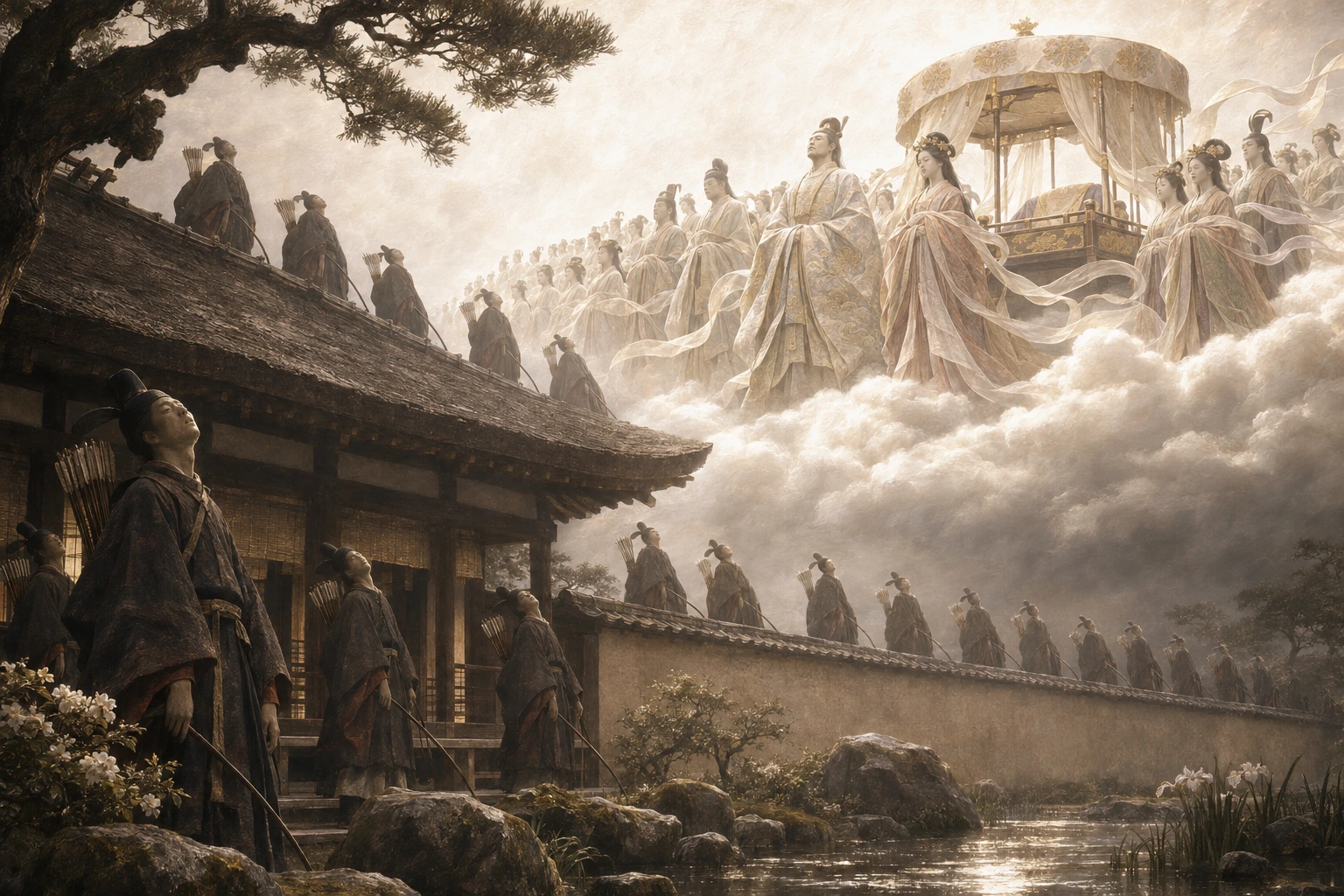
The Mikado sent two thousand guards: a thousand on the walls, a thousand on the roofs. At midnight a light ten times brighter than the full moon filled the house. People came down on clouds and stood in rows in the air, about five shaku above the ground, with a flying carriage under a silk canopy. The guards lost the strength to draw their bows. One who seemed to be their king spoke to the old man: because of some small good deed, they had sent her down to him “for a moment” and given him gold; she had committed a crime, and now it was paid. The locked doors opened by themselves.
They brought a robe of feathers, the ama no hagoromo, and a jar of the elixir of immortality. Kaguya-hime tasted the elixir and wrote to the Mikado. Those who put on the robe, she said, become different at heart. With the letter went a poem: “Now, as I put on the robe of heaven, it is you I remember with longing.” Then the robe was put on her, and her pity for the old man vanished. She stepped into the carriage, and a hundred people of heaven went up with her.
1-6 Smoke on the Mountain
The old couple wept tears of blood, refused medicine and took to their beds. The Mikado read her letter and asked which mountain was nearest to heaven. The answer was a mountain in Suruga. He wrote: “Never to meet her again, I float on my tears: what use to me is a medicine against death?” He sent Tsuki no Iwakasa to burn the letter and the jar on its summit. Because he climbed it with many soldiers, “rich in warriors”, it was named Fuji, and that smoke, they say, still rises into the clouds.
2 Where the Story Is Written Down
- The Taketori monogatari. A single scroll in kana prose. Nakano Kōichi, in Nipponica, places it between the Jōgan (859–877) and Engi (901–923) eras; Nanba Hiroshi, in Heibonsha’s World Encyclopedia, between the late 9th century and the early 10th, before the Kokinshū anthology, with the surviving text somewhat revised later. The author is unknown. Minamoto no Shitagō, Minamoto no Tōru, the monk Henjō and a member of the Inbe family have all been proposed; “there is no proof”, Nanba writes.
- The manuscripts. No Heian copy survives. The oldest dated manuscript is a copy in the hand of the linked-verse poet Satomura Jōha, with a colophon of 1570; before it came to light, the oldest known was the copy once owned by Mutō Motonobu and now in the Tenri Library, with a colophon of 1592. Movable-type printings followed in the Keichō era (1596–1615), and illustrated woodblock editions in 1646 and 1663. Scholars also speak of a gap, from 1271 to 1492, with no record of anyone reading it.
- The Genji monogatari (early 11th century) knows it well. In “Yomogiu” a lonely princess turns over the pictures of “the Tale of Kaguya-hime”; in “Tenarai” a nun who has taken in a lost young woman finds her a greater wonder than Kaguya-hime can have been to the bamboo cutter who found her; and in “Eawase” it is “Taketori no okina, the ancestor of all tales”. In that chapter’s picture contest, an illustrated scroll of the tale is set against another; the rival team sneers that a girl whose bond with this world was tied inside a bamboo “seems of low birth”.
- The Man’yōshū (book 16, no. 3791) has an old man “called the Bamboo Cutter”, Taketori no okina. Climbing a hill in late spring, he meets nine young women cooking broth, who tease him, and he says he has “unexpectedly met immortals”. It is not Kaguya-hime’s story, but the bamboo cutter already had a name in the 8th century.
- The Konjaku monogatari shū (early 12th century), book 31, tale 33, tells a shorter version (section 3).
- In English. F. Victor Dickins published a translation in Tokyo in 1888. He left out the swallow quest “on account of its triviality and lack of interest”.
3 Competing Versions
- The Konjaku’s version. An old basket-maker finds a girl three sun tall in a shining bamboo, and later gold. Her tasks are different: catch “the thunder that roars in the sky”, bring an udonge flower, and “a drum that sounds without being struck”. Her suitors go off to the sea or the mountains, and some die or never return. The emperor comes to make her his empress. “Are you a demon or a god?” he asks. “Neither,” she says, and people come down from the sky with a palanquin and take her up. There is no moon, no elixir and no Fuji: “No one ever knew what she was.”
- The moon or the sky? The Nihon Kokugo Daijiten notes that she goes back to the moon in the Taketori and in the works that quote it, but to the sky or the heavens in the Konjaku and others.
- Why “Fuji”? The tale’s own pun is fu-shi, “rich in warriors” (富士). Nanba Hiroshi reads a second meaning in it, fushi, “no death” (不死), for the elixir. The travel diary Kaidōki (1223) calls it “the peak of no death”, written 富士 after the name of the district. Its Kaguya-hime is found in a nest in the bamboo grove “in the form of a warbler’s egg”, and the diary sets her beside Yang Guifei, the Chinese consort: “she too was an immortal maiden”, and each sent a parting message to an emperor.
- Kaguya-hime as the goddess of Fuji. In the Shintōshū (mid-14th century), book 8, tale 47, a childless old couple find a girl of five or six in the bamboo behind their house and name her Kakuya-hime. She marries the governor of the province. When the old couple die, she tells him she is an immortal maiden of Mount Fuji and goes back to the palace of the immortals on the summit. He climbs after her and throws himself into its pond, and the two appear as the god of Fuji, the Great Bodhisattva Sengen, in a male and a female form.
4 History and Tradition
- Real names. Three of the suitors bear the names and offices of real men at the court around 700. Abe no Miushi became Minister of the Right in 701 and died in 703. Ōtomo no Miyuki, a Grand Counsellor, died in 701. Isonokami no Maro was among other things a Middle Counsellor and died in 717 as Minister of the Left.
- Old patterns, new satire. The tale is built from older story-types: the heavenly wife, the bride who sets impossible tasks, the origin of a place-name. Nakano sees in it “intellectual wordplay” and satire of the nobility. Nanba calls it a forerunner of the satirical novel in Japan.
- A Tibetan Kaguya-hime? In the early 1970s Kimishima Hisako, Momota Yaeko and Itō Seiji brought to notice “Banzhu guniang” (斑竹姑娘), “The Girl of the Mottled Bamboo”, a tale in Jinyu fenghuang, a book of Tibetan tales for children by Tian Haiyan (Shanghai, first published 1957; Song Chengde quotes the tale from the 1961 edition). A girl from a bamboo sets her suitors impossible tasks, much as Kaguya-hime does. Did a Tibetan tale reach Heian Japan? The view that it went the other way is now close to settled, Song reports in 2004. As he sums up Okutsu Haruo’s study, the tale is not among the originals of the Tibetan story-cycle behind Tian’s book, and that cycle reached Tibet only around the 11th century anyway. Song himself traced its wooing half to “The Bamboo Princess”, Zheng Zhenduo’s retelling of the Taketori for Chinese children (1922). Both versions swap the last two quests, and both strand a suitor on a far shore.
- Fuji’s smoke. When the tale was written, Fuji was an active volcano and its smoke could be seen, notes Aoki Shin’ichi of the Mount Fuji World Heritage Centre. Fuji City has a Mount Fuji Kaguya-hime Museum, devoted to the local legend of a Kaguya-hime who goes home to Fuji. In its Taketori Park at Hina, where she is said to have been born, there is an old stone inscribed “Taketori-hime”. Every year the city chooses young women to be its “Kaguya-hime”, its tourism ambassadors.
- The bamboo cutter’s home? In Kōryō, Nara, the Sanuki Shrine stands in what the 10th-century dictionary Wamyōshō lists as Sanuki township in Hirose district, and the town presents the shrine and its Taketori Park as places of the tale.
- In the school reader. In 1933 Japan’s national reader printed “Kaguya-hime” for young pupils. As Saito Mika shows, it kept the bamboo and the moon, cut the five suitors’ quests, and made the emperor a mere “lord” whose offer she refuses; the 1941 reader dropped him too. One of its editors, Kagami Torao, explained in 1938, in words Saito quotes, that refusing princes was “not proper for education”; a girl who defied the emperor must on no account be printed, and two thousand of the emperor’s guards who could not stop the moon could not be given to children as they stood.
- To the moon. Japan’s lunar orbiter SELENE, launched in 2007, was renamed Kaguya after a public poll. Its two small sub-satellites became Okina and Ouna, “old man” and “old woman”.
Kaguya-hime is often called an old folk tale. The Taketori monogatari is a written work, by a learned man whose name is lost. Fukuda Takashi finds that from the Edo period on it was read as a Heian tale of the court, and that Iwaya Sazanami left it out of his Nihon mukashibanashi (1894–96), the pioneering collection of old tales for children: it seems to have become a folk tale, a mukashibanashi, only from the Taishō era (1912–1926) on. Saito Mika traces today’s fairy-tale “Kaguya-hime” to the school reader of 1933.
5 Related Stories
- Hou Yi and Chang’e: The Archer Who Shot the Suns and the Woman in the Moon: Chang’e steals the elixir of immortality and flees to the moon. Writing in Heibonsha’s World Encyclopedia, Shirakawa Shizuka traces how the Chinese moon tales grew into the “Kaguya-hime type”: someone punished by the lord of heaven comes down to earth for a time, and goes back up when the term is over.
- Urashima Tarō: The Fisherman Under the Sea: another Japanese tale of an otherworld where time runs differently. Kaguya-hime was sent down “for a moment” by the moon’s reckoning and spent more than twenty years on earth; Urashima’s short stay away turns out to be centuries at home.
- Chú Cuội: The Man on the Moon: a Vietnamese woodcutter is carried off to the moon by his tree, and stays there. We have not found a scholar who compares the two stories; we link them for the theme.
6 Sources
- Taketori monogatari, Kokumin Bunko text: Wikisource
- F. Victor Dickins (trans.), The Old Bamboo-Hewer’s Story (Tokyo: San Kaku Sha, 1888): Internet Archive
- Genji monogatari, “Yomogiu”, “Eawase” and “Tenarai”, ed. Shibuya Eiichi: Wikisource, Wikisource, Wikisource; Man’yōshū, book 16, no. 3791: Wikisource
- National Diet Library, Japan Search, “竹取物語” (the manuscripts): Japan Search
- Konjaku monogatari shū, book 31, tale 33, text of the Kōshō Konjaku monogatari shū: Yatagarasu Navi
- Kaidōki (1223), Gunsho ruijū text: Wikisource; Kaidōki and Shintōshū, book 8, tale 47, with English translations: Chuo University, The Literature of Mt. Fuji: Japanese Classical Literature: PDF
- “竹取物語”, Nakano Kōichi (Nipponica) and Nanba Hiroshi (Sekai Daihyakka Jiten); “かぐや姫”, Nihon Kokugo Daijiten and Nipponica; “嫦娥”, Shirakawa Shizuka (Sekai Daihyakka Jiten); “竹取翁”; “阿倍御主人”, “大伴御行”, “石上麻呂”; “讃岐神社”, Nihon rekishi chimei taikei: Kotobank, Kotobank, Kotobank, Kotobank, Kotobank, Kotobank, Kotobank, Kotobank
- Fukuda Takashi, 「古典教材としての『竹取物語』」, 2013: J-STAGE; Saito Mika, 「戦時下の軍国主義教育における『竹取物語』の教材化とその影響」, Asian Cultural Studies 48, 2022: researchmap
- Song Chengde, 「『竹取物語』、「竹公主」から「斑竹姑娘」へ」, Kyōto Daigaku Kokubungaku Ronsō 12, 2004: KURENAI; Tian Haiyan, Jinyu fenghuang (1957): NDL
- Aoki Shin’ichi, 「「かぐや姫の物語」と『竹取物語』」, Mount Fuji World Heritage Centre, Shizuoka: PDF; Fuji City, Kōhō Fuji: PDF; Kinki District Transport Bureau, Kōryō proposal (2019): PDF
- NASA, “Kaguya”: science.nasa.gov
Cover and illustrations: AI-generated images made for Arcana. They are interpretations, not historical artworks.