Hou Yi and Chang'e: The Archer Who Shot the Suns and the Woman in the Moon
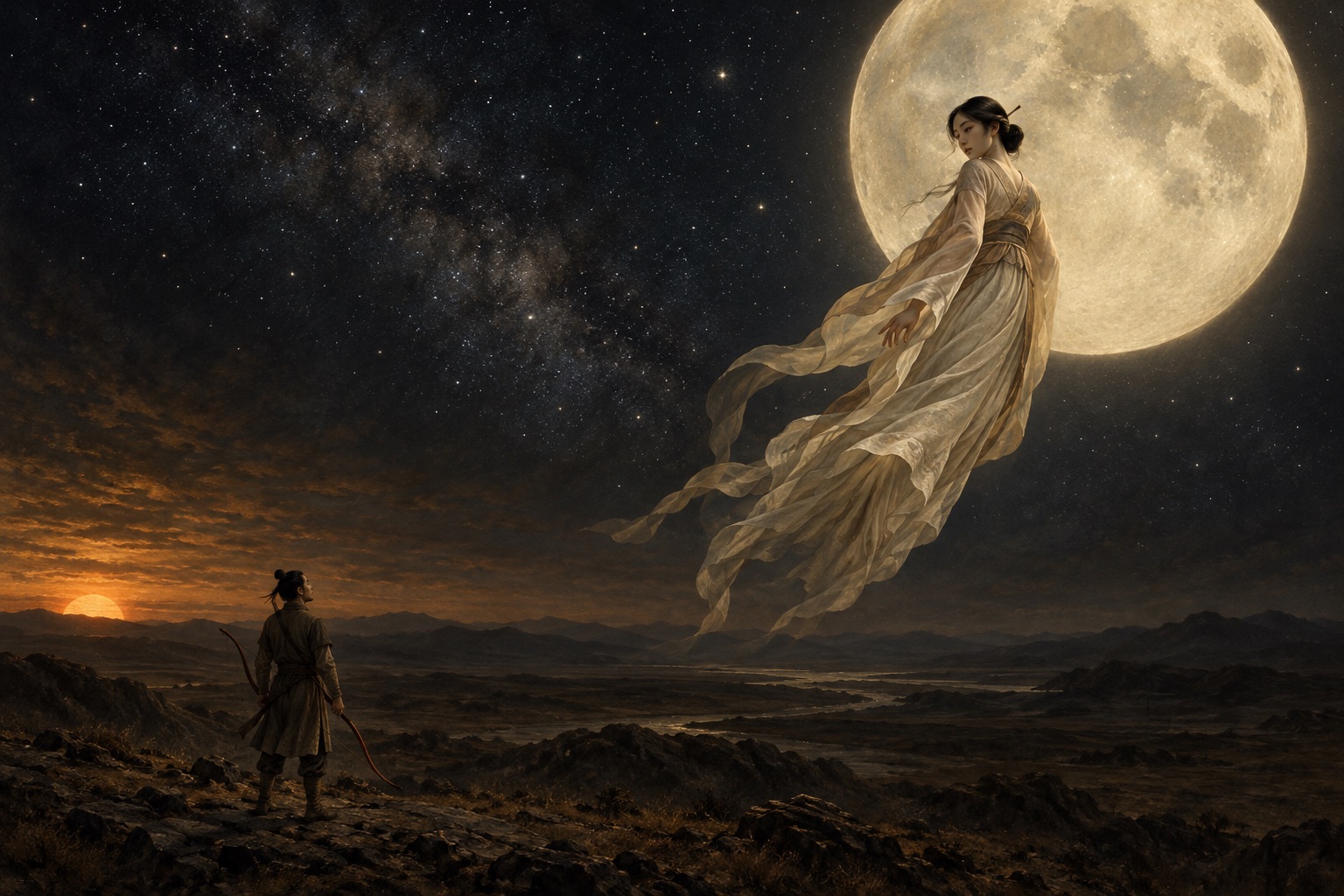
An archer shot down the suns that were burning the world, and a woman stole the elixir of immortality and fled to the moon. Today they are the married couple of the Mid-Autumn Festival. The oldest texts tell two separate stories.
- Type: myth; an archer hero and a moon goddess, two stories later joined into one
- Culture: China; known as Hằng Nga in Vietnam and Jōga in Japan
- Earliest texts: for the archer, the Tianwen of the Chuci (Warring States) and the Shanhaijing; for the woman, Qin-period bamboo slips of the lost Guizang; the Huainanzi (c. 139 BCE) is the first to name both in one sentence
- Key figures: Yi (羿), Heng’e, later Chang’e (姮娥, 嫦娥), Emperor Yao, Di Jun, the Queen Mother of the West (Xiwangmu)
Once, the old books say, ten suns rose together and burned the world, and an archer shot them down. Elsewhere in the same books, a woman swallowed a medicine against death and fled to the moon. It took several centuries for the two to become husband and wife.
Were Yi and Chang’e married? Not in the oldest texts. The Huainanzi puts them in one sentence but never says how they are related. The words “Heng’e was Yi’s wife” first appear in the commentary printed with it, around 200 CE. And the oldest fragments of the moon story, from the lost divination book Guizang, tell it without Yi, as far as they survive.
1 The Telling
These are two stories, each told here from its oldest full source. Section 3 shows how they were joined.
1-1 Ten Suns
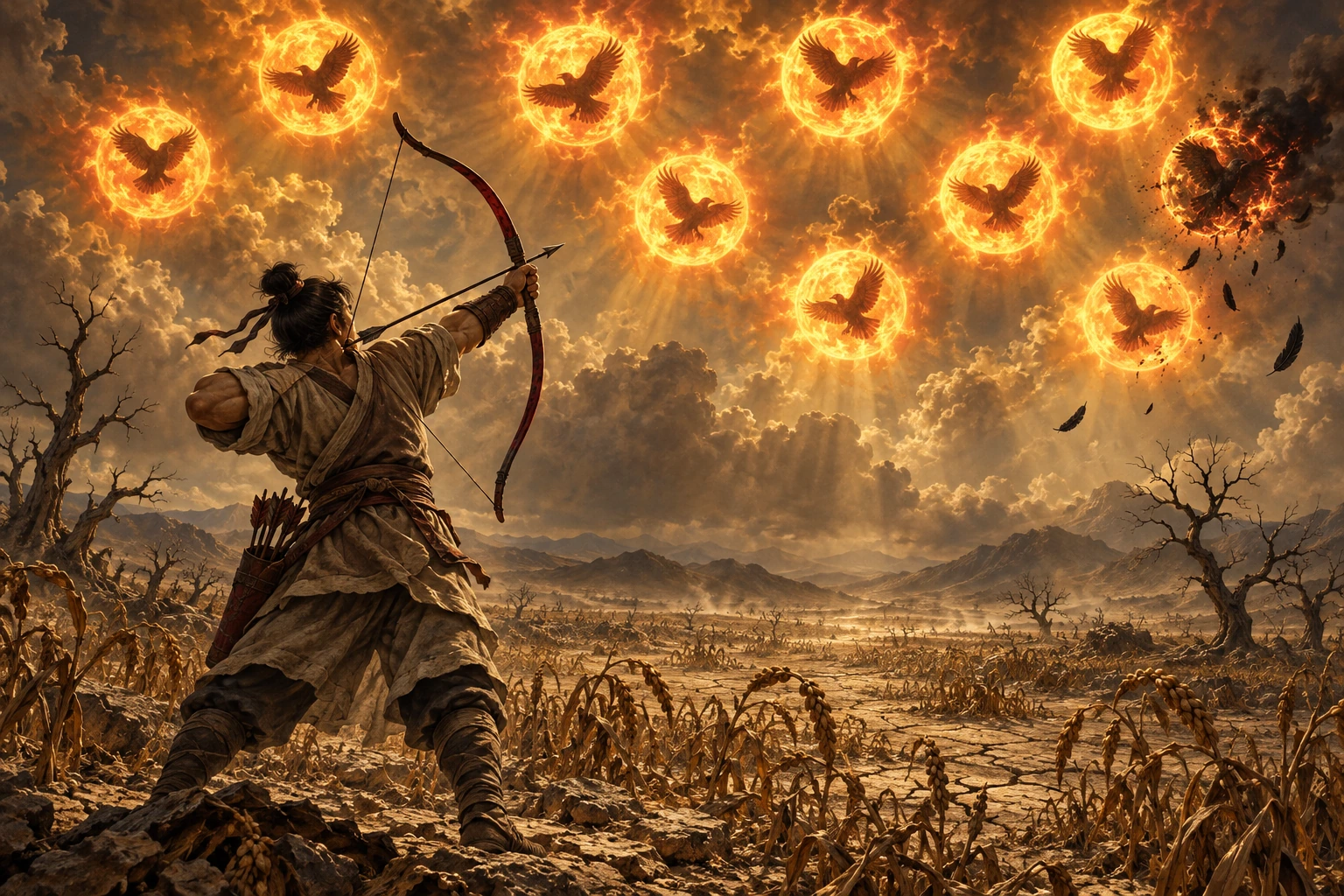
The Huainanzi, compiled at the court of Liu An, king of Huainan, tells it in the chapter “Benjing xun”. In the time of the sage-emperor Yao, ten suns came out together. They scorched the crops and killed the plants and trees, and the people had nothing to eat. Six monsters preyed on them as well, among them Chisel-Teeth, a giant boar and a long serpent.
So Yao sent Yi. He killed or caught the monsters one by one, and “shot the ten suns above”. All the people rejoiced and made Yao the Son of Heaven.
The text says “the ten suns”. It is the commentary that adds: “Ten suns came out together; Yi shot away nine.”
1-2 The Father of the Suns
The Shanhaijing (Classic of Mountains and Seas) knows where the suns came from. Di Jun had a wife, Xihe, who “gave birth to ten suns” and bathed them. They lived in the Fusang tree above the Hot Water Valley: “nine suns stay on the lower branches, one sun on the upper branch”. Each one crosses the sky carried by a crow.
The same book says that “Di Jun gave Yi a red bow and white corded arrows to help the lands below”. But it never says that Yi shot the suns. It sets the two facts side by side without joining them: the father of the suns is the god who armed the archer.
1-3 The Medicine of Immortality
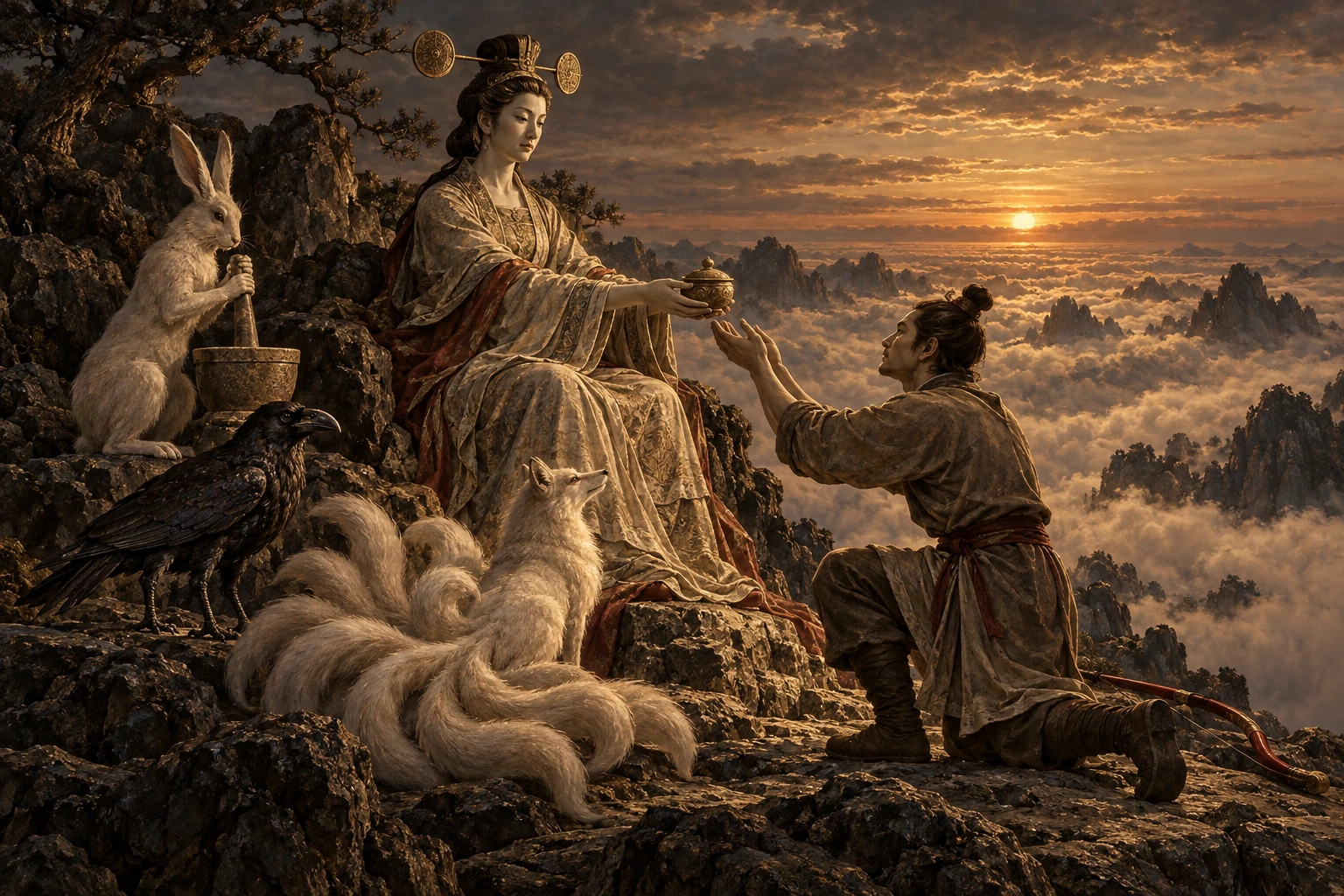
The oldest dated telling of the moon story is one sentence in another chapter of the Huainanzi, “Lanming xun”, used as a comparison in an argument about government: “It is like Yi, who asked the Queen Mother of the West for the medicine of immortality, and Heng’e stole it and fled to the moon. He was left forlorn, with no way to replace it. Why? He did not know where the medicine comes from.”
The author did not need to tell the story; his readers knew it. The commentary fills it in: “Heng’e was Yi’s wife.” Before Yi could take the medicine, she stole it and ate it, became an immortal, and fled into the moon “to be the moon’s essence”.
1-4 The Toad in the Moon
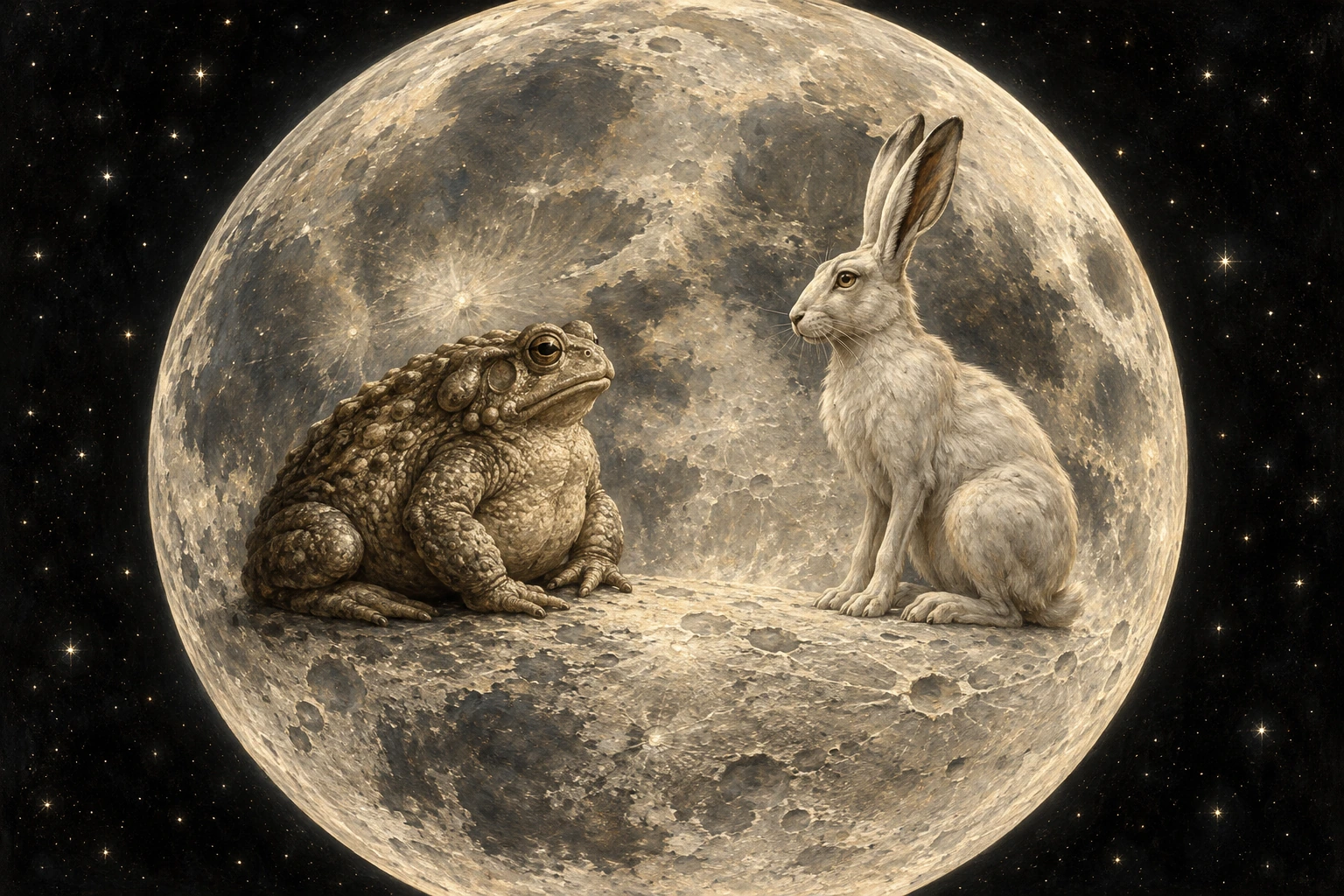
About two and a half centuries later the astronomer Zhang Heng (78–139 CE) told it again in his Lingxian, a treatise on the heavens, and gave it an ending. Before she left, Heng’e had her journey divined by one Youhuang, who answered: “Auspicious. Fluttering, the returning maiden sets out west alone. She will meet a dark and dim sky: let her not be alarmed, not be afraid. Afterwards there will be great prosperity.” So Heng’e entrusted herself to the moon, “and this became the toad”.
In the same passage Zhang Heng says that the moon’s yin essence “gathers into an animal that looks like a hare”. The toad and the hare have shared the moon ever since.
1-5 The Archer’s End
Yi did not end well either. Mencius records that Feng Meng learned archery from Yi, reckoned that Yi was the only man in the world better than himself, and killed him: “Yi too was at fault.” The Huainanzi says Yi died by a club of peach wood, and its commentary adds that this is why ghosts fear peach. Because “Yi rid the world of its harms”, another chapter says, he was honoured after death as the god Zongbu.
2 Where the Story Is Written Down
- The Tianwen (“Heavenly Questions”) of the Chuci, a Warring States poem made of questions, asks: “How did Yi shoot the suns? How did the crows shed their feathers?” Wang Yi’s 2nd-century commentary answers that Yi hit nine of them and “the nine crows in the suns all died”. The poem never mentions Heng’e.
- The Shanhaijing, compiled between the Warring States and the Han, has the ten suns, their mother, Di Jun’s bow and Yi’s fight with Chisel-Teeth.
- The Guizang, an old divination book that survives only in fragments. Bamboo slips found in 1993 in Qin tomb no. 15 at Wangjiatai (Hubei) are identified by scholars as part of it. Under the hexagram Gui mei, “The Returning Maiden”, one slip reads “In the past Heng’e (恒我) stole the [medicine] of immortality…”, another “…fled to the moon, and had it divined…”. Fragments quoted in later books keep the archer apart: “Yi was good at archery; he shot at the ten suns, and did bring them down.”
- The Huainanzi (c. 139 BCE) has the suns in “Benjing xun” and the medicine in “Lanming xun”, the chapter in which Nüwa mends the sky. Its commentary goes under the name of Gao You, who dates his work to 205–212 CE.
- Wang Chong’s Lunheng (c. 80 CE) quotes “the scholars’ books” for a version in which Yao himself shoots, “nine suns went away, and one sun kept coming out”, and calls it false: an arrow flies no more than a hundred paces.
- Zhang Heng’s Lingxian survives only as a quotation in a commentary on the Hou Hanshu. Its divination is so close to the Guizang that the Qing scholar Yan Kejun, long before the slips were found, filed it among the Guizang fragments.
- The Mawangdui banner, painted silk from a Western Han tomb in Changsha, shows a crescent moon with a toad and a hare.
3 Competing Versions
- Who shot the suns, and how many? In the Huainanzi, Yi, sent by Yao, shoots “the ten suns”. In the version Wang Chong rejects, Yao himself shoots and nine go away. For Wang Yi, the Huainanzi commentary and Guo Pu, who annotated the Shanhaijing under the Jin dynasty, it is nine, with one left in the sky.
- Two Yis.
- The Zuozhuan, in a speech set in 569 BCE, tells of Lord Yi of Youqiong (有窮后羿, Hou Yi), who took over the government of the declining Xia. “Trusting in his archery”, he neglected the people for hunting, and his own household killed him and boiled him.
- The Tianwen already mixes the two. Its Yi is “sent down by the Lord” to the Xia, shoots the river god He Bo, takes the goddess of the Luo River as his wife, and falls to a plot.
- The old Huainanzi commentary, as the Song scholar Hong Xingzu quotes it, warns that the Yi of Yao’s time “is not Hou Yi of Youqiong”. Yet the name almost everyone uses for the archer today is, in its oldest source, the usurper’s.
- Heng’e or Chang’e? The slips write 恒我, the Sibu congkan copy of the Huainanzi 𢘆娥, Zhang Heng 姮娥: all “Heng”. The usual explanation for “Chang” is the taboo on the personal name of Emperor Wen of Han, Liu Heng; chang (常) and heng (恒) both mean “constant”. Yet the Huainanzi and Zhang Heng, both later than Emperor Wen, still write Heng.
- Thief or victim? In every Han text she steals. The Tang poet Li Shangyin writes: “Chang’e must regret stealing the elixir: blue sea, blue sky, her heart night after night.” In the version told today on China’s national intangible heritage website, Yi’s pupil Pang Meng (蓬蒙), whose name echoes Mencius’s Feng Meng, threatens her with a sword, and she swallows the elixir so that he cannot have it. We have not found this version in any pre-modern text.
- Toad or beauty? For Zhang Heng she becomes the toad. Later, writes Kirimoto Tōta in Nipponica, the toad faded and she became a lonely, melancholy beauty, a favourite image of Tang poets.
4 History and Tradition
- Mid-Autumn. Moon-viewing is old in China, but it settled on the fifteenth night of the eighth month only from the Tang onward, writes Ueki Hisayuki.
- Meng Yuanlao’s memoir of Kaifeng (preface dated 1147) describes the night: new wine, crabs, crowds in the wine towers enjoying the moon. Chang’e does not appear.
- Jin Yingzhi, whose family had lived in the same city for generations, describes children burning incense to the moon. The boys pray to “climb the immortal cassia”, that is, to pass the examinations; the girls pray “to look like Chang’e, round as the bright moon”. It is the earliest link between Chang’e and the festival that we have found.
- Vietnam. She is Hằng Nga, chị Hằng: the name keeps the old “Heng”. Thiều Chửu’s dictionary gives 嫦娥, read Thường Nga, as “the same as Hằng Nga 姮娥”. She is not alone up there: Vietnamese tradition also puts Chú Cuội on the moon, and Huỳnh Tịnh Của’s dictionary of 1895 explains “Cuội’s banyan tree” as “the shadow of a tree seen on the face of the moon”.
- Japan. She is Jōga (嫦娥) or Kōga (姮娥), names already used in poems written in Japan in the 9th century. Shirakawa Shizuka traces how her tale grew into the “Kaguya-hime type” of story. In the Tale of the Bamboo Cutter, the moon princess goes home on the fifteenth night of the eighth month, leaving the emperor an elixir of immortality, which he has burned on Mount Fuji.
- To the moon. China’s lunar exploration programme is named after Chang’e. Its first probe was launched on 24 October 2007, about six weeks after Japan’s SELENE, which the public had nicknamed Kaguya. In 2013 the rover of Chang’e-3 was named Yutu, “Jade Rabbit”, by an online vote.
It is often said that Mid-Autumn moon worship began when Hou Yi set out offerings for his lost wife. We have found no early text that says so. The Han texts give no date for her flight, and the oldest account linking her with the festival that we found has girls praying to look like her, not mourning her.
5 Related Stories
- Nüwa: The Serpent-Bodied Goddess Who Mended the Sky: the Huainanzi chapter in which Nüwa mends the sky, “Lanming xun”, is the one that closes with Heng’e stealing the elixir. The Tianwen asks about Nüwa and about Yi.
- Amaterasu and the Rock Cave: The Day the Sun Hid: China once had too many suns, and Japan for a while had none. Writing on sun myths for Heibonsha’s World Encyclopedia, the mythologist Ōbayashi Taryō counts Yi among the heroes who shoot down suns, and the rock cave among the myths of a hidden sun drawn back out.
- Jumong: The Archer Born from an Egg: another East Asian hero whose story rests on his bow. We have not found a scholar who compares the two; we link them for the theme.
- The Churning of the Ocean: Gods, Demons and the Nectar of Immortality: two stories about a drink against death. In India the gods churn the ocean to win it; in China one woman takes it and ends up alone on the moon.
- Chú Cuội: The Man on the Moon: the man Vietnamese tradition puts on the moon with Hằng Nga, at the foot of his banyan. As early as 1886, A. Landes noted that the woodcutters’ Cuội, forever cutting his tree, seemed “a confusion” with Wu Gang.
6 Sources
- Huainanzi, “Lanming xun”, “Benjing xun”, “Fanlun xun”, “Quanyan xun”, Sibu congkan reprint of a copy of a Northern Song edition, with the Han commentary (labelled Xu Shen’s in the reprint; Gao You’s preface is included): Wikisource, Wikisource
- Chuci, “Tianwen”, with Wang Yi’s commentary and Hong Xingzu’s supplement (Sibu congkan): Wikisource
- Shanhaijing, “Haiwai dongjing”, “Dahuang nanjing”, “Haineijing” and other chapters: Wikisource; with Guo Pu’s commentary (Sibu congkan, juan 9): Wikisource
- Zhang Heng, Lingxian: Wikisource; Yan Kejun, Quan shanggu sandai wen, juan 15 (Guizang fragments): Wikisource
- Zuozhuan, Duke Xiang 4; Mengzi, “Lilou xia”; Wang Chong, Lunheng, “Ganxu”; Li Shangyin, “Chang’e”; Meng Yuanlao, Dongjing menghua lu, juan 8; Jin Yingzhi, Zuiweng tanlu, juan 4 (Wikisource)
- On the Wangjiatai slips: Shen Jianhua in Chutu wenxian 10 (Tsinghua University); Wang Huaping, Chinese Social Sciences Today, 16 January 2026 (cssn.cn); Li Chongrong, The Paper, 15 February 2022 (thepaper.cn); R. P. R. Kostecki (2022), quoting Edward L. Shaughnessy, Unearthing the Changes (2014) (PDF)
- “嫦娥”, “羿”, “中秋節”, “太陽”, “竹取物語”, Nipponica, Sekai Daihyakka Jiten, Nihon Kokugo Daijiten: Kotobank, Kotobank, Kotobank, Kotobank
- Huỳnh Tịnh Của, Đại Nam quấc âm tự vị (1895): Vietnamese Wikisource; Thiều Chửu, Hán Việt tự điển: hvdic.thivien.net
- China Intangible Cultural Heritage Network, “中秋夜,团圆时”: ihchina.cn; eoPortal, “Chang’e-1”: eoportal.org; NASA, “Kaguya”: science.nasa.gov; The Planetary Society, 27 November 2013: planetary.org; Xinhua on the Mawangdui banner, 19 May 2025: hunantoday.cn
Cover and illustrations: AI-generated images made for Arcana. They are interpretations, not historical artworks.