The Yellow Emperor: The Victor of Zhuolu Who Rode a Dragon to Heaven
He beat the storm-calling Chiyou with the help of a drought goddess, and rode a dragon into the sky from the foot of Mount Jing. Sima Qian made him the first sovereign of Chinese history, but no inscription names him before the 4th century BCE.
- Type: myth and legend; a god of the Qin and Han altars, the first sovereign of Chinese history, and later the ancestor of a nation
- Culture: China; Hoàng Đế in Vietnam, Kōtei in Japan
- Earliest texts: a bronze vessel of King Wei of Qi (4th century BCE); the Classic of Mountains and Seas (Shanhaijing); the Records of the Grand Historian (Shiji, c. 94 BCE), which opens with him
- Key figures: the Yellow Emperor (黃帝, Huangdi), Yandi, Chiyou, the drought goddess Ba, Yinglong, Leizu, Cangjie
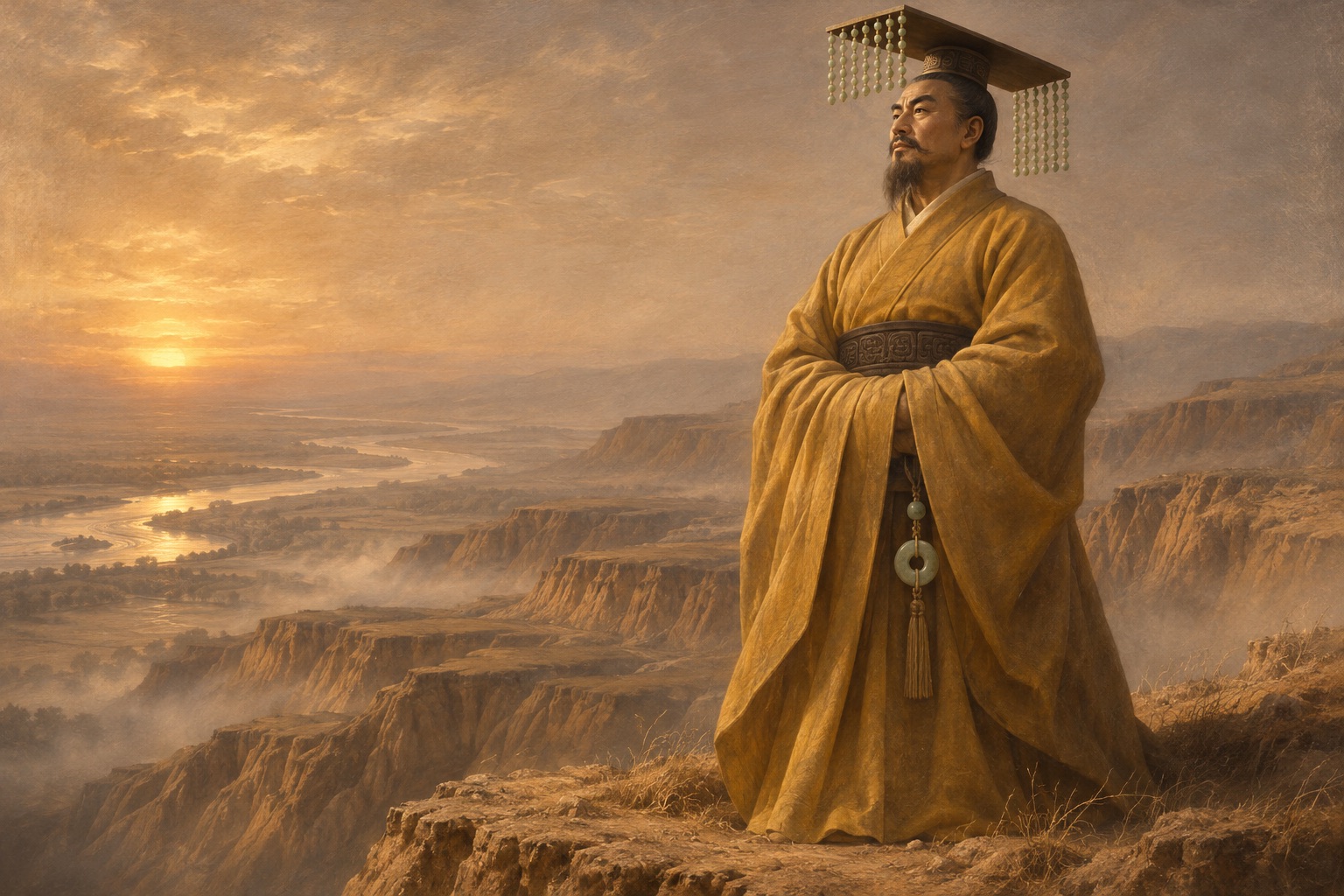
Chinese history, as Sima Qian wrote it, begins with a war. A young lord named Xuanyuan defeated the Flame Emperor, killed the rebel Chiyou and was raised by all the lords as Son of Heaven. In Sima Qian’s account, the sage kings after him and the founders of the Xia, the Shang and the Zhou were all his descendants.
Why “yellow”? Sima Qian gives the reason: “He had the auspicious sign of the virtue of earth, so he was called the Yellow Emperor.” In the theory of the five phases, yellow is the colour of earth and of the centre. And di (帝) means “lord” as well as “emperor”: it is the word for the high god too. The Chinese word for “emperor”, huangdi (皇帝), sounds exactly the same but is written differently (section 3).
1 The Telling
The story follows Sima Qian’s “Basic Annals of the Five Emperors” (Wudi benji), the first chapter of the Shiji, and, for the battle and the end, the Shanhaijing and his “Treatise on the Feng and Shan Sacrifices” (Fengshan shu).
1-1 Banquan
The Yellow Emperor was the son of Shaodian; his surname was Gongsun and his name Xuanyuan. He was born with spirit powers and could speak as an infant. In his time the house of Shennong was in decline. The lords raided one another, and Shennong could not stop them.
So Xuanyuan took up shield and halberd, and the lords came over to him. When Yandi, the Flame Emperor, tried to bully the lords, Xuanyuan trained bears, panther-like beasts and tigers and met him in the field of Banquan. “Three battles, and then he had his way.”
1-2 Zhuolu
Chiyou rebelled next, “the most violent of all”. Xuanyuan called up the armies of the lords, fought him in the field of Zhuolu, captured him and killed him. The lords made Xuanyuan Son of Heaven in place of Shennong: “this was the Yellow Emperor”.
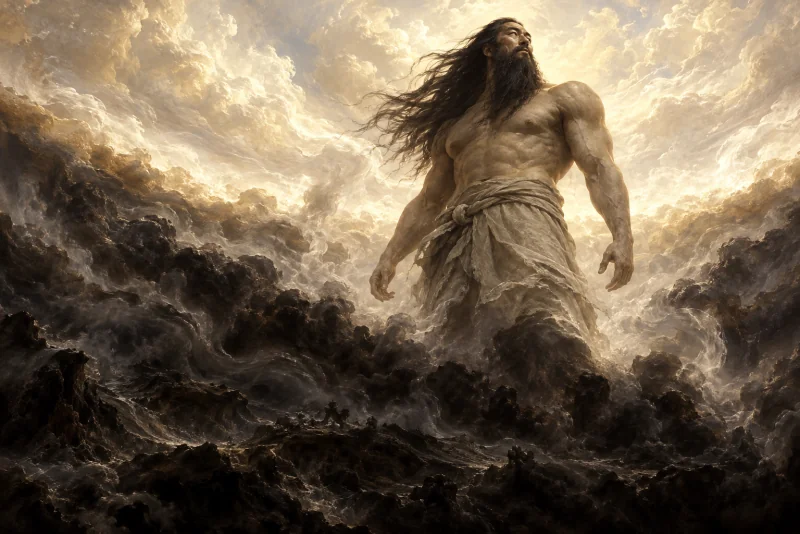
The Shanhaijing, in its “Classic of the Great Wilds: North” (Dahuang beijing), tells the battle as a war of weather. Chiyou made weapons and attacked the Yellow Emperor, who sent the dragon Yinglong against him. Yinglong stored up the waters. Chiyou called on the Wind Earl and the Rain Master, who loosed a great wind and rain. Then the Yellow Emperor sent down a heavenly woman dressed in blue-green, Ba, called his daughter. The rain stopped, and Chiyou was killed.
But Ba could not go back up to heaven, and where she lives no rain falls. She was settled north of the Red Water. When she strays, people drive her out with the command “Goddess, go north!”, and first they clear the waterways and open the ditches. Yinglong could not go back either. Another chapter says it lives at the southern pole, and in a drought people make its image and the rain comes. Ba herself appears in an older book: the Shijing poem “Yun Han”, a prayer in a great drought, already says that “Ba the drought demon does her cruelty”.

1-3 The Yellow Emperor’s Court
The Shiji says he travelled to the sea in the east and to Kongtong in the west, never staying long in one place. He named his officials after clouds, obtained a precious tripod and reckoned the calendar by the sun. He had twenty-five sons, and fourteen of them received surnames.
His principal wife was Leizu, the daughter of Xiling. She bore two sons, and “their descendants all held the realm”: Zhuanxu, the next of the Five Emperors, was her grandson, and the line runs on to Yao, Shun and Yu. “From the Yellow Emperor to Shun and Yu, all were of one surname.”
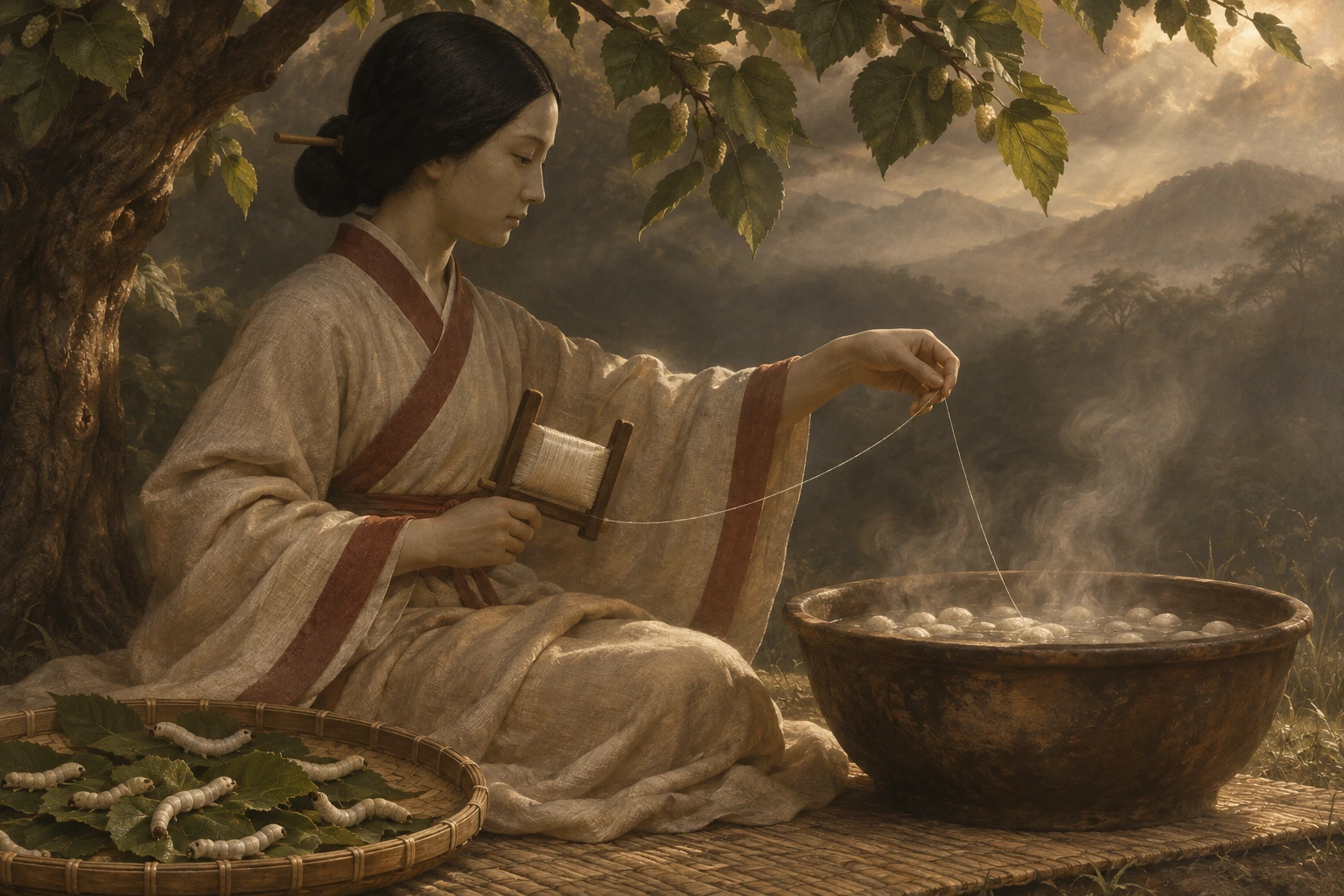
Later books filled his court with inventors. Xu Shen’s preface to the Shuowen jiezi (c. 100 CE) says that Cangjie, the Yellow Emperor’s scribe, “saw the tracks of birds and beasts” and made the first written signs. The Huainanzi adds that when Cangjie made writing, “heaven rained millet and ghosts wept at night”. Later still, his wife Leizu was honoured as the first to raise silkworms (section 3).
1-4 The Dragon at Mount Jing
In the Shiji’s annals the Yellow Emperor simply dies and is buried on Mount Qiao. But the treatise on the sacrifices records another ending, told to Emperor Wu of Han by Gongsun Qing, a man of Qi who claimed to have it from a dead teacher.
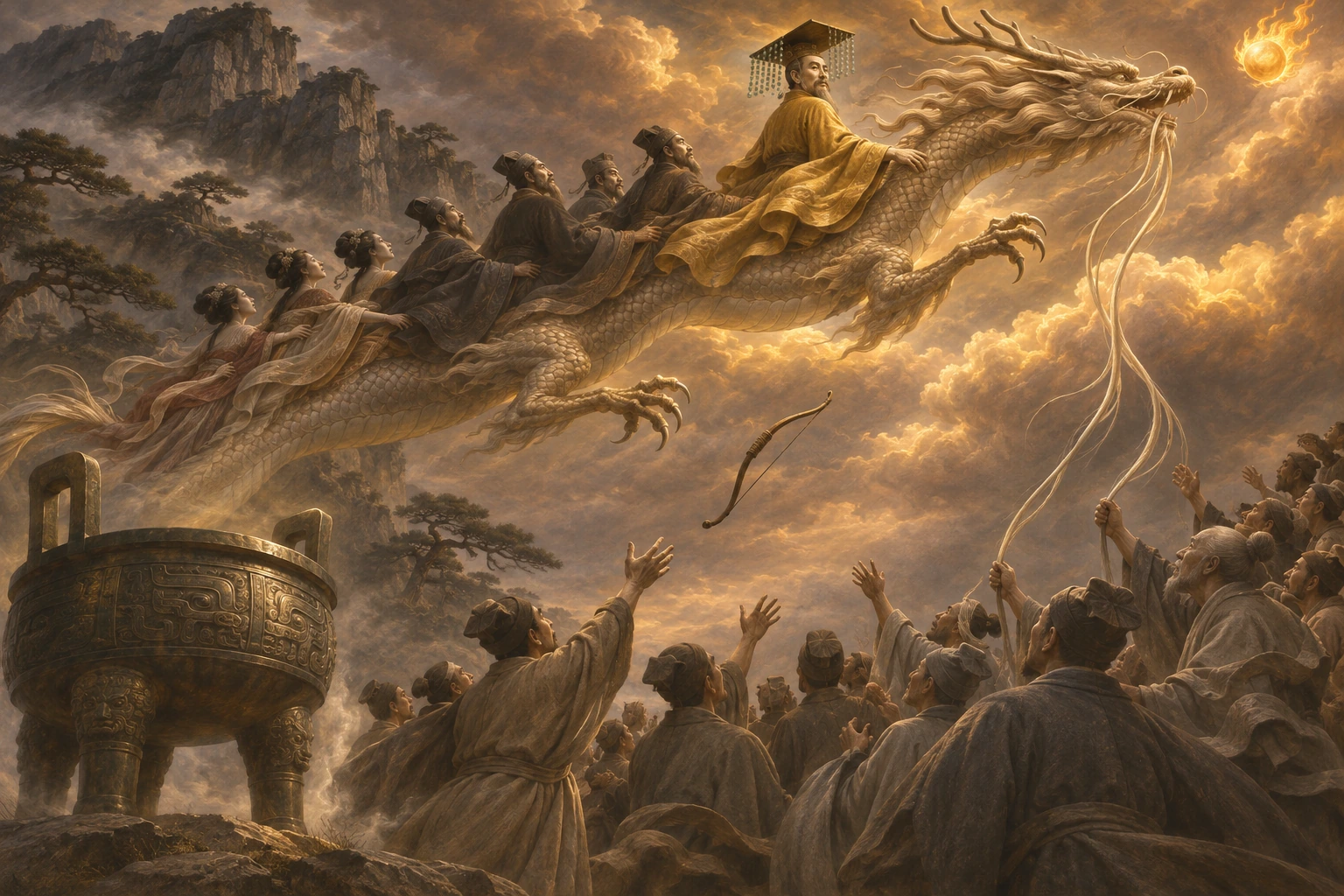
The Yellow Emperor took copper from Mount Shou and cast a tripod at the foot of Mount Jing. When it was finished, a dragon came down for him, its whiskers hanging. He climbed on, and more than seventy ministers and palace women climbed on after him. Then the dragon rose. The lesser officials who could not get on clung to its whiskers, which tore out, and the Yellow Emperor’s bow fell. The people looked up after him, clutching the bow and the whiskers, and wailed. The place has been called Dinghu, “Tripod Lake”, ever since, and the bow Wuhao.
Emperor Wu sighed: “If I could truly be like the Yellow Emperor, I would leave my wife and children as easily as kicking off a slipper.”
2 Where the Story Is Written Down
- The oldest name. Western Zhou bronzes praise ancestors back only to Kings Wen and Wu, writes the historian Wang Ming-ke. The first inscription to name the Yellow Emperor is on a bronze of King Wei of Qi, 4th century BCE: “gaozu Huangdi”. It is usually read “my high ancestor the Yellow Emperor”; Guo Moruo read it as “far off, I take the Yellow Emperor as model”.
- The Guoyu (“Discourses of the States”, “Jinyu 4”) makes the Yellow Emperor and Yandi brothers, sons of Shaodian, raised by the Ji and the Jiang rivers.
- The Yi Zhoushu (“Changmai”), a collection of Zhou documents whose dates are debated, has Chiyou drive out the Red Emperor at the river of Zhuolu.
- The Shanhaijing has the storm battle (“Dahuang beijing”), Yinglong (“Dahuang dongjing”), and a family tree in which Leizu bears Changyi and the Yellow Emperor’s grandson is Gun, the father of Yu (“Hainei jing”).
- The Da Dai Liji (“Wudi de”) has Confucius answer questions about him.
- Sima Qian, Shiji, finished about 94 BCE: the annals and the treatise above. He ends the annals uneasily: the Shangshu records nothing before Yao, and “the hundred schools speak of the Yellow Emperor, but their words are not elegant, and the learned gentlemen find them hard to speak of”. He travelled to Kongtong and Zhuolu, heard the elders, and chose “the words that were most elegant”.
- The Huainanzi (139 BCE) makes him the Lord of the Centre, “earth”, with Houtu as his helper, the planet Saturn as his spirit and the yellow dragon as his beast (“Tianwen xun”).
- Han art. On the west wall of the Wu Liang Shrine in Shandong (Eastern Han), he stands, with a label, in the line of ancient sovereigns that begins with Fuxi and Nüwa.
3 Competing Versions
- Brother, enemy, or ally? In the Guoyu the Yellow Emperor and Yandi are brothers. In the Shiji he fights Yandi at Banquan, then Chiyou at Zhuolu. In the Da Dai Liji his enemy at Banquan is the Red Emperor. In the Yi Zhoushu it is Chiyou who drives out the Red Emperor; the Red Emperor, “greatly afraid”, turns to the Yellow Emperor, who seizes Chiyou and kills him.
- Who was Chiyou? A violent rebel in the Shiji; a lord of storms in the Shanhaijing. In a passage of the Hanfeizi quoted in the encyclopedia Taiping yulan, he walks at the head of the Yellow Emperor’s procession on the western Mount Tai, while the Wind Earl sweeps the road and the Rain Master sprinkles it. Qi worshipped him as the “Lord of Arms”, and Liu Bang, the founder of the Han, sacrificed to him when he took up arms (Fengshan shu). Later books have him raise a fog, which the Yellow Emperor pierces with a south-pointing chariot.
- Four faces, three hundred years. In the Shizi, quoted in the same encyclopedia, Zigong asks whether it is true that the Yellow Emperor had four faces. Confucius answers that he chose four men to govern the four quarters. In the Da Dai Liji, Zai Wo asks: “Was the Yellow Emperor a man, or not a man? How did he reach three hundred years?” A hundred years of benefit while he lived, Confucius explains, a hundred years of awe at his spirit, a hundred years of his teaching.
- Buried or taken up? In the annals he dies and is buried on Mount Qiao. In the treatise the dragon takes him. When Emperor Wu, sacrificing at the tomb, asked why a man who never died had a grave, someone answered: “The Yellow Emperor had become an immortal and gone up to heaven; his ministers buried his robes and cap.”
- Who gave silk? The Shiji calls Leizu his principal wife and says nothing about silk. According to the Book of Sui, the Northern Qi offered the spring rite of the First Sericulturist to the Yellow Emperor himself, while the Northern Zhou offered it to “the spirit of the lady of Xiling”. A Qing ritual compendium quotes a Song history for the sentence that she “first taught the people to raise silkworms”; we did not find it in the copy of that history we checked. The Southern Song Lushi of Luo Mi (1170) already has the Yellow Emperor order the lady of Xiling to promote sericulture, and she gathers mulberry leaves herself.
- 黃帝 and 皇帝. In 221 BCE the king of Qin, master of all China, dropped tai from “Supreme August One”, kept huang, “august”, added the di of the ancient lords “and called himself huangdi”: the First Emperor. The two words sound the same in Chinese, in Japanese (kōtei) and in Vietnamese (hoàng đế). In the Shangshu chapter “Lü xing”, Chiyou is the first rebel, the Miao follow him with cruel punishments, and the one who pities their victims and cuts off the Miao is called 皇帝, “the august lord”. The Heibonsha Mypedia notes the view that the Yellow Emperor’s name grew from 皇帝, a title of the Lord of Heaven.
4 History and Tradition
- A god before a king. Sima Qian says that in the 5th century BCE Duke Ling of Qin built an upper altar for the Yellow Emperor and a lower one for Yandi. When Liu Bang, founder of the Han, asked which gods the Qin altars served, he was told: the white, green, yellow and red Lords; he added the black one to make five. At these altars the Yellow Emperor was a god, one of the Lords on High, each with his colour.
- Huang-Lao. In the early Han, “Huang-Lao”, the teaching of the Yellow Emperor and Laozi, was the art of government. Empress Dowager Dou “loved the words of the Yellow Emperor and Laozi”, and the emperor and the heir had to read them. The Hanshu bibliography lists books under his name in many fields, and the Huainanzi says why: “Those who teach the Way must attach it to Shennong and the Yellow Emperor before they can get a hearing.”
- Mawangdui. In 1973 four lost texts were found copied on the same silk as a Laozi in a Han tomb at Mawangdui, Changsha. Tang Lan suggested they were the Four Classics of the Yellow Emperor of the Hanshu list. Many follow him, but it cannot be proved, and only one of the four mentions the Yellow Emperor.
- The Huangdi neijing. Medicine’s classic, the Inner Classic of the Yellow Emperor, is listed in the Hanshu in eighteen scrolls. The Suwen and Lingshu that carry its name are dialogues between the Yellow Emperor and his physician Qibo, built up over a long time rather than written by one author.
- The tomb at Huangling. The grave on Mount Qiao, in Huangling County, Shaanxi, was among China’s first protected monuments in 1961, numbered “ancient tombs no. 1”. Public and folk sacrifices are held there every year at Qingming and the Double Ninth, and the rites were placed on the national intangible heritage list in 2006. At Qingming 1937 the Nationalists and the Communists sacrificed there together, on the eve of the war with Japan. Mao Zedong’s address, read by Lin Boqu, recalled “the hard fight at Zhuolu”.
- “Descendants of Yan and Huang.” In 1903 the revolutionary Liu Shipei proposed counting the years from the Yellow Emperor: “the Yellow Emperor is the Yellow Emperor of the Han people”. The revolutionary paper Minbao dated 1905 as year 4603, and the revolutionary governments of 1911 used the same count. Reformers such as Kang Youwei replied that the Manchus too were his descendants. The historian Wang Ming-ke, following Patricia Ebrey, shows that claiming descent from him is much older: Tang and Song family histories already traced themselves to Yandi and the Yellow Emperor.
- Japan and Vietnam. In Japan, Nipponica notes that Chiyou’s cult as a war god reached ancient Japan as Hyōsu no kami (兵主神). The Taisu version of the Inner Classic, lost in China from about the Southern Song, survives in an old manuscript at Ninna-ji in Kyoto, a National Treasure. In the Vietnamese Lĩnh Nam chích quái, Âu Cơ cannot take her children north because the Yellow Emperor has closed the border.
“The Yellow Emperor reigned about 4,700 years ago” is often said as fact. No inscription names him before the 4th century BCE, and the oldest Zhou books, the Shijing and the Shangshu, never mention him. The figure matches the revolutionaries’ calendar, which made 1905 the year 4603. In 1923 the historian Gu Jiegang proposed that “the later the age, the longer the legendary ancient history”: the Zhou knew no one older than Yu, Confucius knew Yao and Shun, the Warring States added the Yellow Emperor and Shennong, and after the Han came Pangu. Even Sima Qian was uneasy (section 2).
5 Related Stories
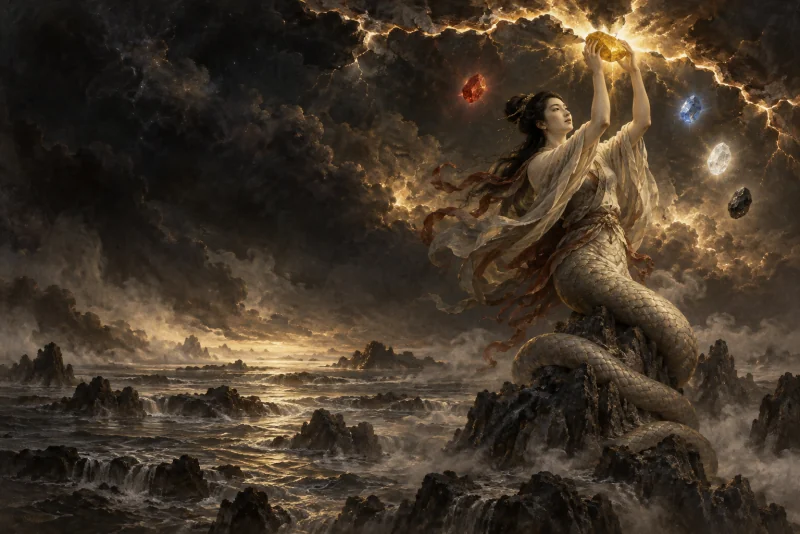
- Nüwa: The Serpent-Bodied Goddess Who Mended the Sky: Sima Qian begins with the Yellow Emperor. The sovereigns placed before him, Fuxi, Nüwa and Shennong, were added in the Tang by Sima Zhen, in his “Basic Annals of the Three Sovereigns”.
- Yu the Great: The Man Who Tamed the Flood: in the Shiji, Yu is the Yellow Emperor’s great-great-grandson, through Changyi, Zhuanxu and Gun. In the Shanhaijing, Gun is his grandson.
- The Chinese Dragon: The Long, Bringer of Rain and Emblem of Emperors: the dragon that came down for him at Mount Jing, Yinglong who stored the waters, and the yellow dragon that is his beast as Lord of the Centre.
- Lạc Long Quân and Âu Cơ: The Dragon, the Fairy and the Hundred Eggs: the Vietnamese founders trace their line to Shennong, whose house the Yellow Emperor replaced, and in that story the Yellow Emperor’s closed border keeps Âu Cơ in the south.
6 Sources
- Sima Qian, Shiji, “Wudi benji”, “Qin Shihuang benji”, “Xia benji”, “Fengshan shu”, “Waiqi shijia”: Wikisource, Wikisource, Wikisource
- Shanhaijing, “Dahuang beijing”, “Dahuang dongjing”, “Hainei jing” (Wikisource text from the Siku quanshu copy): Wikisource, Wikisource, Wikisource
- Guoyu, “Jinyu 4”, with Wei Zhao’s commentary: Wikisource; Yi Zhoushu, “Changmai”: Wikisource; Da Dai Liji, “Wudi de”: Wikisource; Shangshu, “Lü xing”: Wikisource
- Huainanzi, “Tianwen xun”, “Benjing xun”, “Xiuwu xun”: Wikisource; Xu Shen, Shuowen jiezi, preface: Wikisource
- Taiping yulan, juan 79 (quoting the Shizi and the Hanfeizi): Wikisource; Hanshu, “Yiwen zhi”: Wikisource; Suishu, “Liyi 2”: Wikisource; Luo Mi, Lushi, juan 14: Wikisource; Shijing, “Yun Han”: Wikisource
- Wang Ming-ke, “Lun panfu: jindai Yan-Huang zisun guozu jiangou de gudai jichu”, Bulletin of the Institute of History and Philology 73.3: 583–624: PDF
- Gao Xinhua, “Qi Weiwang ‘gaozu Huangdi’ zai renshi” (2008) and “Huangdi, Huang-Lao yu Daojia zhengtong”: aisixiang.com, aisixiang.com
- Chen Xueran on Gu Jiegang, quoting his letter of 1923 and the preface to Gushi bian vol. 4, Journal of Chinese Studies 62 (2016): CUHK; Wang Chunxia on the Huangdi calendar, Twenty-First Century online, October 2004: CUHK
- China Intangible Cultural Heritage Network, “黄帝陵祭典” and “嫘祖信俗”: ihchina.cn, ihchina.cn; interview with Zhang Maoze, China News, 28 March 2023: chinanews.com.cn; Zeng Jun on the joint sacrifice of 1937, The Paper, 10 April 2020: thepaper.cn
- Institute of History and Philology, Academia Sinica, Wu Liang Shrine west wall rubbing
- “黄帝”, “蚩尤”, “蒼頡”, “黄帝内経”, “黄老”, Sekai Daihyakka Jiten, Nipponica, Mypedia: Kotobank, Kotobank, Kotobank, Kotobank, Kotobank
Cover and illustrations: AI-generated images made for Arcana. They are interpretations, not historical artworks.