Yu the Great: The Man Who Tamed the Flood
His father stole a soil that grew by itself to block the flood and was put to death for it; Yu dug the waters a way to the sea and became the founder of China's first dynasty. In the oldest witnesses he is not yet a king, but a worker sent by Heaven.
- Type: myth and legend; a flood hero who becomes the founder of the first dynasty
- Culture: China; known as Đại Vũ in Vietnam and as U (禹) in Japan
- Earliest texts: a Western Zhou bronze, the Bin Gong xu (probably 9th century BCE; bought on the art market, not excavated); hymns of the Shijing; the Shangshu (“Yao dian”, “Yu gong”, “Hong fan”); the Tianwen of the Chuci and the Shanhaijing (Warring States to Han); Sima Qian’s Shiji (c. 94 BCE)
- Key figures: Yu (禹), his father Gun (鯀), the Lord on High, Zhurong, Yao and Shun, the woman of Tushan and her son Qi (啓)
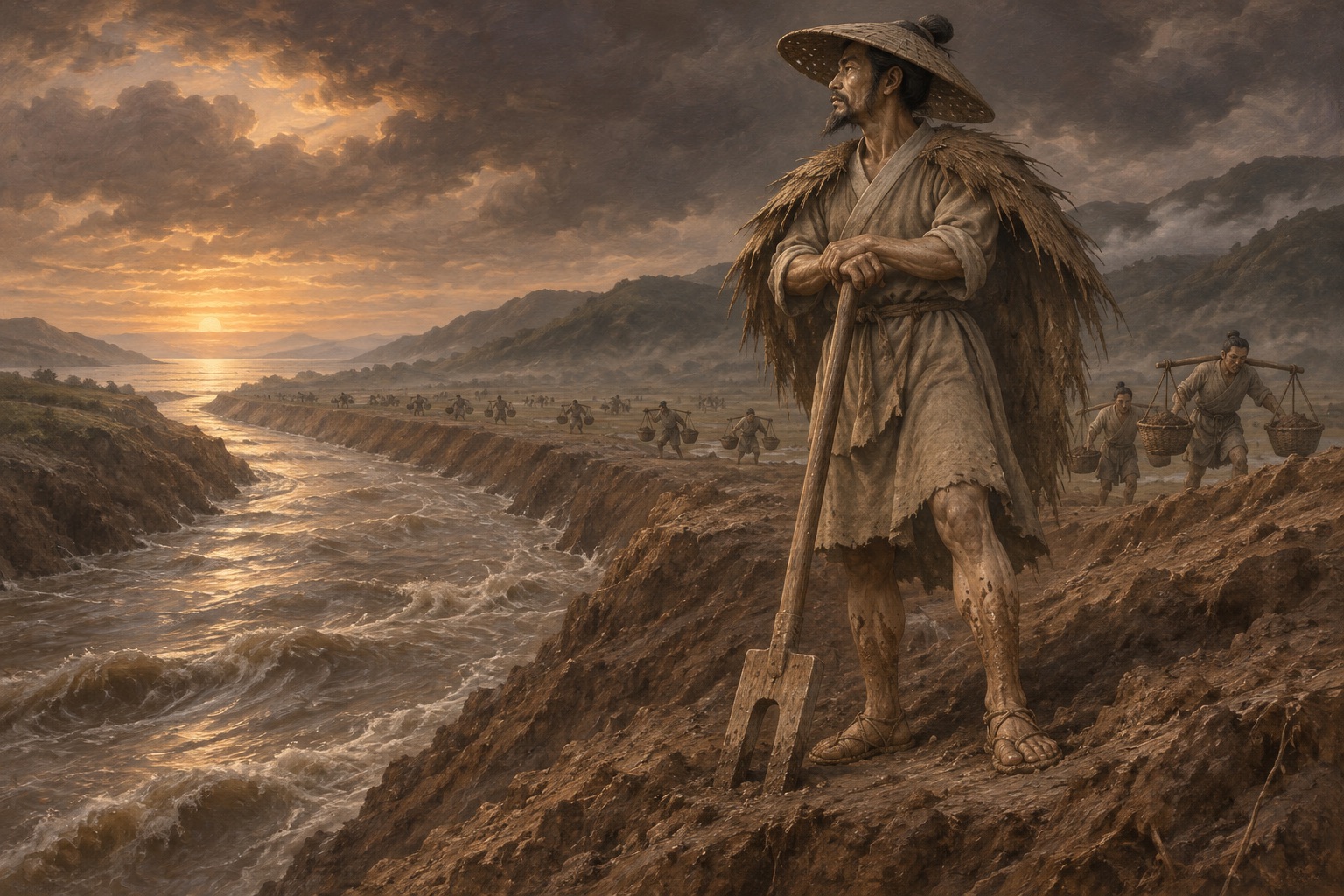
Once, the old books say, the waters rose to the sky. They wrapped around the mountains and climbed over the hills, and people made nests in the trees or dug caves on the heights. A father tried to stop the water and was put to death for it. His son spent years digging it a road to the sea, and the histories made him the founder of the Xia, the first of China’s dynasties.
Did Yu really pass his own door three times? That is Mencius’s version: Yu was “eight years away from his home, and though he thrice passed the door of it, he did not enter” (James Legge’s translation). Sima Qian’s Shiji says thirteen years, and that passing his gate he “did not dare” go in, without counting the times. The Shizi says ten years, the Han Wu Yue chunqiu seven. The numbers change; in every version he stays outside.
1 The Telling
No single text tells the whole story. Gun’s part comes mostly from the Classic of Mountains and Seas (Shanhaijing) and the Tianwen, Yu’s labours from the Shangshu and the Shiji, and the marvels around them from later books, named as they appear.
1-1 The Soil That Grew by Itself
The Shanhaijing ends, in its “Haineijing”, with the whole myth in a few lines: “The flood waters swelled to the sky. Gun stole the Lord’s self-growing soil to dam the flood, without waiting for the Lord’s command. The Lord had Zhurong kill Gun on the outskirts of Feather Mountain. From Gun, Yu was born. The Lord then commanded Yu to finish spreading out the soil, and so to settle the Nine Provinces.”
The soil, xirang (息壤), is in Guo Pu’s commentary of the early 4th century “earth that grows by itself without limit, so that it can block a flood”. Guo Pu also quotes an old divination book, which the Qing scholar Yan Kejun filed among the fragments of the lost Guicang: “Gun died, and for three years he did not rot. He was cut open with a blade of Wu, and turned into a yellow dragon.” In another quotation that Yan Kejun collected, from the Tang encyclopedia Chuxue ji, it ends: “and from him came Yu”.
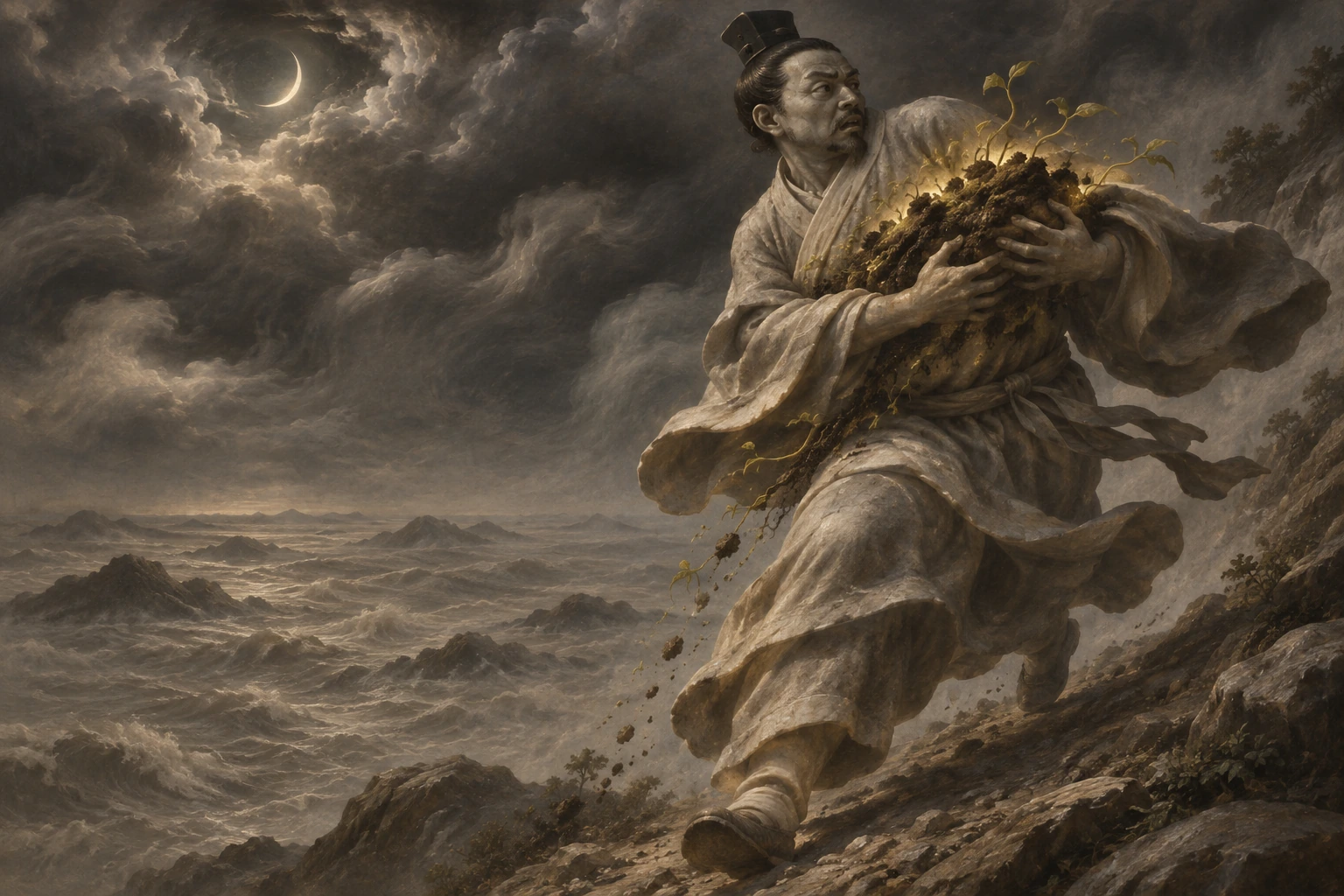
The Tianwen, a Warring States poem made of questions, asks what the myth leaves out: “If he did as they wished and the work went well, why did the Lord punish him?” “Shut away on Feather Mountain, why was he not released for three years?” “What did Gun plan? What did Yu achieve?”
1-2 Thirteen Years Away
Sima Qian’s Shiji, in its “Xia benji”, turns the myth into history, mostly in the words of the Shangshu. In the time of Emperor Yao the waters “swelled to the sky, wrapping the mountains and rising over the hills”. The court proposed Gun; Yao doubted him, but let him try. After nine years the water had not gone down, and Shun, acting for Yao, put Gun to death on Feather Mountain. Then he raised Gun’s son Yu to carry on the task.
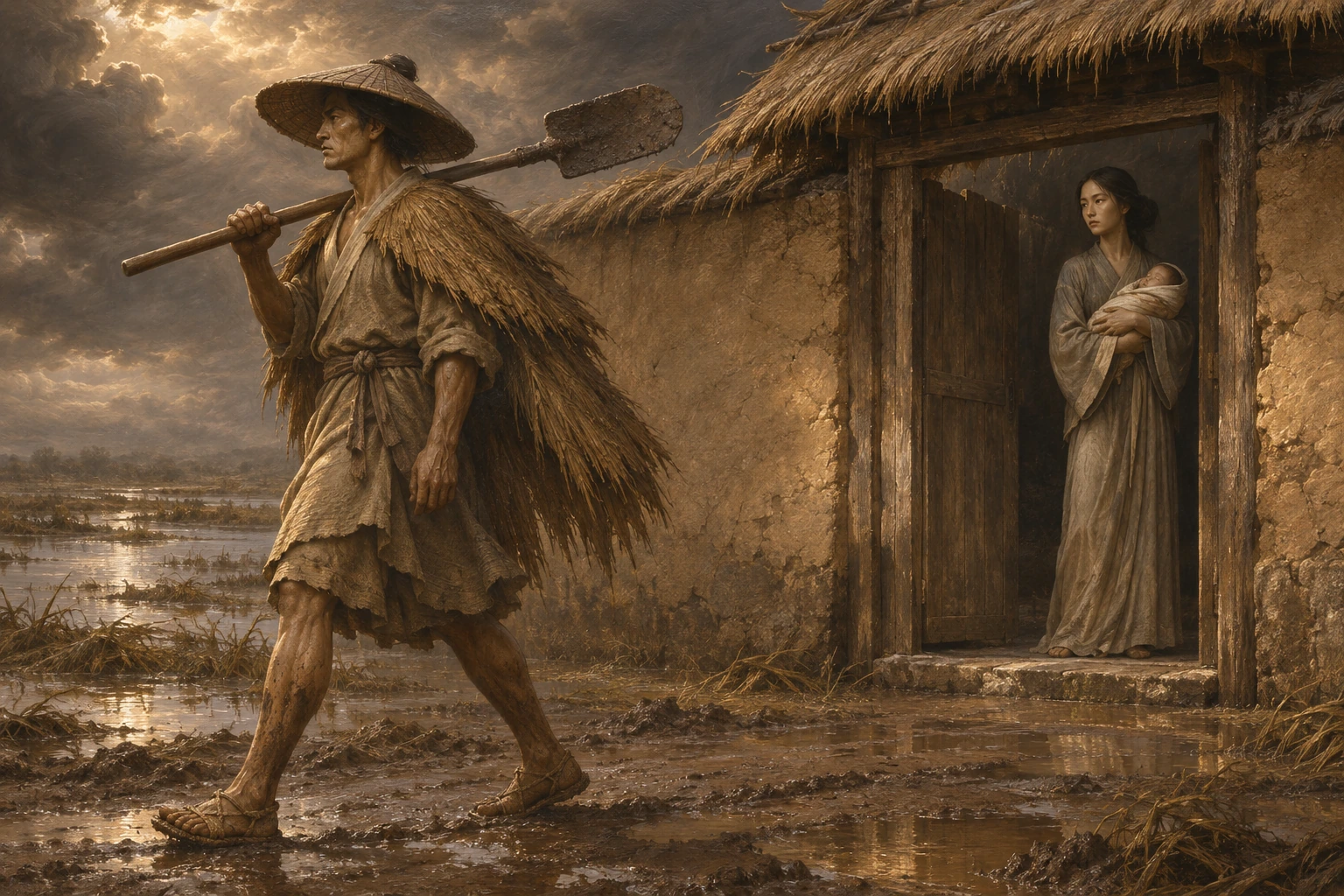
Yu grieved that his father had failed and been punished. “He wore out his body and burned with worry; he lived away for thirteen years, and passing the gate of his house he did not dare go in.” With “level and line in his left hand, compass and square in his right”, he opened the Nine Provinces, cleared nine roads, banked nine marshes and surveyed nine mountains.
Mencius says what he did with the water: Yu “dug the ground and led it to the sea”. When a minister boasted of managing water better than Yu, Mencius answered: “Yu’s regulation of the waters was according to the laws of water. He therefore made the four seas their receptacle, while you make the neighbouring States their receptacle” (Legge).
1-3 The Dragon’s Tail
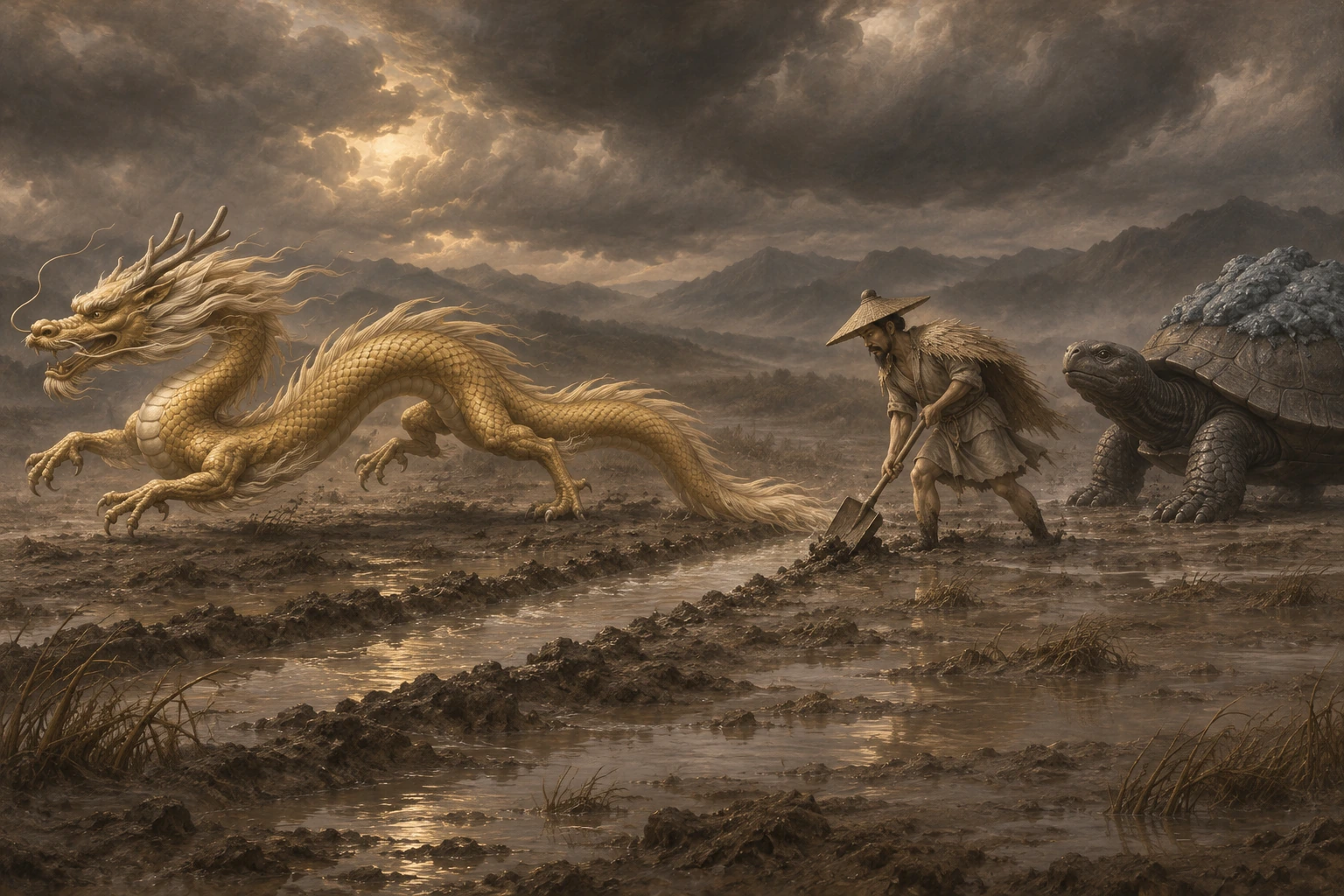
In one reading of its text, the Tianwen asks: “What did the Yinglong trace?” Wang Yi’s 2nd-century commentary answers with a story it gives as hearsay: “Some say that when Yu was regulating the flood, a divine dragon drew on the ground with its tail, showing where the water should be let through, and Yu followed it.” Wang Jia’s Shiyi ji (4th century) gives the dragon a companion: “A yellow dragon dragged its tail in front, a black turtle carried blue mud behind.” Wherever Yu cut through, he sealed the place with the mud, and the turtle stamped it. In Zhao Ye’s Wu Yue chunqiu (Eastern Han), a yellow dragon even lifts Yu’s boat on the Yangzi, and lets it go when Yu laughs at the danger.
1-4 The Woman of Tushan
In the Shangshu chapter “Yi Ji”, Yu himself says: “When I married in Tushan, I remained with my wife only the days xin, ren, gui and jia. When my son Qi was wailing and weeping, I did not regard him, but kept planning with all my might my labour on the land” (Legge’s translation, names in pinyin). The Lüshi chunqiu gives her a voice: she sent her maid to wait for Yu on the south side of Mount Tu and sang “I wait for my man, oh!”, the first song, it says, of the music of the South.
A harsher story belongs to a stone on Mount Song. Two Song books quote it from the Huainanzi, though it is not in the book as we have it: Hong Xingzu’s notes on the Tianwen, and Liu Changshi’s Lupu biji, which copies a note of the Tang commentator Yan Shigu on the Hanshu. While cutting a way through Mount Huanyuan, Yu turned into a bear. He had told his wife to bring his food when she heard his drum; he leapt onto a stone and struck the drum by mistake. She came, saw a bear, and fled in shame, and at the foot of Mount Song she turned to stone, about to give birth. “Give me back my son!” cried Yu, and the stone split open on its north side, and Qi was born. An edict of Emperor Wu of 110 BCE records that he saw “the stone of the mother of Qi, sovereign of Xia”.
1-5 The First Dynasty
The Shangshu chapter “Yu gong”, “The Tribute of Yu”, is the record of the finished work. It walks through nine provinces, naming for each its rivers, its soil and what it sends to the court: white loam in Ji, yellow loam in Yong, wet mire in Yang and Jing, gold of three kinds from Yang. At the end, with a black jade tablet, Yu announces that the work is done.
Shun named Yu his heir. In the Shiji Yu took the throne, called his state Xia and died at Kuaiji, touring the east, ten years later. He had chosen his minister Yi to succeed him, but the lords went to Yu’s son instead: “Our lord is the son of Emperor Yu.” So Qi became king, and the throne passed from father to son for the first time. In the Zuozhuan, a Zhou official recalls the bronze tripods that the Xia cast “when it had virtue”, from metal sent by the nine provinces, with the images of all things on them; they passed to the Shang and then to the Zhou.
2 Where the Story Is Written Down
- The Bin Gong xu. A bronze food vessel bought in the summer of 2002 by the Poly Art Museum in Beijing; it was not excavated, and some scholars doubt it is genuine. Sarah Allan calls it middle Western Zhou and Constance Cook dates it to the 9th century BCE, while Wen Xing finds its writing closer to late Western Zhou. It opens: “Heaven commanded Yu to spread out the land, cut through the hills and dredge the rivers” (天命禹敷土,墮山濬川).
- The Shijing. “Chang fa”, a hymn of the Shang section: “Vast were the flood waters; Yu spread out the lands below.” Allan notes that it praises the Shang ancestors and says nothing of a Xia.
- The Shangshu. “Yao dian”, “Yi Ji”, “Yu gong”, and “Hong fan”, where “of old time K’wăn dammed up the inundating waters”, so that God did not give him “the Great Plan” and Heaven gave it to Yu instead (Legge). The “Yu gong” opens almost as the bronze does, but in its present form it is probably of the Warring States (Allan; Ogura Yoshihiko in Nipponica).
- Warring States: the Tianwen, Mencius, Mozi, the Zuozhuan and the Guoyu; the Shanhaijing, compiled between the Warring States and the Han.
- c. 94 BCE: the Shiji: “Xia benji”, and the treatise on rivers and canals, which opens by quoting a “Book of Xia”: “Yu held back the flood for thirteen years.”
- Later: Zhao Ye’s Wu Yue chunqiu; Guo Pu’s commentary and Wang Jia’s Shiyi ji (4th century); Yan Shigu’s notes on the Hanshu (7th century), which we read as the Song writer Liu Changshi quotes them.
3 Competing Versions
- Who killed Gun, and what became of him? The Lord, through Zhurong (Shanhaijing); Yao (Zuozhuan, Guoyu); Shun (Shangshu, Shiji). In the Zuozhuan his spirit “turned into a yellow bear and went into the Feather Abyss”, and the three dynasties sacrificed to him. In the Guicang fragment he becomes a yellow dragon; in the Shiyi ji he drowns himself and becomes a black fish.
- Whose son? For the Shiji, Yu is the great-great-grandson of the Yellow Emperor, through Changyi, Zhuanxu and Gun; the Shanhaijing says: “The Yellow Emperor begot Luoming, Luoming begot White Horse: White Horse is Gun.” Yu comes from Gun’s body in the Shanhaijing and the Guicang, and in one copy of the Tianwen from “Gun’s belly”; in the Wu Yue chunqiu his mother swallows a seed of Job’s tears and gives birth to him through her side.
- Damming or channelling? The “Hong fan” blames Gun for damming. In the Guoyu, Prince Jin says Gun repeated the crime of Gonggong, who tried to wall up the hundred rivers, while Yu “raised the high, lowered the low, dredged the rivers and drained what was stagnant”. Yet the same speech and the “Yu gong” have Yu bank the nine marshes; the Shanhaijing says that “Yu dammed the flood” and killed Gonggong’s nine-headed minister Xiangyao; and in the Huainanzi Yu “filled the flood with self-growing soil, and made the great mountains”.
Yu is sometimes remembered as a builder of dams. The classic telling says the opposite: blocking the water was Gun’s way, and it failed; Yu dug channels and led the rivers to the sea, “according to the laws of water”, as Mencius puts it. But no early text has him refuse every bank. He banks the nine marshes, and in the Shanhaijing and the Huainanzi he fills the flood with earth, as his father did.
- Who made the tripods? The Xia (Zuozhuan); Yu, who “gathered the metal of the nine pastors” (Shiji, “Fengshan shu”); his son Qi, who had them cast at Kunwu (Mozi). When the Zhou declined, the Shiji says, they sank in the Si River; in 219 BCE Qin Shi Huang sent a thousand men to dive for them, in vain.
4 History and Tradition
- A god before a king? In 1865 James Legge wrote that “the labours of Yu are not history, but myth”. In a letter published in May 1923, the historian Gu Jiegang noted that the Shuowen jiezi defines 禹 as “an insect”, and suggested that Yu was “probably a kind of lizard”, perhaps an animal cast on the nine tripods. “Yu the Great was a bug” became, in the historian Yang Kuan’s words, a byword, and Lu Xun mocked it in his story “Li shui” (1935), where a scholar insists that “‘Yu’ is a worm”. Later scholars returned to the god by other roads: Constance Cook reads the bronze as a song to Yu as founder and earth god, and Allan argues that his work began as a myth of how the world was made fit to live in, tied to the founding of the Xia only later.
- The Xia and Erlitou. No writing of the Xia period has been found. Archaeologists look to Erlitou in Henan (about 1900–1550 BCE, in Allan’s dates), but whether it was the Xia is still argued. In 2016 Wu Qinglong and colleagues reported in Science an outburst flood on the upper Yellow River around 1920 BCE and proposed it as Yu’s flood; in 2017 the journal printed three comments disputing the evidence, with the authors’ reply. Allan objected that the old texts never make Yu’s flood a flood of the Yellow River: he dug the beds of all the rivers.
- The tomb at Kuaiji. Mozi says Yu was buried on Mount Kuaiji in three layers of clothes and a paulownia coffin three inches thick. Qin Shi Huang climbed it to sacrifice to Yu in 210 BCE, and Sima Qian, at twenty, “climbed Kuaiji and explored Yu’s cave”. At Shaoxing, the “Sacrifice to Yu the Great” at the Tomb of Yu is on China’s first national list of intangible heritage (2006): a public ceremony every five years since 1995, local and family rites every year.
- Yu’s step. The Shizi says his labours left half his body withered, so that “his steps did not pass each other; people called it the Yu step”. “The steps of shamans are mostly Yu’s,” wrote the Han philosopher Yang Xiong, and Ge Hong’s Baopuzi teaches the step: whoever practises “the hundred arts” must know it. In Japan, read uho, it became the henbai, danced by yin-yang masters to protect a noble setting out; the Nihon Kokugo Daijiten’s earliest example is from 1284.
5 Related Stories
- Nüwa: The Serpent-Bodied Goddess Who Mended the Sky: the Huainanzi has two answers to the flood: Nüwa piles up the ashes of reeds, and Yu fills it with self-growing soil. Gonggong, who in later versions breaks the pillar of heaven before Nüwa mends the sky, is in the Guoyu the model of Gun’s mistake.
- The Yellow Emperor: The Victor of Zhuolu Who Rode a Dragon to Heaven: Sima Qian makes Yu the Yellow Emperor’s great-great-grandson, and the Shanhaijing makes Gun his grandson. In the same book, the Yinglong fights for the Yellow Emperor against Chiyou.
- Sơn Tinh and Thủy Tinh: The Mountain Spirit, the Water Spirit and the Yearly Floods: in the Red River delta the water comes back every year and the mountain holds it off; in China, Yu digs the water a way out. We have not found a scholar who compares the two; we link them for the theme.
- Utnapishtim: The Flood Survivor, and the Older Atrahasis: in Mesopotamia the gods send the flood and one man rides it out in a boat. The Shangshu, as Legge noted in 1865, never says that its flood punished anyone, and Yu does not escape the water: he drains it. We link them for the theme.
6 Sources
- Shanhaijing, “Haineijing”, “Dahuang beijing”: Wikisource, Wikisource; with Guo Pu’s commentary (Sibu congkan, reprint of a Ming edition of 1470, juan 18): Wikisource
- Chuci, “Tianwen”, with Wang Yi’s commentary and Hong Xingzu’s supplement (Sibu congkan): Wikisource; Yan Kejun, Quan shanggu sandai wen, juan 15 (Guicang fragments): Wikisource
- Shangshu, “Yao dian”, “Yi Ji”, “Yu gong”, “Hong fan”: Wikisource; trans. James Legge, The Chinese Classics, vol. III (1865), with his prolegomena: Internet Archive, Internet Archive
- Mengzi, “Teng Wen Gong” I and II, “Gaozi” II: Wikisource; trans. Legge, The Chinese Classics, vol. II (1861): Internet Archive
- Sima Qian, Shiji, “Xia benji”, “Qin Shihuang benji”, “Fengshan shu”, “Hequ shu”, “Taishigong zixu”: Wikisource; Hanshu, “Wudi ji”: Wikisource; Yan Shigu’s note as quoted in Liu Changshi, Lupu biji, juan 7: Wikisource
- Zuozhuan, Duke Xuan 3, Duke Zhao 7; Guoyu, “Zhouyu” III; Mozi, “Gengzhu”, “Jiezang” III; Lüshi chunqiu, “Yinchu”; Shijing, “Chang fa”; Huainanzi, “Zhuixing xun”; Shizi (ed. Wang Jipei); Yang Xiong, Fayan, “Chongli”; Zhao Ye, Wu Yue chunqiu, ch. 6; Wang Jia, Shiyi ji, juan 2; Ge Hong, Baopuzi, inner chapters 11 and 17; Shuowen jiezi, juan 14; Lu Xun, “Li shui” (Wikisource)
- Edward L. Shaughnessy, “Newest Sources of Western Zhou History: Inscribed Bronze Vessels, 2000–2010” (sample chapter): Chinese University Press; Constance A. Cook, “Sage King Yu and the Bin Gong Xu”, and Wen Xing, “The Suigong Xu Calligraphy and Inscription”, Early China 35 (2013): Cambridge, Cambridge
- Sarah Allan, “The Jishi Outburst Flood of 1920 BCE and the Great Flood Legend in Ancient China: Preliminary Reflections”, Journal of Chinese Humanities 3 (2017): PDF; Wu Qinglong et al., Science 353 (2016), 579–582, with three comments and the authors’ response in Science 355 (2017): doi
- Zhang Yue on Gu Jiegang’s letter of 1923: aisixiang.com; Li Changyin, Kongzi yanjiu 2021/4, quoting Gu Jiegang and Yang Kuan: rujiazg.com; Jiang Ruoshui on Lu Xun’s Gushi xinbian: aisixiang.com
- China Intangible Cultural Heritage Network, “大禹祭典”: ihchina.cn
- “禹”, “夏”, “禹歩”, Nipponica, Sekai Daihyakka Jiten, Yamakawa Sekaishi Shōjiten, Nihon Kokugo Daijiten: Kotobank, Kotobank, Kotobank
Cover and illustrations: AI-generated images made for Arcana. They are interpretations, not historical artworks.