Sun Wukong: The Monkey King Who Fought Heaven
A monkey born from a stone learned the arts of the immortals, ate the peaches of heaven and fought its armies until the Buddha caught him in one hand. The novel that tells it was printed in 1592 without its author's name, and the monkey himself is centuries older.
- Type: novel and legend; a monkey hero who becomes a Buddha in the story and a god in the temples
- Culture: China; Tôn Ngộ Không in Vietnam, Son Gokū in Japan; worshipped as the Great Sage in Fujian, Taiwan and Southeast Asia
- Earliest texts: the monkey first appears in the Da Tang Sanzang qujing shihua, printed under the Southern Song or the Yuan and kept only in Japan; his full story is Journey to the West (Xiyou ji), whose oldest surviving edition is dated 1592
- Key figures: Sun Wukong (孫悟空), the Patriarch Subhūti, the Jade Emperor, Laozi, Erlang, the Buddha, Guanyin, the monk Tang Sanzang
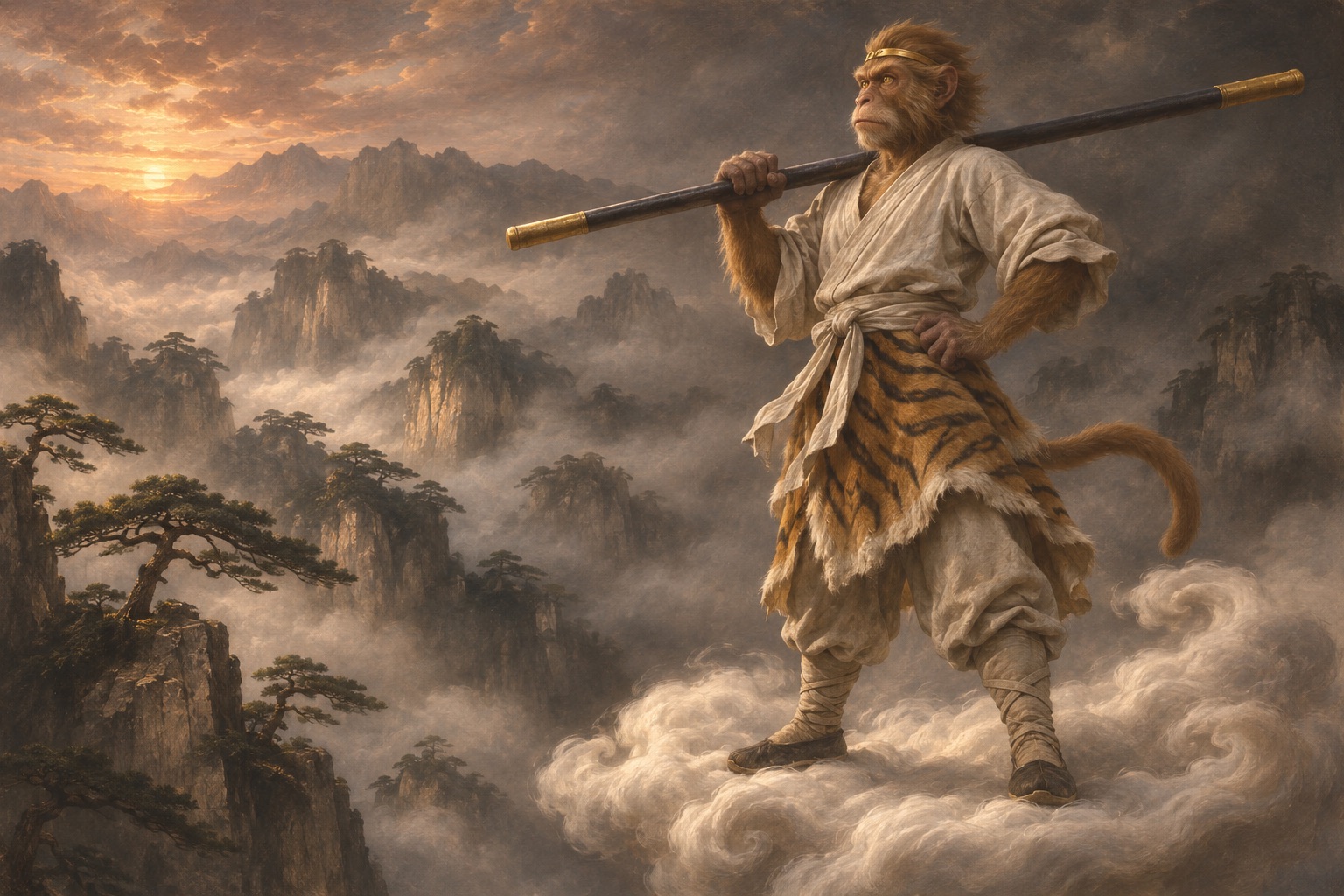
He was born from a stone, learned how not to die, crossed his own name out of the register of the dead and fought the armies of heaven to a standstill. Then he spent fourteen years walking a monk to India. Sun Wukong is the hero of the Ming novel Journey to the West, and in temples from Fujian to Singapore he is a god: the Great Sage Equal to Heaven.
Did Wu Cheng’en write Journey to the West? Perhaps, but no early edition says so. The oldest surviving one, printed in Nanjing in 1592, names no author, and its preface says the older preface did not either. Qing editions gave it to the Daoist master Qiu Chuji. Wu Cheng’en’s name comes from a 17th-century gazetteer of his home prefecture, Huai’an, which lists a “Xiyou ji” among his writings without saying what kind of book it was. Hu Shi and Lu Xun made the attribution famous in the 1920s, and it is still debated.
1 The Telling
This is the story as the hundred-chapter novel tells it, in chapters 1 to 8, 14 and 100. The quotations are our translations of the Chinese text.
1-1 The Stone Monkey
Beyond the sea, in the Eastern Continent, lies the land of Aolai, and off its coast rises the Flower-Fruit Mountain (Huaguo Shan). On its summit stood a magic stone that had absorbed the essences of heaven and earth, sun and moon, since the world began. One day it split and gave birth to a stone egg, and when the wind touched the egg it became a stone monkey. He bowed to the four directions, and two beams of golden light shot from his eyes to the palace of heaven. The Jade Emperor had his officers look, and dismissed it: “Things of the world below are born of the essences of heaven and earth. There is nothing strange in it.”
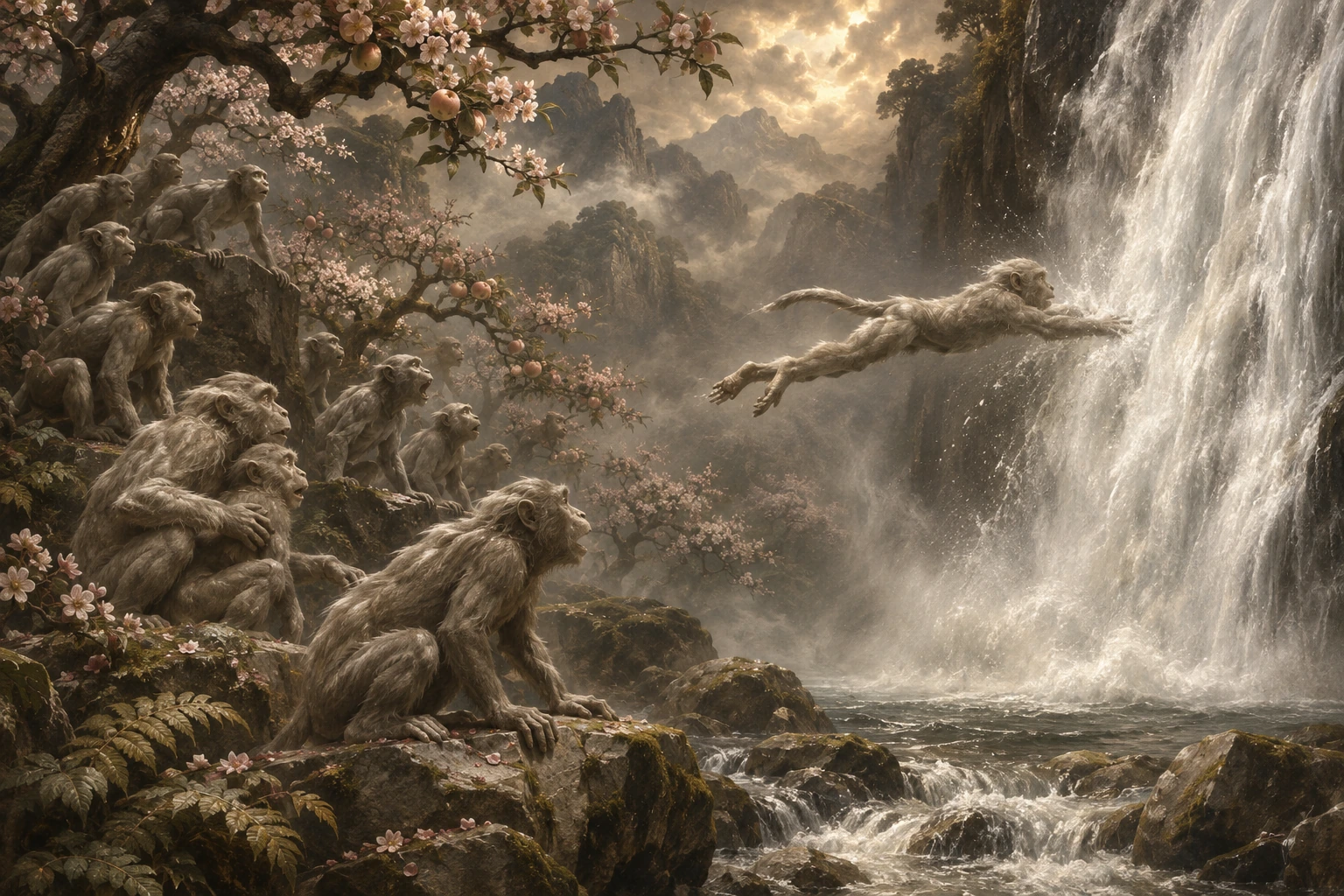
One hot day the monkeys followed a stream to a waterfall and promised to make king whoever could pass through it and come back unharmed. The stone monkey leapt through. Behind the water he found an iron bridge, a stone house with stone beds and stone bowls, and a tablet carved “Blessed land of Flower-Fruit Mountain, cave heaven of the Water Curtain Cave”. He led the troop inside, and they made him the Handsome Monkey King.
1-2 Awakened to Emptiness
Some three to five hundred years later, in the middle of a feast, the king began to weep. One day he would grow old, and the King of the Underworld would take him. An old gibbon told him that only buddhas, immortals and sages escape the wheel of rebirth, so he built a raft of pine and sailed off alone to find one. Years later he found the Patriarch Subhūti in the Cave of the Slanting Moon and Three Stars, and the Patriarch gave him a surname. He looked like a husun, a macaque; take the animal radical off 猻 and you have 孫, sun, made of “boy” and “tiny”, just right, the Patriarch said, for an infant. In his school that generation took the character wu, “awakening”, so the monkey became Sun Wukong, “awakened to emptiness”. In Buddhist tradition Subhūti is one of the Buddha’s ten great disciples, the one foremost in understanding emptiness.
Offered thirty-six transformations or seventy-two, the monkey asked for more and learned the seventy-two transformations. Because he took off with a somersault instead of rising like other immortals, the Patriarch taught him the somersault cloud: “one somersault carries you a hundred and eight thousand li”. Then, to show off to the other disciples, Wukong turned himself into a pine tree. The Patriarch sent him away for it, and forbade him ever to say whose pupil he had been.
1-3 The Staff and the Register
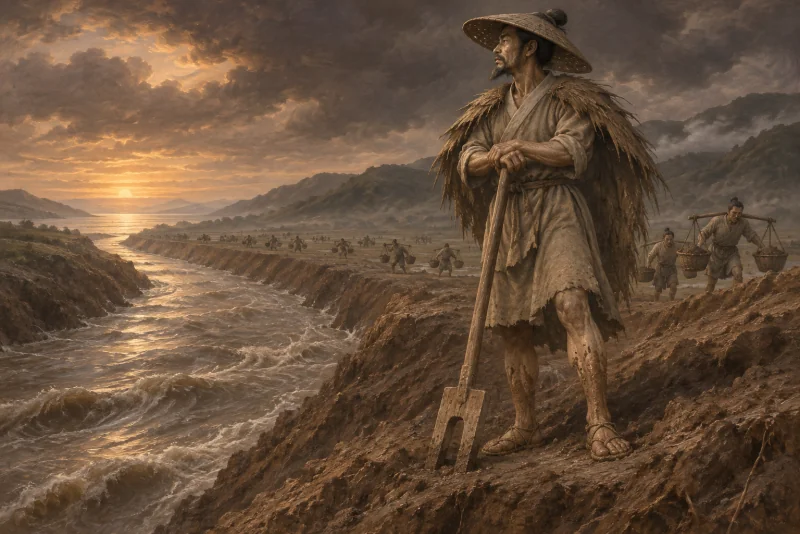
At home the monkeys needed weapons. Sun Wukong went down to the crystal palace of Ao Guang, Dragon King of the Eastern Sea, and found every weapon too light. The dragon’s wife and daughter remembered a pillar of divine iron in their treasury, which the Dragon King called the measure “that Yu the Great used to fix the depth of rivers and seas when he tamed the flood”. Near its golden bands was engraved: “As-You-Will Gold-Banded Staff, weight 13,500 jin”. It grew and shrank at his word, down to an embroidery needle he kept in his ear. The other dragon kings gave him cloud-walking shoes, golden chain mail and a phoenix-plumed cap to be rid of him.
Soon after, two summoners dragged him in his sleep to the Underworld. He fought his way to the hall of the Ten Kings, had the registers brought out and found his entry: “Heaven-born stone monkey: allotted 342 years; a good end.” He crossed it out, with the name of every monkey he could find. From then on, the novel says, many mountain monkeys did not grow old. The Dragon King and the Underworld both sent complaints to the Jade Emperor.
1-4 The Great Sage and the Peaches
Rather than send an army, the Jade Emperor followed the advice of the planet Venus, Taibai Jinxing, and gave the monkey a post in heaven. He was made bimawen, keeper of the heavenly horses, and kept them sleek until he learned that the post was “unranked”, the lowest of all. He went home, where a demon king suggested a better title, and raised a banner: Great Sage Equal to Heaven. Heaven’s generals came to arrest him and lost; among them was the young Nezha, whose three heads and six arms the monkey matched head for head before wounding his arm. So the Jade Emperor granted the title after all, as Venus advised: “a post without pay”.
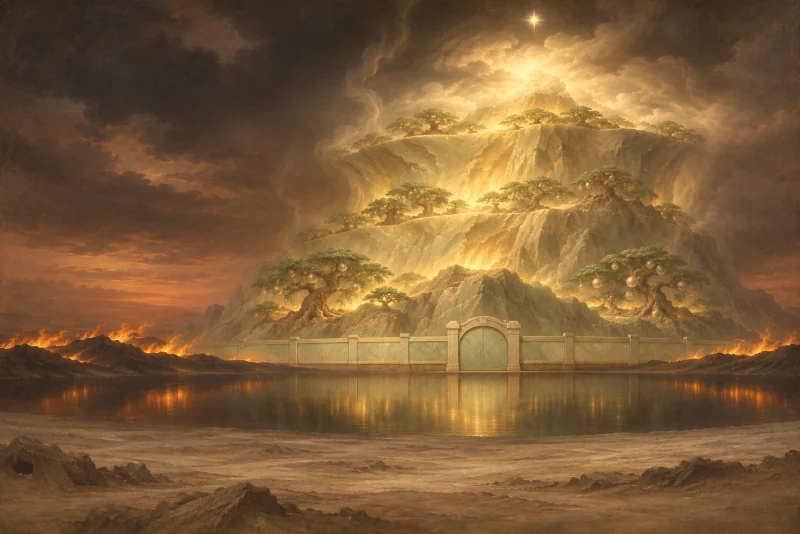
Idle, the Great Sage made friends with every star, and to keep him busy he was put in charge of the Peach Garden. Its local god explained: 3,600 trees, the front ones ripening every three thousand years, the middle ones every six thousand, and the back ones every nine thousand, whose fruit would let you “live as long as heaven and earth”. He sent his attendants away and ate the ripest. These are the peaches of the Queen Mother of the West, whose older story is told in Kunlun. When the Queen Mother sent seven fairies to pick peaches for her Peach Banquet at the Jasper Pool, he learned that he was not invited. He froze the fairies with a spell, went ahead to the Jasper Pool, put the servants to sleep and drank the banquet’s wine. Drunk, he wandered into the palace of Laozi, the Most High Lord Lao, who was away lecturing, found five gourds of golden elixir and ate them all “like fried beans”. Then he fled home.
1-5 The Furnace and the Palm
A hundred thousand heavenly soldiers besieged his mountain and could not take it. Guanyin, who had come for the banquet, recommended the Jade Emperor’s nephew Erlang, the god worshipped at Guankou, who fought him with transformations: fish against osprey, water snake against crane. At last the monkey became a little shrine, his mouth the door, his teeth its leaves, his eyes its windows, and his tail, which he could not hide, a flagpole behind it. Erlang saw through it. Laozi dropped his steel ring on the monkey’s head from the gate of heaven, Erlang’s hound bit his leg, and he was taken.
Swords, axes, fire and thunder could not hurt him: he had eaten too much elixir. So Laozi put him in his Eight Trigrams Furnace for forty-nine days. The monkey hid in the corner of xun, the trigram of wind, for where there is wind there is no fire; but the smoke reddened his eyes, and he came out with fiery eyes and golden pupils. When the furnace was opened he kicked it over and fought his way to the Jade Emperor’s hall.
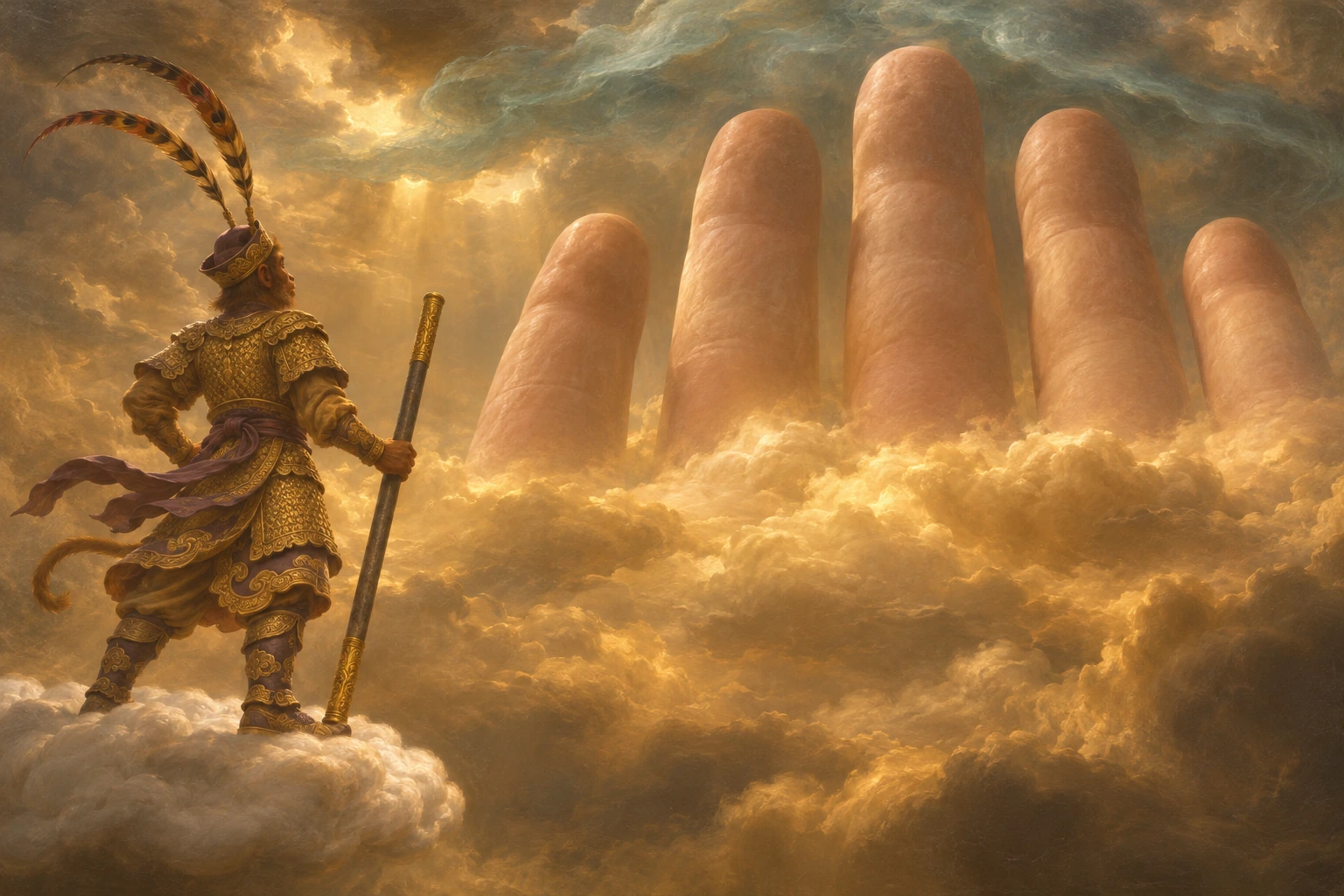
The Jade Emperor sent to the West for the Buddha. The monkey told him: “Emperors take turns. Next year it comes to my house.” The Buddha offered a wager: if Sun Wukong could somersault out of his right palm, heaven would be his. The monkey flew until he reached five flesh-pink pillars holding up a blue mist, the end of the world. He wrote “The Great Sage Equal to Heaven was here” on the middle one, relieved himself at the foot of the first and flew back. The words were on the Buddha’s middle finger.
Before he could jump again, the Buddha turned his hand over, pushed him out through the western gate of heaven and turned his five fingers into five linked peaks of metal, wood, water, fire and earth: the Five Elements Mountain. When the monkey’s head worked its way out, the Buddha had a strip with six golden syllables, Om mani padme hum, pasted on the summit. A local god was set to guard him, to feed him iron pellets when he was hungry and molten copper when he was thirsty.
1-6 The Golden Headband
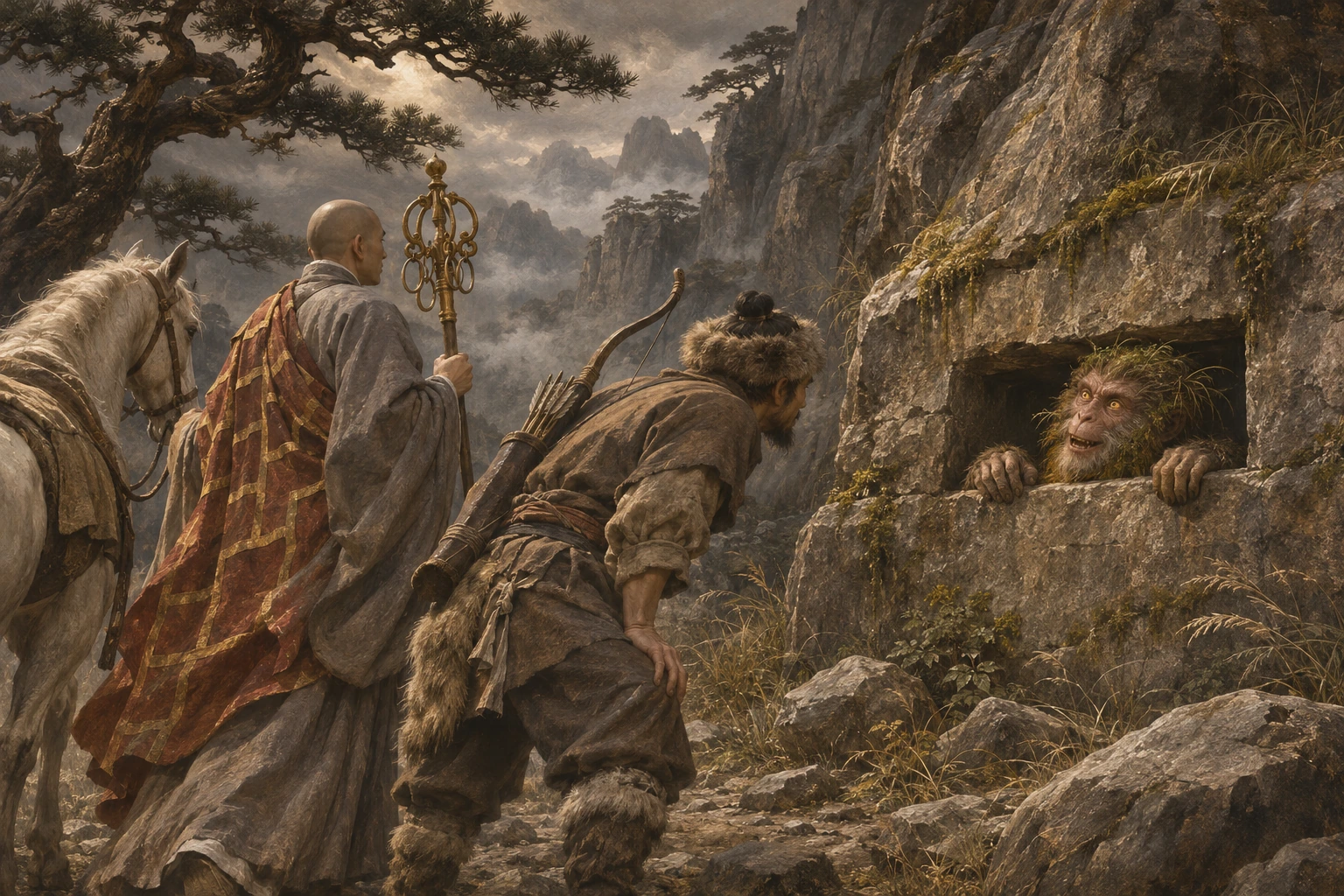
Five hundred years later Guanyin passed the mountain on her way east to find a pilgrim for the Buddha’s scriptures. The monkey said he repented, and she promised that the pilgrim would free him if he served him as a disciple. The pilgrim was the monk Tang Sanzang, the novel’s version of the real Xuanzang. In chapter 14 a hunter leads him to the mountain, now called the Mountain of the Two Frontiers, which, the hunter has heard, fell from the sky when Wang Mang usurped the Han. The monk peels off the seal, the mountain splits and the monkey springs out. Sanzang calls him Xingzhe, “the pilgrim”.
Within days he killed six robbers named after the senses, Eye-That-Sees-and-Delights, Ear-That-Hears-and-Rages and the rest, and when Sanzang scolded him he left in a temper. An old woman then met the monk with a cotton robe, a flowered cap and a spell called the True Words for Settling the Mind. She was Guanyin, and the cap held one of three hoops the Buddha had given her. When the monkey came back and put the cap on, the monk recited the spell, and the golden band tightened until he rolled on the ground. It had taken root; he could not pull it off.
With two more disciples, the pig Zhu Bajie and Sha Wujing of the River of Flowing Sand, they walked fourteen years and a hundred and eight thousand li, through eighty-one ordeals, to fetch the scriptures. In the last chapter the Buddha makes Sun Wukong the Victorious Fighting Buddha. He asks the monk for the spell that loosens the band, so that he can smash it. Now that he is a Buddha, Sanzang answers, it must be gone of itself: “feel for it”. He feels his head. It is gone.
2 Where the Story Is Written Down
- The Da Tang Sanzang qujing shihua (“Poems and Tales of the Great Tang Tripitaka Fetching the Scriptures”). The real Xuanzang went to India from 629 to 645, and the record of the journey he had his disciple Bianji compile became one source of the novel; but the monkey first appears, writes Sakurai Yukie in Nipponica, in the Shihua. Its last line names the Zhang family of the Middle Tile Quarter, a bookshop in Song Hangzhou, but Lu Xun noted that the shop might have outlived the Song. It survives only in Japan, in two copies kept at the Kōzan-ji in Kyoto: one now belongs to the Okura Foundation and is an Important Cultural Property, the other went to Tokutomi Sohō’s Seikidō library. The book “had long disappeared from China”, said Lu Xun in 1924, and was “brought back from Japan”. Here the monkey arrives as a scholar in white: “I am the bronze-headed, iron-browed king of the eighty-four thousand macaques of the Purple Cloud Cave on Flower-Fruit Mountain.” The heavenly king of the north gives the monk an invisibility cap, a staff with golden rings and an alms bowl, and the monkey wields them; there is no Subhūti and no headband.
- The oldest picture. On the western pagoda of the Kaiyuan Temple in Quanzhou, rebuilt in stone in the early 13th century, a relief on the fourth storey shows a monkey-headed guardian with a rosary, a broad blade, a gourd and the scroll of a sutra. Paul Demiéville described it in 1935, as Hera Walker quotes him. A Quanzhou newspaper’s account of the carving adds that a hoop already circles his head and that it is inscribed Hou xingzhe, “Monkey Pilgrim”, the name the Shihua gives him.
- The plays. In the early Ming Xiyou ji drama of Yang Jingxian, the monkey already “stole the Jade Emperor’s immortal wine and Laozi’s golden elixir”, and “Wuzhiqi is his sister”. A Korean source, the Pak tongsa eonhae, summarizes a Yuan Xiyou ji that, Nakano Miyoko writes, seems to have been nearly as full as the Ming novel.
- The 1592 edition, Xinke chuxiang guanban dazi Xiyou ji, printed by the Shidetang, the bookshop of the Tang family in Jinling (Nanjing). It is the oldest surviving edition of the hundred-chapter novel. Only four copies are known, says the National Palace Museum in Taipei, which holds one; the other three are in Japan. Its preface by Chen Yuanzhi, dated only by the cyclical year renchen, says of the older preface he read: “it too did not give his name.” Most scholars, following Hu Shi, take that year as 1592; Huang Yongnian argued for 1532, as Hsieh Ming-hsun notes.
- Qiu Chuji, then Wu Cheng’en. Qing editions put the novel under the name of the Daoist Qiu Chuji, mistaking it for Changchun zhenren xiyou ji, the record of his real journey to Genghis Khan. In the 18th century Qian Daxin judged it a Ming work, and Ji Yun noticed that the offices in it are Ming ones. Scholars of Shanyang (Huai’an) then found Wu Cheng’en, about 1510–1580 by Lu Xun’s reckoning, in their local gazetteer. Hu Shi’s “Xiyou ji kaozheng” (1923) used the passages Lu Xun had copied for him. For Satō Tamotsu, writing in Nipponica, Wu Cheng’en may have had a hand in it, but “cannot be called the author”.
- Translations. Arthur Waley’s Monkey (1942) translated thirty of the hundred chapters; the first complete English translation is Anthony C. Yu’s, finished in 1983 and revised in 2012. In Japanese the first complete translation, by Ōta Tatsuo and Torii Hisayasu, was finished in 1960; Nakano Miyoko’s ten volumes for Iwanami Bunko translate a Ming edition with Li Zhuowu’s commentary.
3 Competing Versions
- Who stole the peaches? In the Shihua, the monkey tells the monk that at eight hundred he stole ten peaches from the Queen Mother’s pool; she caught him and had him beaten with iron rods, eight hundred strokes on the left side and three thousand on the right, and “my ribs still hurt”. When the monk asks him to steal a few more, he does not dare. Lu Xun saw the roles reversed in the novel: there the monkey steals the ginseng fruit and the monk forbids it. The early teller, he suggested, was a townsman and the novelist a scholar.
- Where did the monkey come from?
- Hu Shi (1923) doubted that “this all-powerful monkey” was “a home product” and took him for “an import from India”: Hanuman of the Ramayana, the son of the wind who leaps to Lanka, “perhaps the shadow behind the Great Sage”. He followed a lead from Baron A. von Staël-Holstein.
- Lu Xun pointed instead to Wuzhiqi, the water god of the Huai river in a Tang tale by Li Gongzuo: shaped like an ape, with a white head and golden eyes, he was chained by Yu the Great under Turtle Mountain. The novel, Lu Xun wrote, moved Wuzhiqi’s “magic changes and swift fury” onto Sun Wukong. Hu Shi credited Lu Xun with the lead, and answered that even Wuzhiqi might have been modelled on India.
- Nakano Miyoko, in Heibonsha’s encyclopedia, sees Chinese monkey tales since the Han, monkeys in Buddhist scripture, the Hanumat of the Ramayana and the powers of dragons all mixed in him, with “many mysteries still awaiting explanation”.
- Hera Walker, surveying the debate in 1998, cites Isobe Akira for a monkey cult in Fujian from the late Tang, and concludes that Sun Wukong is “a product of both indigenous and foreign elements”.
4 History and Tradition
- Fujian. Pu Songling (1640–1715) tells in Liaozhai zhiyi of a merchant from Shandong trading in Fujian who was taken to a splendid temple of the Great Sage, “a monkey’s head on a man’s body”. He laughed that Sun Wukong was only “old Qiu’s allegory”; he fell ill, and was won over. Pu Songling’s comment: “Where people’s hearts gather, something comes to dwell.”
- Taiwan. Few temples there have the Great Sage as their main god, writes Wu Szu-hui in a study based on fieldwork, but he is worshipped as a guardian who subdues demons and turns away misfortune.
- Singapore. The Qi Tian Gong in Tiong Bahru was founded in 1920 in an attap hut and moved to its present shophouse in 1938. Its trustees call it the first temple in Singapore dedicated to him, and the National Heritage Board counts more than forty other temples there where he is worshipped. His birthday falls on the sixteenth day of the eighth lunar month, when spirit mediums go into trance.
- Vietnam. He is Tôn Ngộ Không, or Tề Thiên Đại Thánh. Huỳnh Tịnh Của’s dictionary (1896) explains the “stone monkey” as Tôn Ngộ Không, “who had powers equal to Heaven, and so is also called Tề thiên đại thánh”. In Nguyễn Đình Chiểu’s 19th-century verse tale Lục Vân Tiên, a sorcerer calls on “the Great Sage Tề thiên” right after Pangu.
- Japan. He is Son Gokū. The novel spread through the Tsūzoku Saiyūki, begun in 1758, and became above all a book for children; a puppet play, Go-Tenjiku, put him on stage in Osaka in 1816. Toriyama Akira’s manga Dragon Ball (1984–1995) began as a story built on Journey to the West, and its hero takes his name, Son Gokū, from it.
“Sun Wukong is the Indian monkey god Hanuman” is often repeated as fact. It is a hypothesis. Hu Shi put it forward in 1923; Lu Xun pointed instead to Wuzhiqi, the monkey-shaped water god that Yu the Great chained under Turtle Mountain; and later scholars such as Nakano Miyoko see Chinese, Buddhist and Indian monkeys mixed together in him. No source found so far settles the question.
5 Related Stories
- The Jade Emperor: The Ruler of Heaven: the ruler whose throne Sun Wukong claimed, and whose court gave him first a post with no rank, then a title with no pay.
- Guanyin: How the Bodhisattva of Compassion Became a Goddess: in the novel it is Guanyin who names Erlang to fight him, finds him under the mountain and tricks him into the golden headband.
- Nezha: The Boy God Who Gave Back His Flesh: the first of heaven’s champions to fight the Great Sage hand to hand, three heads against three heads, in chapter 4.
- Yu the Great: The Man Who Tamed the Flood: the staff Sun Wukong took from the Dragon King was, the novel says, Yu’s measure for the depth of the rivers and seas. And Wuzhiqi, the monkey Lu Xun saw behind him, is the water god Yu chained under Turtle Mountain.
- Hanuman: The Monkey Who Leapt the Sea: the monkey of the Rāmāyaṇa. In 1923 Hu Shi suggested that he was “perhaps the shadow behind the Great Sage”. Lu Xun pointed to a Chinese monkey instead, and the question is still open.
6 Sources
- Xiyou ji, chapters 1–8, 14, 99 and 100, the text on Chinese Wikisource (a modern text, with variant readings marked): Wikisource, Wikisource, Wikisource, Wikisource
- Da Tang Sanzang qujing shihua, collated text from the small-format copy, compared with the large-character Qujing ji: Wikisource; facsimile of the Okura Foundation’s Song edition, trans. Ōta Tatsuo, notes by Isobe Akira (Kyūko Shoin, 1997): CiNii
- Hu Shi, “Xiyou ji kaozheng” (Dushu zazhi 6, 1923): Wikisource; Lu Xun, Zhongguo xiaoshuo shilüe, chapters 9, 13 and 17, with the notes of the modern edition: Wikisource, Wikisource, Wikisource; “Zhongguo xiaoshuo de lishi de bianqian” (1924), lecture 4: Wikisource; Pu Songling, Liaozhai zhiyi, “Qitian dasheng”: Wikisource
- National Palace Museum, ANiMAL: Art Science Nature Society, “The Journey to the West” (the Shidetang edition): npm.edu.tw; Hsieh Ming-hsun, “Wenxue xiangxiang yu lishi zhenshi”, Dong Hwa Journal of Chinese Studies 42 (2025): PDF
- Hera S. Walker, “Indigenous or Foreign? A Look at the Origins of the Monkey Hero Sun Wukong”, Sino-Platonic Papers 81 (1998), quoting Paul Demiéville, Isobe Akira and Victor Mair: PDF; Li Jiping, on the reliefs of the Kaiyuan Temple pagodas, Quanzhou Wanbao, 18 April 2024: PDF
- “西遊記”, “孫悟空”, “大唐三蔵取経詩話”, “聊斎志異”, “須菩提”, Nipponica, Sekai Daihyakka Jiten, Mypedia, Digital Daijisen: Kotobank, Kotobank, Kotobank, Kotobank, Kotobank; Nakano Miyoko, trans., Saiyūki, Iwanami Bunko, 10 vols. (2005): CiNii; Anthony C. Yu, trans., The Journey to the West, revised edition: University of Chicago Press; Mangapedia, “ドラゴンボール”: mangapedia.com
- Roots.gov.sg, “Monkey God Temple”: roots.gov.sg; Wu Szu-hui, Taiwan Qitian dasheng xinyang yanjiu (MA thesis, National Taiwan Normal University, 2017): Airiti; Huỳnh Tịnh Của, Đại Nam quấc âm tự vị, vol. 2 (1896), under thạch: Vietnamese Wikisource; Nguyễn Đình Chiểu, Lục Vân Tiên, part II: Vietnamese Wikisource
Cover and illustrations: AI-generated images made for Arcana. They are interpretations, not historical artworks.