The Jade Emperor: The Ruler of Heaven
In Chinese popular religion the Jade Emperor rules heaven as an emperor rules his officials, and his birthday falls on the ninth day of the first month. Yet he is younger than Heaven itself: Song emperors gave him his titles in the 11th and 12th centuries, and in Daoist doctrine three gods still stand above him.
- Type: god; the ruler of heaven in Chinese popular religion, and a high god of Daoism
- Culture: China; worshipped as Tiangong in Fujian and Taiwan, as Ngọc Hoàng in Vietnam and as Okhwang Sangje in Korea
- Earliest texts: the name Yuhuang, “Jade Sovereign”, in Tang poems of the 8th century; the titles given by the Song emperors Zhenzong (1015) and Huizong (1116), in the Song shi; his former life in the Daoist Gaoshang Yuhuang benxing jijing, by an unknown author of the Tang or Song
- Key figures: the Jade Emperor (Yuhuang Shangdi), King Jingde and Queen Baoyue Guang, Yuanshi Tianzun, the emperors Zhenzong and Huizong
Between midnight and dawn on the ninth day of the first lunar month, families in Taiwan set out two tables facing the sky. The upper one, for the Jade Emperor, whose birthday it is, holds fruit, vegetarian dishes, noodles tied with red string and three cups of tea; the lower one, with meat and red turtle cakes, is for the gods who attend him. He is the ruler of heaven, and he governs the other gods as an emperor governs his officials.
Is the Jade Emperor the ancient Chinese god of Heaven? He took that god’s place, and late. The Shang kings consulted Di, the Zhou worshipped Tian, “Heaven”. The name Yuhuang, “Jade Sovereign”, appears in Tang poems of the 8th century, and only in 1015 did a Song emperor give him an official title. In 1116 another declared him the same god as Haotian Shangdi, the “Lord on High of Vast Heaven” of the classics, because, says the Song shi, scholars kept speaking of the two separately.
1 The Telling
Two stories are told of him here. The first is the life his own scripture gives him, the Gaoshang Yuhuang benxing jijing (Collected Scripture of the Deeds of the Jade Sovereign on High), as it stands in the Ming Daoist canon. The second is a folk tale about the calendar, told in his name.
1-1 The Childless King
The scripture opens in the Heaven of Pure Subtlety, where Yuanshi Tianzun, the Heavenly Worthy of the Primordial Beginning, is preaching to a countless assembly. The Jade Emperor fills the worlds with light, rises from his seat and kneels facing north, the place of a subject before his lord. Then Yuanshi Tianzun tells the assembly where he came from.
Long ago there was a kingdom called Guangyan Miaole, “Majestic Radiance and Wondrous Joy”. Its king, Jingde, was growing old without a son, and he wondered to whom he could leave the altars of the state and the nine ancestral temples. He had Daoists perform rites in all his palaces at the six hours of day and night, and they prayed for half a year.
Then his queen, Baoyue Guang, “Precious Moonlight”, dreamed that the Most High Lord of the Way came riding a dragon carriage of five colours, holding an infant whose every pore shone with light. She knelt and begged for the child as heir to the throne, and the god granted him. She woke pregnant, and after a year she gave birth in the palace, at noon on the ninth day of the first month of a bingwu year.
1-2 The Prince Who Gave It All Away
The boy was quick, and he grew up kind. He emptied the kingdom’s storehouses for the poor, the widowed and the orphaned, the hungry and the crippled, and his fame spread far beyond its borders. When the old king died, the prince took up the government. Then, thinking how brief life is, he gave his ministers their orders for the succession, left the kingdom and went to practise the Way on Mount Puming Xiangyan.
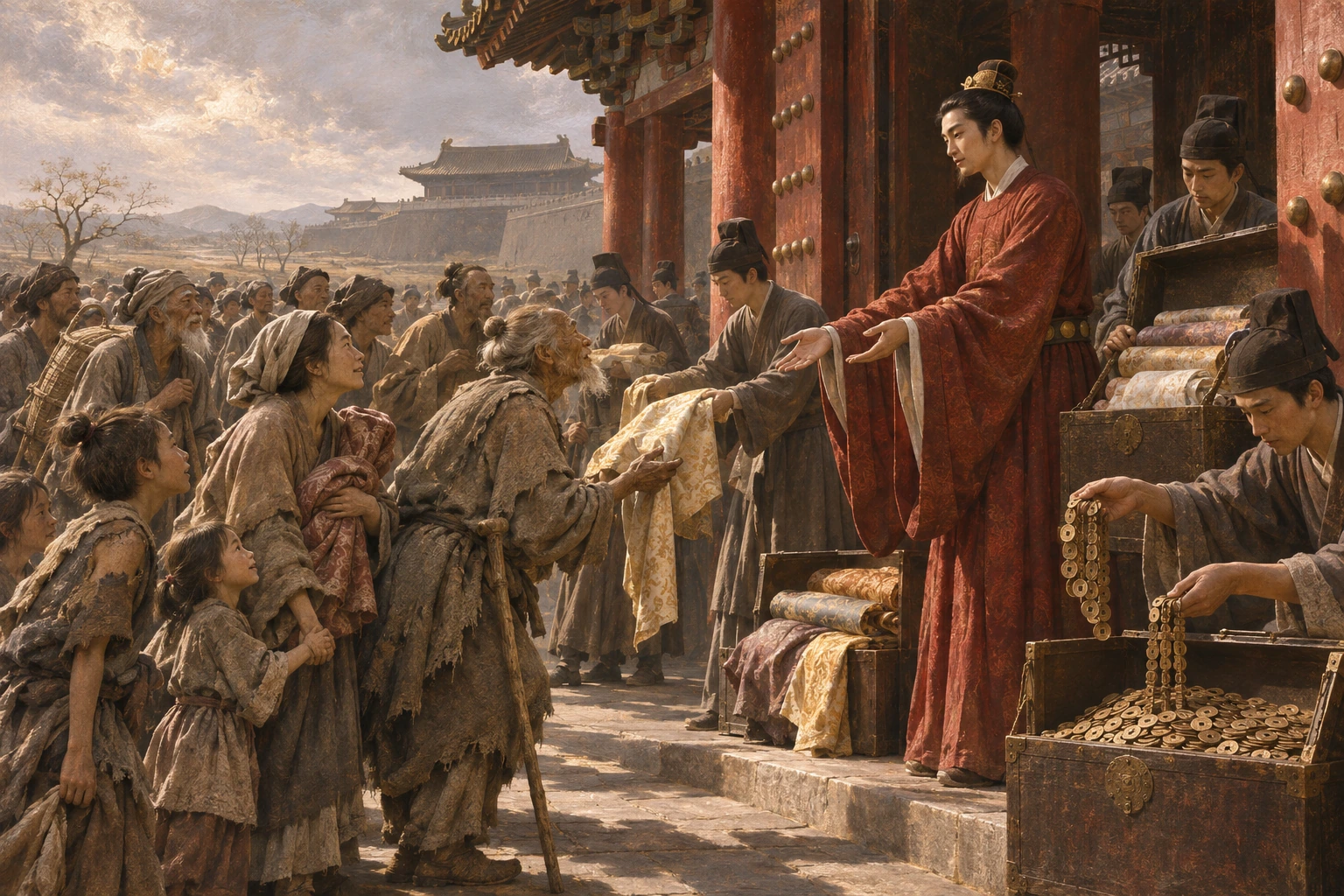
What followed took kalpas, the ages of the world. For eight hundred kalpas he gave up his kingdom again and again; for eight hundred more he gave medicine and healed the sick; for another eight hundred he opened the Daoist scriptures and taught them; and for the last eight hundred he gave his life, “giving up his own flesh and blood” for the sake of patience. After 3,200 kalpas he became a golden immortal, the Pure and Spontaneous Awakened King Tathāgata, and taught the bodhisattvas. Only after a hundred million kalpas more did he become the Jade Emperor. The scripture borrows freely from Buddhism: a prince who leaves his throne, ages without number, a title that ends in “Tathāgata”.
1-3 The Court of Heaven
His scripture shows a teacher; the novels show an emperor. In the Xiyou ji (Journey to the West, printed 1592), he sits in the Hall of Divine Mists with his immortal ministers. When a newborn stone monkey’s eyes flash gold up to the Dipper Palace, he sends Thousand-Mile Eye and Wind-Following Ear to look out of the South Gate of Heaven, and decides: “Things below are born of the essences of heaven and earth. It is nothing strange” (chapter 1).
At a morning court in chapter 3, memorials arrive from below, one from Ao Guang, Dragon King of the Eastern Sea, the other from the underworld, sent by the bodhisattva Dizang through King Qinguang. The Jade Emperor reads each “from beginning to end”. The planet Venus, Taibai Jinxing, advises him to call the monkey up to heaven and give him an office, and what follows is Sun Wukong’s story.
The late Ming Fengshen yanyi (Investiture of the Gods) gives heaven its ministries. In chapter 99 the heroes and immortals who fell in the war that ended the Shang are made gods of the Thunder Ministry, the Fire Ministry, the Plague Ministry and the Dipper, sent across the heavens “to watch over the good and evil of the human world”. Reports went up from every house as well: in Vietnam the kitchen gods ride a carp to heaven each year to tell the Jade Emperor how the family has behaved.
1-4 The Race of the Twelve Animals
Why is the rat first among the twelve animals of the years, and why is there no cat? In the version told among the Hokkien and Hakka of Taiwan, as the Dictionary of Taiwanese Literature summarizes it, the judge is usually the Jade Emperor. He held a race, and the first twelve animals to reach him would name the years.
The cat and the rat set out together and asked the ox to carry them across a river. Halfway over, the rat pushed his friend into the water. Hidden in the ox’s ear, he leapt down just before the finish and came first. Then came the ox, the tiger, the rabbit, the dragon, the snake, the horse, the goat, the monkey, the rooster, the dog and the pig. The cat, who fell in the river, has hunted the rat ever since.
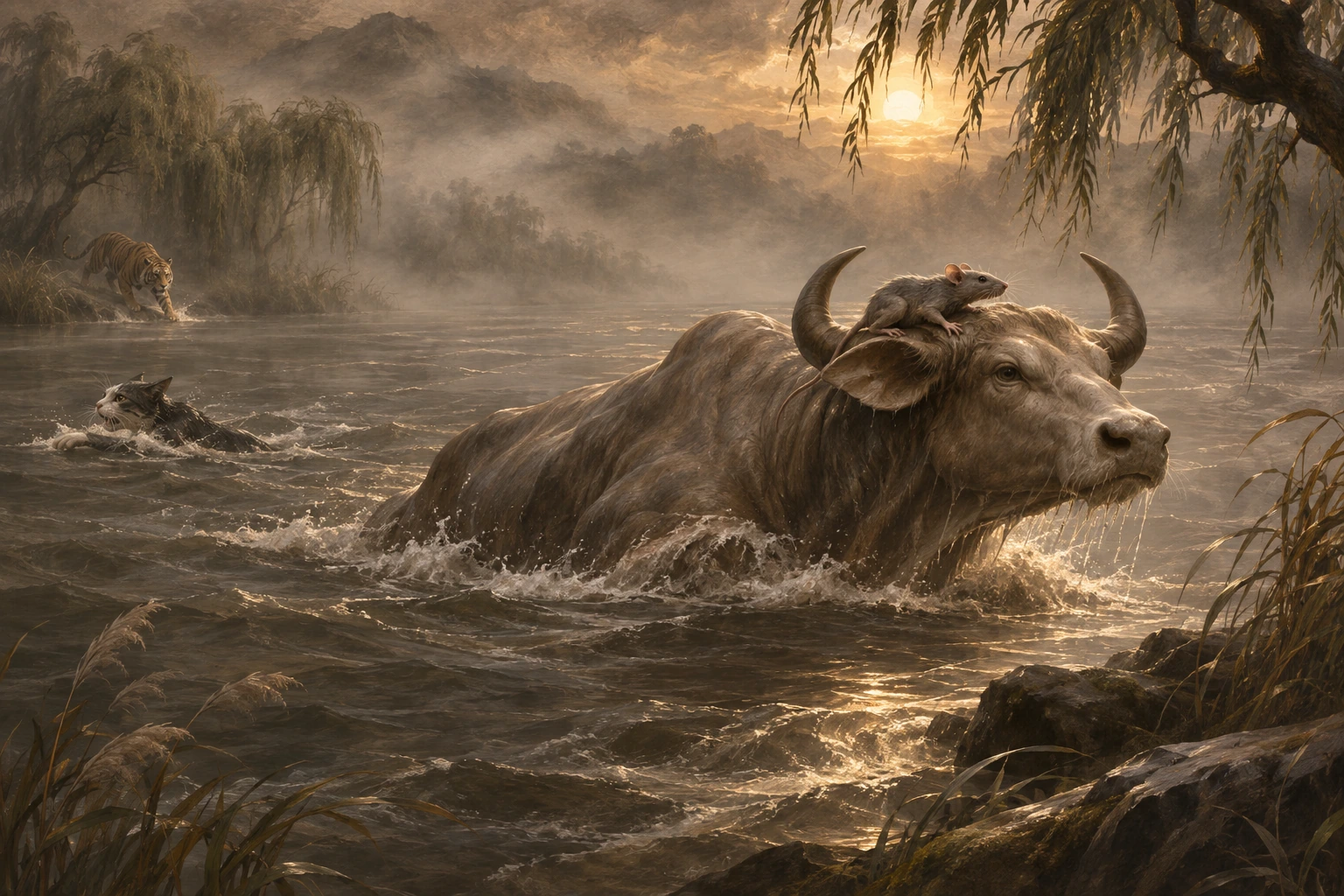
Other tellings vary. In one, the cat asks the rat to wake him early on the day, and the rat tricks him. In a telling recorded in Nago, Okinawa, in 1984, it is simply “God” who sends the rat to call the animals; the rat tells everyone but the cat, rides to the finish on the ox’s horn, and the habu viper takes the place of the snake.
2 Where the Story Is Written Down
- Before him. In the oracle bones of the Shang, writes Kominami Ichirō in Heibonsha’s World Encyclopedia, the high god is Di or Shangdi, who rules rain and harvests and permits the building of cities, but acts through envoys and was not sacrificed to directly. The Zhou spoke of Tian, “Heaven”, instead, and from it drew the ideas of the Mandate of Heaven and the Son of Heaven. Under the Han a Lord on High of Vast Heaven, Haotian Shangdi, stood above five lords of the directions.
- Tang poems. The name was in use in the 8th century. Wei Yingwu’s poem “Answering Youxia at the Qingdu Abbey” begins: “The carefree son of the immortals’ house, morning and evening, pays court to the Jade Sovereign.”
- Song shi (History of the Song), juan 104, the treatise on rites:
- In 1012 the emperor Zhenzong, who had performed the great sacrifices at Mount Tai in 1008, told his ministers he had dreamed of a divine man bringing “the command of the Jade Sovereign”.
- In the ninth month of 1014, images of the Jade Emperor were installed, and the emperor announced that he would offer him a title the next year.
- On the first day of 1015, at the Palace of Jade Purity and Manifest Response, he gave it: “Most High, Who Opened Heaven, Holds the Talisman, Commands the Calendar, Embraces the Truth and Embodies the Way, Jade Sovereign, Great Heavenly Emperor”. On New Year’s Day 1017 he presented the jade register and imperial robes.
- In 1116 Huizong changed the end of the title to “Jade Sovereign of Vast Heaven, Lord on High”.
- Gaoshang Yuhuang benxing jijing, in three juan, in the Ming Daoist canon. Its author is unknown. The Daoist database of Hong Kong’s Fung Ying Seen Koon, following the Great Dictionary of Chinese Daoism (1995), dates it by its language to the Tang or Song, and notes that since the Song and Yuan it has been one of the scriptures Daoist priests recite every day.
- Wu Zimu’s Mengliang lu, a memoir of Southern Song Hangzhou (preface dated 1274), lists “the ninth day of the first month, the birthday of the Jade Emperor, Lord on High”, when the rich of the city gathered at the Chengtian Abbey to burn incense.
- The Xiyou ji and the Fengshen yanyi, quoted above, and the Sanjiao yuanliu soushen daquan, a compendium of gods compiled under the Yuan and completed under the Ming, which retells the prince’s story from the scripture.
3 Competing Versions
- Who bows to whom? In his scripture, the Jade Emperor kneels before Yuanshi Tianzun, and the child was a gift of the Most High Lord of the Way: both are among the Three Pure Ones, the highest gods of Daoist doctrine. In the Fengshen yanyi, the new gods are appointed by a decree of Yuanshi Tianzun. In the Xiyou ji the order is reversed: Laozi, also one of the Three Pure Ones, “memorializes the throne” like a minister (chapter 7), and when the Buddha has saved heaven from the monkey, the Jade Emperor sends his thunder gods to invite the Three Pure Ones to the banquet as guests.
- One god or two? Huizong merged the Jade Sovereign with Haotian Shangdi “because those who discussed them spoke of them separately and could not make them one”. Yet at the Temple of Heaven in Beijing, writes Miura Kunio, the Ming and Qing emperors worshipped Heaven as Haotian Shangdi, without any image. In his General History of Taiwan (preface dated 1918), Lian Heng objected that in antiquity only the Son of Heaven sacrificed to Heaven, and that Tainan’s altar of the Jade Emperor had been built privately by the people.
- Which year? Heibonsha’s encyclopedia dates Zhenzong’s title to 1014, the year the Song shi says he decided on it. The Song shi has it given on New Year’s Day 1015. The Soushen daquan, quoting Zhenzong’s Veritable Records, gives 1017, and its wording already contains “Vast Heaven”, which in the Song shi comes only with Huizong.
- How long did he practise? In the scripture, 3,200 kalpas and then a hundred million more. In the Xiyou ji (chapter 7), the Buddha tells the monkey that the Jade Emperor has practised since childhood through 1,750 kalpas, “each kalpa of 129,600 years”. The monkey answers with a proverb: “Emperors take turns; next year it comes to my house.”
- Why the ninth day? The scripture gives it as his birthday. Lian Heng called this an invention of the fangshi, the masters of occult arts, who borrowed “Initial Nine”, the name of the first line of the first hexagram of the Book of Changes.
- How old is the race? The animals are old: Qin-period bamboo “daybooks” found in Hubei in 1975 already list animals for the twelve earthly branches, and Wang Chong’s Lunheng (about 80 CE) pairs them too: “yin is wood, and its creature is the tiger”. We have not found the race in any pre-modern text. Among the explanations given today for the missing cat is that cats were hardly known in China before the Eastern Han, when the twelve were already fixed.
4 History and Tradition
- Tiangong’s birthday. In Fujian and Taiwan the Jade Emperor is Tiangong, the “Lord of Heaven”, and the ninth of the first month is Tiangong sheng, his birthday. The Ministry of Education’s dictionary in Taiwan describes the rite: from midnight to four in the morning; on the upper table, five fruits and six vegetarian dishes, noodles tied with red string and three cups of tea; on the lower table, for his attendant gods, five meats and red turtle cakes; then gold paper is burned and firecrackers set off.
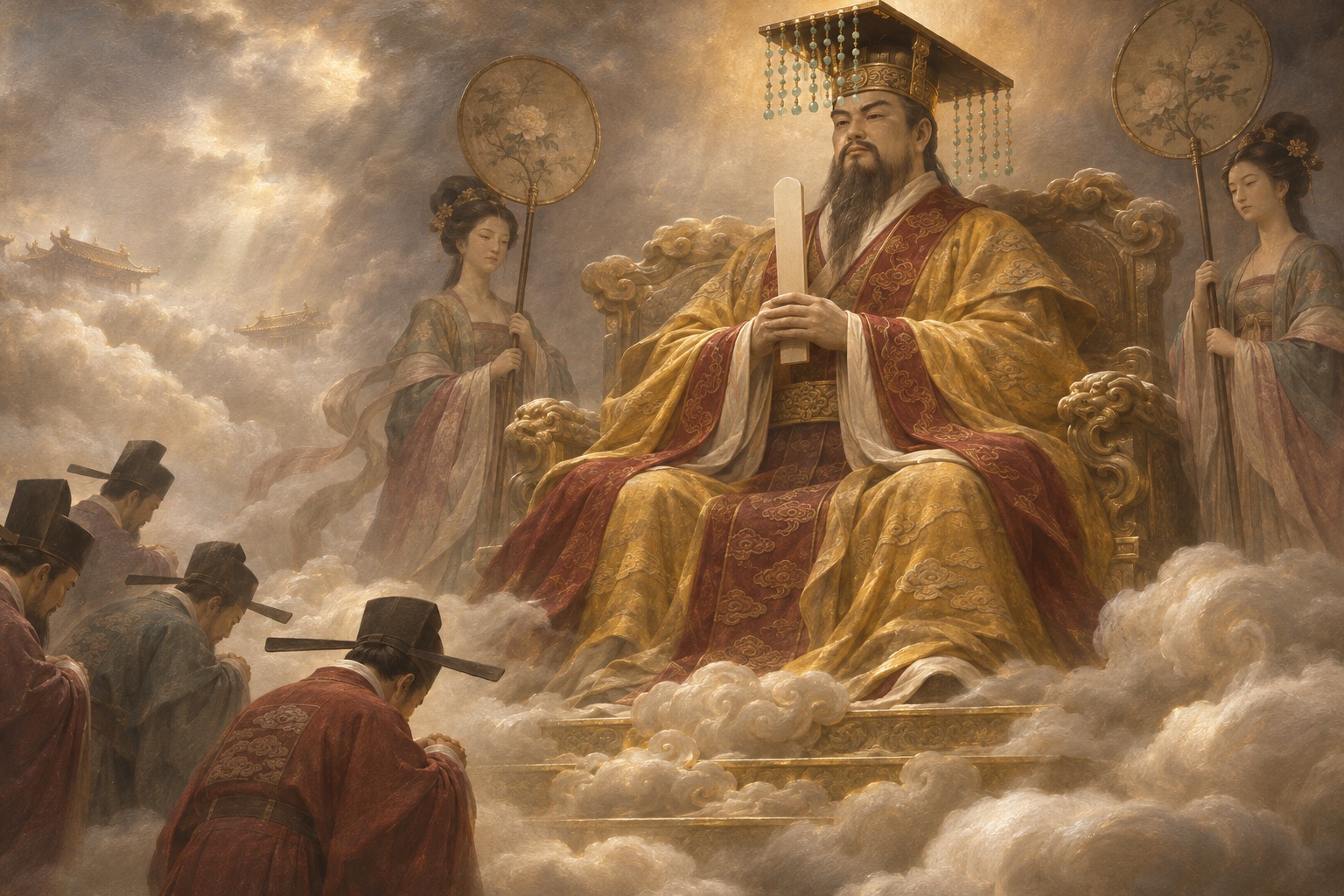
- A god without a statue. Temples rarely make an image of him, notes the Hakka Affairs Council: a censer at the temple gate, the “Tiangong censer”, stands for him, and worshippers bow to it before they enter. When he is painted on a Daoist altar, he is an emperor with a crown of nine bead strings and a yellow cape, holding a tablet.
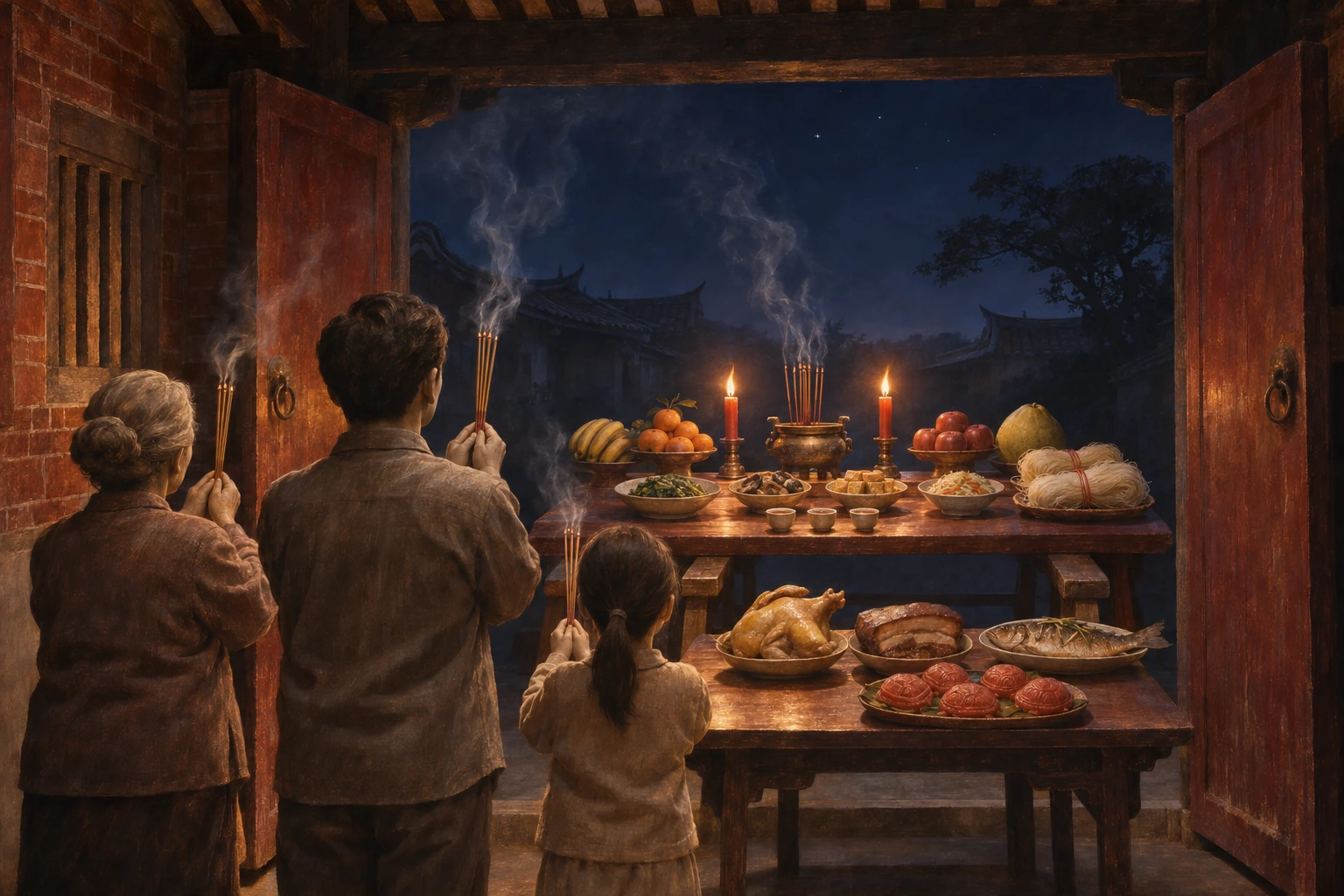
- Receiving the Jade Emperor. The Fung Ying Seen Koon database records a belief that he tours the world on the 25th of the twelfth month, rewarding good and punishing evil, so families set out incense tables and vegetarian food to receive him; in southern Jiangsu this was called “feeding Heaven”.
- At sea. Xu Baoguang, who sailed to the Ryukyu Islands as the Qing emperor’s vice-envoy, listed in his Zhongshan chuanxin lu (1721) the storms sailors expected. On the ninth of the first month came “the Jade Emperor’s storm”: if it blew, the later storms would come true. Other days were those on which the Dragon Kings went to his court.
- Vietnam. As Ngọc Hoàng he receives the kitchen gods’ report every year, and the Mother Goddess Liễu Hạnh is his daughter, sent down to earth for letting a jade cup fall. In Saigon the Jade Emperor Pagoda (Chùa Ngọc Hoàng) in Đa Kao was founded by Lưu Minh, a Cantonese. A booklet on it published in Saigon in 1914 by A.-E. Lelièvre and Ch.-A. Clouqueur, as Henri Cordier summarized it in a review the next year, dates its foundations to 1900 and its opening to 1906. It joined the Vietnamese Buddhist Sangha in 1982 and was renamed Phước Hải tự in 1984. The Jade Emperor still presides over its main hall, among heavenly generals, with the Ten Kings of the underworld in a second hall.
- Korea. As Okhwang Sangje he is a god of the shamans. A 20th-century shamanic painting in the Seoul Museum of History shows him on a chair among clouds, the sun and moon above, wearing a crown with strings of beads and holding a book and a tablet, an official in attendance.
“The Jade Emperor is the highest god of Daoism” is said everywhere, even in Heibonsha’s encyclopedia and in the Seoul Museum of History’s description of a shamanic painting. In popular religion he is the highest. In the doctrine of Daoist priests he is not: the Fung Ying Seen Koon database ranks him “below the Three Pure Ones, above all the other gods”, first of the Four Sovereigns, and in his own scripture he kneels before Yuanshi Tianzun.
5 Related Stories
- Sun Wukong: The Monkey King Who Fought Heaven: the monkey who wanted the Jade Emperor’s throne. Twice the court gives him an office to keep him quiet: the first time he walks out, the second time he wrecks heaven.
- The Cowherd and the Weaver Girl: Qixi, Tanabata and Ngưu Lang Chức Nữ: a note to the Jing Chu suishi ji, written under the Sui, quotes a Daoist book: the Cowherd borrowed twenty thousand cash from the Lord of Heaven for his betrothal gifts, did not pay them back, and was driven off to a far constellation. That Lord of Heaven is the older god whose place the Jade Emperor later took.
- Táo Quân: The Kitchen Gods Who Ride to Heaven: the gods of the hearth, who report on each household to Ngọc Hoàng a week before Tết.
- Liễu Hạnh: The Exiled Princess Who Became the Mother Goddess: his daughter in Vietnamese tradition. In the Mother Goddess religion only the Jade Emperor stands above her.
6 Sources
- Gaoshang Yuhuang benxing jijing, juan 1, “Qingwei tiangong shentong pin”, text of the Ming Daoist canon (Zhengtong Daozang): Wikisource; on its date, Fung Ying Seen Koon Taoist Culture Centre Database, citing Hu Fuchen, ed., Zhonghua Daojiao da cidian (1995): daoinfo.org
- Song shi, juan 104, “Li zhi” 7: Wikisource
- Wei Yingwu, “Qingdu guan da Youxia”: Wikisource
- Wu Zimu, Mengliang lu, juan 19, Siku quanshu text: Wikisource
- Xiyou ji, chapters 1, 3 and 7 (the Wikisource text does not name its base edition): Wikisource, Wikisource, Wikisource; Fengshen yanyi, chapter 99: Wikisource; Sanjiao yuanliu soushen daquan, juan 1, “Yuhuang shangdi”: Wikisource
- Wang Chong, Lunheng, “Wushi”: Wikisource; Zong Lin, Jing Chu suishi ji, with Du Gongzhan’s notes: Wikisource
- Xu Baoguang, Zhongshan chuanxin lu, juan 1, “Fengbao riqi”: Wikisource; Lian Heng, Taiwan tongshi, juan 22, “Zongjiao zhi”: Wikisource
- “玉皇” (Sunayama Minoru), “天帝” (Kominami Ichirō), “天” (Miura Kunio), “三清” (Yoshikawa Tadao), Heibonsha, Sekai Daihyakka Jiten; “玉皇大帝”, Britannica Kokusai Daihyakka Jiten: Kotobank, Kotobank, Kotobank, Kotobank, Kotobank
- Fung Ying Seen Koon Taoist Culture Centre Database, “玉皇大帝” and “四御”: daoinfo.org, daoinfo.org
- Ministry of Education (Taiwan), Chongbian guoyu cidian xiudingben, “天公生”: pedia.cloud.edu.tw; Hakka Affairs Council, Hakka Cloud, “玉皇大帝天公生”: cloud.hakka.gov.tw
- Jian Qiru, “十二生肖的由來”, Taiwan wenxue cidian, National Museum of Taiwan Literature: archived copy; Nago Museum, “十二支の由来” (recorded 1984): jmapps.ne.jp; “十二生肖里为什么没有猫”, Wenzhai bao, 4 March 2021: gmw.cn
- Henri Cordier, review of A.-E. Lelièvre and Ch.-A. Clouqueur, Pagode de Dakao (Saigon, C. Ardin, 1914), Journal des savants (1915), in English translation: historicvietnam.com; “Chùa Ngọc Hoàng - Phước Hải tự có từ khi nào?”, Phật giáo Việt Nam, 23 July 2024: phatgiao.org.vn; Thanh Hằng, “Chùa Ngọc Hoàng và sự kết hợp giữa Đạo giáo và Phật giáo”, Tạp chí Nghiên cứu Phật học, 16 October 2024: tapchinghiencuuphathoc.vn
- Seoul Museum of History, “무속도(일월성신옥황상제도)” (Seoul History 028932): museum.seoul.go.kr
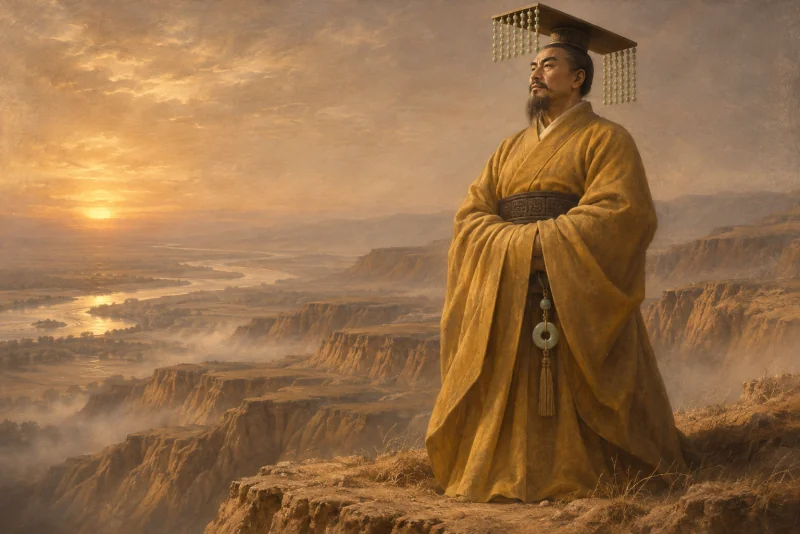
Cover and illustrations: AI-generated images made for Arcana. They are interpretations, not historical artworks.