Liễu Hạnh: The Exiled Princess Who Became the Mother Goddess
A daughter of the Jade Emperor let a jade cup fall, was born in a village of Nam Định and died at twenty-one, then kept coming back until the court that had tried to drive her out gave her a temple and a king's title. The fullest telling was written in the 1730s by a woman scholar, who, scholars broadly agree, reshaped a cult that already existed.
- Type: legend of a goddess, a princess of heaven sent down to earth who becomes the Mother Goddess
- Culture: Việt, northern Vietnam: Vân Cát in Nam Định, Thanh Hóa, Hanoi
- Earliest texts: royal decrees for her cult from the 17th century (the oldest surviving original, kept at Phủ Dầy, is dated 1683); the first full story, Đoàn Thị Điểm’s Vân Cát thần nữ truyện (雲葛神女傳) in the Truyền kỳ tân phả, written in the 1730s
- Key figures: Liễu Hạnh, born Giáng Tiên; the Jade Emperor (Ngọc Hoàng); her father Lê Thái Công; her husband Đào Lang; the scholar Phùng Khắc Khoan; the fairies Quế and Thị
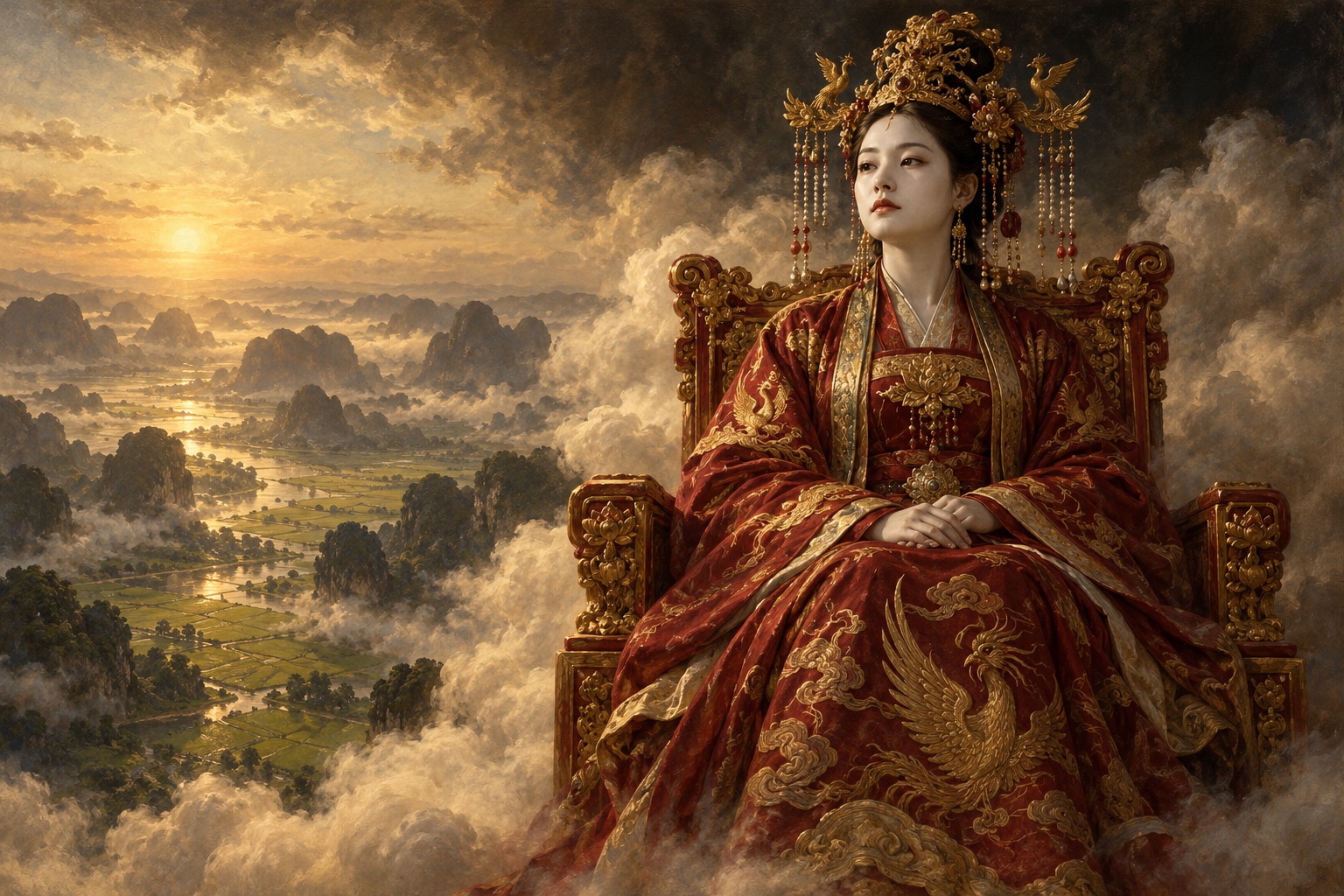
Every spring, in the third lunar month, crowds travel to Phủ Dầy, in the rice country south of the city of Nam Định, where a goddess has her tomb and her temples. A saying of the Red River delta pairs her with the hero Trần Hưng Đạo: “In the eighth month the Father’s anniversary, in the third month the Mother’s.” The Mother is Liễu Hạnh, a princess of heaven who, the story says, was born in this village in 1557 and died here at twenty-one.
Was Liễu Hạnh a real woman? Temple tradition says so, and gives her dates: born at Vân Cát in 1557, died in 1577. The oldest dated witness of her cult is a royal decree of 1683, still kept at Phủ Dầy; one of 1642 survives only as a copy. The oldest full story, Đoàn Thị Điểm’s of the 1730s, is read by most scholars as fiction built on a cult that already existed.
1 The Telling
This is the story as Đoàn Thị Điểm (1705–1748), one of the few women writers of old Vietnam, told it in her Vân Cát thần nữ truyện, “The Goddess of Vân Cát”. We could not open its Classical Chinese text or a full translation. We follow the detailed summary by the historian Olga Dror, who worked from both, and Phan Kế Bính’s Vietnamese retelling in the Nam Hải dị nhân liệt truyện (1930 edition), which tells much of the same story more briefly. Where the two differ, we say so.
1-1 The Jade Cup
In Vân Cát, a hamlet of Thiên Bản district (today Vụ Bản, in Nam Định), lived an upright man, Lê Thái Công, who already had a son. It was 1557, in the reign of Lê Anh Tông. Thái Công’s wife fell ill while carrying their second child. She could not eat and wanted only the scent of incense and flowers, and the sorcerers’ rites made her worse.
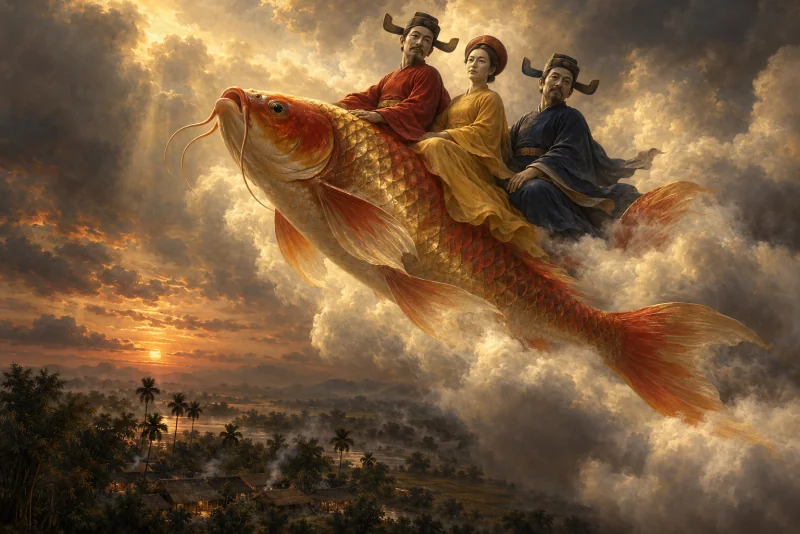
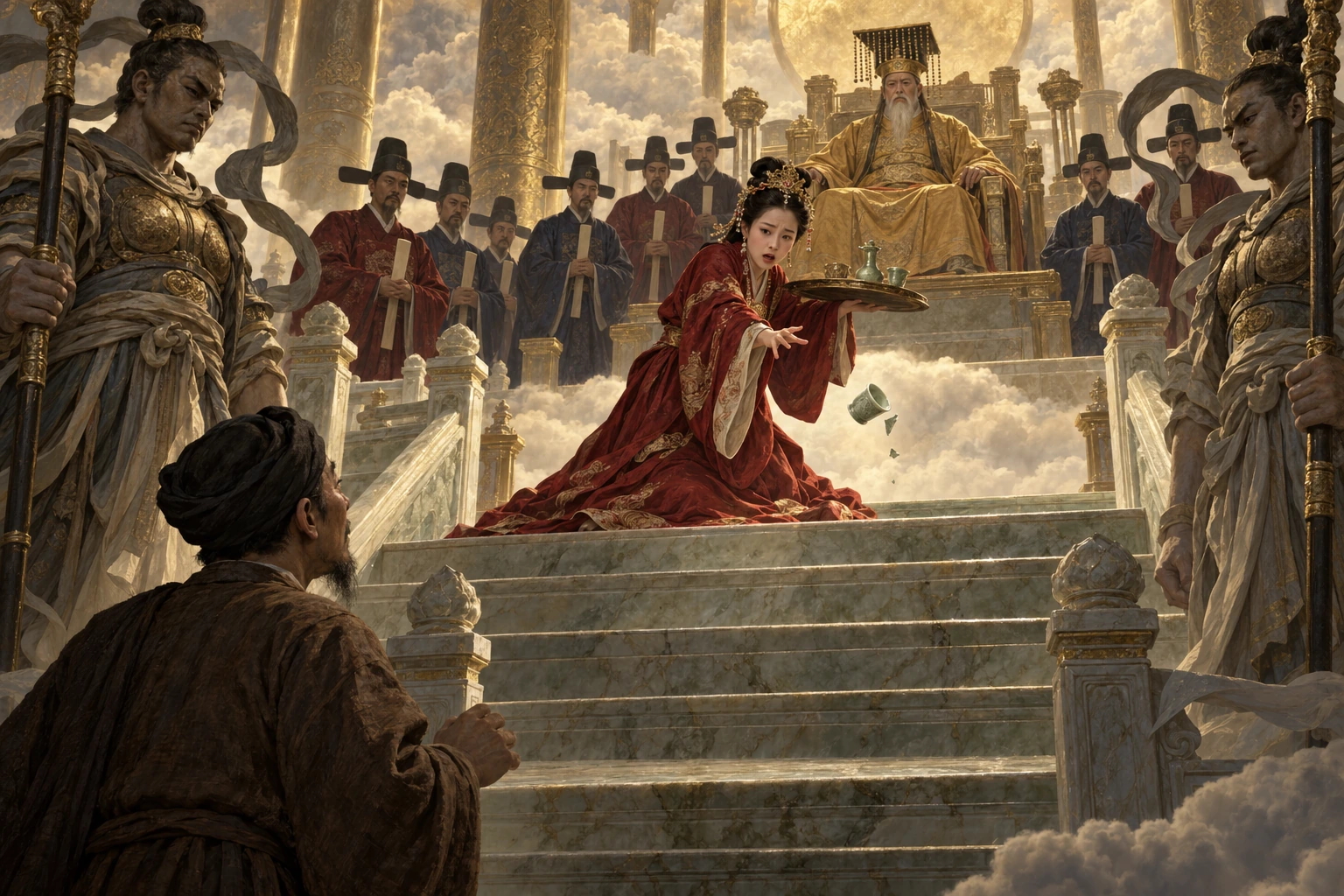
On the night of the Mid-Autumn festival a stranger asked to treat her. He carried a hammer of jade. He chanted a spell and threw the hammer to the ground, and Thái Công fell senseless. Two strongmen led him through nine gates to a palace of gold and jade, where the Jade Emperor sat among his officials. A girl in red, offering him the wine of long life, let the jade cup slip, and it chipped. An official wrote in a register, and envoys and maids led her out through the south gate. “That is the second princess, Quỳnh Hoa,” a strongman told him. “This time she will surely be sent down to earth.” When Thái Công woke, his wife had given birth to a daughter. He named her Giáng Tiên, “the fairy who came down”.
1-2 Twenty-One Years
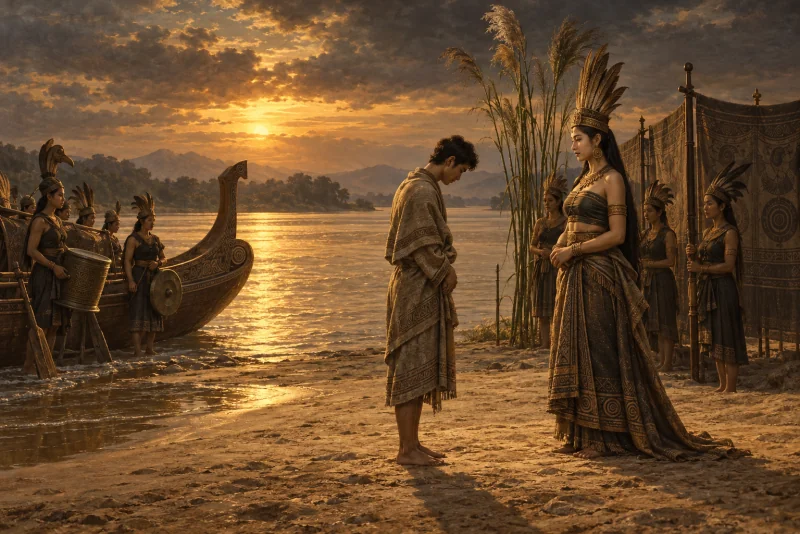
Giáng Tiên grew up beautiful and learned. She played the flute and wrote songs, and Phan Kế Bính copies four of them, one for each season. When her father heard her songs turn sad, he understood that she was of an age to marry. He sent her to live as the adopted daughter of a retired official of the village. There she met Đào Lang, a young man who had been found as a baby under a peach tree (đào). The families agreed, and the two were married. She served her husband’s parents dutifully. Three years later, on the third day of the third month, she died without any illness, at twenty-one. Phan Kế Bính gives her one son; in Dror’s summary she leaves two children.
In heaven she could not forget the earth. The other fairies pleaded for her, and the Jade Emperor let her go back with the title of Princess Liễu Hạnh. On the second anniversary of her death she came home and told her weeping family that she was a fairy whose exile had ended: their names were in heaven’s register, and they would meet again. Then she went to Đào Lang, who had moved to the capital with their children. She spent part of a night with him, urged him back to his studies and his duties, and was gone by dawn, leaving only clouds. After that she roamed in disguise, as an old woman or as a girl playing the flute by moonlight. Those who mocked her met with disaster, those who brought offerings were blessed, and the silver and silk people gave her she carried to her parents.
1-3 The Scholar and the Wine Shop
When her parents, her adoptive parents and her husband had all died and her children were grown, she began to wander the country. On a mountain in Lạng Sơn, beneath a pine by a temple, she sat playing and singing. The scholar Phùng Khắc Khoan, on his way home from an embassy to China, heard her, and the two traded lines of verse. Before he could ask her name, she was gone. Sticks of wood lay scattered on the ground, and with them, written out, 卯口公主: add the “wood” (木) of the sticks, and it reads 柳杏公主, “Princess Liễu Hạnh”. On a stick standing upright were the words 水馬已走, which join into 馮起, “Phùng, begin”. He understood that she wanted the temple restored, and paid for the work.
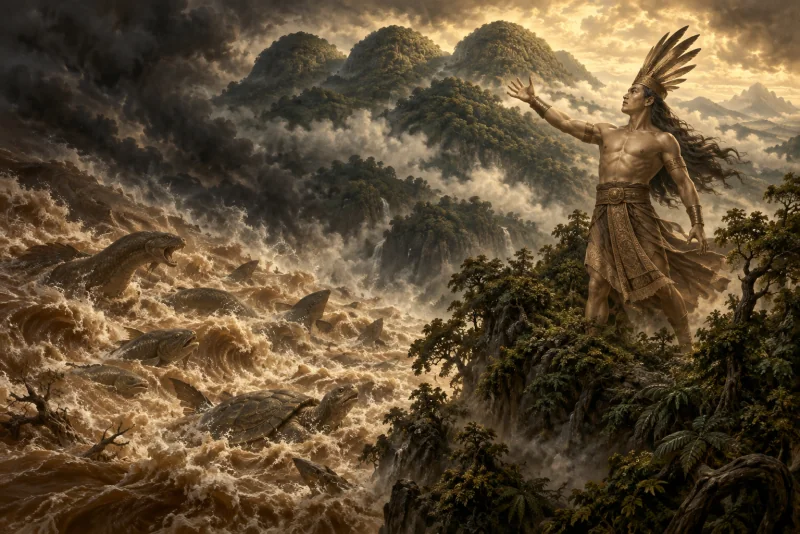
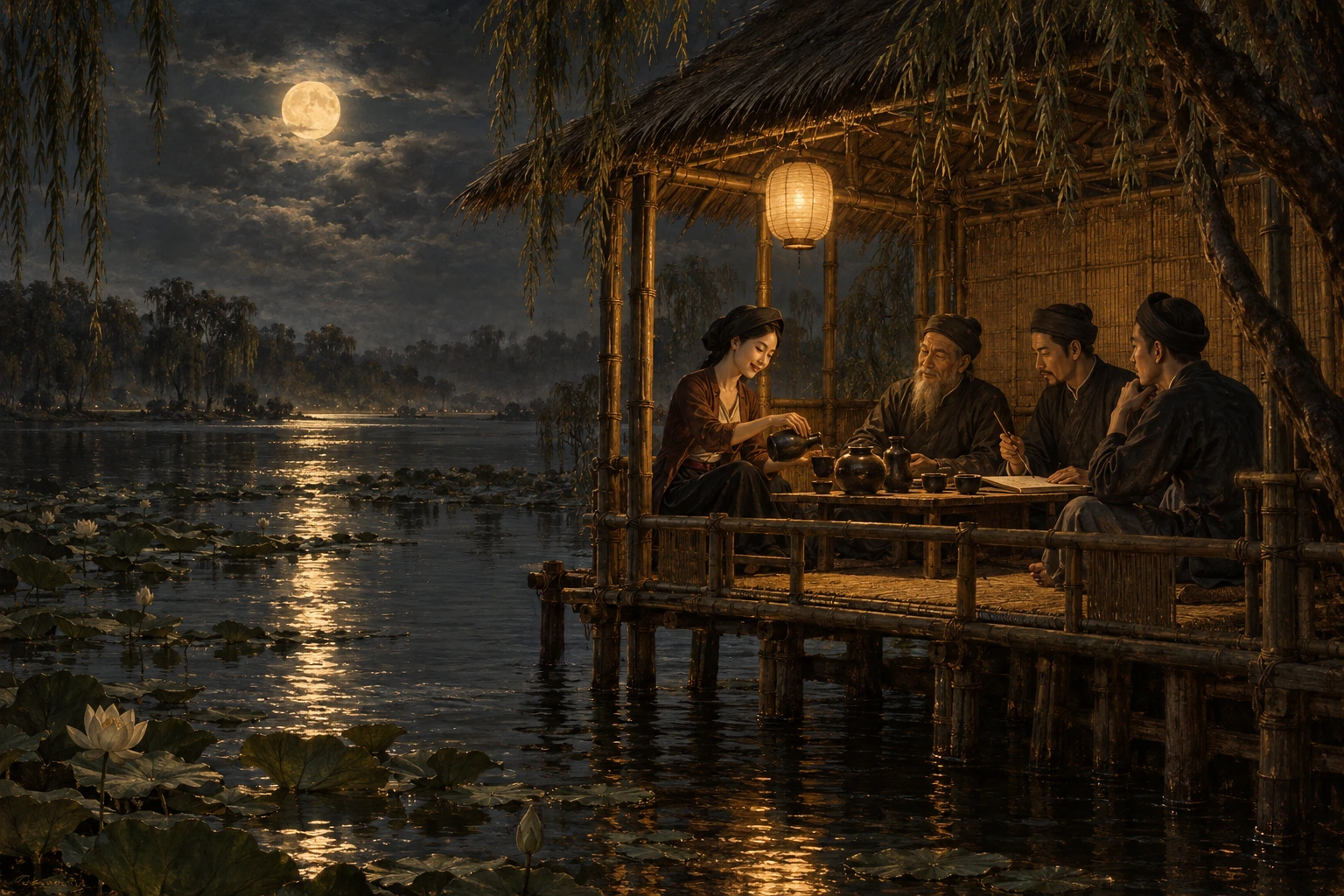
Years later, back in the capital and weary of office, Phùng went walking with two younger friends named Ngô and Lý. By the West Lake they found a wine shop kept by the princess. They drank and traded poems with her, and watched her explain a cryptic verse to a giant fisherman who stood with his feet on the earth and his head in the sky. When they came back another day, there was nothing but the water.
1-4 Sinh
In Nghệ An she met a poor, orphaned young scholar called Sinh and knew him for Đào Lang reborn. Without saying who she was, she asked to stay the night in his house, and he refused. Then he found a poem on flowered paper hanging from a peach tree, wrote his answer beside it, and could think of nothing but its author. One day, after long rain, she called to him from the road. She would have no go-between and no rites, and they were married by moonlight. She sent him back to his books, so that he might serve others and not only his own pride. Within a year she bore a son, and he passed the examinations and took a post at the National Academy (Quốc Tử Giám). Then one day she wept. She was the fairy who had broken the jade cup, she told him, and her exile was over. After she left, Sinh gave up office, raised their son alone and never married again.
1-5 Phố Cát
Back in heaven, she persuaded the Jade Emperor to let her return once more, now with two fairies, Quế and Thị. They came down at Phố Cát, in Thanh Hóa. The good were blessed and the wicked struck down, and the frightened people built her a temple. In Phan Kế Bính she appears there as a beautiful girl selling drinks at the pass, and many who flirted with her died.
In the Cảnh Trị era, in the 1660s, the court heard of a demon in Thanh Hóa. It sent soldiers with masters of magic, and the temple was burnt to the ground. In Dror’s summary it was the magicians’ arts, not the soldiers, that overcame her. Then a plague killed the animals of the whole region. The people raised an altar and prayed, and the princess appeared on it. She was a fairy, she said, and unless they asked the court for a new temple, no one there would live.
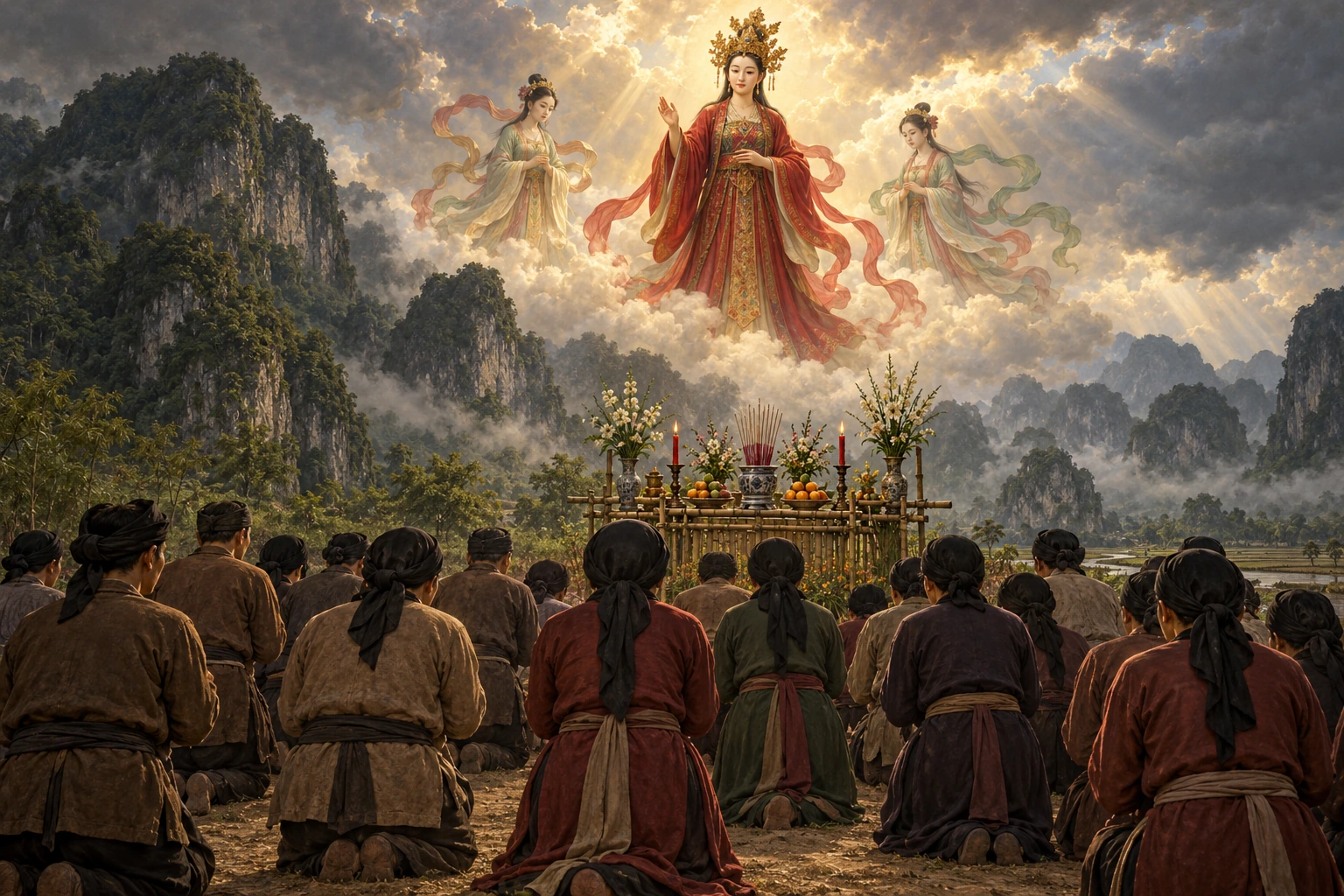
The court declared her divine, named her Mã Hoàng công chúa and ordered a new temple on the mountain of Phố Cát. Later, when the royal army marched against its enemies, she fought on its side, and the court raised her to Chế Thắng Hòa Diệu Đại Vương, roughly “the Great King Who Brings Victory and Peace”. It is a king’s title, not a princess’s, Dror observes: the court gave it to the greatest heroes. From then on, the story ends, every reign set up her statues and built her temples.
2 Where the Story Is Written Down
- Royal decrees. The court’s decrees (sắc phong) are the oldest dated witnesses of the cult. The earliest known, of 1642, survives only as a copy; the oldest original, dated 1683, is still kept at Phủ Dầy, as the historian Chu Xuân Giao has shown. These decrees place her in the Buddhist heaven of Indra, the heaven of the Thirty-Three, and give her the ranks of princess and of great king.
- A missionaries’ treatise. In the 1750s a group of European missionaries around Adriano di St. Thecla described the religions of northern Vietnam in Latin, in the Opusculum de sectis apud Sinenses et Tunkinenses, and in Vietnamese, in the Tam giáo chư vọng. Theirs are the first European notes written directly about “Bà Chúa Liễu Hạnh”.
- Đoàn Thị Điểm’s Vân Cát thần nữ truyện, in her collection Truyền kỳ tân phả (傳奇新譜, A New Collection of Marvellous Tales), written in Classical Chinese in the 1730s, while she taught at home before her marriage. “Most of the stories we know about the Vietnamese goddess,” Dror writes, derive from it. A Vietnamese translation by Ngô Lập Chi and Trần Văn Giáp was reprinted in Hanoi in 2001; we could not open it.
- Temple records. Local texts in Hán and Nôm give her other lives. The stele of the Quảng Cung temple, composed by Nguyễn Đình Việp in 1741, records an earlier birth as Phạm Tiên Nga; Vũ Huy Trác wrote a record of the same temple in 1781; and the Cát thiên tam thế thực lục, “True Record of the Three Lives”, was compiled by several hands. Đoàn Thị Điểm and Kiều Oánh Mậu, by contrast, know only two places where she came down.
- Later retellings. A. Landes’s Contes et légendes annamites (Saigon, 1886) prints popular tales of a “celestial princess Liễu”. Kiều Oánh Mậu’s Tiên phả dịch lục (early 20th century) and Phan Kế Bính’s Nam Hải dị nhân liệt truyện (first printed 1909; we read the 5th edition, 1930) retell her story.
3 Competing Versions
- When did she live? She is born in 1557, the Thiên Hựu era of Lê Anh Tông, in Đoàn Thị Điểm and in Phan Kế Bính. In Landes she comes down in the reign of Lê Thái Tổ, the founder of the Later Lê (1428–1433).
- One life or three? In Đoàn Thị Điểm she is born only once and comes back as a fairy. Some Hán-Nôm texts and the temples give her three births, summed up in a couplet: “Three lives on the wheel of rebirth: at Vĩ Nhuế, at Vân Cát, at Nga Sơn.” First as Phạm Tiên Nga (1434–1473; some give 1443), who never married and spent her life on good works, worshipped at Phủ Quảng Cung in Ý Yên; then as Lê Thị Thắng at Vân Cát (1557–1577), wife of Đào Lang; last as Hoàng Thị Trinh at Tây Mỗ in Nga Sơn, Thanh Hóa (1650–1668), wife of a man of the Mai family who was Đào Lang reborn. Dương Thị Thu Hà names him Mai Thanh Lâm.
- How many children? One son in Phan Kế Bính; two children in Dror’s summary; a son and a daughter in the temple version as Dương Thị Thu Hà tells it.
- Who defeated her? In Đoàn Thị Điểm, the court’s magicians. Later tellings make it a war, the “great battle of Sòng Sơn”: tricked by the masters of the Nội Đạo sect, she loses her powers, and the Buddha comes down to save her; from then on she follows the Buddha’s teaching. The ethnologist Phạm Quỳnh Phương traces this episode to Chu Mạnh Trinh’s Nôm verse, Kiều Oánh Mậu and others. In Landes, eight Buddhist guardians fight her for three days at the Đèo Ngang pass, and the king gives her three strings of gold beads so that she will follow the Buddha’s law. UNESCO’s summary still says that she “became a Buddhist nun”.
- Virtuous or not? The missionaries of the 1750s wrote that she had been a woman of Tonkin killed for her loose life and thrown into a river, whom the people then worshipped. A Lê family record of Vân Cát makes her a granddaughter of a Lê king who died young. Dror’s book asks the same question on its jacket: “Was she a virtuous woman or a prostitute?”
- Mã Hoàng or mạ vàng? The temple records write her first title in three ways (鎷鐄, 禡黃, 禡鐄), and some read it mạ vàng, “gilded”; Phan Kế Bính has Mã-vàng. The scholar Lê Tùng Lâm reads mã hoàng, the sacrifice an army makes to a god where it halts, which fits a goddess who helped the troops. Manuscript A.48 of the Truyền kỳ tân phả writes 禡黃.
4 History and Tradition
A novel? Dror argues that Đoàn Thị Điểm’s tale is “a piece of fiction which reflects the author’s views, experiences and aspirations for greater freedom for women”, and counts eight parallels with the writer’s own life. Phạm Quỳnh Phương notes that scholars broadly agree she reshaped a cult already formed in the 16th and 17th centuries. Trần Đức Dũng and Nguyễn Thị Hạnh Chi read the same women, Giáng Tiên among them, as speaking with the voice of Confucian male norms.
Phủ Dầy. At Kim Thái in Vụ Bản, the Tiên Hương and Vân Cát temples and the Mother’s stone tomb were listed as national monuments in 1975; most of the buildings date from the Nguyễn dynasty. In 1915 Phan Kế Bính called the festival on the eighth day of the third month a “mediums’ festival”: mediums came from everywhere and vied with one another in their dances.
Sòng Sơn and Tây Hồ. Phan Kế Bính ends his tale with her temple “on Mount Sùng Sơn”, which was “still there” in his day. In Thanh Hóa her great temple is at Sòng Sơn, where the later tellings set her battle, and Phủ Tây Hồ, on the shore of the West Lake in Hanoi, is said to stand where she kept her wine shop.
The Mother Goddess religion. Liễu Hạnh is the chief deity of the worship of the Three Realms (Tam phủ): heaven, water, and mountains and forests, to which the Four Palaces (Tứ phủ) add earth. She is identified with the Mother of Heaven (Mẫu Thượng Thiên) among the three Mothers, or with the Mother of Earth among the four, and the other Mothers are seen as her manifestations. Above her is only the Jade Emperor; below her, a pantheon of mandarins, ladies, princes, young women and boys. The ethnologist Ngô Đức Thịnh named the whole system Đạo Mẫu, “the Way of the Mother”. Its central rite is hầu đồng: to the sung liturgy of hát văn, the spirits enter a medium one after another, and the medium changes costume for each.
Discouraged, then listed. Confucian scholars long frowned on mediumship, and in 1915 Phan Kế Bính wrote that the people would stay ignorant as long as sorcery and mediums flourished. From the 1960s until Đổi mới in 1986, write Đỗ Duy Hưng and Trần Anh Châu, the worship was treated as superstition: many shrines were pulled down or left to decay, and festivals and hầu đồng were banned. Policy changed after 1986. Chầu văn singing was listed as national heritage in 2012 and the Phủ Dầy festival in 2013, and in 2016 UNESCO inscribed the “Practices related to the Việt beliefs in the Mother Goddesses of Three Realms”, naming Liễu Hạnh “the Mother of the World”.
The Four Immortals (Tứ bất tử). Vietnamese folk belief honours four immortal saints. For the scholar Dương Thị Thu Hà each stands for something:
- Tản Viên, the god of the mountain (Sơn Tinh), first of the four: the wish to master nature and overcome floods;
- Thánh Gióng, Phù Đổng Thiên Vương: the whole people united against invaders;
- Chử Đồng Tử, with his wife Tiên Dung: love, marriage and prosperity;
- Liễu Hạnh, as the Mother of Heaven: the life of the spirit, blessings and letters, and a woman’s claim to happiness against the bonds of Confucian rites.
In the 18th century the commentator Cao Huy Diệu already ranked Tản Viên’s rites “first among the four immortal gods”, without naming the others. Liễu Hạnh is the only woman of the four, and the only one whose story is set in historical times; the other three belong to the age of the Hùng kings.
Phùng Khắc Khoan (1528–1613) was a real scholar and envoy to China, and some modern writers say that he spoke of meeting the goddess himself. Olga Dror found no mention of it in his own writings, or in works about him, except those that go back to Đoàn Thị Điểm’s tale. She reads both meetings as the novelist’s invention.
5 Related Stories
- Sơn Tinh and Thủy Tinh: The Mountain Spirit, the Water Spirit and the Yearly Floods: the god of Mount Tản Viên heads the Four Immortals, and Liễu Hạnh comes last. Both keep coming back: he to fight the floods every year, she each time heaven lets her go.
- Thánh Gióng: The Boy Who Grew into a Giant: another of the Four Immortals, who leaves the world by riding into the sky. UNESCO lists the Gióng festival (2010) and the practices of the Mother Goddess religion (2016).
- Chử Đồng Tử and Tiên Dung: The Poorest Man and the Princess: the third of the Four Immortals. Tiên Dung, too, takes a husband without asking anyone’s leave, as Liễu Hạnh does with Sinh, and in the Lĩnh Nam chích quái their city rises to heaven in a single night. We link them for the theme.
- Từ Thức: The Man Who Married a Fairy: a fairy and a mortal husband again, the other way round: here the man follows the fairy out of the world. Nga Sơn, where the temple version sets Liễu Hạnh’s last life, has a cave named after him.
- The Jade Emperor: The Ruler of Heaven: Liễu Hạnh’s father in heaven. In China he rose to the top of the gods only late, and Daoist doctrine still sets the Three Pure Ones above him.
6 Sources
- Đoàn Thị Điểm, Vân Cát thần nữ truyện, in the Truyền kỳ tân phả (1730s), as summarised in Olga Dror, “Đoàn Thị Điểm’s ‘Story of the Vân Cát Goddess’ as a Story of Emancipation”, Journal of Southeast Asian Studies 33.1 (2002): 63–76: Cambridge Core; read in Lê Thị Huệ’s Vietnamese translation: Văn hóa Nghệ An
- Phan Kế Bính, Nam Hải dị nhân liệt truyện, no. 45, “Liễu-Hạnh tiên-chúa”, 5th edition (Hanoi, 1930): Vietnamese Wikisource; and Việt Nam phong tục (1915), part III, chapter 27, “Đồng cốt”: Vietnamese Wikisource
- A. Landes, Contes et légendes annamites (Saigon, 1886), tale XXVIII: archive.org
- Lĩnh Nam chích quái, “Nhất Dạ Trạch truyện”: Wikisource (Classical Chinese); Lý Tế Xuyên, Việt điện u linh tập, with Cao Huy Diệu’s commentary, trans. Lê Hữu Mục from manuscript A.751: archived PDF
- Olga Dror, Cult, Culture, and Authority: Princess Liễu Hạnh in Vietnamese History (Honolulu: University of Hawai’i Press, 2007): Project MUSE
- Phạm Quỳnh Phương, “Mẫu Liễu Hạnh”, reference entry: Vietnam Academy of Social Sciences portal
- Chu Xuân Giao, “Căn cước lịch sử của Thánh Mẫu… đạo sắc phong cổ nhất mang niên đại 1683…”, Nghiên cứu và Phát triển 1 (153) (2019): VJOL; “Vũ trụ quan Phật giáo Mật tông… trong nhóm sắc phong sớm nhất cho Liễu Hạnh công chúa”, Nghiên cứu và Phát triển 1 (2020): VJOL; “Mẫu Liễu trong các tác phẩm thời kỳ đầu tiên của người Phương Tây”, Nghiên cứu Tôn giáo 146.8 (2015): 48–77: VJOL
- Lê Tuấn Dương, “Ảnh hưởng của văn hóa Phật giáo lên sắc phong Công chúa Liễu Hạnh”, Tạp chí Nghiên cứu Phật học, November 2024, citing Lê Tùng Lâm: tapchinghiencuuphathoc.vn
- Dương Thị Thu Hà, “Tín ngưỡng thờ Tứ bất tử trong văn hóa người Việt Nam”, Khoa học xã hội Việt Nam 4 (2020): 50–57: VJOL
- Dương Thị Hải Vân, “Vân Hương Thánh Mẫu trong tín ngưỡng thờ nữ thần ở Thừa Thiên Huế”, Tạp chí Khoa học Đại học Huế 132.6D (2023): 17–27: jos.hueuni.edu.vn
- Đỗ Duy Hưng, “Một số kết quả nghiên cứu nổi bật về thực hành tín ngưỡng thờ Mẫu Tam phủ, Tứ phủ ở vùng châu thổ Bắc Bộ hiện nay”, Nghiên cứu Tôn giáo 11 (2021): 53–69: VJOL; with Trần Anh Châu, “Sự hình thành và phát triển của bản hội trong tín ngưỡng thờ Mẫu”, Nghiên cứu Tôn giáo 11 (2022): 84–99: VJOL
- Trần Đức Dũng and Nguyễn Thị Hạnh Chi, “Sự ‘ghi đè’ của thiết chế nam quyền lên giới nữ… qua trường hợp Hải khẩu linh từ, Vân Cát thần nữ truyện, An Ấp liệt nữ lục của Đoàn Thị Điểm”, Tạp chí Khoa học Trường Đại học Thủ đô Hà Nội 101 (2025): 5–13: VJOL
- UNESCO, Practices related to the Viet beliefs in the Mother Goddesses of Three Realms (2016)
- “Công nhận Lễ hội Phủ Dầy là Di sản văn hóa quốc gia”, Nhân Dân, 23 November 2013: nhandan.vn; “Lại chuyện biển tên di tích ở Phủ Dầy”, Báo Văn hóa, 27 October 2021: baovanhoa.vn
Cover and illustrations: AI-generated images made for Arcana. They are interpretations, not historical artworks.