Thánh Gióng: The Boy Who Grew into a Giant
A three-year-old who has never spoken asks the king for an iron horse, grows into a giant, routs the invaders and rides into the sky. The two oldest notices of him have no child and no horse, and the 15th-century texts arm him with a sword, not bamboo.
- Type: legend, a child hero who saves the realm and is worshipped as a god
- Culture: Việt, the Red River delta; Phù Đổng and Sóc Sơn, on the outskirts of Hanoi
- Earliest texts: an entry in Lý Tế Xuyên’s Việt điện u linh tập (1329) and a notice in Lê Tắc’s An Nam chí lược (1330s); the full story in the Lĩnh Nam chích quái and the Đại Việt sử ký toàn thư, both in their 15th-century form
- Key figures: the child of Phù Đổng (Phù Đổng Thiên Vương, popularly Thánh Gióng), his mother, the Hùng king and his envoy, the Dragon Lord Long Quân, the king of Ân
Every spring in Phù Đổng, on the edge of Hanoi, young men train for a month to fight a battle that is only a dance. A Flag Master dances across three mats, paper butterflies scatter the invaders, and the enemy generals are played by twenty-eight girls. It is the battle that the village’s most famous son is said to have won at the age of three, after growing into a giant.
Did Gióng really pull up bamboo to fight with? Not in the oldest versions. In the 15th-century texts the child asks for a horse and a sword, and nothing breaks. Among the texts we could read, the bamboo first appears in Phan Kế Bính’s Nam Hải dị nhân liệt truyện, in its 1930 edition: his sword snaps in the battle, and he tears up bamboo by the roadside to beat the enemy with.
1 The Telling
This is the version of the Lĩnh Nam chích quái, in the copy on Chinese Wikisource, which carries the names of its 15th-century editors, Vũ Quỳnh and Kiều Phú. Where that copy has a gap, the copy translated into English by Eric Henry fills it.
1-1 The Old Man at the Crossroads
The Hùng king was rich and had stopped attending the northern court. So the king of Ân planned to invade, under cover of a royal tour of inspection. A master of the occult arts advised the Hùng king to seek the hidden help of the Dragon Lord, Long Quân. The king built an altar, laid gold, silver and silk on it, fasted, burned incense and prayed for three days.
Then came thunder and a great storm, and an old man appeared, sitting at a fork in the road: more than nine Chinese feet tall, square-faced and big-bellied, his beard and brows snow-white, laughing, singing and dancing. The king brought him to the altar, but he would neither eat nor speak. At last he drew divination slips and said that the northern bandits would come in three years. The king should put his weapons in order, train his soldiers, and search the whole realm for someone able to defeat them, with land and rank as the reward. Then he rose into the air, and they knew that he had been Long Quân.
1-2 The Child Who Did Not Speak
Three years later the border sent word that the army of Ân was coming, and the king sent envoys across the land. In Đổng village, in Tiên Du district, lived a rich man of more than sixty, whose son had been born on the seventh day of the first month. The boy was three years old, and still could not speak or sit up.
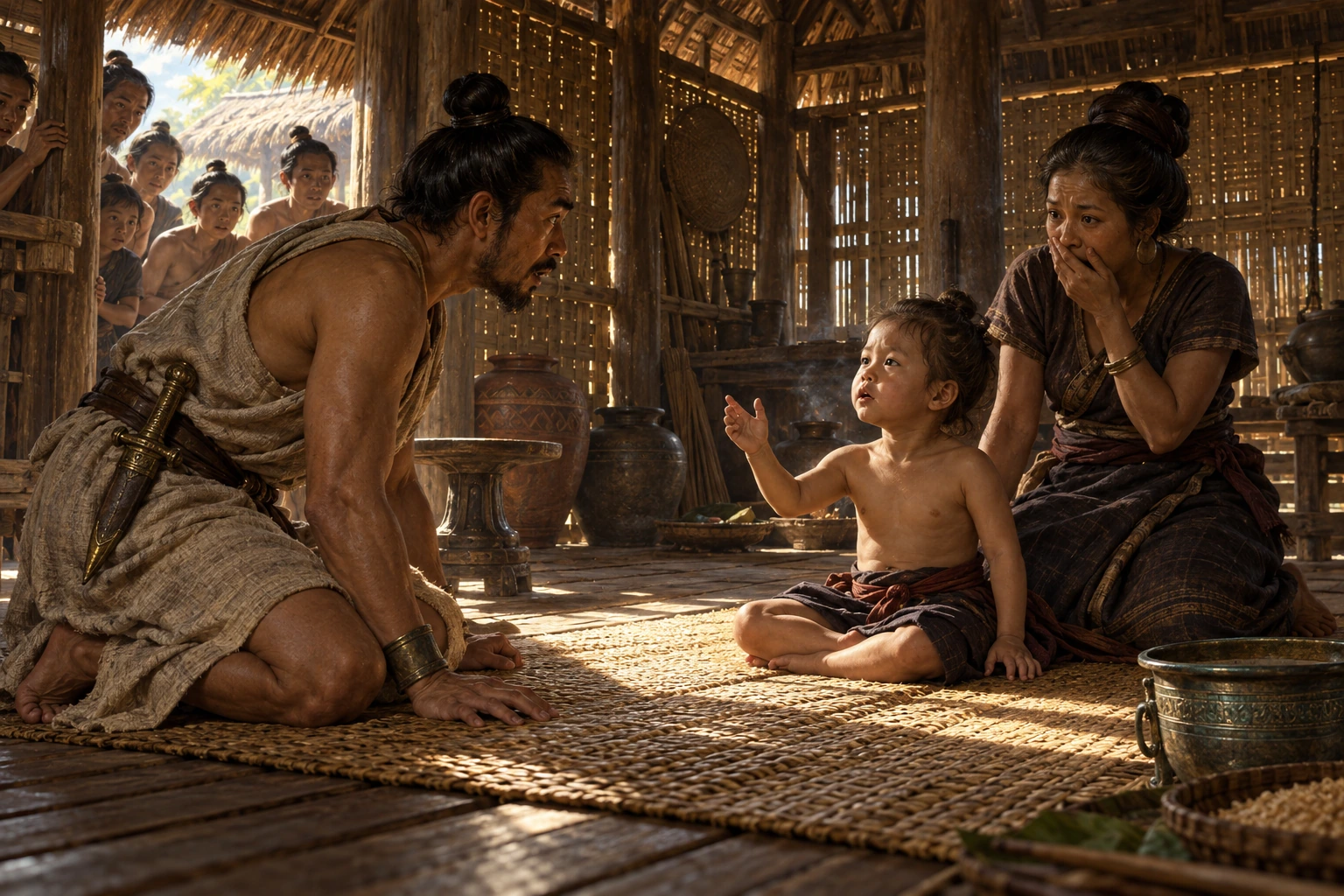
When the envoy came, the boy’s mother teased him. All this son of hers could do was eat and drink, she said; he could never catch bandits, win a reward from the court and repay her for nursing him. At that the child spoke for the first time: “Mother, call the envoy here!” The astonished neighbours fetched him.
The Wikisource copy loses a few words here and picks up again at “an iron hat”. In the copy Henry translated, the child sits up and tells the envoy to have the king cast him an iron horse, an iron sword and an iron helmet; with them he will go and fight, and the king will have nothing to fear.
1-3 A Village Feeds a Giant
The ministers asked how one person could defeat an army. The king grew angry: the Dragon Lord’s words had not been idle. Fifty cân of iron were forged into a horse, a sword and a hat. When they arrived, the mother was terrified, but the boy only laughed and asked her for plenty of food and wine.
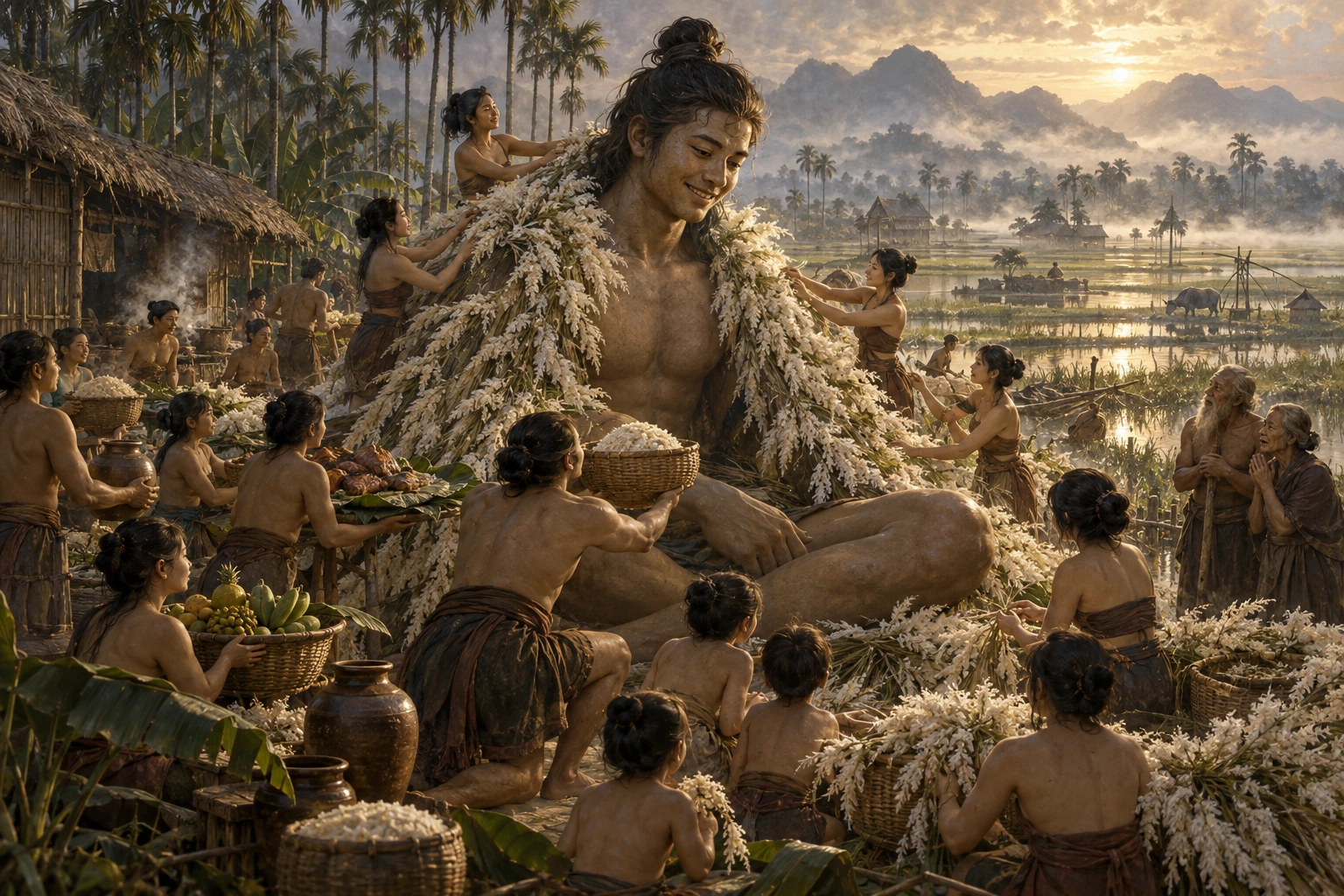
Then his body suddenly grew. He ate so much that his mother could not keep him fed. The neighbours brought cooked beef and wine, dishes and fruit, and still his belly was not full. No amount of cloth and silk would cover him, so they gathered reed flowers and pieced them together to clothe him.
1-4 Trâu Sơn
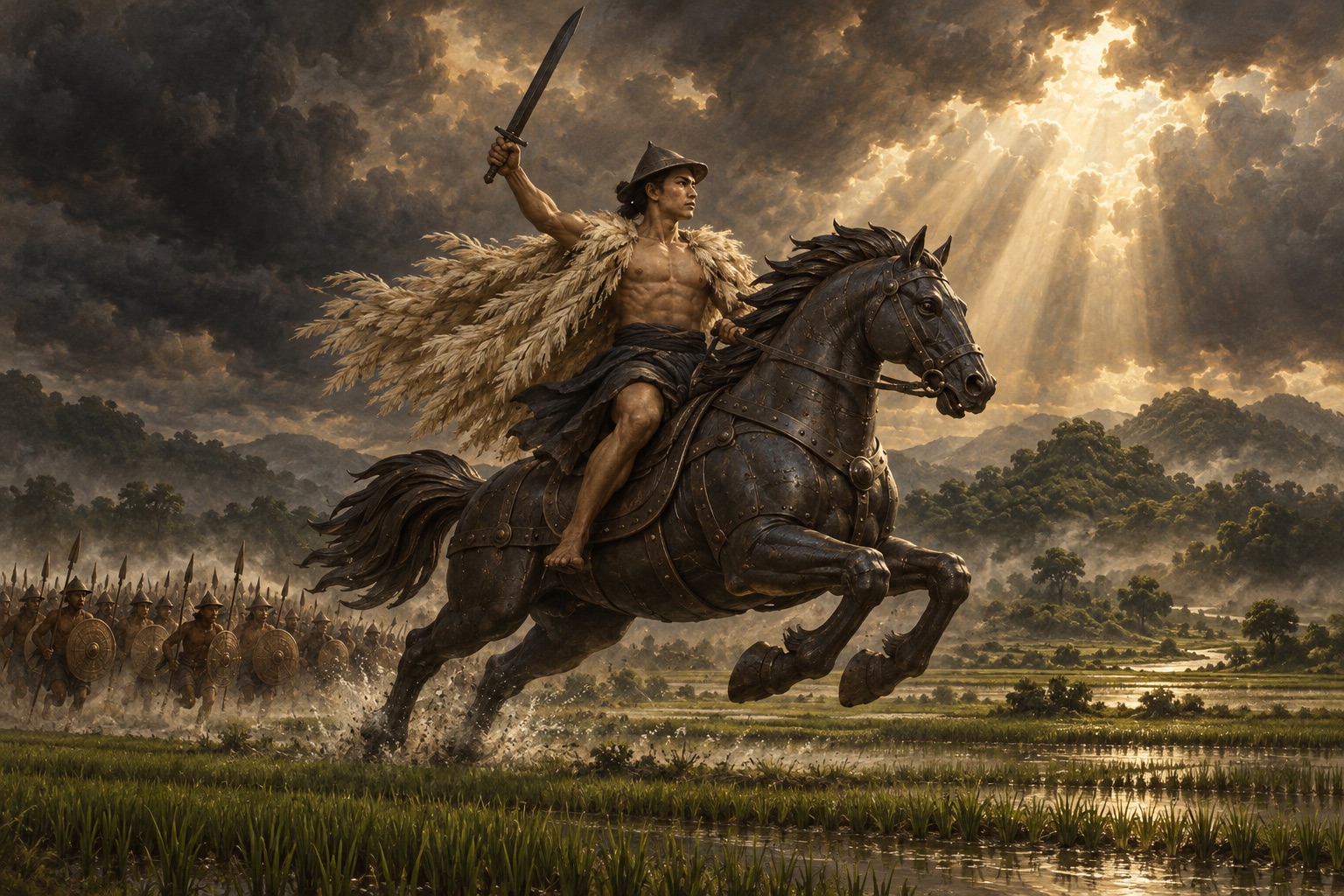
When the army of Ân reached the foot of Trâu Sơn, in Vũ Ninh, the child stretched out his legs and stood up, more than ten Chinese feet tall. He tipped back his head and sneezed more than ten times, drew his sword and cried: “I am a general of Heaven!”
He put on the hat and mounted the horse, and it leapt forward and flew. In an instant he was in front of the king’s army. He rode ahead swinging his sword, and the royal troops followed him up to the enemy camp. The army of Ân fled. Those who were left bowed down in rows, called him the general of Heaven and surrendered, and the king of Ân died on the field.
1-5 Mount Sóc
He rode on to Mount Sóc, in Kim Hoa, took off his clothes there and rode his horse up into the sky. It was the ninth day of the fourth month, and he left his traces on a rock of the mountain.
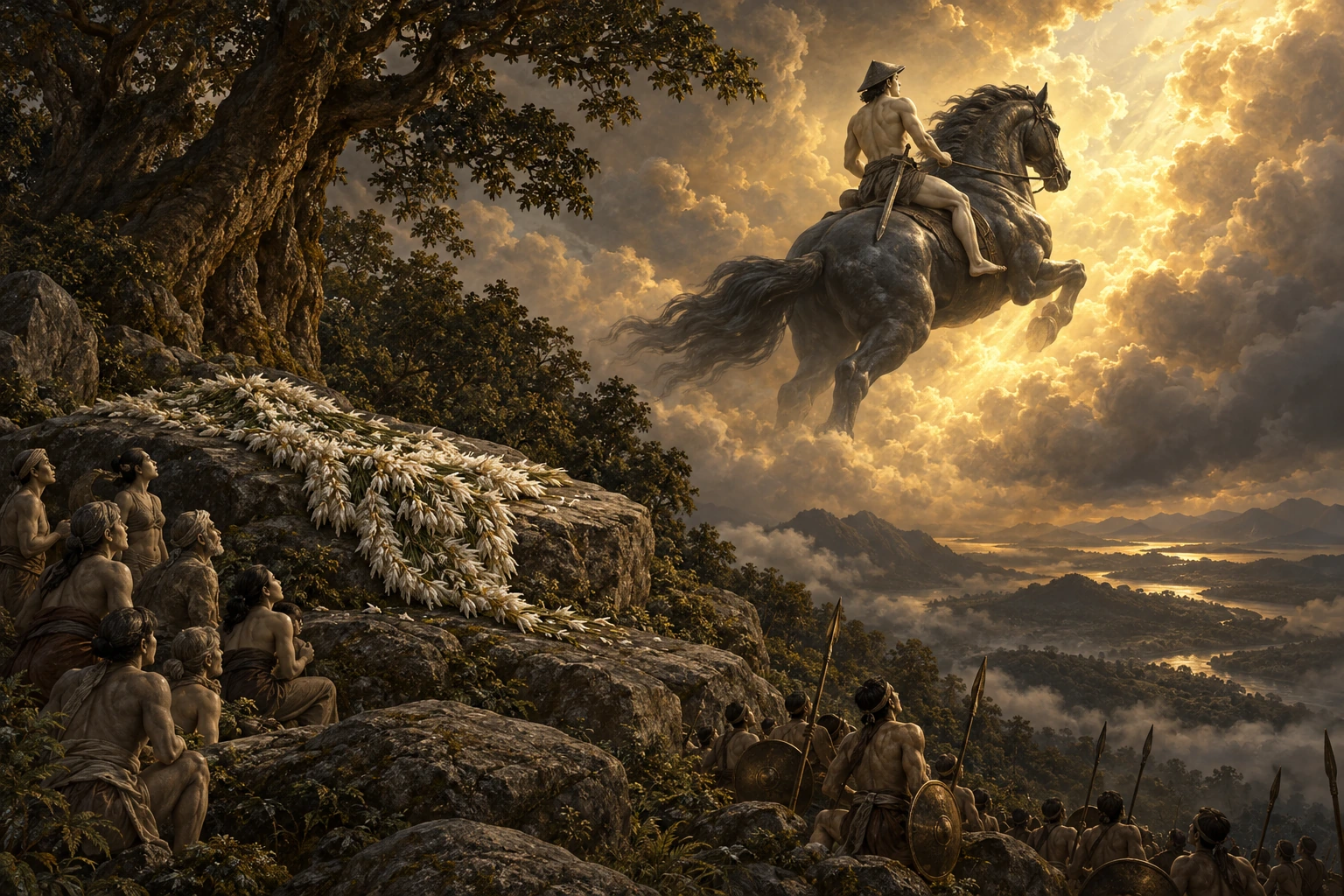
The Hùng king honoured him as Phù Đổng Thiên Vương, the Heavenly King of Phù Đổng. He built him a shrine at his old home and granted a hundred khoảnh of land for offerings morning and evening. For 644 years, the text says, Ân never dared to send troops again. Much later Lý Thái Tổ, the founder of the Lý dynasty, gave him the title Xung Thiên Thần Vương, the Divine King Who Soared to Heaven. His temple stands beside the Kiến Sơ pagoda in Phù Đổng, and his statue on Mount Vệ Linh.
The tale ends with a poem that Ngô Chi Lan, a woman from Phù Lỗ, wrote on the mountain under King Lê Thánh Tông: “The iron horse is in heaven, his name is in the histories.”
2 Where the Story Is Written Down
- The Việt điện u linh tập (Spiritual Powers of the Việt Realm) of Lý Tế Xuyên, with a preface of 1329, read here in Lê Hữu Mục’s translation of manuscript A.751. Its entry on the god of Phù Đổng cites a lost book, the Báo cực truyện. Tradition held, it says, that he was the earth spirit of the Kiến Sơ pagoda in Phù Đổng, whose shrine a Zen master had set up beside the pagoda. When a later master wanted to pull the shrine down, verses appeared on the old tree there. After Lý Thái Tổ came to the throne, a verse on its bark spoke of “Xung Thiên”, and the king gave the god that title. The Trần added Dũng Liệt in 1285, Chiêu Ứng in 1288 and Uy Tín in 1313. There is no child, no horse, no Hùng king, no Ân and no flight to heaven.
- The An Nam chí lược, by Lê Tắc, a Vietnamese who had gone over to the Mongol Yuan and wrote in China (his preface dates from the 1330s). Among the “ancient sites” of the land it lists the Xung Thiên temple in Phù Đổng. When there was disorder in the land, it says, a man of awe-inspiring virtue suddenly appeared and the people rallied to him. He put down the disorder, then “rose into the air and departed”. He was called King Xung Thiên, and the people built him a shrine. There is no child, no iron horse, no Hùng king and no Ân.
- The Lĩnh Nam chích quái (Strange Tales from South of the Passes), the source of section 1. In his preface of 1492, Vũ Quỳnh says he copied and corrected an older text. Its copies differ. The one on Wikisource gives the Hùng king no number. The one Henry translated, published by Lê Hữu Mục in Saigon in 1959, sets the story under the third Hùng king. A Vietnamese translation by Đinh Gia Khánh and Nguyễn Ngọc San, first published in Hanoi, was reprinted in 2013.
- The Đại Việt sử ký toàn thư (Complete Annals of Đại Việt), whose Outer Annals Ngô Sĩ Liên compiled in 1479. It gives the story a few lines, under the sixth Hùng king. A rich old man of Phù Đổng has a son who at three “ate and drank and grew fat, but could not speak or laugh”. When the country is in danger, the boy asks the royal envoy for “a sword and a horse”. He charges ahead of the army and routs the bandits at the foot of the Vũ Ninh hills, where they turn their weapons on one another, and the survivors surrender. Then he rides off into the sky. There is no iron, no growing, no Ân and no Mount Sóc.
- Nguyễn Văn Chất’s supplement to the Việt điện u linh tập. Its author passed the doctoral examination in 1448. His record of Sóc Thiên Vương gives a tradition of “the old men”, who did not remember in which reign it happened. A baby in the cradle, when the king seeks someone to defeat the bandits, asks his mother for food, eats several measures of rice and within months is more than ten trượng tall. He asks the king for “a long sword and an iron horse”, routs the enemy, rides to Mount Vệ Linh, climbs a banyan tree and flies up to heaven, leaving his clothes behind. The villagers call it the tree of the changed clothes.
- Phan Kế Bính’s Nam Hải dị nhân liệt truyện (Lives of Remarkable People of the Southern Sea), first published in 1909. Wikisource has the fifth edition, revised by Lê Văn Phúc (Hanoi, 1930). Its Phù Đổng follows the Lĩnh Nam chích quái closely, down to a horse eighteen thước high and a sword seven thước long. But here the horse “roars out fire” as it runs, the sword breaks, and the hero beats the enemy with bamboo. The book adds that the bamboo he tore up still grows as the đằng ngà bamboo of Gia Bình, and that the village the horse’s fire burned is called Làng Cháy, the Burnt Village.
3 Competing Versions
- Which Hùng king? The sixth in the Toàn thư, in Phan Kế Bính and in Trần Trọng Kim’s Việt Nam sử lược (1920). The third in the copy Henry translated. No number in the Wikisource copy, and no Hùng king at all in the An Nam chí lược. Nguyễn Văn Chất’s old men did not know the reign; his 18th-century commentator Cao Huy Diệu objected that the histories clearly say the sixth.
- Who was the enemy? The Lĩnh Nam chích quái writes Ân (殷), the same character as China’s Shang dynasty. The Toàn thư says only that “there was an alarm in the country”, and calls the enemy bandits. The An Nam chí lược speaks of disorder within the land; Nguyễn Văn Chất, of bandits in the country.
- Sword, rod or bamboo?
- A sword and a horse in the Toàn thư; a long sword and an iron horse in Nguyễn Văn Chất; an iron horse, a sword and an iron hat in the Lĩnh Nam chích quái; the broken sword and the bamboo in Phan Kế Bính.
- An iron horse and an iron rod (roi) in Trần Trọng Kim. Modern retellings add iron armour, and it is the rod that breaks.
- A child or an earth spirit? An earth spirit of a pagoda in the Việt điện u linh tập, a man who appears in a time of unrest in the An Nam chí lược, and a child from the 15th century on. Cao Huy Diệu found the first hard to accept: “if an earth spirit is taken for the Heavenly King, I dare not believe it.”
- What was his name? In the old texts the boy has none. Trần Trọng Kim explains the popular one: the temple is in Làng Gióng, “that is, Phù Đổng village”, and people call him đức Thánh Gióng, the Saint of Gióng.
- Who were his parents? A rich man of over sixty and his wife, in the Lĩnh Nam chích quái and the Toàn thư. In the modern telling an old woman conceives after setting her foot in a giant footprint in the fields. The UNESCO nomination file calls it the footprint of “Mr. Đổng, a god in the Việt’s myths”.
- Where did he leave the earth? From Mount Sóc in the Lĩnh Nam chích quái; simply “into the sky” in the Toàn thư. Nguyễn Văn Chất has him fly up from a banyan on Mount Vệ Linh, leaving his clothes. The tale of Sóc Thiên Vương in fuller copies of the Lĩnh Nam chích quái repeats this, with armour instead of clothes, and adds that he had defeated Ân.
4 History and Tradition
- The oldest layer. The two oldest notices know only a temple at Phù Đổng: to the earth spirit of a pagoda, or to someone who had “risen into the air”. The Việt điện u linh tập, the Toàn thư and the Lĩnh Nam chích quái all place it beside the Kiến Sơ pagoda and credit the title Xung Thiên Thần Vương to Lý Thái Tổ.
- The Buddhist guardian. Nguyễn Văn Chất’s record of Sóc Thiên Vương, also found in fuller copies of the Lĩnh Nam chích quái, says it follows a Buddhist book, the Thiền uyển tập anh. It tells how the great master Khuông Việt, who wished to build a hermitage on Mount Vệ Linh in the reign of Lê Đại Hành, dreamed there of a god in golden armour who called himself Tì Sa Môn: Vaiśravaṇa, one of the Buddhist guardian kings. He carved the god’s image from a great tree on the mountain. When the Song invaded, their army took fright, met with storm and high waves, and fled. Offerings there, the tale adds, are only tea, cakes and vegetarian food.
- The doubting historians.
- The Khâm định Việt sử thông giám cương mục, the Nguyễn court’s history of the 19th century, has no Phù Đổng in its account of the Hùng kings. Emperor Tự Đức’s edict of 1856 on how it was to be compiled invokes “the historian’s rule of setting aside the strange and keeping the ordinary”.
- In 1920 Trần Trọng Kim told the story as a popular tradition that “cannot be believed as fact”. Perhaps, he suggested, a good general had once beaten an enemy and been given a temple out of gratitude.
- The festival. In 2010 UNESCO inscribed the Gióng festival of Phù Đổng and Sóc temples on its Representative List of the Intangible Cultural Heritage of Humanity.
- At the Phù Đổng temple, in the village of his birth, it is held on the seventh to ninth days of the fourth lunar month. His ride into battle on a white horse is re-enacted, the Flag Master dances, and twenty-eight girls aged 9 to 13 play the enemy generals.
- At the Sóc temple, where he rose to heaven, it is held on the sixth to eighth days of the first month. His statue is bathed, and “bamboo flowers”, bamboo shavings dyed mostly yellow, are carried to the temple. The nomination file notes that the festival was not held from 1941 to 1954 or from 1960 to 1980.
- One of the Four Immortals. Vietnamese belief counts Thánh Gióng among the Tứ bất tử, the Four Immortals, with Tản Viên, Chử Đồng Tử and the Mother Goddess Liễu Hạnh. In the 18th century Cao Huy Diệu already wrote that he had been “ranked among the immortals”.
Some tellers, Trần Trọng Kim wrote in 1920, made the Ân the army of China’s Shang dynasty. He called that “a mistake”: the Shang ruled only the lands along the Yellow River, and no Chinese history records such a war. The two oldest notices of the god speak of no invasion at all: one makes him the earth spirit of a pagoda, the other a man who put down unrest within the land.
5 Related Stories
- Lạc Long Quân and Âu Cơ: The Dragon, the Fairy and the Hundred Eggs: the Dragon Lord who came whenever his people called him. In the Lĩnh Nam chích quái he comes once more: the Hùng king prays to Long Quân, and the old man at the crossroads turns out to be him.
- Sơn Tinh and Thủy Tinh: The Mountain Spirit, the Water Spirit and the Yearly Floods: the other famous story of the Hùng age. The Toàn thư tells it a few lines after Phù Đổng, and Trần Trọng Kim paired the two as the Hùng-era stories “that people often talk about today”. Tản Viên, the mountain spirit, is another of the Four Immortals.
- Lang Liêu and the Bánh Chưng: The Cakes of Tết: what came after the war with Ân. Three chapters later in the Lĩnh Nam chích quái, the Hùng king who has just defeated Ân sets his sons a contest for the throne, and Lang Liêu wins it with two rice cakes.
- Liễu Hạnh: The Exiled Princess Who Became the Mother Goddess: the only woman among the Four Immortals, and the post where the group is explained in full.
- Jumong: The Archer Born from an Egg: another hero marked out by a wonder from the start of his life. We have not found a scholar who compares him with Gióng; we link them for the theme.
6 Sources
- Lĩnh Nam chích quái, “Đổng Thiên Vương truyện”, and Vũ Quỳnh’s preface: Wikisource (Classical Chinese)
- Eric Henry, trans., “The Legend of Đổng Thiên Vương” and “The Story of Sóc Thiên Vương”, from the text published by Lê Hữu Mục (Saigon, 1959), Rising Asia Journal 6.2 (2026): Book One, Book Seven
- Ngô Sĩ Liên et al., Đại Việt sử ký toàn thư, Outer Annals, book 1: Wikisource (Classical Chinese)
- Lê Tắc, An Nam chí lược, preface and book 1, “Ancient sites”: Wikisource
- Khâm định Việt sử thông giám cương mục, edicts and memorials, and Tiền biên, book 1: Wikisource, Wikisource
- Phan Kế Bính, Nam Hải dị nhân liệt truyện, no. 39, “Phù-đổng thiên-vương”, 5th edition, revised by Lê Văn Phúc (Hanoi, 1930): Vietnamese Wikisource
- Trần Trọng Kim, Việt Nam sử lược (1920), book I, part I, chapter I, in the 1971 Trung tâm Học liệu printing: Vietnamese Wikisource
- “Truyền thuyết Thánh Gióng”, a modern retelling with no author or date: Vietnamese Wikisource
- UNESCO, Gióng festival of Phù Đổng and Sóc temples (2010), and the nomination file, no. 00443
- Dương Thị Thu Hà, “Tín ngưỡng thờ Tứ bất tử trong văn hóa người Việt Nam”, Khoa học xã hội Việt Nam 4 (2020): 50–57: vjol.info.vn
- Lý Tế Xuyên, Việt điện u linh tập, chapter on Xung Thiên Dũng Liệt Chiêu Ứng Uy Tín Đại Vương (the god of Phù Đổng), with Nguyễn Văn Chất’s supplement on Sóc Thiên Vương and Cao Huy Diệu’s commentary, trans. Lê Hữu Mục from manuscript A.751: archived PDF
Cover and illustrations: AI-generated images made for Arcana. They are interpretations, not historical artworks.