An Dương Vương and Mỵ Châu: The Magic Crossbow and the Trail of Feathers
A golden turtle gave a king its claw to fire his crossbow, and his daughter married the son of his enemy. The oldest version, written in China, has no turtle, no goose feathers and no pearls: only a princess in love and a crossbow sawn through.
- Type: legend, the founding and the fall of the kingdom of Âu Lạc, told through a magic crossbow and a betrayed marriage
- Culture: Việt, the Red River delta; Cổ Loa, on the northern edge of Hanoi, and Mount Mộ Dạ in Nghệ An
- Earliest texts: a lost Jiaozhou waiyu ji, quoted in the Chinese Shuijing zhu (early 6th century); the Việt sử lược (late 14th century); with the Golden Turtle, the Đại Việt sử ký toàn thư (1479) and the Lĩnh Nam chích quái (1490s)
- Key figures: An Dương Vương (Thục Phán), king of Âu Lạc; his daughter Mỵ Châu; Kim Quy, the Golden Turtle; Cao Lỗ, who made the crossbow; Triệu Đà, king of Nanyue, and his son Trọng Thủy
North of the Red River, on the edge of Hanoi, three rings of earthen rampart still wind between the villages of Cổ Loa. In front of the temple of the king who is said to have raised them lies a half-moon pond with a well at its centre. Beside the old communal house, under a banyan, a small shrine keeps a headless stone that the villagers call the princess. The well and the stone are the two ends of the best-known tragedy of early Vietnam: a turtle’s claw, a marriage, a trail of goose down and a father’s sword.
Did the magic crossbow come from the Golden Turtle? Not in the oldest version. A lost Chinese book, quoted in the early 6th century, says that a “divine man” named Cao Thông made it, that one shot killed three hundred men, and that the enemy’s son sawed it through. The Việt sử lược, a Vietnamese history of the late 14th century, still has no turtle. The claw that serves as the trigger appears only in the 15th-century texts.
1 The Telling
This is the version of the Lĩnh Nam chích quái (Strange Tales from South of the Passes), in its chapter “Kim Quy truyện” (金龜傳), “The Tale of the Golden Turtle”. We follow the copy on Chinese Wikisource, which carries the names of its 15th-century editors, Vũ Quỳnh and Kiều Phú. Section 3 notes where Eric Henry’s English translation, made from another copy, and the Đại Việt sử ký toàn thư differ.
1-1 The Wall That Kept Falling
The king of Âu Lạc came from Ba Thục; his family name was Thục and his given name Phán. An ancestor of his had asked the Hùng king for his daughter, Mỵ Nương, and been refused. Phán set out to finish what his ancestor had begun: he destroyed the realm of Văn Lang, renamed it Âu Lạc and ruled it as An Dương Vương. The Toàn thư adds how the last Hùng king fell. Sure of his divine power, he feasted instead of preparing, and when the Thục army arrived he was still drunk; he vomited blood, fell into a well and died.
The new king built a citadel in the land of Việt Thường, but whatever he built collapsed. He set up an altar, fasted and prayed to all the spirits. On the seventh day of the third month an old man came from the east to the gate and sighed: “When will this city ever be finished?” The king brought him into the hall and asked why the walls kept falling. “A messenger of the Clear River will come,” the old man said, “and build it with you.” Then he left.
1-2 The Messenger of the Clear River
The next morning the king went out of the east gate and saw a golden turtle coming from the east, standing on the water. It spoke like a man, called itself the Messenger of the Clear River (Thanh Giang sứ), and knew the affairs of heaven and earth, of yin and yang, of ghosts and spirits. The king had it carried into the city in a golden carriage. The spirit of the mountain, the turtle explained, was a son of the former king seeking revenge for his country. A thousand-year-old white cock had become a demon and hid on Mount Thất Diệu, where musicians of an earlier age lay buried and had turned into ghosts. Beside the mountain stood an inn whose keeper, Ngộ Không, had a daughter and a pair of white chickens, and the ghosts killed whoever stayed the night. Now the white cock had married the innkeeper’s daughter.
So the king went to the inn dressed as a traveller, with the turtle set above the door. The innkeeper begged him to leave before dark. The king laughed: “Life and death are fated. What can ghosts do?” At night the ghosts came, shouting to be let in; the turtle scolded them, and though they spat fire and took a thousand shapes, they could not enter. At cockcrow they fled, and the king and the turtle chased them back to the mountain. In the morning the innkeeper sent men to bury his guest and found him laughing. The king told him to kill the white chicken; when he did, his daughter fell dead. The mountain was dug open, and the old instruments and bones were burned and thrown into the river. At dusk the last of the spirit flew off as a six-footed owl, carrying a written petition to the Lord on High to destroy the city. The turtle became a rat, bit the owl’s foot, and the writing fell, already half eaten by worms.
1-3 The Claw
The walls rose in half a month. The city was more than a thousand trượng across and coiled “like a snail shell”, so it was called Loa Thành, the Snail Citadel; it was also called Tư Long, and the people of the Tang called it Côn Lôn for its height.
The turtle stayed three years, then took its leave. The king thanked it and asked how he should defend the city if enemies came. “The rise and fall of a dynasty and the safety of the realm,” the turtle answered, “turn with Heaven. Men can prolong them by cultivating virtue. But since Your Majesty asks, why should I begrudge it?” It took off one of its claws: “Make this the trigger of a crossbow and shoot at the enemy, and you will have nothing to fear.” Then it went back to the Eastern Sea. The king ordered Cao Lỗ to build the crossbow, with the claw as its trigger, and named it the Divine-Trigger Crossbow of the Golden Turtle of Numinous Light.

1-4 Goose Down at the Crossroads
Later Triệu Đà, king of Nanyue, marched south and was routed by the crossbow. He faced the king from Mount Trâu Sơn, dared not fight, and asked for peace; the king let him rule north of the Tiểu Giang and kept the south. Soon afterwards Triệu Đà asked for a marriage. Suspecting nothing, the king gave his daughter Mỵ Châu to Triệu Đà’s son, Trọng Thủy.
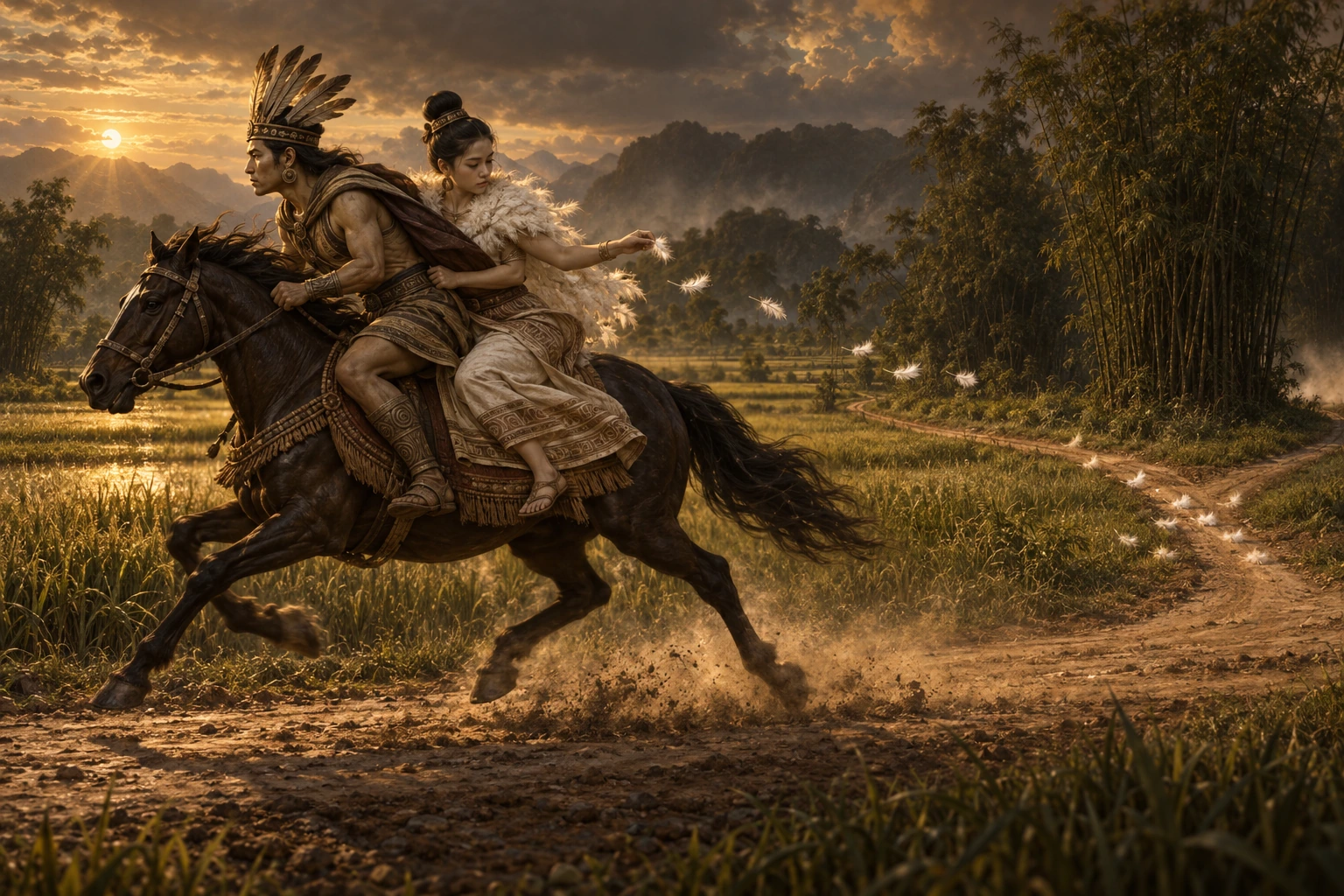
Trọng Thủy coaxed his wife into showing him the crossbow, secretly made another trigger and put it in place of the turtle’s claw. Then he said he must go north to visit his parents. “The love of husband and wife cannot be forgotten,” he told her, “nor can the bond with one’s parents. If our two countries fall out and north and south are cut off, and I come looking for you, what will show me the way?” Mỵ Châu answered that she always kept with her a brocade wrap filled with goose down. Wherever the roads forked, she would pluck the down and leave it there as a sign, so that he could come and save her.
1-5 The Enemy Behind the Saddle
With the claw in his hands, Triệu Đà attacked. The king, trusting his crossbow, sat calmly over a game of weiqi and laughed: “Does Đà not fear my crossbow?” When the enemy was at the walls he raised it, but the divine trigger was gone. He fled south on horseback with Mỵ Châu behind him, and Trọng Thủy followed the goose down.
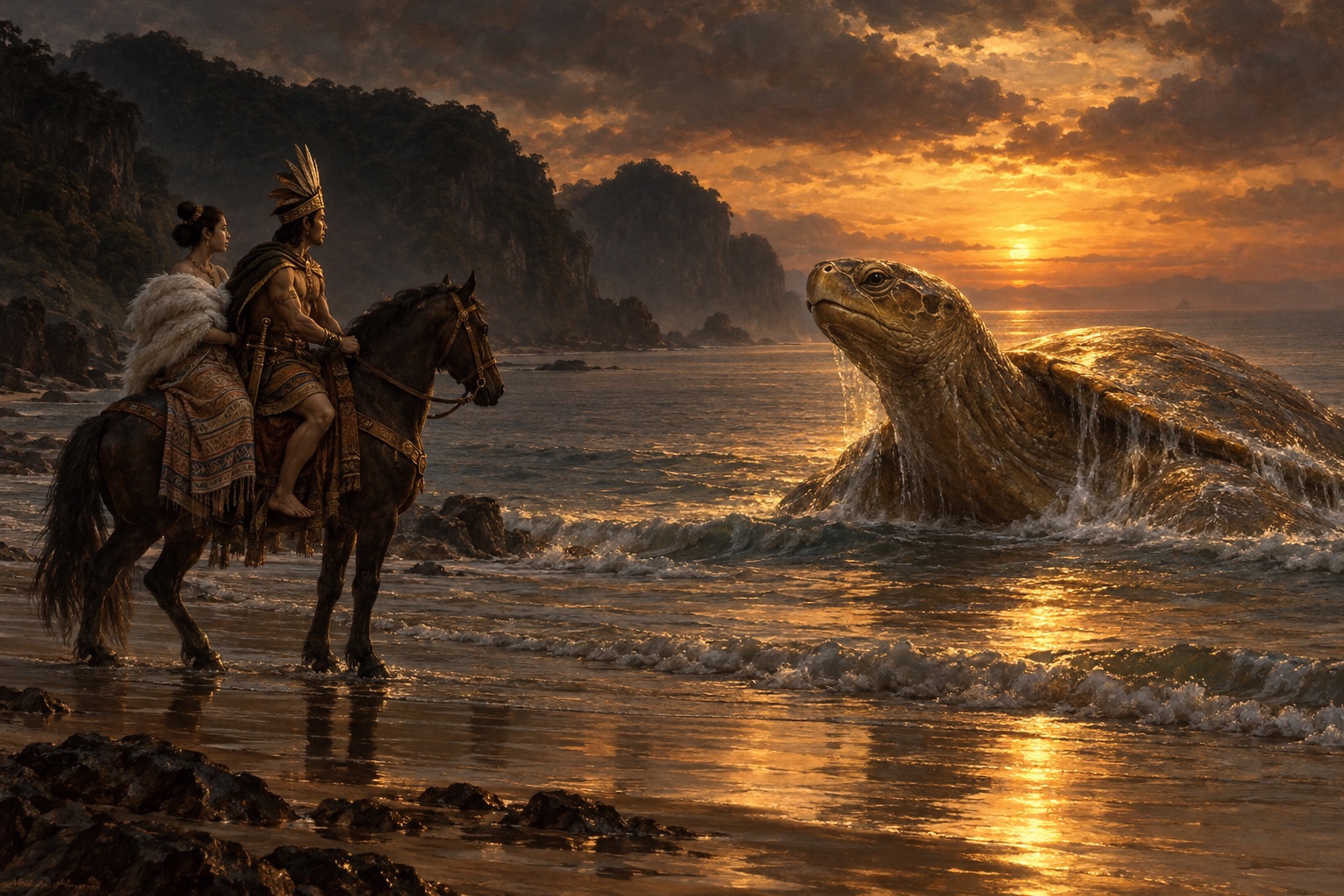
At the sea there was no boat. “The king is lost!” he cried. “Where is the Messenger of the Clear River? Come quickly and save me!” The Golden Turtle rose from the water and said: “The one behind you on the horse is the enemy.” The king drew his sword. Mỵ Châu prayed: “If I have betrayed my father to his death, let me become dust. If I have been loyal and filial and was deceived, let me become pearls and jade when I die, to wash away this shame.” She died on the shore. Her blood ran into the water, the shellfish drank it, and it became bright pearls. Holding a seven-inch horn of patterned rhinoceros, the king followed the turtle into the sea, which opened before him. Tradition places it at Dạ Sơn, in Cao Xá, in the district of Diễn Châu.
1-6 Pearls and a Well
Triệu Đà’s army found only her body. Trọng Thủy carried it back and buried it in Loa Thành, where it turned into jade stone. He could not stop grieving. At the place where she used to bathe, imagining her there, he threw himself into the well and died. Ever since, the chapter ends, pearls from the Eastern Sea washed in that well’s water shine brighter; and so as not to speak Mỵ Châu’s name (châu means pearl), people called pearls đại cửu and tiểu cửu instead.

2 Where the Story Is Written Down
- The Jiaozhou waiyu ji (交州外域記, Record of the Outer Lands of Jiaozhou), a lost book quoted by Li Daoyuan (d. 527) in his Shuijing zhu (水經注, Commentary on the Classic of Waters), book 37. Before there were Chinese commanderies, it says, the land was ruled by Lạc kings and Lạc lords. Then “a son of the king of Thục” came with thirty thousand men, subdued them and called himself An Dương Vương. When Triệu Đà attacked, a divine man named Cao Thông (臯通) came down to help the king and made him a crossbow; “one shot killed three hundred men”. Triệu Đà withdrew and sent his heir, Thủy (始), to serve the king as a vassal. The king, not knowing what Cao Thông was, treated him without courtesy, and Cao Thông left with a warning: “Whoever keeps this crossbow will rule all under heaven; whoever cannot keep it will lose all under heaven.” The king’s daughter Mỵ Châu saw that Thủy was handsome, and they became lovers. He asked her to fetch her father’s crossbow, sawed it through and fled home. When his father attacked, the crossbow broke, and the king took a boat out to sea. There is no turtle, no marriage, no feathers, no pearls and no well.
- The Việt sử lược (越史略), a short history written under the Trần in the late 14th century. A divine man named Cao Lỗ (臯魯) makes a willow crossbow, “one bow, ten shots”, and leaves when the king treats him less well. Mỵ Châu has a secret affair with Thủy, who comes as a hostage, and he destroys the trigger. The king, a rhinoceros horn in his mouth, walks into the water, and the water parts. Still no turtle.
- The Việt điện u linh tập (Spiritual Powers of the Việt Realm), preface 1329, in Lê Hữu Mục’s translation of manuscript A.751. Its chapter on the god Quả Nghị Cương Chính Uy Huệ Vương quotes Đỗ Thiện’s history, which quotes a Giao Chỉ ký: Cao Lỗ was a general of An Dương Vương. Centuries later, he told the Tang general Gao Pian (Cao Biền) in a dream that he had won great merit against the enemy and been slandered by the Lạc lord and killed. An Dương Vương, he added, was the spirit of the Golden Cock, the Lạc lord that of the White Ape, and he himself that of a Stone Dragon. The Trần court gave him titles in 1285, 1288 and 1313. It says nothing of a crossbow.
- The Đại Việt sử ký toàn thư (Complete Annals of Đại Việt), whose Outer Annals Ngô Sĩ Liên compiled in 1479. Its record of the Thục gives An Dương Vương fifty years, from 257 to 208 BCE, with his capital at Phong Khê, “today’s Cổ Loa”. It tells the whole story, Golden Turtle included, and dates it: the turtle in the spring of 255 BCE, Triệu Đà’s first attack in 210, the end in 208. The crossbow-maker is Cao Lỗ, “also called Cao Thông”.
- The Lĩnh Nam chích quái, the source of section 1. Vũ Quỳnh’s preface is dated 1492 and Kiều Phú revised the text in 1493; the copies differ in order and wording.
3 Competing Versions
- Who made the crossbow, and how strong was it? Cao Thông, whose shot kills three hundred, in the Jiaozhou waiyu ji. Cao Thông again in a Nanyue zhi, as the Nguyễn court’s Khâm định Việt sử thông giám cương mục (Cương mục) quotes it from the Song Taiping huanyu ji: one shot kills ten thousand, three shots thirty thousand. Cao Lỗ in the Việt sử lược, the Lĩnh Nam chích quái and the Toàn thư; the first character of the two names is the same, read Cao. Cao Thông leaves because the king slights him; Cao Lỗ is slandered by the Lạc lord and sent away (Toàn thư) or killed (Việt điện u linh tập).
- What did Trọng Thủy do to it? He sawed it through in the oldest notice; he destroyed the trigger in the Nanyue zhi and the Việt sử lược; he put a false trigger in place of the claw in the Lĩnh Nam chích quái and the Toàn thư.
- Lovers or husband and wife? Lovers in the Chinese notices and the Việt sử lược. A marriage that Triệu Đà asks for in the Lĩnh Nam chích quái. In the Toàn thư, Trọng Thủy first comes to serve in the palace guard, then asks for her hand.
- The turtle and the oath. “The one behind you on the horse is the enemy,” in the Wikisource copy; the Toàn thư adds “why not kill her?”, and the copy Henry translated “Kill her first if you want my aid!” The Lĩnh Nam chích quái gives both halves of Mỵ Châu’s oath, dust if guilty and pearls if deceived; the Toàn thư only the second.
- The ending. In the Wikisource copy and the Toàn thư her body turns into jade stone, and the king enters the sea at Dạ Sơn, in Cao Xá. In Henry’s copy her grave becomes a well of jade, into which Trọng Thủy leaps, and the place is Mount Mộ Dạ; Henry also notes versions in which the king simply dies of grief.
- When did Âu Lạc fall? In 208 BCE in the Toàn thư. Sima Qian’s Shiji says that Triệu Đà brought the Western Âu and the Lạc under his rule after Empress Lü died in 180 BCE, and Vietnamese textbooks, the Hanoi heritage centre notes, put the end of Âu Lạc around 179 BCE.
- Where did Thục Phán come from? From Ba Thục, today’s Sichuan, say the old texts. The Cương mục objected that Qin had destroyed the Thục kingdom in 316 BCE, and that many peoples lay between. Modern historians make him a leader of the Tây Âu north of Văn Lang, and a tradition of Cao Bằng tells of a Tục Pắn who won the contest of “nine lords competing for the throne”.
4 History and Tradition
- Âu Lạc in the Chinese histories. The Shiji knows Âu Lạc only from Triệu Đà’s side. In a letter to the Han emperor, Triệu Đà calls it “the naked kingdom” to his west, whose ruler “also calls himself king”. It names no An Dương Vương.
- The doubting historians.
- Ngô Sĩ Liên believed in the turtle, up to a point. When a country is about to fall, he wrote, the spirits come down to observe its wickedness. The king had built his walls without sparing the people, so the spirit spoke through the turtle; and when he begged the spirit for protection, “private intention arose”, and the claw was “the sprout of disaster”. As for the goose down, it “did not necessarily happen”. The same story returns centuries later with the daughter of Triệu Việt Vương, and he suspected the historians had told one event twice. A country stands, he concluded, by the Way, not by a crossbow: “whoever has the Way receives much help”, a line from Mencius.
- The Cương mục, the Nguyễn court’s history of the 19th century, keeps the marriage and the trail of goose down but moves the turtle to a note: “the matter is absurd; we now strike it out”. With the turtle go Mỵ Châu’s death, the pearls and the well. Emperor Tự Đức added: “Won by a marriage, lost by a marriage.”
- The Đại Nam quốc sử diễn ca, a verse history of 1870, closes the reign on the king: he “heeded the spirit, then trusted his child”; his plans were not deep enough, “so whom is there to blame?”
- The citadel. Three rings of rampart survive: an outer ring of about 8 km, a middle ring of 6.5 km and a rectangular inner ring of 1.6 km. Cutting through the middle rampart, Nam C. Kim, Lại Văn Tới and Trịnh Hoàng Hiệp dated its main construction by radiocarbon to the last centuries BCE, before the Han conquest, and showed that it was not the first wall there; the lowest layers go back to the 4th century BCE. Cổ Loa became a Special National Relic in 2012.
- The arrows and the drum. In 1959 a cache of about ten thousand bronze arrowheads was found at Cầu Vực, near the southern entrance, and excavations at the king’s temple in 2004–2007 uncovered furnaces where such arrowheads were cast. On 21 June 1982 young villagers levelling fields at Mả Tre dug up a Đông Sơn bronze drum packed with bronze objects: 247 pieces were recovered, 143 of them ploughshares. Bronze crossbow triggers are common at Đông Sơn sites, and the National Museum of Vietnamese History displays them.
- The temples of Cổ Loa. The temple of An Dương Vương, the Đền Thượng, dates from 1687, and its bronze statue of the king from 1897; a statue of the Golden Turtle and a gilded crossbow stand beside it. In front lies the Ngọc well, in the middle of the half-moon pond, where Trọng Thủy is said to have drowned. The Am Mỵ Châu, the princess’s shrine, keeps a natural stone shaped like a seated figure without a head. It drifted ashore, the legend says, and when the villagers carried it home, the hammock broke under the banyan, so they built the shrine there.
- The festival. Every year on the sixth day of the first lunar month, said to be the day Thục Phán became king, the “eight villages” of Cổ Loa bring their palanquins to the temple, and the king’s statue is carried round the Ngọc well to the communal house: to visit his daughter, it is said. Old Cổ Loa customs include not raising white chickens, ducks or geese, and feasting daughters-in-law but not sons-in-law.
- Mount Mộ Dạ. On the coast of Diễn Châu, in Nghệ An, the Đền Cuông stands where the king is said to have entered the sea, with statues of Cao Lỗ, Mỵ Châu and the Golden Turtle and a shrine to Mỵ Châu on the summit. It has been a national relic since 1975, and its festival falls on the fifteenth day of the second lunar month. A survey has counted at least seventeen places of worship of An Dương Vương, from Cao Bằng to Nghệ An.
- In the classroom. “It is something that every student learns about,” says the archaeologist Trịnh Hoàng Hiệp. The long-used grade-10 literature textbook teaches it as “Truyện An Dương Vương và Mị Châu – Trọng Thủy”, calls the turtle Rùa Vàng, and asks pupils to weigh two opposite judgments of Mỵ Châu for showing her husband the crossbow.
Mỵ Châu is remembered as the princess who gave the crossbow away. A well-known quatrain by the 20th-century poet Tố Hữu, quoted by the National Museum of Vietnamese History and the Hanoi heritage centre, says she put her “heart in the wrong place”. The old texts are less sure. In the Chinese notices and the Việt sử lược she is a lover who shows the bow to a handsome prince. In the Lĩnh Nam chích quái and the Toàn thư she is a wife deceived by her husband: the turtle calls her the enemy, but her blood turns into pearls, as her oath said it would if she had been deceived. Ngô Sĩ Liên blamed her father. Tản Đà’s poem of 1916 gives each of the couple one line: “you changed the trigger, the turtle’s claw; I showed the way with goose down”.
5 Related Stories
- Sơn Tinh and Thủy Tinh: The Mountain Spirit, the Water Spirit and the Yearly Floods: the Toàn thư tells it just before this story. The king of Thục asks for Mỵ Nương and is refused, and the refusal sends his grandson Thục Phán against Văn Lang.
- Chử Đồng Tử and Tiên Dung: The Poorest Man and the Princess: centuries later, Triệu Việt Vương wears a dragon’s claw in his helmet, and a son-in-law takes it from him. Ngô Sĩ Liên thought the second story copied the first.
- Hoàn Kiếm Lake: The Sword Returned to the Turtle: a golden turtle rises from the water again, to take back Lê Lợi’s sword. Some tellings, the Vietnamese government’s Hanoi website among them, call it Kim Quy, as if it were the same turtle.
- Romulus and Remus: The Twins and the She-Wolf: Tarpeia, a commander’s daughter, lets the enemy into Rome’s citadel and dies at their hands. We have not found a scholar who compares her with Mỵ Châu; we link them for the theme.
6 Sources
- Lĩnh Nam chích quái, book 2, “Kim Quy truyện”, text corrected by Vũ Quỳnh and Kiều Phú: Wikisource (Classical Chinese); Eric Henry, trans., “The Tale of the Golden Turtle”, from the text published by Lê Hữu Mục (Saigon, 1959), Rising Asia Journal 6.2 (2026): Book One
- Ngô Sĩ Liên et al., Đại Việt sử ký toàn thư, Outer Annals, book 1, “Thục kỷ”, with Ngô Sĩ Liên’s comment: Wikisource (Classical Chinese); Mạc Bảo Thần’s Vietnamese translation, whose notes quote the Taiping huanyu ji: Vietnamese Wikisource
- Li Daoyuan, Shuijing zhu, book 37, quoting the Jiaozhou waiyu ji: Wikisource; Việt sử lược, book 1, with the Siku catalogue note: Wikisource, Wikisource
- Lý Tế Xuyên, Việt điện u linh tập, chapter “Quả Nghị Cương Chính Uy Huệ Vương” (Cao Lỗ), trans. Lê Hữu Mục from manuscript A.751: archived PDF
- Khâm định Việt sử thông giám cương mục, Tiền biên, book 1, with Tự Đức’s comment: Wikisource; Sima Qian, Shiji, book 113, “Nanyue liezhuan”: Wikisource; Mencius 2B.1: Wikisource
- Lê Ngô Cát and Phạm Đình Toái, Đại Nam quốc sử diễn ca (1870), “Nhà Thục”: Vietnamese Wikisource; Tản Đà, “Mỵ Châu, Trọng Thủy” (1916): Vietnamese Wikisource
- Nam C. Kim, Lai Van Toi and Trinh Hoang Hiep, “Co Loa: an investigation of Vietnam’s ancient capital”, Antiquity 84 (2010): 1011–1027: Cambridge Core; Lauren Hilgers, “Vietnam’s First City”, Archaeology, July/August 2016: University of Wisconsin–Madison
- Thăng Long – Hà Nội Heritage Conservation Centre: Di tích Cổ Loa, Thành Cổ Loa và đền thờ An Dương Vương, Di chỉ Bãi Mèn, Ma Tre relic, My Chau temple, Princess My Chau, Co Loa temple festival, Thuc Phan – King An Duong Vuong
- Department of Cultural Heritage, Di tích lịch sử, kiến trúc nghệ thuật và khảo cổ Cổ Loa; Hồng Hải, “On the tumbler of the cross-bow of Dong Son”, National Museum of Vietnamese History (2009): baotanglichsu.vn; Ngữ văn 10, vol. 1, pp. 42–43, the lesson’s questions as reproduced by a study-help site: loigiaihay.com
- Vũ Thị Nhung, “Hệ thống các di tích thờ An Dương Vương ở Việt Nam”, Văn hóa Nghệ thuật 624 (2025): 50–55: VJOL
Cover and illustrations: AI-generated images made for Arcana. They are interpretations, not historical artworks.