Lạc Long Quân and Âu Cơ: The Dragon, the Fairy and the Hundred Eggs
How Vietnam tells its own beginning: a dragon lord from the water, a fairy from the mountains, one sac of a hundred eggs, and a parting that founded the realm of Văn Lang.
- Type: legend, the founding myth of the Việt people and their first realm
- Culture: Việt, the Red River delta of northern Vietnam
- Earliest full telling: Lĩnh Nam chích quái and Đại Việt sử ký toàn thư, both in their 15th-century form
- Key figures: Lạc Long Quân, Âu Cơ, their hundred sons, the Hùng kings
Ask someone in Vietnam where their people come from and you may hear four words: con Rồng cháu Tiên, children of the Dragon, grandchildren of the Fairy. It is a family tree with its roots in two places at once: a palace beneath the water and the misted peaks of the north.
1 The Telling
1-1 The Dragon Lord of the Water Palace
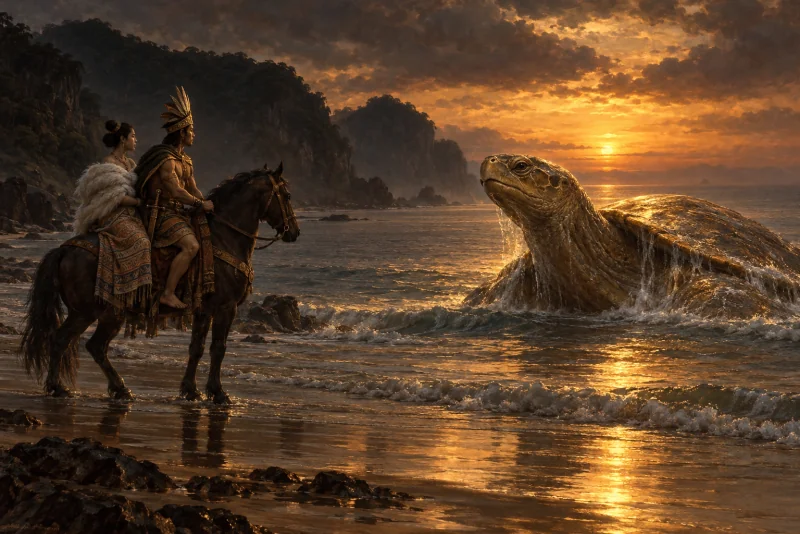
In the version written down in the Lĩnh Nam chích quái, the line begins with Đế Minh, a third-generation descendant of the farming god Shennong (Thần Nông). Travelling south to the Five Ranges, Đế Minh married a daughter of the immortal Vụ Tiên. Their son Lộc Tục left the northern throne to his elder brother and took the south instead, ruling it as Kinh Dương Vương, king of a realm called Xích Quỷ.
Kinh Dương Vương married the daughter of the Dragon King of Động Đình. Their son Sùng Lãm became known as Lạc Long Quân, the Dragon Lord of Lạc. He taught people to farm and to raise silkworms, and set out the bonds between ruler and subject, parent and child, husband and wife. Then he would withdraw to his water palace. When people needed him they called out, “Bô, where are you?” (bô being, the text explains, the local word for “father”), and he came.
1-2 The Fairy from the North
Đế Lai, ruler of the north, came south on a tour and left behind Âu Cơ. The text calls her his beloved daughter, though one reading has “concubine”. Lạc Long Quân took the shape of a handsome young man, and Âu Cơ went with him to live at Long Đại rock.
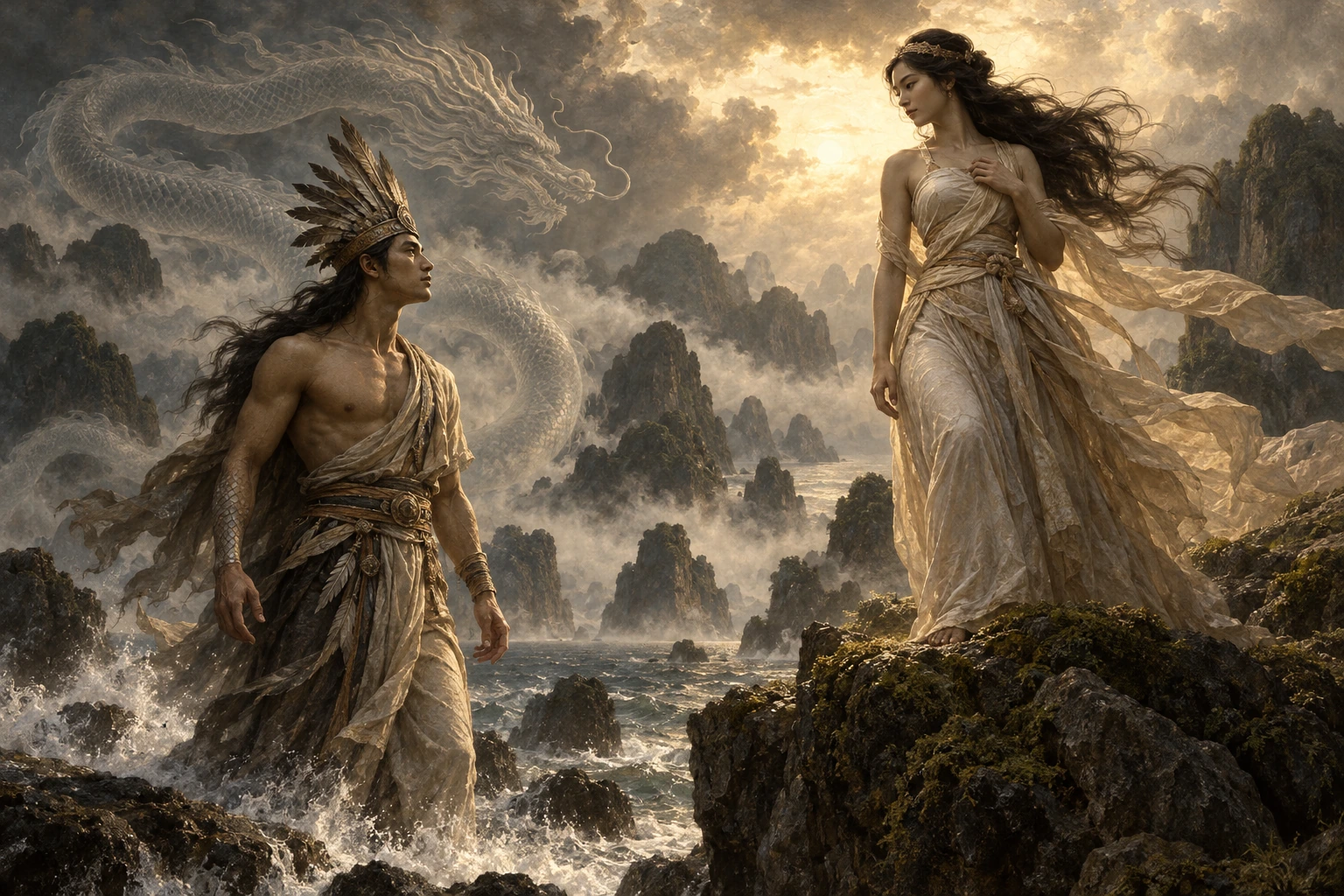
1-3 A Sac of a Hundred Eggs
A year later Âu Cơ gave birth to a sac. Fearing an ill omen, the couple left it in the fields. Six or seven days later it opened: inside were a hundred eggs, and from each egg came a son.
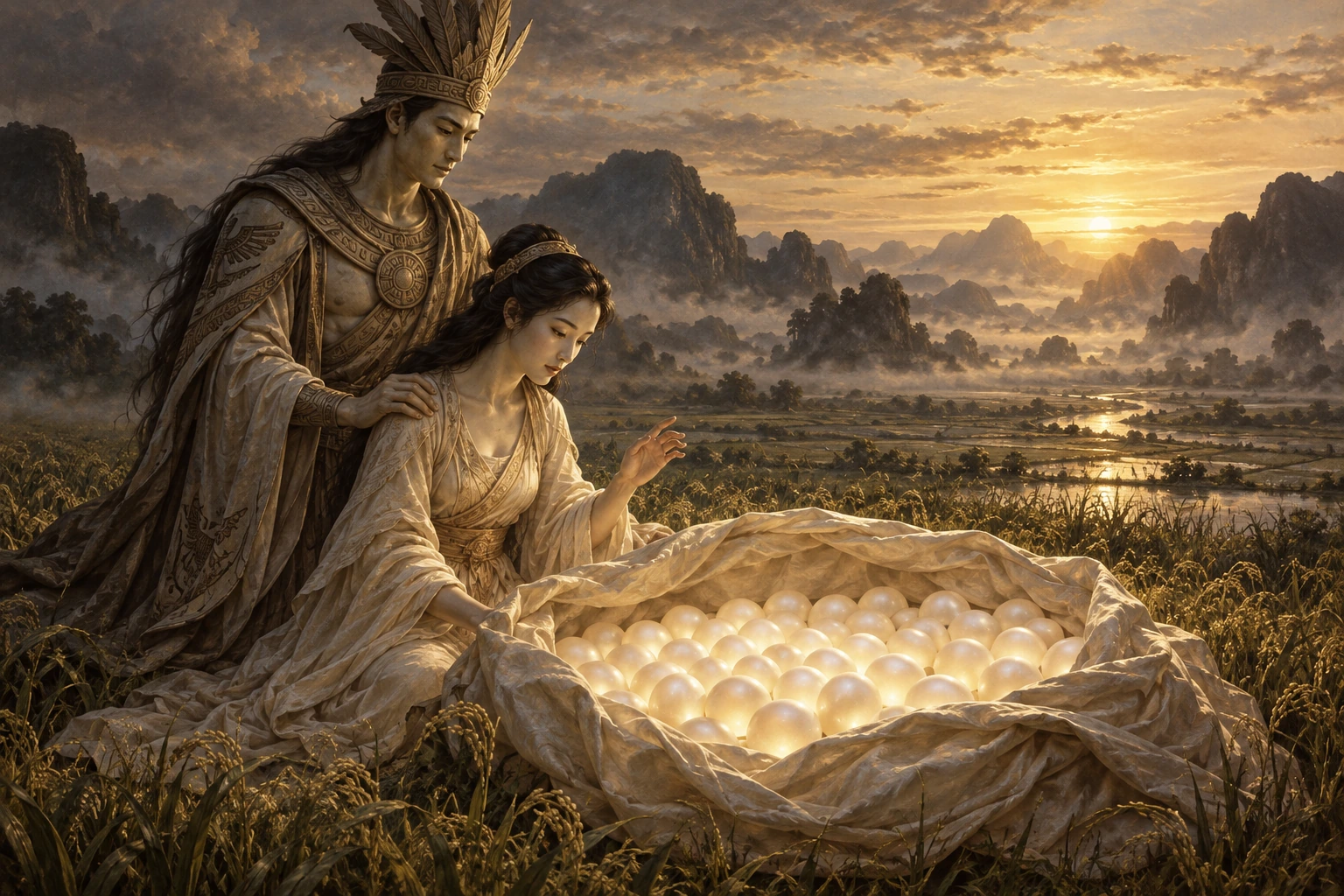
The character the text uses for that sac, 胞 (bào), is the same one found in đồng bào (同胞), the word Vietnamese use for their fellow countrymen. Literally, it means “of the same womb”.
1-4 The Parting
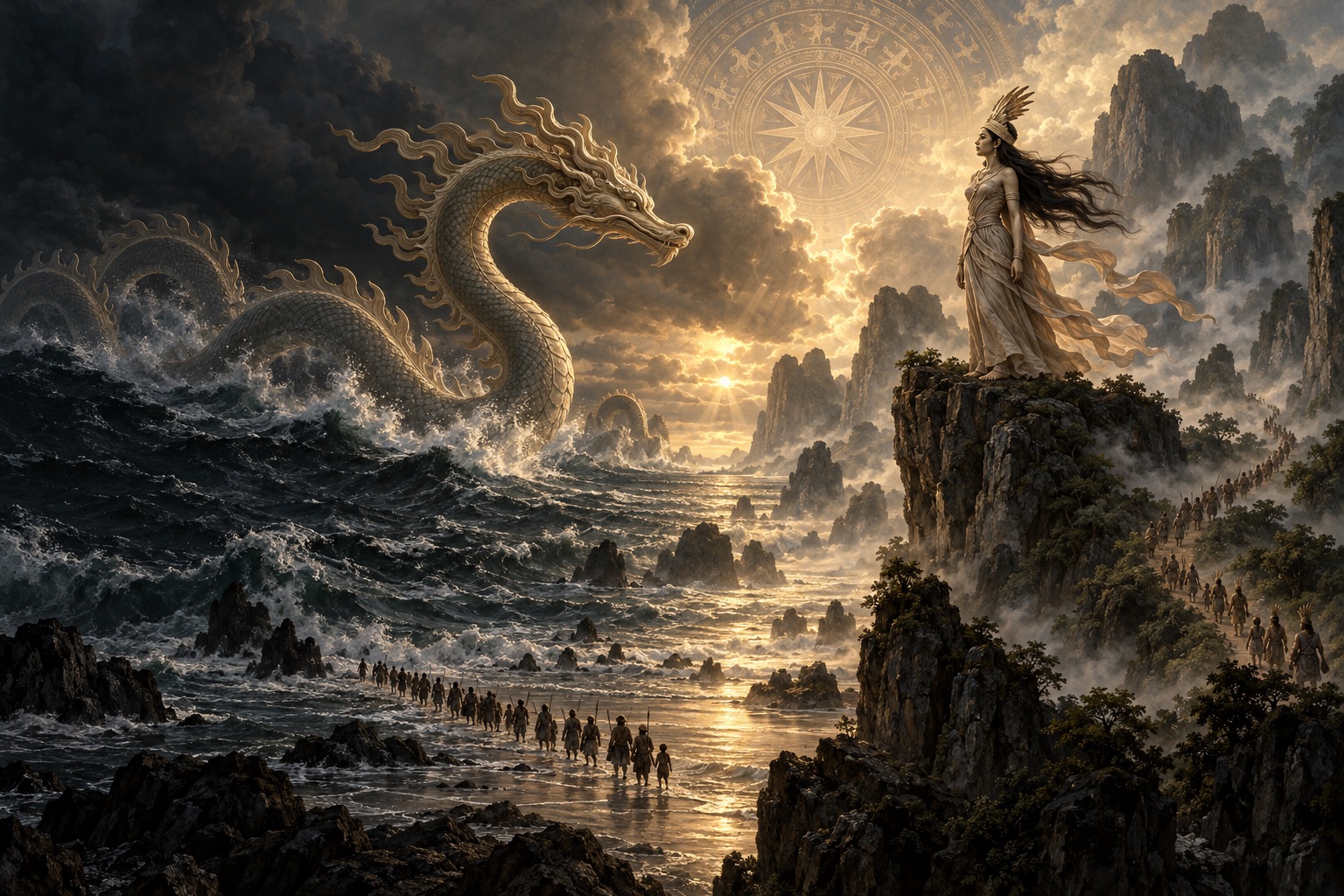
Âu Cơ wanted to take the children north to her own people, but the Yellow Emperor had closed the border. Lạc Long Quân told her they could not stay together: “I am of dragon stock, lord of the water tribes; you are of immortal stock, a person of the land. Water and fire overcome each other.”
Fifty sons followed their father into the water; fifty stayed on land with their mother. His parting words have been quoted ever since: whether you climb the mountains or go into the water, send word when trouble comes, and never abandon one another.
1-5 Văn Lang
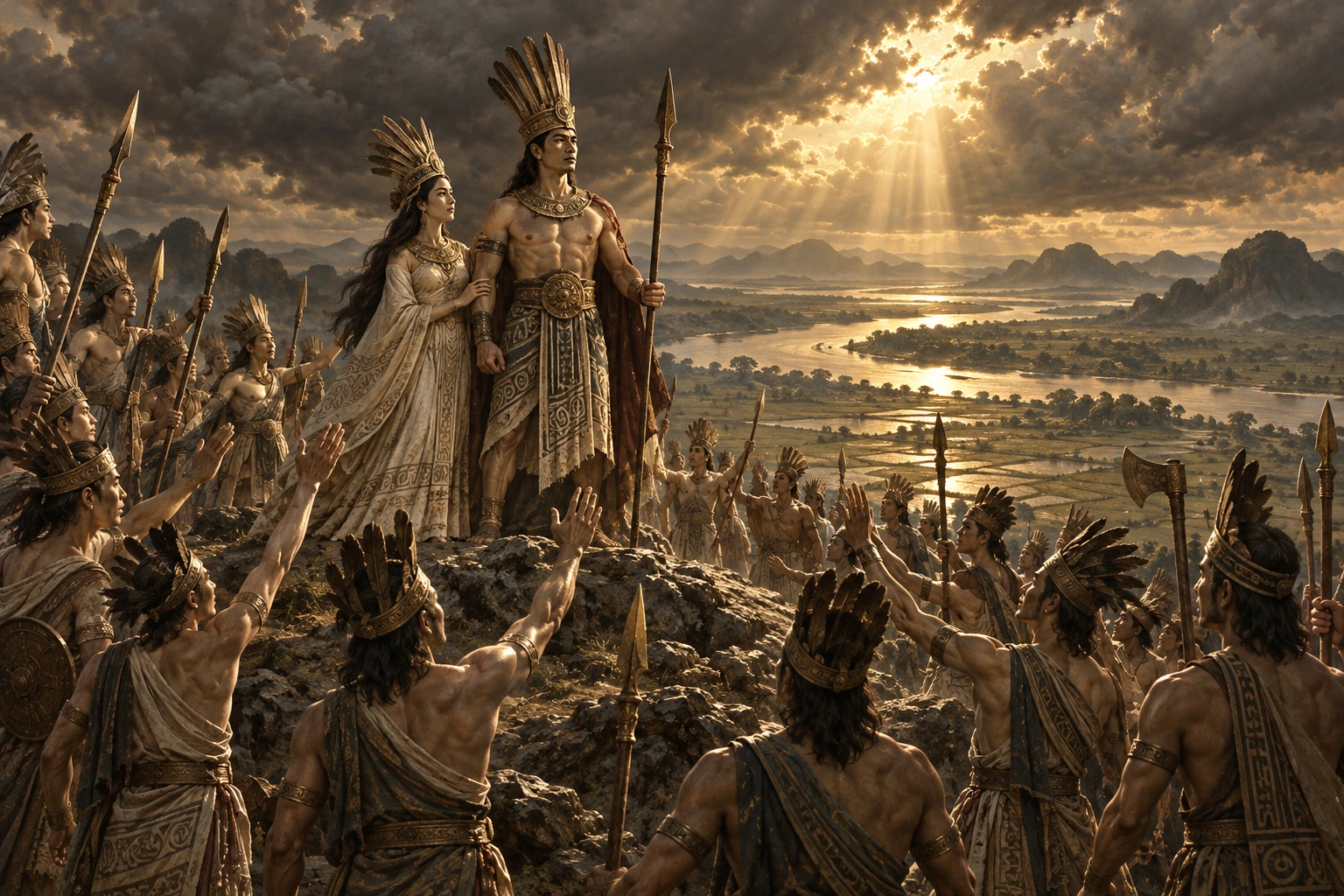
Âu Cơ settled at Phong Châu with her fifty sons. They chose the strongest and most senior of them as ruler and called him Hùng Vương, the Hùng King, and they named the realm Văn Lang, divided into fifteen regions. The text lists its offices:
- Lạc hầu and Lạc tướng, the civil and military lords;
- quan lang for the king’s sons and mị nương for his daughters.
The throne passed from father to son, every ruler bearing the same title. The text gives no count of reigns. It ends by naming the hundred sons as the ancestors of all the Bách Việt, the “Hundred Yue” peoples of the south.
2 Where the Story Is Written Down
No early text tells this story.
- Around the 4th century. Chinese geographers (the Jiaozhou waiyu ji, quoted in the Shuijing zhu, juan 37) describe “Lạc kings” with lords, generals and bronze seals in the Red River lands. They mention no dragon, no fairy and no eggs.
- Late 14th century. The Việt sử lược mentions Văn Lang and a line of kings that “passed down eighteen generations”, but still no Lạc Long Quân or Âu Cơ.
The couple first appears in two works of the 15th century:
- Đại Việt sử ký toàn thư (Complete Annals of Đại Việt). The historian Ngô Sĩ Liên added an “Outer Annals” volume (preface dated 1479) that opens Vietnamese official history with the Hồng Bàng clan. The text that survives is the 1697 edition.
- Lĩnh Nam chích quái (Strange Tales from South of the Passes). In his preface of 1492, Vũ Quỳnh says he copied and corrected an older text whose author and date were unknown, perhaps from the Lý–Trần era. Later tradition credits it to Trần Thế Pháp, but that attribution is uncertain.
The court historians were cautious about their own material. The editorial rules of the Outer Annals say it comes from unofficial histories, that the most fantastic parts were cut, and, of the eighteen generations: “some say eighteen generations; probably not so.”
3 Competing Versions
- Eggs or sons. The Lĩnh Nam chích quái has the sac, the hundred eggs and then the sons. The Toàn thư says simply that Âu Cơ “bore a hundred sons”, and moves “popular tradition says a hundred eggs” into a note. It also drops the abandoned sac, the closed border and the parting promise.
- Who goes where. In the Lĩnh Nam chích quái the father returns to the water palace. In the Toàn thư the mother leads her sons into the mountains and the father leads his “to the south”, or in one reading to the Southern Sea. Today’s retellings settle on fifty to the sea and fifty to the mountains.
- Who becomes king. Either Âu Cơ’s sons choose the strongest of them (Lĩnh Nam chích quái), or Lạc Long Quân makes the eldest Hùng Vương (Toàn thư).
- Âu Cơ’s family. She is Đế Lai’s daughter, or his concubine. Lê Tung, writing in 1514, calls her a woman of the Âu Lạc clan.
- Hùng or Lạc? Chinese sources write the kings’ title as 雒 (Lạc); others write 雄 (Hùng). Since Nguyễn Văn Tố (1941) and Henri Maspero (1948), some scholars have argued that Hùng is a copyist’s error for Lạc. The Toàn thư itself notes that Lạc tướng “was later corrupted into Hùng tướng”. The question is still open.
- The monster-slayer. The same collection tells how Lạc Long Quân killed a sea demon, the Fish Spirit, by throwing red-hot iron into its mouth. It also tells how he flooded the den of a nine-tailed fox, which became West Lake in Hanoi. Modern retellings often credit him with defeating the Tree Spirit as well, but in the 15th-century text that deed belongs to Kinh Dương Vương and to a much later ritual master.
4 History and Tradition
- What is documented.
- The Đông Sơn culture, a Bronze Age culture of northern Vietnam (roughly 1000 BCE to the 1st century CE), is famous for its great bronze drums.
- Since the 1970s, Vietnamese historians have identified it with Văn Lang and its successor, Âu Lạc.
- What is traditional.
- The dates are traditional. The year 2879 BCE, often given for Kinh Dương Vương, is the Toàn thư’s own arithmetic: a dynasty of 2,622 years ending in 258 BCE.
- The names of eighteen Hùng kings come from a temple genealogy kept at the Hùng Temple.
- What is debated.
- The historian Liam Kelley reads the Hồng Bàng story as a medieval “invented tradition” built from Chinese texts. Đế Minh and Đế Lai come from Chinese king lists of the Shennong line, and the Dragon King’s daughter echoes a Tang tale of the Dongting dragon.
- Ngô Sĩ Liên himself wrote that descent from Shennong let the southern realm stand as an equal of the northern court.
- Others have traced how the court’s version and the village cults of the Hùng kings grew into one another over the centuries.
- What is alive.
- The 10th day of the third lunar month, Giỗ Tổ Hùng Vương (the Hùng Kings’ Commemoration Day), was fixed as a state rite in 1917 and became a paid public holiday in 2007.
- In 2012 UNESCO inscribed the Worship of Hùng kings in Phú Thọ on its list of the Intangible Cultural Heritage of Humanity.
Whether or not the Hùng kings ever reigned, the story does what founding myths are made to do: it turns a whole people into brothers and sisters, born from the same sac.
5 Related Stories
- Kuniumi: Izanagi and Izanami Give Birth to Japan: another country whose oldest books begin with a divine couple, a marriage and a parting.
- Nüwa: The Serpent-Bodied Goddess Who Mended the Sky: the mythic China of Shennong and the Yellow Emperor, two names that appear in Lạc Long Quân’s own family tree.
- Dangun: The Bear, the Tiger and the First Korean Kingdom: Korea’s founding myth. Its famous date, 2333 BCE, was also worked out by later chroniclers, and it too is now a national holiday.
- Sơn Tinh and Thủy Tinh: The Mountain Spirit, the Water Spirit and the Yearly Floods: a book quoted in the Lĩnh Nam chích quái makes the Mountain Spirit of Tản Viên one of the fifty sons who followed Lạc Long Quân into the sea.
- The Chinese Dragon: The Long, Bringer of Rain and Emblem of Emperors: the Dragon Kings and their palaces under the water, among them the Dragon King of Lake Dongting, whose grandson Lạc Long Quân is, and the Tang tale of Liu Yi and the Dongting dragon’s daughter.
- Other miraculous births. Ngô Sĩ Liên compared the hundred sons with the births of the founders of the Shang (from a swallow’s egg) and the Zhou (from a giant’s footprint). Among the Mường, the epic Đẻ đất đẻ nước (The Birth of Land and Water) names a pair of birds as the first ancestors.
6 Sources
- Lĩnh Nam chích quái, “Hồng Bàng thị truyện”, plus the tales of the Fish Spirit, the Fox Spirit and the Tree Spirit, and Vũ Quỳnh’s preface: Wikisource (Classical Chinese)
- Ngô Sĩ Liên et al., Đại Việt sử ký toàn thư, Outer Annals, book 1, and its editorial rules: Wikisource (Classical Chinese)
- Việt sử lược, book 1: Wikisource
- Li Daoyuan, Shuijing zhu, juan 37 (quoting the Jiaozhou waiyu ji): Wikisource
- Liam C. Kelley, “The Biography of the Hồng Bàng Clan as a Medieval Vietnamese Invented Tradition”, Journal of Vietnamese Studies 7.2 (2012): 87–130
- Nguyen Dieu Thi, “A Mythographical Journey to Modernity: The Textual and Symbolic Transformations of the Hùng Kings Founding Myths”, Journal of Southeast Asian Studies 44.2 (2013)
- UNESCO, Worship of Hùng kings in Phú Thọ (2012)
- Law No. 84/2007/QH11, amending Article 73 of the Labour Code (2 April 2007)
- Eric Henry, English translation of the Lĩnh Nam chích quái
Cover and illustrations: AI-generated images made for Arcana. They are interpretations, not historical artworks.